- 957 -
Optimization of spray drying conditions of soft persimmon and milk mixture using response surface methodology
Mi-Jeong Park, Sang-Bum Kim, Sook-Jin Kim, Kyung-Mi Kim, Song-Yi Choi, Mi Chang, Gi-Chang Kim*
Department of Agro-Food Resources, National Institute of Agricultural Sciences, Rural Development Adminstration, Wanju 55365, Korea
반응표면분석법을 이용한 홍시와 우유혼합물의 최적 분무건조 조건
박미정․김상범․김진숙․김경미․최송이․장미․김기창*
농촌진흥청 국립농업과학원 농식품자원부
Abstract
The purpose of this study was to determine the optimum spray drying conditions of soft persimmon latte using response surface methodology that is a statistical procedure used for optimization studies. A central composite design was applied to investigate the effects of independent variables, inlet temperature (X1), air flow rate (X2), and feed flow rate (X3), on responses such as yield, water absorption index, and total phenolic compounds. Statistical analysis revealed that independent variables significantly affected all the responses. A maximum yield of 8.11 g was obtained at 90℃ of X1, 51.82 mL/min of X2 and 7.00 mL/min of X3. A minimum water absorption index of 0.58 was obtained at 101℃ of X1, 60.00 mL/min of X2 and 17.00 mL/min of X3. A maximum total phenolic compounds of 298.02 μg/mL was obtained at 90℃ of X1, 43.33 mL/min of X2 and 17.00 mL/min of X3. In conclusion, the best spray drying conditions were as follows: X1, 90℃; X2, 53 mL/min; X3, 17 mL/min. Under those optimal conditions, the powder’s yield (7.46 g), water absorption index (0.54), and the content of total phenolic compounds (294.75 μg/mL) were estimated.
Key words:response surface methodology, spray-drying, soft persimmon, milk
서 론
1)
감(persimmon)은 아열대부터 온대 기후까지 넓은 지역 에 분포하고 있으며, 주요 원산지는 한국, 중국 및 일본이다 (1). 특히, 감은 우리나라 기후에 적합하여 중, 북부 및 일부 산간 지방을 제외하고 전국에서 재배되며 다른 과일에 비 하여 비료와 농약의 사용이 적어 중요성이 매우 큰 과수이 다(2). 감은 단감과 떫은 감으로 분류되는데 단감은 주로 생과로 소비되며, 떫은 감은 탈삽 처리로 떫은 맛을 제거한
*Corresponding author. E-mail:[email protected] Phone:82-63-238-3558, Fax:82-63-238-3881
Received 13 November 2017; Revised 23 November 2017;
Accepted 23 November 2017.
Copyright ⓒ The Korean Society of Food Preservation. All rights reserved.
후 생과로 소비하거나 건시를 만들어 소비한다(3). 단감의 종류는 부유시, 선사환, 부사시, 평무핵, 의문시 등이 있고, 떫은 감은 고종시 반시, 사곡시, 분시, 월하시 등이 있다(4).
본 연구에서 사용한 갑주백목(甲州百目, Diospyros kakai cv.
Hachiya)은 떫은 감의 품종 중 하나로, 예로부터 대봉시, 대알감, 장두감으로 불렸으며, 과실의 무게가 평균 250 g으 로 대과 종이고 전남 영암, 광양, 경남 하동, 진주 등에 주산 지가 형성되어 있다(5). 감의 약리작용과 효능은 동의보감 과 본초강목 등에서 밝혀진 바와 같이 고혈압, 동맥경화, 심장 및 신장 등의 순환기 질환뿐만 아니라 위궤양 및 당뇨 병과 같은 만성질환에도 효능이 있다고 기록되어 있다. 또 한 감은 무기질, 비타민 C, A, B1, 판토텐산, 엽산 등이 풍부 한 알칼리 식품이고(6), gallic acid, catechin, epigallocatechin gallate 등의 phenolic compounds가 다량 함유되어 있으며 dispyrin이라는 수용성 탄닌 성분을 함유하고 있어 건강식
품으로 주목받고 있다(7). 하지만 다른 과실류와 마찬가지 로 일시에 출하되기 때문에 수확 후 일수가 경과하면 생감 과 탈삽한 감 모두 호흡 및 증산작용으로 인한 숙도가 진전 되어 품질 저하가 발생된다(8). 감을 이용한 선행 연구들은 감을 첨가하여 발효시킨 식초(9), 감 첨가량에 따른 두부의 품질변화(10), 감 분말을 첨가한 빵(11), 설기떡(12), 한과 (13), 그리고 감을 첨가한 막걸리 제조(14)등 활용 측면에만 집중되어 있다. 따라서 영양학적 가치는 우수하지만 생과 로 이용이 어려운 홍시의 활용 뿐만 아니라 저장성 증진을 위한 다양한 제품 형태와 가공방법이 필요한 실정이다.
액상 식품을 분말화하는 방법으로는 열풍건조, 분무건 조, 동결건조 등이 있으며(15), 그 중 분무건조법은 고온의 chamber에 노즐을 이용하여 시료를 분산시켜 액상 형태의 물질을 미세한 고체 입자 형태로 연속적으로 변환시키는 건조 방법이다(16). 분무건조법은 미세 캡슐화를 만드는 가장 상업화된 방법으로 제약, 화학, 식품산업에 널리 쓰이 고 있으며(17), 원료와 열의 접촉시간이 수초 이내이므로 비교적 열에 의한 성분의 변화가 적다(18). 또한 다른 건조 방법에 비해 유동성 및 용해성이 좋은 구형 분말 제품을 제조할 수 있으며, 미립화에서 분말 제품에 이르기까지 하 나의 공정에서 이루어진다는 장점이 있다(19).
최적화라는 용어는 가능한 가장 좋은 반응을 생성하는 조건을 발견한다는 의미로서 일반적으로 분석화학에서 사 용되었다(20). 전형적인 최적화 방법으로 알려진 반응표면 분석(response surface methodology, RSM)은 일반적으로 여 러 개의 X1, X2, X3,¨¨, Xk를 사용하여 최적조건을 찾고 하나의 변수와 다른 변수들과의 상호작용으로 인한 종속변 수(dependent variables, Y)를 측정하여 변수들의 최적값을 추론하는 방법이다(21). 반응표면분석은 여러 개의 종속변 수와 상호작용을 평가하는 실험의 횟수를 줄이기 때문에 다른 접근방법보다 시간소모가 적다는 이점이 있어 새로운 추 출조건 또는 식품의 가공조건을 확립할 때 많이 이용된다(22).
본 연구에서는 감의 다양한 가공활용을 위해 홍시라떼를 제조함과 동시에, 분무건조를 이용하여 저장성이 높은 분 말형태를 만들었다. 이러한 홍시라떼의 분무건조 시 높은 회수율, 낮은 수분흡수지수, 열에 의한 total phenolic compounds 분해 최소화를 위하여 반응표면분석법(RSM) 을 이용하여 최적 조건을 설정하였다.
재료 및 방법
재 료
홍시는 경상북도 청도에서 생산되는 ‘갑주백목(甲州百 目, Diospyros kakai cv. Hachiya)을 이용하였으며, 우유는 시중에서 판매되는 매일우유(Maeil, Pyeongtaek, Korea)제 품을 구매하여 사용하였다.
홍시라떼 제조
홍시의 가용부를 제외한 껍질, 씨앗, 꼭지를 제거한 후, 면포에 짜서 용출된 용액 30 g, 우유 70 g을 homogenizer (Ultra-Turrax T25D, IKA, Staufen, Germany)를 이용하여 10,000 rpm, 5 min 동안 균질화하고 distilled water와 1:1 비율로 희석하였다. 제조된 홍시라떼를 분무건조기(Mini spray dryer B-290, BUCHI Labortechnik AG, Flawil, Switzerland)를 이용하여 분말화하였다.
분무건조 최적화를 위한 실험계획
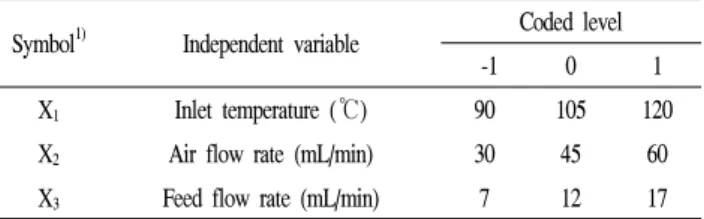
홍시라떼의 최적 분무건조 조건을 예측하기 위해 반응표 면분석법(RSM)을 실시하였고, 실험구는 예비실험 결과를 토대로 중심합성계획법(central composite design)을 사용하 여 설정하였다. 분무건조에 영향을 미치는 인자(parameter) 인 공정상의 독립변수(Xn)는 분무건조기의 inlet temperature (X1)와 air flow rate(X2), 분무건조기 내로 유입되는 시료의 속도인 feed flow rate(X3)로 설정하였고, 독립변수에 대한 실험 범위는 3단계(-1, 0, 1)로 부호화하였다(Table 1). 이후 중심합성계획법으로 중심점수는 2개, 알파 값은 면 중심으 로 설정하여 도출된 16개의 분무건조 조건을 무작위로 실 험하여 분말화된 홍시라떼의 회수량, 수분흡수지수(water absorption index), total phenolic compounds를 측정하였다.
Table 1. Independent variables, and their coded and actual values used for analysis
Symbol1) Independent variable Coded level
-1 0 1
X1 Inlet temperature (℃) 90 105 120
X2 Air flow rate (mL/min) 30 45 60 X3 Feed flow rate (mL/min) 7 12 17
1)X1, Inlet temperature (℃); X2, Air flow rate (mL/min); X3, Feed flow rate (mL/min).
회수량 측정
홍시라떼 제조 방법에 따라 제조하고 분무건조한 후, 분 무건조기의 회수병에 회수된 홍시라떼 분말의 무게를 측정 하였다.
수분흡수지수(WAI) 측정
수분흡수지수(WAI) 측정은 phillips 등(23)의 방법에 준 하여 측정하였다. 분무건조 분말 0.5 g에 distilled water (DW) 20 mL를 첨가하여 4℃, 10,000 rpm에서 20분간 원심 분리(Himac CR21G, Hitachi Koki, Tokyo, Japan)한 후, 침전 물의 무게를 구하였으며 아래와 같이 계산하였다.
WAI= hydrated sample weight-dry sample weight dry sample weight
Total phenolic compounds의 함량 측정
Total phenolic compounds 함량 측정은 Folin과 Denis(24) 의 방법에 준하여 측정하였으며, 시료 1 mL에 95% ethanol 1 mL와 distilled water 5 mL를 첨가하고 1 N Folin-Ciocalteu reagent(Sigma-Aldrich, St, Louis, MO, USA) 0.5 mL를 넣어 잘 섞어준 후, 5% Na2CO3 1 mL를 가하였다. 흡광도 (UV-2550, SHIMADZU, Kyoto, Japan) 725 nm에서 1시간 이내에 측정하여 gallic acid를 이용한 표준곡선{total phenolic compounds in gallic acid(100-500 μg/mL), y=0.0061x-0.0823, R2=0.9971}으로부터 양을 환산하였다.
통계처리
반응표면분석은 분무건조기의 inlet temperature(X1)와 air flow rate(X2), 분무건조기 내로 유입되는 시료의 속도인 feed flow rate(X3)을 독립변수로 설정하였고, 독립변수조건 에 대한 분말의 회수량(Y1), 수분흡수지수(Y2), total phenolic compounds(Y3)을 종속변수로 하였다. 또한 이들의 독립변수(Xn)에 영향을 받는 종속변수(Yn)는 아래와 같은 2차 회귀식으로 나타냈으며, 최적점을 찾기 위해 반응표면 그래프의 최대점, 최소점, 안장점 및 능선의 형태를 파악하 여 예측하였다.
Y=b0+b1X1+b2X2+b3X3+b11X12
+b21X2X1+b22X22
+b31X3X1
+b32X3X2+b33X32
본 실험의 모든 통계분석과 최적화는 Design Expert Ver.10 software(Stat-ease, Minneapolis, MN, USA)를 이용 하였다.
결과 및 고찰
분무건조를 이용한 홍시라떼의 분말화
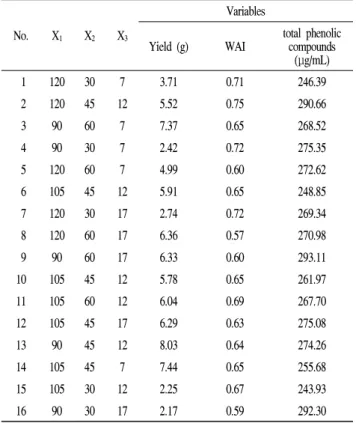
중심합성계획법으로 중심점수는 2개, 알파 값은 면 중심 으로 설정하여 도출된 16개의 실험구와 처리조건에 따른 회수량(Y1), 수분흡수지수(Y2), total phenolic compounds (Y3)는 Table 2와 같다. 분무건조를 통한 홍시라떼 분말의 독립변수(회수량, 수분흡수지수, total phenolic compounds) 에 대한 회귀식은 Table 3과 같고 결정계수(R2)값은 각각 0.91, 0.71, 0.73이었다. 분무건조 시 홍시라떼 분말의 특성 에 따른 각 독립변수의 영향력을 나타내는 F-ratio는 Table 4에 나타내었다. 분말의 회수량과 수분흡습지수는 분무건 조 과정 중 시료의 분사력과 관련이 있는 air flow rate의 영향을 가장 많이 받았으며, total phenolic compounds는 분무건조기 내로 유입되는 시료의 공급속도인 feed flow rate에 가장 큰 영향을 받았다.
회수량
분무건조 조건을 각각 달리하여 얻은 홍시라떼 분말의 회수량은 2.17-8.03 g의 범위로 나타났으며(Table 2), 예측 된 정상점은 inlet temperature(X1) 90℃, air flow rate(X2) 51.82 mL/min, feed flow rate(X3) 7 mL/min 일 때, 최대값 8.11 g이었다(Table 5). F-ratio는 요인 변수 중 air flow rate(X2)가 251.21로 가장 높은 값을 나타내었기 때문에 유 의적으로 가장 큰 영향을 받았다고 해석하였으며, 그 다음 은 inlet temperature(X1) 7.83, feed flow rate(X3) 3.81순 이였 다(Table 4). 그리고 Table 3의 회귀식과 같이 일차항에서 독립변수인 inlet temperature(X1)와 feed flow rate(X3)는 감 소요인으로, air flow rate(X2)는 증가요인으로 나타났다. 또 한 inlet temperature(X1)와 air flow rate(X2)는 부정적인 상호 작용을 보인 반면 feed flow rate(X3)는 inlet temperature(X1) 와 air flow rate(X2) 모두 긍정적인 상호작용을 보였다. 본 실험에서는 inlet temperature(X1)가 증가할수록 홍시라떼 분말의 회수량은 감소하여 Papadakis 등(25)의 건포도 주스 와 유사한 경향을 보였다. 회수량은 분무건조 시 충분히 건조되지 않고 건조기의 유리 벽면에 부착하는 분말의 양 과 반비례하다. 부착하는 분말의 특성은 입자의 표면 온도 와 유리 전이 온도 차이와 관련이 깊으며, 분말의 유리전이 온도보다 표면 온도가 10℃ 이상 높을 때, 약간의 접착력과
Table 2. Experimental points of the central composite design and the experimental data of soft persimmon and milk mixture manufacture under different conditions based on the central composite design for response surface analysis
No. X1 X2 X3
Variables
Yield (g) WAI total phenolic compounds
(μg/mL)
1 120 30 7 3.71 0.71 246.39
2 120 45 12 5.52 0.75 290.66
3 90 60 7 7.37 0.65 268.52
4 90 30 7 2.42 0.72 275.35
5 120 60 7 4.99 0.60 272.62
6 105 45 12 5.91 0.65 248.85
7 120 30 17 2.74 0.72 269.34
8 120 60 17 6.36 0.57 270.98
9 90 60 17 6.33 0.60 293.11
10 105 45 12 5.78 0.65 261.97
11 105 60 12 6.04 0.69 267.70
12 105 45 17 6.29 0.63 275.08
13 90 45 12 8.03 0.64 274.26
14 105 45 7 7.44 0.65 255.68
15 105 30 12 2.25 0.67 243.93
16 90 30 17 2.17 0.59 292.30
Table 3. Polynomial equation caculated by RSM for spray dring of soft persimmon and milk mixture
Responses The second order polynomial1) R2
Yield (g) Y1=-8.2-0.205X1+1.275X2-0.804X3+0.00122X1X1–0.01046X2X2+0.0146X3X3-0.00234X1X2+0.00283X1X3+0.00258
X2X3 0.91
WAI Y2=1.20-0.0138X1+0.0081X2+0.0056X3+0.000079X1X1+0.000005X2X2-0.00162X3X3-
0.000107X1X2+0.000256X1X3+0.000056X2X3 0.71 Total phenolic compounds (μg/mL) Y3=1174-18.61X1+1.69X2+4.53X3+0.0848X1X1-0.0336X2X2+0.080X3X3+0.0188X1X2- 0.0337X1X3 - 0.0282X2X3 0.73
1)Y=b0+b1X1+b2X2+b3X3+b11X12
+b21X2X1+b22X22
+b31X3X1+b32X3X2+b33X32
.
Table 4. Regressive analysis of variables used to determine optimal spray drying conditions
Responses F-ratio
X1 X2 X3
Yield (g) 7.83***1) 251.21*** 3.81*
WAI 6.36** 31.04*** 13.50***
Total phenolic compounds (μg/mL) 7.66*** 6.79** 21.06***
1)*Significant at 10% level; **significant at 5% level; ***significant at 1% level.
Table 5. Predicted values for optimum condition of maximized responses to variables by ridge analysis of their response surface
Responses Extraction condition
X1 X2 X3 Estimated responses Morphlogy
Yield (g) 90 51.82 7.00 8.11 Maximum
WAI 101 60.00 17.00 0.58 Saddle point
Total phenolic compounds (μg/mL) 90 43.33 17.00 298.02 Maximum
Fig. 1. Response surface analysis for the effects of spray drying conditions on yield (g) of soft persimmon and milk mixture.
A, response surface plot of yield showing interaction between inlet temp. and air flow rate; B, response surface plot of yield showing interaction between feed flow rate and inlet temp.; C, response surface plot of yield showing interaction between feed flow rate and air flow rate.
끈적거림이 확인된다(26). 이러한 특성은 탄수화물의 영향 을 많이 받으며, 특히 과당, 포도당과 같은 단순 당류가 포함된 식품은 유리전이 온도가 낮다(27). 이로 미루어 보아 본 실험에서는 홍시에 함유되어 있는 과당으로 인한 분말 의 낮은 유리전이 온도와 표면 온도에 영향을 미치는 분무 건조기의 inlet temperature(X1)와 차이가 작을수록 회수량 이 증가한 것으로 추정된다. 또한, Fig. 1A의 반응표면 그래
프에서 air flow rate(X2)가 증가할수록 회수량이 증가하는 경향을 보였으며 특히, 유리전이 온도와 표면 온도의 차이 가 가장 작은 90℃의 inlet temperature(X1)와 가장 높은 60.00 mL/min의 air flow rate(X2)에서 최댓값의 회수량을 확인하 였다. 분무건조 과정에서 분말 입자는 접착력 때문에 분무 건조기 벽에 쌓이고 다음 분말 입자도 연속적으로 증착된 다. 하지만 분무건조기 벽을 통과하는 air flow rate(X2)의 흐름이 전단응력을 만들어서 벽에 부착된 입자를 분리한다
(28). 따라서 본 실험에서는 분말 입자의 접착력을 최소화하 기 위해 inlet temperature(X1)가 낮을수록, 최대 전단응력을 위해 air flow rate(X2)가 높을수록 회수량이 증가하는 것으 로 판단된다.
수분흡수지수(WAI)
분말의 흡습성이 크면 caking 현상 발생을 유도하고 저장
성이 낮아져(29), 낮은 수분흡수지수는 중요한 가공적성 요인으로 알려져 있다(30). 대부분의 분말은 재수화되어 이용되기 때문에 물에 분산되거나 용해되는 것이 중요하다 (31). 비결정성 물질은 분자가 규칙적으로 배열되지 않은 상태로 유리질 상태(glassy state)의 고체를 의미하는데 비결 정성 부분이 적고 결정성 부분이 클수록 입자의 치밀도가 높아지기 때문에 수분흡수지수가 낮아진다(32). 따라서 수 분흡수지수가 낮은 분말은 내부 입자가 치밀하여 높은 분 무효율 및 균일한 입자분포를 나타낸다(33). 수분흡수지수 는 0.57-0.75의 범위로 나타났으며(Table 2), 예측된 최소점 은 inlet temperature(X1) 101℃, air flow rate(X2) 60.00 mL/min, feed flow rate(X3) 17.00 mL/min일 때, 최소값 0.58 g 이었다(Table 5). F-ratio는 요인 변수 중 air flow rate(X2)가 31.04로 가장 높은 값을 나타내었기 때문에 유의적으로 가 장 큰 영향을 받았다고 해석하였으며, 그 다음은 feed flow rate(X3) 13.50, inlet temperature(X1) 6.36 순이었다(Table 4). 그리고 Table 3의 회귀식과 같이 일차항에서 독립변수인 inlet temperature(X1)는 감소요인으로, feed flow rate(X3)와 air flow rate(X2)는 증가요인으로 나타났다. 또한 inlet temperature(X1)와 air flow rate(X2)는 부정적인 상호작용을
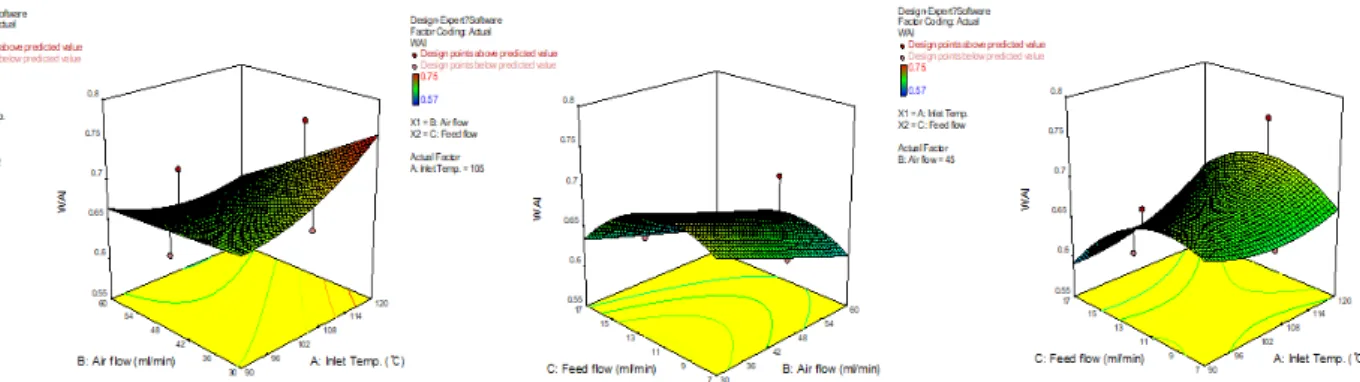
Fig. 2. Response surface analysis for the effects of spray drying conditions on WAI of soft persimmon and milk mixture.
A, response surface plot of WAI showing interaction between inlet temp. and air flow rate; B, response surface plot of WAI showing interaction between feed flow rate and air flow rate; C, response surface plot of WAI showing interaction between feed flow rate and inlet temperature.
Fig. 3. Response surface analysis for the effects of spray drying conditions on total phenolic compounds contents (μg/mL) of soft persimmon and milk mixture.
A, response surface plot of total phenol contents showing interaction between inlet temp. and air flow rate; B, response surface plot of total phenol contents showing interaction between feed flow rate and inlet temp.; C, response surface plot of total phenol contents showing interaction between feed flow rate and air flow rate.
보인 반면 feed flow rate(X3)는 inlet temperature(X1)와 air flow rate(X2) 모두 긍정적인 상호작용을 보였다. Fig. 2A의 반응표면 그래프의 경우 air flow rate(X2)가 60.00 mL/min일 때, inlet temperature(X1)가 높아질수록 수분흡수지수는 감 소하였으며, Santhaalakshmy 등(34)의 jamun 과즙과 Phoungchandang와 Sertwasana(35)의 생강음료도 유사한 경 향을 나타내었다. 이러한 결과는 분말의 유리전이 온도와 inlet temperature(X1)의 차이가 증가할수록 시료는 유리질 상태(glassy state)로 형질 변환되어 분말의 표면 점착성을 변화시키는 것과 연관이 있다(36). 이러한 표면 점착성의 변화는 분무건조 중 입자간의 응집성과 분무건조기 내벽과 의 점착을 감소시키므로 응집체의 수가 적어져 수분 보유 력이 저하되게 된다.(37).
Total phenolic compounds
Phenolic compounds는 식물계에 존재하는 2차 대사산물 로서 flavonoids, catechin, tannin 류로 크게 분류되며, 특히 감은 gallic acid, catechin, epicatechin, epigallocatechin, catechingallate, epicatechin gallate 및 epigallocatechin gallate 등이 함유되어 노화방지, 심혈관 질환 예방 및 항암 효과
등이 있는 것으로 알려져 있다(38,39). 하지만 total phenolic compounds와 같은 유용성분은 열처리에 민감하기 때문에 건조, 가열 등의 과정 중 분해되기 쉽다(40). Leon-Martinez 등(41)의 연구에 따르면, 분무건조는 시료가 고온열풍과 접촉하는 시간이 짧고 건조과정이 매우 빨라서 식품의 향, 색, 영양소의 손실이 적으므로 열에 민감한 식품의 분말화 에 유용하다고 알려져 있다. 이에 본 실험에서는 분무건조 시 처리하는 120℃ 이상 고온의 열풍에도 열에 민감한 phenolic compounds의 손실정도를 알아보고자 total phenolic compounds 함량을 측정하였다. 그 결과 분무건조 조건에 따른 total phenolic compounds는 243.93-293.11 μ g/mL의 범위로 나타났다(Table 2). 이때 정상점은 inlet temperature(X1) 90℃, air flow rate(X2) 43.33 mL/min, feed flow rate(X3) 17.00 mL/min일 때, 최대값 298.02 μg/mL으로 예측되었다(Table 5). F-ratio는 요인 변수 중 feed flow rate(X3)가 21.06로 가장 높은 값을 나타내었기 때문에 유의 적으로 가장 큰 영향을 받았다고 해석하였으며, 그 다음은 inlet temperature(X1) 7.66, air flow rate(X2) 6.79 순 이였다 (Table 4). 그리고 Table 3의 회귀식과 같이 일차항에서 독립 변수인 inlet temperature(X1)는 감소요인으로, feed flow rate(X3)와 air flow rate(X2)는 증가요인으로 나타났다. 또한 inlet temperature(X1)와 air flow rate(X2)는 긍정적인 상호작
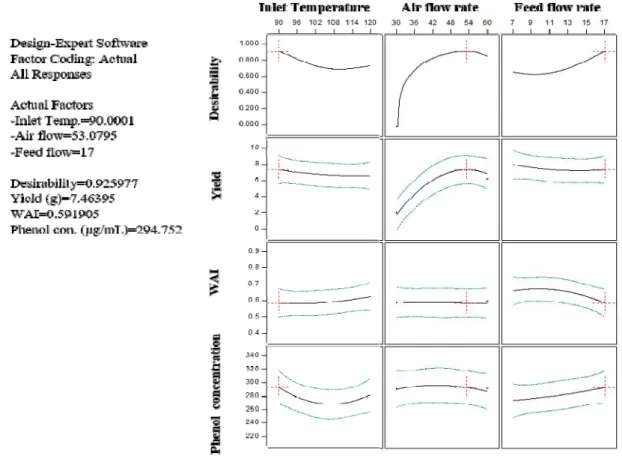
Fig. 4. Process optimization curve for spray drying conditions of soft persimmon and milk mixture.
용을 보인 반면 feed flow rate(X3)는 inlet temperature(X1)와 air flow rate(X2) 모두 부정적인 상호작용을 보였다. Fig.
3B의 반응표면 그래프와 같이 동일한 inlet temperature(X1) 에서 feed flow rate(X3)와 total phenolic compounds 값의 비례관계를 확인하였다. 특히, 가장 낮은 온도인 90℃의 inlet temperature(X1)와 가장 높은 60.00 mL/min의 air flow rate(X2)에서 최댓값의 total phenolic compounds을 확인하 였다. Fang과 Bhandari(42)의 bayberry juice의 분무건조 과 정 중 total phenolics compounds의 유지율은 96%로 본 실험 과 유사한 경향을 확인하였다. 이는 inlet temperature(X1)가 낮고 feed flow rate(X3)가 높을수록 열의 접촉 시간이 짧아 질 뿐만 아니라 분말의 중심 온도가 낮아져 열에 의한 성분 의 변화가 적기 때문으로 판단된다.
홍시라떼의 분말화 조건의 최적화
최종산물인 홍시라떼의 분말은 높은 회수량과 total phenolic compounds, 낮은 수분흡수지수를 갖는 품질을 최 적으로 고려하였다. Fig. 4는 각각의 독립변수에 대하여 2가지의 종속변수를 x축, y축으로 설정하여 표현한 그래프 로서 높은 회수량과 total phenolic compounds, 낮은 수분흡 수지수를 갖는 점은 빨간색의 십자선으로 표현하였다. 반 응 최적화 결과가 모든 반응에 대한 목표를 전체적으로
만족하는 정도를 의미하는 만족도(D)는 0.92로 비교적 높 은 수치를 나타내었다. 각 종속변수의 최적점 조건으로 최 적화한 결과 Fig. 4와 같이 inlet temperature(X1) 90℃, air flow rate(X2) 53 mL/min, feed flow rate(X3) 17.00 mL/min로 결정되었다. 이와 같은 최적점 조건에서 예측된 종속변수 는 회수량 7.46 g, 수분흡수지수 0.54, total phenolic compounds는 294.75 μg/mL 로 예측되었다.
요 약
본 연구는 홍시라떼 분말화의 최적조건 설정을 위하여 반응표면분석법(RSM)을 이용하였으며, 독립변수는 inlet temperature(X1), air flow rate(X2), 시료의 공급속도인 feed flow rate(X3)로 설정하고 종속변수로는 회수량(Y1), 수분흡 수지수(Y2), total phenolic compounds(Y3)로 설정하였다. 각 종속변수에 따른 회귀식은 모두 p<0.001 수준에서 유의성 이 인정되었다. 홍시라떼의 경우 과당이 풍부하여 분말의 부착성이 높기 때문에 유리전이 온도와 입자의 표면 온도 차이가 낮을수록 회수량은 높아졌으며, 분말의 결정성과 응집성은 증가하여 수분흡수지수는 낮아졌다. 또한 낮은 inlet temperature(X1)와 높은 feed flow rate(X3)는 입자의 표면 온도와 열의 접촉 시간을 모두 낮추어 total phenolic compounds의 손실을 최소화 하였다. 각 독립변수와 종속변 수의 영향을 나타내는 반응표면그래프를 이용하여 최적 분말화 조건을 예측한 결과 inlet temperature(X1) 90℃, air flow rate(X2) 53 mL/min, feed flow rate(X3) 17.00 mL/min로 결정되었다.
감사의 글
본 논문은 농촌진흥청 공동연구사업(PJ011629062017) 의 지원에 의해 이루어진 것입니다.
References
1. Lee SW, Lee OS, Jang SY, Jeong YJ, Kwon JH (2006) Monitoring of alcohol fermentation condition for
‘Cheongdobansi’ astringent persimmon (Diospyros kakai T.). Korean J Food Preserve, 13, 490-494
2. Rhee CH, Park HD (1997) Isolation and characterization of alcohol fermentation yeasts from persimmon. Korean J Appl Microbiol Biotechnol, 25, 266-270
3. Bian LL, You SY, Park JJ, Yang SJ, Chung HJ (2015) Characteristics of nutritional components in astringnet
persimmons according to growing region and cultivar.
J Korean Soc Food Sci Nutr, 44, 379-385
4. Hong JS, Chae KY (2005) Physicochemical characterization and antioxidant activity of astringent persimmon concentration by boiling. Korean J Food Cookery Sci, 21, 709-716
5. No JH, Kim JM, Zhang C, Kim HJ, Shin MS (2014) Effect of astringency removal conditions on the quality of Daebong persimmon. Korean J Food Cookery Sci, 30, 351-359
6. Joo OS, Kang ST, Jeong CH, Lim JW, Park YG, Cho KM (2011) Manufacturing of the enhances antioxidative wine using a ripe Daebong persimmon (Dispyros kakai L.). J Appl Biol Chem, 54, 126-134
7. Jeong CH, Kwak JH, Kim JH, Choi GN, Jeong HR, Kim DO, Heo HJ (2010) Changes in nutritional components of Daebong-gam (Dispyros kakai) during ripening. Korean J Food Preserv, 17, 526-535 8. Byun GI, Kwon YJ, Park ML (2008) Development of
granular tea by using astringent persimmon and persimmon leaves. Korean J culinary Res, 14, 273-285 9. Jeong YJ, Lee GD, Kim KS (1998) Optimization for
the fermentation conditions of persimmon vinegar using response surface methodology. Korean J Food Sci Technol, 30, 1203-1208
10. Lee YR, Chung HS, Seong JH, Moon KD (2011) Quality characteristics of Tofu with added astringent persimmon powder. Korean J Food Sci Technol, 43, 329-333 11. Chung JY, Kim KH, Shin DJ, Son GM (2002) Effects
of sweet persimmon powder on the characteristics of bread. J Korean Soc Food Sci Nutr, 31, 738-742 12. Kim HO, Moon HK, Kim GY (2005) Properties on the
quality characteristics of Selgidduck with various concentrations of dried persimmon extract. J East Asian Soc Dietary Life, 15, 591-597
13. Lee HH, Koh BK (2002) Sensory characteristics of Maejakgwa with persimmon powder. Korean J Soc Food Cookery Sci, 18, 216-224
14. Im CY, Jeong ST, Choi HS, Choi JH, Yeo SH, Kang WW (2012) Characteristics of Gammakeolli added with processed forms of persimmon. Korean J Food Preserv, 19, 159-166
15. Ratti C (2001) Hot air and freeze-drying of high–value foods: A review. J Food Eng, 49, 311-319
16. Tan LH, Chan LW, Heng PWS (2005) Effect of oil loading on microspheres produced by spray drying. J Microencapsulation, 22, 253-259
17. Kim JW, Kwon YR, Youn KS (2012) Quality characteristics and antioxidant properties in spray-dried and freeze-dried powder prepared with powdered seaweed extracts. Korean J Food Sci Technol, 44, 716-721
18. Han MW, Youn KS (2009) Quality characteristics of spray drying microparticulated calcium after wet-grinding.
Korean J Food Sci Technol, 41, 657-661
19. Hwang SH (2006) Studies on the stability of squid liver oil by microencapsulation and fluidized bed micro-coating.
Ph D Thesis, Catholic University of Daegu, Gyengsan, Korea, p 5-7
20. Bezerra MA, Santelli RE, Oliverira EP, Villar LS, Escaleira LA (2008) Response surface methodology (RSM) as a tool for optimization in analytical chemistry.
Talanta, 76, 965-977
21. Kim HJ, Yun HJ, Lee JH, Heo KN, Kang BS, Jo CR (2012) Optimization of processs condition of boiled Korean native chicken by response surface methodology.
CNU J Agric Sci, 39, 195-202
22. Lee WC, Yusof S, Hamid NSA, Baharin BS (2006) Optimizing conditions for enzymatic clarification of banana juice using response surface methodology (RSM).
J Food Eng, 73, 55-63
23. Phillips RD, Chinnan MS, Branch AL, Miller J, Mcwatters KH (1998) Effects of pre-treatment on functional and nutritional properties of cowpea meal. J Food Sci, 53, 805-809
24. Folin O, Denis W (1912) On phosphotungastic- phosphomolybdic compounds as color reagents. J Biol Chem, 12, 239-249
25. Papadakis SE, Gardeli C, Tzia C (2006) Spray drying of raisin juice concentrate. Drying Technol, 24, 173-180 26. Bhandari BR, Datta N, Howes (1997) Problems
associated with spray drying of sugar-rich foods. Drying Technol, 15, 671-684
27. Collares FP, Finzer JRD, Kieckbusch TG (2004) Glass transition control of the detachment of food pastes dried over glass plates. J Food Eng, 61, 261-267
28. Samaneh K, Mohammad HM, Wan RWD, Nourouzi MM (2015) CFD modeling of air flow on wall deposition in different spray dryer geometries. Drying Technol, 33, 784-795
29. Chung HS, Hong JH, Youn KS (2005) Quality characteristics of granule prepared by protein-bound polysaccharide isolated from Agaricus blazei and selected forming agents. Korean J Food Preserv, 12, 247-251
30. Moon JH, Kim RS, Choi HD, Kim YS (2010) Nutrient composition and physicochemical properties of Korean taro flours according to cultivars. Korean J Food Sci Technol, 42, 613-619
31. Hogekamp S, Schubert H (2003) Rehydration of food powders. Food Sci Tech Int, 9, 223-235
32. Lee DH, Hong JH (2015) Antioxidant activities of chlorella extracts and physicochemical characteristics of spray-dried chlorella powders. The Korean J Food Preserv, 22, 591-597
33. Beleia A, Varriano-Marston E, Hoseney RC (1980) Characterization of starch from pearl millets. Cereal Chem, 57, 300-303
34. Santhalakshmy S, Bosco SJD, Francis S, Sabeena M (2015) Effect of inlet temperature on physicochemical properties of spray-dried jamun fruit juice powder.
Powder Technol, 274, 37-43
35. Phoungchandang S, Sertwasana A (2010) Spray-drying of ginger juice and physicochemical properties of ginger powders. Science Asia, 36, 40-45
36. Adhikari B, Howes T, Bhandari BR, Truong V (2003) Characterization of the surface stickiness of fructose- maltodextrin solutions during drying. Drying Technol, 21, 17-34
37. Grabowski JA, Truong VD, Daubert CR (2006) Spray- drying of amylase hydrolyzed sweetpotato puree and physicochemical properties of powder. J Food Sci, 71, E209-E217
38. Cha JY, Ahn HY, Eom KE, Park BK, Jun BS, Cho YS (2009) Antioxidant activity of Aralia elata shoot and leaf extracts. J Life Sci, 19, 652-658
39. Kim YJ, Lee SJ, Kim MY, Kim GR, Chung HS, Park HJ, Kim MO, Kwon JH (2009) Physicochemical and organoleptic qualities of sliced-dried persimmons as affected by drying methods. Korean J Food Sci Technol, 41, 64-68
40. Mona ES, Langrish TAG (2016) Spray drying bioactive orange-peel extracts produced by soxhlet extraction: use of WPI, antioxidant activity and moisture sorption isotherms. LWT-Food Sci Technol, 72, 1-8
41. Leon-Martinez FM, Mendez-Lagunas LL, Rodriguez- Ramirez J (2010) Spray drying of nopal mucilage (Opunita ficus-indica): Effects of powder properties and characterization. Carbohydr Polym, 81, 864-870 42. Fang Z, Bhandari B (2011) Effect of spray drying and
storage on the stability of bayberry polyphenols. Food Chem, 129, 1139-1147