Agric. Chem. Biotechnol. 48(2), 89-92 (2005) Article
Germination-Inhibitory Effect of Pulsatilla koreana N. Leaves;
Protoanemonin as Active Principle
Seong-Cheol Bang* Dong-Hwa Kim
1, and Byung-Zun Ahn
2College of Pharmacy, Chungnam National University, Daejeon 305-764, Korea
1Department of Horticulture, Kumsan Industry High School, Kumsan 312-805, Korea
2Central Research Institute, SB Pharmaceutical Co. (Ltd), Korea
Received March 17, 2005; Accepted May 16, 2005
The germination of leaves of Pulsatilla koreanaLactuca sativa N. including abundant ranunculin. Germination inhibitory activityseeds was significantly inhibited by the water extract of the fresh increased in a dose-dependantly. Protoanemonin, produced from ranunculin by enzymatic action during maceration process of leaves, was proved to be the active principle with inhibitory activity was above 90% at concentration of 1 mg/ml.
Key words: Pulsatilla koreana N., Lactuca sativa, germination inhibitory activity, ranunculin, protoanemonin The continuous use of herbicides has caused many serious
problems such as the ecosystem destruction, advent of herbicide-resistant plant, and the environmental pollution, although there is no doubt about a chemical weeding method effectively weed controls. Therefore, a substainable agriculture system is urgently required. Allelopathy, as an important expedient to solving the environmental problems, is presently in the spotlight1). It is a strategy for inter-specific as well as intra-specific competition in populations2). Some plant species secrete toxic natural substances, interfere with the vital processes of other plants, and inhibit seed germination and seeding growth. Thus, the allelopathic substances could be applied either in the form of a mixture with existing herbicides or as a pure substance to eradicate unwanted plants and to protect the environment from herbicide pollution. Plant species such as rice, Indian millet, alfalfa, cucumber, sweet potato, and bean contain allelopathy materials, which are mainly phenolic compounds, and trace amounts of aldehydes, aromatic acids, flavonoids, alkaloids, terpenoids, and steroids1,3-5). However, the weed-removing method using allelopathy effect has not been put to practical use up to now, and related researches are also very restricted to the solvent extracts of plants organ and phenolic compounds and their derivatives. Therefore, demands on finding more effective weed control agents, as well as more effective separation and purification methods of the allelochemicals are increasing.
Therefore, the objective of this study was to evaluate the inhibitory activity of Pulsatilla koreana leaves on the germination of Lactuca sativa and find the active principle involved in the activity. In Europe, the Pulsatilla leaves have
been used for the treatment of neuralgia, migrane, cough, bronchitis, egout, and diuretic, among others6).
Materials and Methods
Ranunculin and protoanemonin were synthesized in our laboratory7).The leaves of P. koreana were collected from Kuemsan, Chungnam during July, 2002 and refrigerated. P.
koreana was authenticated by Professor Bae, Chungnam National University, and “The Flora of Korea” of Professor Lee. L. sativa seeds (HanKuk JongMyo Inc.) screened to equal sizes, then sterilized with 5% sodium hypochloride solution for 3 min. and rinsed at least three times with distilled water. The solvents used for this investigation were either of first class or special quality. The TLC plate (Kieselgel 60) and the incubator were purchased from Merck (Germany) and Forma Scientific Co., respectively.
Germination inhibitory activities of n-hexane, EtOAc, and water extracts obtained from P. koreana leaves (Exp-I). The dried and powdered leaves of P. koreana (27 g) were extracted with 80% MeOH (300 ml) at room temperature for 6 h, followed by vacuum-filtration. After repeating this procedure twice, the extracts were combined and dried under reduced pressure at 40oC, and a green colored MeOH extract (8 g) was obtained. The MeOH extract was suspended in distilled water (200 ml), then extracted with n-hexane (200 ml ×3) and ethyl acetate (200 ml ×3), concentrated, and evaporated to give 1.4 g of yellowish n-hexane extract (HX) and 1.7 g of light-brown ethyl acetate extract (EX), respectively. The remaining water layer was dried to yield 4.5 g of water extract (WX) as a dark- brown syrup. Each 1 g solvent extract was diluted in 10 ml of distilled water (Frt A). To observe the concentration dependence, the Frt A was diluted two and ten times with distilled water, giving Frt A×2 and Frt A×10, respectively.
*Corresponding author
Phone: +82-42-821-7314; Fax: +82-42-823-6566 E-mail: [email protected]
90 Seong-Cheol Bang et al.
The seeds were put into a filter paper-laid Petri dish (170 mm diameter) and added with 6 ml of the test solution. The dish was then shaken to wet the filter paper evenly. For the control group, 6 ml of distilled water was added to the Petri dish. Twenty-five L. sativa seeds were put into each Petri dish containing Frt A, Frt A×2, and Frt A ×10 samples, and water (control). The Petri dishes were incubated at 25oC, and the germinated embryos were counted every 24 hr for 5 days. The germination percentage of the control (GPC) and the relative germination ratio (RGR) were calculated8) by applying the following equations. The experiment was replicated three times.
GPC (%) = Number of germinated seed of control ×100 Total number of seeds of control
RGR (%) = Germination percentage of treated group ×100 Germination percentage of control
Germination inhibitory activity of ranunculin and protoanemonin (Exp-II). The powdered leaves (5 g) were added with 50 ml of water, subjected to Ultrasonic wave shaking for 10 min, and centrifuged for 10 min at 3000 rpm. The resulting water layer was extracted with EtOAc (20 ml ×3), and the remaining water was adjusted to 50 ml with water (WX-1). Subsequently, 25 ml of WX-1 was heated in a microwave heater for approximately 3 minutes to make the plant enzymes inactive and designated as Heat WX-1. Sample A was composed of 4 ml of Wt-1 and 2 ml of water, and sample B was made up of 4 ml of Heat WX-1 and water (Table 2). Sample C is a 6 ml
water solution containing 6 mg of ranunculin. Then, 2 ml of
sample C was added into samples A and B to obtain samples D and E, respectively. Finally, to compare the germination inhibitory effects of ranunculin and protoanemonin, sample F was prepared by dissolving 6 mg of protoanemonin in 6 ml of water. Water (6 ml) was used as the control group, and GPC and RGR values were determined using the same calculation method of Exp-I.
Results and Discussion
Through continuous observation, we observed an allelopathic effect by crushing P. koreana leaf tissues against some plant seeds. To obtain more concrete evidence, the germination inhibitory activities of n-hexane (HX), ethyl acetate (EX), and water (WX) extracts of P. koreana leaves against L. sativa
seeds were measured (Exp-I). Among of them, WX showed the strongest inhibition of germination, and the rest did not show any activity (Table 1). Moreover, the inhibitory activity of the WX showed concentration-dependency based on the observation that the inhibitory effect disappeared after a tenfold dilution. In addition, the germination inhibitory substance extracted from the P. koreana leaves had high polarity and good solubility in water, which strongly suggested a high probability of the presence of glycoside featuring high polarity. Therefore, the leaves of P. koreana were examined to confirm the presence of a glycoside, and to determine whether the substance responsible for the inhibitory activity was the secondary substance generated from the enzymatic reaction or the innate substance within the leaves, as well as to pursue the active principle (Exp-II). As described Table 1. Relative germination ratio (RGR) of n-hexane (HX), ethyl acetate (EX), and water (WX) extracts obtained from P.
koreana leaves in the Exp-I
Exp-I
Groupa RGRe
Frt Ab(0.1 mg/ml) Frt A×2c (0.05 mg/ml) Frt A×10d(0.01 mg/ml)
HX +++ +++ +++
EX +++ +++ +++
WX --- + +++
an-Hexane (HX), ethyl acetate (EX), and water (WX) extracts of P. koreana leaves was grouped.
b-dEach 1 g solvent extract was diluted in 10 ml of distilled water (Frt A). The Frt A was diluted two and ten times with distilled water, giving Frt A×2 and Frt A×10, respectively.
e(%): > 90; +++, 90-70; ++, 70-50; +, 50-30; -, 30-10; --, < 10; ---.
Table 2. Manufacturing conditions and relative germination ratio (RGR) of samples A-H in the Exp-II
Sample Condition RGRc
Exp-II
A WX-1a 4 ml + water 2 ml ---
B Heat WX-1b 4 ml + water 2 ml +++
C Ranunculin 6 mg + water 6 ml (1 mg/ml) +++
D WX-1 2 ml + sample C 2 ml + water 2 ml --
E Heat WX-1 2 ml + sample C 2 ml + water 2 ml +++
F Protoanemonin 6 mg + water 6 ml (1 mg/ml) ---
aThe water extract of P. koreana leaves with the lipophilic or middle polar materials discarded.
bThe water extract of P. koreana leaves heated in the microwave for 3 min to destroy the plant enzymes.
cRGR (%): > 90; +++, 90-70; ++, 70-50; +, 50-30; -, 30-10; --, < 10; ---.
Germination-Inhibitory Effect of Pulsatilla koreana N. Leaves; Protoanemonin as Active Principle 91
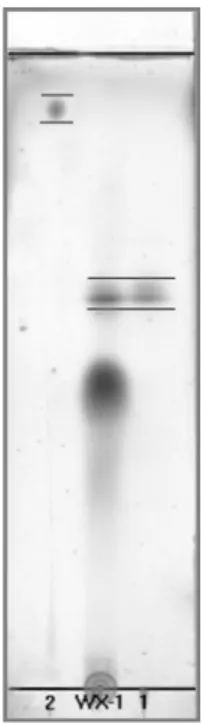
in Table 2, sample B did not have any germination inhibitory activity (RGR: >95%), whereas sample A showed a very strong inhibition activity against the germination of L. sativa seeds. This result suggested that the substance responsible for the germination inhibitory effect could be directly related to the enzymatic reactions. In other words, the inhibitory substance was generated by the enzymatic reaction. Extensive studies have been conducted with regard to the material known as ranunculin, 1 (Fig. 1), which showed a variety of physiological activities and DNA-polymerase inhibition activities, which affect the cellular function9-10). The Rf value of water extract of P. koreana leaves (WX-1) and ranunculin were compared on TLC (Fig. 2). Figure 2 shows the extract was composed of a significant amount of ranunculin.
Therefore, to estimate the inhibitory activity of ranunculin,
sample C was prepared by dissolving 6 mg of ranunculin synthesized in our laboratory with 6 ml of water. Samples D and E were prepared with sample C, WX-1, and Heat WX-1 (Table 2), and their inhibitory activity against germination were measured. Samples C and E, which were composed of ranunculin, had 22-24 units out of total 25 stocks displaying signs of germination (RGR: 88-96%, Table 2). On the other hand, sample D composed of an active enzyme containing WX-1 demonstrated stronger germination inhibitory activity compared to sample C, even though sample D had 1/3 of ranunculin compared to sample C (RGR: 16-21%). Considering these results, the enzymatic reactions play an essential role in exhibiting the germination inhibitory activity of ranunculin within the plant tissues. Yili et al. proposed that ranunculin is autolytically released as a toxin or during the formation of protoanemonin by β-glucosidase (EC 3.2.1.21) within the plant11). The lactone protoanemonin, 5-methylene-2-oxodihydrofuran, 2 (Fig. 1) is the irritant oil responsible for the vesicant properties attributed to the members of the buttercup family including species of Helleborus, Anemone, Clematis, Ceratocephalus, and most commonly Ranunculus. The oil is derived by autolysis during maceration of fresh plant tissue and produces an intense burning sensation when chewed or erythema, dermatitis, and blistering when applied to the skin12). It also has antifungal and antibiotic properties13-14). Protoanemonin (6 mg) was added to prepare sample F. Sample F displayed a very strong inhibition activity with RGR values ranging from 4 to 8% unlike sample C, which was based on ranunculin.
In conclusion, ranunculin in the water extract of P. koreana leaves automatically generated protoanemonin and this secondary substance demonstrated more than 90% inhibition of germination against L. sativa at concentration of 1 mg/ml, suggesting that protoanemonin is one of the active principle of the allelopathy substances, which were generated by the P.
koreana to prevent the invasion of other plants. This discovery of protoanemonin which was an independent substance embedded with the allelopathy characteristic and could be a very meaning outcome of this research. A more concretive and systematical research on protoanemonin and the development of the natural herbicides applying these P.
koreana leaves are highly recommended.
References
1. Kim, S. Y., Kim, C. R., Park, S. T., and Kim, S. C. (1997) Allelopathic effects of medicinal plants on Echinoclhoa crus-galli Beauv. Kor. J. Weed Sci.17, 407-412.
Fig. 1. Structures of ranunculin (1) and protoanemonin (2).
Fig. 2. Comparison of Rf values of protoanemonin (2, Rf= 0.98), the water extract (WX-1) of P. koreana leaves, and ranunculin (1, Rf= 0.61) on thin layer chromatography (Kie- selgel, eluting solvent; CHCl3-MeOH-H2O = 3 : 3 : 1, sprayed with 10% H2SO4 and heated).
Fig. 3. Biosynthetic process of protoanemonin (2) from ranunculin (1) by ranunculase.
92 Seong-Cheol Bang et al.
2. Lee, H. M., Lim, J. D., Kim, M. J., and Yu, C. Y. (2001) The effect of extracts of industrial plant resources on germi- nation and growth of Raphanus sativus L. Korean J. Plant.
Res.14, 108-115.
3. Chon, S. U. (2004) Allelopathic potential of common this- tle (Cirsium japonicum) leaf extracts and residues. Kor. J.
Weed Sci.24, 79-86.
4. Lodhi. M. A. K. (1976) Role of allelopathy as expressed by dominating trees in a low land forest in controlling the pro- ductivity and pattern of herbaceous growth. Amer. J. Bot.
63, 1-8.
5. Harborne, J. B. and Simmonds, N. W. (1964) Biochemistry of phenolic compounds, pp. 77-127. Academic Press, New York.
6. Bae K. H. (1999) Medicinal Plants of Korea, pp. 139. Kyo- Hak Press, Seoul.
7. Bang, S. C., Kim, Y., and Ahn, B. Z. (2004) Modified syn- thesis method & cytotoxic activity of ranunculin and pro- toanemonin, Yakhak Hoeji,48, 117-121.
8. Kil, B. S. and Yun, K. W. (1992) Allelopathic effects of
water extracts of Artemisia princeps var. orientalis on selected plant species. J. Chem. Ecol. 18, 39-51.
9. Benn, M. H. and Yelland, L. J. (1968) Ranunculin, Cana- dian J. Chem.46, 729-732.
10. Hill, R. and van Heyningen, R. (1951) Ranunculin: the pre- cursor of the vesicant substance of the buttercup. Biochem.
J.49, 332-335.
11. Yili, B., Michael, H. B., Walter, M., and Ruth, M. (1996) Extraction and HPLC determination of ranunculin in spe- cies of the buttercup family. J. Agric. Food. Chem. 44, 2235-2238.
12. Spoerke, Jr., D. G. and Smolinske, S. C. (1990) Toxicity of houseplants, CRC Press, Boca Raton, pp. 37-39.
13. Martin, M. San Roman, L., and Dominguez, A. (1990) In vitro activity of protoanemonin, antifungal agent. Planta Med.56, 66-69.
14. Campbell, W. E., Cragg, G. M. L., and Powrie, A. H.
(1979) Anemonin, protoanemonin, and ranunculin from Knowltonia capensis. Phytochemistry, 18, 323-324.