• 검색 결과가 없습니다.

Association between Maternal Adverse Childhood Experiences and Risk of Post-traumatic Stress Disorder in the Offspring

N/A
N/A
Protected

Academic year: 2021

Share "Association between Maternal Adverse Childhood Experiences and Risk of Post-traumatic Stress Disorder in the Offspring"

Copied!
8
0
0

로드 중.... (전체 텍스트 보기)

전체 글

(1)

INTRODUCTION

Adverse childhood experiences (ACEs) are those experienc- es in which individuals aged below 18 years are exposed to traumatic events such as child abuse, neglect, and household dysfunction [1]. Many studies have found that the risks of ad- verse health behaviors, mental health problems, and chronic disease over the lifetime increase in proportion to the ACEs.

In particular, exposure to ACEs is three times higher in per- sons experiencing depressive symptoms than in non-depressed persons; persons with mental illness, including mood disor- der, anxiety, substance abuse, and psychosis have usually had more than three ACEs [2]. A previous study on ACEs and psy- chiatric disorders in young adulthood reported that child

maltreatment experience leads to a 1.97-fold higher risk of post-traumatic stress disorder (PTSD) in adulthood [3].

Recently, evidence has shown that maternal ACEs are asso- ciated with offspring developmental delay, behavioral prob- lems, social-emotional functioning, and psychopathology through intergenerational transmission [4]. Studies have shown that maternal trauma history is directly associated with anx- iety in their offspring, and maternal experience of childhood abuse is associated with depressive symptoms in the offspring during adolescence [5]. In addition, it has been reported that children of parents with a history of four or more ACEs have, on average, 4.2-fold higher odds of emotional disturbance than children of parents with no ACEs [6]. These results show the cumulative dose-response-based intergenerational trans- mission of maternal ACEs.

ACE, namely parental exposure to childhood maltreatment, is an important predictor of maltreatment experiences and

This is an Open Access article distributed under the terms of the Creative Commons Attribution Non-Commercial License (https://creativecommons.org/licenses/by-nc/4.0) which permits unrestricted non-commercial use, distribution, and reproduction in any medium, provided the original work is properly cited.

Association between Maternal Adverse Childhood Experiences and Risk of Post-traumatic Stress Disorder in the Offspring

Min Chull Na 1 , Moon Doo Kim 1,2 , Joon Hyuk Park 1,2 , Young-Eun Jung 1,2 , Duk-Soo Moon 1 , Hyun-Ju Yang 1 , Bung-Nyun Kim 3 , and Na Ri Kang 1,2

1

Department of Psychiatry, Jeju National University Hospital, Jeju, Korea

2

Department of Psychiatry, Jeju National University School of Medicine, Jeju, Korea

3
Department of Psychiatry, Seoul National University School of Medicine, Seoul, Korea

Objectives: Adverse childhood experiences (ACEs) of mothers may negatively affect the mental health of their offspring. Little is known about the intergenerational effect of maternal ACE on post-traumatic stress disorder (PTSD) in the offspring. This study inves- tigated the impact of maternal ACEs on PTSD in the offspring.

Methods: A total of 156 mothers with children aged 13–18 years completed the Diagnostic Interview Schedule for Children (DISC) Predictive Scales to determine the presence of psychiatric disorders in their offspring. The subjects completed the ACE questionnaire and the Early Trauma Inventory Self-Report-Short Form. Multivariable logistic regression was used to analyze the relationship between ma- ternal ACEs and PTSD in the offspring.

Results: Of the mothers, 23.7% had at least one ACE, and PTSD was reported in 21.8% of the offspring. The offspring of the mothers in the ACE group had a significantly higher rates of traumatic experiences and PTSD than the offspring of the mothers in the no ACE group. Maternal household dysfunction independently predicted offspring PTSD [odds ratio (OR)=3.008, p=0.05), and three or more maternal ACEs were significantly related to PTSD in the offspring (OR=10.613, p=0.025).

Conclusion: Maternal ACEs have a significant impact on the risk of traumatic experiences and PTSD in the offspring. These findings suggest the presence of intergenerational transmissions by which maternal ACEs affect the mental health of the offspring.

Key Words: Maternal; Adverse childhood experiences; Offspring; Post-traumatic stress disorder.

Received: December 10, 2020 / Revision: January 6, 2021 / Accepted: January 19, 2021

Address for correspondence: Na Ri Kang, Department of Psychiatry, Jeju National University School of Medicine, 15 Aran 13-gil, Jeju 63241, Korea

Tel: +82-64-717-1850, Fax: +82-64-717-1849, E-mail: [email protected]

(2)

mental health problems in the offspring. In particular, con- sidering that maltreatment of the parents in their childhood is significantly related to PTSD symptoms in their offspring [7], maternal ACEs are a risk factor for PTSD not only in the mothers but also in their offspring. However, the association between maternal ACEs and PTSD in the offspring has not yet been examined. We hypothesized that when maternal ACEs are present, the risk of traumatic experience and the frequen- cy of PTSD for the offspring is high, and maternal ACE is a significant risk factor for PTSD in the offspring. The present study evaluated the prevalence of maternal ACEs and the prev- alence of traumatic experiences and PTSD in the offspring.

We also examined the association between maternal ACEs, including child abuse, neglect, and household dysfunction, and PTSD in the offspring and the effect of cumulative maternal ACEs.

METHODS

Participants and procedure

The participants included mothers with children aged 13 years to 18 years who had attended school for more than 6 months in Jeju Special Self-Governing Province, Korea.

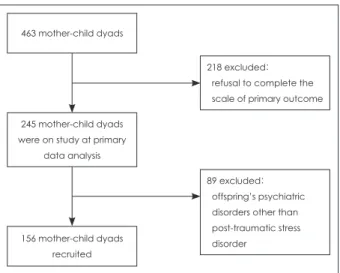
Two middle schools and high schools were selected with the cooperation of the Jeju Special Self-Governing Province Of- fice of Education. We sent the survey forms, including the study background and consent to participate, to parents of students in all grades. For data collection, the survey ques- tionnaires were distributed and collected by trained mental health specialists. A total of 245 mother-child dyads partici- pated in this study. Among them, 156 mother-child dyads, excluding those with psychiatric disorders other than PTSD, participated in the final study (Fig. 1). The data were collect- ed from September to December 2017. Written consent was obtained from the mothers and their children. This study was approved by the Institutional Review Board of the Jeju Na- tional University Hospital (Grant No. 2018-08-004).

Assessments

Adverse childhood experiences questionnaire

The ACE questionnaire collects retrospective data about childhood experiences until the age of 18. It includes 10 ACEs for child abuse (e.g., verbal, physical, and sexual abuse), child neglect (e.g., emotional and physical neglect) and household dysfunction (e.g., parental divorce, domestic violence, alcohol problem, mental illness, and prison) [8]. When the response to the ACE item is “yes,” it is assigned a score of one point; the accumulated points are added to obtain the total ACE score.

In this study, we analyzed the relationship between the total

ACE score, three domains (child abuse, child neglect, and household dysfunction) of ACE, and PTSD in the offspring.

Early Trauma Inventory Self-Report-Short Form The Early Trauma Inventory Self-Report-Short Form (ETISR- SF) consists of 27 items about traumatic experiences that may have occurred until the age of 18 in four domains: general (11 items), physical (5 items), emotional (5 items), and sexual trau- ma (6 items) [9]. Each traumatic experience was scored di- chotomousely (yes=1, no=0). We used the Korean version of the ETISR-SF [10], which is a reliable and valid instrument for measuring childhood traumatic experiences. The total ETISR- SF scores and scores for each of the four domains were used for analysis, with each trauma experience assigned one point.

Diagnostic Interview Schedule for Children Predictive Scales

The Predictive Scales (DPS) includes only the Diagnostic Interview Schedule for Children (DISC) items that are most predictive of a Diagnostic and Statistical Manual of Mental Disorders, fourth edition (DSM-IV) diagnosis [11] and eval- uates the psychiatric symptoms the children display in the last year. DPS has been widely examined, showing high test-re- test reliability and internal consistency [12]. A previous epide- miological survey of children and adolescents conducted in South Korea [13] included 33 questions about diagnoses pre- viously found in the DISC-IV but not in the DPS (selective mutism, eating disorder, elimination disorder, PTSD, tic dis- order, nicotine dependence, pica, and trichotillomania). The present study used the modified DPS; the DPS of offspring’s psychiatric disorders was completed by the mothers. Each psy- chiatric disorder’s diagnostic cutoff was defined according to Cubo et al. [14]. This study analyzed PTSD groups diagnosed according to the PTSD cutoff score and used a control group

Fig. 1. Recruitment profile.

463 mother-child dyads

218 excluded:

refusal to complete the scale of primary outcome

89 excluded:

offspring’s psychiatric disorders other than post-traumatic stress disorder

245 mother-child dyads were on study at primary

data analysis

156 mother-child dyads

recruited

(3)

that included offspring without psychiatric disorders, exclud- ing psychiatric disorders other than PTSD.

Center for Epidemiological Studies Depression Scale for Children

The Center for Epidemiological Studies Depression Scale for Children (CES-DC), which is developed by the National Institute of Mental Health (NIMH), is a scale used to exam- ine the degrees of depressive symptoms in children and ado- lescents aged 6–17 years [15]. We used the standardized CES- DC [16]; a high CES-DC score indicates the presence of severe depressive.

Screen for Children Anxiety-Related Disorders

To measure adolescent anxiety, we used the Screen for Chil- dren Anxiety-Related Disorders (SCARED), which was de- veloped by Birmaher et al. [17] and revised by Kim [18]. It is a self-report scale consisting of 41 questions. The items are scored from 0 to 2, representing not at all, sometimes, and often, respectively. A higher score indicates a higher level of anxiety.

Beck Depression Inventory-II

The Beck Depression Inventory (BDI-II), a self-report scale developed by Beck et al. [19], is based on the criteria for de- pressive disorder in the DSM-IV and consists of 21 questions on cognitive, emotional, and physiological symptoms of de- pression. The items are scored on a Likert scale from 0 point to 3 points, and the scores for the 21 items are summed; the total score ranges from 0 point to 62 points, where the higher the score the more severe the depression. In the present study, the BDI-II was used to evaluate the severity of maternal de- pression; we used the standardized scale for the Korean pop- ulation (Cronbach’s α=0.91) [20].

The mothers completed the ACE questionnaire about ma- ternal ACEs. They also filled in the ETISR-SF and DPS on offspring’s traumatic experience and psychiatric disorders.

The offspring answered the CES-DC and SCARED on de- pression and anxiety, respectively. The CES-DC, SCARED, and maternal BDI-II scores were used in the regression anal- ysis as variables that can affect PTSD in the offspring.

Statistical analysis

We analyzed the participants’ sociodemographic character- istics, frequency of ACE domains, and offspring’s traumatic experience through descriptive analysis. The frequency of the offspring’s traumatic experience and PTSD, according to ma- ternal ACEs, was verified by the chi-squared test; the sum of traumatic experiences was tested by the independent sample t-test. The chi-squared analysis was carried out to compare the

frequency of a maternal ACE item between the PTSD group and the control group. A multivariate logistic regression anal- ysis was conducted to adjust for the emotional state of the chil- dren and mothers using CES-DC, SCARED, maternal BDI-II, and socioeconomic variables such as socioeconomic status, maternal age, maternal education level, and offspring’s age and sex. We examined the odds ratios (OR) and 95% confi- dence intervals (CI) of the total maternal ACE score and the scores on the three domains of maternal ACEs in predicting PTSD in the offspring. SPSS version 18 (SPSS Inc., Chicago, IL, USA) was used for data analysis, and the significance level of all statistical analyses was p<0.05.

RESULTS

Sociodemographic characteristics of the participants Of the total 156 mother-child dyads, the mean age of the subjects was 45.74 (±4.49) years and the mean age of the off- spring was 16.58 (±1.47) years; the offspring groups consisted of 62.8% (n=98) females and 37.2% (n=58) males. A total of 51.0% (n=75) of mothers were in the middle socioeconomic status, and 96.7% (n=143) had education level of high school graduate or higher.

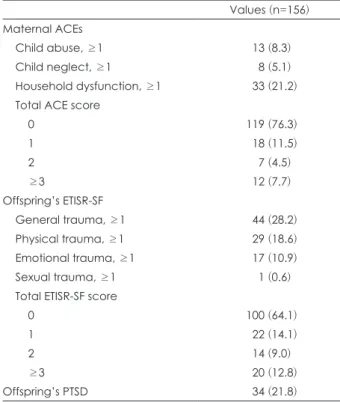
Maternal ACEs and offspring’s traumatic experiences In total, 23.7% (n=37) mothers had more than one ACE, and 7.7% (n=12) had more than three ACEs. When classified into three domains, 8.3% (n=13) experienced child abuse, 5.1%

(n=8) experienced child neglect, and 21.2% (n=32) experienced household dysfunction, which was the most frequently re- ported ACE. Regarding the offspring’s traumatic experiences, 28.2% (n=44) experienced general trauma, while 18.6% (n=

29), 10.9% (n=17), and 0.6% (n=1) experienced physical, emo- tional, and sexual trauma, respectively. In total, 35.9% (n=56) of the offspring had more than one traumatic experience and 12.8% (n=20) had more than three traumatic experiences (Ta- ble 1). A total of 21.8% (n=34) of the offspring were in the PTSD group (Table 1), of which 47.1% (n=16) had only PTSD and 52.9% had PTSD with comorbid disorders. The most com- mon comorbid disorders were attention-deficit/hyperactivity disorder, anxiety disorder, and major depressive disorder.

Frequency of offspring’s traumatic experiences and PTSD according to maternal ACEs

There was no significant difference between the demographic

variables and the offspring’s CES-DC and SCARED scores ac-

cording to maternal ACEs. Maternal BDI-II score was signifi-

cantly higher in the group with maternal ACEs than in group

without maternal ACEs (Table 2). The prevalence rates of gen-

eral (56.8% vs. 19.3%; p<0.001), physical (43.2% vs. 10.9%; p<

(4)

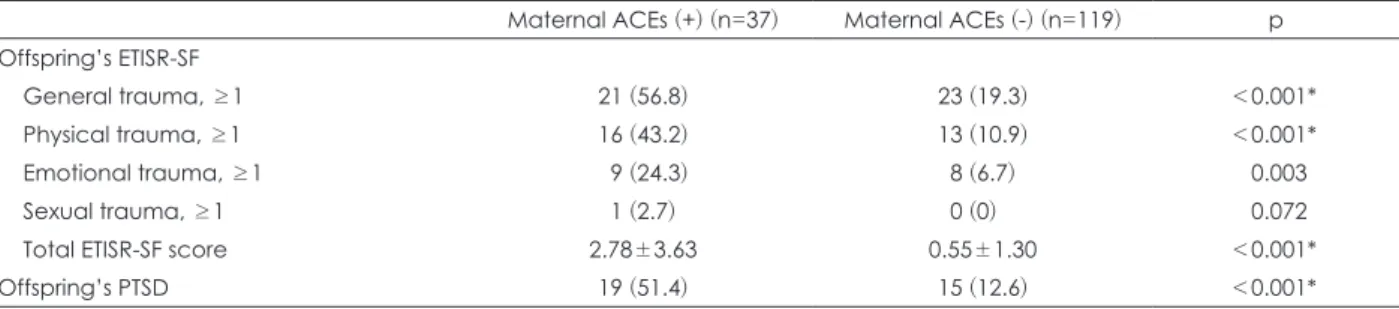
0.001), and emotional traumas (24.3% vs. 6.7%; p=0.003) in the offspring were significantly higher in the group of moth- ers with ACEs than in the group without. The total number

of traumatic experiences of the offspring was 2.78 (±3.63) for those with maternal ACEs, significantly higher than that for the group without maternal ACEs (0.55±1.30, p<0.001). The frequency of PTSD in the offspring was 51.4% (n=19), signif- icantly higher in the group with maternal ACEs than in the group without [12.6% (n=15)] (Table 3).

PTSD in the offspring and maternal ACEs

Verbal abuse (20.6% vs. 1.6%), physical abuse (17.6% vs. 1.6%), emotional neglect (17.6% vs. 1.6%), divorce (32.4% vs. 4.9%), domestic violence (14.7% vs. 5.7%), alcohol problems (20.6%

vs. 5.7%), and mental illness (17.6% vs. 2.5%) of family mem- bers, excluding sexual abuse, physical neglect, and prison sen- tence, were significantly higher in the PTSD group than in the control group (Fig. 2). When the mother experienced house- hold dysfunction among the three domains of ACEs, the OR of their offspring falling under the PTSD group was 3.008 times higher than those with mothers without household dysfunc- tion and statistically significant (OR=3.008, 95% CI=1.238–

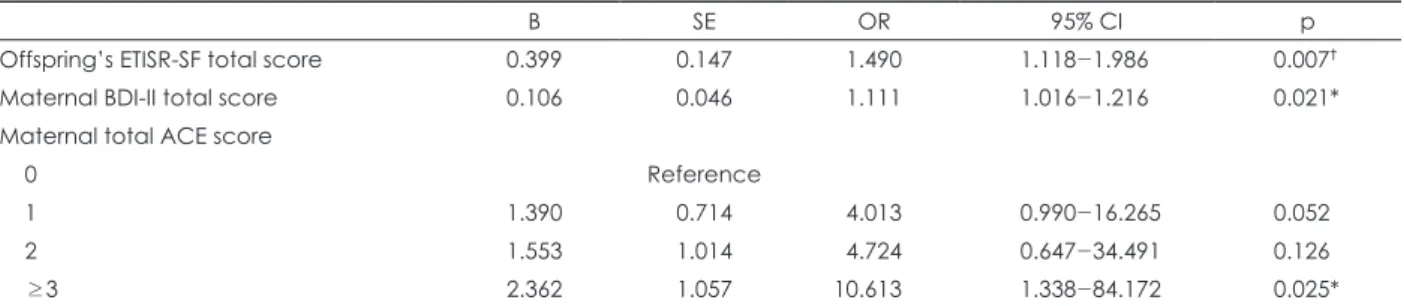
7.305, p=0.05) (Table 4). The OR was significantly higher when the ACE score was 3 or more (OR=10.613, 95% CI=1.338–

84.172, p=0.025) than when ACE was 2 or below (Table 5).

DISCUSSION

The frequencies of traumatic experiences and PTSD were significantly higher in the offspring whose mothers had ACEs than in the offspring whose mothers did not. Among ACEs, household dysfunction was significantly associated with PTSD,

Table 1. Frequency of maternal ACEs and offspring’s traumatic experiences

Values (n=156) Maternal ACEs

Child abuse, ≥1 13 (8.3)

Child neglect, ≥1 8 (5.1)

Household dysfunction, ≥1 33 (21.2) Total ACE score

0 119 (76.3)

1 18 (11.5)

2 7 (4.5)

≥3 12 (7.7)

Offspring’s ETISR-SF

General trauma, ≥1 44 (28.2)

Physical trauma, ≥1 29 (18.6)

Emotional trauma, ≥1 17 (10.9)

Sexual trauma, ≥1 1 (0.6)

Total ETISR-SF score

0 100 (64.1)

1 22 (14.1)

2 14 (9.0)

≥3 20 (12.8)

Offspring’s PTSD 34 (21.8)

Data are presented as n (%). ACE: adverse childhood experi- ence, ETISR-SF: Early Trauma Inventory Self-Report-Short Form, PTSD: post-traumatic stress disorder

Table 2. Comparison of demographic variables according to maternal ACEs

Maternal ACEs (+) (n=37) Maternal ACEs (-) (n=119) p Children related variables

Children’s sex (male) 12 (32.4) 46 (38.7) 0.494

Children’s age, years 16.41±1.54 16.63±1.45 0.418

CES-DC 15.06±11.97 13.89±9.11 0.540

SCARED 17.17±15.02 14.10±10.99 0.190

Mother related variables

Maternal age, years 46.27±5.80 45.58±4.01 0.440

Maternal education level 0.206

High (>high school) 18 (52.9) 41 (36.0)

Middle (high school) 15 (44.1) 69 (60.5)

Low (≤middle school) 1 (2.9) 4 (3.5)

Socioeconomic status 0.110

High 6 (16.7) 15 (13.5)

Middle 13 (36.1) 62 (55.9)

Low 17 (47.2) 34 (30.6)

BDI-II total score 7.27±8.29 3.59±5.37 0.014*

Data are presented as n (%) or mean±standard deviation. *p<0.05. BDI-II: Beck Depression Inventory-II, CES-DC: Center for Epi-

demiological Studies Depression Scale for Children, SCARED: Screen for Children Anxiety Emotional Disorders, ACE: adverse

childhood experience

(5)

and more than three maternal ACEs were significantly asso- ciated with PTSD in the offspring.

Our results are consistent with those of previous studies, namely that parents’ traumatic experiences in childhood in- creased the risk of psychiatric disorders in their offspring.

Haynes et al. [21]. reported that when the offspring had de-

pression and anxiety, the caregivers had many ACEs, such as alcohol use, domestic violence, mental health problems, and verbal abuse. There are few studies on the relationship be- tween maternal ACEs and PTSD in the offspring. Maternal childhood physical and sexual abuse and history of multiple ACEs are significant predictors of PTSD in the offspring [22].

Table 3. Comparison of offspring’s traumatic experiences and PTSD according to maternal ACEs

Maternal ACEs (+) (n=37) Maternal ACEs (-) (n=119) p Offspring’s ETISR-SF

General trauma, ≥1 21 (56.8) 23 (19.3) <0.001*

Physical trauma, ≥1 16 (43.2) 13 (10.9) <0.001*

Emotional trauma, ≥1 9 (24.3) 8 (6.7) 0.003

Sexual trauma, ≥1 1 (2.7) 0 (0) 0.072

Total ETISR-SF score 2.78±3.63 0.55±1.30 <0.001*

Offspring’s PTSD 19 (51.4) 15 (12.6) <0.001*

Data are presented as n (%) or mean±standard deviation. *p<0.01. ACE: adverse childhood experience, ETISR-SF: Early Trauma Inventory Self-Report-Short Form, PTSD: post-traumatic stress disorder

Table 4. Multivariable logistic regression for the offspring’s post-traumatic stress disorder by maternal ACE domains

B SE OR 95% CI p

Offspring’s ETISR-SF total score 0.429 0.158 1.536 1.127-2.904 0.007

Maternal BDI-II total score 0.103 0.047 1.109 1.012-1.215 0.027*

Maternal ACE domain

Child abuse 0.060 0.498 1.062 0.400-2.821 0.903

Child neglect 1.524 1.157 4.589 0.475-44.339 0.188

Household dysfunction 1.101 0.453 3.008 1.238-7.305 0.05

Adjusted socioeconomic status, maternal age, maternal education level, offspring’s age and sex, total score of Center for Epi- demiological Studies Depression Scale for Children and Screen for Children Anxiety-Related Disorders. Hosmer-Lemeshow good- ness of fit (p=0.153). *p<0.05,

p<0.01. ACE: adverse childhood experience, B: regression coefficient, BDI-II: Beck Depression In- ventory-II, CI: confidence interval, ETISR-SF: Early Trauma Inventory Self-Report-Short Form, OR: odds ratio, SE: standard error of B

50 45 40 35 30 25 20 15 10 5 0

Verbal abuse 20.6

17.6

2.9

5.9

14.7

20.6

17.6

1.3 32.4

17.6

1.6 1.6 2.5

0.8

5.7 5.7

2.5 0.8

4.9 1.6

Physical abuse

Sexual abuse Emotional neglect

Physical neglect

Divorce House

violence

Alcohol problem

Mental illness Prison

*

* *

*

*

*

*

PTSD group Control group

Percentage of maternal ACE items

Fig. 2. Comparison of frequency of maternal ACE item between offspring’s PTSD group and control group. *p<0.001. ACE: adverse

childhood experiences, PTSD: post-traumatic stress disorder.

(6)

Previous studies have shown that if parents have PTSD, their offspring are more likely to suffer from childhood trauma [23], and maternal chronic PTSD significantly predicts PTSD symptoms in the offspring [24].

Our finding that mothers who experienced ≥3 ACEs showed a higher ORs of PTSD in the offspring suggests that maternal ACEs above a certain threshold can affect intergenerational transmission of PTSD to the offspring. A previous study report- ed that when the caregiver is exposed to four or more ACEs, the offspring are more likely to experience anxiety and depression, suggesting a dose-response-based transmission of ACEs [21].

In the present study, maternal household dysfunction was a risk factor associated with PTSD in the offspring. Maternal household dysfunction, such as parental alcohol problems, psychiatric disorders, and divorce, increased the risk of poor health behaviors and symptoms in the mothers, such as alco- holism, depression, and suicide ideation [8]. Maternal child- hood adversity affects the offspring’s mental health through emotional neglect or abuse. In previous studies, parental al- cohol use disorder was related to physical, sexual, and witness violence experienced by the children and was a risk factor for lifetime PTSD [25].

Regarding the mechanism of intergenerational transmis- sion leading to maternal ACEs and offspring’s traumatic ex- perience and PTSD, there is a possibility that the offspring’s biological vulnerability that leads to trauma-related mood and anxiety symptoms after trauma exposure is increased. ACEs cause changes in hypothalamic-pituitary-adrenal (HPA) ax- is-relataed gene expression via epigenetic regulation, which affects the dysregulation of the glucocorticoid signaling and stress neurocircuitry [26], and the offspring can be vulnerable to mood and anxiety disorders, including PTSD. Second, ma- ternal ACEs are likely to lead to psychiatric disorders such as maternal depression [27]. Traumatic experiences such as child abuse in the family or maternal mental health problems make it difficult for the mothers to help their offspring regulate their emotions after trauma. In a previous study, the mother’s ex-

periences of domestic violence and related PTSD symptoms were reported as predictors of poor emotional and behavioral outcomes when their children experienced adverse life events [28]. In addition, maternal ACEs tend to lead to dysfunctional parenting of the offspring, resulting in difficulties related to emotional and arousal regulation in the offspring. Third, ma- ternal ACEs increase the risk of traumatic experiences in the offspring. The mother’s childhood maltreatment directly pre- dicts offspring victimization [29]. Higher parental ACEs pre- dict higher ACEs in the offspring [30].

This study has several limitations. First, it is difficult to gen- eralize the results because the present study was conducted in Jeju area. Second, although we used DPS including the DSM-IV criteria to confirm PTSD, DPS is not a structured in- terview tool. Third, since this study evaluated the DPS data reported by the mothers, there is a possibility of the reports being different from the real experience of the offspring. Fourth, there is a possibility of recall bias or underestimation of ACEs and traumatic experiences because the present study used a retrospective questionnaire to evaluate maternal ACEs and traumatic experiences in the offspring. Fifth, this was a cross- sectional study. In the future, prospective studies on inter- generational transmission of ACE are needed.

The present study suggests intergenerational transmission through which maternal ACEs significantly affect the occur- rence of PTSD in the offspring. Future studies should inves- tigate the mediating factors affecting PTSD in the offspring, such as psychiatric disorders in the mother and offspring, par- enting attitude, and temperament of the offspring.

CONCLUSION

This study showed that maternal ACEs were associated with traumatic experiences and PTSD in the offspring through in- tergenerational transmission. Higher maternal ACE scores and experience of household dysfunction are risk factors for psychiatric disorders in the offspring. Maternal ACEs are an

Table 5. Multivariable logistic regression for the offspring’s post-traumatic stress disorder by maternal ACE level

B SE OR 95% CI p

Offspring’s ETISR-SF total score 0.399 0.147 1.490 1.118-1.986 0.007

Maternal BDI-II total score 0.106 0.046 1.111 1.016-1.216 0.021*

Maternal total ACE score

0 Reference

1 1.390 0.714 4.013 0.990-16.265 0.052

2 1.553 1.014 4.724 0.647-34.491 0.126

≥3 2.362 1.057 10.613 1.338-84.172 0.025*

Adjusted socioeconomic status, maternal age, maternal education level, offspring’s age and sex, total score of Center for Epi-

demiological Studies Depression Scale for Children and Screen for Children Anxiety-Related Disorders. Hosmer-Lemeshow good-

ness of fit (p=0.416). *p<0.05,

p<0.01. ACE: adverse childhood experience, B: regression coefficient, BDI-II: Beck Depression In-

ventory-II, CI: confidence interval, ETISR-SF: Early Trauma Inventory Self-Report-Short Form, OR: odds ratio, SE: standard error of B

(7)

important issue in the research on children’s mental health problems and intergenerational transmission of ACEs. Fur- ther research is needed to determine the underlying mecha- nisms of intergenerational transmission of ACE and psycho- pathology in the offspring.

Acknowledgments

This work was supported by a research grant from Jeju National University Hospital in 2018.

Conflicts of Interest

The authors have no potential conflicts of interest to disclose.

Author Contributions

Conceptualization: Na Ri Kang, Bung-Nyun Kim. Formal analysis:

Min Chull Na, Na Ri Kang. Investigation: Bung-Nyun Kim, Duk-Soo Moon. Methodology: all authors. Supervision: Moon Doo Kim, Joon Hyuk Park, Young-Eun Jung. Writing—original draft: Min Chull Na.

Writing—review & editing: Duk-Soo Moon, Na Ri Kang.

ORCID iDs

Min Chull Na https://orcid.org/0000-0003-1991-5545 Moon Doo Kim https://orcid.org/0000-0002-6441-630X Joon Hyuk Park https://orcid.org/0000-0002-0396-5284 Young-Eun Jung https://orcid.org/0000-0001-7608-0009 Duk-Soo Moon https://orcid.org/0000-0001-7878-3410 Hyun-Ju Yang https://orcid.org/0000-0003-0027-2834 Bung-Nyun Kim https://orcid.org/0000-0002-2403-3291 Na Ri Kang https://orcid.org/0000-0002-2086-0927

REFERENCES

1) Felitti VJ, Anda RF, Nordenberg D, Williamson DF, Spitz AM, Edwards V, et al. Relationship of childhood abuse and household dysfunction to many of the leading causes of death in adults: the Adverse Childhood Experiences (ACE) Study. Am J Prev Med 1998;14:245-258.

2) Björkenstam E, Burström B, Vinnerljung B, Kosidou K. Child- hood adversity and psychiatric disorder in young adulthood: an analysis of 107,704 Swedes. J Psychiatr Res 2016;77:67-75.

3) Lee H, Kim Y, Terry J. Adverse childhood experiences (ACEs) on mental disorders in young adulthood: latent classes and communi- ty violence exposure. Prev Med 2020;134:106039.

4) Plant DT, Pawlby S, Pariante CM, Jones FW. When one childhood meets another - maternal childhood trauma and offspring child psychopathology: a systematic review. Clin Child Psychol Psychi- atry 2018;23:483-500.

5) Roberts AL, Chen Y, Slopen N, McLaughlin KA, Koenen KC, Austin SB. Maternal experience of abuse in childhood and depres- sive symptoms in adolescent and adult offspring: a 21-year longi- tudinal study. Depress Anxiety 2015;32:709-719.

6) Schickedanz A, Halfon N, Sastry N, Chung PJ. Parents’ adverse childhood experiences and their children’s behavioral health prob- lems. Pediatrics 2018;142:e20180023.

7) Negriff S, Palmer Molina A, Hackman DA. Parental exposure to childhood maltreatment and offspring’s mental health: investigat- ing pathways through parental adversity and offspring exposure to maltreatment. Child Maltreat 2020;25:422-432.

8) Felitti VJ, Anda RF, Nordenberg D, Williamson DF, Spitz AM, Edwards V, et al. Reprint of: relationship of childhood abuse and household dysfunction to many of the leading causes of death in

adults: the Adverse Childhood Experiences (ACE) Study. Am J Prev Med 2019;56:774-786.

9) Bremner JD, Bolus R, Mayer EA. Psychometric properties of the early trauma inventory-self report. J Nerv Ment Dis 2007;195:211- 10) Jeon JR, Lee EH, Lee SW, Jeong EG, Kim JH, Lee D, et al. The ear- 218.

ly trauma inventory self report-short form: psychometric proper- ties of the Korean version. Psychiatry Investig 2012;9:229-235.

11) Shaffer D, Fisher P, Lucas CP, Dulcan MK, Schwab-Stone ME.

NIMH diagnostic Interview schedule for children version IV (NIMH DISC-IV): description, differences from previous versions, and reliability of some common diagnoses. J Am Acad Child Adolesc Psychiatry 2000;39:28-38.

12) Leung PW, Lucas CP, Hung SF, Kwong SL, Tang CP, Lee CC, et al.

The test-retest reliability and screening efficiency of DISC predic- tive scales-version 4.32 (DPS-4.32) with Chinese children/youths.

Eur Child Adolesc Psychiatry 2005;14:461-465.

13) Cho SC, Go BJ, Kim BS, Kim BN, Kim JW, Shin MS, et al. The 2005 Seoul child and adolescent mental health survey. Seoul:

Child and Adolescent Mental Health Center;2006.

14) Cubo E, Velasco SS, Benito VD, Villaverde VA, Galín JM, Santid- rián AM, et al. Psychometric Attributes of the DISC predictive scales. Clin Pract Epidemiol Ment Health 2010;6:86-93.

15) Fendrich M, Weissman MM, Warner V. Screening for depressive disorder in children and adolescents: validating the Center for Ep- idemiologic Studies Depression Scale for Children. Am J Epide- miol 1990;131:538-551.

16) Shin SC, Kim MK, Yun KS, Kim JH, Lee MS, Moon SJ, et al. The center for epidemiologic studies-depression scale: its use in Ko- rea. J Korean Neuropsychiatr Assoc 1991;30:752-767.

17) Birmaher B, Brent DA, Chiappetta L, Bridge J, Monga S, Baugher M. Psychometric properties of the Screen for Child Anxiety Re- lated Emotional Disorders (SCARED): a replication study. J Am Acad Child Adolesc Psychiatry 1999;38:1230-1236.

18) Kim M. A validation study of the SCARED: for the elementay school uppergrades and middle school students [dissertation].

Seoul: Sookmyung Women’s University Graduate School;2010.

19) Beck AT, Steer RA, Brown GK. Manual for the Beck Depression Inventory-II. San Antonio, TX: Psychological Corporation;1996.

p.490-498.

20) Sung HM, Kim JB, Park YN, Bai DS, Lee SH, Ahn HN. A study on the reliability and the validity of Korean version of the Beck Depression Inventory-II (BDI-II). J Korean Soc Biol Ther Psychi- atry 2008;14:201-212.

21) Haynes E, Crouch E, Probst J, Radcliff E, Bennett K, Glover S. Ex- ploring the association between a parent’s exposure to Adverse Childhood Experiences (ACEs) and outcomes of depression and anxiety among their children. Child Youth Serv Rev 2020;113:

105013.

22) Karatzias T, Shevlin M, Fyvie C, Grandison G, Garozi M, Latham E, et al. Adverse and benevolent childhood experiences in post- traumatic stress disorder (PTSD) and complex PTSD (CPTSD):

implications for trauma-focused therapies. Eur J Psychotraumatol 2020;11:1793599.

23) Yehuda R, Halligan SL, Grossman R. Childhood trauma and risk for PTSD: relationship to intergenerational effects of trauma, pa- rental PTSD, and cortisol excretion. Dev Psychopathol 2001;13:

733-753.

24) Chen XY, Chen J, Shi X, Jiang M, Li Y, Zhou Y, et al. Trajectories of maternal symptoms of posttraumatic stress disorder predict long- term mental health of children following the Wenchuan earthquake in China: a 10-year follow-up study. J Affect Disord 2020;266:

201-206.

25) Bender AK, Bucholz KK, Edenberg HJ, Kramer JR, Anokhin AP,

Meyers JL, et al. Trauma exposure and post-traumatic stress disor-

(8)

der among youth in a high-risk family study: associations with maternal and paternal alcohol use disorder. J Fam Trauma Child Custody Child Dev 2020;17:116-134.

26) McGowan PO. Epigenomic mechanisms of early adversity and HPA dysfunction: considerations for PTSD research. Front Psy- chiatrya 2013;4:110.

27) Chapman DP, Whitfield CL, Felitti VJ, Dube SR, Edwards VJ, Anda RF. Adverse childhood experiences and the risk of depres- sive disorders in adulthood. J Affect Disord 2004;82:217-225.

28) Yehuda R, Halligan SL, Bierer LM. Relationship of parental trau- ma exposure and PTSD to PTSD, depressive and anxiety disor-

ders in offspring. J Psychiatr Res 2001;35:261-270.

29) Madigan S, Cyr C, Eirich R, Fearon RMP, Ly A, Rash C, et al.

Testing the cycle of maltreatment hypothesis: meta-analytic evi- dence of the intergenerational transmission of child maltreatment.

Dev Psychopathol 2019;31:23-51.

30) Narayan AJ, Kalstabakken AW, Labella MH, Nerenberg LS, Monn AR, Masten AS. Intergenerational continuity of adverse childhood experiences in homeless families: unpacking exposure to mal- treatment versus family dysfunction. Am J Orthopsychiatry 2017;

87:3-14.

수치

Fig. 1. Recruitment profile.
Table 1. Frequency of maternal ACEs and offspring’s traumatic  experiences Values (n=156) Maternal ACEs Child abuse, ≥1 13 (8.3) Child neglect, ≥1 8 (5.1) Household dysfunction, ≥1 33 (21.2) Total ACE score
Table 3. Comparison of offspring’s traumatic experiences and PTSD according to maternal ACEs
Table 5. Multivariable logistic regression for the offspring’s post-traumatic stress disorder by maternal ACE level

참조

관련 문서

This study aimed to identify the relations between mental health, organizational commitment and self-resilience of early childhood teachers and verify

The Mann-whitney U test was used to compare and analyze the salivary cortisol concentration according to the duration of symptoms in the temporomandibular disorder patient group

Objectives: This study aimed to investigate the relationship between job stress and turnover intention of employed opticians and to investigate the mediating effect of burnout

We evaluated the general characteristics, mechanism of injury, Revised Trauma Score(RTS), Injury Severity Score(ISS), Trauma Injury Severity Score(TRISS). More men

In the current study, I investigated the association between vascular risk factors as chronic ischemia of the prostate and BPH by conducting experiments to elucidate

An examination of the relationship between emotion dysregulation and intolerance of uncertainty in worry and generalized anxiety disorder (Doctoral

– Graphical representation of the transformation equation for stress – Extremely useful to visualize the relationship between σ x and τ xy – Also used for

 The final results of risk calculation and presentation are individual risk measures, societal risk F-N plots or