Screening of β-Catenin/TCF Transcription Factor Inhibitors in Medicinal Herb Extracts
Yedang Choe1, Byungjo Na2, Seyeon Park1*
1Department of Applied Chemistry, Dongduk Women’s University Seoul 136-714, Korea
2Weedam Korean Hospital Original Article
⋅Received:28 March 2011 ⋅Revised:9 May 2011 ⋅Accepted:11 May 2011
⋅Correspondence to:Seyeon Park
Department of Applied Chemistry, Dongduk Women’s University, 23-1 Wolgok-dong, Sungbuk-ku, Seoul 136-714, Korea Tel:+82-2-940-4514, Fax:+82-2-940-4193, Email:[email protected]
Objectives: This study was performed to screen target-specific inhibitors of β-catenin/TCF signaling whose functional activation plays an important role in early events in carcinogenesis.
Methods: To investigate the activation or suppression of β-catenin/TCF transcription, we established a transiently transfected cell line with a constitutively active β-catenin mutant gene whose product is not degraded. This cell line was also co-transfected with luciferase reporter gene constructs containing either an optimized (TOPflash) or mutant (FOPflash) TCF-binding element. We investigated cytotoxic effects using a 3-(4,5-dimethylthiazol-2-yl)-5- (3-carboxymethoxyphenyl)-2-(4-sulfophenyl)-2H-tetrazolium salt (MTS) assay. To find effective inhibitors of β- catenin/TCF signaling from medicinal herbs, the crude extracts of 99 types of medicinal herbs were screened using a luciferase assay system in HEK-293 and SH-SY5y cells.
Results: At a concentration of 50 μg/ml, extracts of Angelica koreanae radix, Cannabis sativa semen, Ephedrae intermedia Schrenk radix, and Vitis rotundifolia fruit showed the following inhibitory effects on β-catenin/TCF signaling: 40 ± 5.6%, 23 ± 6.1%, 8 ± 5.1%, and 22 ± 9.8% in β-catenin-activated HEK-293 cells and 9 ± 4.7%, 39 ± 8.1%, 39 ± 6.4%, and 42 ± 10.1% in β-catenin-activated SH-SY5y cells, respectively. Crude extracts of E. radix were isolated by silica gel column chromatography, and two non-polar fractions of these extracts showed inhibitory effects on β-catenin/TCF signaling.
Conclusions: In this study, we established a transiently transfected cell line as a screening system and found that various medicinal herb extracts had inhibitory effects on β-catenin/TCF signaling.
Key Words : β-catenin/TCF signaling, carcinogenesis, screening, medicinal herb extract
Introduction
More than 20 target genes of the β-catenin signaling pathway have been identified. Among them, axin-2, TCF, c-myc, cyclin D1, metalloproteinases, and vascular endothelial growth factor are regulators of cell fate, proliferation, migration, polarity, develop- mental control, and carcinogenesis1-2). β-catenin is ordinarily involved in cell-cell adhesion in cooperation with the cytoplasmic domain of E-cadherin3). Cytosolic
β-catenin is phosphorylated by axin/adenomatous polyposis coli (APC)/glycogen synthase kinase (GSK)- 3β complex and is recognized by a degradation system composed of ubiquitin and the proteasome4). Therefore, cytoplasmic β-catenin is rapidly degraded by the proteasome in normal cells5). However, β-catenin accumulation may result from either the mutational inactivation of the APC gene or β-catenin mutations at regulatory amino-terminal serine residues that block its degradation4). When a failure in degradation occurs
in mutant cells, increased amounts of β-catenin accumulate in the cytoplasm and translocate into the nucleus4). In the nucleus, β-catenin has transcriptional activity in cooperation with T-cell factor (TCF) and the lymphoid enhancer factor (LEF) transcription factor.
The oncogenic role of β-catenin was shown by the discovery that β-catenin-activated mutations are detected in approximately 50% of colorectal cancers that contain wild-type APC6). The APC and β -catenin genes are mutated in many types of cancer, including colorectal cancer, melanoma, hepatocellular carcinoma, and gastric carcinoma, and the transcrip- tional activity of β-catenin is up-regulated in these cancers as well7-9). Several studies have reported that β-catenin nuclear localization occurs in one-third of gastric cancers and that β-catenin mutations occur in both diffuse- and intestinal-type gastric cancers at a high rate10), suggesting that activated β-catenin/TCF signaling via the accumulation of β-catenin in the nucleus is related to human carcinogenesis. Therefore, if β-catenin’s transcriptional activity can be markedly down-regulated, tumor growth may be suppressed in a β-catenin-activated types of cancer.
Although there have been many studies using the screening of medicinal herbs for drug development, β-catenin/TCF signaling has rarely been used as a target. In this study, we investigated the inhibitory effects of medicinal herbs using HEK-293 and SH-SY5y cells transiently transfected with a constitutively active mutant β-catenin gene and luciferase reporter gene constructs containing either an optimized (TOPflash) or mutant (FOPflash) TCF-binding element.
These medicinal herbs may be considered cancer chemopreventive agents and facilitate the standardization of combined components that are capable of interrupting the β-catenin signaling target, which has been implicated in oncogenic transformation.
Materials and Methods
1. Cell culture
Human embryo kidney (HEK)-293 and human neuroblastoma (SH-SY5y) cell lines were purchased from Korean Cell Line Bank (Seoul, Korea). The cells were cultured in Eagle’s Minimum Essential Medium with 10% (v/v) heat-inactivated fetal bovine serum (FBS) and 1% (v/v) antibiotics in an incubator at 37°C and 5% (v/v) CO2.
2. Sample preparation
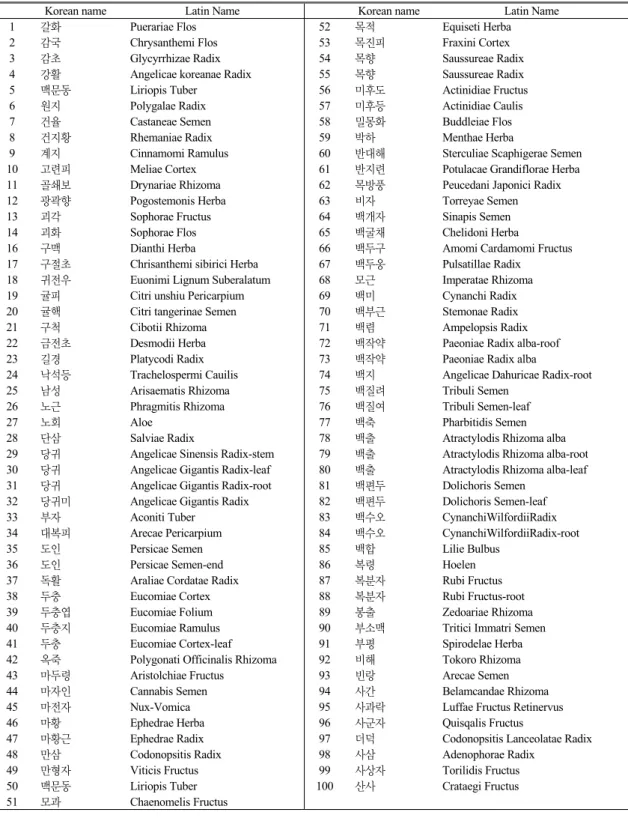
The crude extracts of 99 types of medicinal herbs (Table 1) were obtained from the Plant Extract Bank (Korean Research Institute of Bioscience and Biotechnology, Daejeon, Korea). The medicinal herbs were extracted with 95% ethanol, dried, and dissolved in dimethyl sulfoxide (DMSO; Sigma- Aldrich, St. Louis, MO).
3. Cell cytotoxicity assay
HEK-293 and SH-SY5y cells (5×10³ cells/well) were transfected with a constitutively active mutant of β-catenin (pcDNA S33Y). The cells were treated with medicinal herb extracts (50 μg/ml) or DMSO [2.5×10⁻⁴% (v/v)] as a blank control. After 24 hours, cell cytotoxicity was determined by 3-(4,5-dimethylthiazol- 2-yl)-5-(3-carboxymethoxyphenyl)-2-(4-sulfophenyl)- 2H-tetrazolium salt (MTS) assay, using the CellTiter 96®AQueous One Solution Assay (Promega, Madison, WI). The reagents were applied to the cultures, incubated for 3 hours, and the absorbance was recorded at 490 nm using a multi reader (Zenyth 1100, ANTHOS, Austria).
4. DNA preparation for transfection
JM109 bacteria cells were transformed with a luciferase reporter plasmid containing an optimal Tcf-4-binding site (TOPflash), mutant Tcf-4-binding site (FOPflash), renilla reporter gene (pGL4.74), and
Korean name Latin Name Korean name Latin Name
1 갈화 Puerariae Flos 52 목적 Equiseti Herba
2 감국 Chrysanthemi Flos 53 목진피 Fraxini Cortex
3 감초 Glycyrrhizae Radix 54 목향 Saussureae Radix
4 강활 Angelicae koreanae Radix 55 목향 Saussureae Radix
5 맥문동 Liriopis Tuber 56 미후도 Actinidiae Fructus
6 원지 Polygalae Radix 57 미후등 Actinidiae Caulis
7 건율 Castaneae Semen 58 밀몽화 Buddleiae Flos
8 건지황 Rhemaniae Radix 59 박하 Menthae Herba
9 계지 Cinnamomi Ramulus 60 반대해 Sterculiae Scaphigerae Semen
10 고련피 Meliae Cortex 61 반지련 Potulacae Grandiflorae Herba
11 골쇄보 Drynariae Rhizoma 62 목방풍 Peucedani Japonici Radix
12 광곽향 Pogostemonis Herba 63 비자 Torreyae Semen
13 괴각 Sophorae Fructus 64 백개자 Sinapis Semen
14 괴화 Sophorae Flos 65 백굴채 Chelidoni Herba
16 구맥 Dianthi Herba 66 백두구 Amomi Cardamomi Fructus
17 구절초 Chrisanthemi sibirici Herba 67 백두옹 Pulsatillae Radix
18 귀전우 Euonimi Lignum Suberalatum 68 모근 Imperatae Rhizoma
19 귤피 Citri unshiu Pericarpium 69 백미 Cynanchi Radix
20 귤핵 Citri tangerinae Semen 70 백부근 Stemonae Radix
21 구척 Cibotii Rhizoma 71 백렴 Ampelopsis Radix
22 금전초 Desmodii Herba 72 백작약 Paeoniae Radix alba-roof
23 길경 Platycodi Radix 73 백작약 Paeoniae Radix alba
24 낙석등 Trachelospermi Cauilis 74 백지 Angelicae Dahuricae Radix-root
25 남성 Arisaematis Rhizoma 75 백질려 Tribuli Semen
26 노근 Phragmitis Rhizoma 76 백질여 Tribuli Semen-leaf
27 노회 Aloe 77 백축 Pharbitidis Semen
28 단삼 Salviae Radix 78 백출 Atractylodis Rhizoma alba
29 당귀 Angelicae Sinensis Radix-stem 79 백출 Atractylodis Rhizoma alba-root 30 당귀 Angelicae Gigantis Radix-leaf 80 백출 Atractylodis Rhizoma alba-leaf
31 당귀 Angelicae Gigantis Radix-root 81 백편두 Dolichoris Semen
32 당귀미 Angelicae Gigantis Radix 82 백편두 Dolichoris Semen-leaf
33 부자 Aconiti Tuber 83 백수오 CynanchiWilfordiiRadix
34 대복피 Arecae Pericarpium 84 백수오 CynanchiWilfordiiRadix-root
35 도인 Persicae Semen 85 백합 Lilie Bulbus
36 도인 Persicae Semen-end 86 복령 Hoelen
37 독활 Araliae Cordatae Radix 87 복분자 Rubi Fructus
38 두충 Eucomiae Cortex 88 복분자 Rubi Fructus-root
39 두충엽 Eucomiae Folium 89 봉출 Zedoariae Rhizoma
40 두충지 Eucomiae Ramulus 90 부소맥 Tritici Immatri Semen
41 두충 Eucomiae Cortex-leaf 91 부평 Spirodelae Herba
42 옥죽 Polygonati Officinalis Rhizoma 92 비해 Tokoro Rhizoma
43 마두령 Aristolchiae Fructus 93 빈랑 Arecae Semen
44 마자인 Cannabis Semen 94 사간 Belamcandae Rhizoma
45 마전자 Nux-Vomica 95 사과락 Luffae Fructus Retinervus
46 마황 Ephedrae Herba 96 사군자 Quisqalis Fructus
47 마황근 Ephedrae Radix 97 더덕 Codonopsitis Lanceolatae Radix
48 만삼 Codonopsitis Radix 98 사삼 Adenophorae Radix
49 만형자 Viticis Fructus 99 사상자 Torilidis Fructus
50 맥문동 Liriopis Tuber 100 산사 Crataegi Fructus
51 모과 Chaenomelis Fructus
Table 1. List of Medicinal Herbs.
(Some extracts were isolated from different parts of the same plant and are indicated as such in Latin.)
pcDNA S33Y. DNA was prepared using a QIAGEN® Plasmid Midi Kit (Qiagen, Manchester, UK).
5. Transfection and luciferase assay
Transient transfection was performed using Lipofectamine 2000 (Invitrogen, Carlsbad, CA).
HEK-293 cells (5×10⁴) and SH-SY5y cells (5×10⁴) were transfected with 120 ng TOPflash or FOPflash as a negative control and 120 ng pGL4.74 for signal normalization. The cells were co-transfected with a constitutively active mutant of β-catenin (pcDNA S33Y). After 4 hours, media and reagents were displaced with fresh 10% FBS-containing media.
Tranfected cells were treated with the medicinal herb extracts (50 μg/ml) or DMSO (2.5×10⁻⁴%) diluted in fresh serum-free media. After 24 hours, firefly and renilla luciferase activities were determined using the Dual-Glo™ Luciferase Assay System (Promega) with a luminescence multi reader (Zenyth 1100).
6. Extraction and purification of the Ephedrae radix
Dried E. radix (500 g, China) was purchased from the Korean Pharmacopeia [KP (standard), choice goods (grade), 04. 30. 09' (date of manufacture), Dongui Hanbang, Korea] and extracted with 95%
ethanol (1.0 L) under reflux conditions for 1 hour.
The ethanol extract was concentrated under reduced pressure to yield a powder (13.6 g). The extract powder was suspended in chloroform (30 mL), subjected to a silica gel column chromatography (400 g, silica gel 60, 0.040-0.063 mm, Merck, Germany), and eluted with chloroform containing increasing amounts of methanol. Each eluate was concentrated under reduced pressure, yielding greater than 40 fractions, which were eluted with methanol (1 mL) and analyzed by thin-layer chromatography (TLC: Silica gel 60 F254, Merck) using a chloroform- methanol system at room temperature. The fractions represented the same TLC spots were combined, and
were concentrated to 18 fractions and dissolved in DMSO.
Results
1. S33Y mutant is not degraded by axin/APC/GSK-3b complex
To determine the transcriptional activation of β -catenin/TCF, we performed a luciferase assay using HEK-293 and SH-SY5y cells transiently transfected with the S33Y β-catenin mutant. The S33Y mutant product was not induced for degradation by the axin/APC/GSK-3b complex. Luciferase activity increased approximately 20-fold by S33Y gene transfection as shown in Fig. 1.
2. Plant extracts inhibit β-catenin/TCF signaling
In β-catenin-activated HEK-293 cells, luciferase activity was inhibited more than 50% by 25 different medicinal herb extracts as shown in Fig. 2. Twelve different extracts inhibited luciferase activity more than 50% in β-catenin-activated SH-SY5y cells (Fig.
3). Each value was normalized for transfection efficiency to renilla activity. Percent activity was determined and compared to the value determined with vehicle DMSO. Extracts showing both inhibitory activity toward β-catenin/TCF signaling and cytotoxicity greater than 50% are represented in Table 2.
The radix of A. koreana (number 4 in table 1), the semen of C. sativa L (number 44), the radix of E. intermedia (number 47), and the fruit of Vitis rotundifolia L. fil (number 49) showed inhibitory activity toward β-catenin/TCF signaling in both β -catenin-activated cell lines.
4. Some medicinal herb extracts show cytotoxicity
The cytotoxicity of the medicinal herb extracts (50
negative positive
HEK293 SH-SY5y HEK293 SH-SY5y
Transfected without S33Y Transfected with S33Y 20
18 16 14 12 10 8 6 4 2 0
Relative activity
Fig. 1. Cells were transfected with or without the β-catenin mutant S33Y. The numerical values are the activity ratios of firefly/renilla activity. Negative values represent cells transfected with FOPflash. Positive values represent cells transfected with TOPflash.
viable assay luciferase assay 180
160 140 120 100 80 60 40 20 0
Relative activity
DMSO 43 44 46 47 49 54 55 59 67 77 86 89 99 Number of medicinal herb
(B) HEK-293
viable assay luciferase assay 180
160 140 120 100 80 60 40 20 0
Relative activity
DMSO 4 12 17 18 25 26 27 28 29 30 31 37 Number of medicinal herb
(A) HEK-293
Fig. 2. Viability and luciferase activity in HEK-293 cells transfected with the β-catenin mutant S33Y.
μg/mL) was determined by MTS assay and results are shown in Fig. 2 and 3. Percent viability was determined and compared to the value determined
with vehicle DMSO. Some medicinal herbs showed inhibitory activity of β-catenin/TCF signaling and cytotoxicity greater than 50% in both cases (numbers
viable assay luciferase assay 180
160 140 120 100 80 60 40 20 0
Relative activity
DMSO 3 4 11 44 46 47 49 73 76 83 88 98 Number of medicinal herb
SH-SY5y
Fig. 3. Viability and luciferase activity in SH-SY5y cells transfected with the β-catenin mutant S33Y.
HEK-293 SH-SY5y
3 Glycyrrhizae Radix
4 Angelicae koreanae Radix 4 Angelicae koreanae Radix
12 Pogostemonis Herba 17 Chrisanthemi sibirici Herba 28 Salviae Radix
29 Angelicae Sinensis Radix-stem 30 Angelicae Gigantis Radix-leaf 31 Angelicae Gigantis Radix-root 37 Araliae Cordatae Radix 43 Aristolchiae Fructus
44 Cannabis Semen 44 Cannabis Semen
47 Ephedrae Radix 47 Ephedrae Radix
49 Viticis Fructus 49 Viticis Fructus
54 Saussureae Radix 59 Menthae Herba 67 Pulsatillae Radix
73 Paeoniae Radix alba 76 Tribuli Semen-leaf 77 Pharbitidis Semen
83 Cynanchi Wilfordii Radix 88 Rubi Fructus-root 89 Zedoariae Rhizoma
98 Adenophorae Radix 99 Torilidis Fructus
Table 2. Medicinal Herbs Inhibited β-catenin/TCF Signaling Greater Than 50% in HEK-293 and SH-SY5y Cells. The numbers 4, 44, 47, and 49 were inhibitory in both HEK-293 and SH-SY5y cells.
4, 12, 17, 28, 29, 30, 32, 37, 43, 44, 47, 49, 54, 59, 67, 77, 89 and 99 in β-catenin-activated HEK-293 cells; numbers 3, 4, 44, 47, 49, 73, 76 and 98 in β -catenin-activated SH-SY5y cells). It seems that the cytotoxicity seems to be compatible with inhibitory activity of β-catenin/TCF signaling in this case.
5. Extracts of Ephedrae radix inhibit β-catenin/TCF signaling
Extracts of Ephedrae radix were separated into 18 fractions by silica gel chromatography. Luciferase activity was determined using these fractions (Fig.
4). Fractions 7 and 16 at a concentration of 50 μg/ml
100 90 80 70 60 50 40 30 20 10 0
Percent inhibitory activity (%)
DMSO 1 2 3 4 5 6 7 8 9 10 11 12 13 14 15 16 total Fraction Number
100.0
61.0 71.076.0
56.1 72.3
64.3
36.8 57.5
72.1 94.689.9
78.4 76.0 63.066.7
46.3
22.2
Fig. 4. Fractions of Ephedrae radix inhibited β-catenin/TCF signaling.
inhibited β-catenin/TCF signaling by 36.8% and 46.3%, respectively.
Discussion and Conclusions
We screened various Chinese herbs and found that ethanolic extracts of the radix of A. koreana, the semen of C. sativa L, the radix of E. intermedia, and the fruit of V. rotundifolia L. fil inhibit β- catenin/TCF transcriptional activity.
Medicinal herbs can serve as anti-cancer drugs11). As the importance of β-catenin as a cause of tumorigenesis increases, many more studies on β- catenin inhibitors and their mechanisms of action are underway12). Elevated β-catenin/TCF levels via the accumulation of β-catenin in the nucleus are involved in a number of human cancers, including colon cancer, gastric cancer, and melanoma7-9). Activation of an abnormal APC/β-catenin/TCF signaling pathway and alterations in cellular adhesion mediated through changes in β-catenin homeostasis within the colonic epithelium are crucial factors in the development of the majority of colorectal cancers7).
Various studies on inhibitory agents toward β -catenin/TCF signaling in cancer cell lines have been performed. Non-steroidal anti-inflammatory drugs,
nitric oxide-generating aspirin, Gleevec, and epigallocatechin-3-gallate have been reported to inhibit β-catenin/TCF signaling13-16). Recently, it was suggested that a combination of tea plus sulindac inhibits intestinal neoplasia in mice via effects on the β-catenin/APC pathway17). We have previously reported inhibitory effects of curcumin and the curcumin analogs, quercetin and flavonoids, against β-catenin/TCF signaling.
We therefore investigated the effects of medicinal herb extracts on β-catenin/TCF signaling. The results presented here demonstrate that four types of medicinal herbs, A. koreana, C. sativa L, E. Intermedia, and V.
rotundifolia L. fil, inhibit β-catenin/TCF transcriptional activity.
Ephedrae (Ma Huang) is one of the most extensively studied Chinese herb medicines. Ephedrae has been used clinically to disperse a cold, control wheezing, promote urination, and reduce edema18). Ephedrae has been used for the treatment of asthma, allergies, and immune diseases19). Moreover, Ephedrae has shown not only cytotoxicity but also inhibition of multidrug-resistance system in HeLa cells20). However, the effect and mechanism of Ephedrae on cancer cells have rarely been investigated.
Medicinal herbs possess a variety of biological activities at non-toxic concentrations. The role of
medicinal herbs in cancer prevention has been widely discussed, as have the various mechanisms by which medicinal herbs may affect tumorigenesis, including anti-oxidation and scavenging of activated mutagens and carcinogens. However, concrete and inclusive molecular mechanisms have not been completely elucidated. Given their function in inhibiting β-catenin/TCF signaling, these medicinal extracts may be valuable as a chemotherapeutic agents against β-catenin-activated tumors.
Acknowledgements
This work was supported by a National Research Foundation of Korea Grant funded by the Korean Government (KRF-2007-331-E00322).
References
1. Tetsu O, McCormick F. Beta-catenin regulates expression of cyclin D1 in colon carcinoma cells.
Nature. 1999; 398(6726):422-6.
2. Zhang F, White RL, Neufeld KL. Cell density and phosphorylation control the subcellular localization of adenomatous polyposis coli protein. Mol Cell Biol. 2001; 21(23):8143-56.
3. Mareel M, Boterberg T, Noe V, Van Hoorde L, Vermeulen S, Bruyneel E, et al. E-cadherin/
catenin/cytoskeleton complex: a regulator of cancer invasion. J Cell Physiol. 1997; 173:
271-274.
4. Rubinfeld B, Albert I, Porfiri E, Fiol C, Munemitsu S , Polakis P. Binding of GSK3b to the APC?β-catenin complex and regulation of complex assembly. Science. 1996; 272:1023- 1026.
5. Aberle H, Bauer A, Stappert J, Kispert A, Kemler R. β-catenin is a target for the ubiquitin proteasome pathway. EMBO J. 1997; 16:3797- 3804.
6. Luu HH, Zhang R, Haydon RC, Rayburn E, Kang Q, Si W, et al. Wnt/beta-catenin signaling pathway as a novel cancer drug target. Curr.
Cancer Drug Targets. 2004; 4(8):653-71.
7. Morin PJ, Sparks AB, Korinek V, Barker N, Clevers H, Vogelstein B, et al. Activation of β- catenin-TCF signaling in colon cancer by mutations in β-catenin or APC. Science. 1997;
275:1787-1790.
8. Fujie H, Moriya K, Shintani Y, Tsutsumi T, Takayama T, Makuuchi M, et al. Frequent β- catenin aberration in human hepatocellular carcinoma. Hepatol Res. 2001; 20:39-51.
9. Woo DK, Kim HS, Lee HS, Kang YH, Yang HK, Kim WH. Altered expression and mutation of β- catenin gene in gastric carcinomas and cell lines.
Int. J Cancer. 2001; 95:108-113.
10. Clements WM, Wang J, Sarnaik A, Kim OJ, MacDonald J, Fenoglio-Preiser C, et al. β- catenin mutation is a frequent cause of Wnt pathway activation in gastric cancer. Cancer Res.
2002; 62:3503-3506.
11. Ho JW, Leung YK, Chan CP. Herbal medicine in the treatment of cancer. Curr. Med. Chem.
Anticancer Agents. 2002; 2(2):209-14.
12. Clapper ML, Coudry J, Chang WC. β- catenin-mediated signaling: a molecular target for early chemopreventive intervention. Mutat Res. 2004; 555:97-105.
13. Dihlmann S, Siermann A, Doeberitz MK. The nonsteroidal anti-inflammatory drugs aspirin and indomethacin attenuate bcatenin/TCF-4 signaling.
Oncogene. 2001; 20:645-653.
14. Nath N, Kashfi K, Chen J, Rigas B. Nitric oxide-donating aspirin inhibits β-catenin/T cell factor (TCF) signaling in SW480 colon cancer cells by disrupting the nuclear β-catenin-TCF association. Proc. Natl. Acad. Sci. U S A. 2003;
100:12584-12589.
15. Zhou L, An N, Haydon RC, Zhou Q, Cheng H, Peng Y, et al. Tyrosine kinase inhibitor STI-57/
Gleevec down-regulates the β-catenin signaling activity. Cancer Lett. 2003; 193:161-170.
16. Dashwood WM, Orner GA, Dashwood RH.
Inhibition of β-catenin/TCF activity by white tea, green tea, and epigallocatechin-3-gallate (EGCG):
minor contribution of H2O2 at physiologically relevant EGCG concentrations, Biochem. Biophys.
Res. Commun. 2002; 296:584-588.
17. Orner GA, Dashwood WM, Blum CA, Diaz GD, Li Q, Dashwood RH. Suppression of tumorigenesis in the Apcmin mouse: down-regulation of β- catenin signaling by a combination of tea plus
sulindac. Carcinogenesis. 2003; 24:263-267.
18. Dan B, Andrew G. 1992. Chinese Herbal Medicine. Materia Medica. Eastland Press:
Seattle. 1992:32-34.
19. Bielory L. Complementary and alternative interventions in asthma, allergy, and immunology.
Annals of allergy, asthma & immunology 93.
2004:S45-S54.
20. Takara K, Horibe S, Obata Y, Yoshikawa E, Ohnishi N, Yokoyama T. Effects of 19 herbal extracts on the sensitivity to paclitaxel or 5-fluorouracil in HeLa cells. Biol Pharmaco Bull.
2005: 28:138-142.