제주 연안의 가시복(Diodon holoanthus)에서 분리된 세균의 다양성 및 항균활성 효과
문채윤1, 고준철2, 김민선2, 허문수1*
1제주대학교해양과학대학수산생명의학과
2국립수산과학원제주수산연구소
Received: August 13, 2019 / Revised: November 11, 2019 / Accepted: November 11, 2019
서 론
제주도의해양생태계는지난 20년동안지구온난화로인 해대기의순환이변화되었고 Kuroshio 해류의확장으로온 대에서아열대로변화되었다[11]. 2014년제주의겨울수온 은 14℃이상을유지하고있어다양한난대성어류가회유없 이연중한지역에서출현된다고보고됐다[12]. 난대성어류
인가시복(diodon holoanthus)은전세계열대와온대지역에 널리 분포하여 산호나 암석, 모래펄 등에 서식하며 최대 50 cm까지자란다고알려져있다[10].
어류의장내미생물은수중환경에적응하고숙주가성장
하면서섭취한먹이에따라다양하게변화된다[3]. 대부분의
미생물은낮은 pH의위산, 담즙또는 lysozyme 등에의해저 해되나몇몇내성을가진이들은장내에도달하게된다. 그 러나대부분오래살아남지못하지만, 긴시간동안머무르
게되는경우숙주동물의장내미생물로구성된다[24].
장내미생물은병원균의침입을막아주고정상적인장내 점막을유지시켜숙주의건강과영양공급을촉진시켜주는 Phylogenetic Diversity and Antibacterial Activity in Bacterium from Balloon Fish (Diodon holocanthus) of Jeju Island
Chae-Yun Moon1, Jun-Cheol Ko2, Min-Seon Kim2, and Moon-Soo Heo1*
1Department of Aquatic Biomedical Sciences, Jeju National University, Jeju 63243, Republic of Korea
2Jeju Fisheries Research Institute, National Institute of Fisheries Science, Jeju 63068, Republic of Korea
Over the past 20 years, global warming has transformed the marine ecosystem of the Jeju Island into a sub- tropical zone making it conducive to the production of tropical fishes. Recently, the balloon fish (Diodon holoanthus) has been found off the coast of the Jeju Island. In this study, we analyzed the diversity of its intestinal microorganisms as a representative for the surrounding environment. In addition, the isolates were evaluated for their antibacterial activity. A total of 161 strains of various species were identified and isolated using 16S ribosomal RNA gene sequence analysis. They were separated into three groups, of which Phylum Proteobacteria was found to be the most dominant with 91% sequence similarity. This includes the class γ-proteobacteria that is made up of twelve genera and twenty-four hundred species. The second group comprised strains of the genus Vibrio, made up of 35% Photobacteria, 32% Shewanella, and 6% Psychro- bacter. It was also determined that 4% of the isolates were Acinetobacter, 3% were Enterovibrio, while Moraxella_g2 accounted for 1% of the total isolates. Class α-proteobactera includes five genera and five spe- cies; Brevundimonas, Allorhizobium, Pseudoceanicola and Erythrobcter, each accounting for 1% of the total isolates. The Firmicute strains belonged to six genera and ten species. 5% of the strains were Terribacillus, while Paenibacillus, Salinicoccus, Staphylococcus and Streptococcus accounted for 1% each of the total iso- lates. Actinobacteria accounted for the final phylum with strains belonging to three genera and ten species with Janibacter, Micrococcus and Isoptericola each accounting for 1% of the total isolates.
Keywords: Diodon holoanthus, balloon fish, phylogenetic analysis, 16S rDNA, antibacterial activity
*Corresponding author
Tel: +82-64-754-3473, Fax: +82-64-756-3493 E-mail: [email protected]
© 2020, The Korean Society for Microbiology and Biotechnology
등다양한생리학적역할을한다고알려져있다[16]. 예를들 면자체점막장벽을유지시켜병원균에의한감염또는항 생제치료에따른외부요인에도스스로회복하는능력을지 니고있다. 그러나사람에게장내세균불균형(Dysbiosis)이 일어나는경우, 비만또는당뇨와같은질병이발현되며더 나아가만성감염으로도이어질수있다. 또한이러한질병을 통해장내미생물의감소를야기시킨다고알려져있다[21].
가축동물은장내미생물군집에따라식물의중합체를소 화하거나발효시킬수있고, 면역계자극및독성화학물을 비독성화합물로전환시켜비타민을합성하는등다양한역
할을담당하고있다[2]. 이러한장내미생물의대사활동은
가축의성장증진과건강효과로이어져수많은연구가진 행되어왔다[28]. 어류의경우에도 1992년 Olsson 외저자들 은 담수 어종의 장내 세균으로 어류질병세균인 Vibrio anguillrum에대한항균을보고했는데, 이는숙주동물스 스로의보호메커니즘과밀접할것이라고시사했다[17].
본연구에서는가시복의장내미생물군집을파악하고자하 였고어류질병세균과인체유해세균에대한항균활성을확 인하였으며, 어류질병세균과인체유해세균의항균활성을확 인하여추후질병에대한치료및예방에있어필요한기초 자료를제시하고자하였다.
재료 및 방법
시료 채취
본실험에사용된가시복은 2018년 11월 14일제주도서 귀포시에서채집하여아이스박스에담아 -4℃를유지시키며 운송시킨후분리된장은실험에사용하기전까지 -80℃에 서보관하였다.
장내 미생물 분리
가시복에서식하는장내미생물을분리하기위해멸균된
가위로장을떼어멸균된 0.85% 생리식염수로한번세척하
였다. 다음세척된장을꺼내어 1g만잘라내어 0.85% 멸균 된생리식염수에옮겨단계별(10-3−10-5)로희석시켜 Brain Heart Infusion agar (BHIA, USA), Marine agar (USA), R2A agar (R2A, Difco., USA), Tryptic soy agar (TSA, Difco., USA), MRS agar (MRS, USA)에각각 100 μl씩넣 고도말하였다. 다음일주일동안 25℃에서호기및혐기성 (AnaeroGen TM, Oxioid, Ltd., UK) 배양후 CFU/g-1단위 로환산하였다. 다자라난균들은단일 colony를순수분리 하여 같은 배지 상에 48시간 동안 재 배양시켜 25%(v/v) glycerol에현탁시켜 -80℃에서보관하였다.
장내 미생물의 항균 활성 탐색
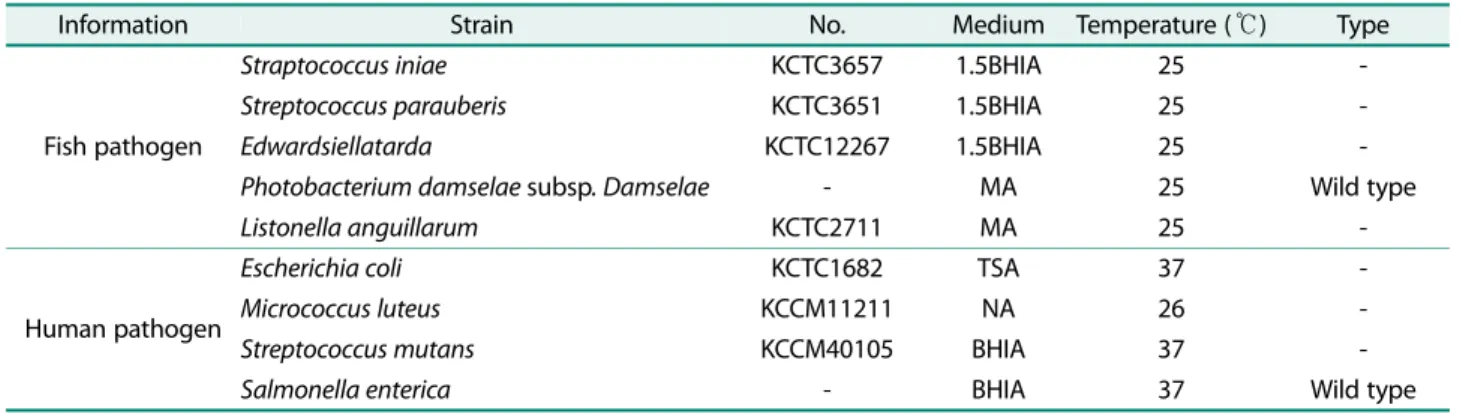
항균활성탐색을위해사용된어류질병세균과인체유해 세균은미생물자원센터(Korean Collection for Type Cultures, KCTC)와한국미생물보존센터(Korean Culture Center of Microorganisms, KCCM)에서 분양받아사용하였고(Table 1), Wild type은인체의피부및병어를통해각각분리하였 다. 그리고 25% glycerol에현탁시켜 -80℃에서보관하였다 가사용하였다. 병원성세균은적절한배지안에서배양되었 고, 가시복에서분리한균주는 BHIA, MA, R2A, TSA에접 종시켜 25℃에서 48시간동안배양하였다. 배양된균주는 1.5 ml tube 안에넣어 14240 ×g로원심 분리하여상등액 과 균체를 분리하였다. 상등액은 0.45 μm syringe filter (Whatman, UK)를통해여과시켰고균체는 0.85% 생리식염 수 50 μ를넣어풀어냈다. 다음여과된상등액과현탁된균 체는각각 멸균된 8 mm paper disc (ADVANTEC, Japan) 에 50, 100μl씩분주하고 25℃에서 24시간동안건조시켰 다. 병원균은 MacFarland turbidity 0.4로 조절한 후 Muller Hinton Agar (MHA, USA)에도말하여각각의배양 온도에맞추어 48시간동안형성된억제환의크기를측정 하였다.
Table 1. List of strains used of antibacterial experiment.
Information Strain No. Medium Temperature (℃) Type
Fish pathogen
Straptococcus iniae KCTC3657 1.5BHIA 25 -
Streptococcus parauberis KCTC3651 1.5BHIA 25 -
Edwardsiellatarda KCTC12267 1.5BHIA 25 -
Photobacterium damselae subsp. Damselae - MA 25 Wild type
Listonella anguillarum KCTC2711 MA 25 -
Human pathogen
Escherichia coli KCTC1682 TSA 37 -
Micrococcus luteus KCCM11211 NA 26 -
Streptococcus mutans KCCM40105 BHIA 37 -
Salmonella enterica - BHIA 37 Wild type
16S rRNA 염기서열 분석
분리한균주는 Genomic DNA Extraction Kit (Bioneer, Korea)로 DNA를추출하였다. 다음 genomic DNA 1μl와 27F/1492R universal primer 각각 0.5 μM primer와 DNA polymerase, dNTPs, reaction buffer가포함된 20μl PreMix (Bioneer)를사용하여 PCR을수행하였다.
PCR 반응 조건은 Intial denaturation (95℃, 2분), Denaturation (95℃, 30초), Annealing (55℃, 30초), Extension (72℃, 30초)으로총 30 cycle로수행한후마지막 으로다시한번 Extension (72℃, 5분) 하였다. 증폭된 PCR products는 Red safe (Intron, USA)가첨가된 1% agarose (PromegaCo., USA) gel에서전기영동하여확인하였다. 다 음 AccuprepTM PCR purification Kit (Bioneer)를사용하 여 PCR products에 남은 primers, nucleotides, polymerase, salts를제거 및 정제하고 elution buffer (10 mM Tris-Cl, pH 8.5) 30 μl로 elution 하였다. PCR products의염기서열 의분석은 (주)솔젠트(Korea)에의뢰하여결과를얻었다. 분 석된염기서열은 EzTaxone (http://eztaxon-e.ezbiocloud.net/)을 이용하여 homology를확인하였다. 다음 ClustalX로 multiple alignment를수행한뒤 MEGA 6.0로계통도(phylogenetic tree)를작성하였다.
결과 및 고찰
가시복 장내 미생물 분리
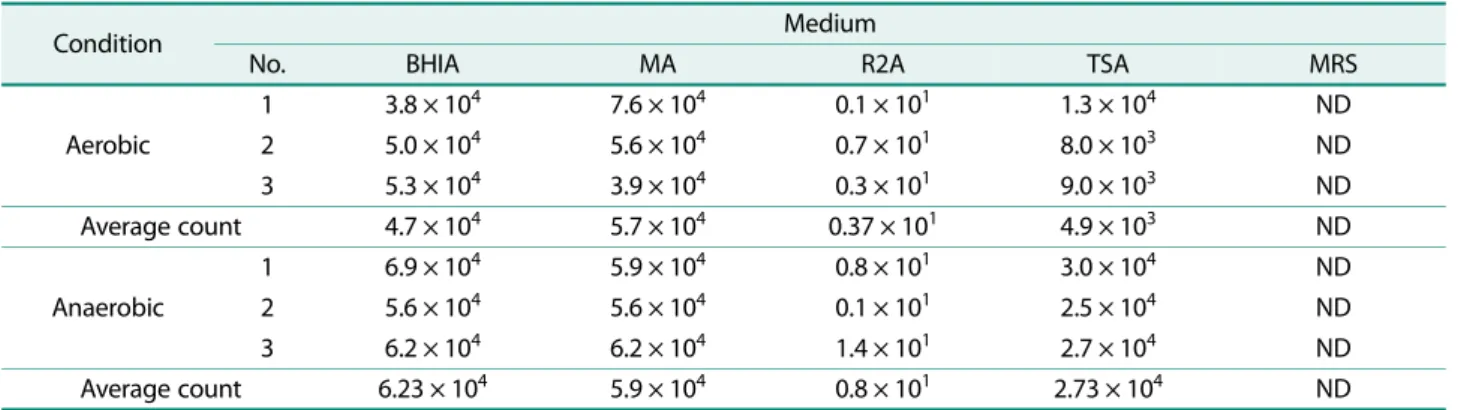
가시복장내미생물의다양성확인을위해평판배지위 에서 colony를계수한수는 Table 2와같다. 호기성배양에 서는 MA 5.7 × 10⁴ cfu/g-1, BHIA 4.7 × 10⁴ cfu/g-1, TSA 4.9 × 10³ cfu/g-1및 R2A 0.37 × 101 cfu/g-1이었고 MA 배지 에서 높게 계수됐다. 반면에 혐기성 배양에서는 BHIA 6.23 × 10⁴ cfu/g-1, MA 5.9 × 10⁴ cfu/g-1, TSA 2.73 × 10⁴ cfu/g-1, R2A 0.8 × 101 cfu/g-1순으로 BHIA에서 높게계수
되었다.
전반적으로호기성과혐기성배양모두 MA와 BHIA에서 높게계수되었고, 혐기성에비해호기성에서여러속(Genus) 이관찰되었다. 젖산균또는유산균은장내 pH를낮춰유해 세균의침입을막아주고, 항상성을유지하는데중요한역할 을한다고알려져있다. 그러나 MRS 평판배지상에서는콜 로니가관찰되지않아가시복장내안에서젖산(lactic acid) 을분비하는세균이없는것으로관찰됐다.
가시복 장내 미생물 항균 활성 탐색
가시복장내미생물의항균활성탐색결과, 일반적으로 비병원성상태로인체피부와공생하는균이지만면역이저 하된환자에게기회성병원체[18]가될수있는 M. luteus균 에서 T6, T8, B21, B22 및 B23이 항균 활성을 나타났다 (Table 3). 그중 T8은 22 mm으로가장높은항균활성을나 타내었고 B21은 20 mm, B22와 B23은 19 mm, 나머지 T6 은 18 mm으로관찰되었다. 상등액에서는오직 T8이 100µl 의농도에서반응을보였으나크게관찰되지는않았고 (NO
DATA), 그외모든질병균주로부터의항균활성은관찰되
지않았다.
장내 미생물은 Aeromonas sp., Staphylococcus sp., 및 Escherichia coli 등과같은유해세균의항균활성에관해오 래전부터보고되어왔었다[23, 24]. 특히사멸하거나살아있 는균체를이용한백신으로면역증가또는생존율이증가 됨을 증명해왔다[7, 14]. 가장 많이 알려져 있는 생균제 Probiotic은장내 pH 산도를낮춰유해균의침입을막아주 고장벽을강화시켜장내건강증진및면역을향상시켜준 다고알려져있다. 또한 ‘symbiosis’ 공생을통한기회성병원 체또는유해세균과의조화를통해이또한숙주건강을유 지하는데중요한역할을하게된다. 예를들어진딧물과공 생하는 Buchnera aphidicola의 plasmid들은숙주의아미노 산 결핍을 보완해주는 생합성 operons을 함유하고 있고,
Table 2. Intestinal microbial flora isolated from the Diodon holoanthus.
Condition Medium
No. BHIA MA R2A TSA MRS
Aerobic
1 3.8 × 10⁴ 7.6 × 10⁴ 0.1 × 101 1.3 × 10⁴ ND
2 5.0 × 10⁴ 5.6 × 10⁴ 0.7 × 101 8.0 × 10³ ND
3 5.3 × 10⁴ 3.9 × 10⁴ 0.3 × 101 9.0 × 10³ ND
Average count 4.7 × 10⁴ 5.7 × 10⁴ 0.37 × 101 4.9 × 10³ ND
Anaerobic
1 6.9 × 10⁴ 5.9 × 10⁴ 0.8 × 101 3.0 × 10⁴ ND
2 5.6 × 10⁴ 5.6 × 10⁴ 0.1 × 101 2.5 × 10⁴ ND
3 6.2 × 10⁴ 6.2 × 10⁴ 1.4 × 101 2.7 × 10⁴ ND
Average count 6.23 × 10⁴ 5.9 × 10⁴ 0.8 × 101 2.73 × 10⁴ ND
*ND: No data.
Rhizobium의 sym-plasmid는 아마도 식물성 병원체인 Agrobacterium tumefaciens에의한 공생을하는데필요한 필수유전자운반을해준다고한다. 이는식물병원체와식 물공생체간의 horizontal 유전자전이에따른것이라고한 다. 결과적으로동물또는식물들은병원체와공생체사이에 유전자정보를서로교환할수있는메커니즘일수있다고 시사했다[8].
흥미롭게도, 본연구에서는어류질병세균 B21 (Streptococcus parauberis sp.)이 인체유해세균으로 작용할 수 있는 M.
luteus균에서항균활성을나타냈다. 그리고 T8은 Vibrio 속
에해당하나종에관한연구결과는미비하고본연구결과 에서는항균능력을갖고있음이관찰됐다. 또한같은속또 는종에속하더라도균주마다의생산하는항균펩타이드는 각기다른것으로추정된다. 이는생산되는항균물질이다 양한메커니즘에따라단백질이합성되고분해되는등다양 한생리학적요인에따라항균활성능력의여부가나뉠것 이라생각된다.
16S rDNA 염기서열의 계통학적 분석
가시복장내미생물은 16S ribosomal RNA PCR로증폭하 Table 3. Antibacterial activity of isolates from an intestinal microorganism of Diodon holoanthus.
Isolated strain Similarity (%) Diameter of inhibition zone (mm) M. luteus
T6 BacilluscirculansATCC4513T 99.86 18
T8 Vibriohyugaensis090810aT 99.93 22
B21 VibrioponticusCECT5869T 99.79 20
B22 PhotobacteriumleiognathiATCC25521T 99.15 19
B23 PhotobacteriumaquimarisLC2-065T 99.69 19
Table 4. Bacterial diversity associated with Diodon holoanthus.
Phylum Class Order Family Genus
Proteobacteria Gammaproteobateria Alteromonadales Pseudoalteromonadaceae Pseudoalteromonas
Shewanellaceae Shewanella
Pesudomonadales Moraxellaceae Acinetobacter
Moraxella_g2 Psychrobacter Pseudoalteromonadaceae Pseudomonas
Vibrionales Vibrionaceae Aliivibrio
Enterovibrio Photobacterium Vibrio
Alphaproteobacteria Caulobacterales Caulobacteraceae Brevundimonas
Rhizobiales Rhizobiaceae Allorhizobium
Rhodobacterales Rhodobacteraceae Pseudooceanicola Sphingomonadales Erythrobacteraceae Erythrobacter
Methylobacteriaceae Methylobacterium
Firmicutes Bacilli Bacillales Bacillaceae Terribacillus
Bacillus Paenibacillaceae Paenibacillus Staphylococcaceae Salinicoccus
Staphylococcus Lactobacillales Streptococcaseae Streptococcus Actinobacteria Actinobacteria Micrococcales Intrasporangiaceae Janibacter
Micrococcaceae Micrococcus
Promicromonosporaceae Isoptericola
고 EZbiocloud을통해 3문(Phylum) 4강(Class) 10목(Order) 17과(Family) 24속(Genus)으로총 161 균주로분석되었다 (Table 4). 그리고가장가까운속또는종의계통수를작성 하였다(Fig. 1).
Proteobacteria문은수중속어류의장안에서발견된다고 알려져있고[15], 가시복장내에서분리한균주중 91%를차 지한우점문으로차지했다. 그중γ-proteobacteria강은 88%
로가장우세하고다음α-proteobacteria는 3%, Frimicutes 문 6%, Actinobacteria문 2% 순으로나타났다(Fig. 2).
Proteobacteria문γ-proteobacteria강은 96−100%의상동 성을보였고 11속 142종으로 Vibrio속 35%, Photobacterium속 32%, Shewanella속 6%, Psychrobacter 4%, Acinetobacter 속 3% 및나머지 Enterovibrio, Moraxella_g2속이각각 1%
를차지했다. 이는 2004년북대서양연안과의같은우세그
룹을 보였고 저자는 따뜻한 환경에 적응하는 Vibrio
parahaemolyticus를주요종으로두어추가연구를진행하 였다. 그결과겨울에서도 V. parahaemolyticus가검출됨에 따라해양의온도의상승또는온대지역에서넘어온아열
대성균주일것이라고시사했다[27]. 제주연안가시복에서
분리된주요종은 Vibrio leiognathi로이에관한연구는미 비한실정이며추가적인계절별변동에따른다양성조사가 필요할것으로사료된다. 그리고종간의그룹조사는생태계 변화흐름을파악하는데필요한기초자료로사용될수있 을거라생각된다. Phobacterium속은대부분호기성이라알 려져있으나가시복에서분리한 Photobacterum panuliri는 혐기성균주로알칼리에내성[4]을지녔다고보고됐다. 이종
은 96.43%의상동성을나타냈고주로해양이나감염된어류
에서분리[15]되는 Vibrio ponticus 또한 96.35%의상동성을 보여추가적인신종실험이필요하다생각된다.
Fig. 1. Neighbour-joining phylogenetic tree determined from the 16S rDNA sequences of bacteria from the Diodon holoanthus. GenBank accession numbers given in parentheses.
Boostrap values (>50%) based on 1,000 replications are shown.
Fig. 2. Pie-diagram showing various genus of bacterial isolated from Diodon holoanthus.
Shewanella속 Shewanella carassii는통성혐기성균주로 여러해양생물에서분리되며, 사람에게기회성병원체가될 수있다고알려져있고[5], Shewanella submarina는최근에 동정[19]을통해분리되고있고본연구에서분리된두종모 두 97.65−97.94%의상동성을보였다. 그리고어류장[26]에 서분리되는 Enterovibrio norvegicus도 97.35%로신종실험 이이루어져야할것으로사료된다.
Proteobacteria문α-proteobacteria강은 96−100%의상동 성을보였고 5속 5종으로 Brevundimonas속, Allorhizobium 속, Pseudooceanicola속, Erythrobacter속및 Methylobacterium 속이각각 1%로나타났다.
해수[9]에서 분리되는 Pseudoceanicola lipolyticus는
96.39%로추가적인신종실험이필요하다.
Firmicutes문 Bacilli강은 99−99%의상동성으로 6속 10종 으로 Bacillus속 5%로 가장 높았고 나머지 Terribacillus속, Paenibacillus속, Salinicoccus속, Staphylococcus속 및 Streptococcus속은 1%로관찰됐다.
어류 장내미생물로부터 분리 가능한 Bacillus속은 Probiotic처럼유용미생물로인식되어사료와첨가[26]를하 기도하며, 발효기술을이용한 cellulose를가수분해[20]하 는이점을갖고있다.
Actinobacteria문 Actinobacteria강은 99−100%의상동성 을 보였고 3속 3종으로 Janibacter속, Micrococcus속 및 Isoptericola속이각각 1%를차지했다. 두속은아직까지어 류에서분리된보고가없는바본자료가추후기초자료로 쓰이는데도움이될것이라생각된다.
지구의온난화는육상동·식물뿐만아니라해양생태계에 도큰변화를주고있다. 한국의해역은열대어가성장하기 에적합하지않고심지어수온이 10℃이하였음에도불구하
고열대어가발견됐다[13]. 제주도역시겨울수온이올라가
는등생태계의변화로인해다양한열대어종이늘어나고 있으며, 그중가시복은온대와열대지역의얕은물에서식 하는열대어로최근제주연안에서도찾아볼수있다.
본연구에서는주변환경의영향을가장많이받을수있 는가시복의장내미생물의다양성을확인하였다. 장내세균 의군집은추후타열대어종과비교분석하여생태계환경의 변화를관찰할수있을것이다. 또한인체세균에대한항 균활성은추가연구를통해생물적제제로이용할수있을 것이라사료된다.
요 약
지구온난화로인한제주도의해양생태계는지난 20년동 안온대에서아열대로변화되었다. 이러한기후변화는난대 성어류가서식할수있는환경이되며, 최근제주연안에서
는가시복(diodon holoanthus)이발견되고있다. 본연구에 서는가시복의장내미생물의다양성을파악하였다. 그리고 다양한균주중어류또는인체유해세균가능성을확인하 고자항균활성탐색을수행하였다.
Proteobacteria는분리된균주중 91%를차지한우점문 으로 γ-proteobacteria강은 11속 142종으로 Vibrio속 35%, Photobacterium속 32%, Shewanella속 6%, Psychrobacter 속 4%, Acinetobacter속 3% 및 나머지 Enterovibrio, Moraxella_g2속이각각 1%를차지했다. α-proteobactera강 은 5속 5종으로 Brevundimonas속, Allorhizobium속, Pseudoceanicola속, Erythrobacter속및 Methylobacterium 속이각각 1%로나타났다. Firmicutes문 Bacilli강은 6속 10 종으로 Bacillus속 5%가가장높았고나머지 Terribacillus 속, Paenibacillus속, Salinicoccus속, Staphylococcus속및 Streptococcus속은 1%로관찰됐다.
Actinobacteria문 Actinobacteria강은 3속 3종으로 Janibacter속, Micrococcus속및 Isoptericola속이각각 1%
를차지했다.
Acknowledgments
This work was supported 2020 scientific promotion program funded by Jeju National University and supported by a grant from the National Institute of Fisheries Science (R2020029) of Korea.
Conflict of Interest
The authors have no financial conflict of interest to declare.
References
1. Bairagi A, Sarkar Ghosh K, Sen SK, Ray AK. 2004. Evaluation of the nutritive value of Leucaena leucocephala leaf meal, inocu- lated with fish intestinal bacteria Bacillus subtilis and Bacillus cir- culans in formulated diets for rohu, Labeo rohita (Hamilton) fingerlings. Aquac. Res. 35: 436-446.
2. Chaucheyras-Durand F, Durand H. 2010. Probiotics in animal nutrition and health. Benef. Microbes. 1: 3-9.
3. Daly K, Kelly J, Moran AW, Bristow R, Young IS, Cossins AR, et al.
2018. Host selectively contributes to shaping intestinal microbi- ota of carnivorous and omnivorous fish. J. Gen. Appl. Microbiol.
65: 129-136.
4. Deep K, Poddar A, Das SK. 2014. Photobacterium panuliri sp. nov., an alkalitolerant marine bacterium isolated from eggs of spiny lobster, Panulirus penicillatus from Andaman sea. Curr. Microbiol.
69: 660-668.
5. Fang Y, Wang Y, Liu Z, Lu B, Dai H, Kan B, et al. 2017. Shewanella carassii sp. nov., isolated from surface swabs of crucian carp and faeces of a diarrhea patient. Int. J. Syst. Evol. Microbiol. 67: 5284-5289.
6. Gomez GD, Balcazr JL. 2008. A review on the interactions between gut microbiota and innate immunity of fish. FEMS Immunol. Med. Microbiol. 52: 145-154.
7. Eigelsbach HT, Downs CM. 1961. Prophylactic effectiveness of live and killed tularemia vaccines. J. Immunol. 87: 415-425.
8. Hentschel U, Steinert M, Hacker J. 2000. Common molecular mechanisms of symbiosis and pathogenesis. Trends Microbiol. 8:
226-230.
9. Huang MM, Guo LL, Wu YH, Lai QL, Shao ZZ, Wang CS, et al.
2018. Pseudooceanicola lipolyticus sp. nov., a marine alphapro- teobacterium, reclassification of Oceanicola flagellates as Pseu- dooceanicola flagellates comb. nov. and emended description of the genus Pseudooceanicola. Int. J. Syst. Evol. Microbiol. 68: 409- 415.
10. Huang YR, Shiau CY, Chen HH, Huang BC. 2011. Isolation and characterization of acid and pepsin-solubilized collagens from the skin of ballon fish (Diodon holocanthus). Food. Hydrocoll. 25:
1507-1513.
11. Kim HS, Kim HS, Jung MM, Lee JB. 2013. New record of dinofla- gellates around Jeju Island. J. Ecol. Environ. 36: 273-291.
12. Kim MJ, Han HS, Kim JS, Kim BY, Song CB. 2014. Species compo- sition and bimonthly changes of fish community in the coastal waters of sagyeoi, Jeju Island. Han. Gug. Eoryu. Hag. Hoeji. 26:
212-221.
13. Kim SW, Chung M, Park HS. 2015. Tropical fish species thriving in temperate korean waters. Mar. Biodivers. 45: 147-148.
14. Krahenbuhl JL, Humphres RC, Henika PC. 1982. Effects of Propi- onibacterium acnes treatment on the course of Mycobacterium leprae infection in mice. Infect. Immun. 37: 183-188.
15. Macian MC, Garay E, Grimont PAD, Pujalte MJ. 2004. Vibrio ponti- cus sp. nov., a neighbor of V. fluvialis-V. furnissii clade, isolated from Gilthead sea bream, mussels and seawater. Syst. Appl.
Microbiol. 27: 535-540.
16. Nayak SK. 2010. Role of gastrointestinal microbiota in fish.
Aquac. Res. 41: 1553-1573.
17. Olsson JC, Westerdahl A, Conway PL, Kjelleberg S. 1992. Intestinal colonization potential of turbot (Scophthalmus maximus) and Dab (Limanda limanda)-associated bacteria with inhibitory effects against Vibrio anguillarum. Appl. Environ. Microbiol. 58:
551-556.
18. Peces R, Gago E, Tejada F, Laures AS, Alvarez-Grande J. 1997.
Relapsing bacteraemia due to Micrococcus luteus in a haemodi- alysis patient with a perm-cath catheter. Nephrol. Dial. Trans- plant. 12: 2428-2429.
19. Sudh Rani P, Saini MK, Pinnaka AK, Kumar GS, Kumar S, Vemuluri VR, et al. 2019. Shewanella submarina sp. nov., a gammaproteo- bacterium isolated from marine water. Int. J. Syst. Evol. Microbiol.
69: 39-45.
20. Ray AK, Bairagi A, Sarkar-Ghosh K. 2007. Optimization of fer- mentation conditions for cellulose production by Bacillus subtilis CY5 and Bacillus circulans TP3 isolated from fish gut. Acta. Ichthyol.
Piscat. 37: 47-53.
21. Sommer F, Anderson JM, Bharti R, Raes J, Rosenstiel P. 2017. The resilience of the intestinal microbiota influences health and dis- ease. Nat. Rev. Microbiol. 15: 630-638.
22. Stephens WZ, Burns AR, Stagaman K, Wong S, Rawls JF, Guillemin K, et al. 2016. The composition of the zebrafish intestinal microbial community varies across development. ISME J. 10: 644-654.
23. Sugita H, Shibuya K, Hanada H, Deguchi Y. 1997. Antibacterial abilities of intestinal microflora of the river fish. Fish. Sci. 63: 378- 383.
24. Sugita H, Shibuya K, Shimooka H, Deguchi Y. 1996. Antibacterial abilities of intestinal bacteria in freshwater cultured fish. Aquaculture 145: 195-203.
25. Tarnecki AM, Burgos FA, Ray CL, Arias CR. 2017. Fish intestinal microbiome: diversity and symbiosis unraveled by metagenomics.
J. Appl. Microbiol. 123: 2-17.
26. Thompson FL, Hoste B, Thompson CC, Goris J, Gomez-Gil B, Huys L, et al. 2002. Enterovibrio norvegicus gen. nov., sp. nov., iso- lated from the gut of turbot (Scophthalmus maximus) larvae: a new member of the family Vibrionaceae. Int. J. Syst. Evol. Microbiol.
52: 2015-2022.
27. Thompson JR, Randa MA, Marcelino LA, Tomita-Mitchell A, Lim E, Polz MF. 2004. Diversity and dynamics of a north atlantic coastal Vibrio community. Appl. Environ. Microbiol. 70: 4103- 4110.
28. Williams BA, Verstegen MWA, Tamminaga S. 2001. Fermentation in the large intestine of single-stomached animals and its rela- tionship to animal health. Nutr. Res. Rev. 14: 207-227.
29. Yang G, Bao B, Peatman E, Li H, Huang L, Ren D. 2007. Analysis of the composition of the bacterial community in puffer fish Takifugu obscurus. Aquaculture 262: 183-191.