• 검색 결과가 없습니다.

Do Blebs or Bullae on High-Resolution Computed Tomography Predict Ipsilateral Recurrence in Young Patients at the First Episode of Primary Spontaneous Pneumothorax?

N/A
N/A
Protected

Academic year: 2021

Share "Do Blebs or Bullae on High-Resolution Computed Tomography Predict Ipsilateral Recurrence in Young Patients at the First Episode of Primary Spontaneous Pneumothorax?"

Copied!
9
0
0

로드 중.... (전체 텍스트 보기)

전체 글

(1)

ISSN: 2233-601X (Print) ISSN: 2093-6516 (Online)

Received: September 17, 2018, Revised: October 17, 2018, Accepted: October 22, 2018, Published online: April 5, 2019

Corresponding author: Hyo Jun Jang, Department of Thoracic and Cardiovascular Surgery, Hanyang University Seoul Hospital, Hanyang University College of Medicine, 222-1 Wangsimni-ro, Seongdong-gu, Seoul 04763, Korea

(Tel) 82-2-2290-8463 (Fax) 82-2-2290-8466 (E-mail) [email protected]

© The Korean Society for Thoracic and Cardiovascular Surgery. 2019. All right reserved.

This is an open access article distributed under the terms of the Creative Commons Attribution Non-Commercial License (http://creativecommons.org/

licenses/by-nc/4.0) which permits unrestricted non-commercial use, distribution, and reproduction in any medium, provided the original work is properly cited.

Do Blebs or Bullae on High-Resolution Computed

Tomography Predict Ipsilateral Recurrence in Young Patients at the First Episode of Primary Spontaneous Pneumothorax?

Sungjoon Park, M.D. 1 , Hyo Jun Jang, M.D. 2 , Ju Hoon Song, R.N. 2 , So Young Bae, M.D. 2 , Hyuck Kim, M.D., Ph.D. 2,3 , Seung Hyuk Nam, M.D. 4 , Jun Ho Lee, M.D., Ph.D. 2

1

Department of Thoracic and Cardiovascular Surgery, Inje University Sanggye Paik Hospital, Inje University College of Medicine, Seoul, Korea;

2

Department of Thoracic and Cardiovascular Surgery, Hanyang University Seoul Hospital, Seoul,

Korea;

3

Department of Thoracic and Cardiovascular Surgery, Hanyang University College of Medicine, Seoul, Korea;

4

Department of Thoracic and Cardiovascular Surgery, Hanyang University Guri Hospital, Guri, Korea

Background: The relationship between the size of bullae and pneumothorax recurrence is controversial. The aim of this study was to retrospectively evaluate the role of blebs or bullae in predicting ipsilateral re- currence in young patients experiencing their first episode of primary spontaneous pneumothorax (PSP) who underwent conservative treatment. Methods: A total of 299 cases of first-episode PSP were analyzed. The sta- tus of blebs or bullae was reviewed on high-resolution computed tomography (HRCT). The dystrophic severity score (DSS; range, 0 to 6 points) was calculated based on HRCT. Results: The 5-year recurrence rate was 38.2%. In univariate analysis, age (<20 years), body mass index (<20 kg/m

2

), a unilateral lesion, and inter- mediate risk (DSS 4 and 5) were associated with recurrence. Sex; smoking history; and the presence, number, and maximal size of blebs or bullae were not related to recurrence. In Cox regression, age and intermediate risk were independent risk factors for recurrence. High risk (DDS 6) was not an independent risk factor.

Conclusion: The presence, number, and size of blebs or bullae did not affect ipsilateral recurrence. DSS failed to show a positive correlation between severity and recurrence. The decision to perform surgery in patients experiencing their first episode of PSP should not be determined by the severity of blebs and bullae.

Key words: 1. Pneumothorax 2. Recurrence

3. Computed tomography 4. Bullae

Introduction

Primary spontaneous pneumothorax (PSP) com- monly occurs in young patients [1]. Its recurrence rate ranges from 22.8% to 42% in patients who re- ceive conservative treatment after the first episode [2]. The recurrence rate of patients treated with vid-

eo-assisted thoracoscopic surgery (VATS) was re- ported to range from 0% to 13% [2]. The British Thoracic Society (BTS) and American College of Chest Physicians (ACCP) guidelines recommend con- servative treatment including observation, aspiration, and chest tube drainage as the first-line treatment of first-episode PSP [3,4]. Still, there is no glob-

https://doi.org/10.5090/kjtcs.2019.52.2.91

(2)

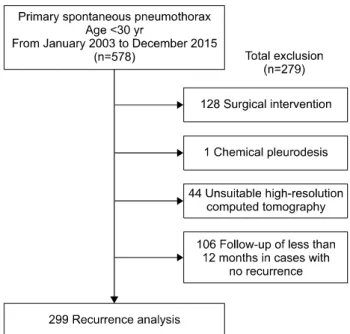
Fig. 1. Flow diagram of study design.

ally-accepted risk stratification system for PSP to de- termine high-risk patients who would benefit from VATS rather than conservative treatment at initial presentation [5]. Recently, a randomized controlled trial (RCT) showed a positive correlation between the risk of recurrence and the size of bullae based on high-resolution computed tomography (HRCT) [6].

However, the data remain insufficient. Moreover, an- other study showed no correlation between the pres- ence of bullae and recurrence [7]. The aim of this study was to evaluate the role of blebs or bullae de- tected using HRCT in predicting ipsilateral recurrence in young patients experiencing their first episode of PSP who underwent conservative treatment.

Methods

1) Patients

This study enrolled 524 patients younger than 30 years who visited the hospital for their first episode of PSP at a single institution from January 2003 to December 2015. PSP was defined as pneumothorax without underlying lung disease described in the medical record at the initial diagnosis. To exclude uncertain diagnoses of PSP in medical records, pa- tients were limited to those younger than 30 years.

This study was reviewed and approved by the Institutional Review Board and informed consent was waived (IRB approval no., 2019-02-018-001).

Fifty-four patients with simultaneous or sequential bilateral pneumothorax were counted as 2 cases for both thoraces. A total of 578 cases were extracted from outpatient and inpatient clinics, including the emergency department. Age, sex, body mass index (BMI), distribution of pneumothorax, smoking history, final management for first-episode PSP, and HRCT findings were collected from the patients’ medical records. Of the 578 cases, 128 underwent VATS, and 1 underwent chemical pleurodesis. After excluding the cases of VATS and chemical pleurodesis, cases with unsuitable HRCT findings (n=44) and those with less than 12 months of follow-up without recurrence (n=106) were also excluded. Finally, 299 cases were enrolled to evaluate ipsilateral recurrence (Fig. 1).

2) High-resolution computed tomography ex- aminations

HRCT without contrast media was generally con-

ducted within 1–5 days after hospitalization. In our practice, if a patient had sequential bilateral pneumo- thorax and was evaluated using HRCT for pneumo- thorax on 1 side, HRCT was not conducted for the contralateral pneumothorax within 1 year. In this study design, HRCT used to assess pneumothorax on 1 side was assumed to be suitable to evaluate the status of blebs or bullae for a contralateral pneumo- thorax if it occurred within 1 month. If HRCT was assessed more than 1 month before the event, it was regarded as unsuitable for evaluation of the con- tralateral status. Such cases were excluded from the study.

HRCT scans were performed using a 64-channel multi-slice CT scanner (Philips Brilliance 64; Philips Medical Systems, Amsterdam, The Netherlands) with the following parameters: 120 kV, 250 mA (planned mA with D-Dom dose modulation), sharp filter, 5-mm slice thickness, 5-mm slice increment, and a pitch of 0674 units. Coronal reconstruction was applied with 2-mm slice thickness and 2-mm slice increments.

The presence, maximal size, and distribution of

blebs or bullae were reviewed. Blebs were defined as

gas-containing spaces smaller than 1 cm within the

visceral pleura, and bullae were defined as gas-con-

taining spaces 1 cm or more in diameter within the

visceral pleura [8]. Some authors have defined blebs

as being smaller than 2 cm [9-11], and a recent RCT

(3)

showed that bullae larger than 2 cm were a risk fac- tor for recurrence [6]. Therefore, bullae were divided into smaller (<2 cm) and larger bullae (≥2 cm).

The dystrophic severity score (DSS) was proposed by Ouanes-Besbes et al. [7] and modified by Casali et al.

[12]. The modified formula is the sum of scores for type (1 or 2 points for blebs or bullae), number (1 or 2 points for single or multiple), and distribution (1 or 2 points for unilateral or bilateral). If blebs or bullae were seen on HRCT, the DSS ranged from 3 to 6 points. If there were no blebs or bullae in HRCT, the DSS was recorded as 0 points. Cases were div- ided into 3 risk groups according to DSS: low risk (0 or 3 points), intermediate risk (4 or 5 points), and high risk (6 points). Two thoracic surgeons (SB and HJ) reviewed the HRCT scans. SB reviewed all HRCT scans, and HJ reviewed only the cases without blebs or bullae that were confirmed by SB.

3) Management

The indications for chest tube drainage were dysp- nea, a distance of more than 1 cm between the later- al lung margin and chest wall, and gradually increas- ing size of the pneumothorax. Observation, including bed rest or outpatient clinic follow-up, was indicated in patients with no symptoms and a small pneumo- thorax, with less than 1 cm between the lateral lung margin and chest wall.

VATS was performed in 128 cases for persistent air leaks (>5 days, 53 cases), a history of con- tralateral pneumothorax (23 cases), complete lung collapse or tension pneumothorax (18 cases), simul- taneous bilateral pneumothorax (8 cases), army serv- ice or studying abroad (8 cases), hemothorax (2 cas- es), and unknown reasons (16 cases). In a single case, chemical pleurodesis was performed in a pa- tient who refused VATS for persistent air leaks.

4) Follow-up

Telephone interviews were performed in July 2018 by an investigator (JS). The incidence of recurrence was assessed through a telephone interview in 228 cases (39.5%), while the remaining 350 cases (60.5%) were reviewed (by JS) using medical records. The last outpatient clinic record of the thoracic department or the last inpatient admission record from other departments was accepted for review. The last outpatient clinic record from other

departments was regarded as an incomplete record for evaluating the patient’s history of pneumothorax.

Cases with less than 12 months of follow-up and no recurrence were regarded as having been lost to fol- low-up and were excluded from the recurrence anal- ysis, because most cases of recurrence develop dur- ing the first year [13]. The follow-up period was de- fined as extending from the date of diagnosis of the first PSP episode to the date of the last medical re- cord or telephone interview. The recurrence-free pe- riod was defined as extending from the date of diag- nosis of the first PSP episode to the date of ipsi- lateral recurrence in cases with ipsilateral recurrence and from the date of diagnosis of first PSP episode to the last follow-up date in cases without recurrence. The cumulative recurrence rate (cRR) was calculated as the rate of experiencing at least 1 recurrence.

5) Statistical analysis

All descriptive data were expressed as the fre- quency and mean with standard deviation. Frequency was compared using the chi-square and Fisher exact tests for dichotomous variables, and continuous vari- ables were compared using the t-test and analysis of variance. The primary endpoint was ipsilateral cRR calculated by time to event using Kaplan-Meier analysis. The ipsilateral cRR according to each varia- ble was calculated, and cRR curves were compared using the log-rank test. All p-values <0.05 were con- sidered to indicate statistical significance. Cox re- gression was performed to identify variables in- dependently associated with recurrence. All variables with p-values <0.05 were included in the analysis.

Statistical analysis was performed using IBM SPSS ver. 24.0 (IBM Corp., Armonk, NY, USA).

Results

1) Characteristics of the patients

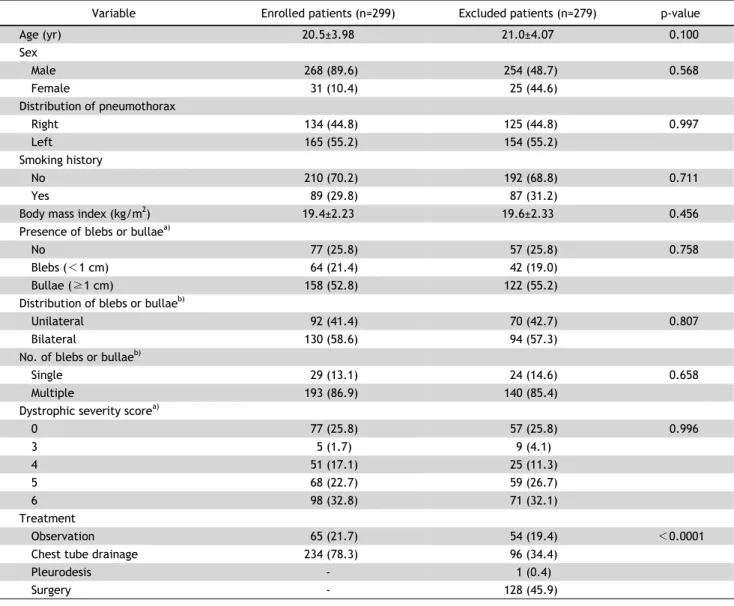
The characteristics of the enrolled and excluded

groups were compared for each variable. Except for

treatment modality, there was no difference between

the groups (Table 1). A total of 299 cases were en-

rolled for the recurrence analysis. The mean age of

the enrolled group was 20.5±3.98 years. Males were

predominant (89.6%). The mean BMI was 19.4±2.23

kg/m

2

. In 77 cases (25.8%), there were no visible

(4)

Table 1. Demographics and high-resolution computed tomography findings in enrolled and excluded patients

Variable Enrolled patients (n=299) Excluded patients (n=279) p-value

Age (yr) 20.5±3.98 21.0±4.07 0.100

Sex

Male 268 (89.6) 254 (48.7) 0.568

Female 31 (10.4) 25 (44.6)

Distribution of pneumothorax

Right 134 (44.8) 125 (44.8) 0.997

Left 165 (55.2) 154 (55.2)

Smoking history

No 210 (70.2) 192 (68.8) 0.711

Yes 89 (29.8) 87 (31.2)

Body mass index (kg/m

2

) 19.4±2.23 19.6±2.33 0.456

Presence of blebs or bullae

a)

No 77 (25.8) 57 (25.8) 0.758

Blebs (<1 cm) 64 (21.4) 42 (19.0)

Bullae (≥1 cm) 158 (52.8) 122 (55.2)

Distribution of blebs or bullae

b)

Unilateral 92 (41.4) 70 (42.7) 0.807

Bilateral 130 (58.6) 94 (57.3)

No. of blebs or bullae

b)

Single 29 (13.1) 24 (14.6) 0.658

Multiple 193 (86.9) 140 (85.4)

Dystrophic severity score

a)

0 77 (25.8) 57 (25.8) 0.996

3 5 (1.7) 9 (4.1)

4 51 (17.1) 25 (11.3)

5 68 (22.7) 59 (26.7)

6 98 (32.8) 71 (32.1)

Treatment

Observation 65 (21.7) 54 (19.4) <0.0001

Chest tube drainage 234 (78.3) 96 (34.4)

Pleurodesis - 1 (0.4)

Surgery - 128 (45.9)

Values are presented as mean±standard deviation or number (%).

a)
The data were limited to cases with suitable high-resolution computed tomography findings (221 cases were excluded).

b)

The data were limited to cases with the presence of bleb or bullae (enrolled group: n=222; excluded group: n=164).

blebs. Blebs were seen in 64 cases (21.4%) and bul- lae were seen in 158 cases (52.8%). More details are presented in Table 1.

2) Follow-up and recurrence

The median follow-up period was 76.3 months (range, 1.7–188.3 months). In 6 cases, the follow-up period was less than 12 months. However, these 6 cases experienced recurrence within a short-term fol- low-up period and were enrolled in the recurrence analysis. Another 293 cases had follow-up period lon- ger than 12 months. During the follow-up period,

116 cases (38.8%) showed ipsilateral recurrence. A total of 86 cases (74.1%) recurred in the first year.

The 1-year, 3-year, and 5-year cRRs of the enrolled

group were 22.8%, 34.0%, and 38.2%, respectively

(Fig. 2). There was no difference in the 5-year cRR

between cases managed by observation and those

managed by chest tube drainage (35.3% versus

39.3%, p=0.458).

(5)

Fig. 2. Overall cumulative recurrence graph.

Table 3. Univariate analysis of the ipsilateral cumulative re- currence rate according to high-resolution computed tomog- raphy findings

Variable 5-Year cumulative

recurrence rate (%) p-value

Presence of blebs or bullae 0.429

No 32.3

Blebs (<1 cm) 40.9

Bullae (≥1 cm) 40.0

Size of bullae 0.273

Smaller (≥1 cm, <2 cm) 43.9

Larger (≥2 cm) 29.4

Distribution of blebs or bullae 0.031

None 32.3

Unilateral 48.6

Bilateral 34.4

No. of blebs or bullae 0.296

None 32.3

Single 46.0

Multiple 39.5

Dystrophic severity score 0.021

Low risk (0, 3) 32.8

Intermediate risk (4, 5) 46.8

High risk (6) 32.3

Table 2. Univariate analysis of the ipsilateral cumulative re- currence rate according to demographics

Variable 5-Year cumulative

recurrence rate (%) p-value

Age (yr) 0.001

<20 47.8

≥20 26.3

Sex 0.473

Male 39.2

Female 30.2

Distribution of pneumothorax 0.786

Right 38.7

Left 37.8

Smoking history 0.884

No 37.6

Yes 39.6

Body mass index (kg/m

2

) 0.026

<20 42.9

≥20 30.1

Table 4. Cox regression analysis of theipsilateral cumulative re- currence rate

Variable Hazard ratio (95%

confidence interval) p-value Age (yr)

<20 1

≥20 0.53 (0.36–0.79) 0.002

Body mass index (kg/m

2

)

<20 1

≥20 0.70 (0.46–1.06) 0.095

Dystrophic severity score

Low risk (0, 3) 1

Intermediate risk (4, 5) 1.63 (1.03–2.58) 0.036

High risk (6) 1.02 (0.61–1.70) 0.935

3) Univariate and multivariate analyses of demographic and high-resolution computed tomography findings

Patients younger than 20 years of age showed a significantly higher 5-year cRR than those older than 20 years (Table 2). The 5-year cRR of patients with a BMI less than 20 kg/m

2

was significantly higher than those with a BMI over 20 kg/m

2

(Table 2). Sex, distribution of pneumothorax, and smoking history showed no statistically significant associations with the cRR (Table 2). The 5-year cRR did not differ to a statistically significant extent among those with no lesions and those with blebs and bullae (Table 3).

When the bullae (≥1 cm) were divided into those with a maximal size less than 2 cm and those that were larger than 2 cm, there were 117 cases with bullae measuring 1–2 cm and 41 cases with bullae measuring ≥2 cm. Interestingly, the 5-year cRR of the group with larger bullae was lower than that of the group with smaller bullae (29.4% versus 43.9%).

However, the difference did not reach statistical sig-

nificance (p=0.273). The 5-year cRR of cases involv-

(6)

Table 5. Subgroup analysis according to high-resolution computed tomography findings Group Bleb (b) or

bullae (B)

Single (S) or multiple (M)

Unilateral (U) or bilateral (B)

Dystrophic severity

score Cases 5-Year cumulative

recurrence rate (%)

0 No No No 0 77 32.3

1 b S U 3 5 -

2 b S B 4 6 -

3 b M U 4 30 37.4

4 b M B 5 23 39.1

5 B S U 4 15 -

6 B S B 5 3 -

7 B M U 5 42 57.8

8 B M B 6 98 32.3

Group 3 versus 4: p=0.767; group 7 versus 8: p=0.002.

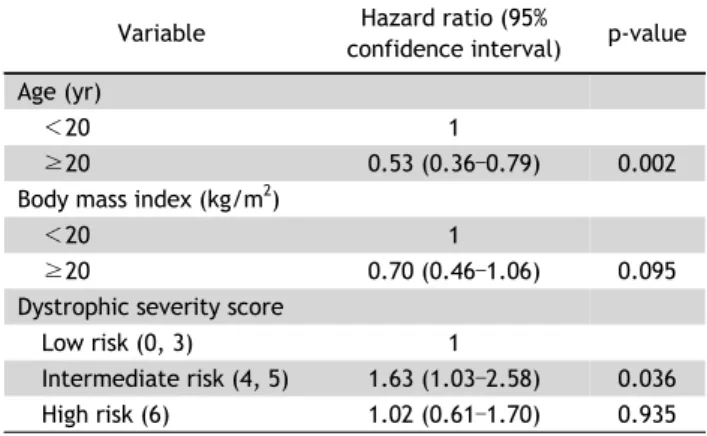
ing unilateral lesions was significantly higher than that of cases with no lesions or bilateral lesions (Table 3). Single lesions (blebs or bullae) had the highest 5-year cRR, but without statistical sig- nificance (Table 3). An intermediate-risk DSS was as- sociated with a significantly higher 5-year cRR than a low- or high-risk DSS (Table 3). In Cox regression analysis, younger age (<20 years) and an inter- mediate-risk DSS were independent risk factors for ipsilateral recurrence (Table 4). However, a high-risk DSS did not affect the development of ipsilateral recurrence.

4) Subgroup analysis

In the HRCT findings, the presence, maximal size, and number of blebs or bullae were not risk factors for ipsilateral recurrence in the enrolled group.

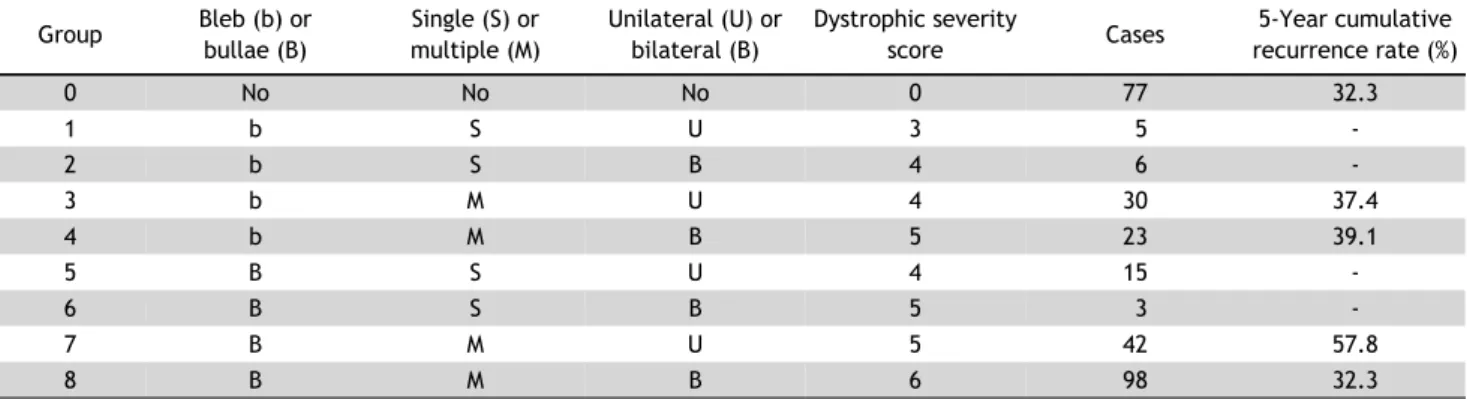
However, unilateral lesions were more strongly asso- ciated with the cRR than were bilateral lesions (Table 3). This may explain why an intermediate-risk DSS risk was an independent risk factor, while a high-risk DSS was not. Subgrouping was performed according to the number and distribution of blebs or bullae to investigate possible confounding factors (Table 5). The single-lesion group (1, 2, 5, and 6) was too small to analyze. Of the groups with blebs, group 3 (blebs, multiple and unilateral lesions) and group 4 (blebs, multiple and bilateral lesions) showed similar 5-year cRRs (37.4% versus 39.1%, p=0.767).

However, in groups with bullae, group 7 (bullae, multiple and unilateral lesions) showed a significantly higher 5-year cRR than group 8 (bullae, multiple and bilateral lesions; 57.8% versus 32.3%, p=0.002).

A subgroup analysis of groups 7 and 8 was

performed. Female sex (23.8% versus 7.1%, p=0.006) and lower BMI (18.8±2.06 kg/m

2

versus 19.7±2.12 kg/m

2

, p=0.018) were significantly predominant in group 7. Mean age, distribution of pneumothorax, smoking history, the maximal size of bullae, and larg- er bullae (≥2 cm) did not show a significantly dif- ferent distribution in groups 7 and 8 (data not re- ported). In the univariate analysis of groups 7 and 8, age less than 20 years (5-year cRR: 50% versus 28.4%, p=0.024) and unilateral lesions (57.8% versus 32.3%, p=0.001) were associated with recurrence.

Sex, BMI, distribution of pneumothorax, smoking his- tory, and larger bullae (≥2 cm) were not associated with recurrence. In the Cox regression analysis, age less than 20 years (hazard ratio [HR], 1.89; 95%

confidence interval [CI], 1.09–3.27; p=0.023) and uni- lateral lesions (HR, 2.35; 95% CI, 1.39–3.98; p=0.002) were independent risk factors of recurrence. The presence of unilateral lesions was not influenced by female sex or lower BMI in the Cox regression analysis.

Discussion

This retrospective study was designed to evaluate the relationship between HRCT findings and ipsi- lateral recurrence after the first episode of PSP in patients receiving conservative treatment. The main positive finding of this study was that unilateral blebs or bullae had a higher recurrence rate than bi- lateral blebs or bullae, resulting in the inter- mediate-risk group (DSS 4 and 5) having a higher re- currence rate than the high-risk group (DSS 6). This finding has no practical utility in clinical settings.

Bilateral disease is usually regarded as more severe

(7)

than unilateral disease in general medicine. In a fur- ther investigation through a subgroup analysis, lesion distribution did not affect recurrence in patients with blebs (groups 3 and 4). However, in patients with bullae (groups 7 and 8), unilateral lesions were an independent risk factor for recurrence. This finding could not be explained by statistical trends. Other than distribution, all other parameters of HRCT find- ings, including the presence, size, and number of blebs or bullae, did not affect ipsilateral recurrence.

Therefore, the relationship between recurrence and lesion distribution might have been pure coincidence, or it could be counterevidence against a dose-re- sponse relationship between the distribution of le- sions and recurrence in cases of PSP.

By Laplace’s law, surface tension is directly pro- portional to radius. According to this law, the largest bullae are theoretically the most prone to rupture.

When VATS was performed in patients with pneumo- thorax, ruptured blebs or bullae could be found.

However, it was not always the largest bleb or bulla that was ruptured. Sometimes, small blebs with thin walls in the superior segment of the lower lobe showed air leaks, instead of large bullae with thick walls in the apex of the upper lobe. Although such cases were not specifically investigated in our study, we suggest that this size-rupture mismatch could be responsible for our negative result regarding the re- lationship between maximal lesion size and recurrence.

Our findings are in disagreement with 3 recently published studies on HRCT findings and PSP re- currence [6,12,14]. The study populations of those 3 studies included patients with their first episode of PSP managed by conservative treatment, as in our study. In an RCT, patients with first-episode PSP were stratified by the presence of bullae (≥1 cm) and then randomized to VATS and chest tube management. In the 99 patients managed by chest tube drainage, those with bullae (≥2 cm) were at a higher risk for recurrence than those with no lesion on HRCT (HR, 4.4; 95% CI, 1.04–18.83; p=0.03) [6].

Interestingly, that RCT incorporated an analysis of ip- silateral DSS data, not full DSS data. Therefore, the maximal DSS was 5, not 6. Bilateral lesions may not have been a risk factor in their analysis, or asympto- matic contralateral lesions were not considered to have been responsible for ipsilateral recurrence.

Unlike the size of the bullae, ipsilateral DSS was not

found to be a risk factor for recurrence in that RCT.

Although the sample size (n=23) was too small to draw a general conclusion, another small prospective study showed that high-grade patients (DSS 4, 5, and 6) had a 90% recurrence rate and that high-grade DSS was an independent risk factor (HR, 3.20; 95%

CI, 1.11–9.22; p=0.03) compared to the low-grade group (DSS 0 and 3) [14]. Another retrospective study analyzed 176 patients, and the presence of blebs or bullae was significantly related to the devel- opment of ipsilateral recurrence [12]. The recurrence rate of patients with a DSS of 0 was remarkably low- er than ours (6% versus 32.3%). This difference re- sulted in the presence of blebs or bullae being a risk factor. However, patients with a DSS of 3, 4, 5, or 6 showed no correlation with ipsilateral recurrence.

Therefore, that retrospective study did not confirm the utility of risk stratification based on DSS.

On the contrary, other studies did not find any correlation between HRCT findings and recurrence [7,9,15]. Ouanes-Besbes et al. [7] originally proposed the DSS. The DSS was not statistically significantly associated with the risk of recurrence based on an analysis of 80 patients with first-episode PSP [7]. In other prospective studies (n=35), the number, size, and distribution of bullae showed no correlation with recurrence [9]. Similarly, another prospective study (n=55) demonstrated that the presence, size, or num- ber of bullae had no influence on the recurrence rate [15]. However, these studies showing negative out- comes had sample sizes that were too small to draw conclusions.

In a recent meta-analysis, patients who received VATS showed a significantly lower recurrence rate than those who received conservative treatment [16].

Some groups have recommended VATS as the first

treatment choice in patients with first-episode PSP

regardless of risk stratification [2,17]. This recom-

mendation is based only on the recurrence rate ac-

cording to modality. However, overtreatment would

occur if such recommendations were followed. The

most recent German S3 guideline recommends VATS

in selected cases of first-episode PSP [18], similar to

the BTS and ACCP guidelines. In our study, sex, BMI,

smoking history, and HRCT findings were not useful

in the risk stratification of ipsilateral recurrence; only

younger age was useful for this purpose. However,

younger age has also been identified as a risk factor

(8)

for recurrence after VATS [19], meaning that it is dif- ficult to determine which age groups could benefit from VATS after the first episode of PSP.

The strengths of our study were as follows. First, the initial management strategy and surgical in- dications for first-episode PSP were consistent during the study period. Our policy was to observe the rec- ommendations of guidelines. Second, chemical pleu- rodesis was performed in only 1 case. Therefore, the outcomes of conservative treatment were uniform.

Third, HRCT was performed in 90% (520 of 578) of cases at the time of the first episode. Fourth, the ex- cluded patients did not show statistically significant differences from the enrolled patients. The likelihood of selection bias was assessed as relatively low based on that comparison. Fifth, there were more cases than in previous studies, and the follow-up period was longer. This increases the reliability of our neg- ative findings.

The primary limitation of this study is its retro- spective design. Selection bias could not be com- pletely eliminated by nature. In addition, 40% of cas- es were confirmed to have experienced recurrence by telephone interview, which could involve recall bias. Some patients might have been confused re- garding ipsilateral versus contralateral recurrence.

However, the investigator asked about recurrence in each thorax separately to reduce recall bias.

Furthermore, only 12.7% (29 of 228) of interviewed cases reported having experienced recurrence. The timing of the HRCT examination might have influ- enced the size of the bullae. Optimal HRCT examina- tions occur when the lung is fully expanded. In our practice, HRCT was performed 1 to 5 days after pneumothorax, and generally showed minimal or moderate pneumothorax. This might have falsely de- creased the size of the blebs or bullae. However, the proportion of cases with no lesion (25.8%; 77 of 299 cases) in our study was not higher than in another study (44%; 30 of 68 cases) designed to examine full lung expansion at 1 to 6 weeks after the event [10]

or in the previous report (37%; 66 of 176 cases) with the largest number of patients [12]. Another possible weakness regarding HRCT in our study was that only thoracic surgeons performed the evaluations.

However, the authors suggest that an evaluation of the size, number, and distribution of blebs or bullae does not require extensive radiologic training.

In conclusion, the ipsilateral recurrence rate was high in young patients with first-episode PSP who underwent conservative treatment. HRCT findings, in- cluding the presence, number, size, and bilaterality of blebs and bullae, were not predictors of ipsilateral recurrence in this study. In other words, the severity of blebs or bullae on HRCT was not useful for strat- ifying patients with a high risk of recurrence. Surgery based on HRCT findings in young patients (<30 years) with first-episode PSP could not be justified.

To confirm the exact role of blebs or bullae on HRCT, a further well-designed, large-scale, prospec- tive cohort study will be needed. Until then, the management of patients with first-episode PSP should follow international guidelines.

Conflict of interest

No potential conflict of interest relevant to this ar- ticle was reported.

Acknowledgments

This study was supported by a Grant of the Samsung Vein Clinic Network (Daejeon, Anyang, Cheongju, Cheonan; Fund no. KTCS04-119).

ORCID

Sungjoon Park: https://orcid.org/0000-0002-0491-4585 Hyo Jun Jang: https://orcid.org/0000-0001-8414-6274 Ju Hoon Song: https://orcid.org/0000-0001-8813-8976 So Young Bae: https://orcid.org/0000-0003-3438-4973 Hyuck Kim: https://orcid.org/0000-0001-6866-0142 Seung Hyuk Nam: https://orcid.org/0000-0002-1557-6753 Jun Ho Lee: https://orcid.org/0000-0001-8237-2542

References

1. Bobbio A, Dechartres A, Bouam S, et al. Epidemiology of spontaneous pneumothorax: gender-related differences.

Thorax 2015;70:653-8.

2. Chambers A, Scarci M. In patients with first-episode pri- mary spontaneous pneumothorax is video-assisted thor- acoscopic surgery superior to tube thoracostomy alone in terms of time to resolution of pneumothorax and in- cidence of recurrence? Interact Cardiovasc Thorac Surg 2009;9:1003-8.

3. MacDuff A, Arnold A, Harvey J; BTS Pleural Disease

(9)

Guideline Group. Management of spontaneous pneumo- thorax: British Thoracic Society pleural disease guideline 2010. Thorax 2010;65 Suppl 2:ii18-31.

4. Baumann MH, Strange C, Heffner JE, et al. Management of spontaneous pneumothorax: an American College of Chest Physicians Delphi consensus statement. Chest 2001;119:

590-602.

5. Bintcliffe OJ, Hallifax RJ, Edey A, et al. Spontaneous pneu- mothorax: time to rethink management? Lancet Respir Med 2015;3:578-88.

6. Olesen WH, Katballe N, Sindby JE, et al. Surgical treat- ment versus conventional chest tube drainage in primary spontaneous pneumothorax: a randomized controlled trial. Eur J Cardiothorac Surg 2018;54:113-21.

7. Ouanes-Besbes L, Golli M, Knani J, et al. Prediction of re- current spontaneous pneumothorax: CT scan findings ver- sus management features. Respir Med 2007;101:230-6.

8. Hansell DM, Bankier AA, MacMahon H, McLoud TC, Muller NL, Remy J. Fleischner Society: glossary of terms for thoracic imaging. Radiology 2008;246:697-722.

9. Mitlehner W, Friedrich M, Dissmann W. Value of computer tomography in the detection of bullae and blebs in pa- tients with primary spontaneous pneumothorax. Respiration 1992;59:221-7.

10. Smit HJ, Wienk MA, Schreurs AJ, Schramel FM, Postmus PE.

Do bullae indicate a predisposition to recurrent pneumo- thorax? Br J Radiol 2000;73:356-9.

11. Noh D, Keum DY, Park CK. Outcomes of contralateral bul- lae in primary spontaneous pneumothorax. Korean J Thorac Cardiovasc Surg 2015;48:393-7.

12. Casali C, Stefani A, Ligabue G, et al. Role of blebs and bul- lae detected by high-resolution computed tomography and recurrent spontaneous pneumothorax. Ann Thorac Surg 2013;95:249-55.

13. Soler LM, Raymond SL, Larson SD, Taylor JA, Islam S. Initial primary spontaneous pneumothorax in children and ado- lescents: operate or wait? J Pediatr Surg 2018;53:1960-3.

14. Primavesi F, Jager T, Meissnitzer T, et al. First episode of spontaneous pneumothorax: CT-based scoring to select patients for early surgery. World J Surg 2016;40:1112-20.

15. Martinez-Ramos D, Angel-Yepes V, Escrig-Sos J, Miralles- Tena JM, Salvador-Sanchis JL. Usefulness of computed to- mography in determining risk of recurrence after a first episode of primary spontaneous pneumothorax: ther- apeutic implications. Arch Bronconeumol 2007;43:304-8.

16. Vuong NL, Elshafay A, Thao LP, et al. Efficacy of treat- ments in primary spontaneous pneumothorax: a system- atic review and network meta-analysis of randomized clinical trials. Respir Med 2018;137:152-66.

17. Herrmann D, Klapdor B, Ewig S, Hecker E. Initial manage- ment of primary spontaneous pneumothorax with vid- eo-assisted thoracoscopic surgery: a 10-year experience.

Eur J Cardiothorac Surg 2016;49:854-9.

18. Schnell J, Beer M, Eggeling S, et al. Management of spon- taneous pneumothorax and post-interventional pneumo- thorax: German S3 guideline. Respiration 2018:1-33.

https://doi.org/10.1159/000490179.

19. Noh D, Lee S, Haam SJ, Paik HC, Lee DY. Recurrence of pri-

mary spontaneous pneumothorax in young adults and

children. Interact Cardiovasc Thorac Surg 2015;21:195-9.

수치

Fig. 1. Flow diagram of study design.
Table 1. Demographics and high-resolution computed tomography findings in enrolled and excluded patients
Table 4. Cox regression analysis of theipsilateral cumulative re- re-currence rate
Table 5. Subgroup analysis according to high-resolution computed tomography findings Group Bleb (b) or  bullae (B) Single (S) or multiple (M) Unilateral (U) or bilateral (B) Dystrophic severity

참조

관련 문서