• 검색 결과가 없습니다.

Early Manifestation of Supravalvular Aortic and Pulmonary Artery Stenosis in a Patient with Williams Syndrome

N/A
N/A
Protected

Academic year: 2021

Share "Early Manifestation of Supravalvular Aortic and Pulmonary Artery Stenosis in a Patient with Williams Syndrome"

Copied!
4
0
0

로드 중.... (전체 텍스트 보기)

전체 글

(1)

ISSN: 2233-601X (Print) ISSN: 2093-6516 (Online)

− 115 −

Department of Thoracic and Cardiovascular Surgery, Kyungpook National University Hospital, Kyungpook National University School of Medicine Received: February 4, 2015, Revised: September 17, 2015, Accepted: September 18, 2015, Published online: February 5, 2016

Corresponding author: Woo Sung Jang, Department of Thoracic and Cardiovascular Surgery, Kyungpook National University Hospital, Kyungpook National University School of Medicine, 130 Dongdeok-ro, Jung-gu, Daegu 41944, Korea

(Tel) 82-53-200-5832 (Fax) 82-53-426-4765 (E-mail) [email protected]

C

The Korean Society for Thoracic and Cardiovascular Surgery. 2016. All right reserved.

CC
This is an open access article distributed under the terms of the Creative Commons Attribution Non-Commercial License (http://creative- commons.org/licenses/by-nc/4.0) which permits unrestricted non-commercial use, distribution, and reproduction in any medium, provided the original work is properly cited.

Early Manifestation of Supravalvular Aortic and Pulmonary Artery Stenosis in a Patient with Williams Syndrome

Jong Uk Lee, M.D., Woo Sung Jang, M.D., Ph.D., Young Ok Lee, M.D., Ph.D., Joon Yong Cho, M.D.

Williams syndrome (WS) is a developmental disorder characterized by vascular abnormalities such as thickening of the vascular media layer in medium- and large-sized arteries. Supravalvular aortic stenosis (SVAS) and peripheral pulmonary artery stenosis (PPAS) are common vascular abnormalities in WS. The natural course of SVAS and PPAS is variable, and the timing of surgery or intervention is determined according to the progression of vascular stenosis. In our patient, SVAS and PPAS showed rapid concurrent progression within two weeks after birth. We report the early manifestation of SVAS and PPAS in the neonatal period and describe the surgical treatment for stenosis relief.

Key words: 1. Congenital heart disease 2. Stenosis

3. Aorta

4. Pulmonary artery 5. Williams syndrome

CASE REPORT

A male neonate born at 39 weeks gestational age and weighing 2,660 g was admitted for feeding difficulties along with abdominal distension and jaundice. Physical examination revealed a mid-systolic heart murmur at the left sternal border and a 20 mmHg lower blood pressure in the lower ex- tremities than that observed in the upper extremities. Initial echocardiographic and computed tomographic (CT) findings showed a type A interrupted aortic arch arch (IAA) with a bicuspid aortic valve, a posterior malaligned ventricular septal defect (VSD), and an atrial septal defect (ASD). The annulus of the ascending aorta measured 4.5 mm (z-value=-3.7), and there was no stenosis of the pulmonary artery. The first sur-

gery was performed nine days after birth when the patient weighed 2,700 g. IAA reconstruction by end-to-side anasto- mosis as well as VSD and ASD closure were performed.

Unusual diffuse aortic wall thickening was observed during the surgery.

Systolic blood pressure was measured at 80–90 mmHg without difference between upper and lower limbs after first surgery. Extubation was performed on postoperative day 6 and respiration was stable without tachypnea. On post- operative echocardiography follow-up at one week, diffuse hypoplasia of the aorta with turbulent flow from the sino- tubular junction to the IAA anastomosis site as well as pe- ripheral pulmonary artery stenosis (PPAS) were observed. The diameter of the ascending aorta was 1.6 mm and that of the

Korean J Thorac Cardiovasc Surg 2016;49:115-118 Case Report

http://dx.doi.org/10.5090/kjtcs.2016.49.1.115

(2)

Jong Uk Lee, et al

− 116 −

Fig. 1. Echocardiography images one week after the first surgery. (A) Turbulent flow from the ascending aorta to the descending thoracic aorta; the velocity of flow at the aorta ranged from 3.7 m/sec to 4.4 m/sec. (B) Stenosis of the MPA, and flow velocity of 3.5 m/sec at the MPA. (C) Left ventricular hypertrophy and hyperechogenic feature at the left ventricular endocardium. MPA, main pulmonary artery.

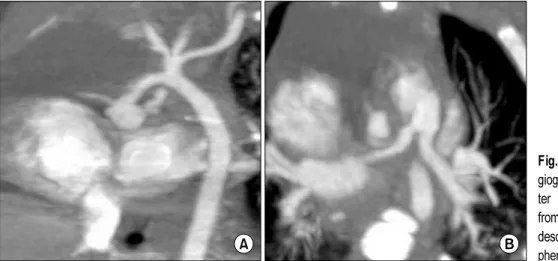
Fig. 2. Computed tomographic an- giography images at two months af- ter birth. (A) Hypoplasia of the aorta from the sinotubular junction to the descending thoracic aorta. (B) Peri- pheral pulmonary artery stenosis.

descending thoracic aorta was 2.8 mm at the anastomosis site. The ratio of the sinotubular junction diameter to aortic annulus diameter was 0.36. The flow velocity at the ascend- ing aorta and IAA anastomosis site was 3.7 m/sec and 4.4 m/sec, respectively. The left and right peripheral pulmonary arterial diameters were 2.1 mm (z-value=-4.68) and 2.2 mm (z-value=-3.92), respectively. The flow velocity at the main pulmonary artery (MPA) was 3.5 m/sec. Left ventricular hy- pertrophy (LVH) with a hyperechogenic feature regarded as endocardial fibroelastosis was also observed (Fig. 1). The in- terventricular septal diameter of the left ventricle was 6.1 mm (z-value=2.5), and the left ventricular posterior wall diameter was 6.5 mm (z-value=4.4). On CT angiography before the

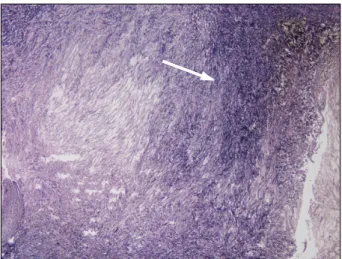
second surgery, supravalvular aortic stenosis (SVAS) and PPAS were clearly observed (Fig. 2). Taking into account the patient’s elfin face and rapid progression of aortic and pulmo- nary artery wall thickening, a chromosomal study was per- formed, and the finding of a micro-deletion on chromosome 7q11.23 led to a diagnosis of Williams syndrome (WS). On histopathologic examination, hyperplastic elastic lamina of media was observed at the stenotic aorta using elastic van Gieson’s stain (Fig. 3). LVH, diffuse aortic hypoplasia and PPAS were aggravated on follow-up echocardiography.

The second surgery was performed at 77 days after birth

when the patient weighed 4,370 g. The Brom’s two-sinus

patch enlargement technique using bovine pericardium was

(3)

Stenosis of Supravalvular Aortic and Pulmonary Arteries

− 117 −

Fig. 4. (A) The two vertical incisions in the aortic sinuses. (B) Accommo- dation of the bovine pericardial pat- ches in each sinus of Valsalva.

Fig. 3. Hyperplastic elastic lamina of media (arrow) was revealed in pathologic findings (elastic van Gieson’s stain, ×40).

performed for SVAS relief (Fig. 4). Two-thirds of the ante- rior ascending aortic wall was reconstructed using a bovine pericardial patch. The MPA and left peripheral pulmonary ar- tery were widened with a 6-mm-long polytetrafluoroethylene vascular graft patch (Goretex; WL Gore & Associates Inc., Flagstaff, AZ, USA) angioplasty.

On postoperative echocardiography at two weeks after the second surgery, the flow velocity at the ascending and at the IAA anastomosis site was 2 m/sec and 3 m/sec, respectively.

Furthermore, LVH deterioration was not observed. The flow velocity at the MPA was 1.1 m/sec, and the diameter of the left and right peripheral pulmonary artery was 3.2 mm and 3.2 mm, respectively. At the five-month follow-up after dis- charge, the patient was found to be free of symptoms. At fol- low-up echocardiography a further five months later, the flow velocity of the ascending aorta, IAA anastomosis site, and MPA was 1.3 m/sec, 2.1 m/sec, and 2.1 m/sec, respectively.

The left ventricular posterior wall diameter was 7.5 mm (z-value=1.08), and the interventricular septal diameter of the left ventricle was 7.2 mm (z-value=1.44). However, a hyper- echogenic feature on the left ventricular endocardium was still observed, although hypertrophy of the left ventricular posterior wall and the interventricular septum was improved.

DISCUSSION

SVAS is a common feature of WS, found in approximately 70% of all patients with WS. The natural course of SVAS is variable. It may remain stable or progress during the first five years of life. Additionally, obstructions of the pulmonary vas- culature have been described in up to 83% of patients with WS, familial elastin arteriopathy, or sporadic non-Williams SVAS. Patients usually show PPAS, and can have localized or diffuse stenosis in the central pulmonary arteries. However, PPAS often resolves spontaneously [1,2]. The mid-term out- come varies with regard to the relief of SVAS or PPAS. In studies on SVAS, the rate of freedom from reoperation or re-intervention ranges from 83% to 98% at five years and from 66% to 83% at 20 years. In studies on pulmonary arte- rial stenosis, the rate of freedom from reoperation or re-inter- vention ranges from 32% to 67% at five years [3-7].

In our patient, unusual aortic wall thickening was observed

as one of the initial operative findings. Moreover, diffuse as-

cending aorta and pulmonary arterial stenosis with severe bi-

ventricular hypertrophy progressed one week after the initial

surgery. In several reports, the mean age for vascular disease

treatment in WS patients ranged from 3.3 years to 10.4 years

and from 3.8 months to 14 months for SVAS and PPAS, re-

spectively [3-7]. However, Albacker et al. [8] reported a case

(4)

Jong Uk Lee, et al

− 118 − of neonatal presentation and repair of SVAS in a patient with WS. Thus, among WS patients, those with aortic hypoplasia, LVH, and PPAS should raise more concern and should un- dergo short-term follow-up with echocardiography, although rapid progression of concurrent supravalvular aortic and pul- monary arterial stenosis in the early period is rare.

Here, we report the early manifestation of supravalvular aorta and pulmonary artery stenosis in the neonatal period and appropriate surgical treatment for stenosis relief.

CONFLICT OF INTEREST

No potential conflict of interest relevant to this article was reported.

REFERENCES

1. Stamm C, Friehs I, Ho SY, Moran AM, Jonas RA, del Nido PJ. Congenital supravalvar aortic stenosis: a simple lesion?

Eur J Cardiothorac Surg 2001;19:195-202.

2. Kim YM, Yoo SJ, Choi JY, Kim SH, Bae EJ, Lee YT.

Natural course of supravalvar aortic stenosis and peripheral

pulmonary arterial stenosis in Williams’ syndrome. Cardiol Young 1999;9:37-41.

3. Stamm C, Kreutzer C, Zurakowski D, Nollert G, Friehs I, Mayer JE, et al. Forty-one years of surgical experience with congenital supravalvular aortic stenosis. J Thorac Cardiovasc Surg 1999;118:874-85.

4. Kramer P, Absi D, Hetzer R, Photiadis J, Berger F, Alexi-Meskishvili V. Outcome of surgical correction of con- genital supravalvular aortic stenosis with two- and three-si- nus reconstruction techniques. Ann Thorac Surg 2014;97:

634-40.

5. Geggel RL, Gauvreau K, Lock JE. Balloon dilation angio- plasty of peripheral pulmonary stenosis associated with Williams syndrome. Circulation 2001;103:2165-70.

6. Monge MC, Mainwaring RD, Sheikh AY, Punn R, Reddy VM, Hanley FL. Surgical reconstruction of peripheral pul- monary artery stenosis in Williams and Alagille syndromes.

J Thorac Cardiovasc Surg 2013;145:476-81.

7. Deo SV, Burkhart HM, Schaff HV, et al. Late outcomes for surgical repair of supravalvar aortic stenosis. Ann Thorac Surg 2012;94:854-9.

8. Albacker TB, Payne DM, Dancea A, Tchervenkov C.

Management of supravalvar aortic stenosis and severely de-

pressed left ventricular function in a neonate with Williams

syndrome. Eur J Cardiothorac Surg 2009;35:915-6.

수치

Fig. 2. Computed tomographic an- an-giography images at two months  af-ter birth. (A) Hypoplasia of the aorta  from the sinotubular junction to the  descending thoracic aorta
Fig. 4. (A) The two vertical incisions in the aortic sinuses. (B)  Accommo-dation of the bovine pericardial  pat-ches in each sinus of Valsalva.

참조

관련 문서