Body image dissatisfaction and self-esteem in adolescence
Body image is commonly conceptualized as an “internal representation of one’s own outer appearance—one’s own unique perception of one’s body.” (Thompson et al., 1999, p.
4). Body image is a multidimensional construct involving diverse cognitive, emotional, and behavioral responses; therefore, body image has been defined depending on what body image dimension is focused on. Among the definitions, body image dissatisfaction focusing on one’s negative perception of and emotional responses to one’s body is the most widely used term in the field (Thompson et al., 1999).
Adolescents’ body image dissatisfaction has been of interest among scholars due to the importance of body image as distinct developmental features during adolescence. In a physical aspect, adolescence is a period of rapid bodily changes due to secondary sex characteristics (Coleman & Coleman, 2002). The drastic bodily changes that adolescents
Body Image Dissatisfaction and Self-esteem among Korean Pre- and Early Adolescent Girls and Boys: A Five-year Longitudinal Panel Study
Woochul Park
11
Department of Human Development and Family Studies, Duksung Women’s University, Professor
후기 아동기 및 초기 청소년의 신체상불만족과 자존감: 종단적 패널 연구 박우철
11
덕성여자대학교 아동가족학과 교수
Received: December 14, 2019 Revised: January 28, 2020 Accepted: February 17, 2020
Corresponding Author:
Woochul Park
Department of Human Development and Family Studies, Duksung Women’s University/(01369) 33, Samyang-ro 144- gil, Dobong-gu, Seoul, Republic of Korea.
Tel: +82-2-901-8369
E-mail: [email protected]
Abstract
Longitudinal studies have shown mixed findings on the association between body image dissatisfaction and self- esteem among adolescents. This study examined the longitudinal, reciprocal influences between body image dissatisfaction and self-esteem among Korean pre- and early adolescents by using nationally representative longitudinal panel data from the Korean Youth Panel Study (KYPS). Analyses based on 2,230 participants indicated that girls’ body image dissatisfaction was significantly higher than boys’. The trajectory of body image dissatisfaction increased sharply during pre- and early adolescence, but stabilized afterwards for both boys and girls. Self-esteem deteriorated rapidly initially, but began to recover as adolescent girls and boys matured. Structural equation modeling showed that reciprocal influences between body image dissatisfaction and self-esteem were detected for boys. Body image dissatisfaction among girls predicted self-esteem during the entire period, while the opposite direction from self-esteem to body image dissatisfaction emerged two years later. The present study found that, during pre- and early adolescence, body image dissatisfaction and self-esteem develop in a circular fashion by forming a vicious cycle. Implications for the development of intervention and prevention programs are discussed in consideration of age and gender.
Keywords
body image dissatisfaction, self-esteem, pre- and early adolescence, gender
Family and
Environment
Research
go through amplify interests in and concerns about their body (Gatti et al., 2014). Compared to other stages of development, adolescence is also the stage when one becomes conscious of other people (Somerville et al., 2013).
It is important for adolescents to understand how they are viewed by others. Adolescents create an imaginary audience that evaluates their outward self represented by their appearance (Elkind, 1967).
Body image dissatisfaction has been investigated in its relation to adolescents’ self-esteem, since self-esteem is a an important component in adolescent life. Self- esteem becomes important during adolescence due to cognitive developmental changes. Cognitive abilities such as integration emerging since middle childhood allow adolescents to construct a global self-concept (Harter, 1999). For instance, based on the ability of integration, adolescents combine separated specific behavior or events in their lives, such as, ‘getting high scores in math’ and ‘being popular among peers’, into a higher-order and abstract concept about self, such as ‘I am a very good person.’
Numerous studies have investigated the nature of the relationship between body image dissatisfaction and self- esteem due to their important features in adolescents’
lives. From a theoretical perspective, both causal pathways from body image dissatisfaction to self-esteem and from self-esteem to body image dissatisfaction are theoretically meaningful. First, the direction from body image dissatisfaction to self-esteem inquires whether the perceived appearance determines global self-worth. The direction is based on empirically-supported William James’
(1890) self-discrepancy model (Harter, 1999) that argues an individual’s success in specific domains where he or she has aspirations to succeed produces high self-esteem because it facilitates congruence between an ideal and real self in such domains. Conversely, lack of success in domains of desire lowers self-esteem because it generates discrepancy between the ideal and real self. It becomes possible after middle childhood to differentially value certain areas more highly than others and compare two representations of real and ideal self. They also begin to place greater importance
on their body as they move into adolescence (Harter, 1999).
Consequently, it can be hypothesized that the effect of body image dissatisfaction on self-esteem would be robust in adolescence. Furthermore, the perception of body would be more influential than other domains in the construction of self-esteem in adolescence because, unlike other domains of self which are bound to specific contexts (academic achievement and athletic competence), body is omnipresent by nature wherever the self is present.
Conversely, the opposite direction from self-esteem and body image dissatisfaction examines if someone holds negative attitudes and feelings toward themselves, then they also will be dissatisfied with their body. From a clinical perspective, this path derives from the etiology of eating disorders (an indicator of a severe body image disturbance) where low self-esteem is a necessary condition for the development of eating disorders (Polivy & Herman, 2002;
Silverstone, 1992). For developmental psychologists focusing on self-processes, this pathway relates to if an individual’
s global evaluation of the self influences their evaluation of domain-specific attributes. Global feelings towards the self may easily permeate how one views their looks since the body is ubiquitous wherever the self is. Harter (1999) argued the direction from global self-worth to body image dissatisfaction is plausible and reported approximately 40%
of adolescents believed that this direction describes the nature of the relationship between the two variables better than the opposite path, while 60% supported the opposite one. Interestingly, girls who supported the direction from self-esteem to body image showed higher self-esteem and lower body image dissatisfaction than their counterparts (Harter, 1999).
Whether the causality of the relationship is
unidirectional or bidirectional has an important implication
in understanding developmental trajectories of body
image dissatisfaction and self-esteem in pre- and early
adolescence. If the causality is reciprocal and circular rather
than linear in the long term, it means that the relationship
of body image dissatisfaction and low self-esteem gradually
develops via a vicious cycle. Individuals who experience
increased body image dissatisfaction will suffer deteriorated self-esteem, which will again intensify their body image dissatisfaction that forms an escalated vicious cycle between them. This might accelerate outbreaks of severe clinical problems such as eating disorders and depression that are indicators of excessive body image dissatisfaction and worsened self-esteem.
Body image dissatisfaction and self-esteem: Empirical studies and limitations
A robust relationship between self-esteem and body image dissatisfaction among adolescents is well- documented in the literature of cross-sectional studies.
Studies reporting bivariate correlations between body image and self-esteem in the U.S. have shown moderate to high associations ( r=.38 to .80) (Harter, 1999; Shaw et al., 2004; Shroff & Thompson, 2006). Similar correlations have been found in samples from other countries (Dorak, 2011;
Harter, 1999), in various ethnic groups (e.g., Latino youth;
Mirza et al., 2011), and in diverse age groups ranging from young children to adults (Harter, 1999). The correlations between body image dissatisfaction and self-esteem are also significantly higher than those found between other characteristics and self-esteem such as scholastic competence, social acceptance, behavioral conduct, and athletic competence (Harter, 1999).
Cross-sectional studies conducted in many countries (including Korea) that used regression analyses and theoretically based directional hypotheses (with body image dissatisfaction considered an independent variable that is hypothesized to influence self-esteem) also have indicated an association between body image dissatisfaction and self- esteem (Delfabbro et al., 2011; Frost & McKelvie, 2004; Han
& Kim, 2006; Mendelson et al., 1996; Park & Choi, 2008;
Polce-Lynch et al., 2001). The opposite causal pathway, from self-esteem toward body image dissatisfaction, has also been supported in cross-sectional studies (Ata et al., 2007; Brunet et al., 2010; Kostanski & Gullone, 1998;
Makinen et al., 2012; Mendelson et al., 1996).
Cross-sectional studies offer information on the
association between variables at a certain point in time;
however, cross-sectional studies cannot provide information on the temporal order required to identify the direction of causality between variables. Therefore, several prospective studies have been conducted in order to clarify the temporal pathway between body image dissatisfaction and self- esteem. However, findings have been mixed in the literature unlike the consistent findings in cross-sectional studies.
Studies conducted in Australia and Europe on the path from body image dissatisfaction to self-esteem have supported such a direction (Birkeland et al., 2012; Johnson
& Wardle, 2005; Tiggemann, 2005). However, a study performed in Canada (Mendelson et al., 1996) indicated that the level of esteem regarding one’s body predicted self- esteem two years later among adolescents aged 11 to 13, but not among younger ones (aged 8 to 10). A study conducted in Korea (Park & Epstein, 2013) also reported that body image predicted the self-esteem of the subsequent year only for adolescent girls, but not for boys.
For the opposite direction from self-esteem to body image dissatisfaction, Paxton et al. (2006) reported that self-esteem predicted body dissatisfaction five years later for girls, but not for boys. Park & Epstein (2013) found that self-esteem for 14-year old Korean adolescents predicted body image dissatisfaction one year later for both genders.
However, studies by Mendelson et al. (1996) in Canada and Tiggemann (2005) in Australia found that the self-esteem of adolescents failed to predict subsequent body image dissatisfaction. Thus, further longitudinal investigations are warranted because it is premature to assume bidirectional and reciprocal influences between body image dissatisfaction and self-esteem among adolescents due to the existence of contradictory findings (Mendelson et al., 1996; Tiggemann, 2005).
Prior research has also had other limitations that need to be addressed with additional studies. Adolescence usually denotes “the period of human development that starts with puberty (10-12 years of age) and ends with physiological maturity (approximately 19 years of age)”
(American Psychological Association (APA), 2007, p. 21);
however, most cross-sectional and prospective studies on adolescent body image dissatisfaction and self-esteem have focused on mid- or late-adolescence (approximately ages 14 to 18). Consequently, there is a lack of knowledge on the relationship between body image dissatisfaction and self-esteem during the transition period from pre- to early adolescence. The present study utilizes panel data encompassing preadolescence (4
thgrade of elementary school) and early adolescence (5
thgrade of elementary school to 2
ndgrade of middle school) to address this issue.
A second limitation of prior longitudinal studies is their use of only two time points for assessment. Thus, they have not addressed how the temporal association between body image dissatisfaction and self-esteem may change over time. Some cross-sectional analyses that included subsamples of different age groups found that the degree of association between body image dissatisfaction and self- esteem differed by age group (Mendelson et al., 1996;
Polce-Lynch et al., 2001). For example, in Mendelson et al.’s study, the variance in self-esteem that body-esteem accounted for was larger for mid-adolescents ( M=14.2 years) than for early-adolescents ( M=10.4 years), which suggests that the importance of body-esteem in relation to self-esteem may be greater in middle adolescence than early adolescence. However, such comparisons by age have never been conducted in longitudinal panel studies with multiple waves with a single cohort. Also, in order to investigate the long term reciprocal, circular relationship between body image dissatisfaction and self-esteem, longitudinal panel studies with a series of waves are called for.
Furthermore, except for one study (Park & Epstein, 2013) that used a nationally representative sample, all previous studies have used convenience samples (Mendelson et al., 1996; Tiggemann, 2005) or locally representative samples collected in western Norway and in the North West of England (Birkeland et al., 2012; Johnson & Wardle, 2005). Therefore, there is a limited degree to which findings from the previous studies may be generalized. Nationally representative data are needed to strengthen the external validity of research findings on this topic.
Lastly, most longitudinal studies did not separate gender in analysis (e.g., Birkeland et al., 2012) or sampled only female adolescents (Johnson & Wardle, 2005; Tiggemann, 2005). This is problematic, given the gender differences a previous study detected (Park & Epstein, 2013). Specifically, the causal direction from body image to self-esteem was significant only for girls, not for boys, which may be due to the sociocultural influence of peers, media, and family members that distribute the message that body/appearance is more important for women than for men (Haworth- Hoeppner, 2000; Heinberg & Thompson, 1995). Such gender differences are also found with regard to the opposite direction from self-esteem and body image dissatisfaction.
A five-year longitudinal study (Paxton et al., 2006) detected a unique set of predictors of body image dissatisfaction by gender, where self-esteem predicted body image dissatisfaction only for girls and not for boys. Therefore, studies stratifying gender in analysis are needed in order to clearly understand the relationship between body image dissatisfaction and self-esteem.
Korean adolescents’ body image from a cultural perspective
The high level of focus by adolescents on their body image and self-concept are observed universally (Harter, 1999). However, the link between body image and general self-concept is assumed to be particularly strong in Asian cultures. The collectivist quality of Asian cultures leads individuals to place a high priority on interpersonal relationships and be sensitive to the cues of external evaluations (Cohen & Hoshino-Browne, 2005;
Nisbett, 2003). In this cultural context, body image, as a
core aspect of the socially constructed self, may have a
significant influence on general self-esteem. However, few
studies have been conducted in Asian countries regarding
the association between adolescents’ body image and
psychological functioning (Jackson & Chen, 2010; Mellor et
al., 2009; Park & Epstein, 2013; Xu et al., 2010).
South Korea may deserve special attention in research on body image dissatisfaction and self-esteem due to the distinctive centrality of body/appearance in Korean society. Koreans are the thinnest among peoples of the Organization for Economic Co-operation and Development (OECD) countries (OECD, 2011); however, the desire to lose weight by Korean young women was the highest among 22 countries (Wardle et al., 2006). Per capita, plastic surgery procedures in Korea were also the highest in the world (International Society of Aesthetic Plastic Surgeons, 2010). Body/appearance-related stress was reported as the second most serious stress among Korean male and female adolescents, following academic-related pressures (Statistics Korea, 2011). Furthermore, Korean adolescents experience body/appearance-related discrimination more often than adolescents in China, the United States, and Sweden (National Youth Policy Institute, 2008), while a recent study reported no association between obesity and bullying victimization from peers among Korean middle school students (Kim et al., 2016).
The preoccupation with body appearance in Korea is notable, even when compared with other East Asian countries. Korean college students of both genders are more likely than counterparts in China and Japan to believe that it is fine to change one’s body artificially. They also tend to place higher priority on body appearance than on health and evaluate their bodies from the viewpoints of others compared to Chinese and Japanese students (Gim & Ryu, 2012). Koreans tend to associate physical attractiveness with intellectual capabilities, success in one’s career, and family harmony (Sung et al., 2009). In such a body/
appearance-centered society, adolescents seem likely to suffer from dissatisfaction related to body image, and body image dissatisfaction may have a negative effect on their global self-concept as soon as early adolescence. Therefore, there is a clear need for research on the association between body image dissatisfaction and self-esteem among early adolescents in Korea.
The purpose of this study is to investigate the longitudinal relationship between Korean pre- and early
adolescents’ body image dissatisfaction and self-esteem over time using nationally representative panel data. The study also provides information about the development of body image dissatisfaction and self-esteem in pre- to early adolescence.
The study suggests the following research questions.
1. Are there age and gender differences in body image dissatisfaction and self-esteem over time?
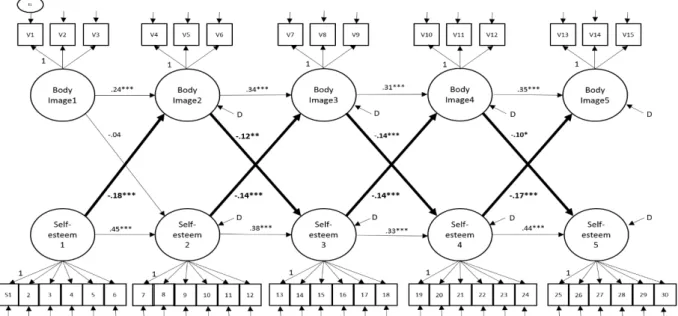
2. Do body image dissatisfaction and self-esteem predict each other over time for both genders?
Methods
Data and sample
This study used the Korean Youth Panel Study (KYPS;
National Youth Policy Institute, 2010) that followed a cohort of over 2,500 adolescents born between March, 1994 and February, 1995. The study was conducted for five years, from 2004 to 2008, from the time when the sample began the fourth year of elementary school through the second year of middle school. KYPS items cover a broad range of topics in order to grasp the general development trend of adolescents such as deviant behavior, everyday activities, self-identity, and life stresses. The survey utilized a stratified multi-stage cluster sampling in the Seoul metropolitan area as well as 14 other metropolitan cities and provinces. Participants were surveyed at school for the first year, whereas in subsequent years, they were tracked with individual interviews conducted at pre-arranged times and places. Participants who failed to complete the survey or missed their appointment were scheduled for an additional interview to minimize attrition. Major reasons for attrition included strong refusal, loss of contact, students’ overseas study and emigration.
This study operationally defined adolescence as between
the ages of 10 to 19 based on guidelines of the World
Health Organization (WHO) and American Psychological
Association (APA). WHO defined adolescents “as those
people between 10 and 19 years of age” (WHO, 2020). APA
defined adolescence as “the period of human development that starts with puberty (10-12 years of age) and ends with physiological maturity (approximately 19 years of age)”(APA, 2007). The present study operationally defined time 1 (4
thgrade of elementary school; age 9.9) as preadolescence and time 2 to 5 (5
thgrade of elementary school to 2
ndgrade of middle school; age 10.9 to 13.9) as early adolescence.
Several steps addressing attrition and missing data were taken to select the final sample for this study. First, for 2,826 children (1,511 boys and 1,315 girls) who participated at Time 1 (baseline), we removed data from 135 (4.8%) who did not participate in the survey at Time 2. We also deleted 13 cases with missing values (.4%) on either body image dissatisfaction or self-esteem. Of the 2,678 participants, 97 (3.6%) did not participate in the survey at Time 3 and were removed from the sample. One case with missing data was also excluded. At Time 4, 2,580 adolescents, 191 (7.4%) had not completed the interview and were deleted from the sample. However, no case had missing data on the variables of interest. At Time 5, 2,389 participants, 159 (6.7%) ceased their participation, with no cases with missing data on the variables of interest. The final sample of 2,230 participants (1,170 boys and 1,060 girls) had complete data. To ensure the national representativeness of the final sample, t-tests examining differences between the participation group and the attrition group were conducted (Tabachnick &
Fidell, 2007). There were no significant differences on self- esteem and body image dissatisfaction at baseline between the participation group ( n=2,230) and the attrition group ( n=596), which supports the generalizability of findings of the present study to the target population of Korean pre-
and early adolescents. The average age of the participants was 9.9 years at Time 1, 10.9 at Time 2, 11.9 at Time 3, 12.9 at Time 4, and 13.9 at Time 5.
Measures
Body image dissatisfaction. Three KYPS items measured body image dissatisfaction: “I am under stress because I am overweight or underweight,” “I am under stress because I am too tall or too small,” and “I am under stress because of my face.” Respondents rated items on a 5-point Likert scale (1=never to 5=always), and each participant’s mean score for the three body image dissatisfaction items was computed. Higher scores indicate a higher level of body image dissatisfaction. The scale showed adequate internal consistency, with a Cronbach alpha of .73 for boys and .71 for girls at Time 1, .77 for boys and .73 for girls at Time 2, .77 for boys and .73 for girls at Time 3, .77 for boys and .75 for girls at Time 4, and .75 for boys and .76 for girls at Time 5.
Self-esteem. Six KYPS items measured self-esteem: “I think I am a good-natured person,” “I think I am a person of ability,” “I think I am a valuable person,” “Sometimes I think I am a person of no use,” “Sometimes I think I am a bad person,” and “By and large, I feel like a failure.”
Respondents rated the items on a 5-point Likert scale (1=strongly disagree to 5=strongly agree). The three negatively worded items were reverse coded for scoring.
Each respondent’s mean score for the six items was calculated, with higher scores indicating higher self-esteem.
The internal consistency of the scale was adequate, with Cronbach alphas of .75 for boys and .76 for girls at Time 1, .77 for boys and .78 for girls at Time 2, .74 for boys and .78 Table 1. Mean Scores for Body Image Dissatisfaction and Self-esteem over Time
Boys (n=1,170)
Measure Time 1 (M=9.9) Time 2 (M=10.9) Time 3 (M=11.9) Time 4 (M=12.9) Time 5 (M=13.9)
Body image dissatisfaction 1.77 (.89) 1.86 (.90) 2.04 (.92) 2.10 (.92) 2.12 (.89)
Self-esteem 3.49 (.70) 3.43 (.69) 3.40 (.67) 3.44 (.67) 3.49 (.67)
Girls (n=1,060)
Body image dissatisfaction 1.99 (.93) 2.13 (.98) 2.41 (.99) 2.50 (.99) 2.50 (.97)
Self-esteem 3.48 (.65) 3.48 (.68) 3.41 (.67) 3.44 (.67) 3.44 (.66)
for girls at Time 3, .77 for boys and .78 for girls at Time 4, and .77 for boys and .79 for girls at Time 5.
Results
Age and gender differences in body image dissatisfaction and self-esteem
Table 1 and Figure 1 present the descriptive statistics for the study’s variables. Two 2 by 5 (sex by age) mixed ANOVAs were computed, in which sex was a between-
subjects factor and age was a within-subjects factor across assessment time points, with body image dissatisfaction as the dependent variable in one analysis and self-esteem as the dependent variable in the other. The analysis for body image dissatisfaction resulted in two significant main effects for sex and age, as well as a sex by age interaction. In the main effect for age (F
(4, 8968)=138.69, p<.001), body image dissatisfaction increased over time. In the main effect for sex ( F
(1, 2242)=150.44, p<.001), girls’ body image dissatisfaction was higher than boys’. Sex by age interaction (F
(4, 8968)=7.09, p<.001) indicated that the degree of change in body image dissatisfaction with age during pre- and early adolescence Figure 1. Change in mean scores of body image dissatisfaction and self-esteem over time.
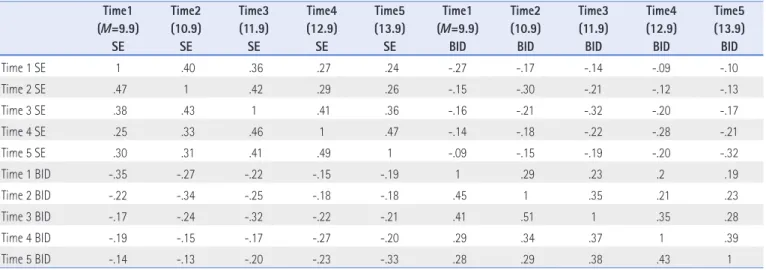
Table 2. Correlations between Body Image Dissatisfaction and Self-esteem within Time and across Time Time1
(M=9.9) SE
Time2 (10.9) SE
Time3 (11.9) SE
Time4 (12.9) SE
Time5 (13.9) SE
Time1 (M=9.9)
BID
Time2 (10.9) BID
Time3 (11.9) BID
Time4 (12.9) BID
Time5 (13.9) BID
Time 1 SE 1 .40 .36 .27 .24 -.27 -.17 -.14 -.09 -.10
Time 2 SE .47 1 .42 .29 .26 -.15 -.30 -.21 -.12 -.13
Time 3 SE .38 .43 1 .41 .36 -.16 -.21 -.32 -.20 -.17
Time 4 SE .25 .33 .46 1 .47 -.14 -.18 -.22 -.28 -.21
Time 5 SE .30 .31 .41 .49 1 -.09 -.15 -.19 -.20 -.32
Time 1 BID -.35 -.27 -.22 -.15 -.19 1 .29 .23 .2 .19
Time 2 BID -.22 -.34 -.25 -.18 -.18 .45 1 .35 .21 .23
Time 3 BID -.17 -.24 -.32 -.22 -.21 .41 .51 1 .35 .28
Time 4 BID -.19 -.15 -.17 -.27 -.20 .29 .34 .37 1 .39
Time 5 BID -.14 -.13 -.20 -.23 -.33 .28 .29 .38 .43 1
Note. SE=self-esteem, BID=body image dissatisfaction; Upper and down sides of the diagonal line denotes correlations among boys and girls, respectively; All
correlations were significant at p<.001.
depended on gender. Girls were shown to experience more rapid increases in their body image dissatisfaction than did boys.
In the 2 by 5 mixed ANOVA for self-esteem, the main effect of age was significant ( F
(4, 8968)=6.66, p<.001).
However, tests of within-subjects contrasts showed that the trend of the change was quadratic and not linear ( F
(1,2242)
=21.54, p<.001). The self-esteem of participants
decreased during the first two years and increased later.
However, whereas boys showed a clear U-shape pattern of change, girls’ self-esteem did not return to the initial level.
The main effect of sex on self-esteem was not significant ( F
(1,2242)