https://doi.org/10.4094/chnr.2020.26.3.323
CHNR
The Association between Hope and Quality of Life among Adolescents with Chronic Diseases: A Systematic Review
Ai Mardhiyah
1, Koshy Philip
2, Henny Suzana Mediani
3, Iyus Yosep
41Graduate Student, Faculty of Health Science, Lincoln University College, Petaling Jaya, Malaysia ․ Faculty Member, Faculty of Nursing, Univeristas Padjadjaran, Bandung, Indonesia; 2Professor, Faculty of Science, Lincoln University College, Petaling Jaya, Malaysia; 3Associate Professor, Faculty of Nursing, Univeristas Padjadjaran, Bandung, Indonesia; 4Faculty Member, Faculty of Nursing, Univeristas Padjadjaran, Bandung, Indonesia
Purpose: Hope has been identified as a protective factor that contributes to achieving a better quality to life, especially in patients with chronic disease. The purpose of this review was to synthesize current knowledge about the relationship between hope and quality of life among adolescents living with chronic illnesses. Methods: We searched major English-language databases (PsycINFO, PubMed, and CINAHL) for studies from January 1, 2002 to July 12, 2019. Studies were included if they provided data on hope and its relationship with quality of life among adolescents with chronic diseases. Results: In total, five articles were selected from the 336 studies that were retrieved. All five studies reported a positive correlation between hope and quality of life, such that people with a higher level of hope had a better quality of life. Hope was found to have direct and indirect effects on quality of life in adolescents with chronic diseases. Conclusion: Healthcare professionals should make more efforts to enhance hope in adolescents with chronic diseases in order to improve their quality of life. Future studies exploring how hope develops in adolescents with chronic diseases and the long-term impact of hope on quality of life are necessary.
Key words: Adolescent; Chronic disease; Hope; Quality of life; Review
INTRODUCTION
More adolescents with chronic illnesses are living longer than was previously the case due to advances in scientific knowledge and medical technology. However, being diag- nosed with a chronic disease could have long-term and on- going impacts on adolescents' psychological, socio-spiritual, and emotional function [1]. Studies have reported that chronic diseases affected sexual maturity in adolescents, disturbed school life, and led to the development of mental health issues [2]. Adolescents with chronic illnesses experienced a higher dependency on family, as well as ambivalence and uncertain- ty about the future [3]. Evidence on adults with chronic dis- eases, such as HIV and cancer, has shown that hope is an im- portant therapeutic factor in healing from and surviving ill- ness [4,5].
Hope has been considered to be a positive attribute for ach- ieving a better quality to life, especially in patients with chron- ic disease [6]. Previous research has reported that hope was associated with health indicators, such as coping, self-esteem, and quality of life [7-9]. It has been proposed that hope should be considered to be a central component of nursing respon- sibilities, with the goal of maintaining and improving pa- Corresponding author Ai Mardhiyah
https://orcid.org/0000-0002-3185-6771
Faculty of Health Science, Lincoln University College,
Wisma Lincoln, No. 12-18, Jalan ss6/12, Off Jalan Perbandaran 47301 Petaling Jaya, Selangor, Malaysia.
TEL +60-3-7806 3479 FAX +60-3-7806 3479 E-MAIL [email protected]
Received Jan 18, 2020 Revised Mar 29, 2020 Accepted May 13, 2020
This is an Open Access article distributed under the terms of the Creative Commons Attribution Non- Commercial License (http://creativecommons.org/licenses/by-nc/4.0/) which permits unrestricted non- commercial use, distribution, and reproduction in any medium, provided the original work is properly cited.
tients' quality of life. Despite extensive research, there are still significant gaps in researchers' understanding of the associa- tion between hope and quality of life among chronically ill adolescents. To date, only two integrative reviews of research addressing hope in adolescents have been published [10,11].
Obtaining further knowledge of the association between hope and quality of life in adolescents with chronic illnesses will provide better insights into ways of optimizing care for those working with chronically ill adolescent patients. The purpose of this review was to synthesize current knowledge on the re- lationship between hope and quality of life among adoles- cents living with chronic illnesses.
METHODS
1. Literature Search and Retrieval Processes
Relevant studies were identified through searches of Psyc- INFO, PubMed, and CINAHL for citations from January 1, 2002 to July 12, 2019. The search aimed to identify studies re- porting data on the relationship between hope and quality of life in adolescents with chronic diseases. The key words used in the search were as follows: “hope,” “hopeful,” “hopeful- ness,” “quality of life,” “QOL,” “health-related quality of life,”
“HRQOL,” and “adolescent,” “young adult,” and “ chronic disease.” Some word truncations were used according to each database. The search strategy is shown in Figure 1. A search on Google Scholar was also conducted, but no new findings resulted. Reference lists were also scanned by hand for all known articles.
2. Inclusion and Exclusion Criteria
The following inclusion criteria were applied: (1) papers in which the participants were adolescents (ranging in age from 10 to 25 years old) diagnosed with a chronic disease (a long- term illness requiring interventions and treatments [11] or cancer) or children with sickle cell disease; and (2) papers that provided data on hope and its relationships with quality of life among adolescents with chronic diseases. The search was limited to articles with the full-text version available in English or Bahasa Indonesia. We excluded papers unrelated to hope and quality of life in adolescents, books, and review papers.
3. Data Extraction
Two reviewers independently screened the titles and ab- stracts who has been mutually trained by the senior re- searched regarding searching articles in different database.
In the first stage of the search process, a standard form and guideline were created to summarize the search results, in- cluding the title, number of articles included or excluded (and the reason for exclusion), and unclear articles (with the ulti- mate decision). If there was a disagreement between the two reviewers, the decision was made by discussion with all researchers. In the next stage, information regarding the in- cluded studies was obtained using a standard form, including the author, publication year, place of study, study, sample size and technique, instrument, and main findings. All re- viewers were provided with specific instructions for data extraction.
4. Quality Appraisal
Quality was independently assessed by two reviewers.
Disagreements between the two reviewers were discussed through panel review. Two criteria were used to assess qual- ity (methodological rigor and relevance) using a 2-point scale (high=2 or low=1) [12]. The criteria for appraisal of observa- tional studies included the sampling method, sample size, participants and setting, measurements and validity, the method of statistical analysis, and confounding.
RESULTS
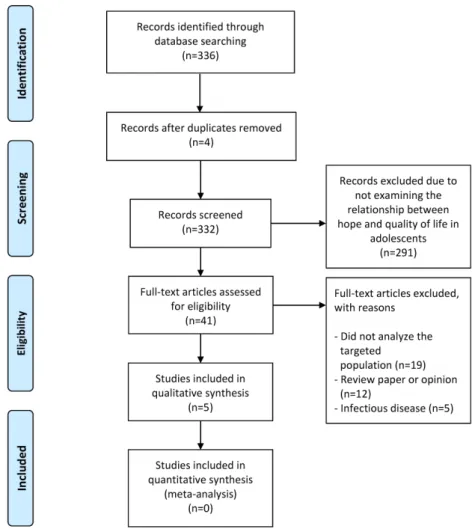
1. Search ResultsFigure 1 summarizes the process for searching and select- ing the articles. A total of 336 papers were identified in the ini- tial search. Forty-one papers were identified as potential ar- ticles for further screening based on the inclusion criteria.
Finally, five papers that met the inclusion criteria were in- cluded in this review.
2. Characteristics of Included Studies
These five papers evaluated the relationship between hope and quality of life in adolescents with different types of chron- ic diseases, in various countries, languages, and settings. A summary of each of the five articles is presented in Table 1.
Two studies were conducted in the United States, two stud- ies in Portugal, and one study in South Korea. All studies were hospital-based. Four studies were conducted using a cross- sectional design and one study had a prospective design. The majority of studies included participants ranging in age from 10 to 18 years, with a mixture of children and adolescents. The number of participants in the studies ranged from 37 to 224, and most used convenience sampling. Hope was measured using the Children’s Hope Scale [13-15] and the Herth Hope
Figure 1. Preferred Reporting Items for Systematic Reviews and Meta-Analyses (PRISMA) flow diagram.
Index [16]. The PedsQLTM 4.0 Generic Core Scale, PedsQL 3.0 Cancer Module, Miami Pediatric Quality of Life Question- naire, and the short version of the DISABKIDS Chronic Gene- ric Measure self-report questionnaire were used to measure quality of life.
3. Quality of Studies
Quality was analyzed based on the risk of bias in the sam- pling, sample size, and the use of appropriate analytical me- thods. All studies had high rigor and high relevance (Table 1).
4. Main Findings
All five studies reported a positive correlation between hope and quality of life, meaning that people with higher lev- els of hope had a better quality of life. One study reported that hope had significant direct and indirect effects on quality of life [16], while another study reported that anxiety mediated
the relationship between hope and quality of life [13]. One study also reported that hope was a mediator in the relation- ship between quality of life and adaptive behavior [15].
Interestingly, Santos et al. [14] highlighted that as children and parents revealed higher rates of family activities, they al- so expressed higher family cohesion and higher hope, which was linked to better quality of life.
The main differences in these five articles were as follows.
Kim et al. [16] analyzed the relationship between hope and quality of life using the adolescent resilience model as a theo- retical framework, which places resilience as a mediator in the relationship between hope and quality of life. Santos et al. [14]
explored mutual dyadic correlations of how parental percep- tions influence those of children, and conversely. Their study emphasized family rituals as an important aspect of promot- ing quality of life in pediatric cancer patients, as moderated by hope and family cohesion in regard to parent-child interac- tions. Ziadni et al. [15] highlighted that higher hope was corre- lated to better quality of life, and that good adaptive behavior
Table 1. Characteristics of the Included Studies (N=5)
Authors,
year Country Study design and
setting Sample Instrument Results
Rigor/
relevance (H or L) Kim, Kim,
& Kim, 2018
South Korea
․Cross-sectional, descriptive correlational design
․Hospital for outpatient care
․N=220 (aged 10~18 years) diagnosed with a chronic disease at least 6 months and receiving medical therapy
․A convenience sample
․Hope: the Herth Hope Index
․Quality of life: the PedsQLTM 4.0 Generic Core Scale
․Hope showed a significant positive correlation with quality of life (r=.41; p<.001)
․Hope had significant direct effects and total effects on quality of life
H/H
Martins et al., 2018
Portugal ․ Cross-sectional
․The oncology wards of two Portuguese public hospitals
․N=211 children and adolescents diagnosed with malignant cancer, on- or off-treatment status—
< 5 years since the end of treatment; and without developmental disorders (e.g., Down syndrome)
․ 99.5% response rate
․The Children's Hope Scale
․Short version of the DCGM-12
self-report questionnaire
․Children's hope was positively associated with quality of life
․Anxiety mediated the relation between hope and quality of life (point estimate=0.10;
CI=0.06~0.16); the R2 for QOL was 0.24 in each group.
H/H
Rosenberg et al., 2018
United States
․Multi-center, prospective, longitudinal, mixed-methods study
․Two places (Seattle Children’s Hospital and
Dana-Farber/Boston Children's Hospital)
․N=37
․Ages 14~25 with newly diagnosed with non-central nervous cancer and under chemotherapy
․Relational hope, namely sub-scores for "agency"
(capacity to create a path to one's objectives) and
"pathway" (capacity to undertake and sustain actions to achieve those objectives)
․Cancer-related QOL (PedsQL 3.0 Cancer Module)
․Hope alone was associated with later QOL (Beta=0.3, 95%
CI=0.10~0.60, p=.020)
H/H
Santos et al., 2015
Portugal ․ Cross-sectional
․Three Portuguese public hospitals
․N=224 (aged 13~20 years) with cancer
․N=165 (aged 8~12 years) with cancer
․Consecutive sampling
․Portuguese version of the Children's Hope Scale
․Portuguese version of PedsQLTM 3.0 Cancer Module
․Hope was associated with QOL (95%
CI=0.01~0.07, p<.001)
H/H
Ziadni et al., 2011
United States
․Cross-sectional
․Marian Anderson Sickle Cell Center at St. Christopher's Hospital for Children
․N=44 (aged 12~18) children with sickle cell disease
․Children's Hope Scale
․MPQLQ
․Family's total annual income was associated with hope (r=.33, p=.043).
․Higher levels of hope and better QOL were associated with higher adaptive behaviour
H/H
CI=Confidence interval; DCGM=DISABKIDS chronic generic module; H=High; L=Low; MPQLQ= Miami pediatric quality of life questionnaire;
PedsQL= Pediatric quality of life; PedsQLTM=Pediatric quality of life inventory; QOL=Quality of life.
was linked to better health-related quality of life (and vice- versa for lower adaptive behavior). In contrast, Martins et al.
[13] explored the difference between pediatric cancer patients on and off treatment and revealed that children and adoles- cents on treatment had higher quality of life compared to those who were off treatment. Hope was positively associated with quality of life, both directly and indirectly via anxiety reduction. In addition, a longitudinal study conducted by Rosenberg et al. [17] found that initial distress predicted fu- ture distress and that initial hope predicted future hope.
However, only the combination of hope/distress scores pre- dicted future quality of life.
DISCUSSION
This review highlighted that adolescents with chronic dis- eases who had higher levels of hope had a better quality of life.
This study also emphasized that hope functioned as an in- direct and direct determinant of quality of life for children and adolescents with chronic illnesses. Quality of life is a widely accepted as an important outcome measure to evaluate the success of treatments and interventions in children or adoles- cents with chronic diseases. Quality of life is a concept that helps healthcare professionals understand the impact of a dis- ease or a treatment on a patient's life. Adolescents with chron- ic diseases may suffer from chronic pain, which could affect their quality of life [3]. Hope is a coping strategy that helps in- dividuals face critical conditions during stressful life events [18]. Therefore, hope is considered to be a protective factor that contributes to improving quality of life in adolescents and young adults with cancer [19]. Addressing hope in adoles- cents with chronic health problems improves their quality of life in all domains, encompassing physical, mental, social, and academic functioning [20]. However, the included studies ex- plored hope in participants with a wide age range, from 8 to 25 years old (i.e., with a mixture of children and adolescents).
Therefore, a topic for further research is how hope develops through the stages of adolescence (early, middle, and late), be- cause such a nuanced perspective would help provide tail- ored interventions to increase hope and to improve quality of life.
Hope has various definitions in health care research, and has been approached from multidimensional perspectives.
For adolescents with chronic diseases, hope is not an abstract state of mind, but an important personal capacity to consider one's position and future problems and prepare oneself to cope positively. Only two tools were used to measure hope in the included studies: the Children's Hope Scale and the Herth Hope Index. There are a few choices of hope measurement tools for use in adolescents with chronic diseases, but the op-
erationalization of the concept of hope should continue to be refined to explore the essence of hope in this population. Fur- thermore, most of the included studies were conducted using a cross-sectional design. However, hope may change depend- ing on the situation; therefore, exploring how hope develops in adolescents through longitudinal follow-up may be needed to explore dynamic changes in hope and its impact on quality of life over time.
The current research should be interpreted in light of some limitations. First, publication and selection bias could not be eliminated from this study because the criteria for inclusion were restricted to research published in the English language and Bahasa Indonesia, and it excluded conference papers and off-line publications. In addition, the studies were conducted in developed countries, and few were from Asia and Africa, which may have important differences in health care systems, cultures and beliefs. However, we nonetheless believe that the included studies provide valuable descriptions about hope and its association with quality of life in their respective countries.
CONCLUSION
In conclusion, this review emphasizes the presence of a positive correlation between hope and quality of life in chil- dren and adolescents with chronic disease. Hope was also re- ported to have direct and indirect relationships with quality of life. Healthcare professionals need to make more efforts to enhance hope in adolescents with chronic diseases in order to improve their quality of life. Future studies should explore the development of hope in adolescents with chronic diseases to provide a better understanding of dynamic changes in hope.
In addition, tailored interventions should be developed to in- crease hope according to adolescents' developmental stages.
Conflict of interest
No existing or potential conflict of interest relevant to this article was reported.
REFERENCES
1. Venning A, Eliott J, Wilson A, Kettler L. Understanding young peoples' experience of chronic illness: A systematic review. Inter- national Journal of Evidence-Based Healthcare. 2008;6(3):321-336.
https://doi.org/10.1111/j.1744-1609.2008.00107.x
2. Borgna-Pignatti C, De Stefano P, Zonta L, Vullo C, De Sanctis V, Melevendi C, et al. Growth and sexual maturation in thalassemia major. The Journal of Pediatrics. 1985;106(1):150-155.
https://doi.org/10.1016/S0022-3476(85)80488-1
3. Saällfors C, Fasth A, Hallberg LR. Oscillating between hope and despair - A qualitative study. Child: Care, Health and Develop- ment. 2002;28(6):495-505.
https://doi.org/10.1046/j.1365-2214.2002.00300.x
4. Herth KA. Development and implementation of a hope interven- tion program. Oncology Nursing Forum. 2001;28(6):1009-1016.
5. Schrank B, Stanghellini G, Slade M. Hope in psychiatry: A review of the literature. Acta Psychiatrica Scandinavica. 2008;118(6):421- 433. https://doi.org/10.1111/j.1600-0447.2008.01271.x
6. Hammer K, Mogensen O, Hall EOC. The meaning of hope in nurs- ing research: A meta-synthesis. Scandinavian Journal of Caring Sciences. 2009;23(3):549-557.
https://doi.org/10.1111/j.1471-6712.2008.00635.x
7. Folkman S. Stress, coping, and hope. Psycho-Oncology. 2010;19(9):
901-908. https://doi.org/10.1002/pon.1836
8. Cantrell MA, Lupinacci P. Investigating the determinants of health- related quality of life among childhood cancer survivors. Journal of Advanced Nursing. 2008;64(1):73-83.
https://doi.org/10.1111/j.1365-2648.2008.04760.x
9. Pipe TB, Kelly A, LeBrun G, Schmidt D, Atherton P, Robinson C. A prospective descriptive study exploring hope, spiritual well-be- ing, and quality of life in hospitalized patients. Medsurg Nursing:
Official Journal of the Academy of Medical-Surgical Nurses. 2008;
17(4):247-253.
10. Esteves M, Scoloveno RL, Mahat G, Yarcheski A, Scoloveno MA.
An integrative review of adolescent hope. Journal of Pediatric Nursing. 2013;28(2):105-113.
https://doi.org/10.1016/j.pedn.2012.03.033
11. Griggs S, Walker RK. The role of hope for adolescents with a chronic illness: An integrative review. Journal of Pediatric Nurs- ing. 2016;31(4):404-421.
https://doi.org/10.1016/j.pedn.2016.02.011
12. Whittemore R, Knafl K. The integrative review: Updated method- ology. Journal of Advanced Nursing. 2005;52(5):546-553.
https://doi.org/10.1111/j.1365-2648.2005.03621.x
13. Martins AR, Crespo C, Salvador Á, Santos S, Carona C, Canavarro MC. Does hope matter? Associations among self-reported hope,
anxiety, and health-related quality of life in children and adoles- cents with cancer. Journal of Clinical Psychology in Medical Set- tings. 2018;25(1):93-103.
https://doi.org/10.1007/s10880-018-9547-x
14. Santos S, Crespo C, Canavarro MC, Kazak AE. Family rituals and quality of life in children with cancer and their parents: The role of family cohesion and hope. Journal of Pediatric Psychology. 2015;
40(7):664-671. https://doi.org/10.1093/jpepsy/jsv013
15. Ziadni MS, Patterson CA, Pulgarón ER, Robinson MR, Barakat LP. Health-related quality of life and adaptive behaviors of ado- lescents with sickle cell disease: Stress processing moderators.
Journal of Clinical Psychology in Medical Settings. 2011;18(4):
335-344. https://doi.org/10.1007/s10880-011-9254-3
16. Kim M, Kim K, Kim JS. Impact of resilience on the health-related quality of life of adolescents with a chronic health problem: A structural equation approach. Journal of Advanced Nursing. 2019;
75(4):801-811. https://doi.org/10.1111/jan.13888
17. Rosenberg AR, Bradford MC, Bona K, Shaffer ML, Wolfe J, Baker KS, et al. Hope, distress, and later quality of life among adolescent and young adults with cancer. Journal of Psychosocial Oncology.
2018;36(2):137-144.
https://doi.org/10.1080/07347332.2017.1382646
18. Umphrey LR, Sherblom JC. The constitutive relationship of listen- ing to hope, emotional intelligence, stress, and life satisfaction.
International Journal of Listening. 2018;32(1):24-48.
https://doi.org/10.1080/10904018.2017.1297237
19. Haase JE, Heiney SP, Ruccione KS, Stutzer C. Research triangula- tion to derive meaning-based quality-of-life theory: Adolescent resilience model and instrument development. International Jour- nal of Cancer. 1999;12:125-131.
https://doi.org/10.1002/(sici)1097-0215(1999)83:12+<125::aid-ijc 22>3.0.co;2-7
20. Shoshani A, Mifano K, Czamanski-Cohen J. The effects of the Make a Wish intervention on psychiatric symptoms and health- related quality of life of children with cancer: A randomised con- trolled trial. Quality of Life Research. 2016;25(5):1209-1218.
https://doi.org/10.1007/s11136-015-1148-7