• 검색 결과가 없습니다.

2. p. 203 Nutritional Components and Antioxidant Activities of Various Stachys Sieboldii Miq Parts

N/A
N/A
Protected

Academic year: 2021

Share "2. p. 203 Nutritional Components and Antioxidant Activities of Various Stachys Sieboldii Miq Parts"

Copied!
13
0
0

로드 중.... (전체 텍스트 보기)

전체 글

(1)

This study was supported by the 2016 research fund of Chosun University.

Received: 2 May, 2017 Revised: 11 May, 2017 Accepted: 22 May, 2017

† Corresponding Author: Jae-Joon Lee Tel: +82-62-230-7725 E-mail: [email protected]

This is an Open-Access article distributed under the terms of the Creative Commons Attribution Non-Commercial License (http://creativecommons.org/licenses/by-nc/3.0) which permits unrestricted non-commercial use, distribution, and reproduction in any medium, provided the original work is properly cited.

Korean J Community Living Sci 28(2): 203~215, 2017 http://doi.org/10.7856/kjcls.2017.28.2.203

초석잠 부위별 영양성분 및 항산화효과

김 연 경ㆍ손 희 경ㆍ이 재 준 조선대학교 식품영양학과

Nutritional Components and Antioxidant Activities of Various Stachys Sieboldii Miq Parts

Yeon-Kyoung KimㆍHee-Kyoung SonㆍJae-Joon Lee Dept. of Food and Nutrition, Chosun University, Gwangju, Korea

1)
ABSTRACT

This study was carried out to compare the major nutrient components and antioxidant activities of Stachys sieboldii Miq leaf and root powders. For proximate compositions, crude protein and crude fat contents of leaf powder were higher than those of root powder, whereas contents of crude ash and carbohydrates were lower in leaf powder. The content of glutamic acid was greater in amino acids of leaf and root powders, and contents of total amino acids and essential amino acids were higher in leaf powder compared with root powder. Root powder contained a higher level of total unsaturated fatty acids than leaf powder. Total contents of organic acids were higher in leaf powder; tartaric acid was the major organic acid in leaf powder, and malic acid was the major organic acid in root powder. The content of vitamin A was higher in leaf powder than in root powder. However, vitamin E content was higher in root powder than in leaf powder.

Total mineral contents of leaf powder were higher than those of root powder, and mineral contents of leaf and root powders were in the order of K>Ca>Mg. Extract yields of leaf and root powders were 27.21% and 58.51%, respectively. Total polyphenols and total flavonoids of leaf extract were 236.35 mg/g and 1.90 mg/g, respectively, which were higher than those of root extract.

The IC 50 values of leaf and root ethanol extracts based on DPPH hydroxyl scavenging were 0.69 mg/mL and 5934.31 mg/mL, respectively, and antioxidative activities of ethanol extracts from all Stachys sieboldii Miq parts dose-dependently increased. These results suggest that Stachys sieboldii Miq can be recommended as an edible functional food material.

Key words: Stachys sieboldii Miq, nutritional component, antioxidant material, DPPH radical

activity

(2)

I. 서론

초석잠( Stachys sieboldii Miq)은 꿀풀과(Labiatae) 석잠풀속(Stachy Linne)의 여러해살이에 속하는 전통 적인 건강채소로 chinese artichoke, Japanese artichoke, crosne, knotroot로 알려져 있다(Stadhouders 1990).

주로 중국, 일본 및 러시아 등에서 재배되어 오다가 최근 우리나라에서도 치매예방에 효과적인 약용식물 로 알려지게 되면서 재배면적이 점차 증가하고 있는 추세이다(Lee et al. 2013). 초석잠은 1년생 본초로 잎 은 장 타원형이며, 줄기는 직립이고, 꽃은 이삭모양의 작은 꽃을 8월 하순에 개화한다. 뿌리는 가을에 지하 에서 3~6 cm 정도로 자라는데 형태가 누에모양을 하 고 있어 식물의 동충하초라고도 불린다. 중국 본초강 목에 의하면 초석잠 뿌리는 기억력을 증진시키고, 뇌 경색 및 치매에 효과가 있으며 장을 강화하는 장수채 (長壽菜)로서 맛이 달고 독이 없어 오랜 옛날부터 애용 해 왔다고 기록되어 있다(Ryu et al. 2002a).

초석잠 뿌리의 주된 성분은 탄수화물, stachyose, phenylethanoid glycosides, 올리고당이 풍부하다고 알려져 있다(Yamahara 1990; Yin et al. 2006). 초석잠 뿌리의 탄수화물 성분 중 올리고당인 stachyose는 장 속의 유익 세균의 생육을 도와서 장의 기능을 촉진하 고, 면역력강화 및 배변작용 개선 등에 효과가 있다고 보고되었다(Yin et al. 2006). 초석잠은 뿌리뿐만 아니 라 잎도 식용이 가능하여 초석잠 잎은 나물로 먹거나 말려서 차로 사용하기도 한다. Yamahara(1990)의 연 구에서는 초석잠의 잎, 줄기 및 뿌리의 추출물을 분석 한 결과, 항산화 활성, 세포막의 지질과산화물이 억제 되어 치매예방과 기억력 개선에 효과가 있다고 보고하 였다. 이외에도 초석잠은 hyarulonidase 억제 활성 (Takeda et al. 1985), 항균효과(Ryu & Park 2002), 항암 및 면역효과(Ryu et al. 2002), 항산화효과(Baek et al. 2004; Feng et al. 2015), 자가면역질환 억제 효과(Sasaki et al. 1989) acetylcholine esterase 및 monoamine oxidase 활성 억제효과(Ryu & Kim 2004) 등이 알려져 있다. 초석잠 잎 추출물은 항균작용도 있

는 것으로 보고되었다(Ryu & Park 2002). 이와 같이 초석잠은 다양한 생리활성 효과뿐만 아니라 맛이나 영 양가면에서도 기호도가 높아 새로운 기능성 건강식품 의 개발가능성이 큰 식물로 여겨진다.

현재 우리나라에서 초석잠을 식품소재로 이용한 연구로는 초석잠 뿌리를 첨가한 즉석식품 개발(Yang 2012), 두부(Lee et al. 2014), 쌀 쿠키(Jung et al.

2014), 식빵(Lee 2015) 및 수프(Tae et al. 2016)에 관 한 것이다. 그러나 초석잠 잎을 이용한 식품소재 개 발에 관한 연구는 전혀 없다. 초석잠을 식품으로의 활용이나 생리활성 기능에 관한 연구는 아직까지 매 우 미진한 편이다. 건강한 식품을 찾는 추세에 따라 초석잠의 잎과 뿌리의 영양학적 성분을 밝히고, 기능 성식품으로 개발하는 연구는 가치가 있을 것이라 사 료된다.

이에 따라 본 연구에서는 초석잠의 잎과 뿌리의 영양성분과 항산화 활성을 비교ㆍ분석하여 초석잠의 여러 측면에서 기능성 식품소재로 활용될 수 있는 기 초 자료를 제공하고자 실시하였다.

Ⅱ. 연구방법

1. 재료

본 실험에 사용된 초석잠은 2016년 7월 경상남도

하동군에서 생산된 것으로 지리산차천지(Hadong,

Korea)에서 구입하여 사용하였다. 초석잠 잎과 뿌리

는 이물질을 제거하고, 흐르는 물에 수세하고, salad

spinner(Caous, WINDAX, Seoul, Korea)를 이용하여

물기를 제거하였다. 시료는 -70℃ deep freezer(MDF-

U52V, Sanyo, Osaka, Japan)에서 냉동시킨 후 동결

건조기(ED 8512, Ilshin, Yangju, Korea)를 이용하여

건조시켰다. 동결건조 된 시료는 분쇄기(HR1378, Philips,

Karner, Slovenia)로 100 mesh로 마쇄한 후, -70℃에

서 냉동보관하면서 시료로 사용하였다. 각 실험항목

에 대한 시료의 분석은 3회 반복 실시하였다.

(3)

2. 일반성분 분석

초석잠 잎과 뿌리 분말의 일반성분 분석 방법은 Association of Official Analytical Chemists(A.O.A.C.) 방법(2005)에 준하여 실시하였다. 수분은 105℃ 상압 가열건조법을 사용하였으며, 조단백질은 micro-kjeldahl 법, 조지방은 soxhlet 추출법 그리고 조회분은 회화법 을 통해서 분석하였다. 탄수화물의 분석은 100에서 수분, 조단백질, 조지방 및 조회분의 함량을 제외한 값으로 나타내었다.

3. 구성 아미노산 분석

구성아미노산의 분석은 분해관에서 건조시킨 시료 0.5 g과 6 N HCl 3 mL를 취하였고, 그 후 탈기하여 121℃에서 24시간 가수분해한 다음 남은 여액을 rotary vacuum evaporator(EYELA VACUUM NVC- 1100, Tokyo, Japan)로 감압ㆍ농축시켜 sodium phosphate buffer(pH 7.0) 10 mL로 정용하였고(Waters Associates 1990), 용액 1 mL를 취한 후 membrane filter(0.2 μm) 로 여과하였다. 그 다음 아미노산자동분석기(Biochrom 20, Pharmacia, England)로 정량 분석하였다.

4. 지방산 분석

지방산 분석은 Wungaarden의 방법(1967)에 준하 여 시행하였다. 시료 2 g을 ether 용액으로 추출ㆍ여 과하여 감압ㆍ농축시킨 지질 약 100 mg을 가지형 플 라스크에 취하였다. 1 N KOHㆍethanol 용액 4 mL 를 섞은 후 유지 방울이 없어질 때까지 교반시켜 14% BF 3 -Methanol 5 mL를 가했다. 이때 냉각기를 부착하고 80℃에서 5분간 가열하면서 methylester화 시켰다. 이 용액에 NaCl 포화용액 3 mL를 첨가한 후 hexane 1 mL를 첨가하여 흔들어서 섞은 후 시험관 에 옮겨 정치하였다. 그리고 상층을 분취하여 무수 Na 2 SO 4 를 넣고 수분을 제거하여 Gas Chromatography (GC-10A, Shimadzu, Kyoto, Japan)로 분석하여 총 26종의 지방산이 분석되었다.

5. 유기산 분석

유기산 분석은 Kim et al.(1997)의 방법에 따라 시 행하였다. 마쇄한 시료 1 g에 증류수 50 mL를 가하 고 80℃ water bath에서 4시간 동안 가열한 후 Whatman filter paper(No. 2)로 여과시켰다. 그리고 여액을 rotary vacuum evaporator(EYELA VACUUM NVC- 1100, Tokyo, Japan)로 감압ㆍ농축한 다음 증 류수 10 mL로 정용하여 Ion Chromatography(DX-600, Dionex, USA)로 분석하여 총 7종의 유기산이 분석되 었다.

6. 비타민 분석

비타민 A, C 및 E의 분석은 식품공전법의 시험방 법(Korea Food and Drug Association 2005)에 준하 여 시행하였다. 비타민 A 및 E의 함량은 시료 0.5 g, ethanol 5 mL 및 ascorbic acid 0.1 g를 취하여 80℃

에서 10분 정도 가열한 다음 50% KOH 용액 0.25 mL을 첨가하였다. 그리고 같은 온도에서 20분간 가 열한 후 hexane 5 mL와 증류수 24 mL를 가하여 1,150 ×g에서 20분 동안 원심분리 하였다. 상징액을 분리한 다음 hexane 40 mL를 가한 후 다시 원심분리 하여 상징액을 취하여 증류수를 가한 다음 10분간 방 치하고 하층부를 제거하였다. 이 과정을 3회 반복 시 행한 후 전 용액을 합하여 무수 Na 2 SO 4 로 탈수하여 rotary vacuum evaporator(EYELA VACUUM NVC- 1100, Tokyo, Japan)를 통해 hexane을 3 mL까지 감 압ㆍ농축시킨 후 HPLC(LC-10AVP, Shimadzu, Kyoto, Japan)로 분석하였다. 비타민 C의 함량은 시료 추출 물을 0.2 μm membrane filter를 통해 여과시킨 후 HPLC(LC-10AVP, Shimadzu, Kyoto, Japan)로 분석 하였다.

7. 무기질 분석

무기질 분석은 A.O.A.C.방법(2005)에 따라 시행 하였다. 시료 0.5 g, 60% HClO 4 3 mL 및 20% HNO 3

10 mL를 취하여 투명해질 때까지 가열한 다음, 0.5

(4)

M HNO 3 로 50 mL를 정용하였다. 분석항목별 표준용 액을 혼합한 다음, vial병에 8 mL씩 취하여 표준용액 으로 하였고, 0.5 M HNO 3 를 대조군으로 하여 원자 흡수분광광도계(AA-6501GS, Shimadzu, Tokyo, Japan) 로 분석하였다.

8. 시료 추출

초석잠 잎과 뿌리 분말 각각 100 g을 80% ethanol 1,500 mL을 첨가한 다음 환류냉각관을 부착하여 6 5℃의 Heating mantle(WHM12016, Daihan-Scientific, Seoul, Korea)에서 3시간씩 3회 반복 추출하였다. 그 리고 여과지(Whatman No. 2)를 이용해 여과한 다음 여액을 40℃ 수욕에서 rotary vacuum evaporator (EYELA VACUUM NVC-1100 Tokyo, Japan)를 통해 용매를 제거하고, 감압ㆍ농축한 다음 동결기(ED8512, Ilshan, Yangju, Korea)로 건조하여 초석잠 잎과 뿌 리 에탄올 추출물의 추출 수율을 구하였다. 시료의 산화방지를 위해서 -70℃에 냉동 보관하면서 실험에 사용하였다.

9. 총 polyphenol과 총 flavonoid 함량 측정 초석잠 잎과 뿌리 에탄올 추출물의 총 polyphenol 함량은 Folin-Denis법(1912)에 따라 측정하였다. 초석 잠 시료 에탄올 추출물 1 mL와 Folin reagent 2 mL를 test tube에 넣은 다음 실온에서 3분간 정치하였다. 그 다음 10% Na 2 CO 3 2 mL을 첨가하고, 이를 혼합한 다음 30℃에서 40분간 정치하였다. 760 nm의 흡광도에서 UV-spectrophotometer (Bio-Rad, Hercules, CA, USA)를 사용하여 측정하였고, 표준곡선은 tannic acid 를 기준물질로 이용하여 최종농도가 0, 0.2, 0.4, 0.6, 0.8, 1.0 mg/mL가 되도록 작성하였다. 이 검량곡선을 통해 시료 중 총 polyphenol 함량을 구했다. 총 flavonoid 함량은 Davis법을 변형한 Chae et al.(2002) 에 따라 측정하였다. 초석잠 시료 에탄올 추출물 1 mL 에 diethylene glycol 2 mL을 첨가한 다음 1N NaOH 20 μL을 넣은 다음 37℃ water bath에서 1시간 동안

반응시켰다. 그리고 UV-spectrophotometer (Bio-Rad, Hercules, CA, USA)로 420 nm에서 흡광도를 측정하 였고, 표준곡선은 rutin을 기준물질로 이용하여 최종 농도가 0, 0.2, 0.4, 0.6, 0.8 및 1.0 mg/mL가 되도록 조제하였다. 이 검량곡선으로부터 시료중의 총 flavonoid 함량을 구했다.

10.1,1-Diphenyl-2-picrylhydrazyl (DPPH) radical scavenging activity

초석잠 뿌리 및 잎 에탄올 추출물의 DPPH radical 소거능은 Blois의 방법(1958)을 이용하여 측정하였 다. 시료 농도별 1 mL과 0.2 mM DPPH 1 mL을 test tube에 취한 후 혼합하여 37℃에서 30분간 반응시켜 UV-spectrophotometer(Shimadzu UV-1601PC, Kyoto, Japan)를 사용하여 517 nm에서 흡광도를 측정하였 다. 이때, 활성의 비교를 위하여 양성대조군으로 합 성 항산화제인 BHA를 이용하여 동일한 방법으로 측 정하였다. 초석잠 뿌리 및 잎 에탄올 추출물의 DPPH radical 소거능은 (1-시료첨가구의 흡광도/무첨가구 의 흡광도)×100에 의하여 계산하여 나타냈다.

11. 통계처리

본 실험의 분석결과는 SPSS program(SPSS version 17.0, SPSS Inc., Chicago, IL, USA)를 사용하여 통계 분석을 하였다. 3회 이상 반복 실시하여 측정한 평균 값과 표준편차로 나타내었고, 통계적 유의성에 관한 검정을 위해 일원배치 분산분석(one-way analysis of variance)을 통하여 통계처리 하였다.

Ⅲ. 결과 및 고찰

1. 일반성분

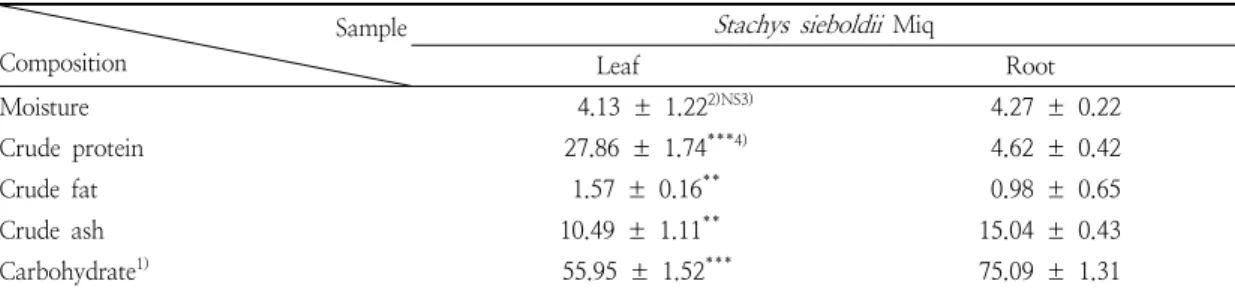
초석잠 잎과 뿌리 분말의 일반성분을 분석한 결과

는 Table 1과 같다. 건물량 기준(dry matter basis)으

로 초석잠 잎 분말의 일반성분 함량은 수분 4.13%,

조단백질 27.86%, 조지방 1.57%, 조회분 10.49% 및

(5)

탄수화물 55.95%이었다. 초석잠 뿌리 분말의 일반성 분 함량은 수분 4.27%, 조단백질 4.62%, 조지방 0.98%, 조회분 15.04% 및 탄수화물 75.09%이었다.

초석잠 잎 분말이 뿌리 분말에 비하여 조단백질과 조 지방 함량은 유의하게 높았으나, 조회분과 탄수화물 함량은 유의하게 낮았다. Lee et al.(2014)의 연구에 서는 초석잠 뿌리의 일반성분 분석결과 조단백질 9.77%, 조지방 0.35%, 조회분 5.78%이 함유되어 있 다고 보고하여, 본 연구 결과의 초석잠 뿌리의 조회 분 함량은 대체로 유사하였으나, 조단백질과 조지방 의 함량은 차이를 보였다. 초석잠과 같이 구근이 약 용으로 쓰이는 근채류인 고들빼기 뿌리의 일반성분 은 수분 4.8%, 조단백질 17.4%, 조지방 3.2%, 조회분 8.7% 및 탄수화물 65.9%로(Kim et al. 2010b), 초석 잠 뿌리가 고들빼기에 비하여 탄수화물의 함량이 높 은 것으로 나타났다. Lee et al.(2013a)의 연구에서 생도라지는 조회분 1.62%, 조지방 1.45%, 조단백질 3.47%, 탄수화물 79.9%, 조섬유 13.56%로 측정되어 초석잠 뿌리에 비하여 생도라지 뿌리의 조회분, 조단 백질, 탄수화물의 함량은 높았으나 조지방은 함량이 낮은 것으로 나타나, 초석잠 뿌리의 경우 다른 근채 류들과 비교해 탄수화물의 함량이 다소 높은 것으로 나타났다.

2. 구성 아미노산

초석잠 잎과 뿌리 분말의 구성 아미노산 함량을 분석한 결과는 Table 2와 같다. 초석잠 잎과 뿌리 분 말 모두 8종의 필수아미노산과 9종의 비필수아미노 산이 검출되어 총 17종의 아미노산이 검출되었다. 초 석잠의 필수아미노산의 총 함량은 잎 분말이 뿌리 분 말에 비하여 유의하게 높아 각각 8,414.34 mg%와 3,258.09 mg%로 그 조성을 살펴보면, 잎 분말은 leucine, lysine, valine 순으로 많았고, 뿌리 분말은 threonine, lysine, valine 순으로 나타났다. 초석잠 잎과 뿌리 분말의 비필수아미노산은 감칠맛의 주성 분인 glutamic acid의 함량이 각각 2,540.99 mg%와 4,712.09 mg%로 가장 높았고, 초석잠 두 부위 모두 cystine 함량이 가장 낮았다. 대표적인 근채류인 연근 의 주요 아미노산은 aspartic acid이었고, 우엉은 arginine이라고 보고하였다(Han & Koo 1993). 초석 잠과 같이 구근이 약용으로 쓰이는 구릿대 뿌리의 총 구성아미노산 함량은 71.68 mg%이고, proline, cystine, glutamic acid 순이었고, 민들레 뿌리의 구성 아미노 산 함량은 241.5 mg%로 보고하였다(Joo & Kang 2005). 또한, Shin(1997)은 칡뿌리의 총 아미노산 함 량은 2,099.9 mg%로 proline, aspartic acid, lysine, glutamic acid, serine순으로 나타나, 본 연구의 초석 잠 뿌리가 다른 구근식물인 구릿대 뿌리와 민들레 뿌

Sample Composition

Stachys sieboldii Miq

Leaf Root

Moisture 4.13 ± 1.22 2)NS3) 4.27 ± 0.22

Crude protein 27.86 ± 1.74 ***4) 4.62 ± 0.42

Crude fat 1.57 ± 0.16 ** 0.98 ± 0.65

Crude ash 10.49 ± 1.11 ** 15.04 ± 0.43

Carbohydrate 1) 55.95 ± 1.52 *** 75.09 ± 1.31

1) Carbohydrate = 100-(moisture+crude protein+crude fat+crude ash+dietary fiber).

2) All values are expressed as mean ± SE of triplicate determinations.

3) NS: Not significant.

4) Significant differences between Stachys sieboldii Miq leaf and tachys sieboldii Miq root measured by Student’s t-test ( ** p<0.01, *** p<0.001).

Table 1. Proximate compositions of Stachys sieboldii Miq powder from different aerial parts

(% dry basis)

(6)

리, 칡뿌리에 비해 구성 아미노산의 함량이 매우 높 은 것으로 나타났다. 초석잠 잎과 뿌리 분말의 전체 구성 아미노산에 대한 필수아미노산의 비율은 74.57%

와 41.58%로 나타났다. 이당귀의 종별 총 아미노산 에 대한 필수아미노산의 비율은 한국당귀 36.22%, 일당귀 40.60%, 중국당귀 36.53%로 보고되어, 초석 잠 뿌리가 더 낮은 것으로 나타났으나(Lee et al.

2009), 흔히 약용으로 많이 쓰이는 생도라지와 흑도 라지의 총 아미노산에 대한 필수아미노산의 비율은 생도라지와 흑도라지 각각 25.6%, 26.3%로 본 연구

결과와 비교하여 비슷한 수준으로 나타났다.

3. 지방산

초석잠 잎과 뿌리 분말의 지방산 조성은 Table 3 과 같다. 초석잠 잎 분말의 지방산 조성을 살펴보면 포화지방산 6종류, 다가불포화지방산 4종이 검출된 반면, 초석잠 뿌리 분말의 지방산 조성은 포화지방산 13종, 단일불포화지방산 4종, 다가불포화지방산 9종 의 총 26종 지방산이 검출되었다. 초석잠 잎의 구성 지방산 중 포화지방산은 heneicosanoic acid 함량이

Amino acid Stachys sieboldii Miq

Leaf Root

Essential

Valine 1,252.16 ± 25.95 *** 495.99 ± 6.14

Methionine 278.91 ± 6.02 *** 40.27 ± 2.47

Isoleucine 975.45 ± 42.06 *** 306.11 ± 5.38

Leucine 1,828.88 ± 96.53 ** 472.77 ± 5.51

Threonine 1,039.53 ± 25.62 *** 606.42 ± 7.10

Phenylalanine 1,109.21 ± 72.58 *** 397.32 ± 8.17

Histidine 649.90 ± 26.43 *** 412.98 ± 4.31

Lysine 1,280.29 ± 41.89 *** 529.24 ± 4.26

Total EAA 1) 8,414.34 3,258.09

Non-essential

Aspartic acid 2,366.17 ± 86.46 ** 888.95 ± 20.41

Serine 1,020.23 ± 50.22 ** 353.52 ± 8.09

Glutamic acid 2,540.99 ± 93.41 *** 4,712.09 ± 41.07

Proline 1,004.88 ± 10.03 *** 188.84 ± 12.33

Glycine 1,114.56 ± 30.10 *** 281.64 ± 8.36

Alanine 1,219.93 ± 144.58 ** 404.55 ± 14.38

Tyrosine 717.34 ± 19.89 *** 376.16 ± 2.12

Cystine 115.69 ± 11.85 ** 46.43 ± 2.30

Arginine 1,184.21 ± 35.29 *** 583.24 ± 22.05

Total AA 2) 11,284.00 7,835.41

EAA/AA(%) 74.57 41.58

1) Total EAA: Total essential amino acids.

2) Total AA: Total amino acids.

3) All values are expressed as mean ± SE of triplicate determinations.

4) Significant differences between Stachys sieboldii Miq leaf and tachys sieboldii Miq root measured by Student’s t-test ( ** p<0.01, *** p<0.001).

Table 2. Contents of free amino acids in Stachys sieboldii Miq powder from different aerial parts

(mg%)

(7)

63.40%로 가장 높았고, palmitic acid, steraric acid 순으로 나타났으며, 초석잠 뿌리 분말의 포화지방산 은 palmitic acid 함량이 22.97%로 가장 높았고, 다음 으로 heneicosanoic acid, stearic acid 순으로 검출되

었다. 단일불포화지방산은 초석잠 잎 분말에서는 검 출되지 않았으나, 초석잠 뿌리 분말은 oleic acid 함 량이 가장 높게 검출되었다. 다가불포화지방산은 잎 과 뿌리 분말 모두 linoleic acid의 함량이 각각

Fatty acid Stachys sieboldii Miq

Leaf Root

Butyric acid (C4:0) N.D. 0.15 ± 0.02 1)

Caproic acid (C6:0) N.D. 0.87 ± 0.03

Luric acid (C12:0) N.D. 0.23 ± 0.01

Myristic acid (C14:0) N.D. 0.17 ± 0.06

Pentadecanoic acid (C15:0) N.D. 0.44 ± 0.06

Palmitic acid (C16:0) 14.63 ± 0.40 *** 22.97 ± 3.34

Heptadecanoic acid (C17:0) 1.08 ± 0.01 *** 0.69 ± 0.03

Stearic acid (C18:0) 1.60 ± 0.01 ** 3.75 ± 1.37

Arachidic acid (C20:0) 0.16 ± 0.03 * 0.42 ± 0.05

Heneicosanoic acid (C21:0) 63.4 ± 3.21 *** 11.16 ± 2.69

Behenic acid (C22:0) 0.48 ± 0.04 *** 1.11 ± 0.06

Tricosanoic acid (C23:0) N.D. 0.09 ± 0.03

Lignoceric acid (C24:0) N.D. 0.31 ± 0.08

Saturated 81.35 42.35

Palmitoleic acid (C16:1) N.D. 0.28 ± 0.02

Oleic acid (C18:1n9c) N.D. 3.83 ± 0.06

Erucic acid (C22:1n9) N.D. 0.42 ± 0.02

Nervonic acid (C24:1) N.D. 0.53 ± 0.13

Monounsaturated 0 5.05

Linolelaidic acid (C18:2n6t) N.D. 0.04 ± 0.01

Linoleic acid (C18:2n6c) 12.27 ± 0.62 *** 33.76 ± 3.21

cis-11,14-Eicosadienoic acid (C20:2) N.D. 0.42 ± 0.31

cis-13,16-Docosadienoic acid (C22:2) N.D. 0.41 ± 0.24

Linolenic acid (C18:3n3) 1.79 ± 0.03 *** 17.12 ± 0.22

ɣ-Linolenic aicd (C18:3n6) 0.92 ± 0.02 *** 0.16 ± 0.01

cis-11,14,17-Eicosatienoic acid (C20:3n3) 1.79 ± 0.03 *** 0.09 ± 0.03

Arachidonic acid (C20:4n6) N.D. 0.42 ± 0.03

cis-4,7,10,13,16,19-Docosahexaenoic acid (C22:6n3) N.D. 0.18 ± 0.02

Polyunsaturated 16.77 52.59

Total 98.12 100.00

1) N.D.: Not detected.

2) All values are expressed as mean ± SE of triplicate determinations.

3) Significant differences between Stachys sieboldii Miq leaf and tachys sieboldii Miq root measured by Student’s t-test ( * p<0.05, ** p<0.01, *** p<0.001).

Table 3. Compositions of fatty acids in Stachys sieboldii Miq powder from different aerial parts

(% total fatty acids)

(8)

12.27%와 33.76%로 가장 높았고, linolenic acid, oleic acid 순으로 검출되었다. 연근과 우엉의 지방산 함량을 분석한 Han & Koo(1993)의 연구 결과, linoleic acid 함량이 각각 44.6%와 65.2%로 가장 높 았고, palmitic acid, oleic acid, stearic acid 등의 순 으로 보고하였다. 한국산 마의 경우 긴마와 단마 모 두 linoleic acid, palmitic acid, oleic acid, linolenic acid 순으로 보고되었다(Kim et al. 1995). 따라서 본 연구를 포함한 대부분의 근채류들의 지방산 조성 및 함량 차이는 있지만 palmitic acid와 linoleic acid가 주요 지방산으로 나타나, 총 지방산의 70% 이상을 차지하였다.

4. 유기산

초석잠 잎과 뿌리 분말의 유기산 함량은 Table 4 와 같다. 초석잠 잎 분말은 총 4종 검출되었으며, 뿌 리 분말은 총 7종의 유기산이 검출 되었다. 초석잠 잎 분말의 총 유기산 함량은 1015.57 mg%이며, 이 중 tartaric acid 함량이 가장 높았다. 초석잠 뿌리 분

말의 총 유기산 함량은 482.28 mg% 검출되었으며, 이 중 malic acid가 272.08 mg%로 가장 많았고, 다 음으로 citric acid 86.67 mg%, formic acid 43.31 mg%, acetic acid 32.34 mg%, lactic acid 22.96 mg%, tartaric acid 16.11 mg%, succinic acid 8.81 mg% 순이었다. 더덕에서는 유기산이 총 1280.74 mg%로 succinic acid, malic acid, citric acid 순으로 검출되었고, 도라지의 유기산 함량은 총 514.02 mg%

로 malic acid, citric acid 순으로 보고되어(Hwang et al. 2011), 더덕과 도라지가 초석잠 뿌리에 비해 유기 산 함량은 많이 검출되었으나, malic acid, citric acid 의 함량이 높게 나오는 점은 유사하였다. 따라서 본 연구의 초석잠 뿌리를 비롯하여 대부분 근채류들은 malic acid가 주요 유기산으로 나타난 점을 확인할 수 있었다.

5. 비타민

초석잠 잎과 뿌리 분말의 비타민 A, E 및 C 함량 을 분석한 결과는 Table 5와 같다. 초석잠 잎 분말은 비타민 A 39.79 mg%, 비타민 E 11.49 mg%이 검출 되었으나, 비타민 C는 검출되지 않았다. 반면 초석잠 뿌리 분말의 경우 비타민 A는 검출되지 않았고, 비타 민 E의 함량은 0.001 mg%로 미량 검출되었으며, 비 타민 C의 함량은 255.76 mg%로 가장 높게 나타났

Oragnic acid Stachys sieboldii Miq

Leaf Root

Citric acid 282.33 ± 9.65 1)***2) 86.67 ± 8.14 Tartaric acid 624.34 ± 14.22 *** 16.11 ± 4.36 Malic acid N.D. 3) 272.08 ± 12.03 Succinic acid 71.61 ± 1.87 *** 8.81 ± 3.37

Lactic acid N.D. 22.96 ± 8.74

Formic acid N.D. 43.31 ± 6.37

Acetic acid 37.54 ± 1.65 * 32.34 ± 3.74

Total 1,015.57 482.28

1) All values are expressed as mean ± SE of triplicate determinations.

2) Significant differences between Stachys sieboldii Miq leaf and tachys sieboldii Miq root measured by Student’s t-test ( * p<0.05, *** p<0.001).

3) N.D.: Not detected.

Table 4. Contents of organic acids in Stachys sieboldii Miq powder from different aerial parts

(mg%)

Vitamin Stachys sieboldii Miq

Leaf Root

Vitamin A 39.79 ± 3.23 1) ND Vitamin E 11.49 ± 0.63 **2) 0.001 ± 0.00

Vitamin C ND 3) 255.76 ± 3.28

1) All values are expressed as mean ± SE of triplicate determinations.

2) Significant differences between Stachys sieboldii Miq leaf and tachys sieboldii Miq root measured by Student’s t-test ( * p<0.05, *** p<0.001).

3) ND: Not detected.

Table 5. Contents of vitamin A, C, and E in

Stachys sieboldii Miq powder from

different aerial parts

(9)

다. 항산화 비타민인 A, E 및 C는 주로 세포의 활성 산소를 제거하여 산화적 스트레스를 완화시키는 영 양소이다. 비타민 C는 수용성 비타민으로 주로 채소 나 과일 속에 함유되어 인체 내 생물학적 반응에 관 여하는 역할을 하는데 주로 수용성 환경에서 강한 생 물학적 환원제로 쓰이는 항산화 기능을 가지고 있고, 비타민 A와 E와 함께 자유라디칼 생성을 억제시켜 피부 탄력섬유의 색소침착과 손상을 억제하는 기능 이 있다고 보고되었다(Hong 2009). 야콘의 비타민 함량을 보면 비타민 A, C 및 E의 함량은 각각 0.057 mg%, 0.670 mg% 및 0.001 mg%로 보고하였으나 (Kim et al. 2010a), 비타민 C의 함량은 초석잠 뿌리 가 월등히 높았다.

6. 무기질

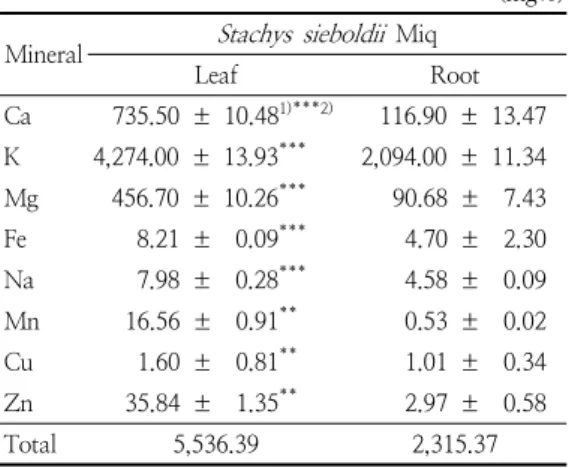
초석잠 잎과 뿌리 분말의 무기질 함량은 Table 6 과 같다. 초석잠 잎과 뿌리 분말 모두 총 8종의 무기 질이 검출되었으며, 잎 분말과 뿌리 분말의 총 무기 질 함량은 각각 5,536.39 mg%과 2,315.37 mg%로 잎

분말이 뿌리 분말에 비하여 2배 이상 총 무기질 함량 이 높았다. 잎과 뿌리 분말 모두 무기질 중 K 함량이 4,724 mg%와 2,094 mg%로 가장 많이 검출되었다.

다음으로 Ca, Mg 순이었고, Fe, Na, Zn, Cu, Mn의 함량은 미량 함유한 것으로 나타났다. K은 Na, Cl 및 H 이온과 함께 산과 염기 균형에 관여하고, 세포내액 에서 Na과 체액의 삼투압과 수분균형을 하는 무기질 이다. 이러한 K의 섭취는 고혈압 예방과 치료에 효과 적이라고 보고되었다(Lee et al. 2013b). 생도라지와 흑도라지는 각각 K 함량이 1,180.75 mg%, 990.02 mg%로 가장 많이 검출되었고, Ca, Mg 순으로 검출 되었으며(Lee et al. 2013b), 야콘(Kim et al. 2010a) 은 무기질 조성 중 K 함량이 414.56 mg%로 가장 높 았고 Na, Ca, Mg 순으로 검출되었다.

7. 추출수율

초석잠 잎과 뿌리 분말의 생리활성을 알아보기 위 해 시료를 80% 에탄올로 추출하여 감압ㆍ농축한 후 고형분 함량을 3회 반복 측정하여 추출수율로 계산

Mineral Stachys sieboldii Miq

Leaf Root

Ca 735.50 ± 10.48 1)***2) 116.90 ± 13.47 K 4,274.00 ± 13.93 *** 2,094.00 ± 11.34 Mg 456.70 ± 10.26 *** 90.68 ± 7.43 Fe 8.21 ± 0.09 *** 4.70 ± 2.30 Na 7.98 ± 0.28 *** 4.58 ± 0.09 Mn 16.56 ± 0.91 ** 0.53 ± 0.02 Cu 1.60 ± 0.81 ** 1.01 ± 0.34 Zn 35.84 ± 1.35 ** 2.97 ± 0.58

Total 5,536.39 2,315.37

1) All values are expressed as mean ± SE of triplicate determinations.

2) Significant differences between Stachys sieboldii Miq leaf and tachys sieboldii Miq root measured by Student’s t-test ( * p<0.05, ** p<0.01, *** p<0.001).

Table 6. Contents of minerals in Stachys sieboldii Miq powder from different aerial parts

(mg%)

Item Stachys sieboldii Miq

Leaf 1) Root 2)

Extraction yield

(%, dry basis) 27.21 ± 0.87 3)**4) 58.51 ± 0.35 Total polyphenol

(mg TAE/g) 236.35 ± 4.03 *** 20.44 ± 0.72 Total flavonoid

(mg RE/g) 101.76 ± 12.30 *** 11.51 ± 0.24

1) Stachys sieboldii Miq leaf 80% ethanol extract 1,000 ppm (1 mg/mL).

2) Stachys sieboldii Miq root 80% ethanol extract 1,000 ppm (1 mg/mL).

3) All values are expressed as mean ± SE of triplicate determinations.

4) Significant differences between between Stachys sieboldii Miq leaf and tachys sieboldii Miq root measured by Student’s t-test ( * p<0.05, ** p<0.01,

*** p<0.001).

Table 7. Extraction yield, total polyphenols, and

total flavonoids of Stachys sieboldii Miq

leaf and root 80% ethanol extracts

(10)

한 결과는 Table 7과 같다. 에탄올은 각종 추출물 제 조에 다양하게 이용되는 용매로서 안전성이 높고, 생 약류와 식물의 에탄올 추출물에서 높은 항산화력을 보여(Kang et al. 1998), 본 실험에서도 초석잠 잎과 뿌리 분말을 80% 에탄올로 추출하여 각각 27.21%와 58.51%의 추출수율을 보였다. 서양 민들레의 부위별 에탄올 추출물 추출수율을 보면 잎은 26.66%, 뿌리 는 29.74%로 부위별로 비슷하다고 보고(Han et al.

2011)하였으나, 본 연구에서는 뿌리가 잎보다 추출수 율이 유의하게 높았다. 해방풍 부위별 에탄올 추출물 의 추출수율은 잎(28.33%)이 뿌리(30.17%)에 비하여 약간 낮은 것으로 나타났다(Gu et al.2017). Kang et al.(1998)이 연구한 각종 생약들의 에탄올 추출수율 을 보면, 생송지가 98.11%로 초석잠 뿌리 보다 더 높 은 수율을 보였으나, 산사자 32.04%, 울금 12.82%, 당귀 12.55%로 보고되었고, 동충하초 10.39%, 가시 오가피 15.37%, 단삼 11.93%의 추출수율을 보여 (Kim et al. 2013), 초석잠 뿌리의 추출수율이 각종 생약성분들보다 더 높았다. 추출수율이 갖는 의미는 아무리 천연 추출물의 생리활성 효과가 높게 인정된 다 하더라도 그 추출수율이 낮으면 경제성이 없어 실 질적으로 이용되기 어렵다. 이러한 관점에서 추출수 율은 식물 추출물의 산업화를 위해 고려되어야 할 중 요한 요인으로서, 그 기준은 현재 국내에서 산업적으 로 많이 사용되고 있는 탈지미강 추출물의 추출수율 이 7~10%이며(Jung 1990), 일반적으로 추출수율이 10% 이상이 되어야 경제성이 있다고 알려져 있다 (Park et al. 2003). 따라서 본 실험의 초석잠 잎과 뿌 리 추출수율은 27.21%와 58.51%로 경제적 측면에서 활용 가능성이 높은 식물 소재라고 생각된다.

8. 총 polyphenol와 총 flavonoid 함량 본 실험에서는 초석잠 잎과 뿌리 분말 에탄올 추 출물의 총 polyphenol과 총 flavonoid 함량 분석 결 과는 Table 7과 같다. 초석잠 잎과 뿌리 분말 에탄올 추출물의 총 polyphenol 함량은 각각 236.35 mg/g 과 20.44 mg/g로 나타나, 잎 추출물이 뿌리 추출물

에 비하여 총 polyphenol 함량이 유의하게 높았다.

본 연구와 유사하게 흰 민들레의 부위별 에탄올 추출 물의 총 polyphenol 함량도 잎 추출물(43.52 mg/g) 이 뿌리 추출물(11.36 mg/g)에 비해 높게 나타났으 며(Park et al. 2015), 초석잠 부위별 에탄올 추출물 이 흰 민들레의 부위별 에탄올 추출물에 비하여 총 polyphenol 함량이 높게 나타났다. 해방풍 에탄올 추출물도 잎 추출물(10.79 g/100g)이 뿌리 추출물 (3.54 g/100g)에 비하여 높게 나타났다(Gu et al.

2017). Phenol성 화합물의 phenol hydroxyl기는 자 유라디칼과 결합하여 안정화된 공명구조의 phenoxy radical을 형성하여 직접적으로 자유 라디칼들을 소 거하거나, 항산화 효소와 함께 간접적으로 자유 라디 칼을 제거하여 항산화 효과, 간 보호 작용, 항암 및 항균 등의 생리활성기능을 가지고 있다(Lee & Lee 1994). 따라서 식물체가 지니고 있는 phenol 화합물 의 함량을 통하여 식물체로부터 천연 추출물의 항산 화 활성을 파악하는데 일차적인 자료가 될 수 있다 (Boo et al. 2009). 초석잠의 총 polyphenol 함량을 분석한 선행 연구를 살펴보면, Jung et al.(2014)의 연구에서 초석잠 뿌리 에탄올 추출물의 총 phenol 함량을 측정한 결과 24.58 mg/g으로 본 연구결과와 유사한 결과를 보였다. 생도라지와 흑도라지 메탄올 추출은 각각 11.89 mg/g, 28.38 mg/g으로 나타났다 (Lee et al. 2013a).

초석잠 잎과 뿌리 분말 에탄올 추출물의 총 flavonoid

함량을 측정 결과는 각각 101.76 mg/g과 11.51

mg/g으로 나타났다(Table 7). 흰 민들레의 부위별

에탄올 추출물의 총 flavonoid 함량도 잎 추출물

(24.89 mg/g)이 뿌리 추출물(6.31 mg/g)에 비해 높

게 나타났으나(Park et al. 2015), 본 연구 결과에 비

하여 총 flavonoid 함량이 두 부위 모두 낮은 것으로

나타났다. 해방풍 에탄올 추출물도 잎 추출물(2.01

g/100g)이 뿌리 추출물(0.79 g/100g)에 비하여 높게

나타났다(Gu et al. 2017). Flavonoid는 주로 식물의

잎, 뿌리, 꽃 등에 함유되어 있으며, 담황색 또는 노

란색을 띠는 천연 polyphenol 화합물의 총칭으로 자

(11)

연에서 유리상태로 존재하기도 하지만 주로 rhamnose, glucose, rutiose 등의 당류와 에테르결합을 통해 배 당체 형태로 존재하여 활성 산소종을 효과적으로 제 거한다고 알려져 있다(Heim et al. 2002). Tae et al.(2016)는 건조방법에 따른 초석잠 뿌리 에탄올 추 출물의 총 flavonoid 함량을 분석한 결과, 열풍건조 와 동결건조 각각 3.73 mg/100 g와 357.27 mg/100 g 으로 보고하였으며, Lee et al.(2014)은 초석잠 뿌 리의 flavonoid 함량은 221.00 mg/g으로 나타나, 동 결건조한 본 연구결과보다 높게 나타났다. Lee et al.(2001)이 보고한 식물성식품 속 근채류들의 flavonoid 함량은 풋마늘 4.01 mg/g, 당근 2.54 mg/g, 씀바귀 1.93 mg/g, 생강 1.98 mg/g, 적무 1.31 mg/g로 본 연구의 초석잠의 flavonoid 함량이 다소 높은 것으로 나타났다. 따라서 본 연구에서 초석잠 뿌리와 같이 약용으로 쓰이는 근채류들에 비해 초석잠 뿌리에서 더 높은 함량의 polyphenol 및 flavonoid를 함유하고 있는 것으로 나타났다.

9. 전자공여능 활성

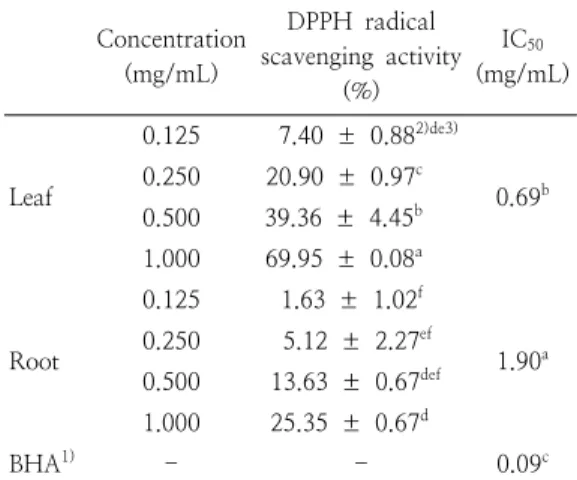
본 연구에서 초석잠 잎과 뿌리 분말 에탄올 추출물 의 전자공여능은 Table 8에서와 같이 농도 의존적으로 나타났으며, 초석잠 잎 추출물이 뿌리 추출물에 비하 여 전자공여능이 더 우수하였다. 50% DPPH radical 소거능 농도인 IC 50 값을 구한 결과는 초석잠 잎 추출물 은 0.69 mg/mL, 초석잠 뿌리 추출물은 1.90 mg/mL로 초석잠 잎이 뿌리에 비하여 항산화 활성이 좋은 것으 로 나타났다. 그러나 초석잠 부위별 추출물의 DPPH radical 소거능은 양성대조군으로 사용한 합성항산화 제인 BHA에 비하여 낮은 것으로 나타났다. 인삼의 부 위별 에탄올 추출물의 DPPH radical 소거능도 본 연구 와 비슷하게 잎이 뿌리에 비하여 우수하다고 보고하면 서, 이는 인삼의 잎이 flavonoid 함량이 많았기 때문이 라고 보고하였다(Lee et al. 2004). 해방풍과 흰 민들레 부위별 에탄올 추출물의 DPPH radical 소거능의 경우 도 잎 추출물이 뿌리 추출물에 비하여 훨씬 우수한 것으로 나타났다(Park et al. 2015; Gu et al. 2017).

본 연구결과 총 polyphenol과 총 flavonoid 함량이 높 게 나타난 잎 추출물이 DPPH radical 소거활성도 높게 나타나 총 polyphenol이 증가하면 항산화 활성도 증가 한다는 연구 결과와도 유사한 경향이였다(Lee et al.

2004; Park et al. 2015; Gu et al. 2017).

Concentration (mg/mL)

DPPH radical scavenging activity

(%)

IC 50

(mg/mL)

Leaf

0.125 7.40 ± 0.88 2)de3) 0.69 b 0.250 20.90 ± 0.97 c

0.500 39.36 ± 4.45 b 1.000 69.95 ± 0.08 a

Root

0.125 1.63 ± 1.02 f

1.90 a 0.250 5.12 ± 2.27 ef

0.500 13.63 ± 0.67 def 1.000 25.35 ± 0.67 d

BHA 1) - - 0.09 c

1) BHA: Butylated hydroxyanisole.

2) All values are expressed as mean ± SE of triplicate determinations.

3) Different superscript letters indicate significant differences at p<0.05 by Duncan’s multiple range test.

Table 8. DPPH radical scavenging activities of Stachys sieboldii Miq leaf and root 80% ethanol extracts

Ⅳ. 요약 및 결론

초석잠 잎과 뿌리 분말의 영양성분과 항산화효과 를 분석한 결과를 보면 일반성분은 초석잠 잎 분말이 뿌리 분말에 비하여 조단백질과 조지방 함량이 높았 으나, 조회분과 탄수화물 함량은 유의하게 낮았다.

초석잠 잎과 분말의 주된 아미노산은 glutamic acid

이며, 총 아미노산과 필수아미노산 함량은 잎 분말이

뿌리 분말에 비하여 높게 나타났다. 초석잠 뿌리 분

말은 잎 분말에 비하여 단일불포화지방산과 다가불

포화지방산 함량이 높게 나타났으며, 초석잠 잎과 뿌

리 분말 모두 불포화지방산 중 linoleic acid 함량이

가장 높았다. 총 유기산 함량은 잎 분말이 뿌리 분말

(12)

에 비하여 높았으며, 잎 분말의 주된 유기산은 tartaric acid이고, 뿌리 분말의 주된 유기산은 malic acid였다. 비타민 A 함량은 초석잠 잎 분말이 가장 높았으며, 비타민 C 함량은 뿌리 분말이 높았다. 초 석잠 잎과 뿌리 분말 모두 무기질 중 K 함량이 가장 많이 검출되었으며, 다음으로 Ca, Mg 순이었고, Fe, Na, Zn, Cu, Mn의 함량은 미량 함유한 것으로 나타 났다. 초석잠 잎과 뿌리 분말 에탄올 추출물의 추출 수율은 각각 27.21%와 58.51%였다. 초석잠 잎 분말 에탄올 추출물의 총 polyphenol과 총 flavonoids 함 량은 각각 236.35 mg/g과 101.76 mg/g로 뿌리 분말 에탄올 추출물의 20.44 mg/g와 11.51 mg/g에 비하 여 유의하게 높았다. DPPH radical 소거능은 초석잠 잎과 뿌리 추출물 모두 농도 의존적으로 증가되었으 며, 50% DPPH radical 소거능 농도인 IC 50 값도 초석 잠 잎 추출물(0.69 mg/mL)이 초석잠 뿌리 추출물 (1.90 mg/mL)에 비하여 항산화 활성이 우수한 것으 로 나타났다. 이상의 결과 초석잠은 향후 기능성 식 재료 소재로서 다양하게 활용 가능할 것으로 기대되 어지나, 추후 in vivo 연구를 통한 기능성 효능 검증 방안의 모색이 필요하다.

References

AOAC(2005) Official methods of analysis. 18th ed.

Association of official analytical chemists, Washington, DC, USA.

Baek HS, Na YS, Kim DH, Lee CH, Ryu BH, Song SK(2004) Antioxidant activities of Stachys sieboldii MIQ roots.

J Life Sci 14(1), 1-7

Blois MS(1958) Antioxidant determinations by the use of a stable free radical. Nature 181, 1199-1203 Boo HO, Lee HH, Lee JW, Hwang SJ, Park SU(2009)

Different of total phenolics and flavonoids, radical scavenging activities and nitrite scavenging effects of Momordica charantia L. according to cultivars. Korean J Med Crop Sci 17(1), 15-20

Chae SK, Kang GS, Ma SJ, Bang KW, Oh MW, Oh SH(2002) Standard food analysis. Paju: Jigu-Moonwha Sa, pp381-382

Feng K, Chen W, Sun L, Liu J, Zhao Y, Li L, Wang Y, Zhang W(2015) Optimization extraction, preliminary characterization and antioxidant activity in vitro of

polysaccharides from Stachys sieboldii Miq. Carbohydr Polym 125(10), 45-52

Folin O, Denis W(1912) On phosphotungastic - phosphomolybdic compounds as color regents. J Biol Chem 12, 239-249

Gu YR, Kim SW, Son YW, Hong JH(2017) Antioxidant activities of solvent extracts from different Glehnia Radix parts and their inhibitory effect against nitric oxide production in raw 264.7 cell. Korean J Food Preserv 24(1), 116-124

Han EK, Jung EJ, Lee JY, Jin YX, Chung CK(2011) Antioxidative activity of ethanol extracts from different parts of Taraxacum officinale . Korean J Soc Food Sci Nutr 40(1), 56-62

Han SJ, Koo SJ(1993) Study on the chemical composition in bamboo shoot, lotus root and burdock - free sugar, fatty acid, amino acid and dietary fiber contents -.

Korean J Soc Food Sci 9(2), 82-87

Heim KE, Tagliaferro AR, Bobilya DJ(2002) Flavonoid antioxidants: chemistry, metabolism and structure- activity relationships. J Nutr Biochem 13(10), 572-584 Hong JK(2009) A Study on skin aging caused by

free-radical and on efficacy of antioxidant vitamins.

Asian J Beauty Cosmetol 7(2), 51-62

Hwang CR, Oh SH, Kim HY, Lee SH, Hwang IG, Shin YS, Lee JS, Jeong HS(2011) Chemical composition and antioxidant activity of Deoduk( Codonopsis lanceolata ) and Doragi ( Platycodon grandiflorum ) according to temperature. J Korean Soc Food Sci Nutr 40(6), 798-803

Jeon KS, Lee NH, Park SI(2015) Quality characteristics of white pan bread with Chinese artichoke( Stachys sieboldii MIQ) powder. Korean J Culin Res 21(4), 1-15 Joo EY, Kang WJ(2005) Analysis on the components of

the Angelica dahurica root. Korean J Food Preserv 12(5), 476-481

Jung MJ, Lee SM, Joo NM(2014) Optimization of rice cookies prepared with Chinese artichoke ( Stachys sieboldii Miq) powder using response surface methodology and quality characteristics. Korean J Food Nutr 27(3), 435-446

Jung SW(1990) A study on the extraction of antioxidative materials from defatted rice bran. M.S Thesis, Korea University

Kang WS, Kim JH, Park EJ, Yoon KR(1998) Antioxidative property of turmeric( Curcumae Rhizoma ) ethanol extract. Korean J Food Sci Technol 30(2), 266-271 Kim AR, Lee JJ, Jung HO, Lee MY(2010a) Physicochemical

composition and antioxidative effects of Yacon ( Polymnia Sonchifolia ). J Life Sci 20(1), 40-48 Kim DH, Lim DW, Bai S, Chun SB(1997) Fermentation

characteristics of whole soybean meju model system inoculated with 4 Bacillus strains. Korean J Food Sci Technol 29(5), 1006-1015

Kim HS, Kim TW, Kim DJ, Lee JS, Kim KK, Choe M(2013)

(13)

Antioxidant activities and α-glucosidase inhibitory effect of water extracts from medicinal plants. Korean J Med Crop Sci 21(3), 197-203

Kim MJ, Park HS, Lee CI, Kim SH, Kim PN, Huh W, Lee DY, Son JC(2010b) Component analysis and antioxidant effects of Youngia sonchifola Max. J Food Hyg Safety 25(4), 354-359

Kim YS, Kim SS, Kim CJ, Kwon JH(1995) Quantitative fractionation of total lipids and their fatty acid composition in Korean yam tubers. Korean J Food Sci Technol 27(5), 652-657

Korea Food and Drug Association(2005) Food standards codex. Korean Foods Industry Association. Seoul, Korea. pp367-368, pp383-385

Lee JE, Jin SY, Han YS(2014) Antioxidant activities and quality characteristics of Tofu supplemented with Chinese artichoke powder. Korean J Food Nutr 27(1), 10-21

Lee JH, Lee SR(1994) Some physiological activity of phenolic substances in plant foods. Korean J Food Sci Technol 26(3), 310-316

Lee JJ, Kim AR, Seo YN, Lee MY(2009) Comparison of physicochemical composition of three species of Genus angelica. Korean J Food Preserv 16(1), 94-100 Lee JM, Son ES, OH SS, Han DS(2001) Contents of total

flavonoid and biological activities of edible plants.

Korean J Diet Cult 16(5), 504-514

Lee SE, Lee SW, Bang JK, Yu YJ, Seong NS(2004) Antioxidant activities of leaf, stem and root of Panax ginseng C. A. meyer. Korean J Med Crop Sci 12(3), 237-242

Lee SJ, Bang WS, Hong JY, Kwon OJ, Shin SR, Yoon KY(2013a) Antioxidant and antimicrobial activities of black Doraji( Platycodon grandiflorum ). Korean J Food Preserv 20(4), 510-517

Lee SJ, Shin SR, Yoon KY(2013b) Physicochemical characteristics of black Doraji ( Platycodon grandiflorum ).

Korean J Food Sci Thechnol 45(4), 422-427 Lee SW, Jung TH, Shin YW(2013) A comparative study

of memory improving effects of Stachys rhizome and Lycopi rhizome on scopolamine-induced amnesia in mice. Korean J Herbol 28(5), 69-77

Park MS, Jeong BR, Bahk GJ(2015) Antioxidant activity and cytotoxicity of ethanol extracts from different parts of Taraxacum coreanum Nakai cultivated in South Korea. Korean J Food Nutr 28(4), 594-601

Park SH, Lim HY, Han JH(2003) A study of medicinal herbs for functional food application (Ⅰ) - nutritional composition and scoplectin analysis of Artemisia capillaris . J East Asian Soc Diet Life 13(6), 552-560 Ryu BH, Kim SO(2004) Effects of methanol extract of

Stachys sieboldii MIQ on acetylcholine esterase and monoamine oxidase in rat brain. Korean J Food Nutr 17(4), 347-355

Ryu BH, Park BG, Song SK(2002a) Antitumor effects of the hexane extract of Stachys sieboldii Miq. Korea J Life Sci 17(6), 520-524

Ryu BH, Park BG(2002b) Antimicrobial activity of the hexane extract of Stachys sieboldii Miq leaf. J Life Sci 12(6), 803-811

Sasaki H, Nishimura H and Morita T(1989) Immunosuppressive principles of Rehmannia glutionsa var. hueichingensis.

Plant Med 55(5), 485-462

Shin SC(1997) A study on the free sugar and amino acids in Korean arrow root. Korean J Plant Res 10, 1-5 Stadhouders PJ(1990) Elsevier’s dictionary of horticultural

and agricultural plant production. p72, 20th ed.

Elsevier Science Publication

Waters Associates(1990) Analysis of amino acid in waters.

PICO, TAG system. Seoul: Young-in Scientific Co.

Ltd., pp41-46

Wungaarden DV(1967) Modified rapid preparation fatty acid esters from liquid for gas chromatographic analysis . Anal Chem 39(7), 848-850

Tae MH, Kim KH, Yook HS(2016) Physicochemical and sensory properties of soup added with Stachys sieboldii Miq root powder. J Korean Soc Food Sci Nutr 45(4), 557-561

Takeda Y, Fujita T, Satoh T, Kakegawa H(1985) On the glycosidic constituents of Stachys sieboldii Miq. and their effects on hyaluronidase activity. Yakugaku Zasshi 105(10), 955-959

Yamahara G(1990) Studies on the Stachys sieboldii Miq.

II. Anti-anoxia action and the active constituents.

Yakugaku Zasshi 110(12), 932-935

Yang MR(2012) The analysis of bioactive materials in Stachy sieboldii Miq and it's application on functional ready-to-eat food. PhD Dissertation, Gyeongnam University

Yin J, Yang G, Wang S, Chen Y(2006) Purification and

determination of stachyose in Chinese artichoke

( Stachys Sieboldii Miq.) by high-performance liquid

chromatography with evaporative light scattering

detection. Talanta 70(1), 208-212

수치

Table  1.  Proximate  compositions  of  Stachys  sieboldii Miq  powder  from  different  aerial  parts
Table  2.  Contents  of  free  amino  acids  in  Stachys  sieboldii Miq  powder  from  different  aerial  parts (mg%)
Table  3.  Compositions  of  fatty  acids  in  Stachys  sieboldii   Miq  powder  from  different  aerial  parts   (%  total  fatty  acids)
Table  4.  Contents  of  organic  acids  in  Stachys  sieboldii   Miq  powder  from  different aerial  parts
+3

참조

관련 문서