24
교신저자:유희철, 전북대학교병원 간담췌이식외과
561-712, 전주시 덕진구 건지로 20 Tel: 063-250-1576, Fax: 063-250-6197 E-mail: [email protected]
접수일:2012년 8월 10일, 수정일:2012년 9월 23일 게재승인일:2012년 10월 24일
본 연구는 2010년 한국정맥경장영양학회에서 대상(주) 학술 연구기금 지원으로 이루어졌음.
췌십이장절제술 환자의 휴식대사량 측정방법 비교 분석
1
전북대학교 의학전문대학원 외과학교실,
2전북대학교병원 영양집중지원팀,
3전북대학교병원 의생명연구원,
4
전북대학교 생활과학대학 식품영양학과
김선형
2,4ㆍ유희철
1,2ㆍ조백환
1,2ㆍ채수완
3ㆍ정미진
2ㆍ최영란
2ㆍ김행순
2ㆍ김주신
2ㆍ김숙배
4A Comparison Between Measured and Pre- dicted Resting Energy Expenditure of Pan- creaticoduodenectomy Patients
Seon Hyeong Kim2,4, Hee Chul Yu, M.D.1,2, Baik Hwan Cho, M.D.1,2, Soo Wan Chae, M.D.3, Mi Jin Jeong2, Yeong Ran Choi2, Haeng Sun Kim, Ph.D.2, Ju Sin Kim, Ph.D.2, Sook Bae Kim, Ph.D.4
1Department of Surgery, Chonbuk National University Medical School, 2Nutrition Support Team, 3Biomedical Research Institute, Chonbuk National University Hospital, 4Department of Food Science and Human Nutrition, Chonbuk National University, Jeonju, Korea
Purpose: An accurate determination of energy expenditure is needed to prevent postoperative complications and provide effective medical care for surgical patients. The aim of this study was to compare measured resting en- ergy expenditure (REE) in patients undergoing pancreati- coduodenectomy (PD) using an indirect calorimetry (IC) with the help of five predictive equations.
Methods: The subjects chosen for the study were 18 pa- tients (12 males, 6 females) who underwent PD at Chon- buk National University Hospital between March 2010 and October 2011. REE was measured by IC (ICREE) and cal- culated with the following five predictive equations - (eqREE)-Harris-Benedict (HB), Mifflin St. Jeor (MI), American College of Chest Physician (AC), Ireton- Jones (IJ) and Cunningham (CU) equation - on postoperative day 3.
Results: The mean measured REE by IC was 1,117.9
±180.2, whereas the mean predicted REE by HB, MI, AC, IJ and CU equations were 1,241.3±156.1, 1,226±153.0, 1,401.7±188.0, 1,355.1±342.7, and 1,324.8±188.7 kcal/
day, respectively. The mean predicted REE by HB, MI, AC, IJ, and CU were found to be significantly different from the measured ICREE. The intraclass correlation co-
efficient (ICC), which describes the degree of agreement with the ICREE, was significantly highest in CUeqREE (r=
0.679). The rate of accuracy of HBeqREE, MIeqREE, ACeqREE, IJeqREE, and CUeqREE for ICREE was 27.8%, 50.0%, 27.8%, 22.2%, and 23.5%, respectively, in individual subjects.
Conclusion: The intraclass correlation coefficient (r=
0.124∼0.679) and accuracy rate (22.2∼50.0%) determi- ned from the results of REE measured by IC and that cal- culated by five predictive equations were low in overall.
The low accuracy rate of energy expenditure by equa- tions, which apply uniform indicators, can be explained by ongoing metabolic changes of the patient. Thus, the use of IC is recommended to assess energy requirements in PD; when this method is not practical in clinical set- tings, nutrition intervention is needed through regular mo- nitoring because of the low accuracy rate of the predictive methods and ICREE that can cause inappropriate energy management, leading to metabolic disorders. (JKSPEN 2013;5(1):24-30)
Key Words: Indirect calorimetry, Rest energy expendi- ture, Predictive energy expenditure, Equation
중심 단어: 간접열량측정기, 휴식에너지소비량, 예측에너지 소비량, 공식
서 론
수술 환자의 영양 상태는 수술 후 예후, 합병증, 유병률 및 재원 기간 등에 영향을 미친다. 에너지부족은 수술 부위 와 상처의 회복 지연, 면역기능 약화 및 호흡기 의존 기간을 연장시키고, 에너지의 과잉공급은 고혈당, 전해질 불균형, 고지혈증, 폐기능 부전 등의 합병증을 유발시킬 수 있으므 로 정확한 에너지요구량 산정을 통한 적절한 영양중재는 치료의 중요한 요소이다.1,2
췌십이지장절제술(pancreaticoduodenectomy, PD)은 영양 소 소화흡수와 직접적으로 연관된 다장기(muti-organs)를 절 제, 재건하는 수술로서 다장기 기능부전 및 인슐린 저항의 증가로 설사, 복부경련, 과량의 가스 생산, 위배출 지연
Fig. 1. Picture of indirect calorim- etry and take a measurement.
(delayed gastric emptying) 등의 합병증에 따른 영양불량 위 험성이 높다. 그러나 최근 연구들은3,4 영양지원 등 적극적 인 영양중재를 통해 장운동 시작, 재원일 및 퇴원 후 회복기 간 등의 단축 효과를 보여주고 있어 PD환자에서 영양관리 가 중요시되고 있다.
에너지요구량을 결정하는 최적의 방법은 간접열량측정 기(indirect calorimetry, IC)를 이용한 산정이지만, 장비 구입 비용이 고가이며 시간, 공간적 제한과 사용절차의 번거로 움으로 훈련된 인력이 요구된다.5 이에 실제 임상에서는 간 편하고 경제적이며 사용하기 용이한 공식들을 기관들의 선 호에 따라 선정하여 이용하고 있다. 그러나 공식을 이용한 산정방법은 공식의 종류와 평가자에 따른 스트레스, 손상 계수 등의 고려계수가 다를 수 있어 산정한 에너지요구량 에 차이가 있다. 이에 본 연구는 PD 환자를 대상으로 간접 열량측정기에 의한 휴식대사량과 임상에서 널리 사용되고 있는 5가지 공식(Harris-Benedict, Mifflin, American College of Chest Physician, Ireton-Jones, Cunningham)으로 산정한 휴 식대사량을 비교 분석하여 간접열량측정기와 근접하는 공 식을 알아보고자 한다.
대상 및 방법
연구 대상자는 전북대학교병원에서 PD를 시행한 18명 (남 12명, 여 6명)으로 하였다. 연구 참가자는 29명이며 PD 를 계획하였으나 실제 PD를 시행하지 못한 환자 4명, 수술 후 3일째 연구 참가를 거부한 환자 2명, 수술 후 3일째 혈액 역동학적 불안정 환자 4명, 수술 직전 수술을 거부한 환자 1명을 포함한 11명의 중도 탈락자가 발생하였다.
18세 미만, 낭포성 섬유종, 발열, 마비(quatraplegia, para- plegia)가 있거나 카테콜라민, 진정제, 근육이완제가 처방된 대상자는 기초대사량에 영향을 미칠 수 있어 제외하였다.
본 연구는 전북대학교병원 임상시험위원회(Institutional Re- view Board)의 승인을 얻고 환자의 동의를 받아 2010년 3월 부터 2011년 10월까지 시행하였다.
대상자는 수술 후 3일째 IC (Vmax 29n; Sensor Medics Co., Yorba Linda, CA, USA)에 의한 휴식에너지소비량 (Resting Energy Expenditure measured Indirect Calorimetry, ICREE) 측정과 수술 전날 Bio Impedence Analyzer (Inbody720;
Biospace Co., Seoul, Korea)에 의한 제지방량(fat free mass), 신장(height), 체중(weight)을 측정한 후 공식에 적용하여 에 너지요구량을 산정하였고 체질량지수(body mass index, BMI)는 체중을 신장의 제곱으로 나누어 계산하였다(kg/m2).
성별, 나이, 진단명, 수술 및 입원일수 등의 일반적 특징과 약제사용 여부는 의무기록지를 검토하였고 영양공급 경로 및 공급량에 대한 정보조사는 의무기록지와 24시간 회상법 을 이용한 환자 및 보호자와의 면담을 통하여 수집하였다.
1. 간접열량측정기
간접열량측정기는 제조사의 권고에 따라 측정 시마다 가 스분석기를 보정하였다. 측정 5시간 전 부터 금식하였고 지 속적으로 주입되는 영양소와 약물의 주입속도는 12시간 전 부터 일정하게 유지시켰다. 또한 측정 전 30분 동안 휴식을 취하며 호흡계수 변화율 <5%, 산소 소비량과 이산화탄소 발생량의 변화율 <10%로 5분 이상 지속적으로 유지되는 평형상태(steady state)에서 반듯하게 누운 자세로 30분 동안 측정하였다. 측정오차를 줄이기 위해 전담 연구원 1명이 적 정 실내온도(thermoneural)가 유지되는 전용병실에서 측정 하였다(Fig. 1).6
2. 휴식대사량 산정 공식
신체계측, 또는 의무기록지를 통하여 용이하게 얻을 수 있는 체중, 신장, 나이 등을 적용하는 Harris-Benedict (HB),7
Table 2. Demographic and anthropometric data
Measurement Data (N=18)
Sex (male/female) Age (yr) Weight (kg) Height (cm)
Ideal body weight (kg) Fat free mass (kg) BMI (kg/m2) Underweight1 Adequate Overweight Obese Diagnosis
Pancreatic head carcinoma Ampulla of vater carcinoma Distal common bile duct carcinoma Operation procedure
Pylorus preserving pancreaticoduodenectomy Whipple procedure
12/6 62.5±12.5 59.4±8.9 160.5±7.3 56.5±5.5 44.2±8.7 23.0±2.7 1 (5.6) 11 (61.1)
6 (33.3) 0 (0)
6 5 7
12 6 Values are presented as mean±standard deviation, number (%), or number only.
1Classified according to the criteria of the World Health Organization body mass index (BMI) <18.5 is underweight, BMI 18.5∼24.9 is adequate, BMI 25∼29.9 is overweight, BMI >30 is obese.
Table 1. Predictiive equations for REE (kcal/day)
Equation Formula (eqREE)
Harris-Benedict
Mifflin
American College of Chest Physician Ireton-Jones
Cunningham
13.75 (W)+5 (H)-6.8 (A)+66 in male 9.6 (W)+1.8 (H)-4.7 (A)+655 in female 10 (W)+6.25 (H)–5 (A)+5 in male 10 (W)+6.25 (H)–5 (A)-161 in female 25 kcal/kg actual wt in non-obese subject 25 kcal/kg adjust wt in obese subject 629-(11A)+(25W) in non-obese subject 629-(11A)+(25W)-609 in obese subject 370+(21.6×FFM)
REE = resting energy expenditure; W = weight (kg); H = height (cm); A = age (yr); FFM = fat free mass (kg).
Table 3. Nutrition route andtotal energy intake (18 patients)
Variable Preoperative
day 1
Preoperative day 3 Nutrition route
Parenteral Parenteral+oral NPO
Total energy intake (kcal/day)
12 1 5 875
0 15 3 1,050 NPO = nil per os = Nothing By Mouth.
Mifflin. St. Jeor (MI),8 American College of Chest Physician (AC),9 Ireton-Jones (IJ)10 공식과 제지방량을 이용하는 Cun- ningham (CU)11 공식으로 휴식대사량(predictiive equations for resting energy expenditure, eqREE)을 산정하였다(Table 1).
3. 통계분석
통계처리는 PASW Statistics (version 18.0; IBM Co., Armonk, NY, USA), SAS (version 9.2; SAS Inc., Cary, NC, USA)를 이용하여 분석하였다.
연구 대상자의 ICREE에 대한 HBeqREE, MIeqREE, ACeqREE, IJeqREE, CUeqREE의 비교와 일치도를 알아보기 위해 paired t-test, intraclass correlation coefficient (ICC), Bland-Altman12 분석 방법을 사용하였다. 각 공식의 정확도는 대상자 개인 별의 eqREE를 ICREE와 비교하여 eqREE가 ICREE의 90∼110%
는 적절 공급, ICREE의 110% 초과는 과잉 공급, ICREE의 90%
미만은 부족 공급으로 구분하며 eqREE가 ICREE의 90∼110%
를 보여주는 적절 공급 대상자 수의 백 분율(%)로 나타낸 다.13통계적 유의 수준은 0.05로 하였다.
결 과
대상자 18명(남 12명, 여 6명)의 평균 연령은 62.5±12.5세 이며, 실제 체중 59.4±8.9 kg, 신장 160.5±7.3 cm, 표준체중 56.5±5.5 kg, 제지방량 44.2±8.7 kg, BMI는 23.0±2.7 kg/m2였 다. 세계보건기구의 비만 분류 기준에 따른 BMI<18.5의 저 체중은 1명(5.6%), BMI 18.5-24.9의 적정체중 11명(61.1%), BMI 25-29.9의 과체중 6명(33.3%), BMI>30의 비만은 0명 (0.0%)이다. 주 진단명은 췌두부암 6명, 팽대부암 5명, 원위 부총담관암 7명이며 그 중 12명은 유문보존췌십이지장절 제술(pylorus preserving PD), 6명은 휘플(Whipple's) 수술을 시행하였다(Table 2).
영양공급 경로 및 공급량은 수술 전날에 정맥영양을 공급 받은 환자는 12명, 경구섭취와 정맥영양을 병행한 환자는 1 명, 금식은 5명이었으며 평균 에너지공급량은 875 kcal/day이 다. 수술 후 3일째는 18명 모두 경구섭취와 정맥영양을 병행 하였으며 평균 영양공급량은 1,050 kcal/day이다(Table 3).
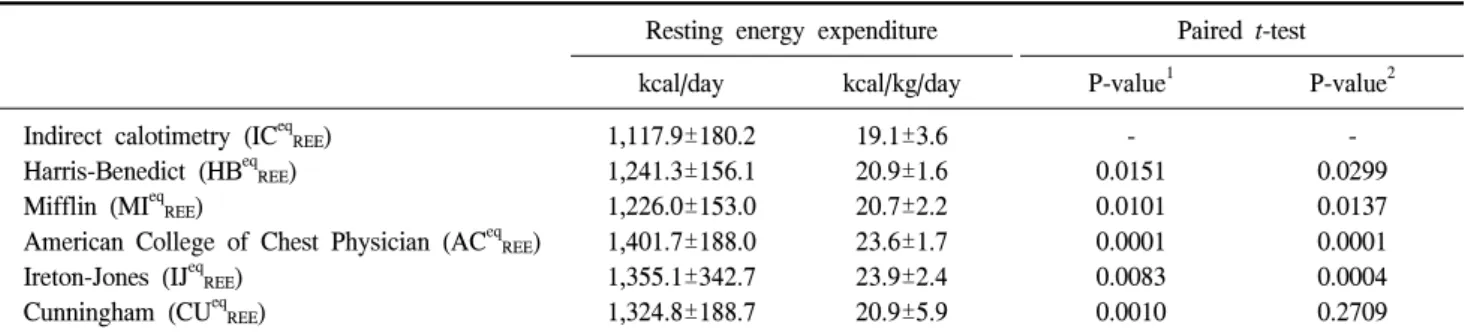
수술 후 3일째 측정한 ICREE 평균값과 비교 공식들 간의 평 균값은 HB, MI, AC, IJ, CU에서 각각 1,117.9±180.2, 1,241.3±
156.1, 1,226±153.0, 1,401.7±188.0, 1,355.1±342.7, 1,324.8±188.7 kcal/day이며 체중당 휴식대사량은 각각 19.1±3.6, 20.9±1.6, 20.7±2.2, 23.6±1.7, 23.9±2.4, 20.9±5.9 kcal/kg/day이다.
ICREE에 대한 공식들의 평균값 비교 시 모든 공식에서 유 의한 차이가 있었다. 체중당 REE (kcal/kg/day) 분석에서
Table 4. Average REE of measured IC and predicted equations
Resting energy expenditure Paired t-test
kcal/day kcal/kg/day P-value1 P-value2
Indirect calotimetry (ICeqREE) Harris-Benedict (HBeqREE) Mifflin (MIeqREE)
American College of Chest Physician (ACeqREE) Ireton-Jones (IJeqREE)
Cunningham (CUeqREE)
1,117.9±180.2 1,241.3±156.1 1,226.0±153.0 1,401.7±188.0 1,355.1±342.7 1,324.8±188.7
19.1±3.6 20.9±1.6 20.7±2.2 23.6±1.7 23.9±2.4 20.9±5.9
- 0.0151 0.0101 0.0001 0.0083 0.0010
- 0.0299 0.0137 0.0001 0.0004 0.2709 Values are presented as mean±standard deviation.
1Comparison mean REE of kcal/day between measured (ICeqREE) and predicted (HBeq, MIeq, ACeq, IJeqE, CUeq) REE.
2Comparison mean REE of kcal/day/kg between measured (ICeqREE) and predicted (HBeq, MIeq, ACeq, IJeq, CUeq) REE.
Statistically significant: P<0.05.
REE = resting energy expenditure.
Table 6. ICC between of measured IC and predicted equations
Equations ICC (r)1 95% CI
P-value Lower bound Upper bound
Harris-Benedict (HBeqREE) Mifflin (MIeqREE)
American College of Chest Physician (ACeqREE) Ireton-Jones (IJeqREE)
Cunningham (CUeqREE)
0.340 0.551 0.124 0.241 0.679
−511.0
−424.8
−771.5
−911.7
−510.3
264.1 280.7 203.9 437.3 88.2
0.077 0.007 0.397 0.160 0.001 One-way random effects model where people effects are random.
10∼1 represents the value of the agreement degree is the closer 1 to the higher: 0∼0.2 indicates poor agreement: 0.3∼0.4 indicates fair agreement; 0.5∼0.6 indicates moderate agreement; 0.7∼0.8 indicates strong agreement; and >0.8 indicates almost perfect agreement.
Statistically significant: P<0.05.
ICC = intraclass correalation coefficient; CI = confidence interval; REE = resting energy expenditure.
Table 5. Accuracy rate of the equations (percentage of predicted ≤10% different from ICREE measured)
HBeqREE MIeqREE ACeqREE IJeqREE CUeqREE2
Appropriate1 Overfeeding Underfeeding
27.8 (5) 61.1 (11) 11.1 (2)
50.0 (9) 50.0 (9) (0)
27.8 (5) 72.2 (13)
(0)
22.2 (4) 61.1 (11) 16.7 (3)
23.5 (4) 76.5 (13)
(0) Values are presented as percentage (number).
1Appropriate feeding, overfeeding, underfeeding means the patient received 90∼110%, >110%, <90% of measured REE, respectively.
2Number of patients is 17 rejected measurement of BIA (fat free mass).
IC = Indirect calotimetry; REE = resting energy expenditure; HB = Harris-Benedict; MI = Mifflin; AC = American College of Chest Physician; IJ = Ireton-Jones; CU = Cunningham.
ICREE에 대한 공식들의 비교값은 HBeqREE, MIeqREE, ACeqREE, IJeqREE에서 유의한 차이가 있었으나 CUeqREE에서는 유의한 차이가 없었다(Table 4).
각 공식별 정확도는 HBeqREE 27.8%, MIeqREE 50%, ACeqREE
27.8%, IJeqREE 22.2%, CUeqREE 23.5%로 MIeqREE가 가장 높은 정확도를 보였다(Table 5).
ICREE과 공식 산출값(eqREE)의 일치도를 나타내는 ICC는
CU (r=0.679), MI (r=0.551), HB (r=0.340), IJ (r=0.241), AC (r=0.124) 순서로 높은 값을 보여주고 있으며 CU, MI는 유 의적으로 높은 일치도를 보여주고 있으나 나머지 공식에서 는 낮게(r=0.340-0.124) 나타났다(Table 6).
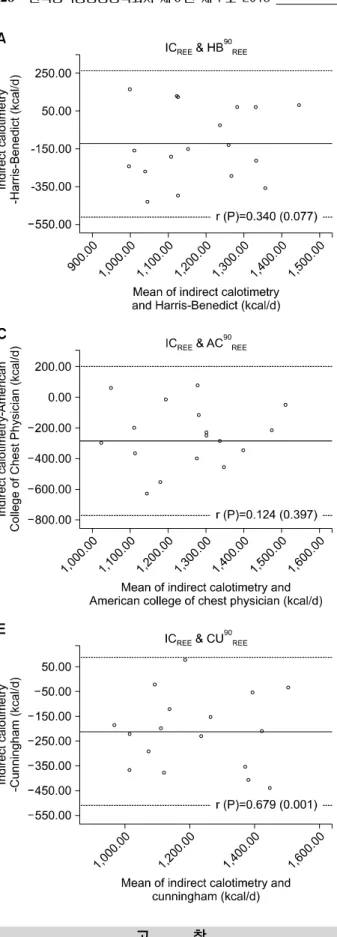
Fig. 2는 ICREE와 HBeqREE, MIeqREE, ACeqREE, IJeqREE, CUeqREE
개인별 일치도의 비교를 그림으로 나타내는 Bland-Altman 분석 결과이다(r=0.340, P=0.077).
Fig. 2. Bland-Altman analysis for comparison of agreement be- tween resting energy expenditure (REE) measured by indirect cal- orimetry and predicted REE using (A) Harris-Benedict, (B) Mifflin St. Jeor, (C) American College of Chest Physician, (D) Ireton-Jones, (E) Cunningham equations. The horizontal lines represent +2SD, mean, and -2SD of the differences between measured and predicted REE.
고 찰
적절한 영양공급은 급성기의 단백질, 백혈구, 콜라겐 등 의 조직 구성물질을 합성하여 상처를 회복시키므로, 수술
후 합병증 예방과 효과적인 치료를 위해 영양관리가 필요 하다. 특히, 적절한 에너지공급은 면역기능 강화, 호흡 및 간 기능을 정상화시켜 유병률 및 사망률을 향상시키므로 적정 에너지요구량 산정이 요구된다.14 PD는 영양소 소화흡
수 및 대사에 직접적으로 연관된 기관(organs)들을 절제 재 건하는 수술로 다양한 합병증과 수술 스트레스로 인한 영 양불량 가능성이 높다. 효과적인 영양공급을 위해 정확한 영양 판정 및 영양요구량 산정이 필요하며 특히 적정 에너 지요구량 산정이 요구된다. 이에 정확도가 높은 간접열량 측정기의 이용을 권장되나 실제 임상에서는 자료수집이 용 이한 지표를 적용하는 공식들을 주로 사용하고 있다. 적절 한 에너지공급을 위하여 IC를 대체할 수 있는 공식을 비교 분석한 연구들을 살펴보면 다음과 같다.
HBeqREE의 ICREE 비교연구에서 Osborne 등15은 심장수술 후 중환자에게 ICREE 대신 HBeqREE를 권장하기도 하였으나, Faria 등16은 25% 환자가 ICREE의 90∼110% 이내로 적정하 게 공급받으며 32∼93%는 과잉공급, 12∼36%는 부족하게 공급받는다고 하였다. 또한 Martins 등2의 연구에서는 ICREE
에 대한 HBeqREE의 낮은 상관관계(r=0.57), 오차 범위 10∼
28%로 IC를 대체할 수 없는 큰 오차값이라 하였다. 여러 연구를 종합하면 HBeqREE의 정확도는 17∼67%이며17-19 본 연구에서도 27.8% 정확도로 낮은 정확도를 보여 주고 있다.
MI 공식은 1990년 건강인 대상으로 개발되었으며 Fran- kenfield 등18의 연구에서는 중환자 대상 MIeqREE와 ICREE 비교 연구에서 25%의 낮은 정확도를 보여주고 있으나 Faria 등16 의 연구에서는 MI 공식이 IC를 대체할 만하다고 하였다.
Frankenfield 등19은 MI 공식이 다른 공식에 비해 가장 정확 도가 높으나 모든 연령, 인종에 일반화하기에는 오류와 제 한점이 있음을 보고하고 있다. 본 연구에서는 50%의 정확 도와 ICC, r=0.551의 일치도로 다른 공식에 비하여 유의적 으로 높은 값을 보여주고 특히 정확도는 사용한 공식 중 가장 높았다.
IJ 공식은 1992년 화상환자를 포함한 대상으로 만들어졌 으며 Walker와 Heuberger17는 중환자에서 IC를 대체할 수 있 는 방법으로 권장하였고 정확도는 28∼83%, 젊은 연령과 비만환자에게서 더욱 높은 값을 보였다고 보고하였다.
ICREE에 대한 IJeqREE의 연구들을 분석한 Frankenfield 등20은 대체적으로 60%의 정확도를 나타낸다고 보고하고 있으나 본 연구에서는 22.2%의 낮은 정확도를 보여 주고 있다.
AC 공식은 1997년 미국 폐 전문의 학회(American College of Chest Physicians)에서 대부분의 환자의 에너지요구량 산정 을 위하여 평소체중(비만인 경우에는 조정체중)의 25 kcal/kg 을 권장하고 있다9. Reid21와 Frankenfield 등18은 ACeqREE을 이 용한 분석에서 각각 18%, 46%의 정확도를 보고하고 있으며 본 연구에서도 27.8%의 낮은 정확도를 보여주고 있다.
CU 공식은 제지방을 이용하여 에너지를 산정하는 방법 으로 Bauer 등22은 췌장암 환자 대상 연구에서 ICREE에 대한 HB, MI, CUeqREE은 대상자 전체의 평균값을 예측하기에 적
당하고 특히 CUeqREE의 경우 개인별 비교 시 ICC r=0.836로 일치도가 높아 IC를 대체할 만하다고 하였으며 본 연구에 서도 r=0.679로 제일 높은 상관값을 나타내고 있으나 정확 도는 23.5%로 낮은 값을 보여주고 있다.
ICREE와 eqREE의 비교한 이번 연구에서 대상자 평균 휴식 대사량값(kcal/day)은 HB, MI, AC, IJ, CU 모든 공식에서 유 의한 차이를 보이고 평균 체중당 휴식대사량값(kcal/kg/
day) 또한 CU 공식을 제외한 나머지 공식에서 차이를 보이 고 있다. ICREE와 eqREE의 일치도를 나타내는 ICC값은 MI, CU, HB, AC, IJ 순서로 높게 나타났으나 CU (r=0.679), MI (r=0.551)의 개인별 정확도가 각각 23.5%, 50.0%로 대체로 낮은 값을 보여주고 있다. 이는 각 공식을 만들 때 대상자 특성이 다르고, 특히 환자의 지속적인 대사변화와 다양한 질병 상태로 인해 일률적인 지표를 적용하는 공식에 의한 에너지요구량의 정확도는 낮게 나타난 것이다. 그러므로 PD환자의 적절한 에너지 공급을 위하여 IC 이용을 권장하 나, 공식을 사용해야하는 경우 위 5가지 공식이 IC를 대체 하기에는 ICREE와의 ICC 및 정확도가 낮아 부적절 에너지 공급으로 인한 대사 장애가 유발될 수 있으므로 정기적인 모니터링을 통한 영양중재가 필요하다.
본 연구는 대상자수가 적어 의미있는 결과를 기대하기에 제한점을 갖고 있다. 합병증이 없는 소화기계 수술환자는 수술 후 1∼3일 이내에 혈액역동학적 안정기와 수분 균형 을 이루므로23 정확한 체중과 제지방량의 측정을 위하여 이 번 연구에서는 수술 후 3일째 ICREE를 측정하였다. 그러나 수술 전 연구에 참가 동의한 환자가 수술 후 3일째 질병 및 정신적 안정기에 이르지 못하여 중도 탈락하는 경우가 발 생하여 연구 대상자의 부족 요인이 되었다.
위의 제한점에도 불구하고 본 연구는 PD환자를 대상으 로 ICREE와 공식 산출값을 비교한 연구이며, 적합한 공식에 대한 지속적인 연구가 필요한 실정으로 추후 PD환자의 에 너지공급을 위한 지침 마련을 위해 필요한 자료를 제공할 수 있으리라 생각된다.
결 론
IC 측정값과 5가지 에너지요구량 산정 공식에 의한 휴식 대사량 비교 결과 CU, MI 공식을 이용한 산출값에서 가장 높은 일치도(r=0.679, 0.551)를 보여주고 있으나 5가지 공식 에서 전반적으로 낮은 일치도(r=0.124∼0.679)와 정확도 (22.2∼50.0%)를 보여주고 있다. 그러므로 PD환자 대상으로 정확한 에너지요구량의 공급을 위하여 IC의 이용을 권장하 나 부득이 공식을 사용하는 경우에는 부적절한 에너지 공 급으로 인한 대사 장애를 유발하지 않도록 정기적인 모니
터링을 통한 영양중재가 요구된다.
REFERENCES
1. Kemper M, Weissman C, Hyman AI. Caloric requirements and supply in critically ill surgical patients. Crit Care Med 1992;20(3):344-8.
2. Auxiliadora Martins M, Menegueti MG, Nicolini EA, Picolo MF, Lago AF, Martins Filho OA, et al. Energy expenditure in critically ill surgical patients. Comparative analysis of pre- dictive equation and indirect calorimetry. Acta Cir Bras 2011;26 Suppl 2:51-6.
3. Pappas S, Krzywda E, McDowell N. Nutrition and pancreati- coduodenectomy. Nutr Clin Pract 2010;25(3):234-43.
4. Lassen K, Kjaeve J, Fetveit T, Tranø G, Sigurdsson HK, Horn A, et al. Allowing normal food at will after major upper gas- trointestinal surgery does not increase morbidity: a random- ized multicenter trial. Ann Surg 2008;247(5):721-9.
5. Wooley JA. Indirect calorimetry: applications in practice.
Respir Care Clin N Am 2006;12(4):619-33.
6. Haugen HA, Chan LN, Li F. Indirect calorimetry: a practical guide for clinicians. Nutr Clin Pract 2007;22(4):377-88.
7. Harris JA, Benedict JA. Biometric studies of basal metabolism in man. Carnegie Institute of Washington, DC; 1919; pub- lication no 270.
8. Mifflin MD, St Jeor ST, Hill LA, Scott BJ, Daugherty SA, Koh YO. A new predictive equation for resting energy ex- penditure in healthy individuals. Am J Clin Nutr 1990;51(2):
241-7.
9. Cerra FB, Benitez MR, Blackburn GL, Irwin RS, Jeejeebhoy K, Katz DP, et al. Applied nutrition in ICU patients. A con- sensus statement of the American College of Chest Physicians.
Chest 1997;111(3):769-78.
10. Ireton-Jones C, Jones JD. Improved equations for predicting energy expenditure in patients: the Ireton-Jones Equations.
Nutr Clin Pract 2002;17(1):29-31.
11. Cunningham JJ. Body composition as a determinant of energy expenditure: a synthetic review and a proposed general pre-
diction equation. Am J Clin Nutr 1991;54(6):963-9.
12. Bland JM, Altman DG. Measuring agreement in method com- parison studies. Stat Methods Med Res 1999;8(2):135-60.
13. Weijs PJ, Kruizenga HM, van Dijk AE, van der Meij BS, Langius JA, Knol DL, et al. Validation of predictive equations for resting energy expenditure in adult outpatients and inpa- tients. Clin Nutr 2008;27(1):150-7.
14. Thorell A, Nygren J, Ljungqvist O. Insulin resistance: a mark- er of surgical stress. Curr Opin Clin Nutr Metab Care 1999;
2(1):69-78.
15. Osborne BJ, Saba AK, Wood SJ, Nyswonger GD, Hansen CW. Clinical comparison of three methods to determine rest- ing energy expenditure. Nutr Clin Pract 1994;9(6):241-6.
16. Faria SL, Faria OP, Menezes CS, de Gouvêa HR. de Almeida Cardeal M. Metabolic profile of clinically severe obese patients. Obes Surg 2012;22(8):1257-62.
17. Walker RN, Heuberger RA. Predictive equations for energy needs for the critically ill. Respir Care 2009;54(4):509-21.
18. Frankenfield DC, Coleman A, Alam S, Cooney RN. Analysis of estimation methods for resting metabolic rate in critically ill adults. JPEN J Parenter Enteral Nutr 2009;33(1):27-36.
19. Frankenfield D, Roth-Yousey L, Compher C. Comparison of predictive equations for resting metabolic rate in healthy non- obese and obese adults: a systematic review. J Am Diet Assoc 2005;105(5):775-89.
20. Frankenfield D, Smith JS, Cooney RN. Validation of 2 ap- proaches to predicting resting metabolic rate in critically ill patients. JPEN J Parenter Enteral Nutr 2004;28(4):259-64.
21. Reid CL. Poor agreement between continuous measurements of energy expenditure and routinely used prediction equations in intensive care unit patients. Clin Nutr 2007;26(5):649-57.
22. Bauer J, Reeves MM, Capra S. The agreement between meas- ured and predicted resting energy expenditure in patients with pancreatic cancer: a pilot study. JOP 2004;5(1):32-40.
23. Nishioka M, Ishikawa M, Hanaki N, Kashiwagi Y, Miki H, Miyake H, et al. Perioperative hemodynamic study of patients undergoing abdominal surgery using pulse dye densitometry.
Hepatogastroenterology 2006;53(72):874-8.