INTRODUCTION
An elevated concentration of plasma low density lipoprotein
(LDL) cholesterol is a major cause of atherosclerosis, which subsequently causes the development of cardiovascular dis- eases.1,2 Since Abifadel, et al.3 reported mutations in the propro- tein convertase subtilisin/kexin type 9 (PCSK9) gene in an au- tosomal dominant form of familial hypercholesterolemia, while Cohen, et al.4 reported that the loss-of-function mutations in PCSK9 have the effects of lowering the LDL-cholesterol level and reducing the risk of coronary heart disease, PCSK9 has at- tracted scientific and industrial attention as a safe and potent target of hypercholesterolemia treatment.
Several strategies have been applied in the development of PCSK9 inhibitors: reduction of the amount of PCSK9 to in- duce the LDL receptor (LDLR); inhibition of the catalytic activ- ity of PCSK9; and obstruction of the interaction of PCSK9 with the LDLR (reviewed by Farnier5). It has been reported recently that monoclonal antibodies targeting PCSK9 were the most
In silico Screening of Chemical Libraries to Develop Inhibitors That Hamper the Interaction of PCSK9 with the LDL Receptor
Dong-Kook Min
1,2, Hyun-Sook Lee
1, Narae Lee
1,2, Chan Joo Lee
1,2, Hyun Joo Song
1, Ga Eul Yang
1, Dojun Yoon
3, and Sahng Wook Park
1,21Department of Biochemistry and Molecular Biology, Institute of Genetic Science, Integrated Genomic Research Center for Metabolic Regulation, Yonsei University College of Medicine, Seoul;
2Brain Korea 21 PLUS Project for Medical Science, Yonsei University College of Medicine, Seoul;
3Department of Biochemistry, Catholic Kwandong University College of Medicine, Gangneung, Korea.
Purpose: Proprotein convertase subtilisin/kexin type 9 (PCSK9) binds to the low density lipoprotein receptor (LDLR) and promotes degradation of the LDLR. Inhibition of PCSK9 either by reducing its expression or by blocking its activity results in the upregula- tion of the LDLR and subsequently lowers the plasma concentration of LDL-cholesterol. As a modality to inhibit PCSK9 action, we searched the chemical library for small molecules that block the binding of PCSK9 to the LDLR.
Materials and Methods: We selected 100 chemicals that bind to PCSK9 where the EGF-AB fragment of the LDLR binds via in sili- co screening of the ChemBridge chemical library, using the computational GOLD algorithm analysis. Effects of chemicals were evaluated using the PCSK9-LDLR binding assay, immunoblot analysis, and the LDL-cholesterol uptake assay in vitro, as well as the fast performance liquid chromatography assay for plasma lipoproteins in vivo.
Results: A set of chemicals were found that decreased the binding of PCSK9 to the EGF-AB fragment of the LDLR in a dose-depen- dent manner. They also increased the amount of the LDLR significantly and subsequently increased the uptake of fluorescence- labeled LDL in HepG2 cells. Additionally, one particular molecule lowered the plasma concentration of total cholesterol and LDL-cholesterol significantly in wild-type mice, while such an effect was not observed in Pcsk9 knockout mice.
Conclusion: Our findings strongly suggest that in silico screening of small molecules that inhibit the protein-protein interaction between PCSK9 and the LDLR is a potential modality for developing hypercholesterolemia therapeutics.
Key Words: PCSK9, in silico, protein-protein interaction, LDL receptor, hypercholesterolemia, inhibitor Yonsei Med J 2015 Sep;56(5):1251-1257
http://dx.doi.org/10.3349/ymj.2015.56.5.1251 pISSN: 0513-5796 · eISSN: 1976-2437
Received: November 19, 2014 Revised: December 2, 2014 Accepted: December 10, 2014
Corresponding author: Dr. Sahng Wook Park, Department of Biochemistry and Molecular Biology, Yonsei University College of Medicine, 50-1 Yonsei-ro, Seodae- mun-gu, Seoul 120-752, Korea.
Tel: 82-2-2228-0836, Fax: 82-2-312-5041, E-mail: [email protected]
This study was selected for a poster presentation in part at the Experimental Biol- ogy 2011 meeting in Washington, DC, on April 9–13, 2011 and at the Molecular Med TRI-CON 2013 meeting, San Francisco, CA, on February 11–15, 2013.
•The authors have no financial conflicts of interest.
© Copyright: Yonsei University College of Medicine 2015
This is an Open Access article distributed under the terms of the Creative Com- mons Attribution Non-Commercial License (http://creativecommons.org/ licenses/
by-nc/3.0) which permits unrestricted non-commercial use, distribution, and repro- duction in any medium, provided the original work is properly cited.
successful approaches in several clinical human trials.6-8 Inhibi- tion of PCSK9 synthesis by siRNA9 or inhibition of PCSK9 bind- ing to the LDLR by small peptide inhibitors10,11 are other prom- ising approaches to the development of hypercholesterolemia therapeutics. However, the most preferred approach in terms of pharmaceutical development would be small molecules tar- geting PCSK by reducing either the amount or the activity of PCSK9. Structure-based screening of small molecules targeting the protein-protein interaction is a powerful tool in drug devel- opment when the structure of the target protein is well estab- lished.12 The structure of PCSK9 and its binding motif to the EGF-A domain of the LDLR is well-characterized by several re- searchers.13-15 In this regard, the PCSK9-LDLR interaction can be a good target for the application of in silico virtual design of small molecules for drug development.
In this study, we intended to develop inhibitors of PCSK9- LDLR interaction using the in silico screening approach, which can be carried out by researchers in a standard laboratory, even when they are unaccustomed to comprehensive compu- tational study. We screened a commercially available chemi- cal library using the GOLD algorithm and found that selected chemicals may inhibit the protein-protein interaction target- ing PCSK9 and the LDLR, thus acting as a modality for hyper- cholesterolemia treatment.
MATERIALS AND METHODS
General methods and supplies
The selected chemicals as putative inhibitors of PCSK9-LDLR interaction were purchased from ChemBridge (San Diego, CA, USA). The polyclonal antibody against the LDLR was raised in rabbits using the synthetic peptide spanning the C-terminus of the bovine LDLR (amino acids 832–841) as described previ- ously.16 Other reagents otherwise not specified were obtained from Sigma-Aldrich (St. Louis, MO, USA) or prepared as de- scribed previously.17
In silico screening of the chemical library
Amino acids from 367 to 381 within PCSK9 where the EGF-A domain of the LDLR binds were considered to be the target of the inhibitors. The initial crystal structure of PCSK9 from the Protein Data Bank was constructed in the presence of the EGF- A domain of the LDLR at neutral pH. After removal of the EGF- A domain, the PCSK9 structure was remodeled by removal of water molecules and supplementation of hydrogen atoms. The docking scores of chemicals from the ChemBridge Express collection (~450,000 chemicals) were calculated using GOLD software version 4.0.1.18 A maximum of ten docked poses were calculated for each chemical, with a searching efficiency of 200%. The top 100 chemicals with the highest Chemscore were selected for further evaluation.
Cell culture
HepG2 cells (ATCC number HB-8065) were maintained in me- dium A (DMEM containing 100 units/mL penicillin and 100 μg/mL streptomycin sulfate) supplemented with 10% (v/v) fe- tal bovine serum at 37°C under a humidified atmosphere of 5%
CO2. For treatment of cells with chemicals, cells were washed twice with phosphate-buffered saline (PBS), and changed to medium A supplemented with 10% delipidated serum19 in the presence of chemicals on day 1. On day 2, cells were washed twice with PBS, harvested, and processed for immunoblot analyses or the fluorescence-labeled LDL uptake assay.
PCSK9-LDLR inhibition assay
Inhibition of the PCSK9-LDLR interaction by chemicals was as- sayed using a CircuLex PCSK9-LDLR in vitro binding assay kit (MBL International, Woburn, MA, USA) with minor modifica- tions. Briefly, each chemical was pre-incubated with 100 μL of the recombinant His-tagged PCSK9 (1 μg/mL) at a final con- centration of 100 μg/mL for 1 h at room temperature with gen- tle shaking. The mixtures were added to an ELISA plate that was coated with EGF-AB peptide of the LDLR. Subsequent procedures were performed according to the manufacturer’s instructions. Relative inhibition was denoted as the difference in percentile between the intensity of the PCSK9-LDLR bind- ing in the presence of the chemical and that in the presence of the vehicle (DMSO), which was set as 100%.
Immunoblot analysis
Total cell lysate of HepG2 cells was prepared as described pre- viously.17 Aliquots of proteins were subjected to SDS-polyacryl- amide gel electrophoresis and immunoblot analysis accord- ing to the standard protocol. The amount of the LDLR and the mature form of PCSK9 were measured using ImageJ software.20
Analyses of LDL-cholesterol uptake
The LDL-cholesterol uptake was measured using florescence- tagged human LDL (Dil-LDL; Biomedical Technologies, Stoughton, MA, USA). After treatment of HepG2 cells with the chemicals, the cells were incubated with Dil-LDL for 2 h. The intensity of cellular fluorescence was quantitated using a FACS- calibur flow cytometer (BD Biosciences, San Jose, CA, USA).
Animal experiment
All animal experiments were performed with the approval of the Institutional Animal Care and Use Committee at Yonsei University Health System. Eight-week-old male C57BL/6J and Pcsk9 knockout (Pcsk9-/-) mice were purchased from the Jack- son Laboratory (Bar Harbor, ME, USA). Mice were maintained on 12-h dark/12-h light cycles with free access to water and the standard rodent chow diet (LabDiet, St. Louis, MO, USA).
The stock solutions of selected chemicals (20 mg/mL in DMSO) were diluted in phosphate-buffered saline and were injected into the tail vein, at 1 mg/kg/day for 2 consecutive days at the
start of the dark cycle. All mice were fasted for 2 h before eu- thanasia which was carried out 18 h after the second injection at the end of the dark cycle. After euthanasia, blood was col- lected in the presence of 2 mM EDTA and aprotinin from infe- rior vena cava for plasma preparation, and livers were stored at -70°C for later use. Determination of the concentration of total cholesterol (TC), and triacylglycerol, and fast performance liquid chromatography (FPLC) of lipoproteins in plasma were carried out as described previously.21
Statistical analysis
The correlation between the order of docking scores and ex- perimental variables (relative inhibition, Dil-LDL uptake, and amounts of LDLR, and PCSK9) was analyzed by Spearman’s rank-order correlation coefficient method using SPSS software (version 20, IBM Corporation, Armonk, NY, USA). All statistical tests were bilateral, and p<0.05 was considered statistically significant.
RESULTS
Evaluation of in silico screening for correlation with functionality in vitro
The top 100 chemicals with the highest docking score from the ChemBridge Express collection were selected via docking simulation using the GOLD algorithm. To evaluate the validity of this virtual screening as a tool for developing PCSK9 inhibi- tors, we performed the following set of in vitro experiments in HepG2 cells: a PCSK9 inhibition assay using the in vitro PC- SK9-LDLR binding assay kit, a LDL-cholesterol uptake assay using fluorescence-labeled Dil-LDL, and immunoblot analy- ses for PCSK9 and the LDLR. The ChemBridge IDs of chemi-
cals, their docking scores, and in vitro effects of chemicals are listed in Supplementary Table 1 and 2 (only online).
To explore the relationship between the order of docking scores and in vitro variables (relative inhibition, Dil-LDL up- take, and amounts of LDLR and PCSK9), we determined the Spearman correlation coefficients (ρ). As shown in Table 1, the order of docking scores correlated closely with the inhibi- tion of PCSK9-LDLR binding (relative inhibition; ρ=0.444, p<0.01). However, being different from what we expected, the order of docking scores did not correlate significantly with changes in the Dil-LDL uptake and the amount of LDLR. A weak relationship of the order of docking scores with the in- crease in the amount of PCSK9 was observed (ρ=0.192); how- ever, this correlation was insignificant statistically. Most nota- bly, the inhibition of PCSK9-LDLR binding by chemicals correlated with all parameters significantly: fluorescence-la- beled LDL-cholesterol uptake (Dil-LDL uptake, ρ=0.400, p<0.01), the amount of LDLR (ρ=0.334, p<0.01), and the amount of PCSK9 (ρ=0.409, p<0.01). The Dil-LDL uptake cor- related with the amount of LDLR (ρ=0.516, p<0.01) most strongly, and there was also a correlation with the amount of PCSK9 (ρ=0.478, p<0.01). The amount of PCSK9 showed posi- tive correlation with the relative inhibition of PCSK9-LDLR binding (ρ=0.409, p<0.01), the Dil-LDL uptake (ρ=0.313, p<0.01), and the amount of LDLR (ρ=0.478, p<0.01). These re- sults suggest that the docking score alone is insufficient for functional validation of candidate chemicals; however, it has strong potential for the prediction of blocking ligands for PCSK9 when one of the in vitro experiments, particularly the PCSK9-LDLR binding assay, is carried out concurrently.
Effects of CB_36 and its analogs in vitro
Effects of the chemical with ChemBridge ID #7926604 (lab ID, Table 1. Spearman’s Rank-Order Correlation Analysis of Docking Scores and Effects of Chemicals
Parameters Docking score Relative inhibition* Dil-LDL uptake† Amount of LDLR‡ Amount of PCSK9‡
Docking score 1.000 0.444§ -0.049 0.008 0.192
Relative inhibition 0.444§ 1.000 0.400§ 0.334§ 0.409§
Dil-LDL uptake -0.049 0.400§ 1.000 0.516§ 0.313§
Amount of LDLR 0.008 0.334§ 0.516§ 1.000 0.478§
Amount of PCSK9 0.192 0.409§ 0.313§ 0.478§ 1.000
LDL, low density lipoprotein; LDLR, LDL receptor; PCSK9, proprotein convertase subtilisin/kexin type 9.
*Relative inhibition represents the difference in percentile between the intensity of PCSK9-LDLR in the presence of each chemical and that in the presence of the vehicle (DMSO), which was set as 100%, †Dil-LDL uptake denotes the factor of the mean fluorescence intensity in HepG2 cells treated with each chemical compared to that in cells treated with the vehicle, ‡The amount of LDLR or PCSK9 denotes the factor of the signal for the LDLR or PCSK9, respectively, from im- munoblot data analyzed by ImageJ, §p<0.01 (bilateral), n=100.
Fig. 1. Structures of CB_36 and its analogs. Numbers represent the ChemBridge ID.
CB_36
(#7926604) #7338220 #7632817
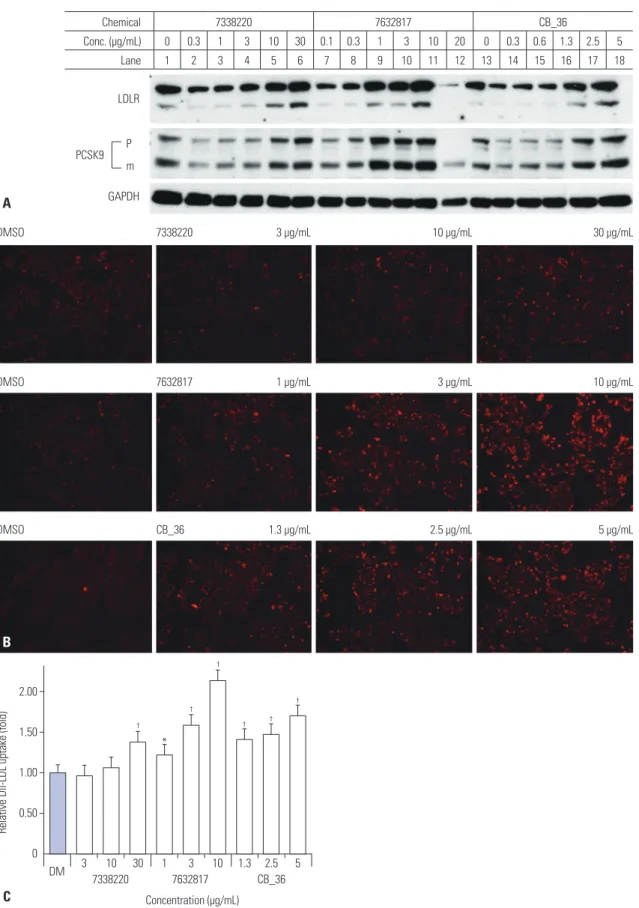
Fig. 2. Effects of CB_36 and its analogs in HepG2 cells. (A) At 18 h after treatment of CB_36, amounts of LDLR and PCSK9 were determined by immunob- lot analysis. (B) Fluorescence-labeled Dil-LDL was incubated for an additional 2 h, and the uptake of Dil-LDL was analyzed by fluorescence microscopy.
(C) The intensity of fluorescence was quantitated by flow cytometry analysis. Each value represents the ratio of the mean fluorescence intensity rela- tive to that in vehicle-treated cells (DM). Error bars represent the SD of triplicate reactions. Similar results were obtained from at least three indepen- dent experiments. *p<0.05, †p<0.01 Student’s t-test when compared with values in DMSO-treated cells. PCSK9, proprotein convertase subtilisin/kexin type 9; LDL, low density lipoprotein; LDLR, LDL receptor; GAPDH, glyceraledhyde-3-phosphate dehydrogenase; DMSO, dimethyl sulfoxide.
Chemical 7338220 7632817 CB_36
Conc. (μg/mL) 0 0.3 1 3 10 30 0.1 0.3 1 3 10 20 0 0.3 0.6 1.3 2.5 5
Lane 1 2 3 4 5 6 7 8 9 10 11 12 13 14 15 16 17 18
LDLR
P PCSK9 m
GAPDH A
DMSO 30 μg/mL
DMSO 10 μg/mL
DMSO
7338220
7632817
CB_36
3 μg/mL
1 μg/mL
1.3 μg/mL
10 μg/mL
3 μg/mL
2.5 μg/mL 5 μg/mL
B
C 2.00
1.50
1.00
0.50
0
Relative Dil-LDL uptake (fold)
DM
†
†
†
† †
†
*
3
7338220 7632817 CB_36
10 30 1 3 10 1.3 2.5 5
Concentration (μg/mL)
CB_36), which had the highest docking score (Supplementary Table 1, only online), and its three-dimensional analogs (#7632817 and #7338220) proposed by ChemBridge’s online website (http://www.hit2lead.com/) were evaluated for in vi- tro parameters in HepG2 cells. The structures of these chemi- cals are depicted in Fig. 1. The concentrations of chemicals applied were determined experimentally and set as low as pos- sible. All three chemicals increased the expression of the LDLR and PCSK9 in a dose-dependent manner (Fig. 2A). The decrease in the LDLR and PCSK9 by the compound #7632817 at a concentration of 20 μg/mL appeared to be due to cytotox- icity (Fig. 2A, lane 12). The uptake of Dil-LDL was increased accordingly with the increase in LDLR and PCSK9 expression (Fig. 2B). When the intensity of the fluorescence in cells was quantitated using flow cytometry analysis, CB_36 at 5 μg/mL increased the uptake of Dil-LDL by a factor of 1.69 compared to the vehicle (DMSO) (Fig. 2C). Interestingly, #7632817, the com- pound that had the most similar three-dimensional structure (94%) and was predicted not by the GOLD algorithm but by ChemBridge, increased the Dil-LDL uptake most strongly by a factor of 2.13. Chemical #7338220 (75% similarity) was rela- tively less effective in increasing the LDL uptake (by a factor of 1.37 at a concentration of 30 μg/mL). These results suggest that CB_36 and its analogs function to increase the uptake of LDL cholesterol in HepG2 cells despite the simultaneous in- crease in the amount of PCSK9.
In vivo effects of CB_36 in wild-type and Pcsk9 knock- out mice
Due to the unavailability of the compound #7632817, which showed the most effective LDL-cholesterol uptake in HepG2 cells, the effect of only CB_36 was elucidated on the plasma cholesterol level in wild-type and Pcsk9-/- mice. The chemical
#7338220 was not evaluated due to its weak effect on the up- take of Dil-LDL in HepG2 cells. C57BL/6J male mice (six per group) and Pcsk9-/- mice (five per group) were injected with CB_36 via tail vein at a concentration of 1 mg/kg for 2 consec- utive days, and metabolic parameters were evaluated (Table 2).
CB_36 significantly lowered the concentration of TC in wild- type mice by 18% compared to that in vehicle-treated mice (p
<0.05), while the other phenotypic parameters in wild-type mice remained unchanged. More importantly, CB_36 had no effect on any parameters in Pcsk9-/- mice, suggesting that the action of CB_36 may involve a PCSK9-dependent pathway.
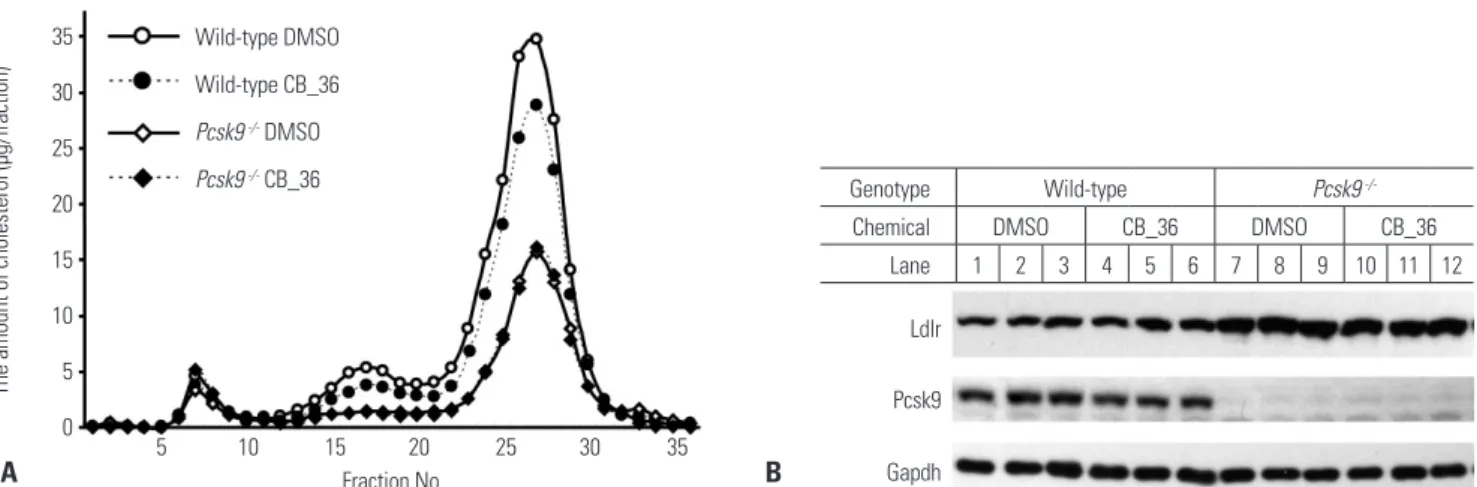
The decrease in the plasma concentration of TC by CB_36 in wild-type mice was re-defined as a consequence of the de- crease in LDL fractions in the lipoprotein profile determined by FPLC in wild-type mice (Fig. 3A; fraction numbers 15–22), while no change was observed in Pcsk9-/- mice. In wild-type mice, CB_36 also lowered the cholesterol level in fractions containing high-density lipoprotein (Fig. 3A; fraction num- bers 23–30), of which the ApoE was also the ligand to the LDLR.22 However, in contrast to the results from HepG2 cells, CB_36 showed no differences in the amounts of LDLR and PCSK9 in the livers of wild-type or Pcsk9-/- mice (Fig. 3B).
These results strongly suggest that CB_36 has the effect of low- ering the TC level in plasma, particularly by lowering the LDL fraction of lipoproteins in a PCSK9-dependent manner, al- though amounts of LDLR and PCSK9 in the liver remained unchanged.
DISCUSSION
Inhibition of PCSK9 is an attractive objective in the develop- ment of new therapeutics for hypercholesterolemia. As almost all patents of statin drugs expired recently, numerous phar- maceutical industries are devoting effort to developing new drugs that can be used in patients with hypercholesterolemia in combination with statins. The other advantage of PCSK9 inhibition is possible augmentation of the cholesterol-lower- ing effect by statins, which induce simultaneously the expres- sion of PCSK9 and LDLR. Among several strategies applied for the development of PCSK9 inhibitors, it is evident that the most up-to-date approach is the use of monoclonal antibod- ies against PCSK9. However, the cost-effectiveness and the in- jection route of antibody therapeutics into patients with hy- percholesterolemia alone would be the major obstacles to overcome. In this respect, recent advances in public compu- tational algorithms and open chemical databases have en- Table 2. The Effect of CB_36 in Wild-Type and Pcsk9 Knock-Out Mice
Parameter Wild-type Pcsk9-/-
Vehicle CB_36 Vehicle CB_36
Number of mice 6 6 5 5
Body weight (g) 26.5±1.2 26.5±0.3 26.1±0.9 27.4±1.4
Liver weight (g) 1.27±0.12 1.24±0.03 1.23±0.11 1.31±0.15
Liver weight/body weight (%) 4.76±0.31 4.68±0.04 4.72±0.40 4.78±0.34
Plasma triglycerides (mg/dL) 77±4 63±5* 38±11 34±3
Plasma cholesterol (mg/dL) 71±9 58±10 58±3 68±11
SEM, standard error of the mean.
Male mice, 10–12 weeks of age, were injected with CB_36 as described under “Materials and Methods.” Each value represents the mean±SEM of the indicat- ed number of mice.
*p<0.05 (Student’s t-test) when compared with values in vehicle-injected mice. Similar results were obtained in one additional independent experiment.
abled standard laboratories to carry out a large-scale screen- ing of small molecular inhibitors of protein-protein interaction for drug development at ease. In silico virtual screening has been used to discover many small-molecule inhibitory li- gands for enzymes such as BCR-ABL tyrosine kinase,23 P. falci- parum dihydrofolate reductase,24 and inhibitors of protein- protein interaction such as interaction between insulin-like growth factor-1 and the N-terminus of the IGF-binding pro- tein-525 or the C-terminal tail of myosin A and the myosin-tail interacting protein in P. falciparum.26 However, without any evident reason, there have been no known reports involving searches for small chemical molecules that inhibit PCSK9- LDLR interaction.
In this study, we report the first approach for the develop- ment of small molecular inhibitors targeting the protein-pro- tein interaction between PCSK9 and the LDLR by performing in silico virtual screening using commercially available chemi- cal libraries and the GOLD algorithm. In general, in order to acceptably predict desirable compounds, multiple selection processes using various docking programs such as AutoDock Vina27 or Glide28 must be applied; however, we did not attempt to complete these comprehensive processes, as the primary purpose of this study was to evaluate the usefulness of rela- tively simple in silico chemical development methods that of- fered ease of use.
CB_36, the chemical with the highest docking score among 100 predicted chemicals, was validated for its ability to inhibit the binding of PCSK9 to the EGF-AB domain of the LDLR in a dose-dependent manner (Supplementary Fig. 1, only online).
Detailed kinetic studies on the mechanism of inhibition by CB_36 were not carried out, as the required research resourc- es were unavailable and the purpose of this study was limited to the overall evaluation of the application of in silico screen- ing. Direct evidence by mapping the ligand-binding site by site-directed mutagenesis of PCSK9 or by performing NMR
studies, for example, needs to be obtained in future studies.
CB_36 and its two analogs, which were proposed by Chem- Bridge’s web-based information, inhibited the PCSK9-LDLR interaction and increased the amount of LDLR, PCSK9, and the uptake of LDL-cholesterol in vitro. Most importantly, CB_36 lowered the total plasma cholesterol level in wild-type mice, particularly LDL cholesterol. Several additional chemi- cals other than CB_36 showed similar results both in vitro and in vivo (data not shown). However, the mechanism for this cholesterol-lowering effect by CB_36 could not be elucidated in mice, as the amounts of LDLR and PCSK9 remained un- changed by CB_36. It is possible to assume that additional mechanisms exert a feedback reconstitution of the LDLR after an increase in the metabolism of LDL cholesterol in the liver as in lovastatin-treated wild-type mice, which showed a de- crease in plasma LDL cholesterol despite a slight decrease in LDLR expression.22
Additional concrete evidence for the usefulness of these chemicals remains to be provided, for example, whether these chemicals bind to PCSK9 directly, whether their effects are mediated by PCSK9 in a specific-manner, whether they are safe enough for practical application in patients, and why the decrease in blood cholesterol level by chemicals is minimal compared to that caused by statin drugs. However, this study provides strong support for in silico screening of chemical li- braries for the development of new cholesterol-lowering agents that inhibit the interaction between PCSK9 and the LDLR.
ACKNOWLEDGEMENTS
Hyun Joo Song at Phillips Exeter Academy, NH 03833, partici- pated in the animal studies as an attendee of an Internship Program in 2013 held by the IGRCMD. This work was sup- ported by a National Research Foundation of Korea (NRF) grant funded by the Korean government [MSIP; (NRF-2008- 35
30 25 20 15 10 5 0
Fraction No.
Wild-type DMSO Wild-type CB_36 Pcsk9-/- DMSO Pcsk9-/- CB_36
5 10 15 20 25 30 35
Fig. 3. In vivo effects of CB_36 in wild-type and Pcsk9 knockout mice. (A) FPLC profiles of plasma cholesterol from wild-type (WT) and Pcsk9-/- mice after injection with CB_36. The pooled plasma from mice described in Table 2 was fractionated by FPLC, and the concentration of cholesterol in each fraction was measured as described under “Materials and Methods.” (B) Aliquots of liver lysates were subjected to SDS-polyacrylamide gel electro- phoresis (livers from two mice were pooled for lanes 1–6 in WT and for lanes 7, 8, 10, and 11 in Pcsk9-/-), and amounts of Ldlr and Pcsk9 were deter- mined by immunoblot analysis. Gapdh was used as an invariant control. FPLC, fast performance liquid chromatography.
Ldlr
Pcsk9
Gapdh
The amount of cholesterol (μg/fraction)
A B
Genotype Wild-type Pcsk9-/-
Chemical DMSO CB_36 DMSO CB_36
Lane 1 2 3 4 5 6 7 8 9 10 11 12
313-E00086, NRF-2010-0011550, NRF-2011-0030086)] and by a faculty research grant from Yonsei University College of Medicine in 2007 (6-2007-0141).
REFERENCES
1. Canto JG, Iskandrian AE. Major risk factors for cardiovascular dis- ease: debunking the “only 50%” myth. JAMA 2003;290:947-9.
2. Nabel EG. Cardiovascular disease. N Engl J Med 2003;349:60-72.
3. Abifadel M, Varret M, Rabès JP, Allard D, Ouguerram K, Devillers M, et al. Mutations in PCSK9 cause autosomal dominant hyper- cholesterolemia. Nat Genet 2003;34:154-6.
4. Cohen JC, Boerwinkle E, Mosley TH Jr, Hobbs HH. Sequence variations in PCSK9, low LDL, and protection against coronary heart disease. N Engl J Med 2006;354:1264-72.
5. Farnier M. PCSK9: From discovery to therapeutic applications.
Arch Cardiovasc Dis 2014;107:58-66.
6. Stein EA, Mellis S, Yancopoulos GD, Stahl N, Logan D, Smith WB, et al. Effect of a monoclonal antibody to PCSK9 on LDL choles- terol. N Engl J Med 2012;366:1108-18.
7. Dias CS, Shaywitz AJ, Wasserman SM, Smith BP, Gao B, Stolman DS, et al. Effects of AMG 145 on low-density lipoprotein choles- terol levels: results from 2 randomized, double-blind, placebo- controlled, ascending-dose phase 1 studies in healthy volunteers and hypercholesterolemic subjects on statins. J Am Coll Cardiol 2012;60:1888-98.
8. Koren MJ, Giugliano RP, Raal FJ, Sullivan D, Bolognese M, Langs- let G, et al. Efficacy and safety of longer-term administration of evo- locumab (AMG 145) in patients with hypercholesterolemia: 52- week results from the Open-Label Study of Long-Term Evaluation Against LDL-C (OSLER) randomized trial. Circulation 2014;129:
234-43.
9. Frank-Kamenetsky M, Grefhorst A, Anderson NN, Racie TS, Bram- lage B, Akinc A, et al. Therapeutic RNAi targeting PCSK9 acutely lowers plasma cholesterol in rodents and LDL cholesterol in non- human primates. Proc Natl Acad Sci U S A 2008;105:11915-20.
10. Rhainds D, Arsenault BJ, Tardif JC. PCSK9 inhibition and LDL cholesterol lowering: the biology of an attractive therapeutic tar- get and critical review of the latest clinical trials. Clin Lipidol 2012;
7:621-40.
11. Mitchell T, Chao G, Sitkoff D, Lo F, Monshizadegan H, Meyers D, et al. Pharmacologic profile of the Adnectin BMS-962476, a small protein biologic alternative to PCSK9 antibodies for low-density lipoprotein lowering. J Pharmacol Exp Ther 2014;350:412-24.
12. Andricopulo AD, Salum LB, Abraham DJ. Structure-based drug design strategies in medicinal chemistry. Curr Top Med Chem 2009;9:771-90.
13. Pearlstein RA, Hu QY, Zhou J, Yowe D, Levell J, Dale B, et al. New hypotheses about the structure-function of proprotein convertase subtilisin/kexin type 9: analysis of the epidermal growth factor-like
repeat A docking site using WaterMap. Proteins 2010;78:2571-86.
14. Bottomley MJ, Cirillo A, Orsatti L, Ruggeri L, Fisher TS, Santoro JC, et al. Structural and biochemical characterization of the wild type PCSK9-EGF(AB) complex and natural familial hypercholes- terolemia mutants. J Biol Chem 2009;284:1313-23.
15. Kwon HJ, Lagace TA, McNutt MC, Horton JD, Deisenhofer J. Mo- lecular basis for LDL receptor recognition by PCSK9. Proc Natl Acad Sci U S A 2008;105:1820-5.
16. Russell DW, Schneider WJ, Yamamoto T, Luskey KL, Brown MS, Goldstein JL. Domain map of the LDL receptor: sequence homolo- gy with the epidermal growth factor precursor. Cell 1984;37:577-85.
17. Jeong HJ, Lee HS, Kim KS, Kim YK, Yoon D, Park SW. Sterol-de- pendent regulation of proprotein convertase subtilisin/kexin type 9 expression by sterol-regulatory element binding protein-2. J Lipid Res 2008;49:399-409.
18. Verdonk ML, Cole JC, Hartshorn MJ, Murray CW, Taylor RD. Im- proved protein-ligand docking using GOLD. Proteins 2003;52:609- 23.
19. Hannah VC, Ou J, Luong A, Goldstein JL, Brown MS. Unsaturated fatty acids down-regulate srebp isoforms 1a and 1c by two mech- anisms in HEK-293 cells. J Biol Chem 2001;276:4365-72.
20. Schneider CA, Rasband WS, Eliceiri KW. NIH Image to ImageJ: 25 years of image analysis. Nat Methods 2012;9:671-5.
21. Kim KW, McCormick J, Helmering J, Véniant MM, Wang M. An optimized fast-performance liquid chromatography method for analyzing lipoprotein profiles using microliter volumes of serum.
Anal Biochem 2008;376:268-74.
22. Rashid S, Curtis DE, Garuti R, Anderson NN, Bashmakov Y, Ho YK, et al. Decreased plasma cholesterol and hypersensitivity to statins in mice lacking Pcsk9. Proc Natl Acad Sci U S A 2005;102:5374-9.
23. Peng H, Huang N, Qi J, Xie P, Xu C, Wang J, et al. Identification of novel inhibitors of BCR-ABL tyrosine kinase via virtual screening.
Bioorg Med Chem Lett 2003;13:3693-9.
24. Rastelli G, Pacchioni S, Sirawaraporn W, Sirawaraporn R, Parenti MD, Ferrari AM. Docking and database screening reveal new class- es of Plasmodium falciparum dihydrofolate reductase inhibitors.
J Med Chem 2003;46:2834-45.
25. Kamionka M, Rehm T, Beisel HG, Lang K, Engh RA, Holak TA. In silico and NMR identification of inhibitors of the IGF-I and IGF- binding protein-5 interaction. J Med Chem 2002;45:5655-60.
26. Kortagere S, Welsh WJ, Morrisey JM, Daly T, Ejigiri I, Sinnis P, et al.
Structure-based design of novel small-molecule inhibitors of Plasmodium falciparum. J Chem Inf Model 2010;50:840-9.
27. Trott O, Olson AJ. AutoDock Vina: improving the speed and accu- racy of docking with a new scoring function, efficient optimization, and multithreading. J Comput Chem 2010;31:455-61.
28. Friesner RA, Banks JL, Murphy RB, Halgren TA, Klicic JJ, Mainz DT, et al. Glide: a new approach for rapid, accurate docking and scoring. 1. Method and assessment of docking accuracy. J Med Chem 2004;47:1739-49.