Veterinary Science
Changes in patterns of antimicrobial susceptibility and class 1 integron carriage among Escherichia coli isolates
Sang-Gyun Kang, Deog-Yong Lee, Sung-Jae Shin, Jeong-Min Ahn, Han-Sang Yoo*
Department of Infectious Disease, College of Veterinary Medicine and School of Agricultural Biotechnology, Seoul National University, Seoul 151-742, Korea
The worldwide use of antimicrobials in different fields has created enormous pressure for the selection of resistance among opportunistic bacterial pathogen. One hundred four
E. coliisolates were collected and identified from swine with diarrhea in Korea during the period of 2002. The isolates showed highly resistant to streptomycin (99.0%), tetracycline (97.1%), neomycin (91.3%) and carbenicillin (84.6%) in antimicrobial susceptibility test.
Moreover, all of the isolates showed multiple antimicrobial resistant to more than 3, and 85% of them were resistant to more than 7 of total 14 antimicrobial agents. In comparison with isolates in 1998, resistance to antimicrobials was more frequent among the isolates in 2002. Presence of class 1 integrons was investigated through amplification of the gene with PCR, and could be classified 8 groups by pattern of 4 different amplicons. Class 1 integrons were observed in 67 strains (64.2%) of
E. colifrom swine in Korea. One and 1.6 kbp of amplicons were revealed to contain
aadA1and
aadB-aadA1gene cassettes respectively.
Two kbp of amplicon had three different gene cassettes,
dhfrXII-orfF-aadA2, and 3.0 kbp of amplicon includes
aadB-cmlA1gene cassettes.
Key words:
class 1 integron, E. coli, multiple antimicrobial resistance, swineIntroduction
Coilbacillosis caused by
Escherichia colioccur primarily in young animals and typically involve septicaemia and/or mild to severe diarrhea. Diarrhea syndrome attribute to
E.coli
infection in neonatal has become one of the most trouble diseases of livestock in Korea. The economic losses occurred by this has been increasing as no appropriate control [7,13,18,19,26]. Antimicrobial agents are often used without any laboratory assessment in the prevention and
treatment of the infection, resulting in the emergence of antibiotic resistant strains. Excessive use of antibiotics in the treatment of animal diseases and large scale administration in the form of feed additives in pig industry could be responsible for free desemination of multiple drug resistance among
E. coliisolates. Nowadays, it is difficult to control the disease using antimicrobial agents owing to emergence of new or multiple antimicrobial resistance [5,11,31].
The multiple antimicrobial resistance may arise from many different genetic determinants and each of them may present specific epidemiological features. Therefore, the assessment of the resistance situation at the genetic level would be important to understand and control antimicrobial resistance in general [21]. Integrons are known to be a new mechanism for spreading genes of resistance among Gram negative bacteria and act as natural expression vectors supplying a common promoter to a mobile gene cassette containing various antibiotic-resistance genes. The essential components of the integron are found within the 5'- conserved segment of the element and include an integrase gene
intI, which encodes a site-specific recombinase, an adjacent site
attI, which is recognized by the integrase and acts as a receptor for gene cassettes, and a common promoter region P
ant, from which integrated gene cassettes are expressed [12,20,27,28]. The horizontal transfer of integrons is considered as the most efficient means for dissemination of resistance genes and emergence of multi- resistant strains [6,14,29].
In this respect, the continuous monitoring for drug resistance of
E. coliisolated from animals would contribute to assess future trends in the antimicrobial resistance pattern.
The purpose of this study is to assess, in the first step, the actual frequency of antimicrobial resistance in pathogenic
E.coli
isolated from swine in Korea at the phenotype level. In the second, frequency of the presence of integron class 1 as resistant determinants in genotype level were identified.
*Corresponding author
Tel: +82-2-880-1263; Fax: +82-2-874-2738 E-mail: [email protected]
Materials and Methods
Bacterial isolates
The present study included 104 bacterial isolates obtained from pigs with diarrhea in Korea during the period of 2002.
The bacteria were isolated by directly streaking with a cotton swab onto blood agar and MacConkey agar. The isolates were cultured at 37
oC overnight and then identified on the basis of Gram-staining, convetional biochemical tests including oxidase and catalse test, and Vitek system (BioMérieux-Vitek, USA). Once identified, the isolates were preserved at
−70
oC in TSB broth containing 20% glycerol.
Antimicrobial susceptibility testing
Fourteen antibiotics were purchased from Becton, Dickinson and Company (USA) and assayed in this study (Table 1).
All bacterial samples were tested with susceptibility discs containing each antibiotic according to the guidelines of the Clinical and Laboratory Standards Institute (CLSI) [8].
Briefly, preliminary tests were conducted to show that all bacterial strains were able to grow in Mueller-Hinton (MH;
Difco, USA) medium. Working cultures were obtained in liquid MH medium after 24 h incubation at 37
oC. Discs containing each antibiotic were then loaded on MH agar medium being spotted with each bacterial strain. The plates were then incubated for 24 h at 37
oC and interpreted by measuring inhibition diameters according to the criteria recommended by CLSI. Three references strains (
E. coliATCC 25922,
Enterococcus faecalisATCC 29212, and
Actinobacillus pleuropneumoniae) were used for quality control [24,30].
Detection of class 1 integrons by PCR
All strains were tested more than once for the presence of class 1 intergron using primers 5'CS, 5'-GGCATCCAAGC
AGCAAG-3' and 3'CS, 5'-AAGCAGACTTGACCTGA-3' [21]. Total DNA of
E. coliwas extracted using Genomic DNA Extraction kit (Promega, USA) following manufacture’s protocol for Gram-negative bacteria. The PCR solution was composed of 10
×buffer 2
µl, dNTPs (2.5 mM) 0.4
µl, 5’CS/3’CS (10 pmol/
µl) 0.5
µl each, Taq DNA polymerase (5 U/
µl, Promega, USA) 0.2
µl, distilled water 15.4
µl and template DNA (50 ng/
µl) 1
µl. Amplification consisted of an initial denaturation at 94
oC for 3 min, followed by 30 cycles of denaturation at 94
oC for 30 s, annealing at 60
oC for 30 s, and extension at 72
oC for 2 min 30 s and a final extension at 72
oC for 5 min. Amplicons were analyzed through electrophoresis on 1.0% agarose gels, and 1 kb ladder (Takara, Japan) was used as a molecular size marker.
Sequencing of amplicons
PCR amplicons to be sequenced were purified from 1%
agarose gels with QIAquick Gel Extraction kit (Qiagen, Germany), according to the manufacturer’s instruction.
Purified amplicons were sequenced using an automated DNA sequence (ABI PRISM 377 × L; Perkin Elmer, USA) and compared to the GenBank database of the National Center for Biotechnology Information BLAST network [3].
Results
Antimicrobial susceptibility
Results of the antimicrobial susceptibility test are summaried in Table 1. The isolates showed highly susceptible to ceftiofur (87.5%) and ampicillin (72.1%), but resistant to streptomycin (99.0%), tetracycline (97.1%), neomycin (91.3%) and carbenicillin (84.6%) in antimicrobial susceptibility test.
Moreover, all of the isolates showed multiple antimicrobial resistant to more than 3, and 85% of them were resistant to more than 7 of total 14 antimicrobial agents (data not shown).
Table 1. Antimicrobial susceptibility of Escherichia coil isolated from swine with diarrhea
Antimicrobial drugs Potency/disc Number of resistant isolate (n=104)
Amikacin (AM) 10 µg 84 (80.8%)
Ampicillin (AN) 30 µg 29 (27.9%)
Chloramphenicol (C) 30 µg 58 (55.8%)
Carbenicillin (CB) 100 µg 88 (84.6%)
Ceftiofur (XNL) 30 µg 13 (12.5%)
Colistin (CL) 10 µg 50 (48.1%)
Enrofloxacin (ENR) 5 µg 59 (56.7%)
Gentamycin (GM) 10 µg 86 (82.7%)
Neomycin (N) 30 µg 95 (91.3%)
Nalidixic acid (NA) 30 µg 74 (71.2%)
Norfloxacin (NOR) 10 µg 55 (52.9%)
Streptomycin (S) 10 µg 103 (99.0%)
Sulfamethoxazole/Trimethoprim (SXT) 23.5 µg/1.25 µg 80 (76.9%)
Tetracycline (Te) 30 µg 101 (97.1%)
Relationships of class 1 integrons, resistance genes, and resistance patterns
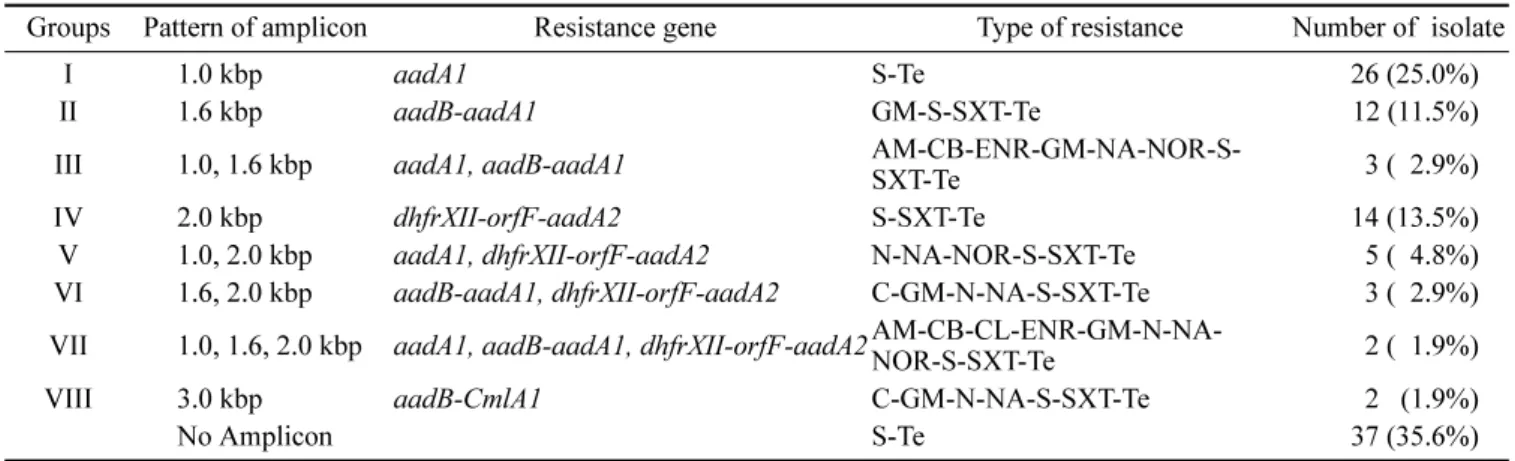
Presence of class 1 integrons was investigated through amplification of the gene with PCR (Fig. 1). Class 1 integrons were present in 67 strains (64.4%) of
E. coli(104 strains) from swine in Korea. Using 5'CS and 3'CS, 1.0, 1.6, 2.0 and 3.0 kbp of amplicons were amplified. Presences of class 1 integrons were classified 8 groups by pattern of amplicons (Table 2). Out of 67 isolates, which have amplicons, 53.7% (36 strains) contained 1 kbp integron in the variable region. One kbp of amplicon was revealed to contain
aadA1gene cassette encoding aminoglycoside 3'- (9)-O-adenyltransferase related to streptomycin and spectinomycin resistance. Comparing with 1.0 kbp amplicon, 1.6 kbp had additionally
aadBgene cassette which encodes aminoglycoside 2''-adenyltransferase related to gentamycin and kanamycin resistance. Two kbp amplicon contained three different gene cassettes,
dhfrXII-orfF-aadA2. Both of
dhfrXIIencoding dihydrofolate dehydrogenase and
orfFencoding dihydrofolate reductase are related to trimethoprim resistance. Three kbp of amplicon holds
aadB-CmlAlgene cassettes.
CmlAcassette encodes chloramphenicol transporter (exporter) known as chloramphenicol resistance gene.
Dissucussion
Antimicrobial susceptibility
In comparison with isolates in 1998 [26], resistance to
antimicrobials was more frequent among the isolate in 2002.
Especially number of isolates resistant amikacin and colistin were dramatically increased from 4.9 to 80.8%, from 3.9 to 48.1% respectively. However, number of isolate resistant ampicillin was decreased from 76.5 to 27.9%. This phenomenon is due to change in the use of antimicrobial agents. The isolate showing resistance to ceftiofur was newly emerged in 2002. Ceftiofur is a newer broad-spectrum cephalosporin antimicrobial agent originally developed for the treatment of bovine respiratory disease in 1991. It is open used as first-line agents for invasive gram-negative infections in swine [9,30,36,37]. Nevertheless, nearly all enteric bacilli including a large number of
E. coli, produce
β- lactamases that can compromise successful
β-lactam chemotherapy of
Enterobacteriaceaeinfections [8,31]. The new emergency of strains resistant to ceftiofur may be explained by newly development and usage of this antimicrobial agent in Korea. Most of all isolates show resistant to tetracycline. Tetracycline resistance is frequently found in zoonotic, pathogenic and intestinal bacteria. Most consequence of the selection pressure is resulted from the extended use of tetracycline, which is used for all different food animal species [34]. The tetracycline resistance is not concerned with the integron and associated cassette. The
tet(A) and
tet(B) genes is occurred predominantly in the intestinal environment of food animals and/or the presence of specific conjugative plasmids [17,20,33,34].
Relationships of class 1 integrons, resistance genes, and resistance patterns
The
aadA(
aadA1and
aadA2) gene cassette (97.0%) was the most frequently found resistance gene in the variable region of integrons. The similar predominant pattern has been reported in
E. colistrains from natural habitat and clinical isolates,
Vibrio choleraeO139, and
Salmonella entericaserotype Gallinarum [4,11,20,21,28]. The predominance of the
aadAsuggests that this gene may either the first cassette to be acquired by an integron and/or may be more stably integrated into the integron than other gene cassette
Fig. 1. Agarose gel (1.0%) electrophoresis pattern of the amplicons generated with 5'CS-3'CS primers. Lane M is 100 bp ladder as a molecular size standard. Lanes 1 to 8 represented gene groups, I to VIII, respectively.
Table 2. Relationships between amplicon size, resistantce genes, and resistance patterns found within E. coli isolates
Groups Pattern of amplicon Resistance gene Type of resistance Number of isolate
I 1.0 kbp aadA1 S-Te 26 (25.0%)
II 1.6 kbp aadB-aadA1 GM-S-SXT-Te 12 (11.5%)
III 1.0, 1.6 kbp aadA1, aadB-aadA1 AM-CB-ENR-GM-NA-NOR-S-
SXT-Te 3 (02.9%)
IV 2.0 kbp dhfrXII-orfF-aadA2 S-SXT-Te 14 (13.5%)
V 1.0, 2.0 kbp aadA1, dhfrXII-orfF-aadA2 N-NA-NOR-S-SXT-Te 5 (04.8%)
VI 1.6, 2.0 kbp aadB-aadA1, dhfrXII-orfF-aadA2 C-GM-N-NA-S-SXT-Te 3 (02.9%)
VII 1.0, 1.6, 2.0 kbp aadA1, aadB-aadA1, dhfrXII-orfF-aadA2AM-CB-CL-ENR-GM-N-NA-
NOR-S-SXT-Te 2 (01.9%)
VIII 3.0 kbp aadB-CmlA1 C-GM-N-NA-S-SXT-Te 2 0(1.9%)
No Amplicon S-Te 37 (35.6%)
*Abbreviation of antimicrobial agents is same as Table 1.
[28]. In addition, both the selection and dispersion of
aadAgenes in integrons could be related to the extensive use of streptomycin in the control of animal diseases. The clinical isolated
E. coliresistant to gentamycin have been increased from 18.3% in 1992 [7] to 82.7% in 2002. The acquisition of the
aadBgene cassette by integron could be responsible for the observed increase of resistance phenotype during last decade. The
dhfrXII-orfF-aadA2genes for the majority of resistant dihydrofolate reductase occur as gene cassettes that are site specificially inserted into the recombinationally active site of class 1 and class2 integrons. The high incidence of trimethoprim resistance gene cassettes inserted into class 1 integrons [2,16]. The
dhfrXIIgene cassette with
aadA2,
dhfrXII-orfF-aadA2also, was reported in urinary tract pathogenic
E. coliand
Shigellastrains [15].
AadA2gene encoding aminoglycoside 3'-adenyltransferase, as well as
aadA1, is one of the six genetic subtypes of
aadA,which show streptomycin and spectinomycin resistance [20,32].
The
CmlAgene confers nonenzymatic resistance to chloramphenicol and functions as a drug efflux pump [5,35].
Chloramphenicol is a broad-spectrum antibiotic that was used extensively in veterinary medicine until Food and Drug Administration ban its use in food animals in the 1980s [10].
Thus, our result of 55.8% rate of resistance to chloramphenicol is an unexpected, but it is very similar to the report of 53%
rate in beta-hemolytic
E. coliassociated with diarrhea in neonatal swine [5]. They and some other European researchers indicated that antimicrobial resistance can persist, as a concequence of coselection with other antimicrobials [1,25].
Integrons seem to play a major role in the epidemiology of resistance to these antimicrobial agents in clinical isolates from animals. However, we observed some isolates showing resistant to several antimicrobial agents in susceptible test, which probably have other resistant gene cassettes. These resistances may not be acquired by integron, but the other vehicles to transport it into the isolates, such as resistant plasmid, bacteriophages, or transposons [6,23].
Acknowledgments
This work was supported by Brain Korea 21 Project, Korea.
References
1.Aarestrup FM, Seyfarth AM, Emborg H, Pedersen K, Hendriksen RS, Bager F. Effect of abolishment on the use of antimicrobial agents for growth promotion on occurrence of antimicrobial resistance in fecal enterococci from food animals in Denmark. Antimicrob Agents Chemother 2001, 45, 2054-2059.
2.Adrian PV, Thomson CJ, Klugman KP, Amyes SGB. New gene cassettes for trimethoprim resistance, dfr13, and streptomycin-spectinomycin resistance, aadA4, inserted on a class 1 integron. Antimicrob Agents Chemother 2000, 44,
355-361.
3.Altschul AF, Gish W, Miller W, Myers EW, Lipman DJ.
Basic local alignment search tool. J Mol Biol 1990, 215, 403- 4.410.Amita S, Chowdhury R, Thungapathra M, Ramanurthy T, Nair GB, Ghosh A. Class 1 integrons and SXT elements in E1 tor strains isolated before and after 1992 Vibrio cholerae O139 outbreak, Calcutta, India. Emerg Infect Dis 2003, 9, 500-501.
5.Bischoff KM, White DG, McDermott PF, Zohao S, Gaines S, Maurer JJ, Nisbet DJ. Characterization of chloramphenicol resistance in β-hemolytic Escherichia coli associated with diarrhea in neonatal swine. J Clin Microbiol 2002, 40, 389- 6.394.Chandler M, Claverys JP. Genome diversity: soureces and
forces. Curr Opin Microbiol 2001, 4, 547-549.
7.Chung ME, Yeo SG. Distribution of antimicrobial resistances and properties of R-plasmids in E. coli isolated from pigs.
Korean J Vet Res, 1994, 34, 759-768.
8.Clinical and Laboratory Standards Institute (CLSI).
Performance standards for antimicrobial disk and dilution susceptibility tests for bacteria isolated from animals;
approved standard. 2nd ed. CLSI document M31-A2. CLSI, Wayne, 2002.
9.Deshpande L, Pfaller MA, Jones RN. In vitro activity of ceftiofur tested against clinical isolates of Escherichia coli and Klebsiella pneumoniae including extended spectrum β- lactamase producing strains. Int J Antimicrob Agents 2000, 15, 271-275.
10.Gilmore A. Chloramphenicol and the politics of health. Can Med Assoc J 1986, 134,423-435.
11.Guerra B, Soto S, Cal S, Mendoza C. Antimicrobial resistance and spread of class 1 integrons among Salmonella serotypes. Antimicrob Agents Chemother 2000, 44, 2166- 2169.
12.Hall RM, Collis CM. Mobile gene cassettes and integrons:
capture and spread of genes by site-specific recombination.
Mol Microbiol 1995, 15, 593-600.
13.Ham HJ, Min KS, Chae CH. Antibiotics susceptibility and biochemical characterization of Escherichia coli associated with diarrhea from preweaning piglets. Korean J Vet Res 1997, 37, 773-777.
14.Hanau-Bercot B, Casin IPI, Collatz E. An intrinsic control element for translational initiation in class 1 integrons. Mol Microbiol 2002, 44, 119-130.
15.Heikkila E, Skurnik M, Sundstrom L, Huovinen P. A novel dihydrofolate reductase cassette inserted in an integron borne on a Tn21-like element. Antimicrob Agents Chemother 1993, 37, 1297-1304.
16.Huovinen P, Sundstrom L, Swedberc G, Skold O.
Trimethoprim and sulfonamide resistance. Antimicrob Agents Chemother 1995, 39, 279-289.
17.Jones CS, Osborne DJ, Stanley J. Enterobacterial tetracycline resistance in relation to plasmid incompatibility.
Mol Cell Probes 1992, 6, 313-317.
18.Kim BW, Rhee JC, Kim DS. The in vitro drug resistance of Escherichia coli Isolated from piglets, calves, lamb and goats with diarrhea. Korean J Vet Res 1979, 19, 121-126.
19.Kim JM, Jean NS, Kim JJ, Jean YH, Lee HS, Kweon CH, Woo SR, Lee HC, Park JM, Kim JH, Rhee JC.
Antimicrobial drug susceptibility and treatment efficacy in mice against Escherichia coli and Salmonella spp isolated from feces of diarrheal animals. Korean J Vet Res 1997, 37, 389-403.
20.Kwon HJ, Kim TE, Cho SH, Seol JG, Kim BJ, Hyun JW, Park KY, Kim SJ, Yoo HS. Distribution and characterization of class 1 integrons in Salmonella enterica serotype Galinarum biotype Gallinarum. Vet Microbiol 2002, 89, 303- 21.309.Lanz R, Kuhnert P, Boerlin P. Antimicrobial resistance and resistance gene determinants in clinical Escherichia coli from different animal species in Switzerland. Vet Microbiol 2003, 91, 73-84.
22.Lévesque C, Piché L, Larose C, Roy PH. PCR mapping of integrons several novel combinations of resistance genes.
Antimicrob Agents Chemother 1995, 39,185-195.
23.Mazel D, Davies J. Antibiotic resistance in microbes. Cell Mol Life Sci 1999, 56,742-754.
24.McDermott PF, Barry AL, Jones RN, Stein GE, Thornsberry C, Wu CC, Walker RD. Standardization of broth microdilution and disk diffusion susceptibility tests for Actinobacillus pleuropneumoniae and Haemophilus somnus: quality control standards for ceftiofur, enrofloxacin, florfenicol, gentamicin, penicillin, tetracycline, tilmicosin, and trimethoprim- sulfamethoxazole. J Clin Microbiol 2001, 39, 4283-4287.
25.Nijsten R, London N, van den Bogaard A, Stobberingh E.
Antibiotic resistance among Escherichia coli isolated from faecal samples of pig farmers and pigs. J Antimicrob Chemother 1996, 37, 1131-1140.
26.Park JY, Shin NR, Park YH, Yoo HS. Characteristics of Escherichia coli isolated from piglets with diarrhea;
antimicrobial susceptibility, genotypes of enterotoxins and pili and plasmid profiles. Korean J Vet Res 2000, 40, 301- 27.310.Recchia GD, Hall RM. Gene cassette: a new class of mobile
element. Microbiology 1995, 141, 3015-3027.
28.Rosser SJ, Young HK. Identification and characterization of class 1 integrons in bacteria from an aquatic environment. J Antimicrob Chemother 1999, 44, 11-18.
29.Rowe-Magnus DA, Mazel D. Integron: natural tools for bacterial genome evolution. Curr Opin Microbiol 2001, 4, 565-569.
30.Salmon SA, Watts JL, Case CA, Hoffman LJ, Wegener HC, Yancey RJ. Comparison of MICs of ceftiofur and other antimicrobial agents against bacterial pathogens of swine from the United States, Canada, and Denmark. J Clin Microbiol 1995, 33, 2435-2444.
31.Sanchez S, Stevenson MAM, Hudson CR, Maier M, Buffington T, Dam Q, Maurer JJ. Characterization of multidrug-resistant Escherichia coli isolates associated with nosocomial infections in dogs. J Clin Microbiol 2002, 40, 3586-3595.
32.Sandvang D. Novel streptomycin and spectinomycin resistance gene as a gene cassette within a class 1 integron isolated from Escherichia coli. Antimicrob Agents Chemother 1999, 43, 3036-3038.
33.Schmidt AS, Bruun MS, Dalsgaard I, Larsen JL.
Incidence, distribution, and spread of tetracycline resistance determinants and integron-associated antibiotic resistance genes among motile Aeromonads from a fish farming environment. Appl Environ Microbiol 2001, 67, 5675-5682.
34.Sengeløv G, Halling-Sørensen B, Aarestrup FM.
Susceptibility of Escherichia coli and Enterococcus faecium isolated from pigs and broiler chickens to tetracycline degradation products and distribution of tetracycline resistance determinants in E. coli from food animals. Vet Microbiol 2003, 95, 91-101.
35.Williams JB. Drug efflux as a mechanism of resistance. Br J Biomed Sci 1996, 53,290-293.
36.Winokur PL, Vonstein DL, Hoffman LJ, Uhlenhopp EK, Doern GV. Evidence for transfer of CMY-2 AmpC β- lactamase plasmids between Escherichia coli and Salmonella isolates from food animals and humans. Antimicrob Agents Chemother 2001, 45, 2716-2722.
37.Zhao S, White DG, McDermott PF, Friedman S, English L, Ayers S, Meng J, Maurer JJ, Holland R, Walker RD.
Identification and expression of cephamycinase blaCMY genes in Escherichia coli and Salmonella isolates from food animals and ground meat. Antimicrob Agents Chemother 2001, 45, 3647-3650.