265 Copyright © 2013 The Korean Society of Cardiology
Korean Circulation Journal
Introduction
Peripheral artery disease (PAD) is a significant medical problem, particularly among the elderly population
1-3) because it is associat- ed with a significantly elevated risk of cardiovascular disease mor- bidity and mortality.
2)
Elderly patients who undergo surgical intervention have higher post operative mortality.
4)5) Hence, percutaneous transluminal an- gioplasty (PTA) has become an accepted alternative to bypass sur- gery in patients with PAD.
1)
However, determining the appropriate access strategy for pe- ripheral vascular interventions often requires a much greater de- gree of planning and foresight than with cardiac catheterization.
Occasionally, PTA through a bypass graft is required to improve
Case Report
http://dx.doi.org/10.4070/kcj.2013.43.4.265
Print ISSN 1738-5520 • On-line ISSN 1738-5555
Percutaneous Transluminal Angioplasty of Contralateral Iliac and Superficial Femoral Arteries via Graft Vessel in a Patient
with FemoroFemoral Bypass Graft
Jin Wook Chung, MD, Deuk Young Nah, MD, and Jun Ho Bae, MD
Department of Cardiology, College of Medicine, Dongguk University, Gyeongju Hospital, Gyeongju, Korea
Peripheral arterial disease represents a significant problem, particularly among the elderly population. There has been great progress made in the treatment of peripheral arterial disease in recent years. Percutaneous transluminal angioplasty (PTA) has been employed as a meth- od of treatment for patients with a variety of peripheral arterial disease. We report our experience with PTA of contralateral common iliac and superficial femoral arteries via graft vessel in a patient with femorofemoral bypass due to ipsilateral iliac artery occlusion. (Korean Circ J 2013;43:265-268)
KEY WORDS: Peripheral artery disease; Percutaneous transluminal angioplasty; Femoral artery; Bypass grafting.
Received: May 14, 2012 Revision Received: July 17, 2012 Accepted: September 6, 2012
Correspondence: Deuk Young Nah, MD, Department of Cardiology, College of Medicine, Dongguk University, Gyeongju Hospital, 87 Dongdae-ro, Gy- eongju 780-350, Korea
Tel: 82-54-770-8561, Fax: 82-54-770-8378 E-mail: [email protected]
• The authors have no financial conflicts of interest.
This is an Open Access article distributed under the terms of the Creative Commons Attribution Non-Commercial License (http://creativecommons.
org/licenses/by-nc/3.0) which permits unrestricted non-commercial use, distribution, and reproduction in any medium, provided the original work is properly cited.
inflow or run-off vessels as well as to treat graft stenosis or occlu- sions as an alternative treatment option to reoperation in patients at high surgical risk.
We report a case in which we successfully performed PTA of con- tralateral inflow iliac artery and superficial femoral artery via fem- orofemoral bypass graft in a PAD patient.
Case
A 73-year-old male with a long-standing left common iliac artery occlusion underwent femorofemoral crossover grafting 4 years ago.
In addition, he had angioplasty and stenting of the right superficial femoral artery on different occasions within the previous year at other hospitals. The patient reported mild improvement in claudica- tion symptoms for a few months only after each of these procedures.
He came to our hospital with a disabling bilateral lower extremity
claudication. He had a past medical history of hypertension and dia-
betes in addition to a 60 pack-year history of smoking. For the past
two months, the patient complained of claudication in both lower
legs as well as severe pain in the right lower leg at rest (Rutherford
category 4). On physical examination, he had a faintly palpable
dorsalis pedis pulse in the right foot. Ankle brachial indices indicat-
ed a score of 0.34 on the right and 0.60 on the left. Computerized to-
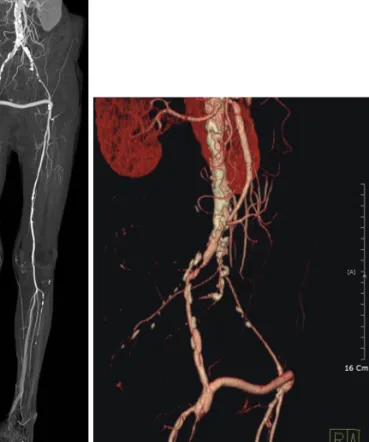
mography angiography revealed a patent graft, but it also showed
a high-grade focal stenosis of the right common iliac artery and a
total occlusion of the superficial femoral artery (Fig. 1). Due to pa-