pISSN 2288-6575 • eISSN 2288-6796 http://dx.doi.org/10.4174/astr.2015.89.5.268 Annals of Surgical Treatment and Research
Occupational stress and related factors among surgical residents in Korea
Sanghee Kang*, Hye Sung Jo*, Yoon Jung Boo, Ji Sung Lee
1, Chong Suk Kim
Department of Surgery, Korea University College of Medicine, Seoul,
1Department of Medical Statistics, Asan Medical Center, Seoul, Korea
INTRODUCTION
Surgery plays a crucial role in modern medical treatment.
The importance of well-qualified surgeons cannot be over- emphasized; however, little attention has been paid in recent times to the quality of training programs for surgical residents in Korea. These days, surgical residents have a heavier workload and experience more stress due to the labor force shortage, which has been caused in part by a decrease in the rate of applicants and an increased workload in systematized hospitals [1]. Moreover, the dropout rate for surgical residents
during training is also increasing. This overworking of surgical residents leads to a vi cious cycle, with the application rate for surgical residency con tinuously decreasing year by year. The decrease in the number of applicants and the high dropout rate of surgical residents has become a serious social issue in Korea. Many things may cause these problems, but one of the important reasons is the excessive workload and high occupational stress these surgical residents are put under [2].
Occupational stress has a positive effect when it encourages individuals to maintain an appropriate level of tension and increases the efficiency of work [3]. On the other hand, the Purpose: The application rate for surgical residents in Korea has continuously decreased over the past few years. The demanding workload and the occupational stress of surgical training are likely causes of this problem. The aim of this study was to investigate occupational stress and its related factors in Korean surgical residents.
Methods: With the support of the Korean Surgical Society, we conducted an electronic survey of Korean surgical residents related to occupational stress. We used the Korean Occupational Stress Scale (KOSS) to measure occupational stress. We analyzed the data focused on the stress level and the factors associated with occupational stress.
Results: The mean KOSS score of the surgical residents was 55.39, which was significantly higher than that of practicing surgeons (48.16, P < 0.001) and the average score of specialized professionals (46.03, P < 0.001). Exercise was the only factor found to be significantly associated with KOSS score (P = 0.001) in univariate analysis. However, in multiple linear regression analysis, the mean number of assigned patients, resident occupation rate and exercise were all significantly associated with KOSS score.
Conclusion: Surgical residents have high occupational stress compared to practicing surgeons and other professionals.
Their mean number of assigned patients, resident recruitment rate and exercise were all significantly associated with occupational stress for surgical residents.
[Ann Surg Treat Res 2015;89(5):268-274]
Key Words: Occupational stress; Surgical resident; Burnout, Professional; Exercise
Reviewed January February March April May June July August September October November December
Received April 29, 2015, Revised June 8, 2015, Accepted June 16, 2015 Corresponding Author: Yoon Jung Boo
Division of Pediatric Surgery, Department of Surgery, Korea University Anam Hospital, Korea University College of Medicine, 73 Inchon-ro, Seongbuk-gu, Seoul 02841, Korea .
Tel: +82-2-920-6844, Fax: +82-2-928-1631 E-mail: [email protected]
*Sanghee Kang and Hye Sung Jo contributed equally to this study as co- first authors.
Copyright ⓒ 2015, the Korean Surgical Society
cc Annals of Surgical Treatment and Research is an Open Access Journal. All
articles are distributed under the terms of the Creative Commons Attribution Non-
Commercial License (http://creativecommons.org/licenses/by-nc/4.0/) which
permits unrestricted non-commercial use, distribution, and reproduction in any
medium, provided the original work is properly cited.
excessive occupational stress that surgeons are under might not only threaten job satisfaction, but also increases medical errors [4]. Previous studies have reported that that extreme stress leads to burnout of surgical residents, which can contribute to impaired technical performance, medical errors, and physical and mental health problems, and may even increase the risk of suicide [5,6].
In other countries, a number of studies have reported the high level of stress and reduced job satisfaction of residents [7-9].
However, this is the first study to investigate the occupational stress and burnout of surgical residents in Korea. The aim was to evaluate the level of the occupational stress and related factors experienced by the entire surgical resident population in Korea.
METHODS
Subjects and data collection
With the support of the Korean Surgical Society, we conducted an electronic survey of Korean surgeons, including surgical residents, in October 2012. The e-mail addresses of all surgeons were provided by the Korean Surgical Society. The cover letter of the e-mail sent to surgeons stated the purpose of this survey, participation was completely voluntary and all responses were anonymous. The study was commissioned by the Korean Surgical Society and overseen by the Institutional Review Board of Korea University Anam Hospital.
Sixty-five questions were used to assess the demographics, characteristics and the level of stress using the full version of the Korean Occupational Stress Scale (KOSS) (Supplementary material), which was validated by the National Study for Development and Standardization of Occupational Stress in Korea [10]. The survey used in this study includes a subscale of the Maslach Burnout Inventory which uses two items
to measure whether a participant is burnt out or not [11], and additional questions to assess their lifestyle variables, working conditions, stress reactions/coping strategies and job satisfaction.
Statistical analysis
Internal consistency was calculated using Cronbach alpha.
KOSS score is expressed as mean ± standard deviation. To compare the stress score of surgical residents with that of other specialized professions, we used the previous reported KOSS scores from a study conducted by the Korean Occupational Safety and Health Agency in 2005 [12]. The comparisons of mean KOSS scores between groups were performed using the Student t-test and one-way variance of analysis, followed by Tukey post hoc test. To find out the most reliable factors affected by occupational stress, multiple linear regression analysis was performed. In this study, a P-value <0.05 was interpreted as statistically significant. All statistical analyses were performed using IBM SPSS Statistics ver. 20.0 (IBM Co., Armonk, NY, USA).
Ethics statement
This study protocol was approved by the Institutional Review Board of Korea University Anam Hospital (IRB No. ED12211).
Informed consent was waived by the board.
RESULTS
All surgeons who were members of the Korean Surgical Society, including surgical residents were eligible for participation in this survey. Of the 4,294 surgeons who were surveyed, 621 (14.5%) participate in this study. Of the 651 surgical residents registered as members of the Korean Surgical Society, 99 surgical residents responded the survey. Therefore,
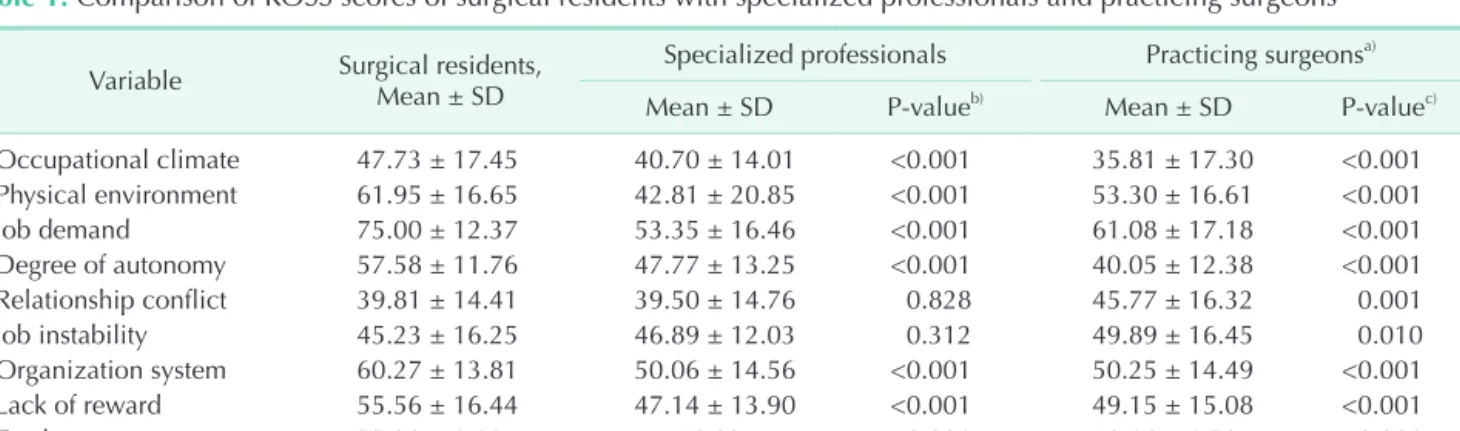
Table 1. Comparison of KOSS scores of surgical residents with specialized professionals and practicing surgeons Variable Surgical residents,
Mean ± SD
Specialized professionals Practicing surgeons
a)Mean ± SD P-value
b)Mean ± SD P-value
c)Occupational climate 47.73 ± 17.45 40.70 ± 14.01 <0.001 35.81 ± 17.30 <0.001 Physical environment 61.95 ± 16.65 42.81 ± 20.85 <0.001 53.30 ± 16.61 <0.001
Job demand 75.00 ± 12.37 53.35 ± 16.46 <0.001 61.08 ± 17.18 <0.001
Degree of autonomy 57.58 ± 11.76 47.77 ± 13.25 <0.001 40.05 ± 12.38 <0.001
Relationship conflict 39.81 ± 14.41 39.50 ± 14.76 0.828 45.77 ± 16.32 0.001
Job instability 45.23 ± 16.25 46.89 ± 12.03 0.312 49.89 ± 16.45 0.010
Organization system 60.27 ± 13.81 50.06 ± 14.56 <0.001 50.25 ± 14.49 <0.001
Lack of reward 55.56 ± 16.44 47.14 ± 13.90 <0.001 49.15 ± 15.08 <0.001
Total 55.39 ± 9.98 46.03 <0.001 48.16 ± 9.53 <0.001
KOSS, Korean Occupational Stress Scale; SD, standard deviation.
a)
Practicing surgeons did not include surgical residents.
b)Comparison with professionals by one-sample t-test.
c)Comparison between
residents and Korean surgeons by Student t-test.
the response rate of the surgical residents was 15.1% (99/651). We analyzed the data of these surgical residents based on variable factors such as working conditions and lifestyle characteristics.
The mean age was 31.3 years old. Of these 99 residents, 57 (57.6%) were men and 42 (42.4%) were women.
Table 1 shows comparisons between the KOSS scores of surgical residents and those of practicing surgeons and other specialized professions. A mean KOSS score for a surgical resident was 55.39 ± 9.98, which was significantly higher than that of the practicing surgeons (48.16 ± 9.53) and the average KOSS score of other specialized professionals (46.03) [13]. Notably, The KOSS score of surgical residents showed
statistically significant differences compared to the practicing surgeons in all subscales including the total KOSS score.
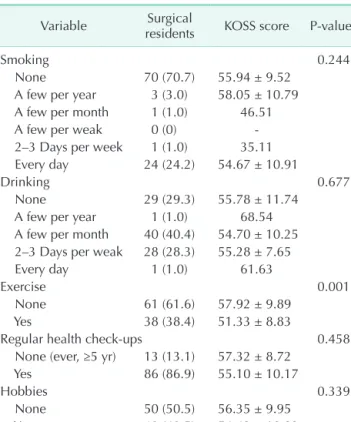
In order to elucidate the factors affecting occupational stress, KOSS score was analyzed with demographic factors and practice characteristics. However, working hours per week, mean number of assigned patients, resident recruitment rate, and number of night shifts per week were not significantly related to the occupational stress of responding surgical residents (Table 2). In terms of lifestyle characteristics, regular exercise was significantly associated with lower KOSS score (P = 0.001) (Table 3).
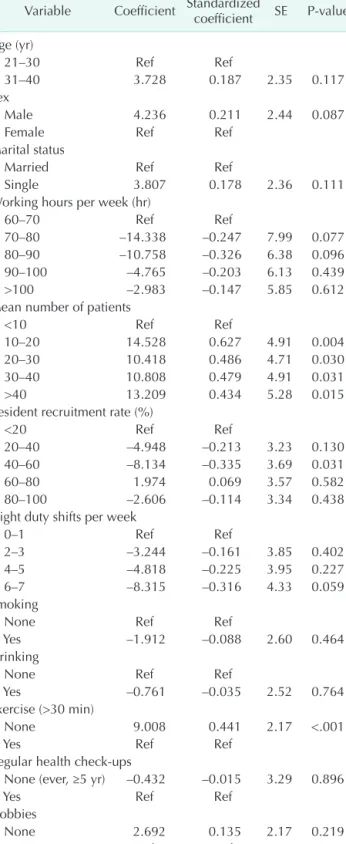
However, when we performed multiple linear regression analysis for KOSS including all variables, such as demographics, practice characteristics and lifestyle characteristics, the mean number of assigned patients, resident recruitment rate and exercise were all significantly associated with KOSS score (Table 4).
The distribution of working hours for surgical residents is shown in Fig. 1. More than 90% of the surgical residents surveyed work more than 80 hours per week. The respondents were divided into two groups; one group consisted of surgeons who work less than 80 hours a week and the other group consisted of surgeons working more than 80 hours a week. The KOSSs of these groups were compared with one another and Table 2. Demographic and practice characteristics and
KOSS score of the responding Korean surgical residents Variable Surgical
residents KOSS score P-value
a)Age (yr) 0.552
21–30 44 (44.4) 54.72 ± 9.21
31–40 55 (55.6) 55.93 ± 10.62
Mean ± SD 31.34 ± 2.91
Sex 0.810
Male 57 (57.6) 55.18 ± 10.62
Female 42 (42.4) 55.67 ± 9.17
Marital status 0.372
Married 31 (31.3) 54.06 ± 8.60 Single 68 (68.7) 56.00 ± 10.56
Working hours per week (hr) 0.347
60–70 3 (3.0) 58.00 ± 6.78
70–80 3 (3.0) 52.65 ± 4.28
80–90 10 (10.1) 49.86 ± 8.88
90–100 23 (23.2) 57.45 ± 9.11
>100 60 (60.6) 55.53 ± 10.62
Mean number of patients 0.597
<10 6 (6.1) 52.67 ± 7.10
10–20 24 (24.2) 57.84 ± 10.17
20–30 31 (31.3) 55.21 ± 9.96
30–40 26 (26.3) 53.60 ± 8.84
>40 12 (12.1) 56.19 ± 13.23
Resident recruit ment rate (%) 0.256
<20 15 (15.2) 57.79 ± 10.60
20–40 24 (24.2) 53.60 ± 8.15
40–60 21 (21.2) 52.50 ± 9.51
60–80 14 (14.1) 58.98 ± 12.36
80–100 25 (25.3) 56.09 ± 9.87
Night duty shifts per week 0.455
0–1 10 (10.1) 54.37 ± 7.53
2–3 41 (41.4) 56.70 ± 9.98
4–5 31 (31.3) 55.77 ± 9.46
6–7 17 (17.2) 52.15 ± 12.05
Values are presented as number (%) or mean ± standard deviation.
KOSS, Korean Occupational Stress Scale; SD, standard deviation.
a)
P-values were calculated from analysis of variance or Student t-test as appropriate.
Table 3. Lifestyle variables and comparison of KOSS score Variable Surgical
residents KOSS score P-value
a)Smoking 0.244
None 70 (70.7) 55.94 ± 9.52
A few per year 3 (3.0) 58.05 ± 10.79 A few per month 1 (1.0) 46.51
A few per weak 0 (0) -
2–3 Days per week 1 (1.0) 35.11 Every day 24 (24.2) 54.67 ± 10.91
Drinking 0.677
None 29 (29.3) 55.78 ± 11.74
A few per year 1 (1.0) 68.54 A few per month 40 (40.4) 54.70 ± 10.25 2–3 Days per weak 28 (28.3) 55.28 ± 7.65
Every day 1 (1.0) 61.63
Exercise 0.001
None 61 (61.6) 57.92 ± 9.89
Yes 38 (38.4) 51.33 ± 8.83
Regular health check-ups 0.458
None (ever, ≥5 yr) 13 (13.1) 57.32 ± 8.72
Yes 86 (86.9) 55.10 ± 10.17
Hobbies 0.339
None 50 (50.5) 56.35 ± 9.95
Yes 49 (49.5) 54.42 ± 10.02
Values are presented as number (%) or mean ± standard deviation.
KOSS, Korean Occupational Stress Scale.
a)
Comparison by analysis of variance or Student t-test as appropriate.
there was no significant difference between the two groups in mean KOSS score or any of the subscales (Fig. 2).
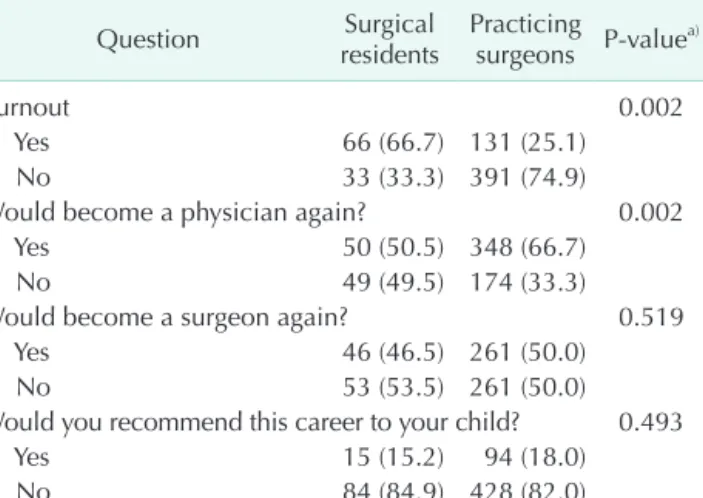
Burnout and career satisfaction were also analyzed. More than half of the surgical residents reported that they had
experienced burnout (66.7%), which was significantly higher than the practicing surgeons (25.1%) (P = 0.002). Moreover, more than half of the surgical residents (53.5%) included in their survey response that, given the opportunity to go back, they would not again choose to become a surgeon. Eighty-four percent of surgical residents answered that they would not recommend this career to their children (Table 5).
DISCUSSION
Despite the fact that the application rate for surgical residents has steadily declined in recent years in Korea, no other reports have investigated the workload of surgical residents and the factors associated with the decline in numbers of surgical residents. This study focused on occupational stress and related factors in surgical residents.
Not surprisingly, the mean KOSS score of a surgical resident is significantly higher than that of other specialized occupations.
Furthermore, surgical residents showed significantly higher mean scores in almost all subscales when compared to individuals with other specialized occupations, except in terms of relationship conflicts and job instability. One intriguing fact is that the subscale of “lack of reward” was still high for surgical residents, despite recent increases in pay for surgical trainees.
This increase in the cost of the surgeons’ labor is a temporary national policy to support the attrition of surgical residents [1].
This finding suggests that the increased labor cost may not be enough to offset the high demands upon surgical residents.
Alternatively, this finding may indicate that this is not an effective policy to overcome the attrition of surgical residents.
According to our previous study, Korean surgeons are under more stress due to the lack of reward than people with other specialized jobs [13]. Therefore, a strategy must be developed to
60 70 hr
3% 70 80 hr
3%
>100 hr
61% 90 100 hr
23%
80 90 hr 10%
Fig. 1. Distribution of working hours of surgical residents.
Table 4. Multiple linear regression for KOSS
Variable Coefficient Standardized coefficient SE P-value
Age (yr)
21–30 Ref Ref
31–40 3.728 0.187 2.35 0.117
Sex
Male 4.236 0.211 2.44 0.087
Female Ref Ref
Marital status
Married Ref Ref
Single 3.807 0.178 2.36 0.111
Working hours per week (hr)
60–70 Ref Ref
70–80 –14.338 –0.247 7.99 0.077
80–90 –10.758 –0.326 6.38 0.096
90–100 –4.765 –0.203 6.13 0.439
>100 –2.983 –0.147 5.85 0.612
Mean number of patients
<10 Ref Ref
10–20 14.528 0.627 4.91 0.004
20–30 10.418 0.486 4.71 0.030
30–40 10.808 0.479 4.91 0.031
>40 13.209 0.434 5.28 0.015
Resident recruit ment rate (%)
<20 Ref Ref
20–40 –4.948 –0.213 3.23 0.130
40–60 –8.134 –0.335 3.69 0.031
60–80 1.974 0.069 3.57 0.582
80–100 –2.606 –0.114 3.34 0.438
Night duty shifts per week
0–1 Ref Ref
2–3 –3.244 –0.161 3.85 0.402
4–5 –4.818 –0.225 3.95 0.227
6–7 –8.315 –0.316 4.33 0.059
Smoking
None Ref Ref
Yes –1.912 –0.088 2.60 0.464
Drinking
None Ref Ref
Yes –0.761 –0.035 2.52 0.764
Exercise (>30 min)
None 9.008 0.441 2.17 <.001
Yes Ref Ref
Regular health check-ups
None (ever, ≥5 yr) –0.432 –0.015 3.29 0.896
Yes Ref Ref
Hobbies
None 2.692 0.135 2.17 0.219
Yes Ref Ref
KOSS, Korean Occupational Stress Scale; SE, standard error.
make up for this lack of reward, based on deep consideration of the surgeons’ workload.
Based on this study, it appears that most surgical residents suffer from long working hours. More than ninety percent of the residents are working over 80 hours per week. Furthermore, sixty-one percent of the residents work more than 100 hours per week. Veasey at al. [14] reported that sleep loss and fatigue of residents can negatively affect the outcome of their patients. Shanafelt et al. [15] analyzed 7,900 members of the American College of Surgeons and reported that the number of hours worked and nights on call per week appear to have a substantial impact on surgeons’ stress. Our previous study also showed that long working hours were related to higher occupational stress levels of surgeons [13]. Korean surgical residents work many more hours than average employees.
For example, based on one survey reported in 2008, over
40% of residents work more than 18 hours per day, which is extraordinarily high [1,16]. This problem has been raised and discussed among residency program directors and government officers, and as a result, the Ministry of Health and Welfare decided to implement a new policy restricting working hours to a maximum of 80 hours per week for training residents to prevent overwork. Many studies that have been conducted overseas reported that an 80-hour work week policy affected neither patients’ outcomes nor residents’ education [17-19].
Therefore, we divided surgical residents into two groups on the basis of this working hour limitation (<80 hours per week) and investigated the differences in the level of occupational stress (KOSS) between the two groups. Contrary to our expectation, there was no significant difference in KOSS score between groups who worked less than 80 hours and more than 80 hours per week. This finding is probably related to the small sample size of residents working less than 80 hours; only six percent of residents worked less than 80 hours per week. This may also explain the lack of significant differences seen when we analyzed KOSS according to working hours. Therefore, it is necessary to reinvestigate the relationship between working hours and the other factors associated with occupational stress when the restriction policy on resident working hours has been put into effect.
On the other hand, in the multiple linear regression analysis, the mean number of patients, and the resident recruitment rate were all significantly associated with KOSS score. These results suggest that the attrition of surgical residents has led to an increased workload on each surgeon, and has also caused increased occupational stress. Our previous study of Korean surgeons also showed that frequent night shifts, a higher mean number of patients, and long working hours were all positively correlated with higher KOSS [13]. In addition, we identified unusually long working hours and uncontrolled overworking of
Occupational climat
e
KOSS score
80 70 60 50 40 30 20 10 0
Physical
environment Job demend
Degree of autonomy
Relationship conflic
t
Job instability
Organization system
Lack of rewar
d
To ta l Working hours per week <80 hr Working hours per week >80 hr
Fig. 2. Comparison of Korean Oc- cupational Stress Scale (KOSS) score according to working hours, with surgeons divided into two groups on the basis of an 80-hour work week.
Table 5. Burnout and career satisfaction
Question Surgical
residents Practicing
surgeons P-value
a)Burnout 0.002
Yes 66 (66.7) 131 (25.1)
No 33 (33.3) 391 (74.9)
Would become a physician again? 0.002
Yes 50 (50.5) 348 (66.7)
No 49 (49.5) 174 (33.3)
Would become a surgeon again? 0.519
Yes 46 (46.5) 261 (50.0)
No 53 (53.5) 261 (50.0)
Would you recommend this career to your child? 0.493
Yes 15 (15.2) 94 (18.0)
No 84 (84.9) 428 (82.0)
Values are presented as number (%).
a)