1)
ABSTRACT
An engine/rotor vibration analysis and monitoring system (EVAMOS; brand name of Dynamic Lab.
of Mokpo Maritime University) was developed to measure, monitor, store, and analyze vibration and noise data. It is highly reliable and user-friendly, therefore, it is recommended for hull and diesel en- gine vibration measurements based on ISO 20283-2, 20283-5, 8528-9, and class rules. To meet cur- rent trends, this software has been upgraded by using an acoustic emission sensor (AES) and the MATLAB language. The upgraded version, named EVAMOS AEM, has been developed for high-sam- pling rate measurements of up to 2 MS/s for each channel . This results in streams of huge amounts of data, which requires a special treatment method. Furthermore, a multithreaded programming algo- rithm and binary file format were applied. Experiments were conducted during the trial of a ship at sea to diagnose engine trouble concerning high frequency. The AES was installed on the cylinder bodies of the marine diesel engine to detect abnormal vibration signals. In this study, the AES char- acteristics were analyzed to distinguish two operating conditions of the main engine: engine top brac- ing (TB) on and engine TB off. In future, problems regarding the turbocharger or lubricating system, etc., can be diagnosed in advance to prevent failure.
요 약
엔진 /회전체 진동 분석 및 모니터링 시스템은 진동과 소음자료를 측정하고, 모니터링하고 저장
및 분석하도록 개발되었다 . 이 시스템은 선체 및 디젤엔진 진동 측정하기 위해 ISO 20283, 6954-2000, 8529-9 및 선급 규정에 기초를 두고 있다. 기존에 EVAMOS라는 선박용 엔진/로터 진 동분석 및 모니터링을 할 수 있는 시스템이 있었지만 음향 방출센서를 사용할 수 있도록 데이터
Corresponding Author ; Member, Mokpo Maritime University E-mail : [email protected]
* Member, Marine Engineering, Mokpo Maritime University
# A part of this paper was presented at the KSNVE 2018 Annual Autumn Conference
Recommended by Editor Jun Hong Park
© The Korean Society for Noise and Vibration Engineering
Acoustic Emission Signal Monitoring Software for Marine Diesel Engine using MATLAB
매트랩 언어를 이용한 선박용 디젤엔진의 음향 방출 신호 모니터링 소프트웨어 개발
Myeongho Song * , QuangDao Vuong * and Donchool Lee †
송 명 호*· 벙광다오*· 이 돈 출†(Received April 24, 2019 ; Revised August 29, 2019 ; Accepted August 29, 2019)
Key Words : Acoustic Emission Signal(음향 방출 신호), Marine Diesel Engine(선박용 디젤 엔진), Multi-threaded
Processing(멀티 스레드 처리)
샘플링속도를 2 MS/s까지 측정 가능한 EVAMOS AEM으로 개선하였다. 그리고 C언어 대신 MATLAB을 이용하여 프로그램화였다. 이 샘플링 속도는 거대한 량의 데이터 흐름을 유도하며, 데이터 처리를 위한 특별한 방법이 필요하여 멀티 스레드 처리 프로그램 알고리즘과 바이너리
파일형식을 적용하였다 . 일부 실험은 고주파에 관련된 엔진의 트러블 진단을 위해 선박의 해상
시운전 중에 수행하였다. AES는 비정상적인 진동신호를 감지하기 위하여 선박용 디젤 엔진의 실 린더 몸체에 설치하여 하였다. 이 논문에서는 주 기관의 두 가지 운전조건 즉 엔진 톱 브레이싱
의 작동상태와 미작동상태를 구분하기 위하여 AES 특성을 분석하였다. 향후 개발된 S/W는 과급
기와 윤활 시스템 등의 진단에 활용할 수 있을 것으로 기대한다 .
1. Introduction
The main engine is the most important part of a marine propulsion system. Diagnosing troubles us- ing AES can help detect abnormal conditions as well as failures of the engine or whole propulsion system before they occur. Acoustic emission signal processing requires a high sampling rate, which leads to streams of huge amounts of data. The sig- nals are typically in the GB range. The EVAMOS software (S/W) was upgraded to a 2 MS/s sampling rate for each channel. Furthermore, MATLAB was used to adapt EVAMOS to the new requirements of acoustic emission signal monitoring and analysis, and it was named EVAMOS AEM.
2. Software Development
MATLAB is a programming language designed for engineers and scientists. The EVAMOS AEM S/W was built using the MATLAB GUI, however, it can be run as an executable program without MATLAB installation. This software can be used for the following functions
(1).
Vibration measurements and real-time signal processing via A/D Board with mechanical trou- ble shooting.
Monitoring entire marine propulsion system as well as on shore engines and structures with alarm and engine shutdown protection in the case of abnormal conditions.
Trend analysis and preventive maintenance by post-signal processing analysis from regular stor-
age data.
Hull and diesel engine vibration measurement support based on ISO 20283-2:2008
(2), ISO 20283-5:2016
(3), ISO 8528-9:2017
(4), and class rules. The maximum sampling rate is 2 MS/s(each channel) for AES measurement.
The EVAMOS AEM S/W supports National Instruments® NI-DAQmx devices such as CompactDAQ, X-Series, M-Series, E-Series, USB, myDAQ, and ELVIS II. Furthermore, it supports many other types of data acquisition hardware made by National Instruments by using MATLAB® and Data Acquisition Toolbox
(5). All the hardware must
Fig. 2 Real time FFT analysis using EVAMOS
AEM S/W
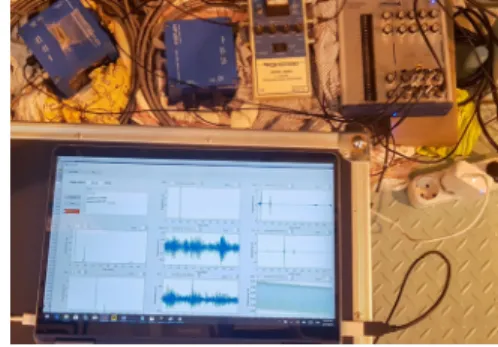
Fig. 1 Acoustic emission measurement using EVAMOS
AEM S/W
be connected to a computer before the EVAMOS AEM S/W begins operating. The characteristics of the acoustic emission, including the FFT algorithm, were analyzed in a frequency domain and displayed online in real time.
3. Signal Treatment Methods
Acoustic emission signal monitoring with a high sampling rate requires efficient treatment methods for the resulting huge amount of data, which is con- tinuously streamed. It should be noted that data will be lost if there is a software overload. The first sol- ution to this is to use the multithreading process.
MATLAB typically processes commands step- by-step, therefore, the subsequent command is not processed until the current command is complete.
This creates a bottleneck effect and the whole sys- tem runs slowly. In this case, the S/W uses only a
one CPU while the remaining processors are idle.
Thus, it is better to divide the total work and send it to the multi-workers, where the commands will be executed in parallel. This method is much more effi- cient with a multicore CPU, and maximum uti- lization of the CPU is achieved by multitasking.
Figure 3 shows the multithreading process. There is a total of 3 threads. The first conducts signal monitoring and saves the data. Second, an FFT analysis is performed by the second thread, and the third involves the trouble diagnosis, alarm, and en- gine shutdown protection. All the threads cooperate simultaneously with the stream analysis of the huge amount of continuous data.
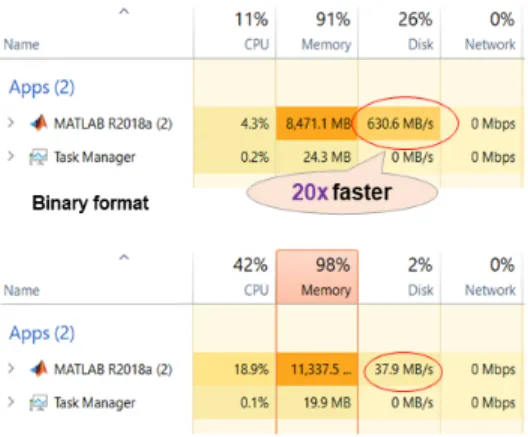
Fig. 4 Comparison of writing speeds between binary
format and text format
Fig. 3 Multithreading process in EVAMOS AEM S/W
Fig. 5 Comparison of file sizes between binary for-
mat and text format
Fig. 6 Schematic of acoustic emission signal meas-
urement using EVAMOS AEM S/W
Fig. 7 Installation of AES and accelerometer on en-
gine cylinder body
The multithreading process helps to increase the computing speed. However, another problem in dealing with such a huge amount of data is the speed of data writing. Using a solid-state drive in- stead of a hard disk drive increases the speed by 10 times. In addition, the measurement data is com- monly stored in text format. This format is easy to open and use, however, the signal data type (dou- ble, integer, etc.) must be converted to the string data type before saving, which takes time. Using the binary format instead can solve this issue. Fig. 4 shows that in the case of binary format, the data saving speed is approximately 20 times faster than that of text format. The other advantage in using the binary format is that less storage space is used.
Tests were performed in which the same data was saved in both binary format (.bin) and text format (.txt). The result is shown in Fig. 5. When binary format was used, the file size was 1.56 GB, equal to less than 60 % of the size of the file in the text format, which was 2.73 GB. With a faster saving speed and the use of less storage space, binary for- mat helps to increase the writing performance by approximately 33.3 %, which is remarkable.
2 60%
33
drive stora faster writing
perfo ge
imp
rm ance ro vement
×
= ×
4. Acoustic Emission Measurement with EVAMOS AEM S/W
Experiments were also conducted during the offi-
cial sea trial of 158 000 DWT VLCC for acoustic emission measurements using the EVAMOS AEM S/W. The AE sensors and the industrial accel- erometers were installed at the same positions on the cylinder bodies of the 16 330 kW HYUN- DAI-MAN B&W 6G70ME-C9.5 marine diesel engine. The purpose of these measurements was to determine the characteristics of acoustic emission at the engine cylinder bodies in 2 operating con- ditions: TB on and TB off. This is the first step in developing the database for detecting the operating condition as well as diagnosing troubles.
A schematic of the measurement system is shown in Fig. 6 the accelerometer PCB 337A26 has a fre- quency range of 0.5 Hz ~ 10 000 Hz while the range of the Kistler AE sensor 8512C11010000 is 100 kHz
~ 900 kHz. The sampling rate is 2 MS/s. All the signals are monitored and analyzed using the EVAMOS AEM S/W. The acoustic emission signal was analyzed for each 6° rotation angle. The results are shown in Figs. 9 ~ 13, and they were analyzed at 10° intervals with a 5° overlap of the crankshaft for combustion pattern analysis. The 1/120 octave band analysis was applied to filter noise and to uti-
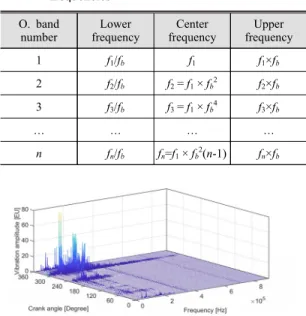
Fig. 8 1/120 octave band frequency calculation
Table 1 1/120 octave band numbers corresponding to
frequencies
O. band
number Lower
frequency Center
frequency Upper frequency
1
f1/f
b f1 f1×f
b2
f2/f
b f2= f
1× f
b2 f2×f
b3
f3/f
b f3= f
1× f
b4 f3×f
b… … … …
n fn
/f
b fn=f
1× f
b2(n-1)
fn×f
bFig. 9 Waterfall map of acoustic emission signal on
body of cylinder no. 6 at 60 r/min with TB on
lize the frequency spectrum results. These can be of simple form from the huge amount of data for vi- bration diagnosis. The value of each band is the maximum value of the vibration amplitude in the range from its lower to upper frequency.
In the 1/120 octave band calculation, the starting frequency was f
1= 50 kHz, while the octave band boundary was f
b= 21/240.
According to the measured data, for the same shaft speeds with the same settings, the vibration character- istics are also the same for each rotation. The meas- urement sampling rate of 2 MS/s helps analyze the sig- nal frequency up to 1 MHz using FFT. The octave
band number range of 300 kHz ~ 500 kHz(frequency of 300 kHz ~ 800 kHz) shows some differences be- tween the 2 operating conditions. For engine TB on, there were twice the number of dominant frequencies at each octave band number range of 330 ~ 350 and 450 ~ 470. These were not available in the engine TB off condition, and were the same for each engine speed. This feature is useful to help detect the oper- ating conditions of the main engine, in this case in the engine TB on and engine TB off conditions.
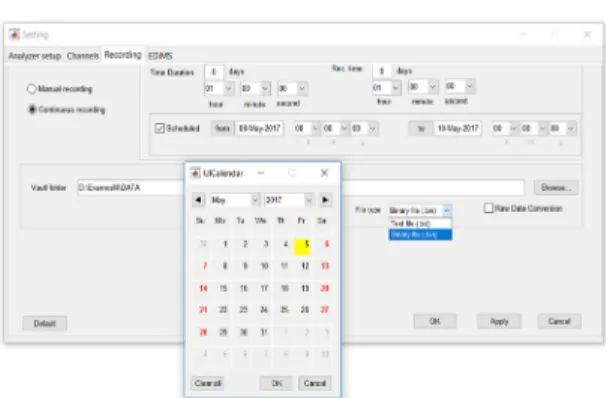
The EVAMOS AEM S/W automatically monitors acoustic emission and noise. As shown in Fig. 14, the time for checking can be specified. During this schedule, the engine operations are continuously analyzed. This helps to save on data storage, but the main engine tends to remain in safekeeping.
5. Conclusion
EVAMOS AEM is an upgraded version of the EVAMOS S/W to adapt to the requirements of AE and noise monitoring. This upgrade was developed
Fig. 10 1/120 octave waterfall map 1 of acousticemission signal on body of cylinder no. 6 at 60 r/min with TB on
Fig. 12 1/120 octave waterfall map 1 of acoustic
emission signal on body of cylinder no. 6 at 60 r/min with TB off
Fig. 13 1/120 octave waterfall map 2 of acoustic
emission signal on body of cylinder no. 6 at 60 r/min with TB off
Fig. 14 Monitoring schedule setting in recording set-
up window of EVAMOS AEM S/W
Fig. 11 1/120 octave waterfall map 2 of acoustic
emission signal on body of cylinder no. 6
at 60 r/min with TB on
using the MATLAB GUI and can be run as an ex- ecutable program without MATLAB installation.
For AE measurements, the sampling rate of 2 MS/s supports analysis of the signal frequency of up to 1
MHz using FFT. Moreover, the multithreaded pro- gramming algorithm helps increase the computational speed. The total work is divided and sent to the multi-workers, and the commands are executed in parallel. This method is more efficient with a multi- core CPU, with maximum utilization of the CPU by multitasking. In addition, the binary file format has many advantages in comparison with the common text file format. By increasing the saving speed and utilizing less storage, the binary format helps to in- crease the writing performance by approximately 33.3 %, which is significantly remarkable.
Experiments were also performed during an offi- cial sea trial using the EVAMOS AEM S/W. The analysis results reveal the AES characteristics on the cylinder bodies of the marine diesel engine. A database was made to detect the operating con- ditions, i.e., TB on and TB off, of the main or aux- iliary engine. In future, problems regarding the tur- bocharger or lubricating system, etc., can be diag- nosed sooner to prevent failure in advance.
Acknowledgement
This study was funded by the Ministry of Trade, Industry and Energy of KOREA. In addition, it was con- ducted within a government-funded project, “Established of authorized test and certification center for me- dium/high speed marine engines and related equipment”.
References
(1) Lee, D. C., Joo, K. S., Nam, T. K., Kim, E. S., and Kim S. H., 2009, Development of Engine Vibration Analysis and Monitoring System(EVAMOS) for Marine Vessels, Transactions of the Korean Society for Noise
and Vibration Engineering, Vol. 19, No. 2, pp. 155~161.
(2) ISO 20283-2, 2008, Mechanical Vibration ― Measurement of Vibration on Ships ― Part 2: Measure- ment of Structural Vibration, International Organization for Standar-dization (IMO).
(3) ISO 20283-5, 2016, Mechanical vibration ― Measurement of Vibration on Ships ― Part 5: Guidelines for Measurement, Evaluation and Reporting of Vibration with Regard to Habitability on Passenger and Merchant Ships, International Organization for Standardization (IMO).
(4) ISO 8528-9, 2017, Reciprocating Internal Combustion Engine Driven Alternating Current Generating Sets ― Part 9: Measurement and Evaluation of Mechanical Vibrations, International Organization for Standardization(ISO).
(5) MathWork® MATLAB Data Acquisition Toolbox, https://www.mathworks.com/products/daq.html
(6) Octave and One-third Octave Frequency Bands.
Acoustical Porous Material Recipes (APMR), http://apmr.matelys.com/Standards/OctaveBands.html
Myeongho Song received his M. Eng.
from Mokpo Maritime University in 2008. He is now working at a ship repair support center. He is also a Ph.D. candidate at Dynamics Lab. of Mokpo Maritime University.
Quang Dao Vuong received his
Ph.D. from Mokpo Maritime University, South Korea. Currently, he is a researcher at Dynamics Lab.
of Mokpo Maritime University.
Don Chool Lee received his Dr. Eng.