Orientation on Organizational Citizenship Behavior
Byung-Ryul Bae*ㆍGantulga Urandelger**ㆍSergelen Darkhantuya***
Contents Abstract
1. Introduction
2. Theoretical Background and Hypothesis
2.1 Customer Orientation 2.2 Organizational Citizenship
Behavior 2.3 Job Satisfaction 2.4 Hypothesis 3. Research Methodology 3.1 Sampling
3.2 Data Collection Procedure 3.3 Measures
3.3.1 Customer Orientation
3.3.2 Organizational Citizenship Behavior
3.3.3 Job Satisfaction 3.4 Results
3.4.1 Data Analysis Procedure 3.4.2 Measurement Model 3.4.3 Structural Model
3.4.4 Moderation Effect Analysis 4. Conclusion and Discussion 4.1 Managerial Implication 4.2 Limitation and Future Research Reference
APPENDIX
Abstract
ㄴ
Every organization needs to maintain its long-term effectiveness through the positive perceptions, attitudes, and behaviors of its members. Customer orientation, job satisfaction, and organizational citizenship behavior (OCB) are the important functioning aspects for the long-term organizational effectiveness. The purpose of this study is to investigate the impact of service-worker’s customer orientation on OCB within Korean bank and insurance sector by analyzing the relationship of constructs in the conceptual model.
To achieve research objectives, survey method is employed. Findings of this research reveal that both need and enjoyment dimension of CO are very important in predicting OCB. We sent 220 questionnaires to service workers of the bank and insurance then received 200 valid responses. The research was conducted in bank and insurance agency in J city. The choice of these two types of organizations was dictated by the fact that they have large number of service worker with diverse background at multiple levels in these industries. Results also indicated that the moderating effect of pay satisfaction on the relationship between their OCB and CO had a weak effect.
Keywords: Customer Orientation, Organizational Citizenship Behavior, Job Satisfaction
접수일(2014년 3월 14일), 수정완료일(2014년 3월 20일), 게재확정일(2014년 3월 21일)
* Chonbuk National University, Department of Business Administration, Professor, [email protected]
** Chonbuk National University, Department of Business Administration, Ph.D. candidate, [email protected]
** Chonbuk National University, Department of Business Administration, Ph.D. candidate, [email protected]
1 Introduction
For the last two decades, organizational citizen- ship behavior (hereafter OCB) has been a major construct in the fields of psychology and manage- ment, thus it has received a great deal of attention in the literature (Bateman & Organ, 1983; Niehoff
& Moorman, 1993; Organ & Ryan, 1995; Podsakoff, MacKenzie, Paine, & Bachrach, 2000). According to Organ (1988), OCB is an important factor that can contribute to the survival of an organization.
Therefore, it is crucial to understand the variables that significantly and positively aid in creating this favorable behavior within the organization.
Determining how OCB contributes indirectly to an organization through the organization’s social system has been increasing interest to both scholars and managers. This behavior provides the necessary flexibility to work through many unforeseen con- tingencies, and it helps employees in an organization to cope with stressful conditions through inter- dependence (Smith, Organ, & Near, 1983). The ex- tant management literature suggests that OCB af- fects overall organizational effectiveness (Walz &
Niehoff, 1996) and that managers often consider OCB when evaluating employee performance, de- termining promotions and having pay increases (Podsakoff & MacKenzie, 1997). Thus, employees who engage in OCB are expected to have higher levels of job motivation and job satisfaction than employees who do not. Furthermore, it is suggested that these higher levels of OCB may lead to increased productivity and, consequently, higher profitability.
Customer orientation (hereafter CO) is important for all firms. Because service workers who exhibit a high degree of CO engage in behaviors that in- crease the satisfaction of their customers (Dunlap
et al., 1988). Kelley (1992) further asserts that cus- tomer oriented behaviors lead to the development of long term relationship between the organization and customer that are beneficial to both parties.
As firms view long-term relationships with custom- ers as central to business strategies, much interest in determinants for customer-oriented employees (Nor and Azli, 2005). Customer orientation culture influences a service firm’s business performance via the development of lasting customer employee relationships (Bove and Johnson, 2000).
Also it focuses on the relationships among cus- tomer orientation, job satisfaction, and OCB. This research argues and then produces empirical evi- dences that job satisfaction has a moderating effect between CO and OCB based on a sample 107 bank customers and 93 insurance customers. The main objective of this research is to answer the following questions:
1. What is the relationship between CO and OCB on bank?
2. What is the relationship between CO and OCB on insurance agency?
3. What is the difference between bank and in- surance agency on CO and OCB?
4. Is there any moderating effect of job sat- isfaction between CO and OCB?
2. Theoretical Background and Hypothesis
2.1 Customer Orientation
The literature in CO is marked by two big ap- proaches: the first approach was proposed by Saxe and Weitz (1982), and the second was evoked by
Brown et al. (2002). It deserves to present both of these approaches and show the difference be- tween them.
For Saxe and Weitz (1982), CO is dedicated to the behavior of the sales force by trying to adjust this one to the benefit of customer satisfaction.
Besides, the period of formalization of the first ar- ticle on the CO by Saxe and Weitz (1982) and the date of publication of the first contributions on the market orientation by Kohli and Jaworski (1990) legitimizes the difference between both concepts. Indeed the market orientation is an or- ganizational concept measured by Narver and Slater’s (1990) scale while the customer orientation is an individual concept measured by the Saxe and Weitz’s SOCO (Selling Orientation–Customer Orientation) scale (1982). Customer-orientation be- havior focuses on the extent to which salespeople practice the marketing concept by helping their customers make purchase decisions that will satisfy their needs (Saxe & Weitz, 1982). Saxe and Weitz (1982) define the customer orientation as being
“the degree according to which the salesman ap- plies the notion of the Marketing by trying to ac- company the customer in his decisions of pur- chases so as to answer effectively his needs.” More recently, Brown et al. (2002) proposed another def- inition of customer orientation.
Their perspective emanates from Saxe and Weitz’s view (1982) but it is based on the services character- istics and the contact employees’ particularity for the company of services. The authors define custom- er orientation as “an employee’s tendency or predis- position to meet customer needs in an on-the-job context”; furthermore, they propose that the customer orientation is composed of two dimensions. The
needs dimension, which ensues from Saxe and Weitz (1982)’s conceptualization, this dimension repre- sents the employees’ ability to satisfy customer needs. The second dimension is the enjoyment di- mension which represents “the degree to which inter- acting with and serving customers is inherently en- joyable for an employee” (Brown et al., 2002). They affirm that the two dimensions are necessary to un- derstand a service employee motivation to serve customers and respond to their needs. We agree with the Brown et al.’s view and will use their customer orientation scale in our study.
Customer-oriented attitude is defined as the amount of a salesperson’s influence for or against customers. It refers to such issue as affinity to be in contact with the customers and the understanding of the importance of customer orientation for both individual and company’s performance. Customer- oriented behavior is conceptualized in a manner con- sistent with pervious research on customer orientation.
According to Saxe and Weitz (1982), customer-ori- ented behavior is defined as the ability of the sales- people to help their customer by engaging in behav- iors that increase customer satisfaction. Examples would include behaviors such as trying to help to achieve the customer’s goals, discussing the custom- er’s need, and trying to influence the customer with information rather than by pressure. From this con- cept we can see customer-oriented attitude is similar to customer orientation (need dimension) and also customer-oriented behavior is similar to customer orientation (enjoyment dimension).
2.2 Organizational Citizenship Behavior
Organizational citizenship behaviors (OCB) are
discretionary behaviors on the part of a salesperson that are also believed to directly promote the effec- tive functioning of an organization, without neces- sarily influencing a salesperson’s objective sales productivity. According to Organ (1988), OCB have a variety of forms including altruism, courtesy, sportsmanship, civic virtue, and conscientiousness.
Netemeyer et al. (1997) classified OCB into four categories. sportsmanship, civic-virtue, conscien- tiousness, and altruism. In our research we use three of them these are the altruism, the civic-virtue and lastly the conscientiousness. We excluded sports- manship because it doesn’t fit our service contexts, the bank and the insurance sector.
Altruism is a helping behavior directed at specific individuals. When individuals have specific prob- lems, need assistance, or seek help, altruistic peo- ple go an extra mile in assisting them. Altruism and Courtesy have been grouped together by some researchers–and referred to as “helping behavior”
(MacKenzie et al., 1998).
Civic Virtue is a behavior which indicates that a salesperson responsibly participates in and is con- cerned about the life of the company (e.g., attend- ing meetings/functions that are not required but helpful to the company, keeping up with changes in the organization, taking the initiative to recom- mend company’s operations or procedures that can be improved).
Conscientiousness is a discretionary behavior that goes well beyond the minimum role requirements of the organization (e.g., working extra - long days, returning phone calls from the home office prompt- ly, never bending the rules, entertaining only when it is clearly in the best interest of the company to do so). The key elements of OCB are type of behav-
ior that goes beyond what is formally prescribed by the organization discretionary type of behavior not directly rewarded or recognized by the formal structure of the organization; and behavior that is very important for the company performance and operational success (Netemeyer et al., 1997). Walz and Niehoff (1996) noted that OCB represents a set of desirable organizational behaviors, which demonstrate multi-dimensional relationships with positive organizational consequences.
According to Podsakoff et al. (2000), OCB would affect the organizational effectiveness for specific reasons. First of all OCB could help extenting the peer performance. Secondly, OCB could improve the managerial productivities. Another, OCB would help improving the use of organizational resource for productive reasons in the efficient manner. The fourth point, OCB could decrease the need of organ- izational resources for the employee maintenance.
Next, OCB may serve as effective basis for the coordination of the activities among team members and work groups. Further more, OCB could im- prove the organizational ability for hiring and keep- ing qualified employees by promoting that the or- ganization as an interesting place to work. In addi- tion, OCB could improve the stability of organiza- tional performance. Finally, OCB could improve the ability to adapt with changes in the business environment.
The unique contribution of Organ was to identify a class of employee’s work behaviors (organizational citizenship behaviors) whose relationship with job satisfaction, among other variables, might be mean- ingfully examined in the search for a practically significant workplace behaviors related to employ- ee job attitudes.
2.3 Job Satisfaction
Job satisfaction is how contented an individual is with his or her job. Scholars and human resource professionals generally make a distinction between affective job satisfaction and cognitive job sat- isfaction (Locke, 1976; Williams, 1991). Affective job satisfaction is the extent of pleasurable emo- tional feelings individuals have about their jobs overall, and is different to cognitive job satisfaction which is the extent of individuals’ satisfaction with particular facets of their jobs, such as pay, pension arrangements, working hours, and numerous other aspects of their jobs. At its most general level of conceptualization, job satisfaction is simply how gratified an individual is with his or her job. At the more specific levels of conceptualization used by academic researchers and human resources pro- fessionals, job satisfaction has various definitions.
Affective job satisfaction is usually defined as a unidimensional subjective construct representing an overall emotional feeling individuals have about their job as a whole. Hence, affective job sat- isfaction for individuals reflects the degree of pleasure or happiness their job in general induces.
Cognitive job satisfaction is usually defined as be- ing more objective and logical evaluation of vari- ous facets of a job. As such, cognitive job sat- isfaction can be unidimensional if it comprises evaluation of just one aspect of a job, such as pay or maternity leave, or multidimensional if two or more facets of a job are simultaneously evaluated.
Cognitive job satisfaction does not assess the de- gree of pleasure or happiness that arises from spe- cific job facets, but rather gauges the extent to which those job facets are judged by the job holder
to be satisfactory in comparison with objectives they themselves set or with other jobs. While cog- nitive job satisfaction might help to bring about affective job satisfaction, the two constructs are distinct, not necessarily directly related, and have different antecedents and consequences. Job sat- isfaction plays a vital role in human life, because it affects positively on the personal and social ad- justment of an individual. On the contrary, job dis- satisfaction adversely affects on the physical and mental health of a person. The relationship be- tween job satisfaction and employee’s performance has always been discussed in organizational behav- ior and human resource management literature. A highly satisfied employee need not necessarily be profound performer. However, an employee, who is dissatisfied can cause irreparable damage to the organizational effectiveness. Job satisfaction can be defined as an emotional state of mind that reflects an affective reaction to the job and work situation (Dipboye et al., 1994: Farkas & Tetrick, 1989, Lance 1991, Russel & Price, 1988). An employee tends to react negatively towards their job which caused withdrawal of behavior and feeling de-mo- tivated towards their work function. In the context of the job satisfaction components studied were pay, promotion, work itself, supervision and co-workers. We only choose a component of job satisfaction as moderate variables which is the pay satisfaction.
2.4 Hypothesis
We define OCB as the non-compulsive, helpful, and constructive behaviors that are directed to the organization or to its members (Bateman and Organ
1983; Podsakoff and MacKenzie, 1994). Researchers suggest that OCB positively influence the work environment. Several OCB dimensions such as al- truism, civic-virtue, conscientiousness have been identified. OCB-altruism is defined as one employ- ee helping another employee who has a work-re- lated problem (MacKenzie, Podsakoff, and Fetter, 1993). MacKenzie et al. (1993) propose that a work- er’s degree of customer orientation, or disposition to meet customers’ needs, is an important construct that is determined more by basic personality traits and the urgency of the specific situational context.
Thus, they believe that customer orientation in a service setting is composed of the need dimension and the enjoyment dimension. These dimensions make an employee behave in a customer oriented way. The need dimension represents employees’ be- liefs about their ability to satisfy customer needs whereas the enjoyment dimension represents the de- gree to which interacting with and serving customers is inherently enjoyable for an employee. Customer- oriented attitude is defined as the amount of a sales- person’s affect for against customers. It refers to such issue as affinity to be in contact with the cus- tomers and the understanding of the importance of customer orientation for both the individual and the company’s performance. According to Saxe and Weitz (1982), customer-oriented behavior is de- fined as the ability of the salespeople to help their customer by engaging in behaviors that increase customer satisfaction. Examples would include be- haviors such as trying to help to achieve the customer’s goals, discussing the customer’s need, and trying to influence the customer with information rather than by pressure. From this concept we can see customer-oriented attitude is similar to customer
orientation (need dimension) and also customer- oriented behavior is similar to customer orientation (enjoyment dimension).
We posit that customer-oriented employees are motivated to help fellow employees, never bend the rules, participate and show concerned about the life of the company as a means of ultimately sat- isfying customers; that is, customer-oriented em- ployees recognize that for successful exchanges with customers to occur, effective internal ex- changes must occur first (George, 1990; Gronroos, 1990). This leads to the following hypotheses:
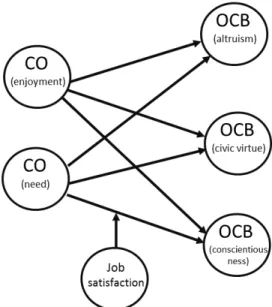
H1-1: Service worker’s CO (enjoyment) will be positively associated with his/her OCB- altruism.
H1-2: Service worker’s CO (need) will be pos- itively associated with his/her OCB- altruism.
OCB-Conscientiousness is enhances the effi- ciency of both an individual and the group (e.g., efficient use of time and going beyond minimum expectations, Organ 1988). We posit that custom- er-orientated employees are motivated to work hard and efficiency as a means of ultimately satisfying customers. This leads to the following hypotheses:
H2(a): Service worker’s CO (enjoyment) will be positively associated with his/her OCB- conscientiousness.
H2(b): Service worker’s CO (need) will be pos- itively associated with his/her OCB- conscientiousness.
OCB-Civic-Virtue is defined as a behavior that
indicates the salesperson responsibly participates in and is concerned about the life of the company (e.g., attending meetings/functions that are not re- quired but helpful for the company, keeping up with changes in the organization, taking the ini- tiative to recommend how company’s operations or procedures can be improved). We posit that cus- tomer-oriented employees are motivated to respon- sibly participate in life of the company. This leads to the following hypothesis:
H3(a): Service worker’s CO (enjoyment) will be positively associated with his/her OCB- civic-virtue.
H3(b): Service worker’s CO (need) will be pos- itively associated with his/her OCB-civic virtue.
Note: Job satisfaction moderated for all path. We showed only the relationship between need and conscientiousness for clarity.
Fig. 1. Research model
2.4.1 Moderating Effects of Job Satisfaction According to Podsakoff et al. (2000), employee job satisfaction is the important determinant of ex- tra-role behaviors, including OCB and CO. We fur- ther suggest that as service employees become more satisfied with their jobs, organization citizen- ship behaviors will increase. It has been shown that job satisfaction is correlated with OCB (Bateman and Organ, 1983; Organ and Ryan, 1995; Smith, Organ, and Near, 1983). Employees who have sat- isfaction from their job tend to value their task and assignment, responsibly and dedicatedly. Therefore, almost no doubt about the relationship between job satisfaction on OCB. Therefore, the hypothesis be- ing tested:
Hypothesis 4: Service worker’s CO and OCB will be moderated by the level of job satisfaction:
H4-1: Service worker’s CO (enjoyment) and OCB (altruism) will be moderated by level of job satisfaction.
H4-2: Service worker’s CO-enjoyment and OCB- civic virtue will be moderated by level of job satisfaction.
H4-3: Service worker’s CO-enjoyment and OCB- conscientiousness will be moderated by level of job satisfaction.
H4-4: Service worker’s CO-need and OCB- altruism will be moderated by level of job satisfaction.
H4-5: Service worker’s CO-need and OCB-civic virtue will be moderated by level of job satisfaction.
H4-6: Service worker’s CO-need and OCB- conscientiousness will be moderated by level of job satisfaction.
3. Research Methodology
3.1 Sampling
For the purpose of achieving research objectives, convenience sampling was used in this study. This study consists of service workers in firms in the banking and insurance industries. The choice of these types of organizations was dictated by the fact that they have large numbers of service workers with diverse background at multiple levels in these industries. Data were analyzed by using the Smart PLS 2.0 (Ringle et al., 2005). The data were ruled out if the participants indicated an inappropriate age or incomplete information. Therefore, the target population of this study was comprised of service workers, who lived in J city Korea.
We collected data from the employees of a fi- nancial institution. The financial services industry was appropriate for testing our hypothesis for vari- ous reasons. Financial institutions employ hun- dreds of people in job ranging from low customer contact to high customer contact. Furthermore fi- nancial services are one of the pure services in the sense that transactions involve few tangible. Many of the services that financial institutions offer are continuous in nature rather than discrete.
Also we collected data from the employees of midsize banks located in J city. We assured all par- ticipants that their individual answers would be held in confidence. All a hundred ten (110) surveys were distributed to three branches of service work- ers in banks. We received 93 completed surveys, for a response rate is 84.5%. The questionnaire in- cluded measures of CO, job satisfaction and OCB, presented in that order. Most respondents were
male (62.4%). We also collected data from the em- ployees of insurance agencies located in J city. One hundred ten (110) surveys were distributed to serv- ice workers in insurance agencies and received 107 completed surveys for a response rate 93.6%. Most respondents were male (50.5%).
3.2 Data Collection Procedure
This research collected the data from September to December in 2012. The research was conducted in bank and insurance agency in J city. Two hun- dred twenty surveys were distributed to two hun- dred twenty service workers (N = 220) of the three branches in Korean bank and insurance industries.
Of this, one hundred ten surveys were distributed to service workers in banks and also one hundred ten were distributed to service worker in insurance companies.
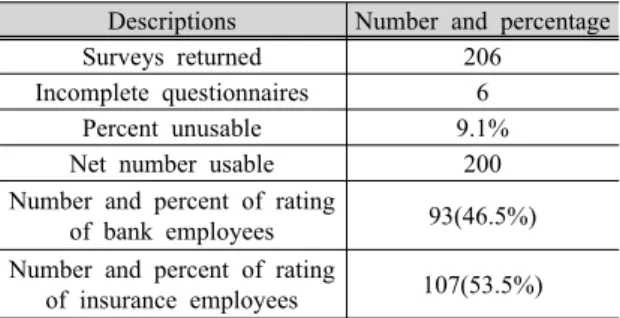
As shown in Table 1, a total of 206 ques- tionnaires were collected. This yielded a 93.6% re- sponse rate. Among the 206 employees 6 employ- ees did not fill out the questionnaires completely.
Among the 200 usable questionnaires, 93 (46.5%) questionnaires were collected from bank employees, 107 (53.5%) questionnaires were collected from in- surance employees.
Descriptions Number and percentage
Surveys returned 206
Incomplete questionnaires 6
Percent unusable 9.1%
Net number usable 200
Number and percent of rating
of bank employees 93(46.5%) Number and percent of rating
of insurance employees 107(53.5%)
Tab. 1. Response Rate
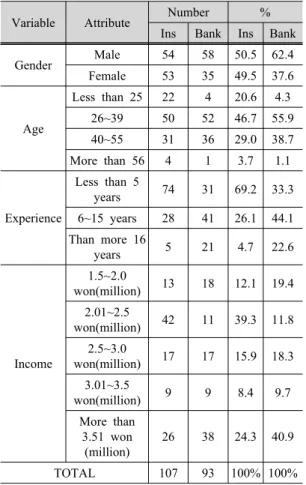
Variable Attribute Number % Ins Bank Ins Bank
Gender Male 54 58 50.5 62.4
Female 53 35 49.5 37.6
Age
Less than 25 22 4 20.6 4.3
26~39 50 52 46.7 55.9
40~55 31 36 29.0 38.7
More than 56 4 1 3.7 1.1
Experience
Less than 5
years 74 31 69.2 33.3
6~15 years 28 41 26.1 44.1 Than more 16
years 5 21 4.7 22.6
Income
1.5~2.0
won(million) 13 18 12.1 19.4 2.01~2.5
won(million) 42 11 39.3 11.8 2.5~3.0
won(million) 17 17 15.9 18.3 3.01~3.5
won(million) 9 9 8.4 9.7
More than 3.51 won (million)
26 38 24.3 40.9
TOTAL 107 93 100% 100%
Tab. 2. Demographic profile of respondents of bank and insurance
3.3 Measures
3.3.1 Customer Orientation
The measure of employee customer orientation used the two dimensional scale from Brown et al.
(2002). The needs dimension is assessed with six items (e.g., I try to help customers achieve their goals), and the enjoyment dimension with six items (e.g., I find it easy to smile at each of my customers).
Each question uses a seven point Likert-type scale anchored on strongly disagree to strongly agree.
In this conceptualization, the first facet reflects the degree to which the individual has the ability
to focus on customer need satisfaction and second reflects the enjoyment received from such a focus.
3.3.2 Organizational Citizenship Behavior The measure of employees organizational cit- izenship behavior used three dimensions from MacKenzie et al. (1993). We used 9 items to assess the dimensions of altruism, civic virtue, and con- scientiousness based on each 3 items. The re- spondents evaluated each item on a seven point scale ranging from 1 (strongly disagree) to 7 (strongly agree).
3.3.3 Job Satisfaction
We use the scales developed by Spector (1997) with four items. This scale is an overall measure of the employee job satisfaction. This scale was administrated to bank and insurance service workers.
The respondents evaluated each item on a seven point scale ranging from 1 (strongly disagree) to 7 (strongly agree).
3.4 Results
3.4.1 Data Analysis Procedure
Partial least square (PLS) was employed to test model and hypotheses. Henseler et al. (2009) de- scribed about the advantages of the PLS path mod- eling as follows: ① represent latent variable scores of constructs, ② avoid small sample size problems,
③ estimate complex model with many latent and manifest variables, ④ have less stringent assump- tions about distribution of variables and error terms, and ⑤ handle both reflective and formative measurement models. Because our research model has many constructs and sample size is small, so
we choose PLS modeling approach. Model estima- tion was performed by Smart PLS 2.0 (Ringle et al., 2005). To test whether path coefficients are statistically significant different from zero, t-values were calculated using bootstrapping procedure with 1000 re-samples (Chin, 1998).
PlS path models have two sets of linear equa- tion: Inner model (structural model) and outer model (measurement model). Inner model specifies the relationship among unobserved or latent varia- ble, and outer model specifies the relationships be- tween latent variable and its observed manifest var- iable (Henseler et al., 2009).
Item Construct SRW* CR AVE alpha enjoy 1
CO (enjoyment)
.674
.847 .528 .776
enjoy 2 .708
enjoy 3 .813
enjoy 4 .710
enjoy 5 .718
need 1
CO (need)
.764
.875 .584 .821
need 2 .773
need 3 .820
need 4 .693
need 5 .766
altruism 1
OCB (altruism)
.832
.901 .753 .838
altruism 2 .918
altruism 3 .875
civic 1
OCB (civic virtue)
.853
.857 .657 .741
civic 2 .813
civic 3 .763
cons 1 OCB
(conscientious ness)
.780
.844 .643 .729
cons 2 .825
cons 3 .800
Tab. 3. List of items for each constructs in Insurance
Note: SRW-Standardized Regression Weights.
* All t-value > 2.00.
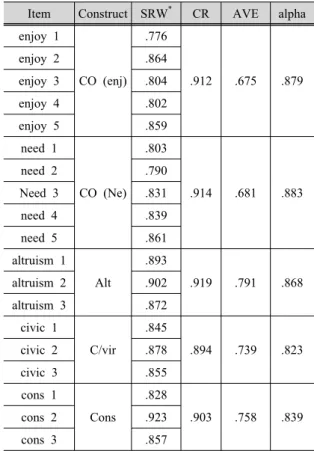
Item Construct SRW* CR AVE alpha enjoy 1
CO (enj) .776
.912 .675 .879
enjoy 2 .864
enjoy 3 .804
enjoy 4 .802
enjoy 5 .859
need 1
CO (Ne) .803
.914 .681 .883
need 2 .790
Need 3 .831
need 4 .839
need 5 .861
altruism 1 Alt
.893
.919 .791 .868
altruism 2 .902
altruism 3 .872
civic 1
C/vir .845
.894 .739 .823
civic 2 .878
civic 3 .855
cons 1
Cons
.828
.903 .758 .839
cons 2 .923
cons 3 .857
Tab. 4. List of items for each constructs in Bank
Note: SRW-Standardized Regression Weights.
* All t-value > 2.00.
3.4.2 Measurement Model
The general approach recommended by Gefen et al. (2000) for evaluating validity and reliability was followed. Convergent and discriminant validity examined for the assessment of validity. Conver- gent validity signifies that a set of indicators repre- sents the same underlying construct. Average var- iance extracted (AVE) used as a criterion of con- vergent validity (Fornell & Larcker’s, 1981). If AVE is more than 0.5, it indicates that construct has sufficient convergent validity. Composite reli- ability (CR) used to measure internal consistency.
CR must be higher than 0.7. Our data shows that
Constructs Bank Insurance
1 2 3 4 5
CR AVE CR AVE
1. CO (enjoy) .912 .675 .847 .528 1.000 .665 .557 .481 .522
2. CO (need) .914 .681 .875 .584 .783 1.000 .570 .511 .660
3. OCB (altr) .919 .791 .901 .753 .551 .629 1.000 .552 .562
4. OCB (c/vir) .894 .739 .857 .657 .605 .594 .626 1.000 .456
5. OCB (cons) .903 .758 .844 .643 .565 .652 .682 .650 1.000
Tab. 5. Reliability, Convergent and Discriminant Validity (Bank & Insurance)
CR is more than 0.7 and AVE is more than 0.5 so all constructs have a convergent validity.
Fornell and Larcker’s (1981) criterion was used to assess discriminant validity. The AVE of each latent variables should be higher than the squared correlations with all other latent variables (AVE >
φ²). Our data shows that all AVE exceed the squared correlation, so all constructs have discrim- inant validity. Table 5 shows the CR, AVE, and correlations among latent variables.
3.4.3 Structural Model
As outer model shows that data is reliable and valid, so we can evaluate inner model. Structural model (inner model) specifies the relations among latent constructs.
We tested the significance level of path co- efficients with a bootstrapping with 1000 re-samples.
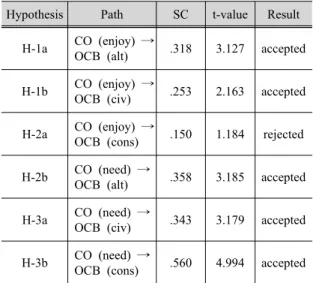
Insurance results shown in Table 6. Results in- dicates that hypotheses 1(a), 1(b) and 2(b) to 3(b) are significant, but hypotheses 2(a) is rejected. Path coefficient from CO (enjoy) to OCB (alt) was sig- nificant (t = 3.12, p < .000), Path coefficient from CO (enjoy) to OCB (civic virtue) was significant (t = 2.16), path coefficient from CO (need) to OCB(alt) was significant (t = 3.18), path coefficient from CO(need) to OCB(civ) was significant (t =
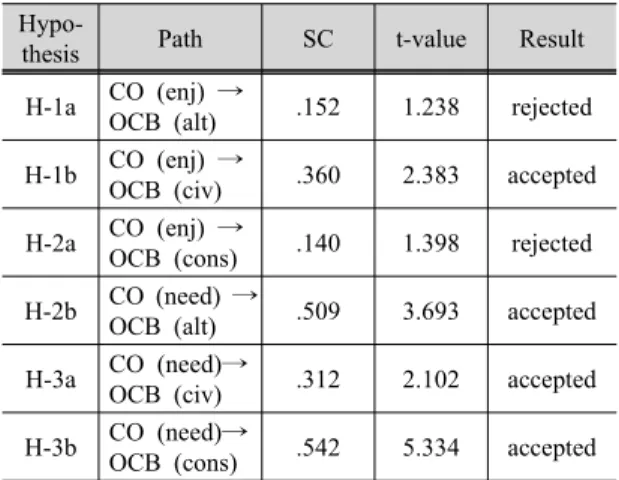
3.17) and path coefficient from CO (need) to OCB (cons) was significant (t = 4.99). Bank results shown in Table 7. Results indicates that hypotheses 1(b) and 2(b) to 3(b) are significant, but hypotheses 1(a) and 2(a) are rejected. Path coefficient from CO (enjoy) to OCB (civ) was significant (t = .2.38, p < .000), path coefficient from CO(need) to OCB (alt) was significant (t = 3.69), path coefficient from CO (need) to OCB (civ) was significant (t = 2.10), and path coefficient from CO (need) to OCB (cons) was significant (t = 5.33).
Hypothesis Path SC t-value Result H-1a CO (enjoy) →
OCB (alt) .318 3.127 accepted
H-1b CO (enjoy) →
OCB (civ) .253 2.163 accepted
H-2a CO (enjoy) →
OCB (cons) .150 1.184 rejected
H-2b CO (need) →
OCB (alt) .358 3.185 accepted
H-3a CO (need) →
OCB (civ) .343 3.179 accepted
H-3b CO (need) →
OCB (cons) .560 4.994 accepted
Tab. 6. Parameter estimation of the theoretical models: Insurance
Note: SC: Standardized Coefficients.
Path Model 1 Model 2
path t-value path t-value
CO (enj) → OCB (alt) .506 7.647 .456 1.442
Pay sat → OCB (alt) .162 1.701 .084 .137
Pay sat * CO (enj) → OCB (alt) .108 .139
R2 .347 .347
CO (enj) → OCB (civ) .446 5.497 .552 1.341
Pay sat → OCB (civ) .116 1.248 .239 .407
Pay sat * CO (enj) → OCB (civ) -.169 .137
R2 .254 .254
CO (enj) → OCB (con) .454 4.92 .730 2.221
Pay sat → OCB (con) .190 2.17 .633 1.253
Pay sat * CO (enj) → OCB(con) -.617 .885
R2 .315 .320
CO (need) → OCB (alt) .530 8.779 .268 .943
Pay sat → OCB (alt) 1.31 1.518 -.404 .635
Pay sat * CO (need) → OCB (alt) .694 .885
R2 .358 .362
CO (need) → OCB (civ) .484 6.39 .400 1.272
Pay sat → OCB (civ) .088 .817 -.091 .141
Paysat * CO (need) → OCB (civ) .229 .277
R2 .278 .279
CO (need) → OCB (con) .617 8.72 .815 3.23
Pay sat → OCB (con) .110 1.24 .350 .923
Pay sat * CO (need) → OCB (con) -.541 .759
R2 .453 .455
Tab. 8. Moderation effect analysis: Insurance
Hypo-
thesis Path SC t-value Result
H-1a CO (enj) →
OCB (alt) .152 1.238 rejected H-1b CO (enj) →
OCB (civ) .360 2.383 accepted H-2a CO (enj) →
OCB (cons) .140 1.398 rejected H-2b CO (need) →
OCB (alt) .509 3.693 accepted H-3a CO (need)→
OCB (civ) .312 2.102 accepted H-3b CO (need)→
OCB (cons) .542 5.334 accepted
Tab. 7. Parameter estimation of the theoretical models: Bank
Note: SC: Standardized Coefficients.
3.4.4 Moderation Effect Analysis
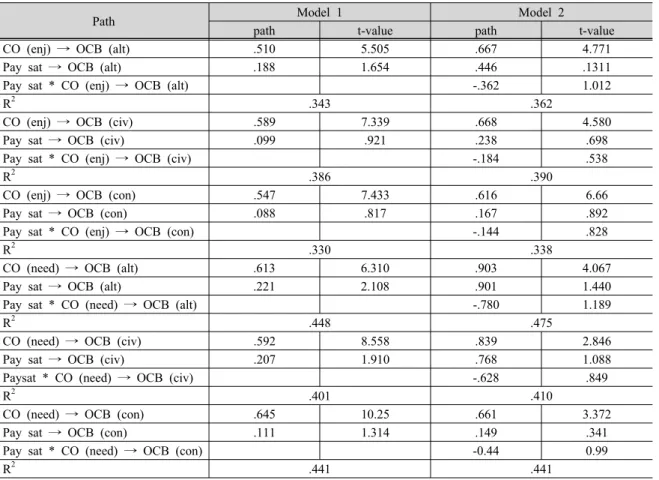
We choose pay satisfaction as a moderator varia- ble to both CO enjoy and CO need which also con- nect to OCB altruism, OCB civic virtue and OCB conscientiousness.
We tested the moderator effect but there are no big differences between two models. pay sat- isfaction doesn’t make much effect towards OCB altruism, OCB civic virtue and OCB conscientious- ness as we checked both prospects bank and in- surance they have the same results. Some re- searchers already proved that customer oriented people who receive and satisfy a higher pay exert
Path Model 1 Model 2
path t-value path t-value
CO (enj) → OCB (alt) .510 5.505 .667 4.771
Pay sat → OCB (alt) .188 1.654 .446 .1311
Pay sat * CO (enj) → OCB (alt) -.362 1.012
R2 .343 .362
CO (enj) → OCB (civ) .589 7.339 .668 4.580
Pay sat → OCB (civ) .099 .921 .238 .698
Pay sat * CO (enj) → OCB (civ) -.184 .538
R2 .386 .390
CO (enj) → OCB (con) .547 7.433 .616 6.66
Pay sat → OCB (con) .088 .817 .167 .892
Pay sat * CO (enj) → OCB (con) -.144 .828
R2 .330 .338
CO (need) → OCB (alt) .613 6.310 .903 4.067
Pay sat → OCB (alt) .221 2.108 .901 1.440
Pay sat * CO (need) → OCB (alt) -.780 1.189
R2 .448 .475
CO (need) → OCB (civ) .592 8.558 .839 2.846
Pay sat → OCB (civ) .207 1.910 .768 1.088
Paysat * CO (need) → OCB (civ) -.628 .849
R2 .401 .410
CO (need) → OCB (con) .645 10.25 .661 3.372
Pay sat → OCB (con) .111 1.314 .149 .341
Pay sat * CO (need) → OCB (con) -0.44 0.99
R2 .441 .441
Tab. 9. Moderation effect analysis: Bank
more effort to do well at the organization. So it means the pay satisfaction motivates them to act the expected response to customers. However, as we tested our moderator variable to both bank and insurance agencies, it doesn’t show any changes.
Either there is a pay satisfaction or no pay sat- isfaction the result is still the same. In addition, we also consider that the prospects for this research can bring different effect.
4. Conclusion and Discussion
In order to sustain the organization’s long-term effectiveness in twenty first century, employees
need to do positive individual behavior and attitudes.
As stated by Yilmaz and Tasdan (2009), organ- izations need employees’ cooperation, benevolence, self-sacrifice and, at times with extra effort. First, our conceptual model has a good fit with the sam- pling data. Based on the insurance data, all hypoth- eses except for hypothesis (H1(b): CO-enjoyment will be positively associated with employee’s OCB- conscientiousness) are empirically supported. Based on the bank data, all hypotheses except for two hypothesis (H1(a): CO-enjoyment will be pos- itively associated with employee’s OCB (altruism) and (H2(a): CO-enjoyment will be positively asso- ciated with employee’s OCB (conscientiousness)
are empirically supported. This study examined how service worker’s customer orientation influen- ces OCB on bank and insurance context. The re- sults indicate that customer oriented service worker enhances OCB. The findings also reveal that cus- tomer orientation development is positively related to OCB. The positive contribution of OCB to or- ganizational performance is well acknowledged by the literatures (e.g., Castro et al., 2004; Podsakoff
& MacKenzie, 1997). However, understanding the importance of the dimensionality of OCB can be extremely useful for organizational behavior studies.
Although the dimensionality of OCB has been studied in previous researches, no known researches have been found to empirically study the di- mensionality of OCB in the J city, Korea context.
Hence, this study has added to the growing body of research in OCB by using a series of tests to test for validity and reliability of the constructs.
We also examined the moderating role of pay sat- isfaction in the link between CO and OCB’s.
Hypothesis 4 examined the moderating role of job satisfaction in the relationship between CO and OCB’s. But among the service employees in bank and insurance sector there were no big difference in job satisfaction.
4.1 Managerial Implication
It is vital for all service companies to empirically test the effect of their employee’s attitudes and be- havior over and above a mere consideration of their performance. For managers, the section on mana- gerial implications discusses the relevance of the findings to the practice of service management and marketing, and makes recommendations for mana-
gerial actions.
Employee job satisfaction moderates the rela- tionship between two CO dimensions and employ- ee OCB. Our results show that OCB is key variable to improve employee customer orientation. Therefore, service managers who want their employees to de- velop behaviors with extraordinary dedication should inspire the personnel and change their com- placency for a set of expectations or challenges to go further than their current way of serving customers. Managers must try to clarify its quality standards and the role of the customer-contact em- ployee, through open and effective communication.
It is important to have leaders who help, show in- terest in knowing employee ideas and opinions, and use internal marketing to implant a vision of service among the customer-contact employees.
Only one job satisfaction (pay) does not affect to employee job satisfaction and OCB. One possible explanation of this result may be that the mediating variables not considered in the study. Our results have important repercussions. Bank and insurance industries who wish their personnel to develop more CO will have to place greater emphasis on service leadership, to incentive a culture of OCB and to achieve greater job satisfaction among cus- tomer-contact employees.
In turn, it will lead to higher quality of service.
In particular, although some managers see OCB as a threat to their authority, they must understand that it is important for customer oriented to become a part of the service culture of the organization.
4.2 Limitation and Future Research
Like all studies, this study also has its limitations.
First, the questionnaire survey was conducted only within two service industries (bank and insurance).
Although, We found that there is no significant differ- ence between these two industries, We cannot com- pletely rule out the possibility that the results may differ across other industries. Future research should be directed to look at these relationships across vari- ous service sectors.
Several limitations, which leads to future studies within this area. One of the circumstances that may have negatively influenced the results is unsat- isfactory number of participants in the present study. Due to limited time, we only admit that 200 service workers from one city in J city may be too small a sample and may have too little of a variability which could reduce correlations between variables making explanation of these correlations by the model more difficult employee’s perception.
Increasing the sample size, testing this model ex- tensively, thus future research could be generalized.
Finally, as many customer service worker take on an increasingly global presence, this study is limited as all respondents work and live within South Korea. Future research should examine these relationships in a multi-national context. Distinct difference may exist between a US sample and the Korean sample used in this study, that when exam- ined could provide guidance to managers of inter- national sales forces.
References
[1] Bateman, T. S. and Organ, D. W. (1983),
“Job satisfaction and the good soldier: The relationship between affect and employee cit- izenship,” Academy of Management Journal,
26, 587-595.
[2] Bove, L. L. and Johnson, L. W. (2000), “A customer-service worker relationship model,”
International Journal of Service Industry Management, 11(5), 491-511.
[3] Brown, T. J., Mowen. J. C., Donavan, D. T., and Licata, J. W. (2002), “The customer ori- entation of service workers: personality trait effects on self and supervisor performance rat- ings,” Journal of Marketing Research, 39(1), 110-119.
[4] Castro, C. B., Armario, E. M., and Ruiz, D.
M. (2004), “The influence of employee organ- izational citizenship behavior on customer loyalty,” International Journal of Service Industry Management, 15(1), 27-53.
[5] Chin, W. W. (1998), “The partial least squares approach for structural equation modeling,” In G. A. Marcoulides (Ed.), Modern methods for business research (pp. 295-236). London:
Lawrence Erlbaum Associates
[6] Dipboye, R. L., Smith, C. S., and Howell, W.
C. (1994), “Understanding and Industrial and Integrated Organizational Approach Psychol- ogy,” Harcourt Brace College Publishers, FortWorth.
[7] Dunlap, B. J., Dotson, M. T., and Chambers, T. M. (1988), “Perceptions of real-estate brok- ers and buyers: a sales orientation, customer orientation approach,” Journal of Business Research, 17, 175-87.
[8] Fornell, C. and Larcker, D. F. (1981), “Evaluat- ing structural equation models with un- observable variables and measurement error,”
Journal of Marketing Research, 18(1), 39-50.
[9] Farkas, A. and Tetrick, L. (1989), “A three-
wave longitudinal analysis of the causal order- ing of satisfaction and commitment on turn- over decisions,” Journal of Applied Psychology, 74, 855-868.
[10] George, W. R. (1990), “Internal marketing and organizational behavior a partnership in devel- oping customer-conscious employees at every level,” Journal of Business Research, 20(1), 63-70.
[11] Gronroos, C. (1990), “Relationship approach to marketing in service contexts: The market- ing and organizational behavior interface,”
Journal of Business Research, 14, 226-229.
[12] Gefen, D., Straub, D. W., and Boudreau, M.
C. (2000), “Structural equation modeling tech- niques and regression: guidelines for research Practice,” Communications of the AIS 1(7), 1-78.
[13] Henseler, J., Christain, M., Ringle, R., and Sinkovics (2009), “The use of partial least square path modeling in international market- ing,” Advances in International Marketing, 20, 277-319.
[14] Kohli, A. K. and Jaworski, B. J. (1990),
“Market orientation: The construct, research propositions and managerial implications”, Journal of Marketing, 54(2), 1-18.
[15] Kelley, S. W. (1992), “Developing customer orientation among service employees,” Journal of the Academy of Marketing Science, 20, 27-36.
[16] Locke, E. A. (1976), “The nature and causes of job satisfaction,” In M. D. Dunnette (Ed.), Handbook of Industrial and Organizational Psychology. Chicago.
[17] Lance, C. E. (1991), “Evaluation of a structural
model relating job satisfaction, organizational commitment, and precursors to voluntary turn- over,” Multivariate Behavioral Research, 26, 137-162.
[18] MacKenzie, S. B., Podsakoff, P. M., and Fetter, R. (1993), “The impact of organizational cit- izenship behavior on evaluations of sales per- formance,” Journal of Marketing, 57, 70-80.
[19] MacKenzie, S. B., Podsakoff, P. M., and Ahearne, M. (1998), “Some possible ante- cedents and consequences of in-role and ex- tra-role salesperson performance,” Journal of Marketing, 62, 87-98.
[20] Netemeyer, R. G., James, S. B, Daryl, O. M., and Robert, C. M. (1997), “An investigation into the antecedents of organizational citizen- ship behaviors in a personal selling context,”
Journal of Marketing, 61(7), 85-98.
[21] Narver, J. C. and Slater, S. F. (1990), “The effect of market orientation on business prof- itability,” Journal of Marketing, 4, 20-35.
[22] Niehoff, B. P. and Moorman, R. H. 1993.
“Justice as a mediator of the relationship be- tween methods of monitoring and organiza- tional citizenship behavior.” Academy of Management Journal, 36, 527-556.
[23] Nor, A. M. N. and Azli, M. (2005), “Individual Factors that Predict Customer-Orientation Behaviour of Malaysian Life Insurance Agents,”
Journal Pengurusan, 24(1), 125-149.
[24] Organ. D. W. (1988), “Organizational citizen- ship behavior: The good soldier syndrome,”
Lexington MA, Lexington books.
[25] Organ, D. W. and Ryan, K. (1995), “A meta analytic review of attitudinal and dispositional predictors of organizational citizenship behav-
ior,” Personnel Psychology, 48, 775-802.
[26] Podsakoff, P. M. and MacKenzie, S. B. (1994),
“Organizational citizenship behaviors and sales unit effectiveness,” Journal of Marketing Re- search, 31, 351-363.
[27] Podsakoff, P. M. and MacKenzie, S. B.
(1997), “The impact of organizational citizen- ship in organizational performance: Review and suggestion for future research,” Human Performance, 10, 133-151.
[28] Podsakoff, P. M., MacKenzie, S. B., Paine, J. B., and Bachrach, D. G. (2000), “Organization citizenship behaviors: a critical review of the theoretical and empirical literature and sugges- tions for future research,” Journal of Management, 26, 513-563.
[29] Russell, D. W. and Price, J. L. (1988), “Dis- criminant validation of measures of job sat- isfaction, job involvement, and organizational commitment,” Journal of Applied Psychology, 73(2), 139-146.
[30] Ringle, C. M., Wende, S., and Will, A. (2005), Smart PLS 2.0, Hamburg, http://www.smartpls.de.
[31] Saxe, R. and Weitz, B. A. (1982), “The SOCO
scale: A measure of the customer orientation of sales people,” Journal of Marketing Re- search, 19(3), 343-351.
[32] Smith, C. A., Organ, D. W., and Near, J. P.
(1983), “Organizational citizenship behavior:
Its nature and antecedents,” Journal of Applied Psychology, 68, 653-663.
[33] Spector, P. E. (1997), “Job Satisfaction: Appli- cation, Assessment, Causes and Consequences,”
Thousand Oaks, CA: Sage.
[34] Williams, L. J. and Anderson, S. (1991), “Job satisfaction and organizational commitment as predictors of organizational citizenship and in-role behaviors,” Journal of Management, 17, 601-617.
[35] Walz, S. and Niehoff, B. P. (1996), “Organiz- ational citizenship behaviors and their effect on organizational effectiveness in limited menu restaurants,” Academy of Management Meetings, 37, 765-802.
[36] Yilmaz, K. and Taşdan, M. (2009), “Organiz- ational citizenship and organizational justice in Turkish primary schools.” Journal of Educat- ional Administration, 47(1), 108-126.
<APPENDIX>
Sample items for Customer Orientation, Organizational Citizenship Behavior and Job Satisfaction scales.
Constructs Items
CO (Enjoyment) Brown et al. (2002)
I find it easy to smile at each of my customers I enjoy remembering my customers names
It comes naturally to have empathy for my customers I enjoy responding quickly to my customer’s request I get satisfaction from making my customers happy I really enjoy serving my customers
CO (Need) Brown et al. (2002)
I try to help customers achieve their goals I achieve my own goals by satisfying customers
I get customers to talk about their service needs with me I take a problem solving approach with my customers I keep the best interest of the customer in mind I am able to answer a customer’s questions correctly
OCB (Altruism) MacKenzie et al. (1993)
Help orient new agents even though it is not required
Always ready to help or lend a helping hand to those around me Willingly give my time to others
OCB (conscientiousness) MacKenzie et al. (1993)
Consciously follow company regulations and procedures
Turn in budget, sales projection, expense report, etc. earlier than required
Return phone calls and respond to other messages and requests for information promptly
OCB (civic virtue) MacKenzie et al. (1993)
Keep up with developments in the company
Attend functions that are not required but that help the company images Risk disproval in order to express my belief about what’s best for the company
Job satisfaction Spector (1997)
I feel I am being paid fair amount for the work I do Raises are too few and far between (R)
I am unappreciated by the organization when I think about what they pay me I feel satisfied with my chances for salary increases
배 병 렬 (Byung R. Bae)
전북대학교 경영학과에서 마케팅으로 박사학위를 취득하였고, 현재 전북대학교 경영학부 교수로 재직 중이다. 미국 인디애나(Indiana) 대학교에서 객원연구원으로 공부한 바 있다.
주요 논문은 유통학회, 유통경영학회지, 산업경제연구, 대한경영학회지 등에 발표되었다. 구조방정식모델링에 많은 관심을 갖고 있어, ‘Amos 19:
구조방정식모델링’, ‘LISREL 9.1: 구조방정식모델링’ 등의 저서가 있다.
간톨가 오란덴갈 (Gantulga Urandelger)
전북대학교 경영학과에서 마케팅으로 석사학위를 취득하였고, 현재 전북 대학교 대학원에서 마케팅 박사과정 중이다. 서비스마케팅 분야에 관심을 갖고 연구를 하고 있다
세르겔렌 따라한토야 (Sergelen Darkhantuya)
전북대학교 경영학과에서 마케팅으로 석사학위를 취득하였고, 현재 전북 대학교 대학원에서 마케팅 박사과정 중이다. 마케팅유통/온라인마케팅 서비스 분야에 관심을 갖고 연구를 하고 있다