Analysis of Relationship between Academic Achievement and Job Satisfaction of Secondary
NCS Vocational Education
Sooho Choi*
Content Abstract
1. Introduction 2. Precedent Research
2.1 Understanding NCS Training 2.2 Educational Service Quality 2.3 Necessity for Vocational Education 2.4 Academic Achievement
2.5 Job Satisfaction
3. Data Collection and Research Hypothesis 3.1 Data Collection
3.2 Research Hypothesis
3.3 Operational Definition of Variables 4. Empirical Analysis
5. Conclusion References Abstract
Abstract
ㄴ
The purpose of this study is to analyze the relationship between academic achievement and job satisfaction in secondary NCS vocational education. The questionnaires were divided into 5 variables : NCS education understanding, quality of education service, necessity of vocational education, academic achievement, job satisfaction. We used SPSS WIN 18.0, to examine the importance, reliability, validity, and association analysis using questionnaires. The results showed that the quality of education service and the necessity of vocational education were influenced on academic achievement in independent variables. But understanding of NCS education was not adopted. In the parameters and dependent variables, academic achievement was found to affect job satisfaction. So if educational institutions are to pay attention to and improve the quality of vocational education service and the need for vocational education, academic achievement will increase.
Academic achievement is expected to positively affect job satisfaction after employment.
Keywords: Vocational Education, Academic Achievement, Job Satisfaction, Quality of Education Service, National Competency Standards
접수일(2017년 10월 24일), 수정일(1차: 2018년 1월 21일, 2차: 2018년 3월 4일), 게재확정일(2018년 3월 15일)
* First Author, Division of Business Administration, Sogang University, [email protected]
1. Introduction
Recently the government has been carrying out appropriate vocational education in connection with employment in accordance with the aptitude and ability of students from high school. In addition, various policies are being implemented so that vocational education can help career choice. Through the vocational education revitalization from high school, we are cultivating professional talents and strengthening the field job capacity to expand employment opportunities for students who want to work. To revitalize meister high and expand employment opportunities, the government plans to start a system to work first and then study (KEDI, 2015.).
The government recently announced the following plans to revitalize customized high school education. First, improve the educational environment to OECD level by 2022. Second, the proportion of school students in vocational high schools increased to 30% by 2022 and employment rate reached 65%. Third, selection of high school students based on talent and aptitude at the center of the score. Fourth, the expanding on social/economy, vocational, arts subjects focusing on schools, consignment education. Fifth, teacher class improvement and students' career-customized learning support (MoE, 2016).
The Ministry of Education also announced plans to carry out customized vocational education at the high school level for a student who does not go to college in high school. The government intends to pursue a personalized
career path, such as trial operation of pre- vocational courses and foster future vocational schools with autonomy including credit system.
The details are as follows. First, pilot the preliminary work process in Grades 1 and 2.
Second, connect with college students and expand foster care courses in the second semester of the second year. Third, expansion of Industrial Information School to future vocational schools (MoE, 2017).
The purpose of this study is to analyze the relationship between academic achievement and job satisfaction in secondary NCS vocational education. This study hopes to increase the proportion of students in vocational high schools and to help with school support in order for vocational education to stabilize.
Understanding the practical difficulties experienced by vocational high schools and suggesting appropriate countermeasures to improve student satisfaction in the future. For this purpose, we conducted questionnaires on vocational high school students and college students over two weeks. The questionnaire consisted of "Understanding NCS education, quality of education service, necessity of vocational education, academic achievement, job satisfaction". We used SPSS WIN 18.0 to examine the importance, reliability, validity, association analysis using the questionnaire.
The independent variables are NCS education
understanding, quality of education service,
necessity of vocational education and the
parameters and dependent variables consisted
of academic achievement and job satisfaction.
2. Precedent Research
2.1 Understanding NCS Training
There are a variety of articles published to emphasize the understanding and necessity of NCS education. In the course of basic vocational abilities of specialized High School NCS Curriculum, it was in the order of writing ability, listening ability, language ability, career development ability, time management ability (Woo, H. J. etc 2, 2016). As a result of analyzing the effect size of NCS-based curriculum, the employment rate was 8.13%
higher than the non NCS curriculum and the size of the employment effect was 1.175 times higher than the non NCS curriculum(Jung, S. J., 2016). The curriculum emphasizes the necessity of NCS based curriculum by introducing the NCS job basic ability in culture education curriculum (Oh, S. Y., 2016). It also suggests ways to develop a NCS-based curriculum and implement a skills-based society by supporting learning modules (In, H. Y., 2016).
2.2 Educational Service Quality
The results of the study on the quality and characteristics of educational service affecting the job of secondary vocational education graduates were published (Lee, S. C., 2016).
The quality of education service including self-efficacy and satisfaction with university facilities and lectures has a significant influence on university life and job satisfaction, thus
emphasizing the importance of quality of education service (Jung, Y. J. & Han, S. Y., 2015). In order to introduce the NCS-based curriculum and improve the quality of the education service, it is necessary to improve the teaching capacity of the specialized curriculum teacher. For that it is argued that competence including analysis, design, development, operation and evaluation and further capacity building for curriculum design, performance evaluation, needs analysis, instructional design, and learning method selection are necessary (Lee, S. J., 2016). In the NCS based vocational education curriculum, we analyzed the difference in the quality of education service investigating the importance of job performance and educational needs of the specialization high school and meister high school teacher (Ham, S. Y., 2016).
2.3 Necessity for Vocational Education
Based on the results of analyzing the need for vocational education through the achievements of the Meister high school policy, meister high school analyzed that it accomplishes both the competitiveness of vocational education and the human resource training required by the industry efficiently (Lim, S. H., & Hwang, J. S., 2015). As a result of looking at the additional demand of secondary vocational education students, 61.2%
of the specialization admission quota, 31.7% of
potential student demand, and 29.5% of actual
student demand, emphasized the necessity and
expansion of vocational education by 2015 (Kim, J. M., etc 6, 2016). The validity of the NCS based vocational curriculum development model was verified using the Delphi preliminary survey tool and the necessity of vocational education was suggested (Kim, D. Y. & Kim, J.
S, 2015). Through a study on the relationship between employment possibility, vocational education services and vocational education satisfaction, as vocational education has a meaningful relationship with employment, it asserted the necessity of vocational education (Woo, B. W., etc 2, 2015). About vocational education of secondary school most parents are aware of vocational education and provided an analysis that they know the importance of vocational education (Hwang, S. Y. etc 2, 2016).
2.4 Academic Achievement
The government provides customized vocational education for students who are not enrolled in universities in general high schools and suggest ways to improve academic achievement (Ministry of Education, 2017), In a Study on the Academic Achievement of Specialized High School and Meister High School Students, it is analyzed that social support, program experience, career barriers, and self-efficacy were statistically significant (Ju, Y. J. etc, 2, 2016). According to the result of the calculation of the support plan for improving the academic achievement by increasing the proportion of secondary vocational education, revising laws, improving
social awareness and securing financial resources were the priorities. Improvement of the working environment, strengthening worker protection and reducing the number of students per class as detailed support measures were the priorities (Kim, J. M. etc 6, 2016). Job relatedness, stress and communication among the contents of education have a significant effect on turnover intention and the higher the academic achievement, the lower the intention to turnover (Bae, S. H. etc, 2016).
2.5 Job Satisfaction
According to the analysis of the relationship between job satisfaction and on-the-job training of high school graduates, in general the higher the job satisfaction, the more tendency to continue employment or to prefer career to similar fields. In addition the study found that the greater the influence of the growth potential, the employment stability, the equality in the enterprise and the geographical position with the company, the higher the job satisfaction (Ahn, J. Y. & Lee, B. W., 2013).
The employment rate of vocational trainees was higher as the recognition of their employment possibility was higher and the lower the perception of instructional ability. The higher the perception of teachers, students, and the relationship between grade and grade, the higher the job satisfaction (Jung, S. J., 2016).
At work suggesting that the better the
communication and the higher the job
satisfaction, the lower the turnover intention
(Bae, S. H. etc, 2016). In order to increase job satisfaction, it is necessary to have a way to improve professional professionalism, and it is necessary to continue self-development including wage and welfare (KRIVET, 2015).
This study is to suggest ways to increase the proportion of students in vocational high schools and to improve students' satisfaction in the future so that vocational education can be stabilized by referring to existing research.
3. Data Collection and Research Hypothesis
3.1 Data Collection
This study analyzes the relationship between academic achievement and job satisfaction of secondary NCS vocational education, for this purpose the survey was conducted for about two weeks from September 18, 2017 to September 29, 2017 for 250 high school students and college students preparing to work in Seoul and the metropolitan area. The questionnaires were divided into 5 variables:
"first NCS education understanding, second education service quality, third necessity of vocational education, fourth academic achievement, fifth job satisfaction". The questionnaire survey was conducted on a 5 point Likert scale for each item, and we looked at the importance, reliability, validity, and relevance analysis. We used SPSS WIN 18.0 to investigate the reliability analysis and exploratory factor using the questionnaire.
3.2 Research Hypothesis
3.2.1 Research Model
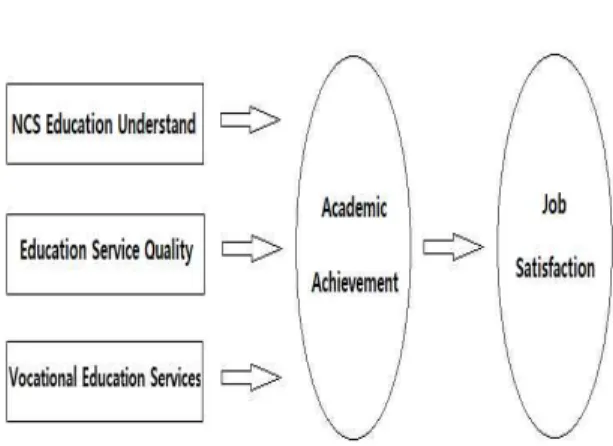
The research model of this paper is [Fig.
3-1].
Fig. 3-1 Research Model
3.2.2. Understanding NCS Education &
Academic Achievement
We expect that the more the students
understand the NCS based education, the higher
the academic achievement will be. Looking at
the progress of the NCS curriculum in Korea
similar to the NOS(National Occupation
Standards) in German and meister training
course, NCS curriculum is affecting academic
achievement (KEDI, 2016). In order to improve
academic achievement in the NCS-based high
school vocational education curriculum, the
recognition of specializing high school teachers
should be improved (Kim, S. J. etc 2, 2016), In
addition, a teaching competency model was
developed and its importance was analyzed to
improve the competence of professional subject
teachers (Lim, J. H., 2017). To increase
academic achievement, the study proposed the task of modifying and promoting the NCS-based higher vocational education curriculum to be suitable for practice and certification (Jang, M, H., 2015). The study have studied the cost of standard education for the operation of curriculum in vocational education institutions (Lee, Y. M. etc 2, 2016). Through the revision of the NCS based high school vocational education curriculum, it was suggested to improve the academic qualification by improving the qualification of professional teaching staff, recruitment and training system (Ministry of Education, KRIVET, 2014).
Hypothesis 1: Understanding of NCS education will affect academic achievement.
3.2.3. Educational Service Quality and Academic Achievement
The results of the study on the relationship between the quality of education service and academic achievement in secondary vocational education showed that the higher the quality of education service, the higher the academic achievement. Therefore, in order to improve the academic achievement of future students, it is suggested that the quality of education service should be improved in accordance with NCS (Seo, Y. B. & Park, C. K, 2016). The present state of secondary vocational education is focused on Meister High School and Specialized Higher Education Curriculum, and suggests ways to link with the academic achievement in the future (Park, H. K., 2014), The authors have studied the service quality of
work⋅education training⋅qualifications for the construction of a sustainable ability based society and studied ways of employment culture after graduating from high school and studied ways of linking with academic achievement (Kim, S. T., 2014). In relation to vocational education of specialization high school students, strengthen our system of getting to work first and going to college later and providing accurate information in the curriculum suggests that students' academic achievement will improve, which will help students decide on their career and strengthen career education after graduation (Hong, S. P., 2016). Focusing on students who have graduated from specialization high school and can not enter university, the authors analyzed the relationship between the characteristics of choosing majors in high school, quality of education service, and achievement in employment (Noh, G. R. & Hur, S. J., 2015).
Hypothesis 2: Quality of education service will affect academic achievement.
3.2.4. Necessity for vocational education and academic achievement
There are various studies on the effect of
vocational education need on academic
achievement. The effects of vocational
education on academic achievement differed
between general high school and professional
high school, and it was investigated that it
affects academic achievement and job search
according to the family background and
education level (Lee, G. J. & Kwak, S. R.,
2016). In a study of the effects of career education activities of middle school students on career development competence and achievement through questionnaire survey, the results of this study are as follows ; it is shown that career education has a statistically significant effect on career development competence and achievement, thus emphasizing the necessity and importance of career education activities in the future (Song, I. B. &
Kang, H. Y., 2016). The results of the analysis of the relationship between the vocational education, the employment ability, the personal characteristics and the academic satisfaction of the vocational high school expected graduates showed statistically significant results (Lee, W.
S. & Na, S. I., 2016). The status of vocational education is classified into specialization high school and meister high school and as a result of analyzing the academic achievement, it was analyzed that it would be helpful to improve the maturity of career attitude and related policies (Oh, S. Y., 2015).
Hypothesis 3: The Necessity for vocational education will affect academic achievement.
3.2.5. Academic Achievement and Job Satisfaction
In a study on the competence and the performance of job performance according to the achievement of secondary vocational education by country, and in countries where vocational education is completed or vocational
education is carried out, the employment performance of young people represents very high. Economic activity, wage level, and occupation level were statistically significant and the higher the academic achievement and the more work-oriented countries, employment performance is high and argued that it was possible for the company to work early (Choi, S. J., 2015). In order to improve the job satisfaction, the policy of going to work first and going to college later analyzed by division into specialization high school and meister high school (Lee, S. Y. etc 2, 2017). Classify the job value types of graduates into 15, the authors analyzed the relationship between academic achievement and first job satisfaction and turnover (Yoo, H. O. etc 2, 2016). About the academic achievement of the vocational trainee, the more women, the higher the age, the higher the new trainees however about job satisfaction, the more men, the lower the age, the higher the former trainees (Jung, S. J., 2016). The results showed that academic achievement of meister high school graduates had a statistically significant effect on job ability and job satisfaction and job ability had a significant effect on job satisfaction (Min, S. G.
etc 2, 2016).
Hypothesis 4: Academic achievement will affect job satisfaction.
3.3 Operational Definition of Variables
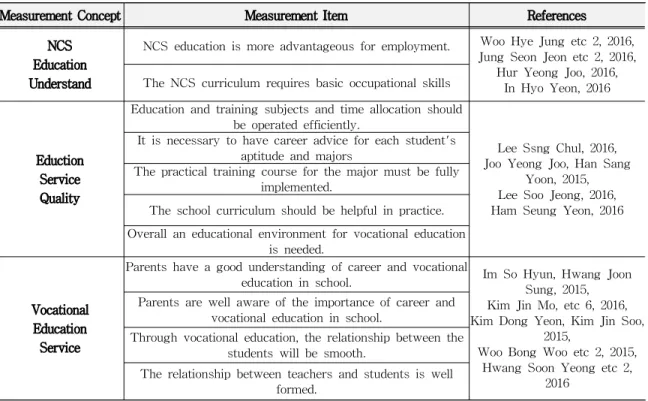
Tab. 3-1 Operational definition of variables (Independent variables)
Measurement Concept Measurement Item References
NCS Education Understand
NCS education is more advantageous for employment. Woo Hye Jung etc 2, 2016, Jung Seon Jeon etc 2, 2016,
Hur Yeong Joo, 2016, In Hyo Yeon, 2016 The NCS curriculum requires basic occupational skills
Eduction Service Quality
Education and training subjects and time allocation should be operated efficiently.
Lee Ssng Chul, 2016, Joo Yeong Joo, Han Sang
Yoon, 2015, Lee Soo Jeong, 2016, Ham Seung Yeon, 2016 It is necessary to have career advice for each student's
aptitude and majors
The practical training course for the major must be fully implemented.
The school curriculum should be helpful in practice.
Overall an educational environment for vocational education is needed.
Vocational Education Service
Parents have a good understanding of career and vocational
education in school. Im So Hyun, Hwang Joon
Sung, 2015, Kim Jin Mo, etc 6, 2016, Kim Dong Yeon, Kim Jin Soo,
2015,
Woo Bong Woo etc 2, 2015, Hwang Soon Yeong etc 2,
2016 Parents are well aware of the importance of career and
vocational education in school.
Through vocational education, the relationship between the students will be smooth.
The relationship between teachers and students is well formed.
Tab. 3-2 Operational definition of variables (Mediated & dependent variables)
Measurement Concept Measurement Item References
Academic Achievement
Vocational education in high school is favorable for
employment. Ministry of Education, 2017,
Joo Yeong Joo etc, 2016, Kim Jin Mo etc 6, 2016, Bae Soo Hyun etc, 2016 A high level of aspirations for education and work will
increase academic achievement.
A high level of achievement in academic work will make a good job.
Job Satisfaction
Early entry into the labor market through vocational education will be beneficial for business and national
development. An Jae Yeong, Lee Byung
Wook, 2013, Jung Seon Jeong, 2016, Bae Soo Hyun etc, 2016,
KRIVET, 2015 Strengthening linkages NCS education/employment/career
development will increase job satisfaction Academic achievement will reduce job stress and turnover
and increase job satisfaction.
4. Empirical Analysis
In this study, we tried to verify the main hy-
pothesis for the analysis of the relationship be-
tween academic achievement and job sat-
isfaction of the secondary NCS vocational
education. By priority operational definition and measurement items were derived from previous studies, and the reliability and validity of the measurement tools were analyzed. Reliability analysis is the process of determining how well the characteristics of the sample are being made and this is an internal consistency check process that verifies whether the respondents clearly understood the questionnaire contents and responded consistently (Chung, C. Y. &
Choi, Y. K., 2001). In this study, Chronbach's Alpha coefficient, which is a reliability test method used in social science research, is used as a method to confirm the internal consistency.
Nunnally(1978) stated that preliminary studies
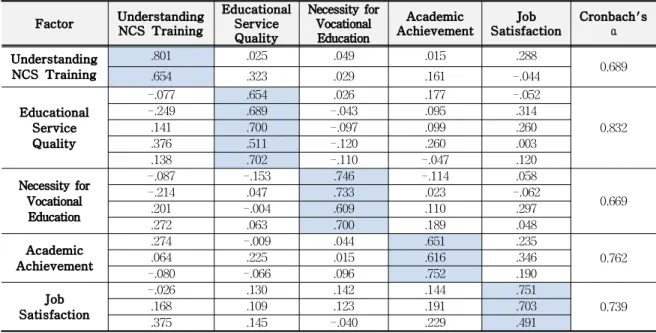
are reliable when the coefficient value is 0.6 or more, and reliability is 0.7 or more in the ac- tual study. In <Tab. 4-1> Cronbach's Alpha coefficient is greater than 0.6, so the measure- ment tools used in this study have internal consistency. In order to verify the validity of the measured variables, exploratory factor analysis was performed using Varimax rotation for principal component analysis. In <Tab.
4-1> factor analysis of independent variables and parameters was performed separately for academic achievement and job satisfaction and the factor loadings of the research were calcu- lated to be 0.5 or more. thus, the same varia- bles were found to be tied together.
Tab. 4-1 Reliability Analysis and Exploratory Factor Analysis of Independent Variable
Factor Understanding NCS Training
Educational Service Quality
Necessity for Vocational Education
Academic
Achievement Job
Satisfaction Cronbach's α Understanding
NCS Training
.801 .025 .049 .015 .288
0.689
.654 .323 .029 .161 -.044
Educational Service Quality
-.077 .654 .026 .177 -.052
0.832
-.249 .689 -.043 .095 .314
.141 .700 -.097 .099 .260
.376 .511 -.120 .260 .003
.138 .702 -.110 -.047 .120
Necessity for Vocational
Education
-.087 -.153 .746 -.114 .058
0.669
-.214 .047 .733 .023 -.062
.201 -.004 .609 .110 .297
.272 .063 .700 .189 .048
Academic Achievement
.274 -.009 .044 .651 .235
0.762
.064 .225 .015 .616 .346
-.080 -.066 .096 .752 .190
Satisfaction Job
-.026 .130 .142 .144 .751
0.739
.168 .109 .123 .191 .703
.375 .145 -.040 .229 .491
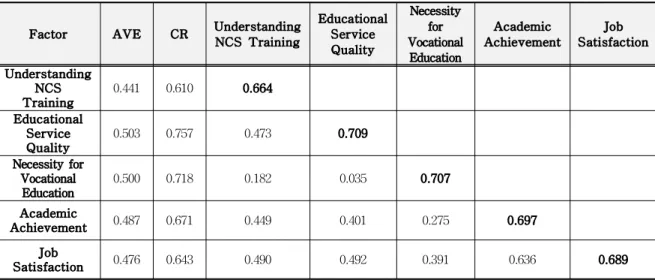
<Tab. 4-2> shows that the AVE and CR val- ues of the measurement items are more than 0.5 or 0.7 and the intuitive validity of the vari-
ables used in this study is largely assured. For
the discriminant validity analysis, the correlation
between variables was analyzed and the AVE
square root of each variable was compared with the correlation coefficient. As shown in
<Tab. 4-2>, the AVE square root of the varia-
bles has a larger value than the other correla- tion coefficients. Thus the validity of discrim- ination between variables is secured.
Tab. 4-2 Discriminatory Feasibility Analysis
Factor AVE CR Understanding
NCS Training
Educational Service Quality
Necessity for Vocational
Education
Academic
Achievement Job
Satisfaction Understanding
Training NCS 0.441 0.610 0.664 Educational
Service
Quality 0.503 0.757 0.473 0.709
Necessity for Vocational
Education 0.500 0.718 0.182 0.035 0.707
Academic
Achievement 0.487 0.671 0.449 0.401 0.275 0.697
Satisfaction Job 0.476 0.643 0.490 0.492 0.391 0.636 0.689
Note : The diagonal bold numbers are the AVE square root of the variable, and the other values are the correlation coefficients
This study confirms the relationship between academic achievement and job satisfaction of secondary NCS vocational education through empirical analysis. In order to verify the pro- posed research model, we use the structural equation model using AMOS 18.0. Prior to the hypothesis testing, the adequacy of the re- search model was verified through Maximum Likelihood Estimation. The results of the analy- sis are as follows :
=145.187(df=110, p=0.014), CFI=0.907(>0.9), IFI=0.913(>0.9),
RMR=0.052 (<0.07), RMSEA=0.056(<0.07), GFI=
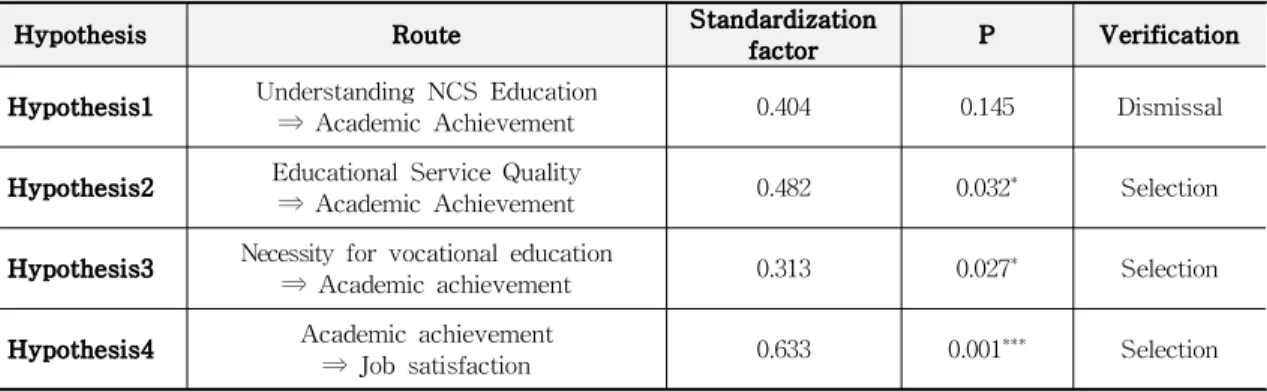
0.892(>0.9). Since this is above the recom- mended standard of fitness, this research model was deemed appropriate and hypothesis testing was conducted. <Tab. 4-3> and [Fig. 4-1]
show the results of the analysis through struc-
tural equations of the causal relationship for the
analysis of NCS education and its necessity and
its performance.
Tab. 4-3 Hypothesis Test by Structural Equation
Hypothesis Route Standardization
factor P Verification
Hypothesis1 Understanding NCS Education
⇒ Academic Achievement 0.404 0.145 Dismissal
Hypothesis2 Educational Service Quality
⇒ Academic Achievement 0.482 0.032
*Selection
Hypothesis3 Necessity for vocational education
⇒ Academic achievement 0.313 0.027
*Selection
Hypothesis4 Academic achievement
⇒ Job satisfaction 0.633 0.001
***Selection
*, **, *** : Correlation Coefficients are significant at the 0.05, 0.01, 0.001 levels.
Fig. 4-1 Research Model Result
5. Conclusion
Prior to this study, we examined the understanding of NCS education, quality of education service, necessity of vocational education, academic achievement and job satisfaction. As a result of the study, the quality of education service and the necessity of vocational education as an independent variable were adopted to affect the academic
achievement, but the understanding of NCS education was not adopted. In the parameters, academic achievement was found to affect job satisfaction.
In order to improve the quality of education
service, First, the subjects and time allocation
of education and training should be operated
efficiently. Second, it is necessary to provide
career guidance for students' individual aptitude
and majors. Third, the practical training course
for the major must be fully implemented.
Fourth, the curriculum to be taught at the school should be helpful in practice. Fifth, education environment for vocational education is needed as a whole.
To increase the need for vocational education First, parents should have a good understanding of career and vocational education in schools.
Second, parents should be aware of the importance of career and vocational education in schools. Third, through vocational education, the relationship between the students should be smooth.
Fourth, the relationship between teachers and students should be smoothly formed.
In order to improve academic achievement, the following points should be considered. First, vocational education in high school is favorable for employment. Second, higher levels of aspirations for education and work will lead to higher academic achievement. Third, I think that the higher the achievement in the study, the better the job.
To improve job satisfaction, the following items should be considered. First, entry into the labor market early through vocational education will be beneficial to the development of enterprises and countries. Second, strengthening the linkages between NCS education, employment, and career development will increase job satisfaction. Third, academic achievement will reduce job stress and turnover and increase job satisfaction.
In conclusion, academic achievement will increase if we pay attention to and improve the quality of vocational education services and the need for vocational education in secondary
schools and college education. Academic achievement is expected to positively affect job satisfaction after employment.
References
[1] An, J. Y. & Lee, B. O. (2013), The Relation Analysis between Working Life Satisfaction and On-The-Job Training Factors of Employees from the Specialized High School, Korean Journal of Technical Education, 13(1), 93-110.
[2] Bae, S. H. & Choi, S. J. (2016), The Effect of Job Relatedness of Content in Learning, Job Stress and Organization Communication on Turnover Intention and Mediating Effect of Job Satisfaction, Vocational Education Research, 35(6), 1-19.
[3] Chang, M. H. (2015), Revising and promoting high school vocational education curriculum based on NCS, KEDI Education Policy Forum ER & D network, 261, 14-17.
[4] Choi, S. J. (2015), Competency and labor market performance of vocational education graduates according to type of secondary vocational education by country, Vocational Education Research. 34(2), 1-30.
[5] Education Ministry (2016), Announcement of High School Customized Education Activation Plan, Education Plan, 1-11.
[6] Ham, S. Y. (2016), Perception of the importance and educational needs of job performance competency of National Competency Standards based vocational education curriculum in technical specialized high schools and meister high schools, Journal of the Korean Institute of Industrial Educators, 41(2), 69-88.
[7] Hong, S. P. & Jung, J. C. (2016), Analysis on the
Vocational High School Students' Classification of Career Decision Making based on the Decision Scales and the Preparation Behaviors on the Pursuit of Higher Education and of Employment and Its Influential Factors, Vocational Education Research, 35(5), 1-30.
[8] Hwang, S. Y. etc 2 (2016), The analysis on awareness of parents concerning career and vocational education of special classes in middle and high schools, Journal of special children education, 18(4) 109-130.
[9] Im, J. H. (2017), Development and importance analysis of vocational high school teachers' competency model for microprocessor course on NCS-based curriculum, Hanyang University Ph.D.
[10] In, H. Y. (2016), NCS based curriculum and learning modules for the implementation of skills-based society, Future Policy Focus, 42-43.
[11] Joo, Y. J. & Han, S. Y. (2015), A Study on Factors Affecting the School Life Satisfaction and First Job Satisfaction of Young College Graduates, The journal of educational research, 13(1), 193-212.
[12] Joo, Y. J. & Hong, Y. N. (2016), Analysis of Structural Relationships among the Variables Related to the Maturity Attitude of Career Attitudes of Characterization High School and Meister High School Students, Vocational Education Research, 35(2), 1-18.
[13] Jung, C. Y. & Choi, Y. G. (2001), Statistical analysis using SPSS WIN, Trading Manager.
[14] Jung, S. J. (2016), Analysis of variables affecting completion and employment of unemployed vocational trainees, Vocational Education Research, 35(3), 1-24.
[15] Jung, S. J. (2016), Survival Analysis on Employment Rate and Employment Retention Rate of
Unemployed Vocational Trainees, Vocational Education Research, 35(6), 39-63.
[16] KEDI (2015), Vocational Education in High Schools in Korea, Education Statistics FOCUS.
[17] KEDI (2016), How to Teach German Higher Vocational Education and Meisters, Monthly Career Aptitude, 38, 1-16.
[18] Kim, D. Y. & Kim, J. S. (2015), Validation of NCS based Vocational Curriculum Procedures Developing Models Recognized by National Competency Standards Experts, Journal of the Korean Institute of Industrial Educators. 40(1), 64-86.
[19] Kim, J. Mo. etc 6 (2016), The Study of Support Plans on Secondary Level Vocational Education with the Change Secondary Level Vocational Education Size, Journal of agricultural education and human resource development, 48(3), 23-52.
[20] Kim, S. J. etc 2 (2016), Teachers' recognition of specialization high school in industrial sector for NCS based vocational courses, Korean journal of technology education, 6(2), 167-190.
[21] Kim, S. T. (2014), Establishment of employment culture after graduation from sustainable competence center high school : Linking work/training/qualifications for building a competence-based society, Education Review, 261, 60-83.
[22] KRIVET (2015), Actual condition on job satisfaction of a professional in Korea, Issue Brief, 83, 1-4.
[23] Lee, G. J. & Kwak, S. R. (2016), The Effects of Job Aspirations and Educational Aspirations on Educational Achievement, Journal of employment and skills development, 19(1), 25-48.
[24] Lee, S. C. (2016), An analysis on the employment
factors of specialized vocational school student, The
journal of economics and finance of education, 25(2), 109-128.
[25] Lee, S. J. (2016), Analysis of Educational Needs of Teaching Competencies of Specialized Subject Teachers according to the Introduction of NCS-based Curriculum, Vocational Education Research, 35(2), 1-16.
[26] Lee, S. Y. & An, S. H. (2017), Validity Analysis of Causal Hypotheses for the 'Work First-then to College Policy' : With a Focus on Specialized Vocational High Schools and Meister High Schools, Education Problem Research, 62, 323-355.
[27] Lee, W. S. & Na, S, I. (2016), The Relationship of Individual Characteristics, Household Characteristics, and School Satisfaction to identify the level of employ ability in Specialized Vocational High School Students of Expected Graduation, Journal of skills and qualifications, 5(2). 51-60.
[28] Lee, Y. M. etc 2 (2016), A study on the calculation of standard education cost of high school vocational education institution by operating NCS based curriculum, KRIVET Basic Research, 1-233.
[29] Lim, S. H. and Hwang, J. S. (2015), Analysis of the performance of Meister High Policy through the recognition of school members, Vocational Education Research. 34(3), 45-66.
[30] Ministry of Education(a) (2017), Customized vocational education at the high school level for students who are not able to enter universities in general high schools, Press Release, 1-9.
[31] Ministry of Education(b) (2017), Provide tailor-made vocational education to high school students who are not able to enter universities in general high school, Press Release, 1-7.
[32] Ministry of Education & KRIVET (2014), NCS based high school vocational curriculum revision and
professional curriculum teacher qualification, recruitment, training system improvement plan, Public hearing materials book.
[33] Min, S. G. & Kim, J. W. (2016), Educational Satisfaction, Job Ability and Job Satisfaction of Meister High School Graduates, Vocational Education Research, 35(2), 17-36.
[34] No, G. R. & Hur, S. J. (2015), Relationship between high school major selection characteristics and high school life, employment performance, Korea Employment Information Service, 2015 Employment Panel Conference, 183-187.
[35] Nunnally, J. C. (1978), Psychometric Theory, McGraw-Hill. New York.
[36] Oh, S. Y. (2015), Study of comparisons of career education status among meister, vocational and general high schools, The Journal of social science, 35, 97-118.
[37] Park, H. G. (2014), The actual situation and task of secondary vocational education : Focusing on NCS, Meister High School and Specialized High School Curriculum, State affairs audit Policy documents, 1-38.
[38] Seo, Y. B. & Park, C. K. (2016), A Study on the Relationship among the Quality of Education Service of High School Vocational Education, the Usefulness of Job Capability, and the Satisfaction about Education, Journal of business research, 31(3), 35-62.
[39] Song, I. B. & Kang, H. Y. (2016), Analysis on the Affecting Factors of School Career Educational Activities for Junior-high School Students' Career Development Competencies, Journal of the Korea contents association, 16(10), 140-149.
[40] Yoo, H. O. & Kim, E. B. (2016), Classification of
Vocational College Graduates' Job Values and Their
Relationships to Job Satisfaction, Vocational Education Research, 35(5), 127-147.
[41] Woo, B. W. etc 2 (2015), A Study on the Relationships among TVET Service, Training Satisfaction, and Employability of Unemployed Vocational Trainees The purpose, Productivity review, 29(1), 229-252.
[42] Woo, H. J. etc 2 (2016), Training Needs Analysis
for the Development of Basic Job Skill Curriculum
for Department Related Machinery in Specialized
High School, Vocational Education Research, 35(3),
1-21.
Choi, Soo Ho ([email protected])
Choi, Soo Ho is studying logistics at Sogang University graduate school business
administration. He is a researcher at the Korea Research Institute for Vocational
Education & Training. He has outstanding talent in statistical analysis.
* 제1저자, 서강대학교 대학원 경영학부 박사과정수료, [email protected]
중등 NCS 직업교육의 학업성취도와 취업만족도 관계 분석
최 수 호*
요 약
ㄴ