THE DAEHAN HWAHAK HWOEJEE Vol, llr Number 4, 1967 Printed in Republic of Korea
Transient State Theory of Significant Liquid Structure Applied to A Binary Mixture of Benzene and Carbon Tetrachloride
by
DONG SIK CHOI; WOON SUN AHN\ KAK CHOONG KIM**. 亀여 SEIHUN CHANG
• Choong:Nam Univaxsi^, Daejun,. Korea
•• The Korea Uhiversiy, Seoul, Korea
Department of Chemistry^ College of Liberal Arts and Sciences^ Seoul National University
(Received October 17, 1967)
이성분 액체 혼합물
(
c^-
ccl)
의 통계열역학적 연구서울대학교 문리과대학 화학과 취동식 • 한운선. - 김각중" - 장세헌
(1967. 10. 17 受理)
요 약
액체 구조에 관한 천이상태 이론을 벤첸롸 사염화탄소의 이성분 액체 혼합물에 적용시켰다. 각 성분희 상태합으로부터 액채 혼합물계의 상태합을 구하고, 이것으로부터 전체입-, 부분압, 몰부피, 혼합엔트로 피 및 압축율 둥의 열역학적 성질을 여러 온도에서 계산하였다. 계산 결과픈 문헌예서 얻온실험값과 근 사적으로 일치함을 발견하였다.
Abstract
The Transient State Theory of SigniHcant Liquid Structure is applied to 거 binary liqu너 solution of benzene and carbon tetrachloride, which gives slightly positive deviation from R자。law. The partition function for the solution is derived according to the proposed theory. The various thermodynamic properties such as total £md partial vapor pressures, molar volumes, entropies of mixing, and compressibilities are calculated at three different temperatures, 29& 15° K, 313.15° K. and 343.1515° K.
The calculated values agree satisfactorily with experimental data.
Intredaction
Unlike the situation for gases and solids, 효n adequate theory to predict and explain the physical properties of liquids has been long s미ig뇨 for. Since the m너die of nineteen thirties, two different approaches to liquid theory, have been made. The one is the form시 and fundamental approach; and the other is by the use of
model's.
H; Eyring and his co-workers proposed the Signi
ficant Liquid Structure Theory, a model approach, and applied the theory to various liquids successfully.
S
* Chang and el developed the Modified Significant Structure Theory under 山은 basacaliy same theoretical approach as the Signiticant Liquid Structure Theory.(4>
H. Pak, W. Aim, and S; Chang proposed the Transient State Theory of Significant Liquid Struct
ure, <5) whtdi is theoretically noore sound and mor 은
_ 143
144 DONG SIK CHOI • WOON SUN AHN - KAK CHOONG KIM - SEI HUN CHANG 大韓化學會誌
widely applicable than above two theories; especially noted are the applicability of this theory to more complicated liquid systems and to liquids of low vapor pressures at the triple point. This theory has been applied to various liquids including binary liquid solutions with successes®).
This paper is the further application of the Tmasient State Theory of Significant Liquid Structure to a binary solution of benzene and carbon tetrachloride.
solid-like molecules. The other symbols in the parti
tion function have their usual physical meanings.
Then, the complete partition function for the solution can be given as follows in accordance with the works
by S. Chang et al(B) and W. Ahn.(6>
_____变虫竺虫
〔N& 宀 J!〔N务土aj!〔N磴(l-Q〕! [N結
Formulation of Partition Function
同亍如
The partition function for benzene was written by Chang et al5 according to the Transient State Theory
£s follows:
F _ 3砂)! I eE</RT i"?
이L (A*! 〔维(1-明 后E혀
r aEs
\/RT
I ―(1 一行砂才)百
((2混海T)“ eV J尤(8兀%】叩그) 1
I A5 K 12A3 I 帀云孟
(1) where, 7T c«H6 = TT(1 ~ e~hvi/kT')30
Considering the basic physical properties of CC1<
discussed by Chang et alT, the partition function for CCL according to the Transient State Theory can be written as
一『 .ee./RT 啓
g 布帀車귀'! 屈EPl
八、膈丁 中F
g이) 广、号/~ 미 £呜(〔-土)
J t2 J 註
] 严(勺 ]
〔】%(—»!八 허 隔(1一})〕! ⑶
心 3-2
where 跖= '~~]上+ and KHiKf + W。 y si
Here, fsll ftu fgl and fs2, fl2, fg2 represent partition functions for degrees of freedom of solid-like, transi
ent, and gas-like of components 1 and 2, respectively.
鑑” is the mole fraction of i th component.
Parameter Determination
The parameters for benzene are determined by the method developed by Cbang et al.⑴
The parameters for carbon tetrachlorides are determi
ned according to the same method except that the experimental value for compressibility at the temperature under consideration is used in order to avoid arbitral choosing of one of the parameters.
The parameters for the both components, thus deter
mined, are shown in Table L
(2兀,展T)“ eV pC-i) 据T)” 1
徉 S l I羽 TTcciJ
(2)
where, ffce[ = 2T(1—e-Av*/*T)
Table 1. The Parametric Values
(°K) (°K)
a Es
(cal. /mole) n
Bezene 56. 515 49.041 0.04524 1,035.0 10,585 Carbon 57.300 54.539 0. 02047 8, 743. 3 11.483 Tetrachloride
Here ‘ 0t and 0t are Einstein's characteristic tem
peratures of solid-like and of the transient molecules, respectively. Es is a parmeter which has close value of the heat of sublimation at the melting point; %”
is proportionality constant; and is the number o£
the nearest neighboring sites around a molecule, “a"
is a fractional number which represents the portion of
Calculation of Thermodynamic Properties
From the fact that the free energy of a system becomes minimum at an equilibrium, the following relationship can be obtained.
山 = - Jsi~rJti 厂쇼#— and at=—
J"-
7ja -rJtt (4)Substituting equation (4) into equation (3)
Vol. 11, No. 4 (1967) Transient State Theory of Significant Liquid Structure Applied to A Binary Mixture 145
〔喝+・N앞〕!
商新耕
(5)
where
一 eEs\/RT f . r 、- n(.x-i>RT 1 1 (1一矿",“)6卩+爲6-以 }循瓦
p, /J?T . a2Es2
F"= “씌禹h +스ST*- ""『g )
1 I
I I济 ~~TTCCl;i
E,_ (2^mikT)3/2 e(V- K+ Vtl°)
Al - p M;
V^C8^kT)lAlc s 1
面 TfcjTT
F _ (2e法7)S e{V~Vs+Vs^
et~ " P ' 柘
J 厂(8 静7)3/2 I
1济 'TTCCL
Here, »R증xp^-『 아"/毎). where, b I 1—exp,(一饥/ 1 ) J
represents the partition function for rotational and vibrational degrees of freedom. Subscripts, t and s stand for transient and solid-like molecules, -respecti vely.
The heat of sublimation of solid-like molecules of component “产 in the mixture can be expressed
£航=萩冷如+加FS而 =&岛°+&£由
wher and g are the molar binding energies between the pair of similar molecules and that of dissimilar molecules, respectively. and "叫” are the coordi
nation number for a molecule of component "产 assu
ming that the surrounding molecules are of i-th component alone and assuming that the surrounding molecules are of i-th component alone, respectively.
Em can be determined by the method developed by Ahn 흐. The claculated values at three different temperatures are shown in Table 2.
Table 2. Calulated E,12 Values Tem.
C°K)
gg
(cal. /mole) &扁2 (cal/mole)
298.15 29.4 9, 487.9
313.15 27.1 9,492. 5
343.15 23.8 9,499.1
By using the basic thermodynamic data, thus obtained, the thermodynamic properties are calculated
at temperatures 298.15° K, 313.15° K, and 345.15° K.
(A) Total Pressures and the Molar Volumes
Using the expression,
^=~kT lnFtotal (T,卩,&,&) ⑹ the curve for Helmholtz free energy vs volume is plotted at constant temperature. Then, as expressed by the well known thermodynamic relationship
P=~QdA/dV) mg (7)
the negative slope of the common tangential line between liquid region and the gasseous region will give the tot이 vapor pressure of the system in equilib
rium with its own vapor. And the tangential point at the liquid region will give the molar liquid volume.
The calculated values for total pressures and molar liquid volumes are shown in second and third columns, respectively, in Tables 3, 4, and 5.
(B) Partial Vapor Pressures:
Since the ideal behavior of vaper is assumed for this work, the partial pressures of the component "i”
can be calculated following relationship
+ ln(pi/p°i) (8)
where,"七 and /z七 are chemical potentials of componet
"i” in the mixture and in the pure state, respectively.
Determining “七 and g七 from the expression,
卩i=(dA/dNi)T VNJ^i ⑼
partial pressure, 仑,can be calculated.
The partial pressures, thus obtained, are shown in the forth columns of Table 3, 4, and 5.
(C) Entropies of Mixing
The entropies of mixing are calculated using the thermodynamic relationships.
S = — [dA/dT) v. (10)
and
=员허이—(务s\+&s%) (11) The calculated values for the entropies of mixing are shown in the seventh (the last) colvmn of Tables 3, 4, and 5.
(D) Compressibilities
The compressibilities are calculated for the equimolar mixture, using the following equation
伊一机3)
The calculated values are tabulated in Table 5.
146 DONG SIK CHOI - WOON SUN AHN • KAK CHOONG KIM • SEI HUN CHANG 大韓化學會誌
Table 3. Thermodynamic Properties at 298.15 °K Molar
Volume
(cc) (mm)
Pi (mm)
P2 (mm)
P】+P호
(mm) (e. u.)
0.0 96.69 113-3 0 113.3 113.3 0
0.1 96.13 113-0 10.5 102.9 113-3 0.685
0.2 95.42 112.3 20.3 92-3 112.7 1. 041
0.3 94.79 111.2 29.9 81.9- 111.9 1.290
0.4 94.01 109.7 39.1 71.4 110.6 1.408
0.5 93.23 107-9 48.3 60-7 T08-9 1.446
0.6 92. 45 105-8 57.4 49.5 106.9 1. 406
0.7 91. 59 103.3 66.4 38.1 104.6 1. 265
0.8 90.77 100.8 75.7 26.1 101-8 1.039
0.9 89. 91 97.8 85.1 13.4 98.5 0.677
1.0 88.97 94.7 94.7 0 94.7 0
Table 4. TKermodynaniic Froperties at 313.15 °K Molar
Volume (cc)
Pf 아이 (mm)
Pi (mm)
P2 (mm)
P1+P2 (mm)
S허 h (e- u.)
o.o 98.19 213.7 0 213.7 213.7 0
0.1 97.59 212.1 19.6 193.8 213.4 0.666
0.2 96.94 210-8 38.4 173-9 211.4 1-057
0.3 96- 24 208.9 56.7 154.1 210.8 1.243
0.4 95.47 206.4 74-5 134.0 208.5 1- 360
0.5 94.68 203.4 92.2 113-5 205.6 1. 386
0.6 93.85 199-9 109.8 92.5 202.2 1- 327
0.7 으 2.99 196.0 127.4 70.8 198.1 1-178
0.8 92.11 191.6 145.2 48- 2; 193.4 0.928
0.9 91.20 186.9 160-3 29.1 189.4 0.546
1.0 90. 27 181.8 181.8 181.8 0 _ _
Table 5. Thermodynamic Properties at 343-15 °K Molar
Volume (cc)
Pfoto/
(mm)
P.
(mm)
Pa (mtn)
P1+P2 (mm)
Smir (e; u.)
0.0 101.56 624.6 0 624.6 624.6 0
0.1 100.89 622.1 57.5 565.7 623-2 0.675
0.2 100.17 618.5 113-6 506.9 620.6 1.045
0.3 99.40 613-& 168.6 447.7 616.3 1.271
0.4 98- 60 607.5 222.9 388-0 610-9 1.400
0-5 97.75 600.3 276.8 327.3 604.1 1.441
0.6 96-88 592.1 330.6 265.5 596.1 1.396
0.7 95.98 583-1 384.6 202.2 586.8 1.263
0.8 95.06 572」) 439.0 137.1 576.1 1.031
0.9 94.11 562.0 494.1 69.8 563.9 0.666
1.0 93.14 550. 2 550.2 0 550.2 0
Results and Discussions
Table 5. Compressibilities of Equimolar Mixture Temp
(°K)
Obsd.
(atm-1)
Calcd.
(atm-1)
Percent
Deviation molar volumes show good agreement with observed 298.15 L050XIO-* O.8O5X1OW 23% values. The deviation from the observed values, 313.15 L172X10T 0.892X10 서 24% which is noticeable at the higher temperature, are.
343-15 1.510X10-* 1.126X10 시 25% about same as that in the theoretical values of each component liquid in the pure state- However, by
Vol. 11, No. 4 (1967) Transient State Theory of Significant Liquid Stroetore. Applied to A Binary Mixture 147
looking at the shape of the curve, the calculated excess volumes seem to be slightly larger than the experimental values.
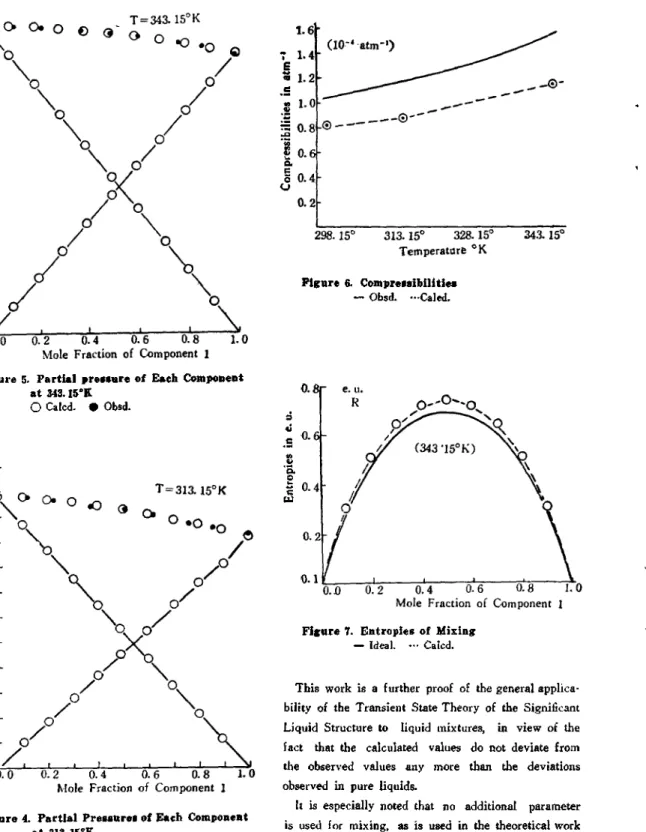
As shown in Figures 2,3,4, and 5, the calculated values for the total and partial pressures agree very well with the observed values 9 (less than 1% at die highest deviation). As stated in the previous chapter, the ideal behavior of the vapor is assumed in calculating the partial pressure. In view of good agreement between calculated and observed values, the assumption seem to be a well valid one.
As shown in Figure 6, the calculated compressibility values show comparatively high deviation (about 25%
at the highest) from the observed values. This again is about the same percent deviation shown in a pure liquid of either component.
The calculated entropies are slightly larger th由)the ideal mixing entropies. Since the behavir o£ the system is not perfectly ideal, this deviation can be expected.
The di 任erence between the calculated and the ideal mixing entropies, shown in Figure 7, are the excess entropies.
u--끈
ns
s 은
d
0.0 0.2 0.4 0.6 0.8 LO
Mole Fraction of Component 1
Figure 1. Molar Volumes of Solution O Calcd. — Obsd.
? ° o o
110- O
105- 100-
95~
T=298.15° K
0
*
0 0.-2 0.4 0.6 0.8 1.0
M시e Fraction of Component 1
Figure 2. Total Pressures of the Solution O Calcd. • Obsd.
Figure 2. Partial PEessnre* of Bacfi Cbmpo&efit at 298.15°K
O Calcd. • Obsd.
148 DONG SIK CHOI - WOON SUN AHN - KAK CHOONG KIM • SEI HUN CHANG 大韓化學會誌
Figure 5* Partial pressure of Each Component at 343.15°K
O Calcd. • Obsd.
Figure 4. Partial Pressures of Each Component at 313.15°K
o Calcd. • Obsd.
Figure 6. Compressibilities
—Obsd.…Caled.
Figure 7. Entropies of Mixing
—Ideal. …Calcd.
This work is a further proof of the general applica
bility of the Transient State Theory of the Significant Liquid Structure to liquid mixtures, in view of the fact that the calculated values do not deviate from the observed values any more than the deviations observed in pure liquids.
It is especially noted that no additional parameter is used for mixing, as is used in the theoretical work on liquid mixtures by other workers.俱叫
Vol. 11, No. 4 (1967) Transient State Theory of Significant Liquid Structure Applied to A Binary Mixture 1491
References
(1) Henry Eyring, Taikyu Ree and H. Hirai Proc.
Nat. Acad. &或,44, 683 (1958)
(2) E.丄 Fuller, T. Ree and H. Eyring, Jbid., 45,
45 1954 (1959)
(3) II. Eyring and T. Ree, Ibid., 47, 526 (1961) (4) Seihun Chan흥 and al, J. of Korean Chem.
Soc., 8, 33 (1964)
(5) H. Pak, W. Ahn and S. Chang, Ibid. 10> 18
(1966)
(6) W. Ahn, Ibid, 10, 136 (1966)
(7) W. Paik and S. Chang, Ibid., 8, 29 (1964)
(8) W. Ahn, H. Pak and S. Chang, Ibid., 9, 215
(1965)
(9) Scott E. Wood and James p. Brusie, J. Am.
Chem. Soc., 65, 1889 (1943)
(10) L. Liang. H. Eyring and R. Marchi, Proc.
Nat. Acad. Sci., 52, 1107 (1964)
(11) S. Ma and H. Eyring, J. Chem, Phys., 42.
1920 (1965)