1. Introduction
In recent years nitro aromatic compounds plays a vital role in the preparation of pesticides, pharmaceu- ticals, explosives, leather, dyes, military industries, chemical fibers, fireworks, matches and rubber prod- ucts
1). There are various nitro aromatic compounds used as an explosives are existing such as Trinitrophe- nol(TNP), Trinitrotoluol(TNT), Methyldinitrobenzene (DNT), Trimethylenetrinitramine(RDX), Nitrobenzol (NB), Dimethyl-dinitro-n-butane(DMNB), and Nitrocar- bol(NM), among these TNP tend to have greater ex- plosive nature when compared to that of TNT
2). These compounds are major source for polluting groundwa- ter as well as soils due to their explosivity and high toxicity
3,4). TNP owes considerable attention, it is not only directly contaminating the environment but also causes a threat to human beings, leading to skin ex- asperation, causes damage to liver or kidney, different
types of cyanosis and a rare type of aplastic anemia when inhaled, ingest or by touch
5,6). Even the nitro aromatic compounds causing threat to the society but there are relatively less efforts has been paid to detect nitro aromatic explosives for the purpose of environmental safety and national security and cost performances of degradation
7,8). Numerous methods were developed to detect these types of molecules, such as mass spectroscopy, photo fragmentation using laser, gas chromatography with electron cap- ture and X-ray imaging. In addition, colorimetric de- tection
9)and fluorescence techniques were adopted for the detection
10). Among these techniques, fluores- cence sensing considered to be simple handling with high sensitivity short response time, and can be ex- amined both in solution and solid phase, moreover it’s a cost-effective process
11).
The graphitic carbon nitride(g-C
3N
4), a metal free n- type semiconductor polymer possesses properties
Fluorescence-Quenched Sensor for Trinitophenol in Aqueous Solution Based on Sulfur Doped Graphitic Carbon Nitride
Kyeong Su Min, Ramalingam Manivannan, Angu Satheshkumar and Young-A Son*
Department of Advanced Organic Materials Engineering, Chungnam National University, Daejeon, Korea
*Corresponding author
Young-A Son ([email protected])
Received_April 13, 2018 Revised_May 21, 2018 Accepted_June 18, 2018
Textile Coloration and Finishing TCF 30-2/2018-6/63-69
ⓒ2018 The Korean Society of Dyers and Finishers
Abstract In this study, we report on successful attempt towards the synthesis of sulfur self-doped g-C
3N
4by directly heating thiourea in air. The synthesized materials were char- acterized using UV-vis spectral technique, FT-IR, XRD and TEM analysis. Further, the ob- tained material shows an excellent detection of carcinogenic TNP(Tri nitro phenol) in the presence of 10-fold excess of various other common interferences. The strong inner filter effect and molecular interactions(electrostatic, π-π, and hydrogen bonding interactions) between TNP and the S-g-C
3N
4Nano sheets led to the fluorescence quenching of the S- g-C
3N
4Nano sheets with an excellent selectivity and sensitivity towards TNP compared to that of other nitro aromatics under optimal conditions and the detection limit calculated was found to be 6.324 nM for TNP. The synthesized nanocomposite provides a promising platform for the development of sensors with improved reproducibility and stability for ultra-sensitive and selective sensing of TNP.
Keywords sulfur, g-C
3N
4, fluorescence, sensing, trinitophenol
like exceptional electric, optical, physiochemical abil- ity and have a lower production cost
12,13). Which make g-C
3N
4and its derivatives have been studied widely in various fields includes, bioimaging hydrogen de- vices, lithium ion storage, optoelectronic device and catalysts
14,15). Additionally, g-C
3N
4Nano sheets of atomic scale thickness and high specific surface area, it promotes photo/electro response. Many attempts have been implemented to improve the quantum ef- ficiency, stability, safety and cheapness of g-C
3N
4, such as preparing mesoporous structure
16)and hollow Nano spheres
17), doping with nonmetal species such as sulfur an effective dopant and has the ability to nar- row down the band gap
18,19). In this study, the as-pre- pared samples exhibited potential application for selective and sensitive detection of 2, 4, 6-trinitrophe- nol (TNP) could provide new insights into the sup- ported S-g-C
3N
4composite materials for environmental pollution detection with public safety and security.
2. Experimental section
2.1 Synthesis and characterization of S-g-C
3N
4The S-g-C
3N
4was prepared more efficiently by a simple heating method. In which 6g of thiourea was taken in an alumina crucible with a lid, and it was heated gradually between the temperature ranges of 450~575 ˚C for 2h by increasing temperature at a rate of 2 ˚C min
-1in atmospheric air, followed by cooling
to room temperature. The resultant yellow composite material was collected and ground into powders for use without further treatment. Scheme 1 shows the formation mechanism of the S-doped g-C
3N
4.
2.2 Characterization
The UV-Vis spectra was measured using UV-2400 spectrophotometer (Shimadzu, Japan) with barium sulfate as reference. FT-IR spectra were recorded using a Perkin Elmer Spectrum One spectrophotometer equipped with a diamond probe ATR attachment (neat sample). XRD analysis was carried out in an X- ray diffraction unit, Cu K α radiation (λ = 1.5418°A) on X-pert pro MPD high performance X-ray diffrac- tometer. The material morphology was identified by High-resolution transmission electron microscopy (HR-TEM) carried out on TEM, FEI TECNAI T20 G2. The sample preparation for TEM analysis carried out by placing a drop of solution on carbon-coated copper grid and dried Fluorescence spectra were recorded using a Varian Cary Eclipse fluorescence spectropho- tometer (1 cm quartz cell) at 25 ℃.
2.3 Fluorescence sensing of TNP
A stock solution(50 μL) of S-g-C
3N
4Nano sheets was mixed with a 10 mM Tris- HCl buffer(pH 8.0) con- taining different concentrations(0 to 300 μM) of TNP.
The volume of solution kept constant 1.0 mL each concentration and kept the solution at room temper-
Scheme 1. The mechanism of the S-doped g-C
3N
4.
ature for 5 min and the fluorescence intensity of the solutions were measured between the wavelength range of 400nm to 590nm by exciting 310nm. Further the sensitivity for other nitro aromatics(TNT, DNT, RDX, NB, DMNB, and NM) with S-g-C
3N
4was measured by adding above mentioned nitro aromatics at the same conditions and concentrations.
3. Results and discussion
3.1 UV-Vis absorption spectra
UV-Vis C
3N
4Nano sheets were studied. A strong ab- sorption peak at 350nm is attributed to the pure g- C
3N
4(Figure 1(curve a)) and after doping sulfur the absorption peak at 350nm is red shifted to 355nm (curve b), which is due to the doping of sulfur on to the surface of g-C
3N
4. The red-shift is due to the en- hanced structural connections due to the improved Vander Waals interaction between the tri-s-triazine cores.
3.2 FT-IR
The functional composite material of S-g-C
3N
4and g-C
3N
4was confirmed by the FTIR spectroscopy(Fig- ure 2).
The many small peaks observed in the range of 900- 1800 cm
-1correspond to stretching vibrations of C=N,
C-N, C-C or C-N-C bonds of C-N heterocycles
20,21). One notable exception is the strong absorbance peak ob- served at 804 cm
-1, this peak has previously been at- tributed to the presence of s-triazine(g-C
3N
4). The band at 884 cm
-1is attributed to the out-of-plane bending vibration of characteristics of triazine rings
22).
Additionally, the broad band at 2900-3500 cm
-1cor- responds to the stretching modes of N-H and C-H of g-C
3N
423). Then above all the peaks which conforms the presence of g-C
3N
4nanosheets
24,25). Obviously, no peak was ascribed to the bond of sulfur with other el- ements because the amount of sulfur was too low
26).
3.3 XRD
To better understand the crystal structure, the as- prepared g-C
3N
4and S-g-C
3N
4was revealed by XRD.
Figure 3(a) shows the XRD pattern of pristine g-C
3N
4displays two distinct diffraction peaks located at 2 θ of about 13.1˚ and 27.3˚, which are in good accor- dance with the characteristic peaks of g-C
3N
4. These peaks correspond to the (1 0 0) and (0 0 2) crystal planes of g-C
3N
427). The main peaks of sulfur-doped g- C
3N
4slightly shift to small angle direction, in addition, close observation shows that the reflection at 13.61˚
becomes more prominent for S-doped g-C
3N
4which may originate from the bending of the graphitic layer due to the distortion of in plane nitride pores by S
Figure 1. UV-Vis absorbance spectra of g-C
3N
4(a) Figure 2. FT-IR spectra of g-C
3N
4(a) and S-g-C
3N
4(b).
doping as shown in Figure 3b.
This observation indicates that the crystal structure of S-doped g-C
3N
4tends to become more stable
19). These result good consistent with the literature re- port
28), from the XRD pattern, it was found that the crystallinity of S-doped g-C
3N
4was 56.15% and the crystal size was found to be 3.26 nm using Scherer for- mula.
3.4 TEM
Figure 4A and Figure 4B displays the TEM images of surface and cross-section morphology of samples g- C
3N
4and S-g-C
3N
4respectively. It can be seen that the pure g-C
3N
4sample consists of layer structure with several nanosheets as shown in Figure 4A. Thorough
the observation of S-g-C
3N
4Figure 4B revealed that the samples were grainy in structure, and their layered structures contain many irregular pores nature
29). Moreover, compared with g-C
3N
4, the particles of S-g- C
3N
4are thicker, which can be observed in Figure 4B.
3.5 Fluorescence determination of TNP
The sensing ability of S-g-C
3N
4with the addition of increasing concentration of TNP was measured using fluorescence technique the spectra showed an emis- sion maximum at 452 nm for S-g-C
3N
4when excited at 310 nm and are shown in Figure 5. With an addition of increased concentration of TNP, the emission in- tensity of the peak at 452 nm was dramatically de- creased by quenching the fluorescence of S-g-C
3N
4. Even with a very low concentration(1.0 nM TNP), the emission intensity of the sample S-g-C
3N
4tend to show a noticeable change in the spectra. The ob- served change in intensity of the peak was mainly due to the interaction of TNP with S-g-C
3N
4and also from the result it is noted that TNP sensing was more sen- sitive compared to that of other nitro aromatics. The quenching results could be quantitatively treated with the Stern-Volmer equation(1),
F
0/F = 1+K
SV[PA] ……… (1)
where,
F
0and F : Represents the fluorescence intensity in
Figure 4. HR-TEM images of g-C
3N
4(A) and S-g-C
3N
4(B).
Figure 3. XRD patterns of g-C
3N
4(a) and S-g-C
3N
4(b).
presence and absence of TNP with S-g- C
3N
4[PA] : Denotes the TNP concentration and Stern- Volmer constant(K
SV), with the fluorescence in- tensity and the concentration of TNP ranging from 1 nM to 0.5 μM, the limit of detection (LOD) calculated was found to be 6.324 nM at a signal-to-noise ratio of 3.
From this experiments it is ascertained that the acidity, benzene and hydroxyl functionalities present in TNP has a possibility of interaction with the termi- nal amino group that is the basic site of triazine moi- ety on the g-C
3N
4nanosheets and the interaction may
be either electrostatic, π-π, or hydrogen bond for- mation. The most probable mechanism for this phe- nomenon is illustrated in Scheme 2.
3.6 Effect of interferences
The selectivity of the fluorescence characteristics of the g-C
3N
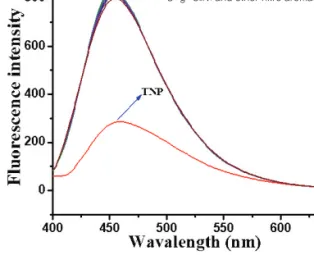
4Nano sheets was evaluated by the addition of other nitro aromatics such as TNT, DNT, RDX, NB, DMNB, and NM in aqueous solution. The results indi- cated that the influence of other nitro aromatics was negligible and no noticeable change in fluorescence was observed. Whereas, with the addition TNP fluo- rescence peak intensity gets decreased significantly as shown in Figure 6.
Figure 5. Fluorescence responses of the S-g-C
3N
4nanosheets in the presence of different concentra- tions of TNP.
Scheme 2. The possible mechanism for the selective detection of TNP using S-g-C
3N
4.
Figure 6. Fluorescence detection of S-g-C
3N
4upon addition of various nitro aromatics such as TNP, TNT, DNT, RDX, NB, DMNB and NM.
S-g-C3N4and other nitro aromatics