의료병원구역의 지역화와 비지역화된 뇌파 감시망 토폴로지의 성능비교
조준모*
Performance Comparison between Localized and Non-Localized Brain Wave Monitoring Network Topology in the Medical Hospital Area
Jun-Mo Jo
*요 약
사람들의 건강상태를 모니터링하기 위해 뇌파신호에 관련된 많은 연구가 진행되고 있다. 특히, 병원에 상주하 는 환자들은 뇌경색, 간질 등과 같은 위급상황에 대비하여 모니터링할 필요가 있다. 뇌파 네트워크 서비스의 안 정성을 요구하는 효율적인 네트워크 토폴로지가 필요하며 본 실험을 위해 OPNet 시뮬레이터를 활용하였다. 따 라서, 환자들의 뇌파는 네트워크에 있는 센서장치로부터 읽어들인다. 네트워크의 성능을 비교하기위해 두 가지 의 센서 네트워크 토폴로지를 제안하고 시뮬레이션하였다. 하나는 지역화된 네트워크이고 다른 하나는 비지역화 된 네트워크이다. 옵넷시뮬레이터를 이용하여 시뮬레이션을 수행하였다.
ABSTRACT
There are many researches related on the brain wave signals to monitor the state of human health. Especially, some patients in the medical hospital need to be monitored in case of emergencies such as a seizure, an epilepsy and so on. To support QoS of the brain wave network in the hospital is a vital issue and the Opnet simulator is used for this experiment. So the efficient network topology is required for the stability of the brain wave network service.
The brain waves of the patients are collected from the sensor devices in the network. Two different sensor network topologies are suggested and simulated for the comparison of the network performance. One topology is localized and the other is non-localized network. The simulation is operated with the Opnet simulator.
키워드
Brain Wave, Sensor Network, Network Simulation 뇌파, 센서 네트워크, 네트워크 시뮬레이션
* 교신저자 : 동명대학교 전자공학과 ㆍ접 수 일 : 2016. 08. 09 ㆍ수정완료일 : 2016. 09. 13 ㆍ게재확정일 : 2016. 09. 24
ㆍReceived : Aug. 09, 2016, Revised : Sep. 13, 2016, Accepted : Sep. 24, 2016 ㆍCorresponding Author : Jun-Mo Jo
Dept. Electronics Engineering, Tongmyong University, Email : [email protected]
Ⅰ. Introduction
The advent of the brain wave health care system is an important issues in the industrial and
research area in these days. It is necessary to detect EEG signals in real-time in order to support the medical emergency service for the epileptic or brain infarct patients.
http://dx.doi.org/10.13067/JKIECS.2016.11.9.917
There are many researches related on the examining the brain waves. To analyze the brain waves related to human concentration using visual stimulus is to induce the concentration. The method is to measure brain waves with several channels and analyze the signals into several frequency bands[1].
The minimization of the medical workers and helpers is accomplished with the automated brain wave collecting network system in these days.
Although having significant benefits, the structure of the network topology is still major challenges.
The efficiency of the sensor networks that transmits brain waves from patients to the server located in the medical center is an important factor for emergencies. This is a special purpose wireless-sensor network that incorporates different networks and wireless devices to enable remote monitoring for various environments. One of the targeted applications of the network is in medical environments where conditions of a large number of patients are continuously being monitored in real-time. Wireless monitoring of physiological signals of a large number of patients is one of the current needs in order to deploy a complete wireless sensor network in healthcare system. The network system has the potential to reduce the healthcare cost as well as the workload of medical professions, resulting in higher efficiency.
Future implementation of medical monitoring necessitates the use of small, low-power sensor nodes with wireless capability[2].
Wireless sensor network technologies are considered as one of the key research areas in wireless network communication and healthcare application industries. The pervasive wireless healthcare systems provide rich contextual information and alerting mechanisms against odd conditions of patients in hospitals[3].
Therefore, in this paper, an efficient communication network topology of the brain wave
transmission is simulated and suggested. The network simulation is operated in the Opnet simulator. In section II, the characteristics of the patients’ brain wave transmitted in the medical hospital network is elaborated. In section III, the suggested localized and non-localized network topologies are explained. Then in section IV, the simulation result of the topologies are analyzed and the efficient topology is suggested. Finally, the conclusion is made in section V.
Ⅱ. Network Transmission of Brain Waves
2.1 Monitoring Brain Waves
Many people suffer from excessive stress. They are also exposed of the mental illness. It is necessary to examining the patient’s brain wave.
Some patient need to be monitored in real time.
There are some experiments related to the brain wave detection using 19 EEG channels to find out the function of the brains. They were established by functional connectivities between brain regions.
There is already a number of monitoring systems developed or being used in medical centers. When multiple sensors are involved, wires are used to connect the sensors to a wearable wireless transmitter. Wired systems restrict patients’ mobility and comfort level, especially during sleep studies.
Fig. 1 EEG dipole
The EEG was recorded before, during and after that meditation exercise. The head surface EEG data were recomputed into 19 cortical regional source model time series[4].
2.2 Characteristics of Brain Wave Network Mostly, they use specific network protocol such as Wifi or Bluetooth for the near field communication. It is an innovative technology that incorporates the capabilities of new generation wireless technology for the mobility. They provide a seemless connectivity to the mobile consumers such as patients in the hospital. While they are on the road, they linked with others who are at their homes or offices and using different networks[5-6].
There are some problems to deploy transmitting brain waves in real-time in a crowded area such as hospital. The security of the drone including collision of drones or dropping of parcels. With the advent of light weight, robust and autonomous platforms as well as wireless networking technologies[7-8].
Since the mobile users are the patients in the hospital, they must have be secured and guaranteed the quality of the network service.
Ⅲ. Brain Wave Network Topology
3.1 Suggested Network Topologies
There are many people and many sections of the areas in the hospital. So there are many important issues to consider about the network performance.
To obtain the better performance, the efficient network topology is required. For instance, the numbers of the patients in certain area and the numbers of the server to collect the data in a section will affect the performance.
For the simulation in this paper, the two network topologies are suggested and simulated. They are the network topologies composed of zigbee devices of a sensor network. In other words, to gather brain
waves with sensor nodes such as zigbee end devices, routers, and a coordinator.
Fig. 2 Non-Localized Brain Wave Topology
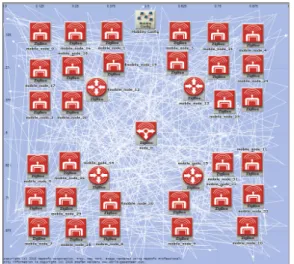
The first network topology is a non-localized brain wave shown in Fig. 2. There are 32 zigbee end devices which are considered as a person walking on the network area transmitting brain waves. The four zigbee routers are propagating the brain waves from the zigbee end users to the zigbee coordinator located in the center.
Fig. 3 Localized Brain Wave Topology
Basically, the brain waves are collected by the end devices. Then the collected data are sent to the zigbee coordinator through the zigbee routers.
The second network topology is a localized brain wave shown in Fig. 3. The most of the scenario is the same the non-localized topology except for that the area of the network topology is separated into four domains.
Fig. 4 Four-Routers in the Network Topologies
Fig. 4 shows the four routers in each suggested network topologies without showing the end devices to show the activities and functions of routers. The routers that receive walking people’s brain waves then propagate to the node_0, the only zigbee server in the network.
The four servers take each of the domain and always stays in the dedicated domain during the simulation time. They just propagates the brain waves only or near their designated area. For instance, the mobile_node_12 only in charge of the section ‘domain 2’. However, they might propagates the zigbee end devices located near the border of the adjacent domains such as domain3, domain4, and domain5 if they are in the scope of the transmitting.
3.2 Mobility and Specification of Zigbee Device
The zigbee end devices and the routers are consistently moves on the network. So the connections between nodes are varies by the simulation time. The dark dotted arrow lines are the connections from the zigbee end devices to the zigbee coordinators through the zigbee routers at certain point of time. The white arrow lines are the trajectories of the zigbee end devices and the zigbee routers. The lines look complicated so the trajectories of the zigbee routers are shown in the next figure.
IV. Simulation Result and Analysis
The suggested localized and the non-localized network topologies are designed and simulated with the Opnet simulator. The localized network topology is called the ‘Section’ and the non-localized network topology is called the ‘NoSection’ in the simulation.
The zigbee end device is considered as a patient to collect brain wave. The simulation results are made with the zigbee coordinator, the node_0, the router, the mobile_node_14 as a sample.
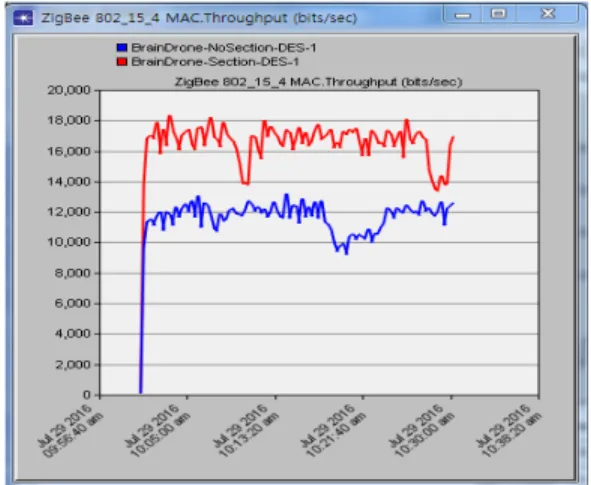
Fig. 5 Throughput Comparison of Global Network
The throughput of the global network shows that the localized network topology have better performance than the non-localized one.
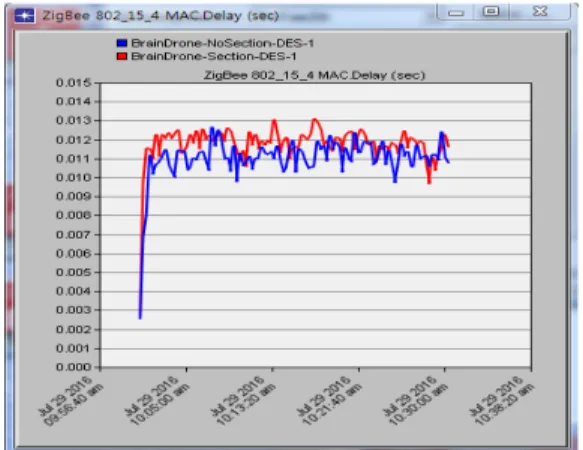
Fig. 6 Delay Comparison of Global Network
However, the delay of the global network shows that the non-localized topology showed slightly better performance as shown in Fig. 6. This gives overall chances to the zigbee end devices to propagate their brain waves to the routers or coordinators. Another words, if the routers have no dedicated boundaries, they could be concentrated on some area to make absence in another place.
Therefore, the slight better performance in delay of the non-localized topology does not mean that it is better since the throughput is low.
Fig. 7 Throughput Comparison of mobile_node_14
The mobile_node_14 is a zigbee end device and the Fig. 7 shows the comparison result of the throughput. Most of the end devices’ non-localized topology’s throughput showed a great degradation of the performance in the middle of the simulation as shown in the figure. This also showed that the localized topology has a better performance.
Fig. 8 Data Traffic Rcvd Comparison of node_0
The data traffic received of node_0 in localized topology also performed better as shown in Fig. 8.
The node_0 is the only coordinator in the network to collect brain waves. The data traffic received rate(bits/sec) of localized network topology also showed better performance as well.
Therefore, the localized network topology generally showed better performance than the non-localized network topology. Even though, the router has their own mobility in their region, they have better performance than the non-localized topology.
V. Conclusion
Some patients in the medical hospital need to be
monitored in real-time for emergencies. For the
efficient network topology, the two brain waves
sensor network topologies are suggested and
simulated for the performance evaluation. One is localized brain wave network topology and the other is non-localized network. As as a result, the localized topology showed better performance. Even though the non-localized topology showed slightly better performance in delay, it is because of the localized topology had much more data to deliver.
And the localized topology showed better other parameters such as the global throughput and the data traffic received parameter. Therefore, the localized network topology performed better than the other topology.
For the further study, the suggested topology in this paper with various routing protocols will be designed and simulated for examining superior routing protocol.
References
[1] Y.-S. Jang and D.-W. Han, “Analysis of EEG Generated from Concentration by Visual Stimulus Task,” J. of the Korea Institute of Electronic Communication Sciences, vol. 9, no. 5, 2014, pp. 589-594.
[2] Mehmet R. Yuce, “Implementation of wireless body area networks for healthcare systems”, Sensors and Actuators, Elsevier, Vol. 162, No. 1, 2010, pp.116-129.
[3] H. Alemdar, C. Ersoy, “Wireless sensor networks for healthcare: A survey”, Computer Networks, Elsevier, 2010, pp.2688-2710.
[4] D. Lehmanna, P. L. Fabera, S. Tei, R. D.
Pasculal-Marqui, P. Milz, and K. Kochi,
“Reduced functional connectivity between cortical sources in five meditation traditions detected with lagged coherence using EEG tomography,” Neuroimaging, Elsevier, Vol. 60, No. 2, 2012, pp.1574-1586.
[5] Z. Sharef, A. Alaradi, and B. Sharef,
“Performance Evaluation for WiMAX 802.16e OFDMA Physical layer”, In Computational Intelligence, Communication Systems and Networks(: CICSyN), Fourth International Conference on, Washington, DC, USA, July
2012, pp. 351-355.
[6] J.-G. Park, J.-D. Choi, Y.-C. Bae,
“Scientometric Analysis of Autonomous Vehicle through Paper Analysis of each Nation”, J. of the Korea Institute of Electronic Communication Sciences, Vol. 8, No. 2, 2013, pp.321-328.
[7] S. Kim, “A Study on the attitude control of the quadrotor using neural networks”, J. of the Korea Institute of Electronic Communication Sciences, vol. 9, no. 9, 2014, pp.1019–1025.
[8] S. Kim, H. Oh, J. Suk, and A. Tsourdos,
“Coordinated trajectory planning for efficient communication relay using multiple UAVs,”
Control Engineering Practice, vol. 29, 2014, pp.
42-49.
Author
조준모(Jun-Mo Jo)