• 검색 결과가 없습니다.

Research on the Short-term Memory Effects on VR Tour Games

N/A
N/A
Protected

Academic year: 2021

Share "Research on the Short-term Memory Effects on VR Tour Games"

Copied!
11
0
0

로드 중.... (전체 텍스트 보기)

전체 글

(1)

Research on the Short-term Memory Effects on VR Tour Games

Qiao, Sui

, Dong-Min Cho

††

ABSTRACT

This thesis mainly studies the impact of short-term memory in VR tour games on users. The thesis is based on VR tour games and short-term memory, using the literature research method, the practical research method, and the investigation method. First, the author designs and makes VR tour games on the Beijing-Hangzhou Grand Canal, and then conducts a questionnaire survey and designs a control experiment. The experiment explores the differences of the short-term memory level of individuals between the normal environment and the VR tour game environment. It verifies whether the influential hypothesis proposed by the research is correct. Research conclusions show that: VR tour games have an impact on short-term memory. Compared with the normal environment, the subjects have better performance in the VR tour game mode and can maintain a high short-term memory level for a longer time. Its conclusions should promote the cultural propaganda of scenic spots and provide theoretical support for tourists' short-term memory of scenic spots culture.

Key words: VR tour game, Short-term memory, Gamification, Memory encoding

※ Corresponding Author : Dong-Min, Cho Address:

(54896) 567, Baekje-daero, Deokjin-gu, Jeonju-si, Jeolla- buk-do, Korea, TEL : FAX : +82-63- 270-3755, E-mail : [email protected]

Receipt date : Apr. 26, 2021, Revision date : Jun. 20, 2021

Approval date : Jul. 12, 2021

††

Dept. of Design & Manufacturing Engineering, Jeonbuk National University

(E-mail : [email protected])

††

Dept. of Industrial Design, Jeonbuk National University

1. INTRODUCTION

1.1 Research background and purpose

The rapid development of virtual reality (VR) technology has enabled games to have more vivid forms of expression. Its high immersion and high sense of realism promote the better application of gamification, such as cultural promotion and scene simulation. Lugrin built a museum based on the VR environment. The VR museum supports 100 users online at the same time and also includes indoor and outdoor space design [1]. Cheng A then, By improving the existing 3D game Crystallize and establishing a VR system for Japanese learning, the author added a bowing session with Japanese cultural characteristics to the system, which en- hanced the users' sense of participation and the participants' language learning efficiency [2]. Dig-

ital experiences are also increasingly implemented as communication and tour strategies, with im- portant information presented in immersive or in- teractive formats such as AR, VR, or 3D simulation (Nayyar, Mahapatra, Le and Suseendran, 2018). In an ordinary tourist environment, people can only learn about historical culture by viewing real ob- jects, two-dimensional text, pictures, or images, especially historical scenes and cultural relics that have disappeared. Standard tourist methods can no longer meet people's daily needs. Tourism depart- ments in many regions use virtual reality technol- ogy to spread local culture or educate tourists to protect heritage. These methods have been im- plemented in museums as a comprehensive and in- teractive learning experience (Kang&Yang, 2020).

With the rapid development and application of vir- tual reality games in the commercial field in recent

***-****-****

(2)

Fig. 1. Research process.

years, the cognitive publicity of tourism culture using gamified thinking has attracted attention.

The practice of gamification is increasing dramati- cally in our daily lives, but there is only a little research to test the hypothetical impact of VR tour games on short-term memory.

1.2 Research methods

This paper will adopt the literature research method, the practical research method, and the survey method. First, the author searches for the information and conducts a case study on a theo- retical basis. Based on the existing research theo- ries, the current short-term memory, VR tour games, and the theory of memory promotion theory are analyzed. A VR tour game is designed for ex- perimental analysis and verification. The thesis ex- periment quantifies the level of short-term memo- ry to obtain data. It uses SPSS analysis to deter- mine the importance, feasibility, and necessity of the relevant theories studied in this thesis. In the experiment, the same cognitive content is com- pared with the common cognitive model and the cognitive model of virtual tour games to demon- strate whether VR tour games impact short-term memory (Fig. 1).

2. THEORETICAL INVESTIGATION

2.1 The concept of short-term memory

Memory is part of the brain's processing of vari- ous information, including encoding, storing, and extracting visual, auditory, and tactile information, and is characterized by repeatability [3]. The length

of time can be divided into sensory memory, Short-term memory, and long-term memory [4]. In our daily activities, we often need to temporarily store and rehearse the information in our mind and form a short-term memory system based on visual space and other materials in a short period. This flexible ability to store and manipulate information memories related to activities in different areas of the brain are called "short-term memory" [5].

Short- term memory is characterized by activated long- term memory or composed of recently per- ceived items (Jonides et al., 2008). There are many ways for humans to obtain external information.

External information first enters sensory memory through different sensory channels. Sensory mem- ory from vision is called image memory, and sen- sory memory from sound is called audiovisual memory. Sensory memory contains a large amount of information, but its retention time is usually only a few seconds, and it will quickly disappear.

Memory is the process of encoding. "Encoding" re- fers to the process of placing the information to be remembered in an easily searchable information library. "Imaging" is the process of memorizing language information through visual images. These processes are all interrelated. A group of closely re- lated information units is called an image or track.

When the image is in short-term storage, closely related information in the long-term storage is ac- tivated and entered into the short-term storage [6]

(Fig. 2).

2.2 Concept of the VR tour game

VR tour game is the application of virtual reality

(3)

Fig. 2. Short-term memory generation.

Fig. 3. VR tour game examples.

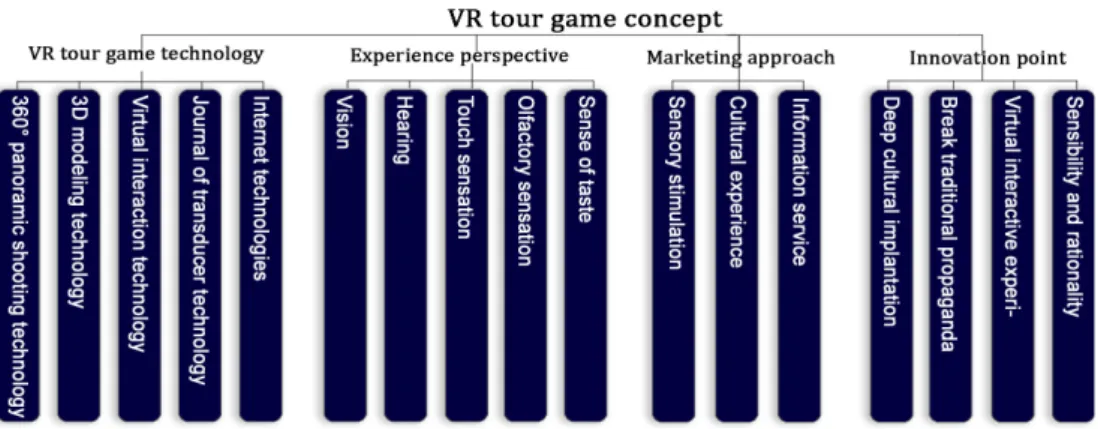
Fig. 4. VR Tour game concept.

technology in tourism, based on the development of information technology [7]. It builds a virtual environment through computer graphics process- ing technology, and lets visitors enter the virtual scene and feel the changes in the virtual scene through various sensing devices. The VR tour game involves 360° panoramic photography tech- nology, 3D modeling technology, virtual interaction technology, sensor technology, Internet technol- ogy, and many other technologies [8]. It provides users with various intuitive and natural real-time

perception and interaction methods such as vision,

hearing, and touch at the same time. Maximum

convenience for the user's operation [9]. VR tour

games can embed in-depth cultural content into

game content and provide players with a virtual

interactive experience with local cultural charac-

teristics. It is no longer a traditional publicity and

video marketing method that displays text, which

has stimulated tourists' interest in participating. It

not only has a strong sense of substitution, but also

the real familiar environment which can give the

game an immersive and safe experience [10]. Since

tourism is a product that ultimately leads to a real

experience, purely analytical services and sensi-

bility cannot promote the direct connection be-

tween users and tourist destinations. The VR tour

game adopts the trinity marketing method of sen-

sory stimulation, cultural experience, and infor-

mation service, taking into account the user's per-

ceptual and rational needs, and can successfully

stimulate the connection between the user and the

tourist destination (Fig. 3-4).

(4)

Fig. 5. Principle of sensory stimulation.

2.3 The principle of VR tour games to promote short-term memory

VR technology has penetrated many application fields such as education, medicine, engineering, space exploration, and communication, and virtual reality technology is widely used in memory re- habilitation [11]. Intervention changes the role of the participant. It makes the participant no longer serve as an information channel, but take the ini- tiative to encode, classify, interpret, store, extract and decode various information through their per- ception of information. And feedback after proc- essing [12]. Virtual reality games are safe and in- teresting, and can provide rich stimuli, timely in- formation feedback, and sound experience effects.

More Different scenarios and setting up different stimulation schemes have achieved good results in the fields of attention deficit, spatial perception im- pairment, memory impairment, Etc [13].

The simulation environment of the VR tour game provides a variety of sensory stimulation, which increases the activation of dopamine and neurotransmitter of the cholinergic system in the experiencer. It enhances the neurotransmitter con- duction function of the dopamine and cholinergic system. The experiencer's cerebral cortex is thick- ened, and a large number of axons and cell bodies are produced after the increase in dendritic branch- es. Therefore, the enhancement of spatial infor- mation coding and retrieval capabilities has pro- moted the initiation of procedural memory, allow- ing people to code during activities and enhance memory storage (Fig. 5).

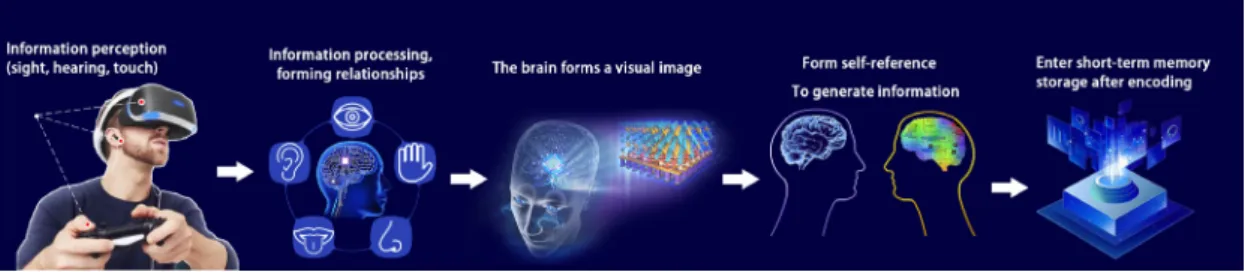
The perceptual imaging in the VR tour game helps to encode and retell information and streng- then the memory effect. In memory, we usually en- code information through auditory encoding, visual encoding, and semantic encoding. The perceptual interaction in the VR tour game experience brings visual, auditory, and tactile visual graphic imaging to the experiencer, structuring fragmented knowl- edge. The experiencers form a self-referential ef- fect after sensory registration to actively generate information. This information is re-encoded into a short-term memory system with limited capacity and a slightly longer retention time. Passing through the game link is also a kind of test and inspection.

The information is extracted, retold, and repro- cessed to promote the transformation of short- term memory and form a state of high short-term memory level (Fig. 6).

3. EMPIRICAL STUDY

3.1 The design goal of the VR tour game of the Grand Canal

This VR tour game is designed for the history and culture of the Beijing-Hangzhou Grand Canal.

The simulation restores the historical scenes and

stories and allows the experiencers to understand

the relevant historical culture through VR tour

games quickly. Through the design of comparative

experiments, the impact of VR tour games on the

short-term memory of the subjects is compara-

tively explored. It is hoped that these practical

studies will investigate the impact of VR tour

(5)

Fig. 6. Short-term memory processing model for VR tour games.

Fig. 7. The game process.

Fig. 8. Design process display.

games on short-term memory and provide effec- tive empirical data to develop VR tour games.

3.2 Design Ideas for VR Touring Game of Beijing- Hangzhou Grand Canal

According to the cultural context and content structure of the Beijing-Hangzhou Grand Canal cultural belt, the Beijing-Hangzhou Grand Canal is mainline, and the cultural places on the Beijing- Hangzhou Grand Canal are displayed one by one by regional division. The game consists of different scenes, and different settings in the scene de- termine the playability of the level. The level con- structs the space and environment in the game.

The level and the scene are inseparable. The level includes the scene and the game objectives, plot, and various objects in the game. Different options go to different historical segments, enhance user experience, and narrow the distance between cul- ture and modern people (Fig. 7).

3.3 The design and production process of the VR tour game of the Beijing-Hangzhou Grand Canal

This design combines the theory of Chapter 2 and refers to the help of virtual reality for memory.

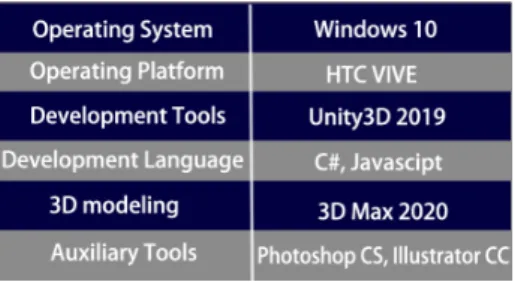
It uses Unity3D game engine, 3DMax modeling software, Photoshop image editing software, Ardui- no single-chip microcomputer, biosensor, and many other software and hardware technologies to de- sign a virtual reality game for visiting the Beijing- Hangzhou Grand Canal. This game is developed in the Windows 10 system environment. The game uses a first-person perspective, including scenes composed of the natural environments. All inter- face elements in Unity3D are in the Canvas com- ponent. Select the Canvas rendering mode as world space, adjust the canvas size and direction, convert the model file and export it to FBX format with information such as pictures and animations (Fig.

8-10).

Click on the main interface to start the game,

and a selection interface appears, which contains

(6)

Fig. 9. Development environment and platform.

Fig. 10. Development process.

Fig. 11. Schematic diagram of game mod- ule selection.

Fig. 12. Interface function selection display.

Fig. 13. HTC VIVE. Fig. 14. Scene display.

three modules: history module, river section mod- ule, and sightseeing module. Users can choose any module to start according to their interests. Then, the user clicks on the main interface, and the se- lection interface appears and can be selected at any time through the handle, which adds questions and answers, task games, testing, etc (Fig. 11-12).

In production, model import and interactive pro- gram settings (including import settings for identi-

fying images, basic material parameters, logic pro- gramming, lighting scene debugging, background music settings, etc.) are tested. After debugging and modification, the final version has been com- pleted. We can use HTC VIVE to enjoy it directly (Fig. 13-14).

4. RESEARCH AND ANALYSIS

4.1 Research questions

The question of this research is whether VR tour games have an impact on short-term memory. Due to the limitations of the research process, this re- search only conducts experiments on the games developed in this article, and more related experi- ments will be carried out in the future.

This research makes hypothetical conclusions:

1) Compared with the ordinary environment, the

(7)

participants have better memory performance in the VR tour game environment; 2) Compared with the ordinary environment, the participants tour the game in VR. The environment can maintain a high short-term memory level for a longer time. 2) Compared with the ordinary environment, the par- ticipants can maintain a high short-term memory level for a longer time in the VR tour game envi- ronment. We designed a comparative experiment for this hypothesis and concluded by analyzing the participants' performance data in the experiment.

It is hoped that through these experiments and studies, it can be verified that the VR tour game has a beneficial effect on short-term memory and can form a state of high short-term memory level.

It can achieve sound cultural propaganda effects and provide effective empirical data to develop VR tour games in scenic spots.

In the experiment, we collected test data from 62 volunteers. It is assumed that the virtual reality experimental group has a significant improvement in short-term visual space memory compared with the control group and can maintain a high short- term memory level for a longer period.

(1) Original hypothesis (H0): The memory effect difference between VR tour games and ordinary environment tours is zero. H0: U1-U2=0

(2) Alternative hypothesis (H1): The memory effect difference between VR tour games and ordi- nary environment tour is not zero. H1: U1-U2≠0

4.2 Questionnaire design

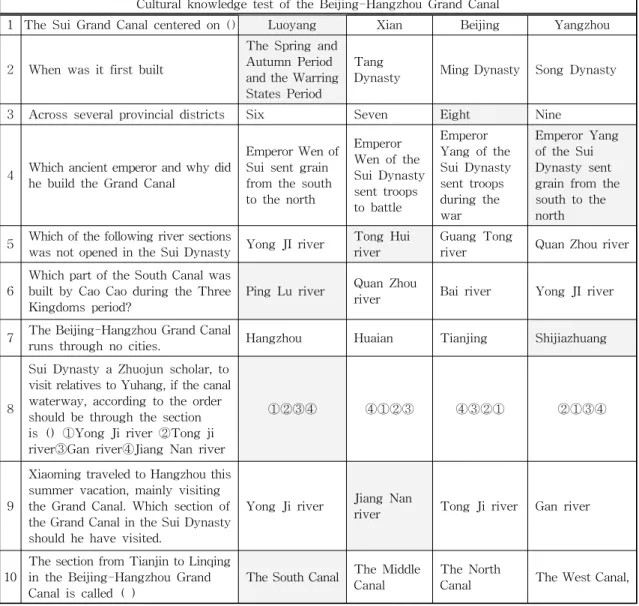
The test sets up ten questions to verify the memory effect of the historical content, which is a percentage system. It sets questions about the historical and cultural knowledge of the Grand Canal displayed in the scenic spot. The survey method of the test is the field test verification 5 minutes after the tour and 30 minutes after the tour. The short-term memory test is a screening test designed to measure a person's ability to store and retrieve information in a short time. Memory

span is the best way to test short-term memory.

This study established the following questionnaire based on the principles of the Benton Visual Reten- tion Short-term Memory Test. Participants did not understand the history and culture of the Grand Canal. This questionnaire is set to allow game users to verify the memory effect after under- standing the culture of the Grand Canal (Table 1).

4.3 Descriptive analysis

This research procedure enlisted 62 volunteers to verify the research questions, and they were divided into experimental groups and control groups.

The average age is 22 years old, undergraduate de- gree, normal vision or corrected vision, and no knowledge of the history of the Beijing-Hangzhou Grand Canal. Comprehensive parameters and de- signs of various VR glasses equipment, the final choice of VR equipment is HTC-Vive, which in- cludes a head-mounted display helmet, two hand- held control handles, and two camera positioners.

HTC Vive head tracking function is better than Oculus Rift, and the design is more suitable for Asian faces. The experience of spatial positioning is very shocking; the motion tracking handle is also excellent to use. The experimental group tested the Grand Canal VR tour game in a non-interference environment. The control group watched the his- torical text and picture introduction of the Grand Canal in a non-interference environment. The two groups took a set of memory tests 5 minutes and 30 minutes after the test, analyzed the two groups' memory test data, and recovered questionnaires.

Perform T-tex Analysis (Fig. 15).

4.4 Data analysis

62 volunteers conducted two tests respectively.

The test score after using the VR tour game for

5 minutes was 79.6774, while the test score after

5 minutes without using the VR tour game was

68.3871; the test score after using the VR tour

game for 30 minutes was 62.5806, and the test

(8)

Table 1. Questionnaire settings.

Cultural knowledge test of the Beijing-Hangzhou Grand Canal

1 The Sui Grand Canal centered on () Luoyang Xian Beijing Yangzhou

2 When was it first built

The Spring and Autumn Period and the Warring States Period

Tang

Dynasty Ming Dynasty Song Dynasty

3 Across several provincial districts Six Seven Eight Nine

4 Which ancient emperor and why did he build the Grand Canal

Emperor Wen of Sui sent grain from the south to the north

Emperor Wen of the Sui Dynasty sent troops to battle

Emperor Yang of the Sui Dynasty sent troops during the war

Emperor Yang of the Sui Dynasty sent grain from the south to the north 5 Which of the following river sections

was not opened in the Sui Dynasty Yong JI river Tong Hui river

Guang Tong

river Quan Zhou river

6

Which part of the South Canal was built by Cao Cao during the Three Kingdoms period?

Ping Lu river Quan Zhou

river Bai river Yong JI river

7 The Beijing-Hangzhou Grand Canal

runs through no cities. Hangzhou Huaian Tianjing Shijiazhuang

8

Sui Dynasty a Zhuojun scholar, to visit relatives to Yuhang, if the canal waterway, according to the order should be through the section is()①Yong Ji river ②Tong ji river③Gan river④Jiang Nan river

①②③④ ④①②③ ④③②① ②①③④

9

Xiaoming traveled to Hangzhou this summer vacation, mainly visiting the Grand Canal. Which section of the Grand Canal in the Sui Dynasty should he have visited.

Yong Ji river Jiang Nan

river Tong Ji river Gan river

10

The section from Tianjin to Linqing in the Beijing-Hangzhou Grand Canal is called( )

The South Canal The Middle Canal

The North

Canal The West Canal,

score after 30 minutes without using the VR tour game is 44.8387 (Table 2).

Users who use virtual reality tour games have a difference of 14.77429 5 minutes after use, 18.92259 after 30 minutes of use, and a P value of 0 is less than 0.05 Table 3. Therefore, the null hy- pothesis that the mean values are equal is rejected.

In the experimental group using virtual reality games, The memory score is higher than the con- trol group that did not use the virtual game. After 30 minutes of use, the memory effect of the ex-

perimental group was significantly higher than that of the control group. The following conclusions are drawn: memory effects and persistence are sig- nificantly different, and visual attention and short- term visuospatial memory are significantly im- proved.

4.5 Data conclusion

This paper proposes hypotheses, designs VR

tour games, and conducts effect evaluation in

groups. The paired T-test is used to analyze and

(9)

Fig. 15. Schematic diagram of operation display and tour experience.

Table 2. Paired Samples Statistics.

Paired Samples Statistics

Mean N Std.Deviation Std. Error Mean correlation Sig.

Pair1 Before using VR for 5 minutes 68.3871 31 12.67459 2.27642

.326 .073

After using VR for 5 minutes 79.6774 31 12.77599 2.29463 Pair2 Before using VR for 30 minutes 44.8387 31 12.34800 2.21777

.021 .911

After using VR for 30 minutes 62.5806 31 14.59857 2.62198

Table 3. Paired Samples Test.

Paired Samples Test Paired Differences

T Df Sig..

(2-tailed)

Mean Std.

Deviation

Std.Error Mean

95%Confidence Interval Of The Different

Lower Upper

Pair1

Before using VR for 5 minutes-After using VR for 5 minutes

11.29032 14.77429 2.65354 5.87107 16.70957 4.255 30 .000

Pair2

Before using VR for 30 minutes-After using VR for 30 minutes

17.74194 18.92259 3.39860 10.80107 24.68280 5.220 30 .000

verify the impact of VR tour games on short-term memory. By comparing the two sets of exper- imental data, the data results show that the VR group performs well in the short-term memory of the 5-minute test session and allows the experi- encer to maintain a high level of memory within 30 minutes.

5. CONCLUSION AND FURTHER STUDY

The VR tour game helps to inspire the partic- ipants' thinking and memory coding through the interaction between the participants and the simu- lation environment. They can obtain all kinds of spatial and logical information contained in the en-

vironment to form short-term memory. The bre- akthrough test of the game link extracts and retells short-term information, which consolidates the ef- fect of short-term memory.

Through practical and empirical Analysis, the performance of the VR group at 5 minutes is 11.2903 points higher than that of the normal group, and the performance of the VR group at 30 minutes is as high as 17.7419 points than the normal group.

This fully shows that VR tour games can help form

efficient and continuous. The short-term memory

effect of sex can better promote the culture of the

scenic spot, which also shows the feasibility of us-

ing VR tour games for cultural promotion. Al-

though this study is only aimed at the cultural tour

(10)

promotion of the Grand Canal culture, it also broadens the scope of the application of VR tour games. There are many shortcomings in this research. The cultural content of the tour and the way to break through are relatively simple. The research in this article is not detailed enough and does not differentiate the population for targeted research. In 2019, Jinan University also conducted similar research in clinical psychology. It is tested separately from short visual-spatial memory, sim- ple cognitive assessment, and spatial breadth memory. The experiment is only for the game de- veloped this time. Later, we will continue to study the virtual reality game in the tourism field and do more experiments.

REFERENCE

[ 1 ] J.-L. Lugrin, F. Kern, and R. Schmidt, “A Location-Based VR Museum,” International Conference on Virtual Worlds and Games for Serious Applications (VS-Games), HCI Group, University of W¨urzburg, Germany, IEEE, pp. 1-2, 2018.

[ 2 ] A. Cheng, L. Yang, and E. Andersen, “Teach- ing Language and Culture with a Virtual Reality Game,” CHI Conference on Human Factors in Computing Systems, ACM, pp.

541-549. 2017.

[ 3 ] B. Rasch and J. Born, “About Sleep's Role in Memory,” Physiol Rev. pp. 681-766. 2013.

[ 4 ] D.A. Bowman and R.P. Cmahan, “Virtual Reality: How Much Immersion Is Enough,”

Computer, Vol. 40, Issue 7. pp. 36-43. 2017.

[ 5 ] L. Velayudhan, S.-H. Ryu, M. Raczek, M.

Philpot, J. Lindesay, M. Critchfield, et al

“Review of Brief Cognitive Tests for Patients with Suspected Dementia,” International Psy- chogeriatrics, Vol. 26, Issue 8, pp. 1247-1262, 2014.

[ 6 ] E, Camina and F, Güell, “The Neuroanatomical, Neurophysiological and Psychological Basis of Memory: Current Models and Their Origins,”

Frontiers in Pharmacology, Vol, 8, No. 438, 2017.

[ 7 ] Y. Zhi and L. Minhua, “Analysis on the Profitability Mode of Virtual Tourism and Network Economy from the Perspective of Mirror Experience,” Journal of Nanning Vocational and Technical College, pp. 121- 127, 2018.

[ 8 ] C. Zhu and J. Shen, “The Application of Virtual Reality Technology in Promoting the Cultural Value of Tourism,” Computer Pro- ducts and Circulation, pp. 258, 2018.

[ 9 ] W. Shujun, “Research on Virtual Reality Technology and Its Application Status,” Hei- longjiang Science and Technology Informa- tion, Issue 26, pp. 69, 2008.

[10] W. Li and D.-M. Cho, “Research on Scene Features of Mixed Reality Game Based on Spatial Perception–Focused on" The Frag- ment" Case Study,” Journal of Korea Multi- media Society, Vol. 24, No. 4, pp. 601-609, 2021.

[11] A. Xing, L. Gang, X. Linwei, and S. Ying, “A Survey on Application of Virtual Reality Te- chnology in U. S. Military Simulation Train- ing,” Missile Institute Air Force Engineering University Sanyuan, Vol. 18, Issue 10, pp. 36- 43. 2011.

[12] H. Xiaoqiang, “The Effect and Evaluation Method of Virtual Reality Games on Working Memory,” Beijing University of Posts and Telecommunications Press, pp. 10-11, 2005.

[13] S. Okahashi, K. Seki, A. Nagano, Z. Luo, M.

Kojima, and T. Futaki, “A Virtual Shopping

Test for Realistic Assessment of Cognitive

Function,” Journal of NeuroEngineering and

Rehabilitation, Vol. 10, Article No. 59, pp. 1-

13. 2013.

(11)

SUI QIAO

2020∼Currently Dept. of Design

& Manufacturing Engineering, Jeonbuk National University, PhD course

2014∼2017 Zhejiang Sci-Tech University, Master

Focus areas: Virtual reality, Animation design

Dong-Min Cho

2009∼Currently, Dept. of Design

& Manufacturing Engineering, Jeonbuk National University, Professor

2008∼2009, Sogang University Game Education Institute, full- time lecturer

2004∼2006 AAU, San Francisco, USA MFA,

Focus areas: Game design, Visual design

수치

Fig. 1. Research process.
Fig. 4. VR Tour game concept.
Fig. 5. Principle of sensory stimulation.
Fig. 6. Short-term memory processing model for VR tour games.
+4

참조

관련 문서