Characterization of Mechanical Property Change in Polymer Aerogels Depending on the Ligand Structure of Acrylate Monomer
Kyu-Yeon Lee, Hae-Noo-Ree Jung, D. B. Mahadik and Hyung-Ho Park
†Department of Materials Science and Engineering, Yonsei University, 50, Yonsei-ro, Seodaemun-gu, Seoul 03722, Korea (Received June 30, 2016: Corrected September 19, 2016: Accepted September 24, 2016)
Abstract: In an effort to overcome the weakness of aerogel, polymer aerogels have been prepared by copolymerizing the different types of monomers through sol-gel process. Polymerizing the successive phase of a high internal phase emul- sion, which has interconnected porous structure, porous polymer aerogel can be manufactured. In this paper, we use the styrene/divinylbenzene chain as a basic monomer structure, and additionally use 2-ethylhexyl methacrylate (2-EHMA) or 2-ethylhexyl acrylate (2-EHA) as monomers for distinguishing the visible mechanical properties of synthesized polymer aerogel. We can observe the different tendency of polymer aerogels by kinds of monomer or ratio. Flexibility and micro- structure can be changed by the types of monomer. EHA polymer aerogel shows high flexibility and thin microstructure, and EHMA polymer aerogel shows high hardness and thick microstructure. EHA/EHMA polymer aerogel shows the inter- mediate nature between them. By utilizing the mechanical properties of three types of polymer aerogels to adequate sit- uation or environment, polymer aerogels could be used as drug agent, ion exchange resin, oil filter and insulator, and so on.
Keywords: high internal phase emulsion, polymer aerogel, flexible, radical condensation, sol-gel process
1. Introduction
Aerogels are mesoporous materials which have a lot of nanopores inside.
1,2)Porous structure can be made by supercritical drying of crosslinked wet-gel prepared by sol- gel process and their porosity is up to 99%.
1-3)Aerogels have been considered as promising porous materials since they have high surface area, low thermal conductivity (0.013-0.04 W/mK) and low density (0.003-0.1 g/cm
3).
4)Because of these properties, their applications are diverse and they can be used in thermal, electronic, and catalytic field, so aerogels have led significant attention as future material.
4-6)However, aerogels are very fragile and brittle so they can be easily destructed when they undergo exter- nal force or mechanical stress.
1,7)Their low mechanical strength is a big problem in terms of wide application of aerogels. In an effort to overcome their weakness and expand the application of aerogels, some solutions have been brought up such as aerogel blanket
8)and composite aerogel, which can be made by combining aerogel with mechanically strong material just like a metal, fiber, carbon compound and organic material.
2,4,5,7)As one of these solutions, polymer aerogels have been
researched as alternative materials which can keep good properties and relieve the problems of aerogels for several years.
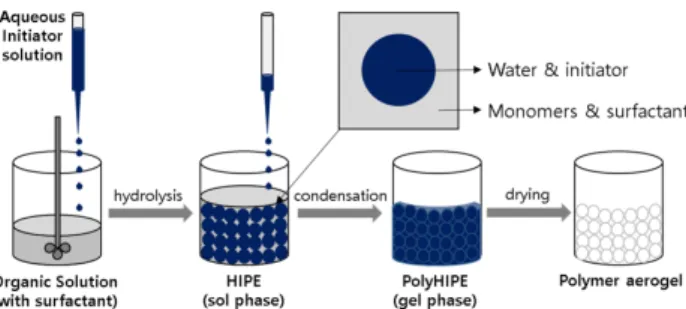
1,9)Through this research, high internal phase emul- sion (HIPE) has been considered as one of the useful mate- rials.
9)By polymerizing the successive phase of a high internal phase emulsion, porous polymers with intercon- nected porous structure can be manufactured.
10)HIPE is also called high concentrated emulsion or gel emulsion since it is like a jelly in stable state.
11)HIPE is a dispersed phase with a volume fraction of more than 74.05% and up to 99% emulsion system.
11,12)These kinds of polymer are also known as polyHIPE.
12)It is made by emulsion polym- erization and radical condensation with phase reversion.
By these processes, less than 10 µm size pores are made inside.
11-14)Therefore, it is also called as polymer aerogel because aerogel also has many pores inside. Also, poly- HIPE has various applications such as drug agent,
12)blood absorbent,
15,16)ion exchange resin,
17-19)oil filter
12,20)and insulator
11,12)so it can be used for diverse situation and environment.
Styrene/divinylbenzene monomer chain is the most researched polyHIPE structure.
10)And polyHIPE materials which have specific properties can be made from emul-
†