Process Analysis of Digital Right Management for Web-Based Multicast Contents
Wildan Toyib
†, Man-Gon Park
††ABSTRACT
In recent years, advanced in digital technologies have created significant changes in the way we re- produce, distribute and market Intellectual Property (IP). DRM for multicast contents is complicated risk, the further technology development and human demand, this approaching is still being researched by the scientist and all by the company which is conducting in piracy management reduced, and every country has national policy to make this consortium to limit piracy properties, based on this paper research development, just only two approaching to reduce piracy in DRM they are Industrial Property (IP) and Copyright. In this paper, we are not only figuring and analyzing about the processes to reduce and limit the piracy and unprotected copy law but also describing about the encryption process, watermarking and digital signature process algorithms. The basic concepts of this encryption process for web-based multicast content in DRM are implemented in Java. We conduct this method is a computerized through web based application system approaching to reduce unprotected copy and piracy. Which is used in DRM for multicast content in every section, by providing a fundamental in information technology devel- opment, we believe this research is reliable to prove that is unprotected copy, and piracy can be reduced by protecting with this paradigm.
Key words: Digital Right Management (DRM), Web-Based Multicast Contents, Encryption Process, Intellectual Property (IP)
※ Corresponding Author : Man-Gon Park, Address: (608- 737) 599-1 Daeyeon-Dong, Nam-Gu, Busan, Rep. of Korea, TEL : +82-51-629-6240, FAX : +82-51-628-6155, E-mail: [email protected]
Receipt date : Nov. 16, 2011, Revision date : Dec. 26, 2011 Approval date : Dec. 31, 2011
††
Dept. of Advanced Information Science and Technol- ogy, Graduate School, Pukyong National University (E-mail: [email protected])
††
Dept. of IT Convergence and Application Engineering, Pukyong National University, Rep. of Korea
1. INTRODUCTION
Digital Rights Management (DRM) technology is the core system that allows the owners to dis- tribute their films in a controlled way. The owner specifies, in which ways and under which con- ditions each cinematic asset may be accessed (digital rights, licensing), and the DRM system will try to ensure that each asset can only be accessed as specified by the owner (enforcement). The same
DRM system can also be used to distribute films over the Internet. For example, a film studio may specify that each film may be showed in a licensed cinema for a given period starting at a given time by codec system software application [1-3].
The content or asset we consider in this paper
is newly released very high value entertainment
content of a cinematic title, including video, audio
but also text and metadata[4,5]. From the data
management perspective, a typical two hour 35 mm
feature film scanned at a standard high-quality
resolution of 1920 by 1080 pixels and 24 frames per
second (used for high-end HDTV as well) would,
in its uncompressed form, require more than one
terabyte of disk space[6]. The goal of a pirate is
to obtain an unprotected copy of a given film, mov-
ies and music, which can be distributed without
restriction. In the past, pirates have used a variety
of distribution channels for stolen video content,
including physical distribution (e.g., production and distribution of video CD/DVD, sometimes based on copies made with camcorders in cinemas) and electronic distribution over the internet network- ing[7]. Multicast is the delivery of a message or information to a group of destination computers si- multaneously in a single transmission from the source creating copies automatically in other net- work elements, such as routers, only when the top- ology of the network requires it. The Encryption based technologies transform content into unin- telligible forms[8,9]. This transformation is being reversible naturally, allows perfect recovery of content before consumption. Technologies based on watermarking embed data directly into the con- tent, resulting in imperceptible degradation in vis- ual quality. End to end security is the most critical requirement to create of new digital markets where copyrighted content is the key product of DRM [10-12].
In this paper we propose the business process models and encryption process data models for DRM system implemented in a frame work of web-based multicast contents. These models rep- resent some fundamental concepts of protecting the resources and keys of DRM system applied in portal of web-based multicast contents.
2. RELATED WORK
2.1 Multicast Contents
Multicast enables efficient large-scale content distribution by providing an efficient transport mechanism for one-to-many and many-to-many communication. Over the years, multicast has been the topic of many research, engineering, and de- ployment efforts. These efforts have continued to transform multicast into a technology that can be relied on by many applications. Work has been done in reliability, manageability, scalability, qual- ity of service (QoS), and ease of deployment. As these areas become more mature, there is increased
potential for multicast to be used as the underlying distribution mechanism for content distribution ap- plications[13]. Therefore, security in multicast content distribution is a concern. The maturity of multicast security solutions have the potential to enable the use of multicast for confidential and high value content, and help spark the use of multicast by new applications. There are a number of se- curity issues in multicast content distribution di- rectly related to the properties of multicast that make it efficient and attractive[14].
There has been research that provides solutions to many of these security issues. Some of these solutions are ready for deployment, some are near- ing maturity, and others are only in the early phas- es of research. The maturity and deployment of these solutions will help increase the ability of multicast technology to deliver new applications and more content. In this article we examine these various issues and solutions for providing secure multicast content distribution, and outline several future research directions.
Multicast is a receiver based concept, receivers join a particular multicast session group and traffic is delivered to all members of that group by the network infrastructure. In a traditional system, the sender does not maintain a list of receivers. Only one copy of a multicast message passes over any link in the network, and copies of the message are made only where paths diverge at a router.
Multicast packets from remote sources are relayed by routers, which forwards them on to the local network if there is a recipient for the multicast group on the LAN. The Internet Group Manage- ment Protocol (IGMP) is used by multicast routers to identify the existence of group members sending IGMP queries and having receives report their group membership. Multicast services accom- modate capabilities such as mobility, bandwidth, flexibility, and security[13-15].
2.2 IP Television Multicast Distribution
An Internet Protocol (IP) television system can
distribute information through a switched tele- phone network. These functions show that end users are watching a movie that is initially supplied by media centre (media server) that is located some distance and several switches away from end users (movie watchers). When the first movie watcher requests the movie content, it is requested from the telephone end office through Digital Subscriber Line (DSL)[15].
The telephone end office determines that the movie is not available in its video storage system and the end office switch requests the movie from the interconnection switch. The interconnection switch also determines the movie is not available in its video storage system (main server) and the movie is requested from the distant media source.
When the movie is transferred from the media cen- tre to the end customer, the interconnecting switches may make a copy for future distribution to other users. This program distribution process reduces the interconnection requirements between the switching distribution systems, to illustrate the concept of IP television multicast distribution as depicted in Fig. 1.
Movie M ovie
M ovie
Movie
M ovie Interconnect
Switch Interconnect
Switch
Telephone End Office Telephone End Office Media
Center Media Center Media Adapt
Temporary Store Popular Video
Video Switch
Video Switch Supply All Video
High Speed Line
DSL
DSL
Fig. 1. IP Television Multicast Distribution.
2.3 Multicast Single Source
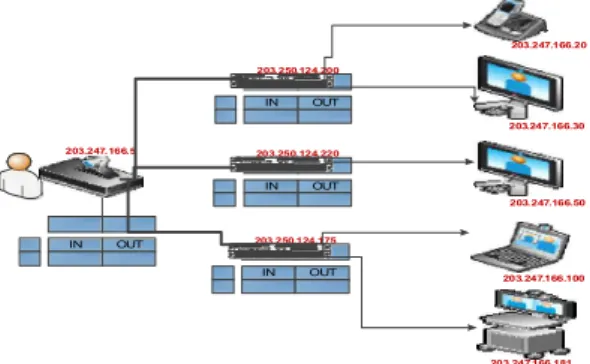
A single source multicast data session is to al- low a single source to send the same information to multiple receivers without the need to repeat the transmission, back through multiple switches and routers in the network[16,17]. Fig. 2 shows that an
IP address source is combined with a single multi- cast address that allows each router in the multi- cast tree to forward the packets only to members of the group (single source), the more detailed il- lustration of this figure will be shown in below.
IN OUT
203.250.124.200
IN OUT
C C330 0 A larm sStatus
CRTM LRMN RPWRN ICD ISKPWR
203.250.124.220
IN OUT
C C330 0 CRTM LRMN RPWRA larm sN ICD ISKPWRStatus
203.250.124.175
IN OUT
CC33 00 Alarm sStatus
CRTM LRM N RPWRN ICD ISKPWR
203.247.166.5
203.247.166.20
203.247.166.30
203.247.166.50
203.247.166.100
203.247.166.181
Fig. 2. Multicast Single Source.
2.4 Multicast Share Source
Multicast share source shows how a shared source multicast data session to allow multiple sources to send the information to multiple re- ceivers through the user of a reference address (rendezvous point/RFC 2362). In this illustration, the data from each source is sent to the Rendezvous Point (RP) which then distributes the information through a tree structure to the multicast group re- cipients[18]. This diagram shows that there is the potential for some duplicate transmission in the shared source multicast session as the source and destination may be sent in different directions through the same routers, the Fig. 3 illustrates the process of multicast share source implementation.
3. DRM SYSTEM FOR MULTICAST CONTENTS
DRM for multicast content is a research which
is never ending a couple of year. Based on the cas-
es according to intellectual property, the interna-
tional consortium applied two categories right of
rules to handle covered about digital right in multi-
cast contents. It is divided into two categories: The
first (1) is industrial property which includes in-
IN OUT
CC3 300
Status Alarm s
CRTM LRM N RPWRN ICDISKPWR
IN OUT
CC33 00
Status A larms CRTM LRM N RPWRNICD ISKPWR
IN OUT
C C3300 Alarm sStatus
CRTM LRM NRPWRN ICD ISKPWR
IN OUT
CC3 300
Status Alarm s
CRTM LRM N RPWRN ICDISKPWR
IN OUT
CC33 00 A larm sStatus
CRTM LRM N RPWRN ICD ISKPWR
203.250.124.200 203.250.124.150
203.250.124.25 Rendezvous Point
Fig. 3. Multicast Share Source.
ventions (patents), trademarks, industrial designs, brand image, scientific source, publication, proto- typing, geographic indications of source, founding of great idea in social network as is Facebook, twitter etc. The Second (2) is copyright which in- cludes literary and artistic works as are novels, both of poems and plays, films, journal, musical creation, artistic creation as is to be drawings, paintings, photographs, sculptures, and architec- tural designs. A multicast content is a cluster of digital audio/visual (A/V) devices including set top boxes, TVs, Internet TV, VCRs, DVD players, and general purpose computing devices such as PC, notebook, smart phone devices, and radio tele- communication infrastructure. Copyrighted digital multimedia content may be delivered to the con- sumers from a number of sources including the Internet, satellite, terrestrial or cable television systems. It may also be made available as pre- packaged media (e.g., a digital tape or a digital vid- eo/audio disc) at retail stores. Before releasing their content for distribution, the content owners may require protection by specifying certain access conditions and Digital Rights Management (DRM) [16,17]. According to complicated matters in devel- oping country which is for buying high quality or branded of a trade mark property license, it is lim- ited by patents and copyright, hence the price of properties is too expensive for weak economic realm. Therefore piracy is the economic way to capture all the properties in multicast content nei-
ther in many cast demand within couple a year[18].
To limited all the piracy environment by re- ducing production the properties unprotecting, such as trademarks, industrial designs, geographic indications of source, novels, both of poems and plays, films, musical creation, artistic works as are drawings, paintings, photographs, sculptures and architectural designs, so DRM is a basic scientific to cover all these cases. We conduct to create an engineering approaching way, by collaborating science and technology to prove all the methods in information technology field[19].
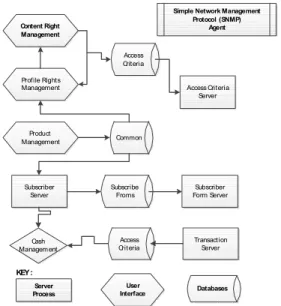
The Fig. 4 is a diagrammatic representation of a number of real-time processes, databases and user interfaces that together provide the function- ality of a conditional access server according to an exemplary embodiment of the present invention.
Content Right Management
Profile Rights Management
Access Criteria
Access Criteria Server Simple Network Management
Protocol (SNMP) Agent
Product
Management Common
Subscribe Froms Subscriber
Server
Subscriber Form Server
Cash Managem ent
Access Criteria
Transaction Server
KEY : Server
Process User Databases
Interface
Fig. 4. Function Chart of DRM System.
4. ENCRYPTION PROCESS AND DIGITAL SIGNATURE OF DRM SYSTEM FOR WEB-BASED MULTICAST CONTENTS
4.1 Architecture of Web-Based Multicast Contents
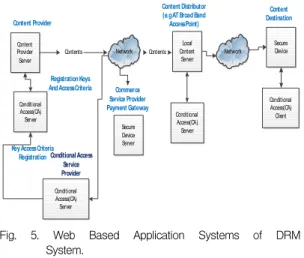
The development process of DRM can be applied
in internet application as a web based system. Fig.
Hash Result
Signat ure Funct ion
Digital Signature Symmet ric
Key
License
Hash Funct ion
Fig. 6. Encryption Process for Generating Digital Signature.
5 is a block diagram illustrating further details re- garding software components that may reside at various location of the content distribution system to facilitate distribution and delivery processes, ac- cording to an exemplary embodiment of the present invention, encryption is the process of trans- forming information (referred to as plaintext) using an algorithm (cipher) to make it unreadable to any- one except those possessing special knowledge [20], usually referred to as a key.
Network
Network NetworkNetwork
Content Provider Server
Conditional Access(CA) Server Content Provider
Registration Keys And Access Criteria
Key Access Criteria Registration
Contents Contents
Local Content Server
Conditional Access(CA) Server
Conditional Access(CA) Server
Secure Device Server
Secure Device
Conditional Access(CA) Client Content Distributor
(e.g AT Broad Band Access Point)
Content Destination
Commerce Service Provider Payment Gateway
Conditional Access Service Provider
Fig. 5. Web Based Application Systems of DRM System.
In this method, we are applying simple hash function algorithm as shown in Fig. 6. It is an en- cryption flowchart providing further details re- garding a method, according to an exemplary em-
bodiment of the present invention of generating the digital signature for a license utilizing a symmetric key (e.g. product keys). The license is subject to a hash function generating a hash result.
The hash result and a symmetric key in the ex- emplary form of a product key provide input to a signature function that generates a digital sig- nature for the license from these two inputs[21].
To get the product key, hash function will be veri- fied by the symmetric key and digital signature as shown in Fig. 7.
Hash Function
Hash Result
Verification Function
Digital Signature Symmet ric
Key
Verification Result License
Fig. 7. Combining Process between Encryption and Digital Signature Methods.
According to an exemplary embodiment of the present invention of verifying a content license, it can be utilized by a digital signature generated uti- lizing a symmetric key (e.g., a product key). The license is again subject to the hash function to gen- erate the hash result. A verification function re- ceives the three inputs, namely the hash result, the symmetric key and the digital signature[22]. As the digital signature was generated utilizing the sym- metric key. The verification function is able to ver- ify the content license utilizing these three inputs.
The function of the Business Process Modelling
(BPM) in Fig. 8 for web-based multicast content
is to accumulate the effective approaching to clas-
sify the requirement of system application. The
key-concept of this figure is to get direction as is
methodology to be a frame work of an encryption
Encry ption Process of D RM f or web based Multicast Contents
Process Analy sis of DRM f or Web-Based Multicast C ontents Wildan Toyib 10/27/2011 10:09 PM
Content Destinations
Secure C ontent Destinations
Report Generator
Conditional Access(CA) Client
Decryption Process Graphic User Interface(GU I) Local C ontent Server(LC S) Database
Manager Server(D BMS) Conditional
Access Server(C AS) Content
Provider
Conditional Access Service Provider Content Distribution(AT Broadband Access
Point)
Data Replication Server
Key Access C riteria Registration
Design Patterns
Secure D evice Server Networking
Encryption Process
Web-Tier Framework Design
Registration K ey and Access Criteria
Access Control List(ACL)
Network Secure D evice
Server Third Party
Application Commerce Service Provider Payment
Gateway Virtual Private Network (VPN ) Process Analysis of
DRM for Web-Based Multicast Contents
A0
$0
Fig. 8. Context Diagram for Business Process Modelling (IDEF0) of DRM System with Web-Based Multicast Contents.
Encry ption Process of DRM f or Web-Based Multicast Contents Wildan Toyib 10/27/2011 10:19 PM
Granted access Subscriber
Sof tware Component dev eloped Internet Access/Radio Frekuency
Normailization of DBMS Repository Local Content (Localhost)
Trav eling users access/Remote Access Telev ision Broadcasting
Protection of Content
Authorizes pay ment f or online serv ice Sharing Inf ormation
Receiv ing Dev ice Signature and Certif icate
Spreadsheet / XML data f eed
Ensuring authenticity /Integrity
Sof tware design description or template
Interaction between humans and machines occurs Model-View-Controller(MVC) Implementations
Encry pted inf ormation readable / Rev erse Engieering Interconnected by communication channels
Rev erse process with Chiper Algorithm Adv anced Encryption Standard Process
Granting access to this content f or client A12.1
$0 Communication
Session
A12.2
$0 Session Transport
A12.3
$0 Service Front End
A12.4
$0 Communication
Session Manager
A12.5
$0 Encryption
Process Design
A12.6
$0 Database (DB) Configuration
A12.7
$0 User Interface
Framework
Fig. 9. Work Flow Model (IDEF3) of Encryption Process for DRM System with Web-Based Multicast Contents.
Communication Session Wildan Toy ib 10/27/ 2011 10:30 PM
Sessi on Logger
Sessi on Cookies Content Destinati on Content D istri butor (e. g AT Broad B and Access Point)
Condi ti onal Access(C A) Server
Condi ti onal Access(C A) Server
Condi ti onal Access(C A) Server Condi ti onal Access(C A) Server
Contents Contents
Network Network
Secure Devi ce Server Local Content
Server
1
$0
Ses sion Partic ipant _0A
2
$0 Ses sion Partic ipant _0B
3
$0
Ses sion Partic ipant _0C
4
$0 Communication
Ses sion Fac tory
Fig. 10. Work Flow Diagram for Communication Session Part of Content Provider Busi- ness Process.
Session Participant_0A Wildan Toy ib 10/27/2011 10:40 PM
Contents
Network Conditional Access(CA)
Server EndPoint System 1
Service Front End
Endpoint System 2 Operations
Even Leg
Controller
Connection
Endpoint End Point
System Application Service Interface
Channel Endpoint
Media Client Application
Session Transport
Session Transport Factory
Channel Endpoint
Media Client Application Leg Controller(Connection state) 1
$0 Service
Layer
2
$0
Communication Session Layer
3
$0 Connection
Layer
4
$0
Transport Layer
Fig. 11. Work Flow Diagram at 2nd Level for Session Participant Part of Content Provider Business Process.
process of DRM for web-based multicast contents.
In order easy to classify the system requirement the BPM of the system above is extracted to be- come work flow data modelling and diagraming which is illustrated by following frame work Fig 9.
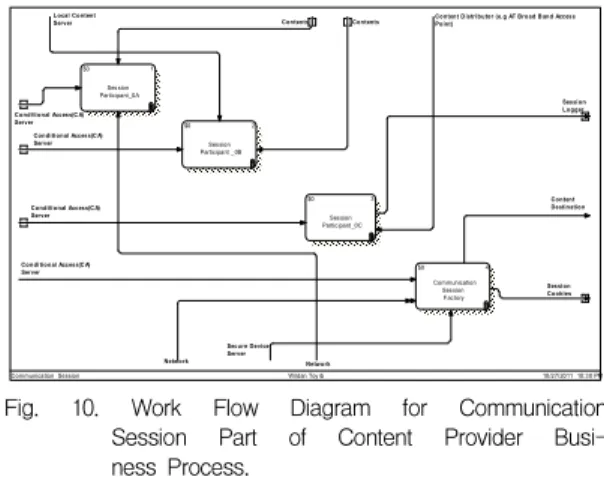
In designing content provider business process as a part of web-based multicast content, the detail extraction method is the effective way, in order to understand the algorithm of system running in de- ployment and code development. The Fig. 10 is an extraction process of work flow diagram is to be focusing in communication session which is con- figured in communication layer application.
The modelling method and diagramming in ses- sion participant part of content provider business process is an extraction process from Data Flow Diagram (DFD) system from Fig. 8 in communica- tion session layer, therefore on the Fig. 11 the modelling method and diagramming is created to extract running well in service layer details.
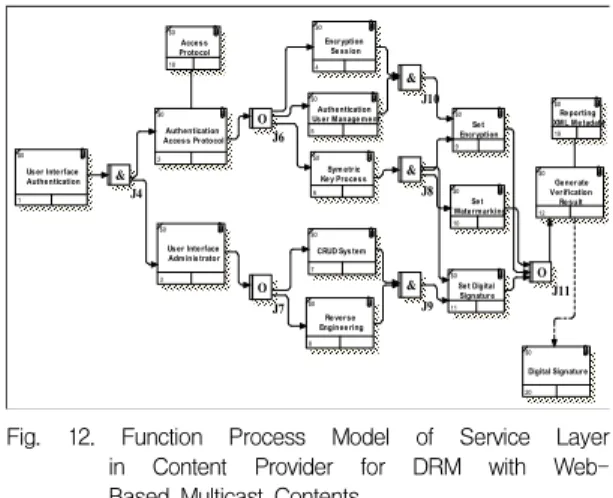
The decision support system to configure an en-
cryption process of DRM system for web-based
multicast content is figured on the Fig. 12, this il-
lustration is a logical method of Data Flow
Diagram (DFD), and this algorithm is using the
key combination AND/OR Gate to generate ver-
ification result, finally on the output process within
this layer delivery digital signature and report[23].
1
$0 Us er Inte rface Authentication
2
$0 Authentication Acces s Pr otocol
3
$0 Us er Inte rface Adm inis trator 18
$0 Acces s Pr otocol
8
$0 Re ver se Enginee ring 7
$0 CRUD Sys tem 6
$0 Sym etr ic Ke y Proces s 5
$0 Authentication Us er Manage m ent
4
$0 Encr yption
Se ss ion
11
$0 Se t Digital Signatur e 10
$0 Se t Water m ar king 9
$0 Se t Encr yption
20
$0 Digital Signatur e
12
$0 Gener ate Ver ification
Re sult 19
$0 Re porting XML Me tadata
&
J8
&
J9
&
J10
O O J11
J7 O
J6
&
J4
Fig. 12. Function Process Model of Service Layer in Content Provider for DRM with Web- Based Multicast Contents.
Both of this output is produced from setting of en- cryption, watermarking and digital signature.
These processes are running in service layer appli- cation to authenticate user interface to get report of verification result on encryption process of DRM system for web-based multicast contents. Further information about this figure sees the illustrations below.
Finally, Database schema for web-based multi- cast content in DRM system is produced in Fig.
13. These processes are reverse engineering from business process management of this research.
The structure data for this system is according to the business process for the DRM likewise in the primary key for industrial property and copyright. We create four big tables to manage da
Fig. 13. Database Schema for Web-Based Multi- cast Contents in DRM System.
ta warehouse on this schema simplify.
We configure the simple method to build this schema, there are four table which represent, where is a web-based for DRM for multicast con- tent can gather the input process data from the client. The CRUD (Create, Read, Update, and Delete) is responsibility of the user authority with Access Control List (ACL) privileged[24]. The main result of this function is to generate a report classification in to two categories, the first is Industrial Property (IP) and the second is copyright in web based reporting system. These database system is configure in DB designer, to produce this schema many ways to do, as to be here database configuration will be exported to XML schema. It is going to be used for SOAP entity in content pro- vider deployment[25].
Database configuration for this system is con- figured as pseudo-code logic below; in this web- based system we apply to use an enterprise Oracle DB Server. So then the Structure Query Language (SQL) is the answer for this method. The following is the database connection URL syntax: jdbc:db_
drm:[subsubprotocol:] [databaseName] [;attrib- ute=value]*, subsubprotocol specifies where com- mand should search for the database, either in a directory, in memory, in a class path, or in a JAR file[29,30]. It is typically omitted. Database name is the name of the database to connect to. Attribute equal to value represents an optional, semicolon- separated list of attributes. These attributes enable to instruct database to perform various tasks, in- cluding the following: Create the database specified in the connection Uniform Resource Locater (URL), Encrypt the database specified in the connection URL, Specify directories to store logging and trace information and Specify a user name and password to connect to the database[25,26].
On the other hand to limit increasing entry data
until the space limitation is reached. We implement
an algorithm to execute the views related to the
query1, query2, query3, and query4. The ratio of
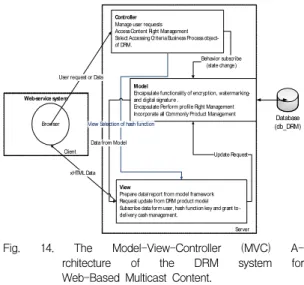
Browser Web-service system
Controller Manage user requests Access Content Right Management Select Accessing Criteria Business Process object- of DRM.
Model
Encapsulate functionality of encryption, watermarking- and digital signatur e .
Encapsulate Perform profile Right Management Incorporate all Commonly Product Management
View
Prepare data/report from model framework Request update from DRM product model Subscribe data for m user, hash function key and grant to - delivery cash management.
Server
Database (db_DRM) User request or Data
Client
xHTML Data
View Selection of hash function
Behavior subscribe (state change)
Data from Model
Update Request