Ⅰ. Introduction
The airport is an infrastructure facility that connects air and land transportation. Airport airside includes facilities for aircraft take off and landing
and air navigation(MOLT, 2017). This area which supports aircraft operations, contains high risk of accidents due to the many aircraft, vehicles, and people moving all the time(Lacagnina, 2007).
Workers in this area are required specific training for airside safety regulation. The majority of work in the airport airside are to carry out in-flight meals, cleaning, baggage handling, etc. and it is considered to be unrelated to aircraft disasters classified into high risk groups such as aircraft crash. Although the airside events were not fatal,
Original Article
https://doi.org/10.12985/ksaa.2018.26.4.043 ISSN 1225-9705(print) ISSN 2466-1791(online)Study on the Relationship among Airport Safety Management System, Safety Knowledgy, and Safety Behaviour
- Case of Incheon International Airport Airside Workers - In Kie Na*, Kwang-eui Yoo**
공항안전관리시스템(SMS)과 안전지식 및 안전행동의 관계에 대한 연구
- 인천공항 이동지역종사자를 중심으로 - 나인기*, 유광의**
ABSTRACT
안전관리시스템(Safety Management system, SMS)은 국제민간항공기구(ICAO)에서 정의된 서비스제공자의 의무사항으로 우리나라의 공항 분야는 2005년 부터 구축되어 현재까지 운 영되고 있다. 항공교통량 증가에 따른 사고의 발생가능성 증가에 대응하기 위해 채택된 새 로운 체계가 SMS라는 점을 고려할 때, 공항 SMS는 항공사와 조업사 등 관련 업체와 연계 되며 이동지역에서 근무하는 종사자의 행동에도 긍정적인 영향을 미칠 수 있어야 할 것이 다. 본 연구는 인천공항이 실행하고 있는 외부지향적인 SMS활동이 항공사, 조업사 등에 소 속된 이동지역 종사자의 지식과 행동에 미치는 영향에 대해 연구하고자 하였다. 총 593명의 종사자가 조사에 참여하였으며, 공항SMS는 안전지식을 통해 안전행동에 영향을 미치는 것 으로 나타났다. 이 연구 결과는 공항이 조업사 등 별개의 업체 종사자에 대한 안전정책 설 정을 위한 기초자료로 활용될 수 있을 것으로 기대된다.
Key Words : 공항안전관리시스템(Airport Safety Management System), 공항 이동지역 안전
(Airside Safety), 안전지식(Safety Knowledgy), 안전행동(Safety Behaviour), 이동지역 종사자 (Airside workers)
Received : 25. Nov. 2018. Revised : 07. Dec. 2018.
Accepted : 23. Dec. 2018
*
한국항공대학교 대학원 항공교통물류학과**
한국항공대학교 대학원 항공교통물류학과 교수 연락저자E-mail : [email protected]
연락저자 주소
: 10540
경기도 고양시 덕양구 항공 대학로76
but property and operational losses are huge due the frequency. To make it worse, more air traffic may cause more accidents on space-limited airside.
Flight safety foundation states that more than 27,000 airside accidents(one per 1,000 departures) occurred and injuring more than 243,000 people(9 per 1,000 departures) in the world(Flight Safety Foundation, 2008). They caused at least $ 10 billion loss a year for major airlines. International organizations including ICAO, ACI, etc are making various efforts to develop a Ground Accident Prevention Program(GAP) to prevent accidents by joint efforts. Despite these efforts, changes in the environment, such as the increase of flights, induce more possibility of accidents. In addition, due to the nature of the airport, many different types of duties are performed at same place and same time.
The causes of accidents at the airport are very diverse, which makes the prevention of accidents more difficult. Therefore, it is necessary for all relevant stake holders’ efforts to prevent accidents.
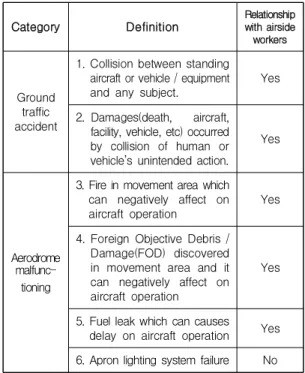
It is indicated that the safety management system of aerodrome operators should include the safety organization, responsibility and obligation, safety policy and management procedures required for its own safety management in accordance with the state safety program(MOLT, 2017). The items set as safety objectives for korean airport operators consist mainly of(5 out of 6) aircraft-related accidents and incidents that can be exposed to operators within the airside. It is shown in Table 1.
Airport SMS is required to operate for apron and aircraft safety in the airside area.
The purpose of this study is to analyze the safety knowledge by airport SMS on the safety behavior of the worker belonging to separate company rather than the airport.
Additionally, in order to identify practical meaning for airport safety in the nationwide, identifying the SMS strategy and its components where positively and efficiently affect airside workers' safety will follow.
Table 1. Korean Airport Safety Objectives
Category Definition
Relationship with airside workers
Ground traffic accident
1. Collision between standing aircraft or vehicle / equipment and any subject.
Yes
2. Damages(death, aircraft, facility, vehicle, etc) occurred by collision of human or vehicle’s unintended action.
Yes
Aerodrome malfunc-
tioning
3. Fire in movement area which can negatively affect on aircraft operation
Yes
4. Foreign Objective Debris / Damage(FOD) discovered in movement area and it can negatively affect on aircraft operation
Yes
5. Fuel leak which can causes
delay on aircraft operation Yes 6. Apron lighting system failure No
Ⅱ. Main subject
2.1 Theoretical background
ICAO defines the SMS as a system that can ensure safe operation through effective risk management(ICAO, 2013). The countries with ICAO agreement shall establish State Safety Program(SSP), and their international service providers, including airports and airline, are required to operate SMS. South Korean airport operators - Incheon International Airport Corporation(IIAC) and Korea Airport Corporation(KAC) - defines that SMS is a management procedure includes organization, policy, accountability and obligation to carry out airport safety management in accordance with the state safety program(IIAC, 2018).
International organizations and many CAAs
distinguish four components of SMS : safety
policy and objectives, risk management, safety
assurance, and safety promotion. Safety policies
are the official expression of the organization's investment in principles, regulations and safety on safety issues(Cooper, Philips, 2004). The Federal Aviation Administration(2006) has obliged to US air service providers to establish policies and procedures and organizational structures in their SMS. Risk management is a process to assess the level of exposure to risks in the current operating environment (Kim, Sin, 2011) and mitigation strategy to reduce risk must be ALARP(As Low As Reasonably Praticable). Safety assurance process is a performance monitoring procedure that can confirm whether the safety policy and goals are achieved (Park, 2014). It can also continuously monitor or measure safety activities, including identified hazards (FAA, 2006), and collected reports (voluntary / mandatory). Safety promotion is an activity that fosters a positive safety culture and environment by encouraging safety attitudes and actions (ICAO, 2013). ICAO Doc(Document) 9859 has stated training and communication are the main items in the promotion of safety. In addition to activities indicated from ICAO Doc 9859, South Korean airport operators have conducted activities such as FOD campaigns, training, and bulletins that share information that airport airside workers should be aware of. In this study, the operational definition of the safety management system is safety activities that affect airport stakeholders' safety and limited in airside operation. Kallgren & Wood (1986) conclude that safety knowledge plays a positive role in matching individual attitude and external behaviors. Sherehiy & Kawowski (2006) distinguishes safety knowledge in two types - explicit knowledge and tacit knowledge.
Explicit knowledge is easy to share knowledge with an organization in which many individuals can be documented. on the other hand, tacit knowledge is an individual
experience depending on the situation, and it is difficult share with others. Chang & Liao(2009) reported that safety knowledge, documented and learned by workers, had a positive effect on attitudes, which can be seen as explicit knowledge. On the other hand, Håvold(2010) measured the tacit knowledge used as a measure to distinguish office workers from field workers through his research evaluating his own safety knowledge and experience.
Carrillo & Chinowsky(2006) stressed the importance of field knowledge because effective knowledge management encouraging ideas exchange appeared as productivity, customer service, and staff settlement. Hofmann, Jacobs
& Landy(1995) defined that safety knowledge is the acquisition of regulatory procedures, as an understanding of the safety operating procedures and the appropriate training and instruction personnel. In this study, safety knowledge is defined from previous studies plus knowledge from training related to the field and regulations shared from the company and the airport safety management system.
Safety behavior is the activities of protecting individuals from harm by adding safety knowledge and skills needed for the way they do their work safely (Gressgård, Hansen, 2015).
Safety behavior has been categorized into two types: complying with mandatory requirements (safety compliance) and being actively (safety participation) involved in many previous studies. Jiang & Probst(2016) defined safety compliance as an action that requires an immediate situation in relation to safety (eg.
wearing a safety guard before work).
Gressgard(2015) stressed that safety compliance
is a key component of safety behavior. Safety
participation, on the other hand, is a more than
passive action that goes a step further from
regulatory compliance, meaning that it has an
active role (eg, volutary reports). In this study,
the operational definition of safety behavior is
‘active or passive behavior that contributes to prevent accidents by airside workers'. Based on previous studies and operational definition, we analyze the effect of safety management system airside workers deployed at airports on safety knowledge and safety behavior.
2.2 Research model
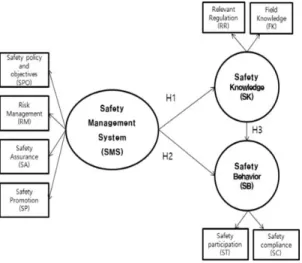
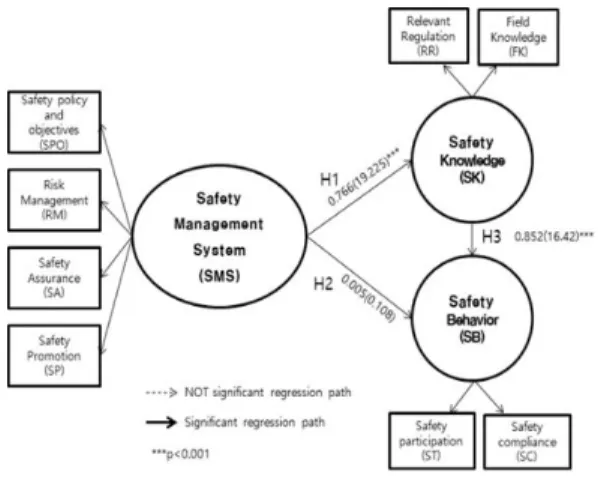
The purpose of this study was to investigate the effect of safety management system operated by airport operator on the safety behavior of external stakeholder's employees with safety knowledge as a parameter. In order to accomplish these research objectives, following research model is presented as shown in Figure 1.
Fig 1. Research Model
2.3 Hypothesis
Based on the empirical research model presented above, this study sets up a research hypothesis as follows. Tam et al.(2001) reported that a change in the attitude of construction workers after introducing a new safety management system resulted in a change in the safety system that affected the cognitive response and public behavior change through
attitude. Vinodkumar & Bhasi(2010) conducted a survey of 1,566 workers about safety- organized work practices on the safety behavior. The result show that safety knowledge and motivation were core mediators to safety behaviour. This safety management practice is specifically concerned with safety management factors such as safety regulations, procedures, training, and communication that can predict safety knowledge. Therefore, the following hypotheses can be advanced for this study based on the above-mentioned previous researches in Korea and abroad.
H1. The safety management system will positively affect safety knowledge.
Chen & Chen(2014) found that variables including perceived SMS practices, morality leadership and self efficacy have a significant impact on the safety behavior of pilots. Cho at el.(2014) also found that airline safety management systems had a positive effect on safety behaviors such as compliance with safety rules and safety awareness through individuals' motivation. Kim(2015) pointed that the components of the safety management system had a significant effect on the safety behavior.
Moreover, Vinodkumar & Bhasi(2010) also found that the safety management system, including management participation, safety regulations and procedures contributed workers' safety compliance and participation.
Cho(2015) analyzed the systemic factors to safety behaviour performance, and the result was that invisible factors (interests, mood, training results etc) in systemic factor have an important influence on safety behaviour.
Previous research in other industry than
aviation shows that the human resource
management system, similar to aviation safety
management system, has an effect on
organizational behavior and creative behavior
(Jang, 2015). In the study of Moon(2013) certain sub-factors of performance management system have effects on the behaviors such as job satisfaction.
H2. The safety management system will positively affect safety behavior.
Studies that safety knowledge affects on safety behavior have been conducted early in other areas. Neal. et al(2000). conducted a survey of 525 Australian workers divided into 32 groups, which suggested that safety knowledge positively affects compliance and participation that constitute safety behavior.
Chang & Liao(2009) analyzed the safety behaviors of 288 passengers who received safety training from the crew after boarding the aircraft. The result was that safety knowledge acquired through crew's practice positively influenced safety behaviors including the safety attitude of passengers. Chen & Chen(2014) surveyed 239 pilots and found that the components of SMS directly affected the safety behavior, and Watcher & Yorio(2013) argued that perceived SMS directly affects on safety behaviour and accident reduction.
H3. Safety knowledge will positively affect safety behavior.
2.4 Instrument and measure
The questionnaires used in this study were prepared based on the previous literature research, and the questionnaires were supplemented and revised. The questionnaire consists of demographic characteristics and safety management system, safety knowledge, and safety behavior. The scale on the questionnaire was composed of 5 points of Likert scale, 5 points of `strongly agree` and 1 point of ‘not at all’. The paper based survey was conducted from June 12, 2017 to October 14,
2017, for airlines, ground handlers, and contractor companies in Incheon international airport. A total of 650 questionnaires were distributed, of which 612 were collected. Of the samples, 57 were used in the final analysis, except for the analysis of 57 questions that were insufficient or inadequate.
2.5 Data analysis
In order to verify the hypothesis of this study, the collected data based on the questionnaires were analyzed using SPSS 21.0 program and AMOS 20.0 package program. First, frequency analysis was conducted to examine the demographic characteristics of the respondents.
Second, factor analysis was conducted to verify the validity of the measurement tools. Cronbach's Alpha value was calculated through reliability analysis to verify the internal consistency between variables. Third, the research hypothesis was verified using Structural Equation Modeling (SEM) to identify Confirmatory Factor Analysis(CFA) and path coefficients of structural models.
2.6 Empirical Analysis 2.6.1 Population
In order to analyze the characteristics of
respondents, frequency analysis was conducted
on demographic characteristics and general
characteristics. There were 540 (91.1%) males
and 53 females (8.9%) in the gender distribution
of airside workers. By age, 193(32.5%) were in
their 30s, 171 (28.8%) were in their 40s,
followed by 66 (11.1%) for 20s, 50s were
133(22.4%) and 60s were 30 (5.1). The reason of
relatively small portion in 20s is attributed to
the frequent move for job due to their physical
hardship and low wages.
Table 2. Population
Category 1 Category 2 Population Portion(%)
Gender
Male 540 91.1
Female 53 8.9
Age
20s 66 11.1
30s 193 32.5
40s 171 28.8
50s 133 22.4
60s or over 30 5.1
Total 593 100.0
2.6.2 General characteristics
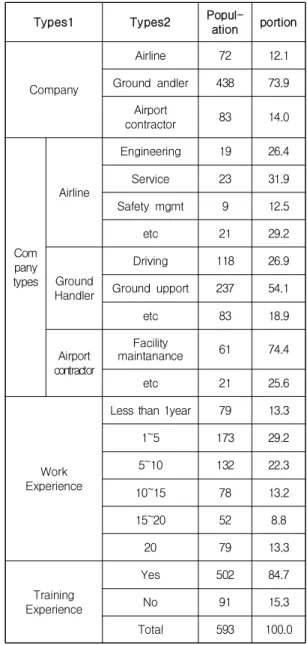
593 employees in safety and operational departments who could be related to airport accidents directly or indirectly. 438 workers in ground handling (73.9%) answered that they had the largest number of respondents, 83 from airport contractors (14%) and 72 from airlines (12.1%). The survey was intended to ground handling workers mainly related to the airport safety management system. 51(71%) of airlines(72) was answered that their duties have a direct impact on safety such as maintenance, safety management, and flight service support. 61 out of 82 employees in airport maintenance contractors responded their duty related airport safety. Considering that survey was conducted to departments related to airport safety, there are certain portion of respondents those did not aware that his work is related to safety. 17.3%
(29.9%) of respondents had between 1 to 5 years of job experience and 132 (22.3%) of respondents answered between 5 to 10 years of job experience.
therefore less than 10 year experienced employees occupied largest portion(51.4%) of respondent working related to airport safety.
Table 3. General Characteristics
Types1 Types2 Popul-
ation portion
Company
Airline 72 12.1
Ground andler 438 73.9 Airport
contractor 83 14.0
Com pany types
Airline
Engineering 19 26.4
Service 23 31.9
Safety mgmt 9 12.5
etc 21 29.2
Ground Handler
Driving 118 26.9
Ground upport 237 54.1
etc 83 18.9
Airport contractor
Facility
maintanance 61 74.4
etc 21 25.6
Work Experience
Less than 1year 79 13.3
1~5 173 29.2
5~10 132 22.3
10~15 78 13.2
15~20 52 8.8
20 79 13.3
Training Experience
Yes 502 84.7
No 91 15.3
Total 593 100.0
2.6.3 Confirmatory Factor Analysis
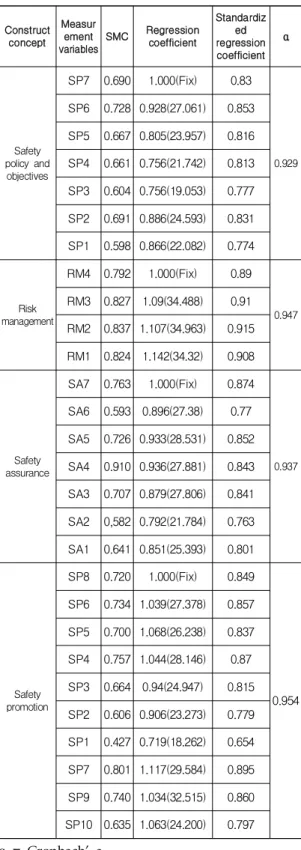
Before the research hypothesis was verified,
validation was verified by confirmatory factor
analysis in this study. The results shows that,
the standardized regression coefficient of each
measurement variable was 0.7 or more and
the SMC (Squared Multiple Correlations) was
0.4 or more.
Construct concept
Measur ement variables
SMC Regression coefficient
Standardiz ed regression coefficient
α
Safety policy and objectives
SP7 0.690 1.000(Fix) 0.83
0.929
SP6 0.728 0.928(27.061) 0.853 SP5 0.667 0.805(23.957) 0.816 SP4 0.661 0.756(21.742) 0.813 SP3 0.604 0.756(19.053) 0.777 SP2 0.691 0.886(24.593) 0.831 SP1 0.598 0.866(22.082) 0.774
Risk management
RM4 0.792 1.000(Fix) 0.89
0.947
RM3 0.827 1.09(34.488) 0.91 RM2 0.837 1.107(34.963) 0.915 RM1 0.824 1.142(34.32) 0.908
Safety assurance
SA7 0.763 1.000(Fix) 0.874
0.937
SA6 0.593 0.896(27.38) 0.77 SA5 0.726 0.933(28.531) 0.852 SA4 0.910 0.936(27.881) 0.843 SA3 0.707 0.879(27.806) 0.841 SA2 0,582 0.792(21.784) 0.763 SA1 0.641 0.851(25.393) 0.801
Safety promotion
SP8 0.720 1.000(Fix) 0.849
0.954 SP6 0.734 1.039(27.378) 0.857 SP5 0.700 1.068(26.238) 0.837 SP4 0.757 1.044(28.146) 0.87 SP3 0.664 0.94(24.947) 0.815 SP2 0.606 0.906(23.273) 0.779 SP1 0.427 0.719(18.262) 0.654 SP7 0.801 1.117(29.584) 0.895 SP9 0.740 1.034(32.515) 0.860 SP10 0.635 1.063(24.200) 0.797 Table 4. Confirmatory Factor Analysis(SMS)
α = Cronbach’ a
The result of confirmatory factor analysis show that GFI 0.844, AGFI 0.805, RMR 0.042, CFI 0.937, TLI 0.927, NFI 0.920 and RMSEA 0.077. The GFI did not appear to be above the acceptance level of 0.9, however, the remaining indices fit the acceptance level, which is totally satisfactory. As a result of calculation for each latent variable in the measurement model, the AVE value of all constituent concepts is 0.5 or more and the conceptual confidence value is 0.6 or more. There is intensive validity among the measurement variables used in this study.
Table 5. Evaluation of discriminant validity (Safety Management System)
SPO RM SA SP AVE Conceptual
reliability
SPO 1 0.680 0.680
RM 0.448 1 0.840 0.840
SA 0.487 0.376 1 0.702 0.702
SP 0.296 0.227 0.389 1 0.695 0.700
Discriminant Validity is compared with the
intensive validity by determining whether there
is a difference between the construct concepts,
and it is verified by comparing the average
variance extracted with the square of the
correlation coefficient of each factor. The
criterion for discriminant validity is satisfied if
each variance extracted index (AVE) is greater
than the squared correlation coefficient (Fornell
and Larcker, 1981). The results of Average
Variance Extracted(AVE) of each construction
concept are shown in Tables 4 and 6.
Table 6. Confirmatory Factor Analysis(Safety Knowledge, Safety Behavior)
C o n s truc t co n c e p t
Me as ure m ent
v ar ia ble SM C R e gre ssio n c o ef ficien t
Standar diz e d regre ssion co efficie nt
α
SK RR
Regulation1 0.528 1.000(Fix) 0.727
0.93 Regulation2 0.603 1.055(27.61) 0.776 Regulation3 0.694 1.346(20.082) 0.833 Regulation4 0.717 1.37(20.358) 0.847 Regulation5 0.709 1.421(18.5) 0.842 Regulation6 0.693 1.257(20.07) 0.832 Regulation7 0.692 1.364(20.129) 0.832
FK
Field1 0.558 1.000(Fix) 0.747
0.92 Field2 0.601 1.071(21.225) 0.775 Field3 0.631 1.132(19.873) 0.794 Field4 0.631 1.173(19.888) 0.794 Field5 0.715 1.219(21.329) 0.846 Field6 0.614 1.196(19.45) 0.784 Field7 0.568 1.265(18.774) 0.753
SB ST
participation1 0.479 1.000(Fix) 0.692
0.924 participation2 0.629 1.097(22.891) 0.793 participation3 0.627 1.055(17.936) 0.792 participation4 0.711 1.21(18.977) 0.843 participation5 0.773 1.289(19.688) 0.879 participation6 0.533 1.168(16.614) 0.73 participation7 0.617 1.234(17.797) 0.786
SC
compliance1 0.696 1.000(Fix) 0.834
0.931 compliance2 0.786 1.031(27.864) 0.886 compliance3 0.798 1.037(28.18) 0.893 compliance4 0.804 1.055(28.312) 0.897 compliance5 0.665 0.945(24.107) 0.815 compliance6 0.488 0.964(19.409) 0.698
Table 7. Safety Knowledge and Safety Behavior Confirmatory factor analysis showed that GFI 0.833, AGFI 0.788, RMR 0.048, CFI 0.928, TLI 0.915, NFI 0.911, and RMSEA 0.079.
The GFI did not appear to be above the acceptance level of 0.9, but the remaining indices fit the acceptance level, In addition, the AVE value of all constructs is 0.5 or more in the measurement model, and there is intensive validity among the measurement variables used in this study.
Table 7. Discriminant Validity Analysis(Safety Knowledge, Safety Behavior)
FK RR ST SC AVE
Conceptualreliability