492
Copyright © 2020 The Korean Society of Fisheries and Aquatic Science pISSN:0374-8111, eISSN:2287-8815
서 론
넙치
(Paralichthys olivaceus)
는우리나라,
일본및중국연안 에널리분포하고있는어종으로,
상품성이높은대표적인양식 어종이다(Lee, 2006; Hwang and Myeong, 2010). 2018
년국내 넙치의양식생산량은약32,238
톤으로전체어류양식생산량의 약46%
를차지하고있다.
하지만41,636
톤을생산한2016
년과41,207
톤을생산한2017
년을비교해볼때생산량이지속적으 로감소하고있다(KOSIS, 2019).
양식종자의열성화,
양식생산단가상승
,
수요와공급의불균형등으로인해현재넙치양 식산업은큰위기를맞이하고있다.
특히선어로이용되는대 체어종인연어(Oncorhynchus keta)
와방어(Seriola quinquera-
diata)
의소비량이크게늘면서넙치양식어가수가급격하게줄었다
(KOSIS, 2019).
따라서이러한어려운상황을극복하기위 해선발육종을통한고부가가치넙치의종자개발이새로운대 안으로제기되고있다.
어류의체색은시장에서상품가치를 결정하는중요한경제 적요인으로인식되고있으며
,
멜라닌(melanin),
카로티노이드황금색 넙치(Paralichthys olivaceus)의 발현을 예측할 수 있는 Microsatellite Marker 개발
김민성·곽주리·김태환·한재용·박지빈·조현경·서종표
1·이우재*
어업회사법인(주)불루젠코리아, 1(영)해연
Identification of Genetic Markers Distinguishing Golden Flounders from Normal Olive Flounders Paralichthys olivaceus Using Microsatellite Markers
Min Sung Kim, Ju Ri Kwak, Tae Hwan Kim, Jae Yong Han, Ji Been Park, Hyeon Kyeong Jo, Jong-pyo Suh
1
and Woo-jai Lee*BLUGEN KOREA, Busan 48071, Korea
1Haeyeon Fish Farm, Jeju 63359, Korea
Despite its economic importance, olive flounder Paralichthys olivaceus aquaculture industry is facing a crisis with a continuous production decline. There have been many solutions to overcome the complicate predicament proposed.
Increasing genetic diversity and discovering new commercial value through selective breeding are among them.
The aims of the present study are to increase the selection power of the golden flounders. We examined the genetic diversity of the breeder population of golden flounders and developed selective markers for the golden flounder population. The 6 microsatellite (MS) markers were selected from melanogenesis-related genes, which are believed to be involved in the pigmentation of fish. All markers were polymorphic (except PO4) and 5 of them had PIC value of 0.6 or above. All makers had distinctive alleles indicating either normal or golden individuals. For examples, from PO4 marker, the frequency of an allele (316) in the golden population was 100% and in normal population was 0%
(P<0.001). Although some more studies with more samples at the later generations should be performed to confirm this result, the 316 allele from PO4 marker could be a distinctive tool for decision of the colors in olive flounders at an early stage of the life cycle.
Keywords: Olive flounder, Leucism, Microsatellite, Genetic diversity
*Corresponding author: Tel: +82. 70. 8771. 9090 Fax: +82. 51.912. 9091 E-mail address: [email protected]
This is an Open Access article distributed under the terms of the Creative Commons Attribution Non-Commercial Licens (http://creativecommons.org/licenses/by-nc/3.0/) which permits unrestricted non-commercial use, distribution, and reproduction in any medium, provided the original work is properly cited.
Received 16 June 2020; Revised 11 August 2020; Accepted 21 August 2020 저자 직위: 김민성(연구원), 곽주리(연구원), 김태환(연구원), 한재용(연구원), 박지빈(연구원), 조현경(연구원), 서종표(대표이사), 이우재(대표이사) https://doi.org/10.5657/KFAS.2020.0492
Korean J Fish Aquat Sci 53(4), 492-498, August 2020
(carotenoid),
프테리딘류(pteridine),
퓨린류(purine)
는체색을 조절하는주요결정요인으로알려져있다(Kennedy, 1979).
색 소세포는전구세포인chromatoblast
의분화과정에따라흑색 멜라닌을생성하는melanophore,
황금색색소를가지는xan- thophore,
그리고반짝이는은빛색소를가지는iridophore
로발 달하게되는데,
마우스또는토끼와같은포유류의단순한백화 현상(albino)
과는달리어류에서는melanophore
로분화가억제되면
xanthophore
로의분화가촉진되어황금색이나타난다고알려져있다
(Lin and Fisher, 2007; Nord et al., 2016).
체색 발현과고정에관한연구는zebrafish
에서주로이루어지고있 는데, tyrosinase
의발현조절을통해chromatoblast
의melano- phore
분화가억제된다고보고되었다(Lamason, et al., 2005;
Minchin and Hughes, 2008; Curran et al., 2010).
넙치의경우색소포부족으로색상이발현되지않는유안측백색증
(hypo-
meanosis)
과과도한색소포발현으로흑색반문이발생하는무안측흑화증
(hypermeanosis)
이대표적인멜라닌이상증상으 로넙치의상품성을 결정하는체색변화이다(Shikano, 2005;
Kang et al., 2007; Kang at al., 2016).
멜라닌색소결핍으로인한체표전체의체색변화는두가지로 형태로알려져있다
(Veena et al., 2011; Muto et al., 2013; Song et al., 2017).
특정유전자변이에의해망막및체표의멜라닌 소체(melanosome)
발현이억제되어발생하는알비노(albino),
망막의멜라닌소체는발현이되지만표피의색소침착은억제 되는루시즘(leucism)
이있다(Kinnear et al., 1985).
루시즘은 유전적요인,
내교배(inbreeding),
환경요인으로인한 생리적 변화등이원인으로알려져있으며,
알비노와는달리비가역적 으로체색변화가유도되기때문에발생기전에대해서는명확 히밝혀져있지않다(Kuriiwa et al., 2007; Veena et al., 2014;
Song et al., 2017).
하지만어류의루시즘개체에대한연구는 지속적으로보고되고있으며,
상업적가치를위한선택적육종을통해서루시즘품종을개발한것으로알려져있다
(Kadlec,
1995; Odenthal et al., 1996; Quigley et al., 2017; Quigley et al., 2018; Quigley and MacGabhann, 2018).
본연구에이용 된황금넙치는망막의색소침착이이루어져있으나체색이황 금빛을띄는특이개체로,
성체가되는과정에서체색변화가 이루어지는것으로보아루시즘개체로추정된다.
하지만,
발달 과정중에체색변화가없는개체부분적으로체색변화가발생 하는개체등동일한집단임에도불구하고체색발현이일괄적 으로이루어지지않아이를극복하기위한체색발현연구가필 요한실정이다.
따라서
,
본연구는일반넙치와황금넙치의유전형을비교하여 황금넙치의체색마커를개발하고자하였다.
넙치의멜라닌합 성신호전달기전과관련된유전자의microsatellite (MS)
마커 개발을통해황금넙치특이적인대립유전자를찾고,
이를토대 로황금넙치조기판별을위한유전자마커개발및새로운종자 개발을위한기초자료를제공하고자한다.
재료 및 방법
시료 수집 및 DNA 추출
넙치시료는영어조합법인해연
(Jeju, Korea)
에서사육중인 일반넙치90
개체와체표의색이황금색인황금넙치109
개체 를선별하여총199
개체를이용하였다.
각개체의꼬리지느러 미조직10 mg
을잘라100%
에탄올에넣은후-20°C
보관하여 사용하였고, DNeasy blood and tissue kit (Qiagen, German-
town, MD, USA)
으로제조사에서제공하는표준방법을변형하여
total genomic DNA
를추출하였다. Microsatellite marker 개발
MS (microsatellite)
마커는여섯마리의일반넙치에서추출 한genomic DNA (deoxyribonucleic acid)
를이용하여paired- end library
를만들었으며, Hiseq4000 (Illumina, San Diego, CA, USA)
플랫폼으로 염기서열을 생산하였다.
생산된raw sequence
는Quality score 20
을 기준으로trimming
하였고, SOAPdenovo2 (v2.04) software (Luo et al., 2012)
를기반으로De novo assembly
를수행하였다. MS
서열은MIcroSAtelitte (MISA) tool
을사용하여탐색하였다.
개발된
MS
마커는황금넙치와일반넙치의RNA sequencing
을이용한differential expressed gene analysis
결과를바탕으 로발현량의차이가있는유전자를1
차적으로선별하였으며,
이 후멜라닌합성과관련된MS
서열을2
차선별하여본연구에 사용하였다(data not shown).
선별된MS
영역을증폭하기위한primer
는Primer3 software
를활용하였고, TM
값을58-62°C,
증폭산물의크기는150-350 bp
로설정하여MS
마커를디자인 하였다.
또한reverse primer
의5’
말단에oligomer (GTTTCT)
를추가하여background noise
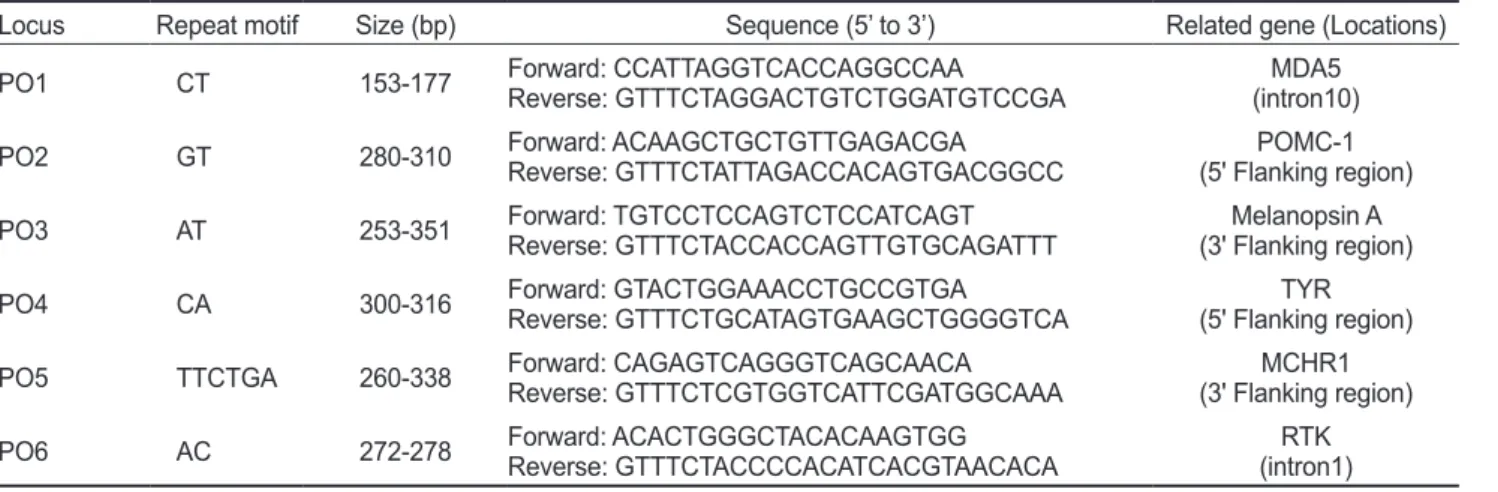
를줄이는방법으로제작하였다(Table 1).
Multiplex-PCR
Multiplex-PCR (polymerase chain reaction)
반응액은Ge- nomic DNA 100 ng, primer mixture 8 μL, hot start Taq DNA polymerase 0.6 μL, 10x buffer 1.8 μL, dNTP 1.5 μL
를첨가 한후,
반응액을총15 μL
로제조하였고, geneAmp PCR sys- tem 9700 (Applied Biosystems, Foster City, CA, USA)
을이 용하여PCR
을진행하였다. PCR
분석은95°C
에서10
분간pre- denaturation
을실시한후95°C
에서60
초, 58°C
에서60
초, 72°C
에서60
초를1 cycle
로하여35 cycle
반복하였고,
마지막으로70°C
에서10
분extension
후4°C
에서종료하였다.
Microsatellite 유전자형 분석
증폭된
PCR
산물은30
배로희석시킨 후,
증폭산물1 μL
와GeneScan 500 LIZ dye Size Standard (ThermoFisher Scien-
tific, Walthamm, MA, USA)
및Hi-Di Formaide (Applied Bio-
systems, Foster City, CA, USA)
혼합물을1:9
로희석하여분 석을위한시료로사용하였다.
이후자동염기서열분석장치인3730xl DNA Analyzer (ThermoFisher Scientific, Walthamm,
MA, USA)
를이용하여모세관전기영동을실시하였다.
각마커에대한표준대립유전자를분석하기위해
geneMapper ver- sion 4.0 (ThermoFisher Scientific, Walthamm, MA, USA)
분 석프로그램을이용하여모든개체를분석하고,
크기와표식자 의종류별로분류하여분석하였다.
유전다양성 및 통계 분석
6
개의마커를이용하여일반넙치집단과황금넙치집단의유전적다양성분석을수행하였다
.
각유전자좌의대립유전자의 수(number of alleles, K),
기대이형접합율(expected hetero- zygosity, Hexp),
관측이형접합율(observed heterozygosity, Hobs),
다형성정보지수(polymorphism information content, PIC), Hardy-Weinberg equilibrium (HWE)
에대한유의성검 증은adjusted P
값인Bonferroni correction
을적용하여Cervus 3.07 software
를이용하여분석하였다(Marshall et al., 1998).
또한 대립유전자 풍부도
(allelic richness, Ar),
근교계수(in-
breeding coefficients, Fis),
유전자다양성지수(gene diversity)
는FSTAT 2.9.3 program
으로분석하였다.
통계분석은로지스 틱회귀분석(logistic regression)
으로P value
가0.05
미만인대 립유전자를선별한후교차비(odds ratio)
와신뢰도(95% con- fidence interval)
를구하였고,
카이제곱 검증(Chi-square test)
및Z-
검정(Z-test)
를통해유의성분석을실시하였다.
모든통계 분석은R ver. 3.5.0 (The R Foundation, Vienna, Austria; http://
www.R-project.org)
를사용하였으며, P value<0.05
일때통계 적으로유의한것으로판정하였다.
결과 및 고찰
일반넙치 집단과 황금넙치 집단의 유전다양성 및 특 성 분석
멜라닌합성과관련된유전자에서선별한
6
개의MS
마커를 활용하여 일반넙치 집단(n=90)
과 황금넙치 집단(n=109)
총199
마리의넙치를대상으로 유전다양성을분석하였다(Table 2, 3).
일반넙치집단의평균대립유전자의수는평균5.3
개,
평 균대립유전자풍부도는8.2
개로황금넙치집단보다2.84
개높Table 2. Genetic diversity at 6 microsatellite makers in normal population of Paralichthys olivaceus
Locus K N Ar Hobs Hexp PIC Fis Gene diversity HWE P value
PO1 8 90 8 0.48 0.81 0.78 0.41 0.81 0.001**
PO2 6 90 6 0.70 0.69 0.63 -0.03 0.68 0.001**
PO3 10 90 10 0.73 0.82 0.79 0.09 0.82 0.625
PO4 2 90 2 0.01 0.01 0.01 0.00 0.01 1.000
PO5 10 90 10 0.86 0.85 0.83 0.00 0.86 0.001*
PO6 13 90 13 0.87 0.91 0.89 0.05 0.91 0.001**
Average 8.17 90 8.17 0.61 0.68 0.65 0.09 0.68
K, number of alleles; N, sample size; Ar, allelic richness; Hobs, observed heterozygosity; Hexp, expected heterozygosity; PIC, Polymor- phism information content; Fis, inbreeding coefficients; HWE, Hardy-Weinberg equilibrium. *Significant level at P<0.01. **Significant level at P<0.001.
Table 1. Information on 6 microsatellite markers used in this study
Locus Repeat motif Size (bp) Sequence (5’ to 3’) Related gene (Locations)
PO1 CT 153-177 Forward: CCATTAGGTCACCAGGCCAA
Reverse: GTTTCTAGGACTGTCTGGATGTCCGA MDA5
(intron10)
PO2 GT 280-310 Forward: ACAAGCTGCTGTTGAGACGA
Reverse: GTTTCTATTAGACCACAGTGACGGCC POMC-1
(5' Flanking region)
PO3 AT 253-351 Forward: TGTCCTCCAGTCTCCATCAGT
Reverse: GTTTCTACCACCAGTTGTGCAGATTT Melanopsin A (3' Flanking region)
PO4 CA 300-316 Forward: GTACTGGAAACCTGCCGTGA
Reverse: GTTTCTGCATAGTGAAGCTGGGGTCA TYR
(5' Flanking region)
PO5 TTCTGA 260-338 Forward: CAGAGTCAGGGTCAGCAACA
Reverse: GTTTCTCGTGGTCATTCGATGGCAAA MCHR1
(3' Flanking region)
PO6 AC 272-278 Forward: ACACTGGGCTACACAAGTGG
Reverse: GTTTCTACCCCACATCACGTAACACA RTK
(intron1)
게관찰되었다
.
일반넙치집단의평균관측이형접합율은0.61,
평균기대이형접합율은0.68
의수치를보여관측이형접합율이 기대이형접합율보다낮은값을보였다.
반면에,
황금넙치집 단에서는관측이형접합율이기대이형접합율과비교하여높은 값을나타냈다.
황금넙치집단은친자확인을위한넙치MS
마 커를활용하여유전다양성을확보할수있는교배지침을적용 하여세대생산을수행하기때문으로판단된다.
다형성정보지수는일반넙치집단과황금넙치집단에서각각평균
0.65
및0.60
으로0.5
이상의값을보여0.01
과0.38
의값을나타낸PO4
마커를제외한다면적절한다형성정보를반영하기에황금넙 치판별을위한마커로이용할수있을것으로판단된다.
근교계수는일반넙치집단에서평균
0.09,
황금넙치집단에서평균-0.21
로음의값을보였다.
근교계수는개체내에포함된아집 단(subpopulation)
에서의변이의비율을의미하는데,
두집단 모두매우낮은근교계수값으로확인되었다.
또한,
유전다양성 지수의값이일반및황금넙치집단에서각각0.68 (0.01-0.91)
과0.60 (0.51-0.77)
의값으로나타났다.
일반넙치집단의PO4
마커가
0.01
로가장작고, PO6
마커가0.91
로가장높게나왔으며
, PO4
마커를제외한모든마커에서유전다양성이비교적높게확인되어각집단의유전다양성이잘유지되어있다고판단 된다
. Markov chain procedure test
를이용하여집단이HWE
에따르는지를검토하였다.
일반넙치집단의PO3, PO4
를제 외한4
개의마커와황금넙치집단의PO2
을제외한모든마커 에서Bonferroni
분석에따라유의적인차이를보였다.
영덕,
서 천,
거제,
완도에서식하는자연집단넙치의유전학적조성은유 의적차이없이HWE
를따르는것으로보고되었다(Jeong and Jeon, 2008).
또한, 6
개유전자좌를이용하여넙치의양식집단 과자연집단의HWE
를확인한결과, 3
개의자연집단에서는유 의적인차이없이HWE
을따랐지만, 2
개의양식집단에서는유 의적인차이를보였다(Jeong et al., 2009).
이와비교해볼때,
본연구의결과는양식집단의유전적특이성을잘보여준다.
자연집단에서는개체의유전자풀이다양하고무작위적으로교 배가이루어짐으로써그집단의유전적조성이거의평형을이 루면서유지된다(Zhou et al., 2011; Bohling et al., 2016).
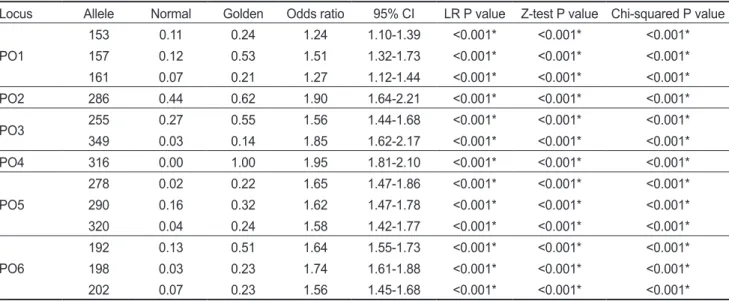
반면Table 4. Comparison of allele frequencies between normal and golden population of Paralichthys olivaceus
Locus Allele Normal Golden Odds ratio 95% CI LR P value Z-test P value Chi-squared P value
PO1
153 0.11 0.24 1.24 1.10-1.39 <0.001* <0.001* <0.001*
157 0.12 0.53 1.51 1.32-1.73 <0.001* <0.001* <0.001*
161 0.07 0.21 1.27 1.12-1.44 <0.001* <0.001* <0.001*
PO2 286 0.44 0.62 1.90 1.64-2.21 <0.001* <0.001* <0.001*
PO3 255 0.27 0.55 1.56 1.44-1.68 <0.001* <0.001* <0.001*
349 0.03 0.14 1.85 1.62-2.17 <0.001* <0.001* <0.001*
PO4 316 0.00 1.00 1.95 1.81-2.10 <0.001* <0.001* <0.001*
PO5
278 0.02 0.22 1.65 1.47-1.86 <0.001* <0.001* <0.001*
290 0.16 0.32 1.62 1.47-1.78 <0.001* <0.001* <0.001*
320 0.04 0.24 1.58 1.42-1.77 <0.001* <0.001* <0.001*
PO6
192 0.13 0.51 1.64 1.55-1.73 <0.001* <0.001* <0.001*
198 0.03 0.23 1.74 1.61-1.88 <0.001* <0.001* <0.001*
202 0.07 0.23 1.56 1.45-1.68 <0.001* <0.001* <0.001*
CI, confidence interval; LR, logistic regression. *Significant level at P<0.001.
Table 3. Genetic diversity at 6 microsatellite makers in golden population of Paralichthys olivaceus
Locus K N Ar Hobs Hexp PIC Fis Gene diversity HWE P value
PO1 5 109 5 0.49 0.62 0.56 0.22 0.62 0.001*
PO2 3 109 3 0.52 0.48 0.37 -0.10 0.48 0.404
PO3 7 109 7 0.63 0.61 0.55 -0.04 0.61 0.001*
PO4 3 109 3 0.86 0.51 0.38 -0.71 0.51 0.001*
PO5 8 109 8 0.99 0.77 0.72 -0.29 0.77 0.001*
PO6 6 109 6 0.84 0.63 0.57 -0.32 0.63 0.001*
Average 5.33 109 5.3 0.72 0.60 0.52 -0.21 0.60
K, number of alleles; N, sample size; Ar, allelic richness; Hobs, observed heterozygosity; Hexp, expected heterozygosity; PIC, Polymor- phism information content; Fis, inbreeding coefficients; HWE, Hardy-Weinberg equilibrium. *Significant level at P<0.001.
에양식집단은비교적적은수의일부개체만교배과정에참여 하며
,
시장성있는형질을보유한개체를선별하여산란에적극 적으로참여시키는선별육종의방법을이용하기때문에,
세대 를거듭하면서생산된종묘의유전학적조성이평형을벗어나 유전적부동(genetic drift)
이진행된다고판단된다(Dudgeon et al., 2006).
일반넙치 집단과 황금넙치 집단간의 대립유전자 빈도 분석
황금넙치의 체색과 관련된 마커의 대립유전자를 확인하기 위해서일반넙치집단과황금넙치집단간의대립유전자빈도 분석을실시하였다
(Table 4). PO2
마커와PO3
마커에서는각 각한개의대립유전자가유의적인차이를보였다. PO2
마커의
255
대립유전자는일반넙치집단과황금넙치집단에서각각0.44
그리고0.62
의빈도가나타났고,
교차비가1.90 (95% CI;
1.64-2.21)
로유의적인차이를보였다.
반면PO4
마커는대립 유전자수가각집단에서2
개또는3
개로나타났으며316
대립 유전자빈도는각각0
과1,
교차비가1.95 (95% CI; 1.81-2.10)
로분석에이용된모든황금넙치개체가
316
대립유전자를보유하고있었지만일반넙치는보유하고있지않았다
. PO4
는ty- rosinase
유전자와관련된마커로tyrosinase
는멜라닌생합성 기전의핵심적인 효소로써 색소침착과피부노화를 유발하는 중요인자로알려져있다(Wang et al., 2007; Cal et al., 2017).
또한
L-tyrosine (L-Tyr)
을L-3,4-dihydroxyphenylalanine (L- DOPA)
로, L-DOPA
를dopaquinone
으로변환하는촉매로작 용한다(Slominski et al., 2012; Almeida-Paes et al., 2017). Ty- rosinase
발현억제가사람과마우스의in vivo
및in vitro
연구에 서멜라닌생성을저해하는결과를나타냈다(Hartmann et al., 2009; Zolghadri et al., 2019).
본연구에서개발된
MS
마커는멜라닌합성과연관되어있 는유전자의intron
또는flanking region
에위치하는MS
를이 용하였다. PO2
와관련된Melanopsin A
는광반응메커니즘을 통해서빛을통한피부의색소침착을유발하는데,
주위환경 으로인해유도되는색소조절기전이다(Altimus et al., 2008;
Chen et al., 2011; Ruby et al., 2002). Pro-opiomelanocortin 1 (POMC)
는melanocyte
의tyrosinase
의발현을증가시키고,
POMC, MCH, MCHR1
으로이어지는신호전달기전을통해서
melanosome
의이동과멜라닌발현을조절한다(Rogers et al., 1997). PO1
마커와관련된melanoma differentiation-asso- ciated gene 5 (MDA5)
은melanocyte
에서발현량이높게유지되는것으로알려져있는데
, MDA5
의발현조절이정상적이지못할때
melanocyte
의증식과사멸을유도하여체색을변화시 킨다(Kang et al., 2004).
일반넙치와황금넙치의
tyrosinase
발현분석연구에서확인 된황금넙치의tyrosinase
발현감소결과(data not shown)
와본 연구결과를비교해볼때, PO4 316
대립유전자와발현조절의관련성에대해추가적인연구가필요하다고판단된다
. PO1, PO3, PO4, PO5
마커는2
개이상의대립유전자에서유의적인 차이를보였는데각대립유전자의교차비가PO1
마커161
대 립유전자의1.24 (95% CI 1.10-1.39)
부터PO3
마커349
대립 유전자의1.85 (95% CI; 1.62-2.17)
까지총11
개의대립유전자 에서통계적으로유의적인차이를확인하였다.
결론적으로본연구에서는황금넙치판별을위한특이적
MS
마커를개발하고자멜라닌합성과관련된6
개의유전자를이 용하여MS
마커를개발하였다.
개발된마커를이용하여일반 넙치집단과황금넙치집단을대상으로유전형을분석한결과, PO4
마커를제외하면충분한다형성이나타났으며,
각집단의 유전적특성을잘반영된결과를보였다.
그리고각마커에서일 반넙치와황금넙치를구분할수있는특정대립유전자군을확 보하였는데,
특히tyrosinase
와관련된PO4
마커의316
대립유 전자는황금넙치집단에서특이적으로보유하고있는것으로 확인하였다.
그러나본연구에서개발된마커는각각의유전형 에따른발현량의차이와기능적인평가가수행되지않았기에,
유전형과유전자의관련성에대한추가적인연구가필요하다.
본연구결과를이용하여황금색이발현되지않은치어의체색 발현을조기에예측하여양식과정에서소요되는제반비용을절 약할수있을것으로예상되며,
넙치체색연구를위한기초적인 자료를제공할수있을것으로판단된다.
사 사
이논문은해양수산부의재원으로농림식품기술기획평가원 의
Golden Seed Project
사업(213008-05-4-SB220)
의지원을 받아수행된연구이며연구비지원에감사드립니다.
References
Almeida-Paes R, Borba-Santos LP, Rozental S, Marco S, Zan- copé-Oliveira RM and da Cunha MML. 2017. Melanin bio- synthesis in pathogenic species of Sporothrix. Fungal Biol Rev 31, 50-59. https://doi.org/10.1016/j.fbr.2016.09.001.
Altimus CM, Güler AD, Villa KL, McNeill DS, LeGates TA and Hattar S. 2008. Rods-cones and melanopsin detect light and dark to modulate sleep independent of image formation.
Proc Natl Acad Sci U S A 105, 19998-20003. https://doi.
org/10.1073/pnas.0808312105.
Bohling J, Haffray P and Berrebi P. 2016. Genetic diversity and population structure of domestic brown trout Salmo trutta in France. Aquaculture 462, 1-9. https://doi.org/10.1016/j.
aquaculture.2016.04.013.
Cal L, Suarez-Bregua P, Cerdá-Reverter JM, Braasch I and Rotl- lant J. 2017. Fish pigmentation and the melanocortin sys- tem. Comp Biochem Physiol Part A Mol Integr Physiol 211, 26-33. https://doi.org/10.1016/j.cbpa.2017.06.001.
Chen SK, Badea TC and Hattar S. 2011. Photoentrainment and
pupillary light reflex are mediated by distinct populations of ipRGCs. Nature 476, 92-95.
Curran K, Lister JA, Kunkel GR, Prendergast A, Parichy DM and Raible DW. 2010. Interplay between Foxd3 and Mitf regulates cell fate plasticity in the zebrafish neural crest. Dev Biol 344, 107-118. https://doi.org/10.1016/j.yd- bio.2010.04.023.
Dudgeon D, Arthington AH, Gessner MO, Kawabata ZI, Knowler DJ, Lévêque C, Naiman RJ, Prieur-Richard AH, Soto D, Stiassny MLJ and Sullivan CA. 2006. Freshwater biodiversity: importance, threats, status and conservation challenges. Biol Rev 81, 163-182. https://doi.org/10.1017/
S1464793105006950.
Hartmann JT, Haap M, Kopp HG and Lipp HP. 2009. Tyrosine kinase inhibitors-a review on pharmacology, metabolism and side effects. Curr Drug Metab 10, 470-481. https://doi.
org/10.2174/138920009788897975.
Hwang JW and Myeong JI. 2010. An economic effect of the se- lective breeding program on the oliver flounder aquaculture.
J Fish Bus Adm 41, 113-128.
Jeong DS and Jeon CY. 2008. Genetic variability and popula- tion structure of olive flounder Paralichthys olivaceus from stocked areas using microsatellite DNA markers. Korean J Ichthyol 20, 156-162.
Jeong DS, Noh JK, Myeong JI, Lee JH, Kim HC, Park CJ, Min BH, Ha DS and Jeon CY. 2009. Genetic variability com- parison of wild populations and cultured stocks of flounder
Paralichthys olivaceus based on microsatellite DNA mark-
ers. Korean J Ichthyol 21, 221-226.Kadlec J. 1995. The xanthoric form of Aphyosemion australe Rachow, 1921. Freshwater Marine Aquarium 18, 72-78.
Kang DY, Kim HC, Kim JH, Kim KG and Myeong JI. 2007.
Effects of environment factors on the occurrence of pseudo- albinism in cultured flounder, Paralichthys olivaceus. Ko- rean J Fish Aquat Sci 40, 234-242. https://doi.org/10.5657/
kfas.2007.40.4.234.
Kang DC, Gopalkrishnan RV, Lin L, Randolph A, Valerie K, Pestka S and Fisher PB. 2004. Expression analysis and ge- nomic characterization of human melanoma differentiation associated gene-5, mda-5: a novel type I interferon-respon- sive apoptosis-inducing gene. Oncogene 23, 1789-1800.
Kang DY, Kim HC, Park KJ and Beak JM. 2016. Possible rel- evance of blind-side skin hypermelanosis in cultured olive flounders Paralichthys olivaceus to chronic stress. J Mar Biol 1, 56-62.
Kinnear PE, Jay B and Witkop CJ. 1985. Albinism. Surv Ophthalmol 30, 75-101. https://doi.org/10.1016/0039- 6257(85)90077-3.
KOSIS (Korean Statistical Information Service). 2019. The cur- rent fish culture by city and province, ward and county, by culture type by species. Retrieved from https://kosis.kr/eng/
on Nov 4, 2019.
Kuriiwa K, Hanzawa N, Yoshino T, Kimmura S and Nishida M. 2007. Phylogenetic relationships and natural hybridiza- tion in rabbitfishes (Teleostei: Siganidae) inferred from mi- tochondrial and nuclear DNA analysis. Mol Phyl Ecol 45, 69-80. https://doi.org/10.1016/j.ympev.2007.04.018.
Lamason RL, Mohideen MAP, Mest JR, Wong AC, Norton HL, Aros MC, Jurynec MJ, Mao X, Humphreville VR, Humbert JE, Sinha S, Moore JL, Jagadeeswaran P, Zhao W, Ning G, Makalowska I, McKeigue PM, O'donnell D, Kittles R, Parra EJ, Mangini NJ, Grunwald DJ, Shriver MD, Canfield VA and Cheng KC. 2005. SLC24A5, a putative cation exchang- er, affects pigmentation in zebrafish and humans. Science 310, 1782-1786. https://doi.org/10.1126/science.1116238.
Lee NS. 2006. A study on the distribution and consumption structure of aquacultural flatfish. J Fish Bus Admin 37, 61- Lin JY and Fisher DE. 2007. Melanocyte biology and skin pig-83.
mentation. Nature 445, 843-850. https://doi.org/10.1038/
nature05660.
Luo R, Liu B, Xie Y, Li Z, Huang W, Yuan J, He G, Chen Y, Qi P and Liu Y. 2012. SOAPdenovo2: an empirically improved memory-efficient shortread de novo assembler. Gigascience 1, 2047-217X-1-18.
Marshall TC, Slate J, Kruuk LEB and Pemberton JM. 1998. Sta- tistical confidence for likelihood-based paternity inference in natural populations. Mol Ecol 7, 639-655. http://dx.doi.
org/10.1046/j.1365-294X.1998.00374.x
Minchin JE and Hughes SM. 2008. Sequential actions of Pax3 and Pax7 drive xanthophore development in zebrafish neu- ral crest. Dev Biol 317, 508-522. https://doi.org/10.1016/j.
ydbio.2008.02.058.
Muto N, Noda T and Kai Y. 2013. First record of albinism in the rockfish Sebastes pachycephalus complex (Scorpaeni- formes: Scorpaenidae). Ichthyol Res 60, 195-197. https://
doi.org/10.1007/s10228-012-0320-0.
Nord H, Dennhag N, Muck J and von Hofsten J. 2016. Pax7 is required for establishment of the xanthophore lineage in zebrafish embryos. Mol Biol Cell 27, 1853-1862. https://doi.
org/10.1091/mbc.e15-12-0821.
Odenthal J, Rossnagel K, Haffter P, Kelsh RN, Vogelsang E, Brand M, van Eeden FJ, Furutani-Seiki M, Granato M, Hammerschmidt M, Heisenberg CP, Jiang YJ, Kane DA, Mullins MC, Nüsslein-Volhard C. 1996. Mutations affect- ing xanthophore pigmentation in the zebrafish, Danio rerio.
Development 123, 391-398.
Quigley DTG, de Carlos A, Barros-Garcia D and MacGabhann D. 2018. Albinism and leucism in blonde rays (Raja brachy-
ura Lafont, 1871) (Elasmobranchii: Batoidea) from the Irish
Sea. Bull European Assoc Fish Patholog 38, 79.Quigley DTG, Lord R, MacGabhann D and Flannery K. 2017.
First records of xanthochromism in three-bearded rockling
Gaidropsarus vulgaris (Cloquet, 1824) and pollack Polla-
chius pollachius (Linnaeus, 1758). J Appl Ichthyol 33 1208-
1210. https://doi.org/10.1111/jai.13456.Quigley DTG and MacGabhann D. 2018. An albino xantho- chromic spotted or homelyn ray (Raja montagui Fowler) from Irish waters. Bull European Assoc Fish Patholog 38, Rogers SL, Tint IS, Fanapour PC and Gelfand VI. 1997. Regu-109.
lated bidirectional motility of melanophore pigment gran- ules along microtubules in vitro. Proc Natl Acad Sci 8, 3720- 3725.
Ruby NF, Brennan TJ, Xie X, Cao V, Franken P, Heller HC and O'Hara BF. 2002. Role of melanopsin in circadian responses to light. Science 298, 2211-2213.
Shikano T. 2005. Marker-based estimation of heritability for body color variation in Japanese flounder Paralichthys oli-
vaceus. Aquaculture 249, 95-105. https://doi.org/10.1016/j.
aquaculture.2005.03.023.
Slominski A, Zmijewski MA and Pawelek J. 2012. L-tyrosine and L-dihydroxyphenylalanine as hormone-like regulators of melanocyte functions. Pigment Cell Melanoma Res 25, 14-27. https://doi.org/10.1111/j.1755-148X.2011.00898.x.
Song HY, Moon SJ, Kim KS and Bang IC. 2017. Genetic spe- cies identification by sequencing analysis of nuclear and mi- tochondrial genes for albino misgurnus species from korea.
Korean J Ichthyol 29, 139-145.
Veena S, Muktha M, Edward L, Uma Mahesh V, Rao MV, Megharajan S, Dhanraju K, Kumar MS, Moshe CH and Ghosh S. 2014. Leucism in seerfish Scomberomorus com-
merson, landed at landed at Chintapalli, Andhra Pradesh.
Mar Fish Infor Serv T E Ser 221, 13-13.
Veena S, Thomas S, Raje SG and Durgekar R. 2011. Case of leu- cism in the spadenorse shark, Scoliodon laticaudus (Muller and Henle, 1838), from Man galore Karnataka. Indian J Fish 25, 109-112.
Wang J, Hou L, Zhang R, Zhao X, Jiang L, Sun W, AN J and Li X. 2007. The tyrosinase gene family and albinism in fish.
Chin J Oceanol Limn 25, 191-198. https://doi.org/10.1007/
s00343-007-0191-9.
Zhou Y, Shu M, Zhao X and Zhu X. 2011. Microsatellite analy- sis on genetic diversity of wild and cultured populations of
Scylla paramamosain. Acta Agriculturae Zhejiangensis 23,
712-716. https://doi.org/10.3724/SP.J.1231.2011.17102g.Zolghadri S, Bahrami A, Hassan Khan MT, Munoz-Munoz J, Garcia-Molina F, Garcia-Canovas F and Saboury AA. 2019.
A comprehensive review on tyrosinase inhibitors. J Enzym Inhib Med Ch 34, 279-309. https://doi.org/10.1080/147563 66.2018.1545767.