Effects of Simulation Education with Problem-based Learning on Information Literacy, Self-directed Learning Ability, and Academic
Self-efficacy of Nursing Students
Ok-Hee Cho
1, Kyung-Hye Hwang
2*1
Associate Professor, Department of Nursing, Kongju National University
2
Associate Professor, Department of Nursing, Suwon Science College
문제중심학습기반 시뮬레이션 실습교육이 간호대학생의 정보활용능력, 자기주도적 학습능력, 학업적 효능감에
미치는 효과
조옥희1, 황경혜2*
1공주대학교 간호학과 부교수, 2수원과학대학교 간호학과 부교수
Abstract The objective of this study was to determine the effects of simulation education with problem-based learning (SIM-PBL) on information literacy, self-directed learning ability, and academic self-efficacy of nursing students. The subjects were 81 fourth-year nursing students attending a university in Chungcheongnam-do, Korea. SIM-PBL was provided once per week (150 minutes each) for four weeks, and a structured questionnaire was used to survey information literacy, self-directed learning ability, and academic self-efficacy before and after educational training. After completing the four-week program, abilities in the sub-items of information literacy, such as information integration (ṕ =.030), information expression (ṕ =.003), and information ethics (ṕ =.016) were improved.
However, no differences in self-directed learning ability and academic self-efficacy were noted. Findings confirmed that SIM-PBL is an effective teaching method for improving the information literacy of nursing students. Therefore, it is necessary to come up with an SIM-PBL education plan for utilizing reliable and useful information ethically.
Key Words : Education, Problem-based Learning, Information Literacy, Students, Nursing
요 약 본 연구의 목적은 SIM-PBL이 간호대학생의 정보활용능력, 자기주도적 학습능력, 학업적 효능감에 미치는 효과를 규명하기 위함이다. 대상자는 한국의 일개 대학교 간호학과 4학년 학생 81명이었다. SIM-PBL은 4주 동안, 주 1회(150분) 제공하였고, 교육 전후에 구조화된 설문지를 활용하여 정보활용능력, 자기주도적 학습능력, 학업적 효능감을 조사하였다.
교육 후에 정보활용능력의 하부영역 중 정보통합(ṕ =.030), 정보표현(ṕ =.003) 및 정보윤리(ṕ =.016) 영역의 능력이 향상되었다.
그러나, 자기주도적 학습능력과 학업적 효능감은 교육 후에 변화가 없었다. SIM-PBL은 간호대학생의 정보활용능력을 향 상시키는데 효과적인 교수법임을 확인하였다. 앞으로, 신뢰성 높은 유용한 정보를 윤리적으로 활용할 수 있도록 돕는 SIM-PBL 교육방안이 필요하다.
주제어 : 교육, 문제중심학습, 정보활용능력, 학생, 간호
*Corresponding Author : Kyung-Hye Hwang([email protected]) Received February 11, 2019
Accepted April 20, 2019
Revised March 13, 2019 Published April 28, 2019
1. Introduction
1.1. Background
In clinical practice, the necessary competencies of nursing students are autonomous education skills, leadership, knowledge, information management and literacy, interpersonal communication and teamwork, specialized values, and excellence in nursing practice [1].
Information literacy is the ability to search for necessary information and evaluate and summarize the information obtained to solve problems [2]; it also refers to the ability to integrate necessary information by recognizing, searching, and analyzing it to solve the health problems of patients [3,4].
Nurses must be able to perceive reliable and useful information among countless data and perform high-quality nursing tasks [1,5]. Information literacy is the basic ability to perform evidence-based nursing practices [6]. Previous studies have reported that problem-based learning and web-based programs are effective for improving information literacy [7,8].
In the undergraduate curriculum, nursing students’
self-directed learning abilities are advanced to the level of self-regulation and control by verifying and diagnosing learning resources, setting goals, performing, and evaluating [9]. Montenery argued that problem-based learning activities improved nursing students’ readiness for self-directed learning [10], and Jun, Cho, Park, and Kim stated that self-directed learning abilities improved as a result of nursing students’ learning plans and practices after simulation training related to the care of patients with cerebrovascular disease [11]. Self-directed learning and nursing practice competency seems to be positive correlation [12], therefore development for self-directed learning of nursing students is important to improve nursing practice competency.
Academic self-efficacy is a learner’s judgment about his or her ability to organize and practice actions necessary to perform a task [13], and it has been reported that nursing students with high levels of academic self-efficacy demonstrate considerable
confidence in clinical practice [14]. The higher academic self-efficacy, the better learning motivation and communication skill [15]. It can give self-confidence and efficacy of study in school life.
The curriculum to enhance information literacy, self-directed learning ability, and academic self-efficacy of nursing students is important, equipping them to collect, select, and use the latest specialized medical and health information systematically once they become nurses. The curriculum also enhances their confidence in actively performing evidence-based nursing.
Simulation education with problem-based learning (SIM-PBL) is an education method that links problem-based learning—which enables nursing students to solve clinical problems according to their own initiative and with the use of all kinds of information—
and realistic simulation training [16]. SIM-PBL is effective for practicing health assessments, clinical decision-making, nursing practicums, and communication skills, and it is a teaching-learning strategy that integrates student-led learning activities and performance-based assessment [17].
Previous studies reported that SIM-PBL for nursing students was effective in enhancing knowledge, decision-making skills, academic achievement [18-20], problem-solving skills, competency [17,21], meta-cognitive ability, and presence [22,23]. Previous study using simulation have reported improvement in clinical skill such as cardiopulmonary resuscitation and professional nursing knowledge.
Therefore, there is insufficient research to verify the effects on information literacy, self-directed learning ability, and academic self-efficacy.
1.2 Study purpose
The purpose of this study was to establish the
baseline data to promote simulation training programs
by determining the effects of SIM-PBL on the
information literacy, self-directed learning ability, and
academic self-efficacy of nursing students.
2. Study methods
2.1 Study design
This study was quasi-experimental, utilizing the pretest-posttest (one group) time series design to determine the effects of simulation training on the information literacy, self-directed learning ability, and academic self-efficacy of nursing students.
2.2 Setting and sample
To determine the effects of SIM-PBL, researchers for this study conducted a secondary analysis of variables not reported by Kim et al. [24] among the variables collected (communication anxiety, self -expression, self-efficacy in clinical practice, information literacy, self-directed learning ability, and academic self-efficacy). Subjects were selected by convenient sampling of fourth-year nursing students attending a university in Chungcheongnam-do, Korea.
The minimum required number of subjects was selected to verify the mean difference before and after training using G*POWER 3.1.9.2. With levels for significance at .05, for power at .95, and for effect size at .5 (medium size) as the standards, the minimum number of subjects necessary to maintain the predicted power was 54. Power was secured in this study by analyzing the data of 81 subjects who had completed at least 1,000 hours of regular clinical training and two credits for four sessions of simulation training in the second semester of the sophomore year.
Data were collected from September to December 2016, and the pretest involving research variables was conducted a week before the educational training began. An orientation was provided for students regarding the overall details of simulation training, and teams were formed by drawing lots. After that, the SIM-PBL module was presented to the subjects once per week (150 minutes) for four weeks. The posttest was conducted a week after completion of the training sessions.
2.3 Measures
2.3.1 Information literacy
Information literacy was measured using the tool developed by Lee and Nam [2]. This tool consists of information need, information search, information evaluation, information integration, information expression, and information ethics. A total of 39 items are rated on a 5-point Likert scale from Strongly disagree (1) to Strongly agree (5), with higher scores indicating higher levels of information literacy. In the study by Lee and Nam [2], Cronbach’s ɑ was .61–.86;
in this study, it was .65–.89 before educational training and .67–.92 afterward.
2.3.2 Self-directed learning ability
Self-directed learning ability was measured with the Korean version [25] of the self-directed learning readiness scale developed by Guglielmino [26]. This tool includes 58 items rated on a 5-point Likert scale from Strongly disagree (1) to Strongly agree (5), with higher scores indicating greater self-directed learning ability. In the study by Jeon [25], Cronbach’s ɑ was .61 –.86; in this study, it was .90 before the training sessions and .89 after completion.
2.3.3 Academic self-efficacy
Academic self-efficacy was measured using the Academic Self-Efficacy Scale developed by Kim and Park [13], for which the validity was tested. This tool includes 28 items rated on a 6-point Likert scale from Strongly disagree (1) to Strongly agree (6), with higher scores indicating higher academic self-efficacy.
In the study by Kim and Park [13], Cronbach’s ɑ was .74–84, whereas in this study, it was .80–91 before educational training and .85–.86 afterward.
2.4 Research procedures
2.4.1 SIM-PBL module development
For SIM-PBL, a simulation training module paired
with four problem-based learning scenarios was
developed for the topic of “hospitalization and nursing
before/after surgery of a patient with colorectal cancer (F/55, colostomy and enterostomy).”
In week 1 of training, the scenario and tasks for “the patient visiting the emergency room because of an abdominal health problem” were presented in the problem-based learning process; in the simulation training, the scenario of “the case of the patient with abdominal pain visiting the emergency room” was implemented. In week 2, SIM-PBL was undertaken for the scenario of “nursing the inpatient.” The scenario for week 3 was “nursing the patient before surgery,” and for week 4, it was “nursing the patient after surgery.”
The validity of the developed programs was tested by experts (three nursing professors with experience in SIM-PBL)(see Table 1).
Sub -ject
Admission, pre-and post-operation care of female colon cancer patient (55/F)
Wk (min)
Problem-Based Learning session (90min)
Simulation-based learning session practice (15min), debriefing (30min), rest (15min)
1wk (150)
PBL session on patient care in emergency room with abdominal health problem
Sim session on patient care in emergency room with abdominal health problem
2wk (150)
PBL session on admission care
Sim session on admission care 3wk
(150)
PBL session on pre-operation care
Sim session on pre-operation care
4wk (150)
PBL session on post-operation care
Sim-session on post-operation care
Conte nts
-Scenario, task presentation -Group task
problem discussion -Find scenario
-focused subjects -Establishing
nursing goal, a hypothesis
-Organizing priority-focus - ed nursing processes -Establishing nursing
planning for nursing problem-solving -Performing nursing inter
-ventions
-Summarize the whole process and the contents of the lesson -Present nursing student's
feelings
Table. 1. Simulation education integrated with problem-based learning module
2.4.2 SIM-PBL operation
As mentioned previously, this training program was conducted once a week for four weeks, with each
session lasting about 150 minutes. There were four classes, with each one divided into four teams. Each team consisted of five or six members.
The SIM-PBL was carried out with problem-based learning (90 minutes), simulation training (15 minutes), debriefing (30 minutes), and a break (15 minutes). The subjects were provided with “information use guidelines” that were to be studied thoroughly before training began. The guidelines included the use of reliable online data, citation of research articles, presentation of references, and contents about learning ethics. In problem-based learning activities, students were the main agents of each team, designated to deal with the task presented to solve the patient’s health problem according to the nursing process (assessment, diagnosis, planning/performance, evaluation). To perform the task, they could use textbooks, previous studies, and online data. Teams that completed problem-based learning were to proceed with simulation training. To minimize the effect of the experimenters, one instructor with experience in simulation training led the program.
2.5 Data analysis
The data collected were analyzed using SPSS/WIN 23.0. The general characteristics, information literacy, self-directed learning ability, and academic self-efficacy of the subjects were verified with real numbers, percentages, means, and standard deviations.
The differences between these variables before and after education were analyzed with a paired t-test.
3. Results
3.1 General Characteristics of Subjects
The subjects of this study were 81 nursing students
in their fourth year, and their average age was 22.4
(range: 21–28). There were 71 females (87.7%) and 10
male students (12.3%). For subjective academic
achievement, 15 (18.5%) students were evaluated as
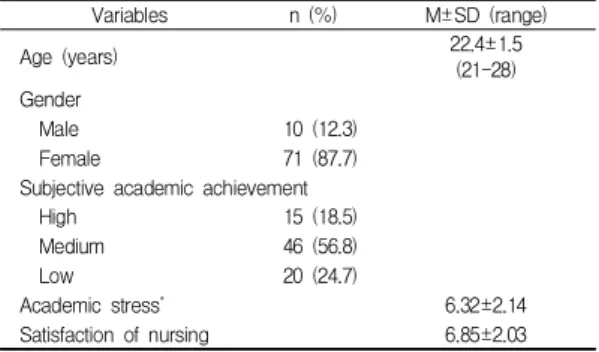
high; 46 (56.8%) students, medium; and 20 (24.7%) students, low. Academic stress received 6.32 (±2.14) points and satisfaction with nursing received 6.85 (±2.03) points (see Table 2).
Variables n (%) M±SD (range)
Age (years) 22.4±1.5
(21-28) Gender
Male 10 (12.3)
Female 71 (87.7)
Subjective academic achievement
High 15 (18.5)
Medium 46 (56.8)
Low 20 (24.7)
Academic stress* 6.32±2.14
Satisfaction of nursing 6.85±2.03
* Numeric Rating Scale (0-10)
Table 2. General Characteristics of Participants
(N=81)3.2 Effects of Simulation Training
The overall average of information literacy increased from 3.87 points before educational training to 4.02 points afterward (t = 2.57, p = .012). Among the sub-items, information literacy increased after completion
of the training program, as follows: information integration (t = 2.21, p = .030), information expression (t = 3.06, p = .003), and information ethics (t = 2.46, p
= .016). However, there was no significant change in self-directed learning ability and academic self-efficacy after completion of the program (see Table 3).
4. Discussion
Regarding the aim of this study to determine the effects of SIM-PBL on information literacy, self-directed learning ability and academic self-efficacy of nursing students, information literacy of nursing students increased after SIM-PBL, especially in terms of information integration, information expression, and information ethics among the sub-items. This finding is similar to the result of a previous study in which information literacy of Turkish nursing students increased after problem-based learning (relative to classroom learning)[27]. Furthermore, Williamson et al.
stated that simulation training can help improve technical competencies for evidence-based nursing [28].
Arthur et al. also supported this result by verifying that nursing students who participated in simulation training showed improvement in their ability to read the general flow of the situation and integrate information, their ability to apply required expertise immediately, and their ability to read and use information and medical device results [29]. If university students acquire information literacy, their ability to understand the ethical, legal, and socioeconomic issues of information may also improve [5].
In this study, it seemed that the preparatory learning activities such as searching for and using health information obtained through a website search and reviewing knowledge from the curriculum (major) obtained before SIM-PBL may have helped improve information literacy in terms of information integration.
Cho and Gu stated that nursing information literacy competency showed direct effects on problem solving ability [30]
Variables
Pre- education
Post-
education t p
M±SD M±SD
Information literacy 3.87±0.47 4.02±0.29 2.57 .012 Information need 3.91±0.64 4.01±0.56 1.42 .158 Information search 3.74±0.57 3.87±0.70 1.77 .081 Information
evaluation 3.83±0.59 3.94±0.71 1.54 .127
Information
integration 3.82±0.58 3.99±0.50 2.21 .030 Information
expression 3.90±0.72 4.17±0.77 3.06 .003
Information ethics 4.07±0.61 4.27±0.69 2.46 .016 Self-directed
learning ability 3.37±0.34 3.42±0.28 1.65 .103 Academic
self-efficacy 3.64±0.49 3.69±0.54 0.78 .436 Task difficulty
preference 3.29±0.79 3.38±0.67 1.40 .165
Self-regulatory
efficacy 3.85±0.62 3.95±0.62 1.63 .108
Self-confidence 3.83±0.74 3.73±0.83 -1.02 .311
Table 3. Differences after SIM-PBL education on
Information Literacy, Self-directed Learning Ability, Academic Self-efficacy
(N=81)