고추의 육성계통에 따른 Capsaicinoids와 Ascorbic Acid 분석
⁃연구노트⁃
정미리1․황 영2․김혜영B3․정헌상1․박지성4․박동복4․이준수1†
1충북대학교 식품공학과, 2농촌진흥청 국립농업과학원 농식품자원부 전통한식과
3용인대학교 식품영양학과, 4제일종묘 육종연구소
Analyses of Capsaicinoids and Ascorbic Acid in Pepper (Capsicum annum L.) Breeding Lines
Miri Jung1, Young Hwang2, Hae Young Kim3, Heong-Sang Jeong1, Jisung Park4, Dongbok Park4, and Junsoo Lee1†
1Dept. of Food Science and Technology, Chungbuk National University, Chungbuk 361-763, Korea
2Korean Food & Culture Division, Rural Development Administration, Gyeonggi 441-853, Korea
3Dept. of Food Science and Nutrition, Yong In University, Gyeonggi 449-714, Korea
4Jeil Seed Company, Chungbuk 368-812, Korea
Abstract
Peppers (Capsicum annuum L.) are a rich source of phytochemicals including polyphenolics, flavonoids, capsaicinoids and ascorbic acid. Capsaicinoids are a group of 12 or more related alkaloids responsible for the pungent sensation in the fruits of the genus Capsicum. Ascorbic acid is another functional and nutritional constituent of peppers. In this study, the contents of two major capsaicinoids (capsaicin and dihydrocapsaicin) and ascorbic acid in 131 pepper breeding lines were quantified by HPLC. In 131 pepper breeding lines, capsaicin and dihydrocapsaicin contents were in the range of 0.0 to 219.6 and 0.0 to 110.8 mg/100 g, respectively. The breeding lines with higher capsaicin content contained higher dihydrocapsaicin content as well. Ascorbic acid contents were 264.9 to 1695.5 mg/100 g for the 131 pepper breeding lines. The analytical method validation parameters including accuracy, repeatability, and reproducibility were calculated to ensure the method's validity.
This study provides basic information to plant breeders and biotechnologists who are planning to breed genotypes with high content of phytochemicals.
Key words: pepper, capsaicinoids, ascorbic acid, HPLC, breeding lines.
†Corresponding author. E-mail: [email protected]
†Phone: 82-43-261-2566, Fax: 82-43-271-4412
서 론
고추(Capsicum annuum L.)는 가지과(Solanaceae)에 속 하며 남미 유역이 원산지다. 한국인의 고추 소비량은 건고추 기준으로 4 kg에 이르며 이는 세계 최고 수준이다(1,2). 고추 는 400년 전에 국내로 도입되었고 이후 매운맛을 내는 대표 적인 향신 조미료로서 우리 식생활에서 중요한 위치를 차지 하고 있다(3,4). 과거 고추는 음식의 매운맛과 고추 특유의 붉은색을 내는 향신료로 주로 사용되어졌지만 최근 신체와 정신의 건강한 삶을 모방하는 ‘웰빙(well-being)’이 하나의 중요한 문화적 패턴으로 떠오르면서 고추의 생리활성 성분 과 그 활성에 관한 관심이 높아지고 있다. 고추는 고유의 매운맛뿐만 아니라 풍부한 색상과 단맛을 특징으로 하며 고 유 성분에 의한 기능적인 효과가 매우 크다(5).
고추에는 일반적으로 capsaicinoid, ascorbic acid, β- carotene, polyphenol, flavonoid 등의 생리활성 phyto-
chemical들이 존재하는 것으로 알려져 있다(6-9). 고추의 매 운맛의 주성분은 capsaicinoids라는 물질로, capsaicin, dihydrocapsaicin, nordihydrocapsaicin, homocapsaicin, homodihydrocapsaicin 등의 동족체로 구성되어있다. 이중 capsaicin과 dihydrocapsaicin이 매운맛의 주성분이다(10).
Capsacinoid는 항균작용, 통증완화 효과, 항암효과 및 항비 만 효과를 나타내는 것으로 보고되어 있다(11,12). Ascorbic acid는 고추 100 g당 220 mg으로 사과보다 50배, 귤보다는 2~3배로 다량 함유되어 있다(13). 이처럼 고추의 다양한 생 리작용이 밝혀지면서 고추에 대한 소비자의 수요가 증가하 는 추세로 소비 형태와 기호성이 다양해짐에 따라 고추도 그 요구에 부응하도록 육성하는 것이 절실히 필요하다. 따라 서 우수한 색상과 다양한 기능성을 가진 고추 품종을 위해 육성을 통한 품종개량 연구는 꾸준히 진행되고 있다(14,15).
그러나 각 품종에 따른 재배조건이나 고추의 외관 및 맛에 대한 특징은 보고되어 있으나 각 품종이나 육성계통
(breeding line)에 따른 고추의 기능성 성분에 관한 연구는 미비한 실정이다. 따라서 본 연구에서는 육성계통에 따른 131종 고추의 capsaicinoids와 ascorbic acid 함량을 분석하 였으며 이를 보고하고자 한다.
재료 및 방법
재료 및 시약
본 실험에 사용된 고추는 제일종묘에서 재배하여 수확하 였으며 재배관리는 표준재배에 준하여 관리하였다. 수확된 시료는 분석을 위해 고추의 꼭지 제거 후 과피를 2~3등분 절단하고 열풍건조기를 이용하여 건조하였으며 분쇄기를 이용하여 균질화한 뒤 -70oC에 보관하면서 분석에 사용하였 다. Capsaicinoids 측정에 이용된 표준물질은 capsaicin과 dihydrocapsaicin의 혼합물로 Fluka(St. Louis, MO, USA) 에서 구입하였으며 L-ascorbic acid와 그 밖에 사용된 시약 은 Sigma Chemical Co.(St. Louis, MO, USA)에서 구입하였 고, acetonitrile, methanol, water은 J.T. Baker(Phillipsburg, NJ, USA)로부터 HPLC 등급을 사용하였다.
Capsaicinoids 함량
Capsaicin 및 dihydrocapsaicin 함량은 Attuquayefio와 Buckle(16)의 방법을 변형하여 실행하였다. 동결 건조된 고 추시료 1 g을 acetonitrile 50 mL과 혼합하여 homogenizer (Ultra-Turrax T25, IKA Labortechnik Co., Staufen, Germany)로 2분간 교반하여 추출하였다. 균질화 후 100 mL mass flask에 깔대기를 놓고 Toyo No. 2 filter paper를 이용 하여 여과 후 acetonitrile로 정용하였다. 정용 후 2 mL을 0.45 μm membrane filter로 여과하여 HPLC(Jasco, Tokyo, Japan)로 분석하였다. HPLC 조건은 Luna 5 μ C18(2) 100A column(5 μm, 4.6×250 mm, Phenomenex Inc., Torrance, CA, USA)을 사용하였으며, fluorescence detector(Exλ=280 nm, Emλ=320 nm)를 이용하여 검출하였다. 이동상은 ace- tonitrile : water : glacial acetic acid(60:39:1, v/v/v)로 flow rate는 1.0 mL/min이며 시료의 일회 주입량은 20 μL이었다.
Ascorbic acid 함량
Ascorbic acid 함량은 Wang 등(17)의 방법을 변형하여 실행하였다. 건조된 시료 0.2 g에 3% metaphosphoric acid 용액 50 mL을 가하고 homogenizer로 2분간 균질화 시킨 후 100 mL mass flask에 3% metaphophoric acid로 정용하 였다. 정용 후 원심분리기를 이용하여 12,000 rpm(14,000×g) 에서 2분간 원심 분리하여 얻은 상등액 1 mL을 0.45 μm membrane filter로 여과하여 HPLC로 분석하였다. 컬럼은 CrestPak C18S(5 μm, 4.6×150 mm, Jasco)을 사용하였고 flow rate는 0.8 mL/min이었으며 이동상은 water : tri- fluoroacetic acid(99:1, v/v)를 사용하였다. 시료의 주입량은 20 μL였으며 UV detector를 사용하여 254 nm에서 측정하였다.
분석법의 검증
Capsaicinoid 및 ascorbic acid 표준용액을 시료에 spike하 고, 시료 전처리 과정에 따라 추출한 후 HPLC에 주입하여 얻은 피크 면적의 비를 이용하여 회수율을 구하였다. 분석법 의 반복성(repeatability)을 평가하기 위하여 하루 3반복 실 험을 실시하였으며 재현성(reproducibility)은 3일간 동일 실 험을 반복수행 하였다.
결과 및 고찰
Capsaicin 함량 및 dihydrocapsaicin 함량
고추의 맛 성분 중 가장 중요한 성분은 매운맛을 가진 지 용성 성분인 capsaicin(trans-8-N-vanillyl-6-nonenamide) 이며 한국산 고추의 매운맛은 capsaicin과 dihydrocapsaicin 에 기인한다고 보고되고 있다(18). 매운맛 정도에 따라 식품 소재로의 활용도가 다양하므로 미리 검토해야하는 품질 특 성으로 capsaicin과 dihydrocapsaicin을 분석하였다. 육성계 통 고추의 capsaicinoids 함량은 Table 1에 나타내었다. 선행 연구에서 국산 고추 47종의 capsaicinoids 분석 결과, 10.5~
250.9 mg/100 g의 값을 갖으며 47품종 중 85% 이상이 100 mg/100 g 이하의 capsaicinoids 함량을 갖는 것으로 보고하 였다(19). 또 다른 연구에 의하면 국내산 고춧가루의 cap- saicin 함량은 3~33 mg/100 g의 범위이며(20), capsaici- noids의 함량이 7.0~57.4 mg/100 g으로 매우 광범위하다고 보고하였다(21). 본 연구에서 분석한 고추의 capsaicinoids 분석 결과는 0.0~219.6 mg/100 g으로 나타났다. Capsaicin 의 평균 함량은 29.0 mg/100 g이었으며 dihydrocapsaicin은 15.8 mg/100 g의 함량을 나타내어 선행 연구결과와 유사한 분석치를 나타내었다. 또한 분석시료 중 No. 2687이 cap- saicin 함량 219.6 mg/100 g, dihydrocapsaicin 함량 110.8 mg/100 g으로 가장 높게 분석되었다. Capsaicinoid 함량의 빈도 분포도를 분석해 본 결과 본 연구에서 분석된 육성계통 고추 대부분이 40 mg/100 g 이하의 함량을 나타내는 것을 알 수 있었다(Fig. 1).
Ascorbic acid 함량
Ascorbic acid는 고추의 대표적인 수용성 비타민 및 항산 화 성분으로 본 연구에서 HPLC로 분석한 육성계통 고추의 ascorbic acid 함량은 Table 1에 나타내었다. 분석 결과 ascorbic acid 함량은 264.9 mg/100 g에서 1695.5 mg/100 g으로 넓은 분포 범위를 보였다. 평균값은 809.8 mg/100 g이 었으며 분석시료 중 No. 2524가 ascorbic acid 함량 1695.5 mg/100 g으로 가장 높은 함량을 보였고 No. 2687이 264.9 mg/100 g으로 가장 낮게 분석되었다. Choi(22)는 한국산 고 추의 ascorbic acid를 분석한 결과에 의하면 평균 84.07 mg/100 g(fresh weight) 함량을 갖는 것으로 보고하였다.
또한 Kye 등(23)의 HPLC를 이용한 ascorbic acid의 분석 결과는 63.4 mg/100 g 수준으로 보고하였으며 본 연구의
Table 1. Contents of capsaicinoids in pepper (Capsicum annum L.) breeding lines B.L4) Capsaicinoids1)
AsA2),7) B.L Capsaicinoids
AsA B.L Capsaicinoids
AsA B.L Capsaicinoids
C5) DHC6) C DHC C DHC C DHC AsA
2412-1 2413 5332 5312 3201 2408-1
5326 2519 3212 2404 3216 2505 2561 3233 1368 5314 2469 1382 2147 2554 2486 2509 4423 3220 5335 4438 2514 5185-1
2474 3232 5323 2518 3152 3151
17.293) 18.97 0.33 10.15 86.75 0.24 0.23 0.16 21.96 109.53 42.12 0.54 0.52 3.31 141.86 13.10 33.65 47.64 9.74 15.00 0.02 0.03 149.10 0.08 12.90 14.48
0.29 0.20 63.48 0.33 0.40 0.28 108.83 24.61
19.86 14.30 0.25 6.08 49.65 0.06 0.00 0.03 10.63 42.88 18.67 0.20 0.16 1.50 93.17 6.09 32.81 17.75 5.15 10.70 0.03 0.02 55.09 0.02 7.56 8.99 0.10 0.03 19.48 0.04 0.05 0.16 38.15 8.14
632.31 570.40 743.72 762.26 279.13 480.71 919.86 652.40 518.40 388.91 368.44 531.79 409.57 310.92 607.73 575.28 498.52 382.24 339.65 617.56 946.86 623.42 425.09 1320.80 1179.60 967.04 575.70 1302.90 718.81 1117.13 1344.51 827.72 866.50 866.50
5333 4432 3214 2501 1310 2523 1327 4283 2689 3150 3222 2513 2546 1874 2042 2418 2508 5317 2550 2401 2458 2476 3205-1 1762-1 5322 5316 1270 2528 2427 2500 2524 4021 5336 2421
0.17 43.86 0.33 0.07 17.61 0.33 18.66 28.11 0.17 6.06 75.73 12.01 85.68 169.62 43.80 4.78 23.35 0.42 197.58 61.40 16.04 0.27 30.58 47.85 0.46 7.90 7.55 0.08 0.17 1.65 1.52 7.60 19.99 14.15
0.07 19.13 0.43 0.00 12.30 0.22 20.46 22.37 0.15 1.98 41.79 9.72 35.41 102.75 16.24 1.74 19.85 0.20 97.77 40.69 12.30 0.08 19.63 16.89 0.30 4.27 6.54 0.00 0.11 2.32 0.91 10.13 12.63 7.84
916.50 754.71 716.30 1199.60 860.29 1479.28 923.01 1013.34 584.88 839.95 994.60 911.24 603.03 823.45 1055.09 820.47 1102.00 1056.52 751.17 528.07 671.75 1092.44 824.99 997.31 841.35 960.53 1037.93 735.21 939.89 514.66 1695.52 666.89 1016.58 824.73
2433 1760-3
2549 2545 2537 2483 3889-1
2456 2471 2416 3217 2415 3224 2472 4328 1271 2409 5330 2533 3203 2470 1214 2455 2485 5321 4413 5331 2521 2516 5329 2548 2468 2520 5319
16.16 7.90 135.61 172.81 0.98 0.17 0.05 96.09 7.59 7.14 10.31 6.72 0.09 34.53 6.39 7.65 2.27 32.04 110.86 16.61 59.57 3.68 34.71 0.17 2.97 8.54 0.02 0.00 0.00 0.00 5.38 5.80 0.02 0.00
7.48 4.40 109.26 60.12 0.66 0.00 0.00 49.05 4.58 3.84 10.41 7.69 0.07 14.41 6.85 4.69 1.45 27.63 67.78 15.67 32.66 2.75 26.03 0.03 1.51 3.11 0.00 0.02 0.00 0.00 3.32 4.17 0.05 0.00
1078.88 1201.37 796.63 504.87 645.07 701.31 1421.06 610.43 783.92 625.44 540.96 559.74 840.79 819.84 424.59 881.63 646.41 955.79 851.58 800.53 292.09 757.01 662.50 422.19 751.14 502.93 993.34 1468.42 818.28 1211.67 671.75 711.21 959.47 1347.56
2531 2497 2536 3211 2417 3943 1367 2541 2484 2481 2685 2512 3206 4429 2557 5337 3228 3218 2690 2473 2482 5315 1915 2522 2687 5327 2411 3213 3731 Max Min Mean
67.93 0.16 61.91 47.83 51.29 125.16 18.69 30.88 0.46 0.07 23.95 0.18 1.30 35.11 95.99 5.78 0.50 17.64 0.12 157.81 0.94 0.59 13.79 0.56 219.59 0.05 87.74 35.94 9.13 219.59 0.00 28.99
26.01 0.06 29.91 43.40 41.85 80.93 10.21 9.17 0.16 0.03 9.53 0.04 0.84 21.89 55.38 2.52 0.06 10.85 0.05 48.29 0.14 0.35 9.48 0.57 110.83 0.06 55.68 13.41 8.94 110.83 0.00 15.77
880.54 722.09 755.05 782.17 632.92 891.19 786.65 630.54 738.90 821.45 1127.63 1169.76 1310.58 914.38 754.67 756.74 717.07 850.50 1019.66 637.02 867.98 849.17 837.07 1028.73 264.91 1427.06 915.25 680.16 623.74 1695.52 264.91 809.77
1)Contents expressed as mg/100 g sample as dry weight basis.
2)Contents expressed as mg/100 g sample as dry weight basis.
3)All samples were assayed in duplicates.
4)B.L: breeding lines. 5)C: capsaicin. 6)DHC: dihydrocapsaicin. 7)AsA: ascorbic acid.
Capsaicinoids (mg/100g)
~40 ~80 ~120 ~160 ~200 ~240
Number of lines
0 50 100 150 200 250
Capsaicin Dihydrocapsaicin
Fig. 1. Frequency distribution of capsaicin and dihydrocap- saicin contents in pepper (Capsicum annum L.) breeding lines.
Ascorbic acid (mg/100g)
~500 ~700 ~900 ~1100 ~1300 ~1500 ~1700
Number of lines
0 10 20 30 40 50
Ascorbic acid
Fig. 2. Frequency distribution of ascorbic acid contents in pepper (Capsicum annum L.) breeding lines.
분석치와 상당한 차이를 나타내었다. 이는 고추에 함유된 ascorbic acid 함량은 품종 간의 변이뿐만 아니라 재배 지역
의 기후 및 토양조건, 재배시기, 저장 조건의 차이에서 비롯 되는 것으로 생각된다(5,22,24). 131종의 육성계통 고추에 존
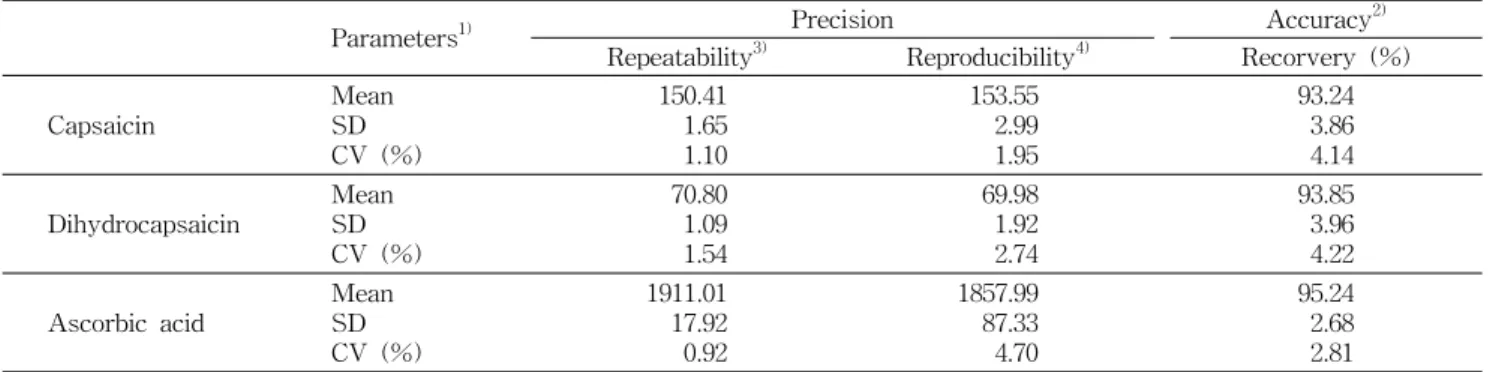
Table 2. Precision and accuracy of the methanol extraction method
Parameters1) Precision Accuracy2)
Repeatability3) Reproducibility4) Recorvery (%)
Capsaicin
Mean SD CV (%)
150.41 1.65 1.10
153.55 2.99 1.95
93.24 3.86 4.14 Dihydrocapsaicin
Mean SD CV (%)
70.80 1.09 1.54
69.98 1.92 2.74
93.85 3.96 4.22
Ascorbic acid
Mean SD CV (%)
1911.01 17.92 0.92
1857.99 87.33 4.70
95.24 2.68 2.81
1)Mean, n=3 (mg/100 g); SD, standard deviation; CV, coefficient of variation.
2)A measure of the closeness of the analytical result to value evaluated by analyzing a spike sample.
3)Refers to the results of independent determinations carried out on a sample by analyzing 3 replicates of the sample on the same
4)day.
Refers to the results independent determination carried out a sample by analyzing 3 replicates of the sample at periods of time.
재하는 ascorbic acid 함량 분포도는 Fig. 2에 나타내었으며 분포도에서 보는 것처럼 80% 이상이 500에서 1100 mg/100 g 사이의 함량 분포를 보였다(Fig. 2).
분석 방법의 검증
Capsaicinoids와 ascorbic acid의 회수율은 모두 90% 이 상으로 우수하였으며 또한 capsaicinoids 및 ascorbic acid의 반복성과 재현성의 CV(coefficients of variation)는 모두 5%
이하로 우수하였다(Table 2).
요 약
본 연구에서는 130여종의 육성계통 고추의 capsaicinoids 와 ascorbic acid 등의 기능성 성분의 함량을 분석함으로써 부가가치 높은 우수 고추 품종 개발을 위한 database를 제공 하고자 하였다. Capsaicinoids 및 ascorbic acid 분석을 위해 역상 HPLC를 이용하였다. 연구 결과 capsaicin의 평균함량 은 29.0 mg/100 g, dihydrocapsaicin은 15.8 mg/100 g으로 나타났으며 ascorbic acid의 평균 함량은 809.8 mg/100 g이 었다. 육성계통 고추 No.2687의 capsaicin 함량은 219.6 mg/100 g, dihydrocapsaicin 함량은 110.8 mg/100 g으로 가 장 높게 분석되었으나 ascorbic acid 함량은 264.9 mg/100 g으로 가장 낮게 분석되었다. 또한 육성계통 고추 No. 2524 가 ascorbic acid의 함량이 1695.5 mg/100 g으로 가장 높았 으나 capsaicinoid 함량은 평균 이하로 낮게 나타났다. 분석 방법을 검증하기 위해 재현성, 반복성 및 회수율을 구하였으 며 그 결과 재현성과 반복성의 CV는 5% 이하였으며 회수율 은 90% 이상으로 우수하였다. 본 연구 결과는 고추의 육성 계통별 기능성 성분의 함량을 분석하고 그 결과를 토대로 우수품종 개발을 위한 기초자료를 제공함에 그 의의가 있다.
감사의 글
본 연구는 농촌진흥청의 연구비 지원(과제번호
PJ0075242010)에 의해 수행되었으며 이에 감사드립니다.
문 헌
1. Cho YS, Cho MC, Suh HD. 2000. Current status and proj- ects of national hot pepper industry in Korea. J Korean Capsicum Res Coop 6: 1-27.
2. Park JB, Lee SM, Kim S. 2000. Capsaicinoids control of red pepper powder by particle size. J Korean Capsicum Res Coop 6: 51-62.
3. Kang IH. 1983. Hankook Shiksenghwalsa. Samyongsa, Seoul, Korea. p 190.
4. Park CR, Lee KJ. 1975. A study on the influence of drying methods upon the chemical change in red pepper, part 2, changes of free amino acid, free sugar. Korean J Nutr 8:
27-31.
5. Kim S, Kim KS, Park JB. 2006. Changes of various chem- ical components by the difference of the degree of ripening and harvesting factors in two single-harvested peppers (Capsicum annuum L.). Korean J Food Sci Technol 38:
615-620.
6. Lee SW. 1979. Gas liquid chromatographic studies on sug- ars and organic acid in different portions of hot pepper fruit (Capsicum annuum L.). Korean J Food Sci Technol 11:
278-282.
7. Kawaguci Y, Ochi T, Takaishi Y, Kawazoe K, Lee KH.
2004. New sesquiterpenes from Capsicum annuum L. J Nat Prod 67: 1893-1896.
8. Davis BH, Mathews S, Kirk JTO. 1970. The nature and biosynthesis of the carotenoids of different colour varieties of Capsicum annuum L. Phytochemistry 9: 797-800.
9. Materska M, Piacente S, Stochmal A, Pizza C, Olezek W, Peruka I. 2003. Isolation and structure elucidation of fla- vonoid and phenolic acid glycosides from pericarp of hot pepper fruit Capsicum annuum L. Phytochemistry 63:
893-898.
10. Chiang GH. 1986. HPLC analysis of capsaicins and simulta- neous determination of capsaicins and piperine by HPLC- ECD and UV. J Food Sci 51: 499-505.
11. Zhang WY, Po ALW. 1994. The effectiveness of topically applied capsaicin. Eur J Clin Pharmacol 46: 517-522.
12. Mori A, Lehman S, O'kelly J, Kumagai T, Desmond JC, Pervan M, McBride WH, Kizaki M, Koeffler P. 2006.
Capsaicin, a component of red pepper, inhibits the growth
of androgen-independent, p53 mutant prostate cancer cells.
Cancer Res 66: 3222-3229.
13. Howard LR, Smith RT, Wagner AB, Villalon B, Burns EE, 1994. Provitamin A and ascorbic acid content of fresh pep- per cultivars (Capsicum annuum L.) and processed jalapeños. J Food Sci 59: 362-365.
14. Topuz A, Ozdemir F. 2007. Assessment of carotenoids, cap- saicinoids and ascorbic composition of some selected pepper cultivars (Capsicum annuum L.) grown in Turkey. J Food Compos Anal 20: 596-602.
15. Deepa N, Kaur C, George B, Singh B, Kapoor HC. 2007.
Antioxidant constituents in some sweet pepper (Capsicum annuum L.) genotypes during maturity. Food Sci Technol 40: 121-129.
16. Attuquayefio VK, Buckle KA. 1987. Rapid sample prepara- tion method for HPLC analysis of capsaicinoids in capsicum fruits and oleoresins. J Agric Food Chem 35: 777-779.
17. Wang HF, Tsai YS, Lin ML, Ou AS. 2006. Comparison of bioactive components in GABA tea and green tea produced in Taiwan. Food Chem 96: 648-653.
18. Shin HH, Lee SR. 1991. Quality attributes of Korean red pepper according to cultivars and growing areas. Korean J Food Sci Technol 23: 296-300.
19. Kim S, Park JH, Wang IK. 2002. Quality attributes of vari- ous varieties of Korean red pepper powders (Capsicum annuum L.) and color stability during sunlight exposure.
J Food Sci 67: 2957-2961.
20. Park JS, Kim MH, Yu RN. 1999. Approximative study of nutrients and intakes determined from capsaicin contents in powdered soups of Korean instant noodles and hot pepper. J Korean Soc Food Sci Nutr 28: 501-504.
21. Chai JY, Kim MS, Han IK, Lee SY, Yeo IH. 1994. Relation- ships between the content and sensory evaluation of pun- gent principles in red pepper. J Korean Soc Anal Sci 7:
541-545.
22. Choi SH. 2006. Ascorbic acid of Korean pepper by cultivat- ing season, region and cooking method. J East Asian Soc Dietary Life 16: 578-584.
23. Kye SH, Lee JD, Paik HY. 1993. Analysis of ascorbic acid contents in raw, processed and cooked foods by HPLC. J Korean Home Assoc 31: 201-208.
24. Cho BC, Park KW, Kang HM, Lee WM, Choe JS. 2004.
Correlationship between climatic elements and internal characteristics of red pepper fruit in different growing periods. J Bio-Env Con 13: 67-72.
(2010년 6월 14일 접수; 2010년 11월 8일 채택)