157
for Marine Environment and EnergyVol. 18, No. 3. pp. 157-165, August 2015
Original Article
원자력발전소의 온배수 배출해역에서 대형 저서동물 군집구조의 차이
맹준호1 · 김근용2,† · 김영윤2 · 손명백3 · 김진희2 · 손민호2
1
한국환경정책·평가연구원
2
해양생태기술연구소
3
한국선급
Difference in Macrobenthic Community Structures at Thermal Effluent Discharge Areas of Two Nuclear Power Plants in Korea
Jun-Ho Maeng1, Keun-Yong Kim2,†, Young Ryun Kim2, Myung Baek Shon3, Jin Hee Kim2 and Min Ho Son2
1
Korea Environment Institute, Sicheong-daero, Sejong 399-007, Korea
2
Marine Eco-technology Institute Co., Ltd., Nam-gu, Busan 680-830, Korea
3
Korean Register, Gangseo-gu, Busan 618-814, Korea
요 약
본 연구는 고리원자력발전소와 신고리원자력발전소로부터 배출되는 온배수의 영향을 받는 해역에서 퇴적물 특성과 대형 저서동물의 군집구조를 조사하고 비교하였다. 두 배출해역의 퇴적물 특성들 중에서 모래와 펄, 유기물의 함량 이 통계적으로 유의한 차이를 보였다. 대형 저서동물의 출현종과 개체 수는 고리원자력발전소보다 신고리원자력발 전소의 배출해역에서 더 많았으며, 그 수는 이전의 다른 연구결과들과 유사한 수준이었다. 두 원자력발전소의 온배 수 배출해역은 퇴적물 특성과 대형 저서동물의 출현종 수에서 유의한 차이를 보였다.
Abstract − This study investigated and compared sediment properties and macrobenthic community structures within heated effluent plumes at the discharge areas of Kori Nuclear Power Plant (KNPP) and Sinkori Nuclear Power Plant (SNPP) in Korea, which have different thermal effluent discharge systems. There were significant differences in sand, clay and organic carbon contents between sediments at the two discharge areas. Species richness and abundance of macrobenthos were higher at the SNPP discharge area than at that of the KNPP, although the values at both areas were comparable to previous studies in coastal areas of eastern Korea.
Keywords: Discharge system(배출방식), Macrobenthos(대형 저서동물), Nuclear power plant(원자력발 전소), Sediment properties(퇴적물 특성), Thermal effluent(온배수)
1. Introduction
Benthic organisms are capable of actively responding to physicochemical variables in aquatic environments, and their spatial and temporal distributions are largely influenced by sed- iment properties such as sediment particle sizes and organic carbon contents (Gray[1974]; Pearson and Rosenberg[1978];
Weston[1990]). Their distribution and community structure are highly affected by various human activities including logging, mining, reclamation, dredging, dumping, water pollution, oil spills, fishing, fish farming and so forth (Gray[1997]; Pearson and Rosenberg[1978]; Thrush and Dayton[2002]; Weston[1990]).
In addition, altered temperatures via thermal pollution by fos- sil-fuel and nuclear power plants have potentials to affect phys- iological processes of all aquatic life forms and thus have caused great concerns in residents and fishermen of affected areas
†
Corresponding author: [email protected]
(Krishnakumar et al.[1991]).
Kori Nuclear Power Plant (KNPP), constructed in 1978, was the first large-scale nuclear power plant in Korea (Fig. 1). Com- posed of four turbines, it uses 5.1 billion tons of coastal seawater per year as condenser coolant and directly discharges heated effluent onto sea surface (KHNP[2013]). This discharge system has been widely adopted by most thermal power plants in Korea because of its economic feasibility (GESAMP[1984]); however, it has caused considerable public concerns and debates on prob- able adverse effects on coastal ecosystems. Sinkori Nuclear Power Plant (SNPP), constructed in 2012, has four turbine gen- erators and uses 2.8 billion tons of coastal seawater per year (Fig. 1). In an effort to minimize environmental impacts associated with heated effluent, it adopted a novel outfall design where heated effluent goes through pipe lines submerged into seabed and discharges through diffusers at 15-20 m depth into overlying water column (KHNP[2013]). This discharge system is expected to mitigate ecological disturbance by rapid dilution and heat dispersal of effluent through mixing with underwater currents.
As a result, the extent of heated effluent plume at the SNPP discharge area is much narrower than that at the KNPP (Fig. 1).
In this study, we compared sediment properties and macro- benthic community structures at the thermal effluent discharge areas of KNPP and SNPP. This study will provide baseline data that will improve not only our understanding of the ecological
effects of thermal effluent, but also our ability to take effective conservation measures in the impacted areas.
2. Materials and methods
2.1 Sediment sampling
Study areas for KNPP and SNPP were limited to areas with a delta temperature (∆t) of 3
oC, which indicates a 3
oC increase in seawater temperature caused directly by heated effluent plumes (Fig. 1). Sediment samples were collected from each of 21 stations in soft bottoms at the two discharge areas between June 11-13, 2013 (Fig. 1), after considering the tide which had considerable effects on thermal plumes. Roughly 30 g of surface sediment was collected with a van Veen grab sampler (surface area: 0.1 m
2). To analyze macrobenthic community structure, two- replicate samples were collected and pooled together (total area: 0.2 m
2). Fine sediment particles were removed with a 1-mm metal sieve, and the remaining sample was fixed with 10% neutral- ized formalin. Fixed samples were kept in watertight plastic bags and transported to the laboratory on ice in a cooler.
2.2 Sediment properties
To analyze sediment texture and type, sediment samples were air-dried and pretreated with boiling sodium acetate (NaCH
3CO
2) to remove carbonates and with hydrogenperox- ide (H
2O
2) to oxidize organic matters. Pretreated samples were sieved using 0.062-mm metal mesh (phi scale, ϕ = 4). Sandy particles retained on the sieve were separated according to the phi scale using a Roe-tap sieve shaker for 15 min (Ingram[1971]), and the resulting filtrate was analyzed using the pipette method of McBride[1971]. Sediment texture and type were classified according to Folk[1968] and Folk and Ward[1957], respectively.
Organic carbon content was determined according to San- tisteban et al.[2004]. About 5 g of each sediment sample was placed in a preweighed porcelain crucible and dried at 105
oC for 24 h in a drying oven. After cooling to room temperature, sample weight was measured using an analytical balance (Adventurer
™, Ohaus Co., Pine Brook, NJ, USA). Dried samples were then ignited in a muffle furnace at 550 °C for 30 min and weighed after cooling to room temperature in a desiccator. Percent organic carbon was calculated as the sediment weight lost after ignition com- pared with before.
2.3 Macrobenthic community structure
Macrobenthic community structure at each discharge area was examined by delicately separating each fixed sediment sample Fig. 1. Two study areas showing sampling stations at the thermal effluent
discharge areas of Kori Nuclear Power Plant (KNPP), which has the
surface discharge system, and Sinkori Nuclear Power Plant (SNPP),
which has the submerged discharge system. All sampling stations are
located within the heated effluent plume of delta 3
oC.
into aquatic organisms and sediment particles under a magnifying lens or stereomicroscope (SZ51, Olympus, Japan). The organisms were identified to the lowest possible taxonomic level. Macro- benthic species richness of each station was determined as the number of species residing on and in the sediment and expressed by the sampling volume (species 0.2 m
-2).
Abundances were determined by the number of individuals of each species from each station. Total pooled biomass of all organisms was measured after removing as much water as pos- sible by blotting with a paper towel. Abundance and biomass were converted to the number of individuals per square meter (ind. m
-2) and wet weight gram per square meter (ww g m
-2), respectively.
In addition, to evaluate the health status of these macroben- thic assemblages, the Benthic Pollution Index (BPI) (Choi et al.
[2003]) and Azti’s Marine Biotic Index (AMBI) (Borja et al.
[2003]) were calculated based on species abundance.
2.4 Statistical analysis
Macrobenthic communities at the KNPP and SNPP discharge areas were compared with a nonparametric Mann Whitney’s U-test using SPSS software for Windows ver. 12.0 (SPSS Inc., Chi- cago, IL, USA). For multivariate analysis, square root transfor- mation of the abundance data of macrobenthic fauna was applied.
Cluster analysis and non-metric multidimensional scaling (nMDS) ordination based on the Bray-Curtis similarity matrix were per- formed using the PRIMER software ver. 5.0 (Clark and War- wick[1994]).
3. Results
3.1 Sediment properties
Sediment textures at the KNPP and SNPP discharge areas are shown in Table 1. At the discharge area of KNPP, gravel content ranged from 0.0-41.1% [6.5 ± 9.5% (mean ± SD)], while sand was
11.8-93.6% (47.6 ± 29.9%), silt was 0.1-37.3% (19.4 ± 15.3%) and clay was 0.1-48.2% (26.5 ± 19.5%). Their mean particle size (ϕ) at KNPP was 4.3 ± 3.2. At the SNPP discharge area, gravel content ranged from 0.0-15.1% (4.0 ± 3.8%), sand was 33.4- 94.9% (70.0 ± 17.0%), silt was 0.1-27.1% (11.4 ± 8.1%) and clay was 0.1-39.5% (14.7 ± 10.9%). Their mean particle size (ϕ) at SNPP was 3.1 ± 1.7. Overall, sediment composition was similar between the two discharge areas, with sand comprising the majority of each area, followed by clay, silt and gravel. However, the SNPP dis- charge area had significantly higher sand content (70.0% vs.
47.6%) and lower clay content (14.7% vs. 26.5%) than the KNPP (both P < 0.05).
Spatial distribution patterns of the sediment types (Folk[1968]) at the KNPP and SNPP discharge areas are shown in Fig. 2. Sed- iment samples were divided into four types: sand, muddy sand, sandy mud and clayey sand. Samples from KNPP (n = 21) were predominantly sandy mud (n = 12), followed by sand (n = 7), muddy sand (n = 1) and clayey sand (n = 1). In contrast, sediment samples from SNPP (n = 21) were mostly muddy sand (n = 15), followed by sand (n = 5) and sandy mud (n = 1). At both KNPP and SNPP, sandy sediment was typically found at stations proximal to the outfalls under the direct physical influence of discharged effluent, and both sandy mud and muddy sand were found distal to the outfall.
Organic carbon content was significantly higher at the KNPP discharge area (range: 2.6-8.7%; mean ± SD: 4.9 ± 1.5%) than that at the SNPP (2.2-6.2%; 3.9 ± 1.0%) (Table 1; P < 0.05).
3.2 Macrobenthic community structure
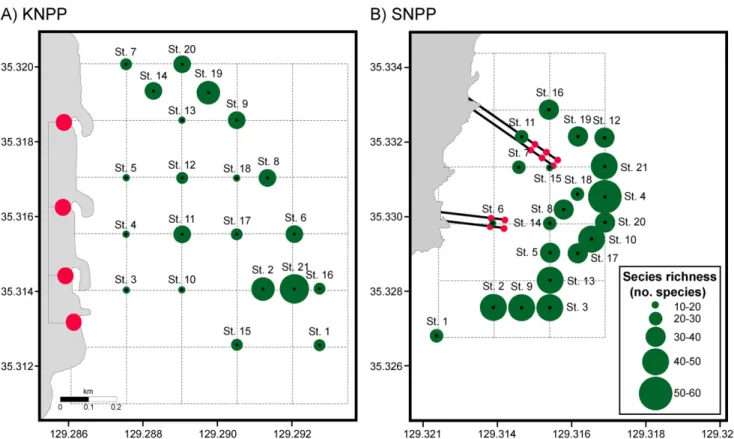
Species richness, abundance and biomass of macrobenthos at the thermal effluent discharge areas of KNPP and SNPP are compared in Table 2. Species richness at the KNPP discharge area ranged from 5 to 52 species (St. 3 and 21, respectively), with a mean of 27 ± 12 species. A total of 153 species were found in the KNPP discharge area, of which abundances ranged from 50 to 1,517 (St. 3 and 2, respectively) with a mean of 743 ± 380 ind. m
-2. Table 1. Sediment texture, composition and organic content [minimum-maximum values (mean ± standard deviation)] at the thermal effluent discharge areas of Kori Nuclear Power Plant (KNPP) and Sinkori Nuclear Power Plant (SNPP) (n = 21)
Variable KNPP SNPP P value
Water depth (m) 13.0–27.0 (19.9 ± 3.7) 8.0–30.0 (21.7 ± 5.5) 0.086
Sediment texture
Gravel (%) 0.0–41.1 (6.5 ± 9.5) 0.0–15.1 (4.0 ± 3.8) 0.724
Sand (%) 11.8–93.6 (47.6 ± 29.9) 33.4–94.9 (70.0 ± 17.0) 0.014
*Silt (%) 0.1–37.3 (19.4 ± 15.3) 0.1–27.1 (11.4 ± 8.1) 0.084
Clay (%) 0.1–48.2 (26.5 ± 19.5) 0.1–39.5 (14.7 ± 10.9) 0.043
*Mean particle size (Φ) 0.02–7.71 (4.3 ± 3.2) 0.04–6.42 (3.1 ± 1.7) 0.062
Organic content (%) 2.6–8.7 (4.9 ± 1.5) 2.2–6.2 (3.9 ± 1.0) 0.015
**
P < 0.05
Fig. 2. Spatial distributions of sediment types at the thermal effluent discharge areas of Kori Nuclear Power Plant (KNPP) (A) and Sinkori Nuclear Power Plant (SNPP) (B). Seawater depth contours are marked by gradients.
Table 2. Species diversity, abundance and biomass of macrobenthos at the thermal effluent discharge areas of Kori Nuclear Power Plant (KNPP) and Sinkori Nuclear Power Plant (SNPP) ( n = 21)
Station Species diversity (no. species 0.2 m
-2) Abundance (no. individuals m
-2) Biomass (wet weight g m
-2)
KNPP SNPP KNPP SNPP KNPP SNPP
1 27 27 500 630 179.50 24.20
2 48 43 1,517 1,142 88.50 415.08
3 5 45 50 940 0.30 154.33
4 15 52 910 1,200 86.50 140.67
5 11 31 758 990 60.50 202.00
6 32 15 1,120 2,088 77.50 38.38
7 25 21 633 338 53.83 80.50
8 31 34 900 763 16.30 30.63
9 30 43 1,020 790 86.80 50.30
10 17 44 1,025 1,463 1,833.50 300.38
11 39 24 958 880 34.50 83.50
12 27 30 533 627 28.25 38.80
13 14 40 330 992 195.60 119.67
14 30 26 590 1,075 45.10 24.50
15 24 16 400 338 30.00 28.75
16 22 37 600 733 131.69 16.75
17 24 39 392 623 31.92 88.85
18 15 28 300 500 13.50 16.75
19 43 39 1,000 980 50.47 122.90
20 31 31 583 573 56.58 636.80
21 52 43 1,487 892 178.07 61.42
Total 153 195 15,606 18,557 3,278.91 2,675.16
Mean (± SD) 26.8 (± 12.0) 33.7 (± 10.0) 743.1 (± 380.0) 883.7 (± 394.2) 156.14 (± 388.38) 127.39 (± 154.15)
P value 0.045
*0.291 0.571
*
P < 0.05
Total biomass ranged from 0.30 to 1,833.50 ww g m
-2(St. 3 and 10, respectively) with mean of 156.14 ± 388.38 ww g m
-2. Meanwhile, at the SNPP discharge area, species richness ranged from 15 to 52 (St. 6 and 4, respectively) with a mean of 34 ± 10 species. A total of 195 species were found. Abundances ranged from 338 to 2,088 m
-2(St. 7 and 15, and St. 6, respectively) with a mean of 884 ± 394 ind. m
-2, and biomass ranged from 16.75 to 636.80 ww g m
-2(St. 16 and 18, and St. 20, respectively) with a mean of 127.39 ± 154.15 ww g m
-2. Species richness was signifi- cantly higher at the SNPP discharge area compared with KNPP (P
< 0.05), but there were no statistical differences in abundance and biomass.
Spatial distributions of macrobenthic species richness at the KNPP and SNPP discharge areas (Fig. 3) were similar in pattern to the distributions of sediment types (Fig. 2). Species richness was low at the stations close to the discharge outfalls and high at the ones on the outer edges of both discharge areas. Fig. 4 shows macrobenthic community compositions in terms of spe- cies richness, abundance and biomass of the KNPP and SNPP discharge areas. Among the macrobenthos, Polychaeta was the most dominant taxon at both discharge areas, with the largest number of species (50.4% and 46.2% of species richness at KNPP and SNPP, respectively), followed by Arthropoda (17.6%
and 23.1%), Mollusca (12.4% and 12.3%) and Echinodermata (7.2% and 6.7%). It was also the most abundant taxon at both KNPP and SNPP (62.8% and 65.9% of samples, respectively).
At KNPP, the second most abundant taxon was Arthropoda (12.1%), followed by Echinodermata (9.8%) and Mollusca (5.8%), whereas Echinodermata was the second most abundant at SNPP (10.9%), followed by Arthropoda (7.3%) and Mollusca (6.4%). Composition ratios by biomass were distorted by the occurrences of large-bodied invertebrates, which included the cnidarian Cerianthus filiformis at the KNPP discharge area and the molluscan Siphonalia fusoides at SNPP.
BPI and AMBI values were calculated to evaluate the health status of the benthic habitat at the two thermal effluent dis- charge areas of KNPP and SNPP based on the macrobenthic community structures (Table 3). BPI values ranged from 47 to 92 with a mean of 66 ± 13 at KNPP and from 18 to 76 with a mean of 61 ± 11 at SNPP. According to Choi et al.[2003]), both discharge areas resembled offshore environments without organic pollution. Similarly, AMBI values at KNPP (0.3-3.0;
mean ± SD: 1.9 ± 0.7) and SNPP (1.2-2.7; 1.9 ± 0.4) indicated that the ecological status of both discharge areas was ‘good’
(Borja et al.[2003]; five classes: high, good, moderate, poor and bad).
Fig. 3. Spatial distributions of species richness (species 0.2 m
-2) at the thermal effluent discharge areas of Kori Nuclear Power Plant (KNPP)
(A) and Sinkori Nuclear Power Plant (SNPP) (B).
3.3 Cluster analysis and nMDS ordination
From the results of cluster analysis and nMDS ordination, the KNPP and SNPP discharge areas were divided into four groups with similar species compositions at 18% similarity level.
Group A was composed of only one station (St. 6) of the SNPP discharge area and had no prominent dominant species. Group B was also composed of only one station (St. 3) of the KNPP discharge area and showed the lowest values of the species rich- ness and abundance. Both stations were characterized by close locations to discharge outfalls, high ratio of sand and shallow water depth. Group C consisted of four stations (St. 4, 5, 13 and
17) of the KNPP discharge area. Diogenes edwardsii (Arthropoda) dominantly appeared as a dominant species in this group. The sediments of the three stations (St. 4, 5 and 17) were characterized by high ratio of sand and the other one (St. 13) did by muddy sand.
Finally, Group D included all the other stations of both KNPP and SNPP discharge areas and were characterized by small sediment particle sizes and high species richness and abundance. Over- all, our results showed that there were no prominent differences between the two discharge areas of KNPP and SNPP in terms of macrobenthic fauna besides several stations close to discharge outfalls.
Fig. 4. Taxonomic compositions of macrobenthos in terms of species richness, abundance and biomass at the thermal effluent discharge areas of Kori Nuclear Power Plant (KNPP) (A) and Sinkori Nuclear Power Plant (SNPP) (B).
Table 3. Minimum and maximum values (mean ± standard deviation) of the Benthic Pollution Index (BPI) and Azti’s Marine Biotic Index (AMBI), which indicate pollution and ecological status of benthic habitats at the thermal effluent discharge areas of Kori Nuclear Power Plant (KNPP) and Sinkori Nuclear Power Plant (SNPP) ( n = 21)
KNPP SNPP Reference
BPI Value 47-92 (66 ± 13) 18-76 (61 ± 11) Choi et al.[2003]
Ecological quality Offshore Offshore
AMBI Value 0.3-3.0 (1.9 ± 0.7) 1.2-2.7 (1.9 ± 0.4) Borja et al.[2003]
Ecological status Good Good
4. Discussion
This study investigated and compared the sediment properties and macrobenthic community structures at the thermal effluent discharge areas of two nuclear power plants with differing dis- charge systems. Sediments of the discharge areas of KNPP and SNPP were both composed primarily of sand, followed by clay, silt and gravel. However, there was significantly less sand and more clay at the KNPP discharge area (47.6% and 26.5%, respectively) than those in the SNPP (70.0% and 14.7%, respectively). These differences in the ratio of sand and clay contents were also reflected in a larger mean particle size at the KNPP discharge area (ϕ = 4.3) than that at the SNPP (ϕ = 3.1). Furthermore, sediment texture differences were well aligned with those of sediment types; the KNPP discharge area was mostly composed of sandy mud, whereas SNPP was dominated by coarser muddy sand.
Correlation analysis confirmed that most sediment properties (sand, clay and organic carbon content, and mean particle size) were significantly correlated with each other at both discharge areas (data not shown).
In agreement with previous studies (Kim et al.[2011]; Loi and Wilson[1979]), species richness and abundance of macro- benthos were higher at the SNPP discharge area where the sed- iments have higher sand and lower organic carbon contents
than those at the KNPP, although only species richness was sig- nificantly higher. Sediment properties play a pivotal role in driving spatial distributions of macrobenthos (Gray[1974]; Pearson and Rosenberg[1978]; Weston[1990]). Though our findings cannot be directly compared with previous studies because of differences in seasonality, sampling volume and expertise in taxonomy, the species richness of the KNPP and SNPP discharge areas (153 and 195 species, respectively) were quite similar to those found previously at the KNPP discharge area (157 species, Kim et al.[2011]), as well as in unaffected eastern coastal areas (136 species, Choi et al.[2000]; 117 species, Shin et al.[2001]). They were also quite similar to those of Wolseong Nuclear Power Plant on the eastern coast of Korea (163 species, Seo et al.[2009]), but substantially lower than the species richness in uncontami- nated coastal areas in Korea (319 species, Paik et al.[2007];
284 species, Yoon et al.[2009]). These comparisons suggest that species richness was not significantly decreased (e.g., Krishnaku- mar et al.[1991]) by thermal effluent at the KNPP and SNPP discharge areas.
Abundance of macrobenthos at the KNPP and SNPP discharge areas (743 and 884 ind. m
-2, respectively) were comparable but slightly higher than abundances previously found at the KNPP discharge area (552 ind. m
-2, Kim et al.[2011]). They were also comparable to abundances in other eastern coastal areas (1,168 ind. m
-2, Choi et al.[2000]; 535 ind. m
-2, Shin et al.[2001]) and at the Wolseong Nuclear Power Plant discharge area (1,005 ind.
m
-2, Seo et al.[2009]), but less than half those of uncontami- nated coastal areas in Korea (1,972 ind. m
-2, Paik et al.[2007];
2,202 ind. m
-2, Yoon et al.[2009]).
Compositions by taxonomic group of macrobenthos were similar between the KNPP and SNPP discharge areas both in terms of species richness and abundance. Nearly half the species found at both discharge areas belonged to Polychaeta. It was also the most abundant taxon, comprising slightly more than 60% of the total abundances at both discharge areas. Previous studies of other coastal areas of Korea similarly showed that Polychaeta dominated in terms of species richness and abundance (e.g., Kim et al.[2011]; Seo et al.[2009]; Yoon et al.[2009]). Although highly contaminated areas typically exhibit abnormally high bio- mass of opportunistic species (e.g., Bamber and Spencer[1984]), the KNPP and SNPP discharge areas showed no obvious detri- mental effects of heated effluents in terms of macrobenthic com- munity structures.
Because our study did not include replicated control sites that experienced only natural temperatures, it is not possible to determine the direct effects of heated effluent on macrobenthic Fig. 5. Result of cluster analysis and nMDS ordination plot based
on square-root transformation of abundance data of macrobenthos at
the thermal effluent discharge areas of Kori Nuclear Power Plant
(KNPP) and Sinkori Nuclear Power Plant (SNPP). All stations were
divided into four groups at 18% similarity level.
communities (e.g., Kim et al.[2013]; Lardicci et al.[1999]; Riera et al.[2011]). However, agreements between our study and pre- vious ones at nearby areas (Kim et al.[2011]; Seo et al.[2009]) to our study areas and foreign areas (Lardicci et al.[1999]; Loi and Wilson[1979]; Riera et al.[2011]) suggest no detrimental effects of heated effluent from either KNPP or SNPP on mac- robenthic community structure. However, a few previous studies have reported detrimental effects of heated effluent (Bamber and Spencer[1984]; Kailasam and Sivakami[2004]). Kim et al.[2013] also reported that species richness and abundance of meiobenthic nematodes were significantly different between impacted and control sampling locations at the KNPP discharge area.
Spatial distributions of sediment types within the heated effluent plumes were similar between the KNPP and SNPP dis- charge areas. At both areas, stations close to the discharge outfalls were composed primarily of sand, while offshore stations were mostly sandy mud at the KNPP discharge areas and coarser muddy sand at the SNPP. In addition, spatial distribution patterns of macrobenthic species richness were aligned with the sediment types. At both discharge areas, species richness was low at the proximal stations to the discharge outfalls of which sediments were relatively coarse, and high at the outer stations of which sediments were characterized by fine sediment types. These distribution patterns are consistent with those of previous stud- ies (Kailasam and Sivakami[2004]; Kim et al.[2011]; Riera et al.[2011]) and partially explained by strong flow intensity removing fine sediments near the discharge outfalls.
Acknowledgement
This study was conducted by Korea Environment Institute (KEI) grant support. We have to disclose that this study was based on the partial extract of ‘Studies on Marine Environment Impact Prediction and Minimizing Measures according to Thermal Effluent Discharge from Power Plants’ of KEI.
References