Introduction
Stair negotiations are a challenging and common factor in walking performance encountered in everyday life [1]. A staircase is a series of horizontal platforms with a vertical off-set between adjacent platforms to facilitate walking up or down a hill or other tilted surface [2]. The distinction between stand and swing phases of the stair descending are similar to overground walking, but stair descending would need the more muscle performance depending on the height and slope
of the stairs compared to overground walking [3]. Stair negotiations require more capabilities of the magnitude of joint motion, the intensity of muscle action, and the forces generated during the ascent or descent than walking on flat overground [4]. Due to the nature of the stairs, it moves vertically and horizontally, and requires more muscle strength in the lower extremities compared to walking on flat ground to maintain Postural balance [5]. Motions on stair-like surface would change the muscle activations of the shine and calf muscles such as soleus and tibialis anterior (TA) muscles [6].
Received: Feb 15, 2021 Revised: Mar 4, 2021 Accepted: Mar 11, 2021
Corresponding author: Sujin Hwang (ORCID https://orcid.org/0000-0001-8471-0103)
Department of Physical Therapy, Division of Health Science, Baekseok University, P.O. Box 76, Munam-ro, Dongnam-gu, Cheonan-si, ChungcheongNam-do Republic of Korea, 31065
Tel: (+82)-41-550-2309 Fax: (+82)-41-550-2829 E-mail: [email protected]
This is an Open-Access article distributed under the terms of the Creative Commons Attribution Non-Commercial License (http://creativecommons.org/licenses/
by-nc/4.0) which permits unrestricted non-commercial use, distribution, and reproduction in any medium, provided the original work is properly cited.
Copyright © 2021 Korean Academy of Physical Therapy Rehabilitation Science
Muscle Activation of Soleus and Tibialis Anterior according to Landing Strategy of Initial Contact during Descending Stairs:
Comparison of Forefoot and Whole Foot
Suwoong Choi
a, Yunbin Lee
a, Taeyang Park
a, Sujin Hwang
a3)aDepartment of Physical Therapy, Division of Health Science, Baekseok University
Objective: To control the rate at which body weight drops, forefoot initiates floor contact with the limb relatively extended at each joint. However, when the knee joints could not extend enough with going down the stairs, the forefoot cannot be contact initially.
The purpose of this study was to investigate the differences between forefoot and whole foot in initial contract on soleus and tibialis anterior for health young adults when descending stairs.
Design: A cross-sectional observational study design.
Methods: Fifteen healthy young adults participated in this study. To compare between forefoot and whole foot in initial contact when going down the stairs, this study measured muscle activation on soleus and tibialis anterior. This study used the paired t-test to analyze the collected data and compare the supporting conditions.
Results: After analyzing, the muscle activation of soleus was not statistically significant difference as 25.16% at forefoot initial contact and 24.37% at whole foot initial contact when descending stairs (p>0.05). However, the muscle activation of tibialis anterior muscle was significantly difference was 49.19% at forefoot contact and 71.55% at whole foot contact.
Conclusions: The results of this study was that the muscle activation of the tibialis anterior was a higher at whole foot contact than that at fore foot contact when descending stairs. This study suggests that the landing strategy of the initial contact is a beneficial effect at the forefoot contact to maintain the postural balance and the muscle performance effectively when descending stairs in individuals with healthy young adults.
Key Words: Postural balance, Soleus muscle, Stair negotiation, Anterior tibialis pISSN 2287-7576
eISSN 2287-7584
2021, 10(1), 16-21 www.jptrs.org
The TA muscle is an essential element in the ankle and knee joints, plays an important role in bending the dorsiflexion of the foot and helps to keep constantly the axis of the ankle joint [7]. The TA muscle also needs to walk, run, and perform daily activities, and is unconditionally necessary for sports activities. The TA muscle weakness affects as a risk factor that may reduce postural stability while standing or walking. Weakness of the TA is deeply related to the limitations of walking speed, walking on stairs, and functional activities, and should be continuously managed and evaluated to maintain the movement and balance of the ankle joint [7]. Soleus as an antagonist muscle of the TA performs the plantarflexion together with the gastrocnemius muscles, generates about 93% of the torque of the plantarflexion, and plays a role in squatting or erecting the back [8,9]. It also plays an important role in posture control, and brings a sense of postural stability in walking speed than many types of plantar flexors. In walking, the EMG signal of the soleus muscle is the largest when moving the weight protrusion and when toe-off in gait cycle [1]. TA and soleus play a key role in maintaining postural balance and the TA muscle provides more proprioception than the soleus muscle [6,10].
When maintaining balance, it is mainly controlled through the soleus and TA muscles. As the difficulty of postural control increases, the activations of these muscles increase [11,12]. Initial contact of gait cycle was made to the whole foot, not the forefoot when developing muscle fatigue of the TA muscle [13].
Previous studies have reported that the characteristics of worn shoes on muscle activations of soleus and TA [14].
During descending the stairs, the dominant functional task is to control the rate at which body weight drops. It is placed on the knee joints as the great demand, while ankle serves as the fulcrum for modification of limb alignment on the stairs [15]. There are still insufficient that studies on muscle activation of dorsiflexors and plantar flexors of the ankle joints according to the initial contact site of foot while descending the stairs [13-15].
This study hypothesized that there would be a difference in the muscle activation of the soleus and TA muscles depending on the initial contact area of foot when descending the stairs, because of generated power and muscle fatigue-accumulated. The purpose of this study
was to investigate the differences between forefoot and whole foot in different initial contract on soleus and TA for health young adults when descending the stairs.
Methods
Study participants
Fifteen healthy young adults participated in this study.
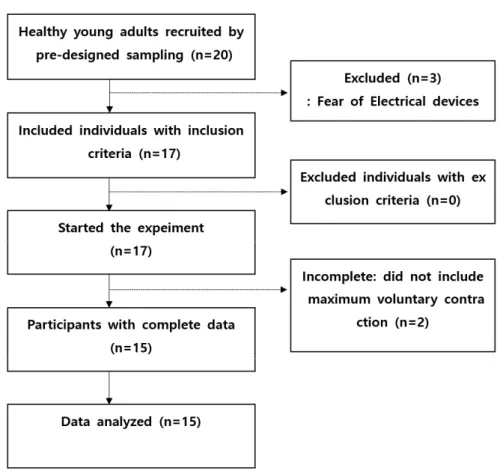
The inclusion criteria were as follows: a health young adults (1) without any orthopedic diseases to affect the results of this study, (2) without any neurological diseases, (3) who did not have orthopedic or neurosurgery damage within the last 1 year, (4) without any psychological problems, (5) who followed the instructions of the assessors, and (6) who spontaneously registered for participation. The experiment excluded all participants who did not continue to participate until the end of the study and did not participate in similar experiments within the last 6 months (Figure 1).
Study design and approvals
This study was a cross-sectional, observational study, that was approved by the Baekseok University’s Scientific Ethical Committee (approval No. BUIRB- 202010-HR-027 All researchers in this study received appropriate ethical and scientific education and training for human subject research, and took responsibility for research ethics education. This study was based on the Helsinki Declaration, personal identification information was excluded and data collection was conducted. All participants of the study voluntarily agreed to participate in the study after receiving a full explanation of the purpose of the study. Participants in the study were informed in advance that they may withdraw from the study at any time during the course of the study, and that there is no penalty for it.
Procedure
This experiment was conducted for about 3 weeks
from November 3 to November 25, 2020. Prior to the
experiment, a sufficient explanation of the experimental
process was given, and then properly recognizing that
the participant had a minimum risk. This study involved
two initial contact conditions including forefoot and
whole foot conditions during stair descending. To
measure the muscle activation on soleus and tibialis
anterior, the participants selected the examination orders among A (forefoot condition and then whole foot condition), and B (whole foot condition and forefoot
condition).
A ten-step stairs (step height 18 cm, tread depth 28 cm, and step width 120 cm, handrails on both sides) was Figure 1. The flow diagram of this study
Figure 2. Experimental procedure of this study
used to perform stair descent and a 200 cm walkway was extended at each end of the stairs. Participants performed level walking on the stairs followed by stair descent in a step-over-step manner and continued their walk for ten-step after stepping down from the stairs.
All participants descended the stairs 20 times at a self-selected walking speed wearing their exercise shoes. An initial familiarization session with the staircase was allowed. Participants rested for 5 min after every five trials to exclude fatigue effects. The start points were spaced 50 cm apart to prevent memorization of the distance from the stairs. Two initial contact conditions were tested (1) forefoot contact and (2) whole foot contact. When the participant descended 10-step, 4-step in beginning and ending section were cut off and muscle activation was measured at 3-step in the middle session. Initial contact during the 200 ms on initial contact were determined via an electromyography to quantify muscle activity. Participant rested every 5 minutes and the average value of 3 measurements was used control the measurement error (Figure 2).
Experimental equipment
This experiment used the surface electromyography system (Trigno wireless biofeedback system; Delsys Inc.
Co., USA) for measuring muscle activations of soleus and tibialis anterior muscles. The converted digital signal was processed using Trigno on a personal computer system. Signal sampling rate was set as 1,024 Hz, and band pass filter of 20-500 Hz was used to minimize the noise. The collected signal was processed to root-mean-square. The surface electrodes were placed
at 1/3 on the line between the tip of the fibula and the tip of the medial malleolus for measuring the muscle activation of tibialis anterior muscle, and at 2/3 of the line between the medial condyle of the femur to the medial malleolus.
Statistical analysis
Data from initial contact to stair descent transition is being utilized for the purpose of this study. The independent variables of this study were forefoot contact and total foot contact, and the dependent variable was ankle joint muscle activity. The general characteristics of the study subjects were analyzed by descriptive statistics. A paired t-test was used for initial contact comparisons between the forefoot contact and the power plant contact. The statistical significance level (α) was set to 0.05. For statistical processing, the statistical package SSPS ver25.0 for Windows (SPSS ver25.0;
IBM Co, USA) was conducted.
Results
In common characteristics of the participants, the average age was 24, the average height was 170.33 cm, and the average weight was 65.27 kg (Table 1). The muscle activation of soleus was not statistically significant difference as 25.16% at forefoot initial contact and 24.37% at whole foot initial contact when descending stairs. However, the muscle activation of TA muscle was significantly difference between forefoot and whole foot at initial contact during descending stairs (p<0.05). The muscle activation of the TA was higher at
Variables Mean (SD)/frequency (percent) Minimum Maximum
Sex (male/female) 10 (66.37)/5 (33.33)
Age (yr) 24.00 (1.41) 21 26
Height (cm) 170.33 (10.15) 155 183
Weight (kg) 65.27 (14.16) 40 85
*mean(SD), mean(standard deviation)
Table 1. Common characteristics of the participants in this study (n=15)
Muscle Mean±SD t p
Fore foot Whole foot