번행초(Tetragonia tetragonioides)로부터 추출한 Phenolic Compounds의 미용 식품 활성
조재범․이은호․조영제 경북대학교 식품공학부/식품생물연구소
Beauty Food Activities of Isolated Phenolic Compounds from Tetragonia tetragonioides
Jae-Bum Jo, Eun-Ho Lee, and Young-Je Cho
School of Food Science & Biotechnology/Food & Bio-Industry Research Institute, Kyungpook National University
ABSTRACT This study examined the beauty food activities of water and ethanol extracts from Tetragonia tetragonioides.
Content of phenolic compounds extracted with water and 50% ethanol extracts were 3.29 mg/g and 4.14 mg/g, respectively. 1,1-Diphenyl-2-picrylhydrazyl free radical scavenging activities of water and ethanol extracts were 98.45%
and 91.20%, respectively, at 200 μg/mL of phenolics. 2,2'-Azinobis-(3-ethylbenzothiazoline-6-sulfonic acid) radical decolorization activity was 97.28% for water extracts and 97.83% for ethanol extracts at 100 μg/mL of phenolics.
Antioxidant protection factor (PF) was 1.77 PF for water and ethanol extracts at 200 μg/mL of phenolics. Thiobarbituric acid reactive substances of water and ethanol extracts were 94.77% and 95.64%, respectively, at 100 μg/mL of phenolics.
Tyrosinase inhibitory activity, which is related to skin-whitening, was confirmed to be 34.96% for ethanol extracts at 200 μg/mL of phenolics. Elastase inhibitory activity and anti-wrinkle effect of 50% ethanol extracts were 78.9%
at 200 μg/mL of phenolics. Collagenase inhibitory activity of ethanol extracts was 61.29% at 200 μg/mL of phenolics.
Astringent effect was not detected in water extracts but was 7.82% for 50% ethanol extracts at 200 μg/mL of phenolics.
Hyaluronidase inhibitory activity as a measure of anti-inflammation was confirmed to be 81.04% for water extracts at 200 μg/mL of phenolics. Based on these results, Tetragonia tetragonioides extracts can be used as a functional material and functional beauty food with antioxidant effects.
Key words: biological activity, extracts, Tetragonia tetragonioides, beauty food
Received 9 September 2015; Accepted 25 January 2016 Corresponding author: Young-Je Cho, School of Food Science &
Biotechnology/Food & Bio-Industry Research Institute, Kyungpook National University, Daegu 41566, Korea
E-mail: [email protected], Phone: +82-53-950-7755
서 론
급격한 산업화의 발달로 고도의 경제성장이 이루어지고 있으며 식품생산이 점차 다양화되고 있는 가운데, 여러 가지 식품 중에서도 건강 기능성에 효과가 있는 식품에 대하여 점차 관심이 있는 추세이다. 이러한 추세에 발맞추어 새로운 라이프 스타일인 웰빙, 로하스의 개념인 건강 기능성 식품의 시대가 도래하였다. 웰빙은 행복과 삶의 만족, 질병이 없는 상태를 모두 포괄하는 개념으로 개인의 웰빙은 다양한 경로 를 통해 개인의 생활양식에 변화를 주고 있다(1). 웰빙은 행 복과 삶의 만족, 질병이 없는 상태를 모두 포괄하는 개념인 데 건강식품, 기능성 식품 등을 통하여 개인의 웰빙을 다양 한 경로를 통해 개인의 생활양식에 변화를 주고 있다. 또한
웰빙 문화가 전개됨에 따라 유기농 식품의 식품시장 점유율 이 점차 높아지고 있는 것과 같은 이유로 사람의 외관을 돋 보이게 해주는 기능성 화장품 산업에도 웰빙 문화가 강하게 확산하여 천연물을 이용한 천연 화장품에 대한 수요도 급격 히 증가하고 있다. 이에 따라 최근 삶의 질 향상을 위한 건강 식품의 섭취와 더불어 기능성 화장품의 수요가 증가하여 천 연 약용작물을 이용한 기능성 화장품 개발이 주목받고 있다.
특히 약용작물의 약리적 기능이 과학적으로 입증되면서 이 를 이용한 천연 화장품의 개발이 활발히 이루어지고 있다(2, 3). 이처럼 건강과 미용을 가꾸는 일은 현대인들에게 필수가 되어가고 있는 가운데 환경오염, 배기가스, 자외선, 식품첨 가물에 대한 노출, 과로, 스트레스 등에 의해 활성산소가 과 도하게 체내에서 발생하면서 각종 성인병과 피부 노화를 유 발해서 건강과 아름다움을 유지하기 위한 노력에 적신호가 되는 상황이다.
번행초(Tetragonia tetragonioides)는 갯상추 또는 뉴질 랜드 시금치로 불리는 석류풀과(Aizoaceae)에 속하는 다년 생풀로 뉴질랜드, 중국, 일본, 남아시아, 오스트레일리아, 남
아메리카 등지에도 분포하고 있고, 생명력이 강하여 자갈밭 이나 바위틈 등 몹시 척박하고 물기가 없는 곳에서도 잘 자 라며, 우리나라 남부지방 및 제주도의 바닷가 모래땅에서 군락지를 형성하고 있다(4-7). 옛날 우리나라에서는 번행초 를 ‘바다의 상추’라고 할 정도로 귀하게 여긴 약초이며, 번행 초는 생채를 샐러드해서 먹거나 데쳐서 나물로 식용할 수 있다. 또한 산에서 나는 식물 약초로 ‘삽주뿌리’, 약나무로는
‘예덕나무’와 함께 바닷가의 염생 식물로 번행초가 위장을 튼튼하게 하는 ‘3대 약초’로 알려졌다. 모든 위장병에 이 세 가지 약초를 항상 가까이하고 늘 차처럼 달여서 먹는다면 무병장수하게 될 것으로 믿어 의심치 않는다고 할 정도로 효능이 뛰어나다고 알려졌다(7,8). 조선시대 명의 허준이 스 승 유의태의 위암을 치료하기 위해 찾던 약초가 번행초로 위장병의 예방 및 치료 효과가 뛰어난 작물로 알려지면서 최근 위암, 위염, 위궤양, 위산과다, 소화불량 등 갖가지 위 장병에 치료 및 예방 효과가 높은 식물로 한방에서는 귀한 약제로 취급받고 있다(9,10). 번행초에 대한 효능은 항암, 청열, 해독, 부종, 패혈증, 풍열, 장염, 항염증 및 항궤양 등이 있으며(7), 현재까지 번행초에서 분리된 성분은 β-car- otene, diterpene, flavone, cerebrosides, oxilic acid, sterylglucoside와 polysaccharide 등이 보고되었으며(10- 15), phenyl propane type으로는 ferulic acid, trans- ferulic acid, p-methoxy cinnamic acid, 4'-methoxy cin- namic acid, trans isoferulic acid 등이 분리되었다고 보고 하였다(16). 현재 국내 자생 번행초의 활성 성분의 분리 및 분석에 관한 연구가 활발하지 못한 상황이고, 미용 식품 또 는 기능성 화장품 원료로서의 연구는 매우 미비한 실정이다.
따라서 본 연구에서는 한국산 약용식물인 번행초로부터 phenolic compounds를 분리하여 항산화 활성 및 미용 식품 활성 등을 규명하여 기능성 미용 식품에 적용하기 위한 기초 자료를 얻고, 천연 미용 식품 및 천연 미용 화장품의 소재 개발 가능성을 확인하고자 하였다.
재료 및 방법
실험재료
본 실험에서 사용한 번행초는 시중에서 판매되는 것을 구 입하여 사용하였고, 45°C dry oven(Jeiotech, Daejeon, Korea)에서 건조한 후 40 mesh로 분쇄하여 시료로 사용하 였다.
번행초 추출물의 제조
시료 추출은 열수 추출물의 경우 건조 번행초 분말 1 g에 증류수 200 mL를 가하고 용액이 100 mL가 될 때까지 15분 간 가열하여 증발시킨 후 냉각하여 상온에서 교반 추출하였 으며, ethanol 추출물은 시료 1 g에 50% ethanol 100 mL를 추출용매로 가하여 24시간 동안 상온에서 교반 추출하였다.
추출액은 Whatman No.1 filter paper(Whatman, Maid-
stone, UK)로 여과한 후 필요에 따라 rotary vacuum evap- orator(Eyela NE, Tokyo, Japan)에서 농축하여 시료의 phenolic compounds의 농도를 맞추어 사용하였다.
Total phenolic compounds의 함량 측정
Total phenolic compounds 함량 측정은 Folin과 Denis (17)의 방법에 따라 측정하였으며, 시료 1 mL에 95% etha- nol 1 mL와 증류수 5 mL를 첨가하고 1 N Folin-Ciocalteu reagent(Junsei, Tokyo, Japan) 0.5 mL를 넣어 잘 섞어주 고 5분간 방치한 후, 5% Na2CO3 1 mL를 가한 다음 흡광도 725 nm에서 1시간 이내에 측정하여 gallic acid를 이용한 표준곡선으로부터 양을 환산하였다.
항산화 효과 측정
1,1-Diphenyl-2-picrylhydrazyl(DPPH) radical에 대 한 소거 활성은 Blois(18)의 방법에 따라 측정하였으며, 전 자공여능(%)은 1-(반응구의 흡광도/ 대조구의 흡광도)×
100으로 나타내었다. 2,2'-Azinobis-(3-ethylbenzothia- zoline-6-sulfonic acid) radical cation decolorization (ABTS)의 측정은 Pellegrin 등(19)의 방법에 의해 측정하 였고, 저해율(%)은 1-(반응구의 흡광도/ 대조구의 흡광도)
×100으로 나타내었다. Antioxidant protection factor(PF) 는 Andarwulan과 Shetty(20)의 방법으로 측정하였으며, PF는 반응구의 흡광도/대조구의 비로 나타내었다. Thio- barbituric acid reactive substance(TBARS) 측정은 Buege 와 Aust(21)의 방법에 따라 측정하여 저해율(%)을 1-(반 응구의 TBARS μM/ 대조구의 TBARS μM)×100으로 나타 내었다.
Elastase 저해 효과 측정
Elastase 저해 효과 측정은 Kraunsoe 등(22)의 방법에 따라 측정하였다. 반응구는 0.2 M Tris-HCl buffer(pH 8.0) 1 mL에 기질액 0.8 mM N-succinyl-(Ala)3-ρ-nitroani- lide 용액 0.1 mL의 혼합액에 1.0 U/mL porcine pancre- atic elastase(PPE)(Sigma-Aldrich Co., Louis, MO, USA) 효소 용액 0.1 mL와 50~200 μg/mL phenolic compounds 농도의 시료 0.1 mL를 넣고 대조구에는 시료 대신 증류수 0.1 mL를 첨가하여 25°C에서 20분간 반응시킨 후 ρ-ni- troaniline 생성량을 흡광도 410 nm에서 측정하여 저해율 (%)을 (1-시료의 absorbance/ 대조구의 absorbance)×
100으로 계산하였다.
Collagenase 저해 효과 측정
Collagenase 저해 효과 측정은 Wunsch와 Heidrich(23) 의 방법에 따라 측정하였다. 반응구는 0.1 M Tris-HCl buffer(pH 7.5)에 4 mM CaCl2를 첨가하여 4-phenyl- azobenzyl oxycarbonyl-Pro-Leu-Gly-Pro-D-Arg(0.3 mg/mL)를 녹인 기질액 0.25 mL와 50~200 μg/mL phe-
nolic compounds 농도의 시료 용액 0.1 mL의 혼합액에 0.2 mg/mL collagenase(Sigma-Aldrich Co.) 0.15 mL를 첨가 하여 실온에서 20분간 방치한 후 6% citric acid 0.5 mL를 넣어 반응을 정지시킨 다음, ethyl acetate 2 mL를 첨가하 고 320 nm에서 흡광도를 측정하여 저해율(%)을 (1-시료 의 absorbance/ 대조구의 absorbance)×100으로 계산하 였다.
Tyrosinase 저해 효과 측정
Tyrosinase 저해 효과 측정은 Hearing(24)의 방법에 준 거하여 측정하였다. 반응구는 0.1 M sodium phosphate buffer(pH 6.8) 2.3 mL와 기질액 1.5 mM L-tyrosine 용액 0.4 mL의 혼합액에 250 U/mL mushroom tyrosinase (Sigma-Aldrich Co.) 0.1 mL와 50~200 μg/mL phenolic compounds 농도의 시료 0.2 mL를 넣고 대조구에는 시료 대신 증류수를 0.2 mL를 첨가하여 37°C에서 20분간 반응 시켜 다음, 흡광도 475 nm에서 측정하여 저해율(%)을 (1-
시료의 absorbance/대조구의 absorbance)×100으로 계산 하였다.
Astringent 저해 효과 측정
Astringent 활성 측정은 Lee 등(25)의 방법에 따라 측정 하였다. 피부 단백질과 유사한 혈액 단백질(hemoglobin)을 사용하여 원심분리관 용기에 각각의 시료 용액과 헤모글로 빈 용액(Sigma-Aldrich Co.)을 1:1로 넣어서 진탕 혼합한 다음, 1,500 rpm에서 3분간 원심분리 후 576 nm에서 흡광 도를 측정하였다. Astringent 활성은 (1-시료첨가군의 흡 광도/ 대조구의 흡광도)×100으로 나타내었다.
Hyaluronidase(HAase) 저해 효과 측정
HAase 저해 활성 측정은 Reissig 등(26)의 방법에 준거 하여 sodium-hyaluronic acid(HA)로부터 형성된 N-ace- tylglucosamine을 glucoxazoline 유도체로 변형시킨 후 ρ- dimethylaminobenzaldehyde(DMAB)로 발색시켜 흡광도 를 측정하였다. 즉 0.1 M acetate buffer(pH 3.5)에 녹인 7,900 U/mL HAase(Wako, Osaka, Japan) 0.05 mL와 50
~200 μg/mL phenolic compounds 농도의 시료 0.1 mL를 혼합하여 37°C에서 20분간 반응시켰다. 12.5 mM CaCl2 0.1 mL를 가하여 혼합 후 다시 20분간 배양하였다. 기질로 서 0.1 M acetate buffer(pH 3.5)에 녹인 HA(12 mg/mL)를 첨가하여 다시 40분간 배양하고, 0.4 N potassiumtetrabo- rate 0.1 mL와 0.4 N NaOH 용액 0.1 mL를 첨가하여 3분 동안 water bath에서 반응 후 완전히 냉각시켰다. 냉각시킨 반응액에 발색시약 DMAB 시약 3 mL를 가하여 37°C에서 20분간 반응시킨 후 600 nm에서 투과율(%)을 측정하여 저 해율(%)을 (1-시료의 absorbance/ 대조구의 absorbance)
×100으로 계산하였다.
통계처리
본 실험의 결과는 6회 반복하여 측정한 평균값을 나타내 었으며, 평균±표준편차로 나타내었다. SPSS 7.5 for win- dows 프로그램(Statistical Package for Social Science, Chicago, IL, USA)을 이용하여 통계처리 하였고 분산분석 (analysis of variance) 및 Duncan의 다중범위검정법(Dun- can's multiple range test)으로 95% 수준에서 유의성을 검정하였다.
결과 및 고찰
용매 종류 및 용매 농도가 phenolic compounds의 용출 함량에 미치는 영향
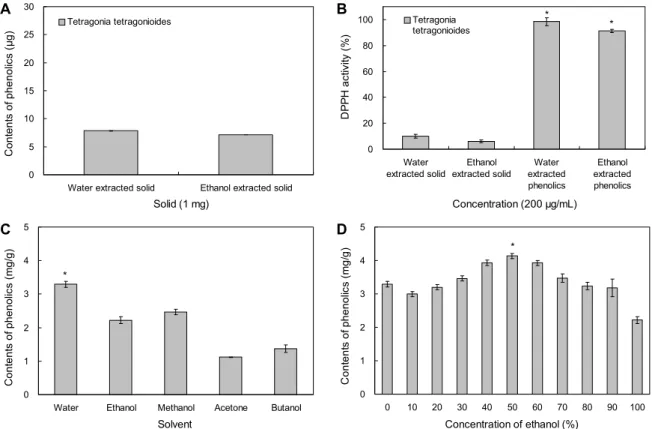
식물의 방어기작에 의하여 생산되는 2차 대사산물의 한 종류인 phenolic compounds는 식물체에 존재하는 천연 항 산화제로 널리 알려졌으며, 분자구조 내에 존재하는 phe- nolic hydroxyl기에 의해 단백질 등의 거대 분자들과 결합 하는 특성이 있어 다양한 생리 기능을 나타낸다고 보고되어 있다(27). 번행초 추출물의 고형분에 포함된 phenolic com- pounds의 성분 함량은 매우 낮게 나타났으며(Fig. 1A), phenolic compounds의 함량이 낮은 고형분의 생리활성 역 시 매우 낮은 수준으로 나타났다(Fig. 1B). 따라서 생리활성 에 대한 효능은 번행초 추출물에 함유된 phenolic com- pounds의 성분에 의해 효과가 달라질 것으로 판단되었다.
또한 phenolic compounds는 주로 식물의 줄기, 잎, 과일, 뿌리, 꽃과 씨앗 등의 부위에 따라 다양하게 함유되었으며, 식물의 종류와 부위에 따라 phenolic compounds의 성분과 함량의 차이를 보인다고 보고하였다(28). Kim 등(29)은 노 니 부정근에 함유된 rubiadin의 추출 효율에 미치는 영향을 조사한 결과 추출용매와 추출에 사용된 용매의 농도, 추출 방법, 추출 시간에 따라서 유효 성분의 추출 효율이 달라진 다고 보고한 바 있다. 번행초의 생리활성 물질로서 phenolic compounds를 추출하기 위해 water, ethanol, methanol, acetone, butanol을 100% 농도로 추출용매를 다양하게 하 여 추출하는 방법과 ethanol을 추출용매로 사용하여 다양한 농도로 추출하는 방법을 최적 추출조건을 찾는 방법으로 이 용하여 phenolic compounds의 용출량을 알아보았다. 그 결과 용매별로 추출한 Fig. 1C의 결과와 같이 water, meth- anol, ethanol, butanol, acetone 순으로 3.29, 2.46, 2.22, 1.37, 1.12 mg/g의 용출량을 나타내었다. Lee 등(30)은 번 행초를 각 용매 추출액의 phenolic compounds 함량을 측정 한 결과 dichloromethane, ethyl acetate, methanol, bu- tanol, hexane 추출 분획 순으로 각각 73.76, 69.17, 41.65, 37.06, 28.81 μg/mg으로 측정되었다고 보고하였고, 본 실 험의 용매별 추출방법의 결과와 유사한 결과를 나타내었다.
식품 소재에 사용하기 적합한 용매인 ethanol을 추출용매로 사용하여 다양한 농도로 추출한 결과 Fig. 1D와 같이 50%
ethanol 추출물이 4.14±0.07 mg/g으로 가장 높은 phe-
0 5 10 15 20 25 30
Water extracted solid Ethanol extracted solid Solid (1 mg)
Contents of phenolics (μg) . Tetragonia tetragonioides
A
0 20 40 60 80 100
Water extracted solid
Ethanol extracted solid
Water extracted phenolics
Ethanol extracted phenolics Concentration (200 μg/mL)
DPPH activity (%)
Tetragonia tetragonioides
* *
B
0 1 2 3 4 5
Water Ethanol Methanol Acetone Butanol Solvent
Contents of phenolics (mg/g) .
*
C
0
1 2 3 4 5
0 10 20 30 40 50 60 70 80 90 100
Concentration of ethanol (%)
Contents of phenolics (mg/g) . *
D
Fig. 1. The content of phenolic compounds in extracted solid (A), antioxidative activity of extracted solid and phenolics (B). The effect of various solvents (C) and ethanol concentration (D) on extraction of phenolic from Tetragonia tetragonioides. The data were expressed as the mean±SD (n=6). *P<0.05.
nolic compounds의 용출량을 나타내었다. 따라서 번행초 를 식품 산업에 적용하기 위하여 생리활성에 효과를 나타내 는 phenolic compounds가 가장 많이 용출된 50% ethanol 추출물과 물 추출물을 사용하여 50~200 μg/mL의 특정 농 도로 조절하여 미용 식품 활성을 측정하였다.
번행초 추출물의 항산화 효과
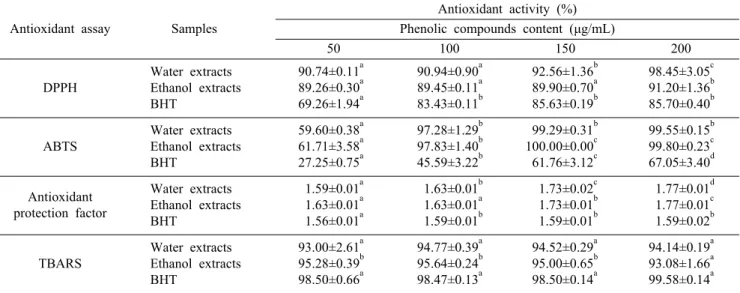
일반적으로 DPPH법은 DPPH 자유 라디칼의 소거능 측 정을 통해 천연물질의 수용성 혹은 유기용매 추출물의 항산 화 지표로써 널리 사용되고 있다. 특히 DPPH 라디칼 소거능 을 가진 물질들은 주로 DPPH 라디칼에 수소를 제공해 줌으 로써 비라디칼 형태인 DPPH-H로 전환해 흡광도를 감소시 키는 것으로 알려졌다. 따라서 DPPH 라디칼을 비라디칼 형 태인 DPPH-H로 전환해 흡광도 값을 감소시키는 것으로 잘 알려진 α-tocopherol, sesamol, BHA, TBHQ 등과 같은 수소 공여능이 뛰어난 항산화 물질을 이용하여 positive control로 사용하여 흡광도 517 nm에서의 흡광도 비를 산 출하였다(31). 번행초 추출물을 이용하여 전자공여능을 측 정한 결과 Table 1과 같이 50~200 μg/mL의 phenolic com- pounds 농도 범위에서 물 추출물은 90.74~98.45%의 높은 전자공여능 결과를 나타내었고, ethanol 추출물은 89.26~
91.20%의 전자공여능을 나타내었다. Ha 등(32)은 남해 약 쑥의 잎, 줄기, 뿌리 부위를 60% ethanol로 각각 추출하여
125 μg/mL의 농도로 전자공여능을 측정한 결과 87, 36, 44%의 라디칼 소거 활성을 나타내었다고 보고하였고, Kim 등(33)은 모시풀잎 70% ethanol 추출물이 52.5 μg/mL 농 도에서 72%의 라디칼 소거 활성을 나타내었다고 보고한 결 과와 비교하였을 때 번행초의 라디칼 소거 활성이 더 우수하 다고 판단되었다. ABTS는 과산화수소에 의해 metmyo- globin이 혈장 내에서 활성화되어 ABTS+ free radical을 형성한다. ABTS와 potassium persulfate가 반응하면 ABTS assay는 파랑/녹색의 ABTS+ free radical을 형성하고 항산 화제 존재 시 ABTS+ free radical이 소거되는 정도를 분석 하는 방법(34-36)으로 ABTS를 측정한 결과 Table 1과 같 이 물과 ethanol 추출물 모두 100 μg/mL의 phenolic com- pounds 농도에서 각각 97.28±1.29%, 97.83±1.40%의 높 은 활성을 나타내었다. Cha 등(37)은 시판 흑마늘 4종류를 1,000 μg/mL 농도로 ABTS 라디칼 소거 활성을 측정한 결 과 water, ethanol 추출물이 각각 65.04~86.15%, 46.42~
58.41%의 라디칼 소거 활성을 나타내었고, Shon(38)은 복 령과 후박을 버섯균사체로 발효시켜 20~100 μg/mL 농도 로 측정한 결과 ABTS 라디칼 소거능이 농도 의존적으로 증가한다고 보고하였다. 이 결과로 번행초 추출물이 수용성 물질에 대한 항산화 효과가 높으며, 이는 수용성 항산화제인 비타민 C와 같이 수용성 부분에서 활성산소와 반응하여 이 를 불활성화시키고, 수용액 상에서 +3가 철분(Fe3+)을 +2
Table 1. Antioxidant activity of extracts from Tetragonia tetragonioides Antioxidant assay Samples
Antioxidant activity (%) Phenolic compounds content (μg/mL)
50 100 150 200
DPPH
Water extracts Ethanol extracts BHT
90.74±0.11a 89.26±0.30a 69.26±1.94a
90.94±0.90a 89.45±0.11a 83.43±0.11b
92.56±1.36b 89.90±0.70a 85.63±0.19b
98.45±3.05c 91.20±1.36b 85.70±0.40b ABTS
Water extracts Ethanol extracts BHT
59.60±0.38a 61.71±3.58a 27.25±0.75a
97.28±1.29b 97.83±1.40b 45.59±3.22b
99.29±0.31b 100.00±0.00c 61.76±3.12c
99.55±0.15b 99.80±0.23c 67.05±3.40d Antioxidant
protection factor
Water extracts Ethanol extracts BHT
1.59±0.01a 1.63±0.01a 1.56±0.01a
1.63±0.01b 1.63±0.01a 1.59±0.01b
1.73±0.02c 1.73±0.01b 1.59±0.01b
1.77±0.01d 1.77±0.01c 1.59±0.02b TBARS
Water extracts Ethanol extracts BHT
93.00±2.61a 95.28±0.39b 98.50±0.66a
94.77±0.39a 95.64±0.24b 98.47±0.13a
94.52±0.29a 95.00±0.65b 98.50±0.14a
94.14±0.19a 93.08±1.66a 99.58±0.14a The data were expressed as the mean±SD (n=6).
Means with different letters (a-d) within a row are significantly different at P<0.05 by Duncan's multiple range tests.
0 20 40 60 80 100
50 100 150 200
Phenolic content (μg/mL)
Elastase inhibition (%) . Water Extracts
50% Ethnol Extracts Ursolic Acid
a a
a b
ab
ab b
b c
c
c d Water extracts
50 Ethanol extracts Ursolic acid
Fig. 2. Inhibitory activity of extracts on elastase from Tetragonia tetragonioides. The data were expressed as the mean±SD (n=6).
Means with different letters (a-d) above the bars in the same extract are significantly different at P<0.05 by Duncan's multiple range tests.
가 철분(Fe2+)으로 환원시켜 지방질을 과산화시키는 효소인 lipoxygenase의 활성을 저하함으로써 발생하는 것으로 추 측하였다(31). 번행초 추출물의 PF의 차이를 측정한 결과 Table 1과 같이 물 추출물과 ethanol 추출물이 200 μg/mL 의 농도에서 각각 1.77 PF와 1.77 PF의 비교적 높은 항산화 능을 나타내었다. Choi 등(39)은 천마와 발효 천마를 물과 70% ethanol 추출물로 PF를 측정한 결과 천마의 물과 ethanol 추출물은 1.12, 1.21 PF를 나타내었고, 발효 천마 의 물과 ethanol 추출물은 1.21, 1.29 PF를 나타내었다고 보고한 결과보다 번행초의 PF 측정 결과가 더 우수하다고 판단되었다. Kim 등(40)은 산삼배양근을 1~20 mg/mL의 농도로 조절하여 TBARS를 측정한 결과 물 추출물은 4.74
~24.88%, 70% ethanol 추출물은 9.18~66.59%로 나타내 었다고 보고하였는데, 이는 번행초 추출물이 50 μg/mL의 저농도에서 Table 1과 같이 물 추출물은 93±2.61%, etha- nol 추출물은 95.28±0.39%의 저해력을 나타내어 지용성 물질에 대한 항산화력이 더 우수한 것을 확인할 수 있었다.
이러한 결과로 보아 번행초 추출물은 수용성 및 지용성 물질 에 대한 높은 항산화능을 나타내었고, 추출물의 phenolic compounds에 농도 의존적인 양상을 나타내는 것으로 확인 되었다.
번행초 추출물의 elastase 저해 효과
피부 구조와 탄력 유지 역할을 하는 주요 단백질 중의 하 나인 elastin을 분해하는 elastase는 collagen을 비특이적 으로 가수분해하는 효소이다. 나이가 증가함에 따라 colla- gen 생성 감소 또는 분해속도 증가, 자외선 등에 의해 증가 하는 elastase 활성 등이 피부 진피의 elastin 그물망 구조를 절단하여 피부 탄력섬유를 점차 감소시켜 피부에 주름이 형 성된다고 알려졌다(41,42). 번행초 추출물의 elastase에 대
한 저해 활성을 측정한 결과 Fig. 2와 같이 200 μg/mL의 phenolic compounds 농도에서 물 추출물은 76.32±2.64%
의 활성을 나타내었고, ethanol 추출물은 78.90±4.84%의 저해 활성을 나타내었다. Kim 등(43)은 품종별 복숭아(마도 카, 용택골드, 장택백봉, 몽부사, 천중도백도, 홍백) 유과 씨 추출물에서 각각 40.55, 34.43, 28.86, 22.94, 22.73, 13.77
%의 elastase 저해 효과를 나타내었고, Cho와 Choi(44)는 감태 열수 추출물이 0.5, 1 mg/mL에서 38, 44%의 elastase 저해 효과를 나타내었다고 보고하였다. 또한 Kim 등(45)이 유근피에서 분리한 phenolic compounds의 elastase 저해 활성은 200 μg/mL의 phenolic compounds의 농도에서 69.5
%로 나타낸다고 보고한 것과 비교하였을 때 번행초 추출물 의 elastase 저해 활성이 더 우수한 것으로 나타났다.
0 20 40 60 80 100
50 100 150 200
Phenolic content (μg/mL)
Collagenase inhibition (%) . Water extract 50% Ethanol extract EGCG
a a
a a
a a
b b
Fig. 3. Inhibitory activity of extracts on collagenase from Tetra- gonia tetragonioides. The data were expressed as the mean±SD (n=6). Means with different letters (a,b) above the bars in the same extract are significantly different at P<0.05 by Duncan's multiple range tests.
0 20 40 60 80 100
50 100 150 200
Phenolic content (μg/mL)
Tyrosinase inhibition (%) .
Water extract 50% Ethanol extract Kojic Acid
b b
b a
a
.acid
ab ab
a
Fig. 4. Inhibitory activity of extracts on tyrosinase from Tetrago- nia tetragonioides. The data were expressed as the mean±SD (n=6). Means with different letters (a,b) above the bars in the same extract are significantly different at P<0.05 by Duncan's multiple range tests.
번행초 추출물의 collagenase 저해 효과
Collagen은 피부의 섬유아세포에서 생성되는 세포 외 기 질(extracellular matrix)의 주요 구성성분으로 견고한 3중 나선 구조를 가지고 있는 단백질이며 피부, 건(tendon), 뼈 및 치아의 유기 물질 대부분을 형성한다(46). 이러한 colla- gen은 광노화에 의해 감소하게 되며, collagen의 감소는 피 부의 주름 형성과 밀접한 연관이 있다(47,48). 번행초 추출 물을 50~200 μg/mL phenolic compounds의 농도로 첨가 하여 collagenase 저해 활성을 측정한 결과 Fig. 3과 같이 번행초 물 추출물은 억제 활성이 나타나지 않았지만, etha- nol 추출물은 52.3~61.3%의 collagenase 억제 효과를 나타 내었다. 시중에 주름개선 화장 원료로 이용되고 있는 EGCG 보다는 낮지만 높은 collagenase 억제력을 나타내었다. 번 행초 추출물은 collagenase 저해 활성에 대해 농도 의존적 으로 억제 효과를 나타내었다. Lee 등(49)은 화장품 개발을 위해 배롱나무 가지 추출물로 collagenase 저해 활성을 측 정한 결과 50 ppm에서부터 85% 이상의 저해 활성을 나타 내었다고 보고하였고, Lee 등(50)이 자귀나무 잎의 물과 ethanol 추출물을 2,000 μg/mL 농도로 조절하여 측정한 결과 48, 30%의 collagenase 저해 활성을 나타낸다고 보고 한 것과 비교하였을 때 번행초 추출물은 200 μg/mL의 저농 도에서도 61%의 높은 저해 활성을 나타낸다는 것을 확인할 수 있었다. 이러한 결과로 번행초 추출물이 가지는 collage- nase 억제 활성에 의해 진피층의 뼈대를 구성하는 collagen 의 분해를 막아 주름개선을 위한 기능성 미용 식품 소재로 활용이 가능할 것으로 판단되었다.
번행초 추출물의 tyrosinase 저해 효과
흑갈색의 색소 melanin은 피부의 melanocyte 세포에서 펩타이드 tyrosinase에 의해 생성된다. Tyrosinase는 인체 내의 melanin 생합성 경로에서 가장 중요한 초기 속도결정 단계인 L-tyrosine에서 L-DOPA를 거쳐 L-dopaquinone 으로의 전환에 관여하는 효소로, 피부가 자외선에 노출되었
을 때 활성화되어 피부 노화를 촉진하며 피부에 암갈색의 색소 물질을 침착시키기 때문에 미백 성분 효과를 평가하는 데 널리 이용되고 있다(51). 번행초 추출물의 tyrosinase 저해 활성을 측정한 결과 Fig. 4와 같이 phenolic com- pounds의 200 μg/mL 농도에서 ethanol 추출물은 34.96±
1.83%의 저해 활성을 나타내었고, Kim 등(45)은 유근피에 서 분리한 phenolic compounds의 tyrosinase 저해 활성이 200 μg/mL의 phenolic compounds의 농도에서 23.9%의 저해 활성을 나타낸다고 보고하였다. Jee(52)는 상백피를 1,000 μg/mL 농도로 조절하여 물과 ethanol 추출물로 측정 한 결과 80, 93%의 저해 활성을 나타내었다고 보고하였고, Lee 등(53)은 가죽나무의 뿌리, 줄기, 잎 추출물을 2 mg/
mL로 조절하여 측정한 결과 7, 5, 16%의 tyrosinase 저해 활성을 나타내었다고 보고하였다. 번행초 추출물도 고농도 로 농도를 조절하여 측정한다면 더 높은 tyrosinase 저해 활성을 나타낼 것으로 판단하였다.
번행초 추출물의 astringent 저해 효과
수렴작용의 원리는 피부 단백질이 고분자 flavonoids와 결합하여 가교결합을 형성하여 피부가 수축하는 현상을 말 한다(51). 수렴이란 뜻에는 기본적으로 주름이 지고 혹은 움츠린다는 의미가 있으며, 수렴제는 단백질과 결합하는 성 질을 가지기 때문에 일반적으로 헤모글로빈의 단백질이 추 출물과 결합하는 정도에 따라서 수렴 효과 정도를 판단할 수 있다(54). 이러한 수렴작용에는 외용 작용 때문에 피부와 점막의 표면에 난용성의 피막을 형성하고, 조직을 조밀하게 하여 세포막의 투과성을 감소시키는 효과가 있다고 할 수 있다(55). 번행초 물 추출물과 ethanol 추출물의 astringent 효과를 측정한 결과 Fig. 5와 같이 물 추출물은 수렴 효과가 나타나지 않았지만, ethanol 추출물은 phenolic compounds 의 200 μg/mL 농도에서 7.82±0.49%의 수렴 효과를 나타 내었다. Youn 등(56)은 눈개승마 추출물을 10 mg/mL의 고 농도로 조절하여 astringent 효과를 측정한 결과 물, etha-
0 20 40 60 80 100
50 100 150 200
Phenolic content (μg/mL)
Astrigent effect (%) .
Water Extracts 50% Ethnol Extracts Tannic Acid
a
a a
b b
b b Water extracts
50 Ethanol extracts Tannic acid
Fig. 5. The astringent effect of extracts from Tetragonia tetrago- nioides. The data were expressed as the mean±SD (n=6). Means with different letters (a,b) above the bars in the same extract are significantly different at P<0.05 by Duncan's multiple range tests.
0 20 40 60 80 100
50 100 150 200
Phenolic content (μg/mL)
Hyaluronidase inhibition (%) . Water extract
50% Ethanol extract PDTC
b
a b
b c
c c
a d
a
ab ab
Fig. 6. Inhibitory activity of extracts on hyaluronidase from Tetragonia tetragonioides. The data were expressed as the mean
±SD (n=6). Means with different letters (a-d) above the bars in the same extract are significantly different at P<0.05 by Duncan's multiple range tests.
nol 추출물은 각각 16.35, 91.27%의 효과를 나타내었다고 보고하였고, Lee 등(57)은 광원별로 재배한 브로콜리 etha- nol 추출물을 5,000 ppm의 농도로 조절하여 astringent 효 과를 측정한 결과 형광등, 적・청색광, 청색광, 적색광의 순서 로 각각 21.5, 39.6, 40.0, 51.6%의 효과를 나타내었다고 보고하였다. 또한 Kim 등(58)이 하고초 추출물을 이용하여 astringent 효과를 측정한 결과 750 μg/mL의 phenolic compounds의 농도에서 31.1%의 효과를 나타내었다고 보 고한 것과 비교하였을 때 번행초 추출물은 200 μg/mL의 저농도에서도 효과를 나타내는 것을 확인할 수 있었다.
번행초 추출물의 HAase 저해 효과
염증반응은 외부자극에 대한 생체조직 방어반응의 하나 로서 활성화된 면역세포에 의해 일어나는 일련의 면역반응 이다. 염증 형성의 중요 요소인 macrophage의 phagocytic ability는 고분자 다당인 HA에 의해 저해되지만, 저분자 HA 는 inflammation, fibrosis collagen deposition을 증가시키 는 것으로 알려졌다. 따라서 HA 분해효소인 HAase의 활성 을 억제함으로써 HA의 고분자 형태를 유지해 항염증 효과 를 기대할 수 있다(59,60). 번행초 물 추출물과 ethanol 추 출물의 HAase 억제 효과를 측정한 결과 Fig. 6과 같이 물 추출물 200 μg/mL의 phenolic compounds의 농도에서 81.04%의 높은 염증 억제 효과를 확인할 수 있었다. Cha와 Lee(61)는 야생 복숭아를 methanol, hexane, ethyl ace- tate, butanol, water로 분획한 추출물을 125 μg/mL의 농 도로 조절하여 HAase 억제 효과를 측정한 결과 각각 57, 3, 67, 52, 4%의 효과를 나타내었다고 보고하였고, Kim 등 (62)은 섬쑥부쟁이 추출물을 10 μg/mL의 농도로 조절하여 HAase 억제 효과를 측정한 결과 hexane 분획물은 17.9%, ethyl acetate 분획물은 24.4%, butanol 분획물은 15.7%, water 분획물은 8.8%의 효과를 나타내어 염증반응 조절에 다소 낮은 역할을 한 것으로 나타내었다고 보고하였다. Choi 등(63)은 프로폴리스 추출물을 10 mg/mL의 고농도로 조절
하여 HAase 억제 효과를 측정한 결과 ether 분획물은 51%, ethyl acetate 분획물은 25%, butanol 분획물은 17%, wa- ter 분획물은 별다른 저해 활성이 나타나지 않았다고 보고한 결과와 비교하였을 때 번행초 추출물의 염증 억제 효과가 월등히 우수한 것으로 나타났다. 이상의 결과에 따라 번행초 추출물은 미용 식품으로서의 활성이 우수하여 기능성 미용 식품 또는 기능성 화장품 소재로서 적용이 가능할 것으로 생각한다.
요 약
본 연구는 물과 ethanol을 추출용매로 사용한 번행초(Tet- ragonia tetragonioides) 추출물이 미용 식품 소재로 사용 가능한 기능성을 증명하고자 하였다. Phenolic compounds 는 물 추출물에서 3.29 mg/g, 50% ethanol 추출물에서 4.14 mg/g의 결과를 각각 나타내었다. 전자공여능 측정 결 과 200 μg/mL phenolic compounds의 농도에서 물 추출물 은 98.45%, 50% ethanol 추출물은 91.20%의 활성을 나타 내었다. ABTS radical 활성 측정 결과 100 μg/mL phenolic compounds의 농도에서 물 추출물은 97.28%, 50% etha- nol 추출물은 97.03%의 활성을 나타내었다. Antioxidant protection factor(PF) 측정 결과 200 μg/mL phenolic compounds의 농도에서 물과 ethanol 추출물 모두 1.77 PF 의 같은 결과를 나타내었다. Thiobarbituric acid reactive substance(TBARS) 측정 결과 100 μg/mL phenolic com- pounds의 농도에서 물과 ethanol 추출물은 94.77%와 95.64
%의 높은 활성을 나타내었다. 미백과 관련 있는 tyrosinase 저해 활성을 측정한 결과 200 μg/mL phenolic compounds 의 농도에서 ethanol 추출물은 34.96%의 억제력을 나타내 었다. 주름 개선 효과를 측정하는 elastase 저해 활성과 collagenase 저해 활성을 측정한 결과 200 μg/mL phenolic compounds의 농도에서 ethanol 추출물만 78.90%와 61.3
%의 높은 저해 활성을 나타내었다. 수렴 효과를 나타내는
astringent effect에서 200 μg/mL phenolic compounds 농도의 ethanol 추출물은 7.82%의 효과를 나타내었다.
Hyaluronidase 저해 효과 측정 결과 물 추출물 200 μg/mL phenolic compounds의 농도에서 81.04%의 염증 억제 효 과를 나타내었다. 이러한 결과들로 미루어 보았을 때 번행초 추출물은 항산화 작용과 미용 식품으로서의 기능성을 기대 할 수 있다.
REFERENCES
1. Oh KH. 2010. Study on the satisfaction and purchasing be- haviors in users of DIY natural cosmetics. MS Thesis. Sook- myung Women's University, Seoul, Korea. p 1-93.
2. Cho YJ. 2011. Characteristics of cosmetic with whitening compounds from Phellodendron amurense. J Appl Biol Chem 54: 108-113.
3. Cho YJ, An BJ, Kim JH. 2011. Application of isolated ty- rosinase inhibitory compounds from persimmon leaves. J Life Sci 21: 976-984.
4. Lee TB. 1978. Illustrated flora of Korea. Hyangmunsa, Se- oul, Korea. p 323.
5. Shin MK. 1986. Clinical galenic pharmacy. Youngrimsa, Seoul, Korea. p 338-339.
6. National Chinese Medicine Administration Chinese Materia Medica Editorial Board. 1999. Chinese materia medica.
Shanghai Science and Technology Publisher, Shanghai, Chi- na. p 1391.
7. New Jiangsu Medical Center. 1998. Dictionary of Chinese medicine. Shanghai Science and Technology Publisher, Shanghai, China. p 2280-2281.
8. Kato M, Takeda T, Ogihara Y, Shimizu Mm, Nomura T, Tomita T. 1985. Studies on the structure of polysaccharide from Tetragonia tetragonoides. Ⅰ. Chem Pharm Bull 33:
3675-3680.
9. Singh NP, Schmidt RR. 1989. Synthesis of a (4E,8Z)-sphin- gadienine moiety containing cerebroside from Tetragonia tetragonoides with antiulcerogenic activity. J Carbohydr Chem 8: 199-216.
10. Aoki T, Takagi K, Hirata T, Suga T. 1982. Two naturally occurring acyclic diterpene and norditerpene aldehydes from Tetragonia tetragonioides. Phytochemistry 21: 1361-1363.
11. Cambie RC, Ferguson LR. 2003. Potential functional foods in the traditional Maori diet. Mutat Res 523-524: 109-117.
12. Okuyama E, Yamazaki M. 1983. The principles of Tetrago- nia tetragonioides having anti-ulcergenic activity. Ⅰ. Isola- tion and identification of a sterol glucoside mixture (com- pound A). Yakugaku Zasshi 103: 43-48.
13. Kemp MS, Burden RS, Brown C. 1979. A new naturally occurring flavanone from Tetragonia expansa. Phytochem- istry 18: 1765-1766.
14. Mori K, Kinsho T. 1988. Synthesis of sphingosine relatives,
Ⅶ. Synthesis of anti-ulcerogenic cerebrosides isolated from Tetragonia tetragonoides. Liebigs Ann Chem 1988: 807- 814.
15. Bar T, Schmidt RR. 1988. Glycosyl imidates, 35. Synthesis of a cerebroside having a (4E,8E)-sphingadienine moiety from Tetragonia tetragonioides with antiulcerogenic activity.
Liebigs Ann Chem 1988: 669-674.
16. Chung AK. 2003. Phenolic constituents from Tetragonia tetragonoides. Sungkyunkwan University, Seoul, Korea. p 18-19.
17. Folin O, Denis W. 1912. On phosphotungstic-phosphomo- lybdic compounds as color reagents. J Biol Chem 12: 239- 249.
18. Blois MS. 1958. Antioxidant determinations by the use of a stable free radical. Nature 181: 1199-1200.
19. Pellegrin N, Roberta R, Min Y, Catherine RE. 1998.
Screening of dietary carotenoids and carotenoid-rich fruit extracts for antioxidant activities applying 2,2'-azinobis(3- ethylenebenzothiazoline-6-sulfonic acid) radical cation de- colorization assay. Method Enzymol 299: 379-389.
20. Andarwulan N, Shetty K. 1999. Phenolic content in differ- entiated tissue cultures of untransformed and Agrobacte- rium-transformed roots of anise (Pimpinella anisum L.). J Agric Food Chem 47: 1776-1780.
21. Buege JA, Aust SD. 1978. Microsomal lipid peroxidation.
Method Enzymol 52: 302-310.
22. Kraunsoe JA, Claridge TD, Lowe G. 1996. Inhibition of human leukocyte and porcine pancreatic elastase by homo- logues of bovine pancreatic trypsin inhibitor. Biochemistry 35: 9090-9096.
23. Wunsch E, Heidrich HG. 1963. Zur quantitativen bestimmung der kollagenase. Hoppe-Seylers Z Physiol Chem 333: 149- 151.
24. Hearing VJ Jr. 1987. Mammalian monophenol monooxygen- ase (tyrosinase): purification, properties, and reactions cata- lyzed. Methods Enzymol 142: 154-165.
25. Lee JT, Jeong YS, An BJ. 2002. Physiological activity of Salicornia herbacea and its application for cosmetic materi- als. Kor J Herbology 17: 51-60.
26. Reissig JL, Storminger JL, Leloir LF. 1995. A modified col- orimetric method for the estimation of N-acetylamino sugars.
J Biol Chem 217: 959-966.
27. Choi Y, Kim M, Shin JJ, Pack JM, Lee J. 2003. The anti- oxidant activities of the some commercial teas. J Korean Soc Food Sci Nutr 32: 723-727.
28. Kim SM, Cho YS, Sung SK. 2001. The antioxidant ability and nitrite scavenging ability of plant extracts. Korean J Food Sci Technol 33: 626-632.
29. Kim MK, Jeong CS, Shin YK, Park KH, Lee WJ, Lee EJ, Park KY. 2010. Effects of extraction condition on extraction efficiency of rubiadin in adventitious roots of noni (Morinda citrifolia). Kor J Hort Sci Technol 28: 685-690.
30. Lee MA, Choi HJ, Kang JS, Choi YW, Joo WH. 2008.
Antioxidant activities of the solvent extracts from Tetrago- nia tetragonioides. J Life Sci 18: 220-227.
31. Kyu JM. 2010. Monitoring the changes of 2,2-diphenyl- 1-picrylhydrazyl (DPPH) absorbance and oxidation products in thermally oxidized linoleic acid. MS Thesis. Seoul Nation- al University, Seoul, Korea. p 24.
32. Ha GJ, Jeong CH, Jeong HR, Heo HJ, Shon GM, Rho CW, Kim NK. 2011. Antioxidant activities from the different parts of Artemisia argyi H. using an in vitro system. J Agric Life Sci 45: 109-117.
33. Kim C, In MJ, Kim DC. 2015. In vitro antioxidant activity of ethanol extract from Boehmeria nivea L. leaves. Food Eng Prog 19: 76-81.
34. Ratnam DV, Ankola DD, Bhardwaj V, Sahana DK, Kumar MN. 2006. Role of antioxidants in prophylaxis and therapy:
A pharmaceutical perspective. J Control Release 113: 189- 207.
35. Sies H. 1997. Oxidative stress: oxidants and antioxidants.
Exp Physiol 82: 291-296.
36. Beckman KB, Ames BN. 1998. The free radical theory of aging matures. Physiol Rev 78: 547-581.
37. Cha JY, Lee SJ, Shin JH, Sung NJ. 2012. Antioxidant and inhibition of nitrosodimethylamine formation in marketing black garlics. J Agric Life Sci 46: 151-162.
38. Shon MY. 2007. Antioxidant and anticancer activities of Poria cocos and Machilus thunbergii fermented with myce- lial mushrooms. Food Industry and Nutrition 12(2): 51-57.
39. Choi JH, Kim JH, Jung JY, Suh SG. 2013. Comparison of nerve growth factor induction and anti-aging activity us- ing dried Gastrodia and fermented Gastrodia extracts. Kor J Hort Sci Technol 31: 380-387.
40. Kim JW, Lee SH, No HK, Hong JH. 2010. Antioxidant properties of cultured wild ginseng roots extracts. Korean J Food Preserv 17: 861-866.
41. Vinson JA, Su X, Zubik L, Bose P. 2001. Phenol antioxidant quantity and quality in foods: fruits. J Agric Food Chem 49: 5315-5321.
42. Tsukahara K, Nakagawa H, Moriwaki S, Takema Y, Fuji- mura T, Imokawa G. 2006. IInhibition of ultraviolet-B-in- duced wrinkle formation by an elastase-inhibiting herbal ex- tract: implication for the mechanism underlying elastase-as- sociated wrinkles. Int J Dermatol 45: 460-468.
43. Kim DM, Kim KH, Kim YS, Koh JH, Lee KH, Yook HS.
2012. A study on the development of cosmetic materials using unripe peaches seed extracts. J Korean Soc Food Sci Nutr 41: 110-115.
44. Cho EK, Choi YJ. 2010. Physiological activities of hot wa- ter extracts from Ecklonia cava Kjellman. J Life Sci 20:
1675-1682.
45. Kim KB, Jo BS, Lee JY, Park KT, An BJ, Lee SH, Cho YJ. 2012. Beauty food activities of isolated phenolic com- pounds from Ulmus pumila. J Appl Biol Chem 55: 207-215.
46. Perlish JS, Lemlich G, Fleischmajer R. 1998. Identification of collagen fibrils in scleroderma skin. J Invest Dermatol 90: 48-54.
47. El-Domyati M, Attia S, Saleh F, Brown D, Birk DE, Gas- parro F, Ahmad H, Uitto J. 2002. Intrinsic aging vs. photo- aging: a comparative histopathological, immunohistochem- ical, and ultrastructural study of skin. Exp Dermatol 11: 398- 405.
48. Wlaschek M, Tantcheva-Poór I, Naderi L, Ma W, Schneider LA, Razi-Wolf Z, Schüller J, Scharffetter-Kochanek K.
2001. Solar UV irradiation and dermal photoaging. J Photo- chem Photobiol B 63: 41-51.
49. Lee BG, Kim JH, Ham SG, Lee CE. 2014. Study on bio- logical activities of extracts for cosmeceutical development from Lagerstroemia indica L. branch. Korean J Plant Res 27: 29-34.
50. Lee YS, Kim BO, Kim NW. 2014. Anti-wrinkle and anti-
oxidant activity of the extract of Albizzia julibrissin leaves.
J Invest Cosmetol 10: 317-326.
51. Tsuji N, Moriwaki S, Suzuki Y, Takema Y, Imokawa G.
2001. The role of elastases secreted by fibroblasts in wrinkle formation: implication through selective inhibition of elas- tase activity. Photochem Photobiol 74: 283-290.
52. Jee SO. 2009. Antioxidant activities and whitening effect of the mulberry (Morus alba L.) root bark extracts. Korean J Plant Res 22: 145-151.
53. Lee YS, Choi JB, Joo EY, Kim NW. 2007. Antioxidative activities and tyrosinase inhibition of water extracts from Ailanthus altissima. J Korean Soc Food Sci Nutr 36: 1113- 1119.
54. Roth GJ, Siok CJ, Ozols J. 1980. Structural characteristics of prostaglandin synthetase from sheep vesicular gland. J Biol Chem 255: 1301-1304.
55. DeWitt DL, Rollins TE, Day JS, Gauger JA, Smith WL.
1981. Orientation of the active site and antigenic determi- nants of prostaglandin endoperoxide synthase in the endo- plasmic reticulum. J Biol Chem 256: 10375-10382.
56. Youn JS, Shin SY, Wu Y, Hwang JY, Cho JH, Ha YG, Kim JK, Park MJ, Lee S, Kim TH, Kim TW. 2012. Antioxidant and anti-wrinkling effects of Aruncus dioicus var. kamtscha- ticus extract. Korean J Food Preserv 19: 393-399.
57. Lee SY, Jun HJ, Yoon JY, Kim TS, Park S, Lee SP, Park JH, Lee JY. 2012. Cosmeceutical activity of broccoli (Bras- sica oleracea var. italica Plenck) with different light sources.
J Life Sci 22: 347-353.
58. Kim JS, Lee JY, Park KT, An BJ, Lee SH, Cho YJ. 2013.
The biological activity from Prunella vulgaris extracts. Ko- rean J Food Preserv 20: 234-241.
59. Cho YJ, AN BJ. 2008. Anti-inflammatory effect of extracts from Cheongmoknosang (Morus alba L.) in lipopolysaccha- ride-stimulated raw cells. J Korean Soc Appl Biol Chem 51: 44-48.
60. Ghosh P. 1994. The role of hyaluronic acid (hyaluronan) in health and disease: interactions with cells, cartilage and components of synovial fluid. Clin Exp Rheumatol 12: 75- 82.
61. Cha BC, Lee EH. 2004. Antioxidant and antiinflammation activities of Prunus persica tree extracts. Korean J Med Crop Sci 12: 289-294.
62. Kim HH, Park GH, Park KS, Lee JY, An BJ. 2010. Anti-ox- idant and anti-inflammation activity of fractions from Aster glehni Fr. Schm. Kor J Microbiol Biotechnol 38: 434-441.
63. Choi HJ, Shim SB, Kim NJ, Kim JW. 1988. Studies on the efficacies of water extract of propolis. J Appl Pharmacol 6: 261-268.