1. INTRODUCTION
Charcoal has long been used for agriculture and fuel in many countries (Rocha et al., 2002;
Steiner et al., 2004; Yatagai et al., 1986).
Today, the supply of gas, electricity and oil has reduced the production of charcoal, however,
developing countries are still producing charcoal for fuel. Recently, in Korea and Japan, the val- ue of charcoal has been re-evaluated again as a subject of interest as nature and health-friendly material. In developing countries, the use of kilns such as Degussa-retort, Lambiotte process and Calusco tunnel retort is widely used in the
Original Article
Characteristics of Wood Tar Produced as Byproduct from Two Types of The Kiln in The Manufacture of Oak Charcoal 1
Bong Suk Yang
2⋅Jiwook Yang
2⋅Dae-Young Kim
2⋅ Jin-Kyu Kim
3⋅Won-Jung Hwang
4⋅Gu-Joong Kwon
2,†ABSTRACT
This study investigated the characteristics of wood tar, produced as a byproduct during the production of charcoal using oak wood by the modified traditional kiln and mechanical steel kiln. The wood tar was analyzed with a number of techniques, including Py-GC/MS, NMR, MALDI-TOF, FT-IR, TG and DSC. The Py-GC/MS analysis indicated that modified traditional kiln generated a higher hydrocarbon ratio in the wood tar than that of mechanical steel kiln. On the other hand, mechanical steel kiln resulted in a higher proportion of phenolic and aromatic hydrocarbon components than that of modified traditional kiln. Those results were also confirmed by NMR analysis. The MALDI-TOF analysis suggested that the wood tar produced in the mechanical steel kiln had a slightly higher molecular weight than the wood tar produced in the modified traditional kiln. In addition, the FT-IR analysis showed characteristic peak of symmetrical stretching vibration of CH
3from the modified tra- ditional kiln while characteristic peaks of the C-C and C-O stretching vibration were observed from the mechan- ical steel kiln. Moreover, TG and DSC analysis suggested that the mechanical steel kiln is more thermally sta- ble than that of modified traditional kiln. Those findings clearly showed that the method of making charcoal greatly affects the properties of wood tar.
Keywords : wood tar, traditional kiln, mechanical steel kiln, lignin, pyrolysis
1
Date Received September 18, 2017, Date Accepted October 30, 2017
2
College of Life Science & Biotechnology, Dongguk University, Goyang-Si 10326, Republic of Korea
3Gyeonggido Business & Science Accelerator, Suwon-Si 16229, Republic of Korea
4
Department of Forest Products, Korea Forest Research Institute, Seoul 02455, Republic of Korea
†
Corresponding author: Gu-Joong Kwon (e-mail: [email protected], ORCID: 0000-0002-4338-5591)
manufacture of charcoal (Griessacher et al., 2012). In the manufacturing process of char- coal, the constituents of wood are discharged as smoke, pyrolysis product, and liquid woody vinegary like substance is obtained as a by-product by air or water cooling. Crude wood vinegar is divided into three layers when left standing for an extended period. A thin layer of light oil on the uppermost layer, water-soluble light brown wood vinegar in the middle layer, and a black oily liquid wood tar is formed in the low layer.
Liquid vinegars of various compounds such as acetic acid and alcohol, organic acids, and phenols, which are formed by pyrolysis of wood constituents (cellulose, hemicellulose, and lignin) (Mohan et al., 2006; Mun and Ku, 2010). This wood vinegar is widely used as fertilizer. Wood tar is a substance obtained by pyrolysis of lignin (Wenzl, 1970), which is a complex mixture of aromatics and oxygenated compounds mainly composed of aromatic hy- drocarbons (Amen-Chen et al., 1997; Blanco et al., 2012).
Lignin is an aromatic polymer that accounts for about 15-36% (Brebu et al., 2011; Liu et al., 2015; Saiz-Jimenez and De Leeuw, 1986) of woody biomass resources and is an amor- phous material that does not have a uniform bonding unit. This ingredient is attracting atten- tion as a renewable raw material due to the in- crease in market price of aromatic (petroleum) chemicals and the increase in production of shale gas in the United States (De Wild et al., 2014). Currently, Lignin is produced in a large
amount in pulp mills, and research is being ac- tively carried out to replace lignin with raw materials such as resin and plastic (Lee and Deng, 2015; Lora and Glasser, 2002; Park et al., 2008; Setua et al., 2000; Zhao et al., 2001). In addition, it is considered to be a source of potential chemical substances and has received much attention in research on pyrolysis lignin (Brebu and Vasile, 2010). Pyrolysis lig- nin can be used as an auxiliary in the wood-based industry since pyrolysis is an eco- nomical thermochemical process capable of converting 60-75% (by mass) of biomass into energy-dense crude oil (Jiang et al., 2010;
Scholze et al., 2001). In addition, lignin can be
produced as an inexpensive industrial raw mate-
rial, and carbon fiber manufacturing research is
being conducted as a precursor for producing
low-cost carbon fiber (Jung et al., 2016). This
is because carbon materials are attracting atten-
tion as an alternative to energy conservation,
and the spread of carbon materials in the mate-
rials and components industries worldwide is
expected to increase. Studies around the world
show that coal and petroleum tar are the most
promising candidates for advanced carbon mate-
rial precursors. However, considering the eco-
nomic and technological aspects such as lignin,
it is possible to obtain many materials that can
be applied from abundant and inexpensive raw
materials, and to pay attention to resources that
are based on the biomass of fossil resources
(Prauchner et al., 2001). Therefore, it is ex-
pected that lignin-derived wood tar will be used
in the future. Since these wood tar vary in the
process, maturity temperature, and other factors, it is necessary to study the wood tar according to each manufacturing process (Sarohia et al., 2014).
The production of charcoal in Korea has been conducted modified traditional kiln and mechan- ical steel kiln. Modified traditional kiln is con- structed of clay and refractory bricks. It has been modified to improve the convenience and yield of charcoal. It is widely used for the pro- duction of black and white charcoal. Black charcoal refers to charcoal produced by carbon- izing wood at 350 to 400 ℃ raising the temper- ature to about 700 ℃ at the end, refining the charcoal, and cooling it sufficiently to cool the wood. White charcoal is produced by carboniz- ing wood at a relatively low temperature for several hours at the end of the process, raising the kiln temperature to about 1000 ℃ at the end of the process, removing the charcoal and cov- ering it with powder and cooling it quickly.
The mechanical steel kiln produces charcoal in the temperature condition of 400-500 ℃ by us- ing a closed machine device. In Korea, about 90% of the kilns used for the production of charcoal modified traditional kiln. Such wood tar is a combustible liquid, which has no appa- rent industrial use. Then, it is burned or aban- doned, which causes environmental pollutants.
Therefore various have been conducted to solve the problem (Ahn and Lee, 2014; Ku and Mun, 2006; Kwon et al., 2011; Kwon et al., 2010;
Mun et al., 2007).
At present, massive wastes from industrial development are polluting the global environ-
ment, and this threatens the life of mankind in the future. As the environmental and sustain- ability problems increase, waste disposal be- comes increasingly important, and new re- cycling methods are being sought. Therefore, it is necessary to examine the properties of wood tar for utilization of effective resources of wood tar that remain as waste resources.
This study was conducted to compare the composition, chemical structure and thermal properties of wood tar as a byproduct in the process of making charcoal using modified tra- ditional and mechanical steel kilns.
2. MATERIALS and METHODS 2.1. Materials
Wood tar from the modified traditional kiln
was obtained from the A Company producing
charcoal by oak located in Hongcheon-Gun,
Gangwon Province. The structure of the im-
proved traditional carbonized furnace was clog-
ged with mud. Since the ceiling is where max-
imum heat is received from the kiln, it is a
structure with a thick steel plate on it, covered
with soil, and the steel plate is supported with
a thick beam. The chimneys are piled up with
stones and clay, making the lower part wider
and narrower as it goes up, minimizing the out-
er air flow back into the kiln. The inside of the
kiln is about 340 cm in width, 310 cm in
length, and 210 cm in height. The vinegar pro-
duction start when the smoke has reached 80 -
90 ℃, and when the temperature reach 150℃,
the vinegar production has stopped. The tem- perature inside the kiln while obtaining vinegar solution is around 600 ℃ and it takes about 40 hours to collect wood vinegar during the whole charcoal production period.
The mechanical steel kiln was used in the production of charcoal using oak chips at B Company in Kimhae city, Kyungnam Province.
In the case of mechanical steel kiln, the wood chips are less than 10 mm in size and put into the carbonizer via a conveyor belt. The tem- perature of the kiln is carbonized at about 400 to 450 ℃ with a carbonization time of 5 to 10 minutes. At this time, the gas generated by pyrolysis of the wood is liquefied through the cooling device to produce wood vinegar, and the carbonized charcoal is collected downward.
At this time, the amount of carbonized wood is made into a structure in which the wood chip is continuously fed through the conveyor belt.
2.2. Analysis of Wood tar Composition
2.2.1. Pyrolysis-GC/MS measurement Component analysis for wood tar was per- formed using Py-GC/MS. The analytical method was analyzed by dividing the sample into heat detachment section and pyrolytic section and analyzing it at 75 - 800 ℃ by a double shot method which obtains a chromatogram each.
Py-GC/MS measurements were carried out us- ing a Double-shot pyrolyzer (PY-2020iD, Frontier Lab. Co. Ltd.) with a 6890N GC/MS system (Agilent Tech. Ltd.). A stainless steel
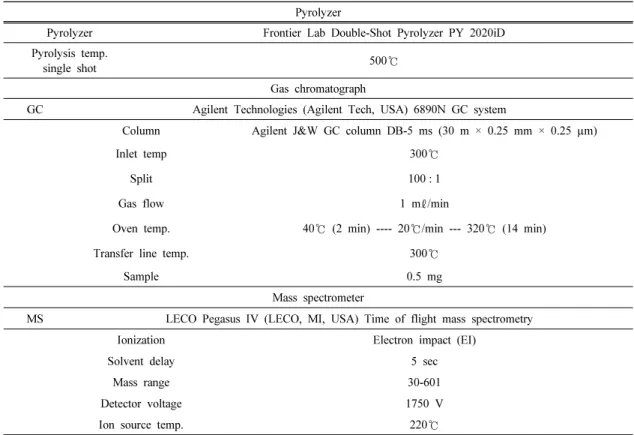
capillary column (30 m, 0.25 mm I.D.) coated with a 0.25 µm bonded film of DB-5 ms was used for the separation. The sample (0.5 mg) was placed in a stainless steel sample cup. The cup was placed on top of the pyrolyzer at near ambient temperature. Table 1 shows analysis condition.
2.2.2. FT-IR analysis
The chemical behavior of the wood tar was evaluated using FT-IR (Fourier Transform Infrared Spectroscopy, Excaliber FT/IR-3000).
The KBr method was used to measure the range of 800 to 4000 cm
-1.
2.2.3. NMR (Nuclear Magnetic Resonance) analysis
1
H and
13C NMR analyses were carried out using Bruker Avance III 700 MHz to examine the chemical structure of the wood. Analytical solvents were determined using CDCl
3.
2.2.4. Molecular weight distribution
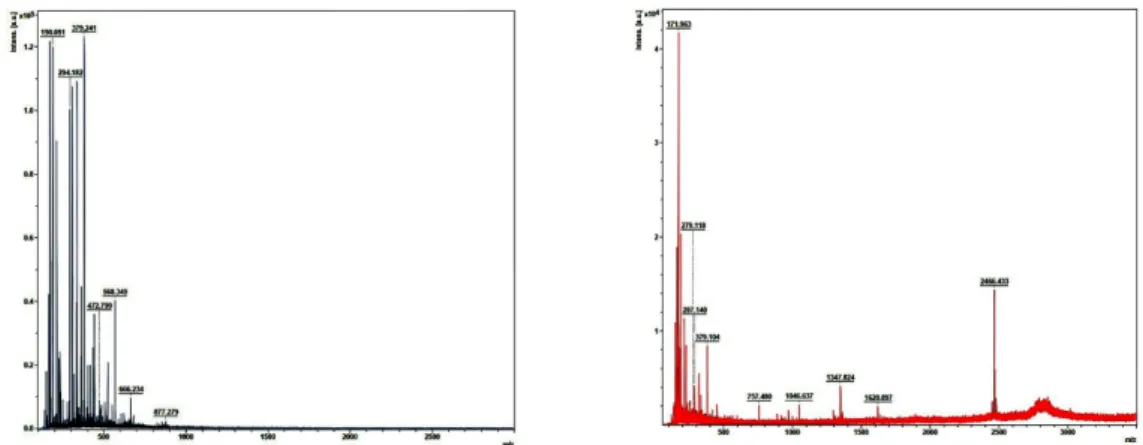
MALDI-TOF (Matrix-Assisted Laser Desorption Ionization-Time of Flight Mass Spectrometry) analysis was performed to examine the molec- ular weight distribution of wood tar. α-Cyano- 4hydroxycinnamic Acid was used as a matrix for ionization. Samples and matrix were mixed at a ratio of 1 : 20 and coated on a MALDI-TOF plate using a dried droplet method. The plate was dried at room temperature for 12 hours and analyzed.
Molecular weights of 60 - 3000 m/z were measured.
The equipment used was a Bruker Daltonics
Autoflex MALDI-TOF mass spectrometer.
2.2.5. Thermal properties
The thermal properties of wood tar were ana- lyzed by TGA (Thermogravimetric analysis) and DSC (Differential Scanning Calorimetry).
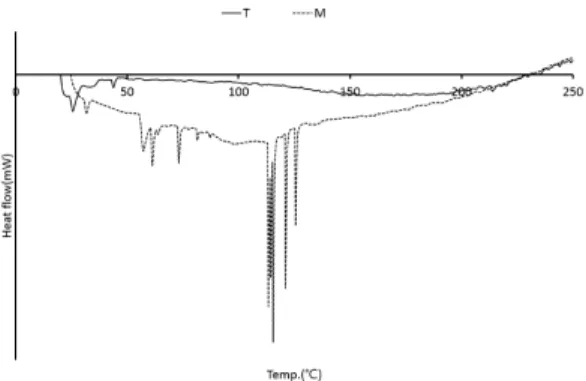
The thermogravimetric analysis was carried out by thermogravimetry of a 7 mg sample in a ni- trogen atmosphere using a thermogravimetric analyzer (Sinco, TGA N-1000) at 600 ℃ at a heating rate of 10 ℃/ min. Differential scanning calorimetry was performed using a differential scanning calorimeter (Sinco, DSC N-650). The peak of the endothermic or exothermic reactions was observed during the heating of the 2 mg sample to 260 ℃ at a rate of 5℃/ min. In a ni-
trogen atmosphere was analyzed.
3. RESULTS and DISCUSSION 3.1. Eletmental Analysis of Wood tar by
Py-GC/MS
The chromatogram of the wood tar produced from the modified traditional carbonized furnace using Py-GC/MS at 70-200 ℃, 300℃, and 450-800 ℃ is given in Fig. 1. Whereas, Fig. 2 is a summary of the peaks in the GC/MS chromato- gram by library searching and mass spectrum of acid, alcohol, aldehyde, ketone, furan, phenol, ester and hydrocarbons. Hydrocarbons were most
Pyrolyzer
Pyrolyzer Frontier Lab Double-Shot Pyrolyzer PY 2020iD Pyrolysis temp.
single shot 500 ℃
Gas chromatograph
GC Agilent Technologies (Agilent Tech, USA) 6890N GC system
Column Agilent J&W GC column DB-5 ms (30 m × 0.25 mm × 0.25 µm)
Inlet temp 300 ℃
Split 100 : 1
Gas flow 1 m ℓ/min
Oven temp. 40 ℃ (2 min) ---- 20℃/min --- 320℃ (14 min)
Transfer line temp. 300 ℃
Sample 0.5 mg
Mass spectrometer
MS LECO Pegasus IV (LECO, MI, USA) Time of flight mass spectrometry
Ionization Electron impact (EI)
Solvent delay 5 sec
Mass range 30-601
Detector voltage 1750 V
Ion source temp. 220 ℃
Table 1. Py-GC/MS conditions for samples analysis
abundant in the low-temperature region below 300 ℃ and fatty acid ratio in the high temperature region above 450 ℃. The acid was detected at a high rate in the condition of 450-850 ℃. Overall, the proportion of phenolic compounds was low.
The major components detected in each condition are as follows - components such as tetradecane (5.6%), nonadecane (7.2%), 2-propyn-1-ol (7.5%), eicosane (8.1%), hexadecane (10.9%) and hep- tacosane (7.9%) occupy a large proportion at 70-200 ℃. Friedelan-3-one (12.5%), heneicosane (5.7%) and tetradecane (4.6%) are the most im-
portant components at 300 ℃. Hexadecanoic acid (17.9%), methacrylic acid (23.1%) and 1-docosene (24.2%) were the most abundant in the high tem- Fig. 1. TIC profile for volatile products separated at different pyrolysis temperatures using wood tar from modi- fied traditional kiln.
Fig. 2. Comparison of the product distributions from
the wood tars of modified traditional kiln.
perature region (450-800 ℃).
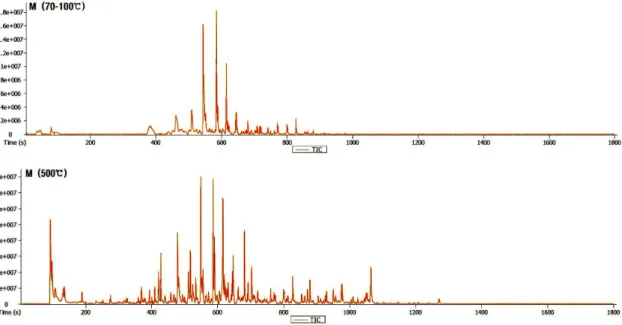
The Py-GC/MS chromatogram of the wood tar produced from the mechanical steel kiln Fig.
3, and Fig. 4 show the results of the compo- nents identified by library searching and mass spectrum of the detected peaks. Most of the wood tar produced from the mechanical steel
kiln was found to contain large amounts of phe- nolic and aromatic hydrocarbon components.
Sugar components were also detected under 500 ℃ condition. This could probably be due to py- rolysis of the cellulose and hemicellulose con- stituents of the wood. At 70-100 ℃, components such as cresol (6.6%), 4-ethyl-2-methoxy-phenol (6.2%), 2,6-dimethoxy-phenol (25.3%), 1,2,4-tri- methoxy benzene (14.8%) and 1,2,3-trime- thoxy-5-methyl (8.1) were detected. At 500 ℃, methyl alcohol (5.5%), 2,6-dimethoxy-phenol (7.6%), 1,2,4-trimethoxy benzene (7.5%), 1,2,3-trimethoxy- benzene (9.3%) were detected.
Overall, the ratio of phenolic compounds and aromatic compounds were found to be higher in the mechanical steel kiln than in the wood tar produced in the modified traditional kiln.
Ben and Regauskas (2011) reported that the
]
Fig. 3. TIC profile for volatile products separated at different pyrolysis temperatures using wood tar from me- chanical steel kiln.
Fig. 4. Comparison of the product distributions from
the wood tars of mechanical steel kiln.
formation of pyrolysis oil from lignin is related to pyrolysis temperature (Ben and Ragauskas, 2011), and Iatridis and Gavalas (1979) reported that hydrocarbon production increases with in- creasing lignin pyrolysis temperature (Iatridis and Gavalas, 1979). In addition, Alen et al.
(1996) showed that lignin was converted to pri- mary pyrolysis products such as vanillins and guaiacols at 400 ℃, vanillin derivatives were converted to various catechols and phenols at 600 ℃, and at above 800℃, thermoplastic hy- drocarbons (Aromatic hydrocarbons) and other phenols were formed as major pyrolysis prod- ucts (Alén et al., 1996). Therefore, it is consid- ered that the difference in the composition of the wood tar produced in the two kilns is influ- enced by the carbonization temperature during the production of the charcoal. Since the car- bonization temperature of the mechanical steel kiln is set at a condition of 400 ℃ to 450℃, the temperature in the kiln can be controlled.
However, since the carbonization temperature of the modified traditional kiln is manual, the tem- perature control is difficult and the condition in
which the wood tar is produced is generated at a high temperature (600 ℃) compared to the mechanical steel kiln. Due to this reason, it is considered that there is a difference in the com- position of the wood tar produced from the modified traditional kiln and the wood tar pro- duced from the mechanical steel kiln.
3.2. Structural Analysis of wood tar by NMR
13