정태준 외 1인: SHVC 및 MVC 통합 기반의 스케일러블 다시점 비디오 부호화 설계 및 구현 405 (Tae-jun Jung et al.: Design and Implementation of Scalable Multi-view Video Coding Based on Integartion of SHVC and MVC)
SHVC 및 MVC 통합 기반의 스케일러블 다시점 비디오 부호화 설계 및 구현
정 태 준a), 서 광 덕a)‡
Design and Implementation of Scalable Multi-view Video Coding Based on Integration of SHVC and MVC
Tae-jun Junga) and Kwang-deok Seoa)‡
요 약
다시점 이미지의 뷰포인트 간에 높은 유사도가 존재함을 바탕으로 MV-HEVC는 뷰포인트 내에서 전통적인 시간적 방향 예측 뿐만 아니라 뷰포인트 간에 예측을 수행함으로써 높은 부호화 효율을 얻는다. 본 논문에서는 HEVC를 기본 계층으로 사용하는 스케일러블 다시점 비디오 부호화를 구현하기 위해 SHVC와 MVC를 통합 구현함을 제안한다. 실험결과에 의해 BD-PSNR 개선이 1.5dB에 이르 고 동시에 BD-Bitrate를 50~60% 가량 줄일 수 있음을 확인하였다.
Abstract
Based on the fact that high similarities exist between viewpoints of multi-view images, MV-HEVC achieves high encoding efficiency by performing conventional temporal direction prediction in a single viewpoint as well as inter-view prediction between viewpoints. In this paper, we propose to integrate SHVC and MVC (Multi-view Video Coding) to implement scalable multi-view video encoder using HEVC as a base layer. According to experimental results, it is verified that the BD-PSNR improvement reaches up to 1.5dB while reducing the BD-Bitrate by around 50~60%.
Keywords : Scalable Multi-view video coding, HEVC, SHVC, MV-HEVC
a) 연세대학교 컴퓨터정보통신공학부(Division of Computer and Telecommunications Engineering, Yonsei University)
‡Corresponding Author : 서광덕(Kwang-deok Seo) E-mail: [email protected] Tel: +82-33-760-2788
ORCID: http://orcid.org/0000-0001-5823-2857
※This research was supported by the Basic Science Research Program through the National Research Foundation of Korea(NRF) funded by the Ministry of Education(NRF-2015R1D1A1A01058873).
・ Manuscript received December 30, 2016; Revised April 14, 2017; Accepted April 14, 2017.
레터논문 (Letter Paper)
방송공학회논문지 제22권 제3호, 2017년 5월 (JBE Vol. 22, No. 3, May 2017) https://doi.org/10.5909/JBE.2017.22.3.405
ISSN 2287-9137 (Online) ISSN 1226-7953 (Print)
406 방송공학회논문지 제22권 제3호, 2017년 5월 (JBE Vol. 22, No. 3, May 2017)
Ⅰ. Introduction
To provide optimum quality multi-view video service un- der heterogeneous network environments and mobile equip- ment, it is needed to encode multi-view video in a layered for- mat based on scalability [1], [2]. So it is important to develop a scalable multi-view video coding structure which combines multi-view video coding technology, MV-HEVC, and lay- ered video coding technology, SHVC [1]. But there must be an update in the reference picture management when we com- bine the two separate codecs to develop a scalable multi-view encoder. Reference picture is generally managed by reference picture list. To perform picture-to-picture prediction effi- ciently in the process of video encoding and decoding, many reference pictures should be stored in the memory. And the DPB (Decoded Picture Buffer) also needs to be changed to ac- commodate the developed scalable multi-view coding struc- ture [3].
In this paper, we propose an efficient design and im- plementation of scalable multi-view video coding based on integration of SHVC and MVC. The proposed design mainly consists of three parts: 1) reference picture reordering part which reorganize the sequence of the reference pictures, 2) marking process part which stores and dispatches refer- ence pictures to and from the DPB memory, and 3) refer- ence picture list reconstruction part which composes the two conventional reference picture lists, each one used for SHVC and MV-HEVC. With the proposed reference pic- ture list design, the predictive coding of the developed scalable multi-view video coding can be performed effi- ciently in terms of advanced prediction accuracy in motion estimation, systematic DPB management, and improved coding efficiency.
Ⅱ. Design Of Reference Picture List and Prediction Mechanism
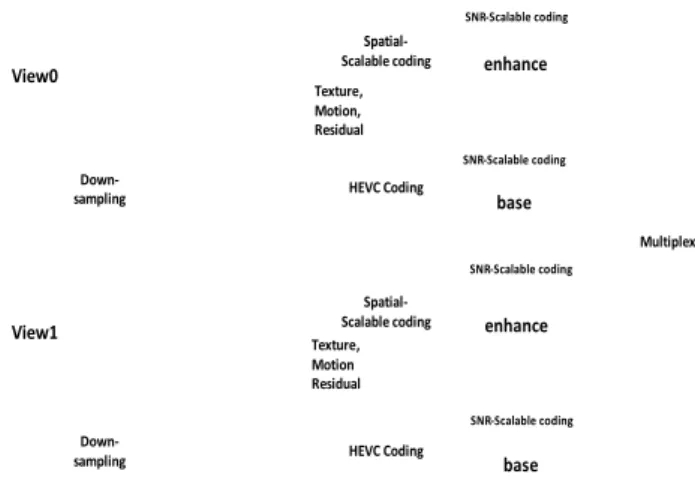
Fig. 1 shows the system architecture of the proposed scal- able multi-view video coding based on integration of SHVC and MVC for dual-views video, where major coding struc- tures and mechanisms of SHVC and MV-HEVC are integrated. Each view is basically processed by applying the layered coding mechanism of SHVC to generate the base and enhancement layers in a scalable way. To achieve inter-view prediction effect, the reconstructed picture of view0 is used as an additional reference frame for coding view1.
Down- sampling
Down- sampling View0
View1
Spatial- Scalable coding
SNR-Scalable coding
Multiplex HEVC Coding
SNR-Scalable coding
enhance
base Texture,
Motion, Residual
Spatial- Scalable coding
SNR-Scalable coding
HEVC Coding
SNR-Scalable coding
enhance
base Texture,
Motion Residual
그림 1. SHVC 및 MVC 결합 기반의 제안된 스케일러블 다시점 비디오 부호화 구조
Fig. 1. System architecture of the proposed scalable multi-view video cod- ing based on integration of SHVC and MVC
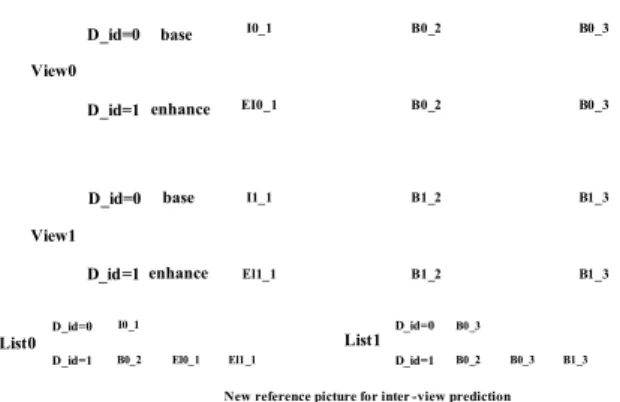
Fig. 2 shows the overall architecture of the designed refer-
ence picture list for the proposed scalable multi-view video
coding based on integration of SHVC and MVC employing
inter-view prediction. In this architecture, predictive coding
efficiency can be improved by using enhancement layer pic-
ture of view0 (B0_2) as an additional reference picture for
coding the picture of view1 (B1_2).
정태준 외 1인: SHVC 및 MVC 통합 기반의 스케일러블 다시점 비디오 부호화 설계 및 구현 407 (Tae-jun Jung et al.: Design and Implementation of Scalable Multi-view Video Coding Based on Integartion of SHVC and MVC)
I0_1 B0_2 B0_3
EI0_1 B0_2 B0_3
I1_1 B1_2 B1_3
El1_1 B1_2 B1_3
base
enhance
base
enhance D_id=0
D_id=1
D_id=0
D_id=1 View0
View1
B0_3
B0_2 B0_3 B1_3
D_id=0 D_id=1 List1
I0_1
B0_2 El0_1 El1_1 D_id=0
D_id=1 List0
New reference picture for inter -view prediction
그림 2. 시점 간 예측을 지원하기 위해 설계된 참조화면리스트의 전체 구조 Fig. 2. Overall architecture of the designed reference picture list supporting inter-view prediction
Fig. 3 shows prediction structures between layers. Each of them is denoted as follows: 1) simulcast case: all layers are coded independently with HM (HEVC test model) software, 2) MV-HEVC simulcast case: layers are coded with HTM (MV-HEVC reference software) where D1 and D0 are coded independently, 3) SHVC simulcast case: layers with spatial dependency are coded with SHM (scalable HEVC reference
D1V0 D1V0
D1V0 D1V0
D1
D0
V0 V1
Simulcast
D1V0 D1V0
D1V0 D1V0
D1
D0
V0 V1
SHVC
D1V0 D1V0
D1V0 D1V0
D1
D0
V0 V1
MV-HEVC
D1V0 D1V0
D1V0 D1V0
D1
D0
V0 V1
SHVC + MV-HEVC
software) where V0 and V1 are coded independently. 4) MV-HEVC+SHVC case: In addition to inter-view prediction predicted from D0 at the same view using inter-layer pre- diction, D1 is predicted from D0 at the same view using in- ter-layer prediction. In this implementation, we adopted the prediction mechanism of 4) MV-HEVC+SHVC case.
Ⅲ. Experimental Results
In order to evaluate the compression efficiency and video quality after applying the proposed mechanism in actual cod- ing process, we developed a scalable multi-view video coding system which integrates SHM-10.0 [4] and HTM-13.1 [5]
together. Test condition for the performance evaluation was set to GOP_size=8, Intra_period=16, and frame_rate=25 frames per second. We used Poznan Hall HD sequences which are composed of dual views, one for the left-view and the other for the right-view. The maximum number of refer- ence frames for motion estimation was set to 6. We compare the performance in terms of compression efficiency and aver- age PSNR between the bitstreams generated by the conven- tional SVC+MVC predictive coding mechanism and by the proposed predictive coding mechanism integrating SHVC and MVC. The test is performed using four different values of QP (quantization parameter) values such as 27, 30, 33, and 35.
Table 1 shows the test results for coding the left-view video of the Poznan Hall sequences with HD resolution. “SVC pre- diction” in Table 1 denotes the results of coding for the left-view video by using MVC+SVC predictive coding architecture. “Proposed prediction” denotes the results ob- tained by using the proposed predictive coding architecture.
The experimental results in Table 1 show that we could achieve
408 방송공학회논문지 제22권 제3호, 2017년 5월 (JBE Vol. 22, No. 3, May 2017)
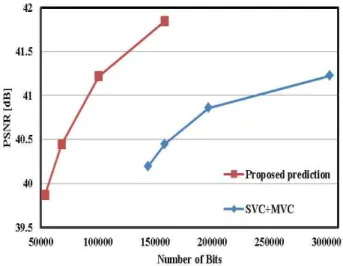
1.4697 dB increase in BD-PSNR and 57.5634% decrease in BD-Bitrate at the same time by employing the proposed pre- diction mechanism. Fig. 4 shows the comparison of PSNR performance by plotting RD (rate-distortion) curve for the Poznan Hall test sequences.
그림 4. Poznan Hall 시퀀스에 대한 PSNR 성능 비교
Fig. 4. Comparison of PSNR performance for the Poznan Hall sequence.
Overall, the application of the proposed prediction archi- tecture results in not only decrease in compressed data size measured in bit-rate, but also quality improvement measured in average PSNR, when compared to the SVC's conventional prediction architecture, and this performance improvement is proportional to the size of QP values. For other test sequences, we could observe similar improved results in terms of
BD-PSNR and BD-Bitrate.
Ⅳ. Conclusions
In this paper, we proposed an efficient design and im- plementation of scalable multi-view video coding based on integrating SHVC and MVC mechanism. Experimental re- sults showed the superiority of the proposed scalable mul- ti-view video coding compared to the conventional im- plementation in terms of compression efficiency and video quality.
참 고 문 헌 (References)
[1] H. Schwarz, D. Marpe, and T. Wiegand, “Overview of the scalable vid- eo coding extension of the H.264/AVC standard,” IEEE Trans.
Circuits Syst. Video Technol., Vol. 17, No. 9, pp. 1103-1120, Sep. 2007.
[2] A. Vetro. T. Wiegand, and G. Sullivan, “Overview of the Stereo and multiview video coding extensions of the H.264/MPEG-4 AVC stand- ard,” Proc. IEEE, Vol. 99, No. 4, pp. 694-707, Apr. 2011.
[3] T. Jung, H. Lee, and K. Seo, “Design schemes for scalable multi-view video coding using GPB,” IEEE International Conference on
Consumer Electronics (ICCE), Las Vegas, USA, 2015.
[4] “SHM reference software version 10.0,” available at https://hevc.hhi.
fraunhofer.de/shvc.
[5] “MV-HEVC reference software version 13.1,” available at https://hevc.
hhi.fraunhofer.de/mvhevc.
Encoding test sequence data
SVC+MVC Proposed prediction BD-PSNR
(dB)
BD-Bitrate (%)
(bits) (PSNR) (bits) (PSNR)
Poznan Hall
QP=27 302880 41.67 158224 41.84
1.47 -57.56
QP=30 196728 40.86 100505 41.22
QP=33 158496 40.45 68093 40.44
QP=35 143872 40.20 53612 39.87
표 1. HD급 해상도의 Poznan Hall 시퀀스에 대한 다양한 QP 값 변동에 따른 BD-PSNR 및 BD-Bitrate 비교
Table 1. Comparison of BD-PSNR and BD-Bitrate for various QP values for the Poznan Hall video sequences of HD resolution