산림치유 프로그램 개발을 위한 일반 성인의 숲과 숲길의 선호도 분석 1a
김윤희2*⋅김동준3⋅연평식4⋅최병진5
Preference Analysis of General Adult on the Forest and Forest Road for the Development of Forest Therapy Program
1aYoun-Hee Kim
2*, Dong-Jun Kim
3, Pyung-Sik Yeoun
4, Byung-Jin Choi
5요 약
본 연구는 산림치유 프로그램 개발을 위한 일반 성인의 숲과 숲길의 선호도에 관한 연구이다. 숲과 숲길의 선호도에 대한 수요자 선호를 파악하여 보다 표적화되고 차별화된 산림치유 프로그램의 개발을 위한 기초자료 제공을 목적으로 실시하였다. 이를 위해, 잠재 수요자인 일반 성인 남·여를 대상으로 2014년 4월 19일부터 6월 30일까지 온라인 설문으 로 숲과 숲길의 선호에 관한 설문조사를 실시하였다. 본 연구에서는 총 613부의 유효표본이 실제 분석에 사용되었다.
자료분석은 SPSS 21.0 프로그램을 사용하여 기술통계분석, 빈도분석, 교차분석, 다중응답분석을 통해 인구통계학적 특성(성별, 연령, 교육수준, 직업, 월평균 가계 소득)에 따른 숲과 숲길의 선호도의 차이를 살펴보았다. 분석 결과, 선호하는 계절의 숲은 봄, 가을, 계절 상관없음, 여름, 겨울 순으로 나타났고, 성별, 연령, 월평균 가계 소득에 따라 선호도에 유의한 차이가 있는 것으로 조사되었다. 선호하는 상태의 숲은 월평균 가계 소득에 따라 선호도에 유의한 차이가 있는 것으로 조사되었다. 산림치유 프로그램 장소로서 선호하는 숲은 자연휴양림, 치유의 숲, 도시숲, 공원, 학교숲 순으로 응답하였다. 거주지로부터 프로그램 장소까지의 거리에 따른 선호하는 숲을 조사한 결과 모든 경우에 대해 통계적으로 유의한 차이가 없게 나타났다. 숲길의 형태에 관해서는 약간의 경사가 있는 길을 가장 선호하는 것으로 조사되었다. 산림치유 목적으로 1회 걸을 때 선호하는 숲길의 길이는 1.5~3㎞, 1.5㎞이하, 3㎞ 이상 순으로 나타났고, 성별과 연령, 교육, 월평균 가계 소득, 교육에 따라 선호도에 유의한 차이가 있는 것으로 조사되었다. 이러한 산림치유 프로그램 개발을 위한 일반성인의 숲과 숲길조사를 통하여, 성별, 연령, 교육수준, 직업, 월평균 가계 소득에 따라 숲과 숲길에서의 프로그램에 차별성을 두어야 할 것으로 판단된다. 특히, 연령에 따라 차별화된 프로그램이 제공되 어야 할 것으로 판단된다. 본 연구 분석 결과가 성인을 대상으로 하는 산림치유 프로그램 개발을 위한 기초자료로 활용되기를 기대한다.
주요어: 온라인 설문조사, 인구통계학적 특성, 표적화, 차별화
1 접수 2014년 9월 15일, 수정 (1차: 2014년 10월 10일, 2차: 2014년 10월 19일), 게재확정 2014년 10월 20일 Received 15 September 2014; Revised (1st: 10 October 2014, 2nd: 19 October 2014); Accepted 20 October 2014 2 충북대학교 대학원 산림치유학과 Forest Therapy, Graduate School, Chungbuk National Univ., Cheongju 361-763, Korea([email protected]) 3 충북대학교 대학원 산림학과 Forest Science, Chungbuk National Univ., Cheongju 361-763, Korea([email protected]) 4 충북대학교 대학원 산림학과 Forest Science, Chungbuk National Univ., Cheongju 361-763, Korea([email protected]) 5 충북대학교 대학원 산림치유학과 Forest Therapy, Graduate School, Chungbuk National Univ., Cheongju 361-763, Korea([email protected]) a 이 논문은 충북대 ‘BK21 플러스 산림치유특화전문인재양성사업단’ 지원으로 연구되었음.
* 교신저자 Corresponding author: [email protected]
ABSTRACT
The preference of general adult on the forest and forest road was surveyed and analyzed for the development
of forest therapy program. This study was conducted for the purpose of providing a basis for the development of more targeted-and differentiated-forest therapy program by analyzing the preference of general adult on the forest and forest road from 19 April 2014 to 30 June 2014 through on-line survey. The sample group of 613 adults has been used in practical analysis. Using SPSS 21.0, We looked at the preference differences of the forest and forest road according to the demographic characteristics(sex, age, education level, occupation and monthly income) through descriptive statistics analysis, frequency analysis, cross tabulation analysis, multiple response analysis. The seasonal preference was spring, autumn, any season, summer, winter in order and there was a significant difference according to one's sex, age, occupation and monthly income. There was a significant difference in the configuration of forest according to one's monthly income. The favorite type of forest as a place of forest healing program was natural recreational forest, healing forest, urban forest, park, school forest in order. There was no significant difference in the favorite forest type regarding to the distance to the healing place from one's residence in all cases. There was a significant difference in the type of forest according to one's monthly income. The most favorite configuration of forest road was gentle sloped road. Once walking into the forest for the purpose of healing, the favorite forest road length was 1.5 ~ 3 ㎞, less then 1.5 ㎞, more than 3
㎞ in order and there was a significant difference in preference according to one's sex, age, education level and monthly income. We believe that the healing program should be differentiated from the general form of it according to one's sex, age, education level, occupation and monthly income as a result of this investigation of preference of general adult on the forest and forest road for the development of forest therapy program. In particular, we believe that the differentiated program should be offered according to one's age. We expect this analysis to be used as a basis for the development of forest therapy program.
KEY WORDS: ON-LINE SURVEY, DEMOGRAPHIC CHARACTERISTICS, TARGETED, DIFFERENTIATED
서 론
2012년 국민여가활동조사에 의하면 우리나라 국민이 향 후 집 이외에 가장 이용하고 싶은 개별 여가 공간(1순위 기 준)으로 ‘숲’(8.2%)이 가장 높게 나타났다(Ministry of Culture, Sports and Tourism, 2012). 2013년 국민 생활체육 참여 실태조사에 의하면, 생활체육 참여 종목은 전체적으로 걷기(31.8%)가 가장 많았으며 그 다음으로 등산(22.6%)순 으로 나타났다(Ministry of Culture, Sports and Tourism, 2013). 국민의 81.6%가 적어도 1년에 1회 이상 숲을 방문하 고 있고(An et al., 2010), 숲길 이용이 증가되고 있으며, 그 수요가 급증하고 있다(Korea Forest Service, 2012). 이처 럼, 산림 내에서의 활동이 확대되면서 산림치유 프로그램에 대한 요구도 증가하고 있다.
산림치유란 향기, 경관 등 자연의 다양한 요소를 활용하 여 인체의 면역력을 높이고 건강을 증진시키는 활동을 말한 다(Korea Forest Service, 2013). 산림치유 프로그램 개발에 관한 연구(Kim et al., 2008; Shin, 2013; Kim, 2014; An
and Lee, 2013; Lee, 2011), 산림치유 효과성 규명에 관한 연구(Hong et al., 2010; Yoo, 2011; Lee et al., 2010; Lee et al., 2011; Lee et al., 2014; Min, 2014), 산림치유 프로그 램 개발을 위한 성인 대상별 관심도 및 요구도 분석(Kim et al.,2014), 성인의 산림치유 프로그램 선호도 분석(Kim et al.,2014)에 관한 연구 등이 진행되었다.
숲길은 현재 확산되고 있는 산림휴양서비스의 한 분야로, 숲이 지닌 보건의학적인 기능을 활용하여 심신의 안정을 취 하려는 사람들을 위해 치유목적으로 숲에 조성된 길이다 (Kim, 2009). 숲길 이용자들의 이용경험과 관계된 연구도 진행되었다. Kwon and Lee(2013)는 대구 광역시 숲길을 중심으로 대도시 생활권 숲길 이용자의 방문동기 및 이용만 족, Lee et al.(2011)은 지리산 숲길 이용객의 만족도와 행동 의도 영향 요인, Son and Ha(2012)는 숲길 특성에 따른 이 용객의 이용행태 비교, Seo et al.(2013)은 숲길 유형별에 따른 이용객 이용행태 및 심리적 편익 분석 등에 관해 조사 분석하였다. 대부분 숲길의 이용행태와 만족도 수준을 분석 하는 연구들이 있다. 숲길 관련 이용자 경험과 관계된 연구 이외에도 최근 북한산 국립공원 조성 관련 지역 주민 인식에
Variable Categories Scale Number Demographics
of respondents Sex, Age, Education, Monthly income, Occupation Nominal 5 Favorite
forest
① Favorite season in forest(spring, summer, fall, winter)
② Favorite type of forest
(urban forest, school forest, park, healing forest, natural recreation forest)
③ Distance-related preferring forest(nearby-not so good, far away-good)
Nominal 3
Favorite forest road
④ Favorite forest road(flat, gentle slope, a little steepy, quite steepy)
⑤ Favorite forest road length once walking into the forest (less then 1.5km, 1.5~3km, more then 3km)
Nominal 2
Total 10
Table 1. Survey contents
관한 연구도 진행되었다(Kim, 2011; Yoo et al., 2012).
Yoo(2014)는 지리산 둘레길을 중심으로 이용자 인식, Lee and Kim(2013)은 숲길 경관과 숲길 주변 임목밀도에 대한 대중의 선호도를 조사 분석하였다. 또한, 숲길 프로그램 개 발을 위한 이용객 특성 분석에 관한 연구(Son et al., 2012) 도 진행되었다. 숲 조성사업이 확대되면서, 치유의 숲 내에 서 어떤 활동을 할 것인가, 어떤 프로그램을 진행할 것인가 에 대한 논의가 진행 중이다(Ha, 2014).
산림치유 프로그램 개발 및 운영 시 각 대상을 고려해 맞춤형으로 특화된 서비스가 요구되고 있다(Seok and An, 2013). Seo et al.(2013)은 숲길 이용객들의 심리적 편익을 향상시키기 위해서는 이용객 특성에 따른 효율적인 숲길 조 성 및 양질의 숲길 이용 서비스 제공이 필요하다고 했다.
산림치유 프로그램 개발은 대상자 이해(요구조사), 목적 및 목표설정, 프로그램 계획, 프로그램 실행 및 효과평가 과정 을 거친다. 산림치유 프로그램을 개발하는 데 있어서 일차적 으로 가장 중요한 것은 치유 프로그램에 참여하고자 하는 대상이 누구인가를 파악하여 대상자를 이해하는 것이다(Ha, 2014). 산림치유 프로그램의 대상자는 특정 질환이나 질병 이 있는 환자군 뿐 아니라 일반인들을 포함하여 심신의 회복 과 휴양, 생활습관 개선 등 신체와 정신의 건강을 원하는 모두이다(Korea Forest Research Institute, 2014). 개인적 특성(성별, 연령, 직업, 학력 등), 질병의 유무(건강인, 준환 자, 환자), 질병의 종류 등에 따라 산림치유 프로그램에 대한 다양한 요구와 특성을 가지고 있다(Yeoun, 2014; Park et al., 2012). 참가자들의 특성은 프로그램에 영향을 미친다.
한 집단의 특성에 방향이 맞춰진 프로그램은 다른 특성의 집단에게는 효과적이지 않을 수 있다(Yeoun, 2014). 이런 관점에서 산림치유 프로그램은 참가자들의 특성을 파악하 고 각각의 요구되어지는 바를 바탕으로 하여 제시되어야 한 다(Ha, 2014). 대상자를 이해하기 위해서는 참가자들에 대 한 사전조사를 선행해야 한다. 이러한 흐름을 반영하여 산림 치유 프로그램에 참여하는 잠재 수요자들의 숲과 숲길에 대 한 선호를 파악하는 것은 산림치유 프로그램 서비스 제공
시 의미가 있고, 산림치유의 치유효과를 높이기 위해 매우 유의미하고 필연적인 과제라 할 수 있다. Lee et al.(2011)의 연구에 의하면 산림치유 프로그램에 참여한 대상자 중 가장 높은 비율이 일반인 집단이라고 하였다.
이에 본 연구는 산림치유 프로그램에 참여할 잠재 수요자 인 일반 성인을 대상으로 숲과 숲길의 선호를 파악하여 인 구통계학적 특성에 따라 숲과 숲길의 선호도 차이를 분석하 고, 대상의 특성에 맞춘 산림치유 프로그램 개발과 실행을 위한 기초자료를 제공하고자 수행되었다.
연구방법
1. 대상 및 조사방법
본 연구에서의 설문조사는 산림치유에 참여하게 될 잠재 수요자인 일반 성인(만 19세 이상) 남·여를 대상으로 편의표 본추출(convenience sampling)방법으로 2014년 4월 19일 부터 6월 30일까지 온라인 설문으로 실시하였다. 서울·경기 지역 E여성인력개발센타와 N여성인력개발센터, S중학교, H기업, K대학교, H동호회를 대상으로 연구 주제를 설명하 고 설문에 참여의사가 있는 경우에 한해서 설문지를 배포하 였다. 또한 연구 참여자의 남편, 자녀, 친구, 동료 등도 참여 의사가 있는 경우 설문지를 배포하였다. 총 1,300부 중 660 부가 회수되어 50.8%의 응답률을 보였다. 회수된 설문지 중 무응답, 중복응답으로 인한 통계처리가 불가능한 총 47 부를 제외하고, 총 613부의 유효표본이 실제 분석에 사용되 었다.
2. 설문지 구성
설문지 구성은 인구통계학적 질문, 선호하는 계절의 숲, 산림치유 프로그램 장소로 선호하는 숲, 산림치유 프로그램 장소까지의 거리에 따른 선호하는 숲, 선호하는 숲길의 형 태, 산림치유 목적으로 걷는 숲길의 길이에 대한 선호도의
Category
Frequency(%)
χ2, p
Spring Summer Fall Winter Any
Season Sum
Sex Male 55(26.3) 32(15.3) 74(35.4) 6(2.9) 42(20.1) 209(100) 16.570,
0.002**
Female 173(42.8) 48(11.9) 105(26.0) 8(2.0) 70(17.3) 404(100)
Age
20~29 25(30.5) 10(12.2) 27(32.9) 3(3.7) 17(20.7) 82(100)
38.633, 0.000***
30~39 51(41.1) 12(9.7) 36(29.0) 3(2.4) 22(17.7) 124(100)
40~49 91(36.3) 32(12.7) 94(37.5) 5(2.0) 29(11.6) 251(100)
Over 50 61(39.1) 26(16.7) 22(14.1) 3(1.9) 44(28.2) 156(100)
Education
Less than high school 20(37.0) 4(7.4) 19(35.2) 2(3.7) 9(16.7) 54(100)
7.781, 0.082 College/university student 27(35.1) 8(10.4) 24(31.2) 2(2.6) 16(20.8) 77(100)
Graduate from college 126(36.3) 45(13.0) 105(30.3) 7(2.0) 64(18.4) 347(100) More than graduate school 55(40.7) 23(17.0) 31(23.0) 3(2.2) 23(17.0) 135(100)
Occupation
Student 25(35.7) 9(12.9) 22(31.4) 3(4.3) 11(15.7) 70(100)
41.151, 0.052
Teacher 31(46.3) 5(7.5) 16(23.9) 0(0.0) 15(22.4) 67(100)
Housewife 48(39.3) 16(13.1) 37(30.3) 2(1.6) 19(15.6) 122(100)
Producer․Technician․Server 27(45.0) 9(15.0) 19(31.7) 0(0.0) 5(8.3) 60(100) Secretary․Administrant․Executive 32(32.7) 17(17.3) 28(28.6) 0(0.0) 21(21.4) 98(100) Self-employed․CEO 12(29.3) 4(9.8) 14(34.1) 4(9.8) 7(17.1) 41(100) Specialist․Researcher 30(46.2) 9(13.8) 12(18.5) 2(3.1) 12(18.5) 65(100) Unemployed․Etc. 23(25.6) 11(12.2) 31(34.4) 3(3.3) 22(24.4) 90(100) Monthly
income (Won)
Less than 2 millions 55(26.3) 32(15.3) 74(35.4) 6(2.9) 42(20.1) 209(100)
16.570, 0.002 2 millions - less than 4 millions 173(42.8) 48(11.9) 105(26.0) 8(2.0) 70(17.3) 404(100)
More than 4 millions 228(37.2) 80(13.1) 179(29.2) 14(2.3) 112(18.3) 613(100)
Total 288(37.2) 80(13.1) 179(29.2) 14(2.3) 112(18.3) 613(100)
Table 2. Favorite season in forest
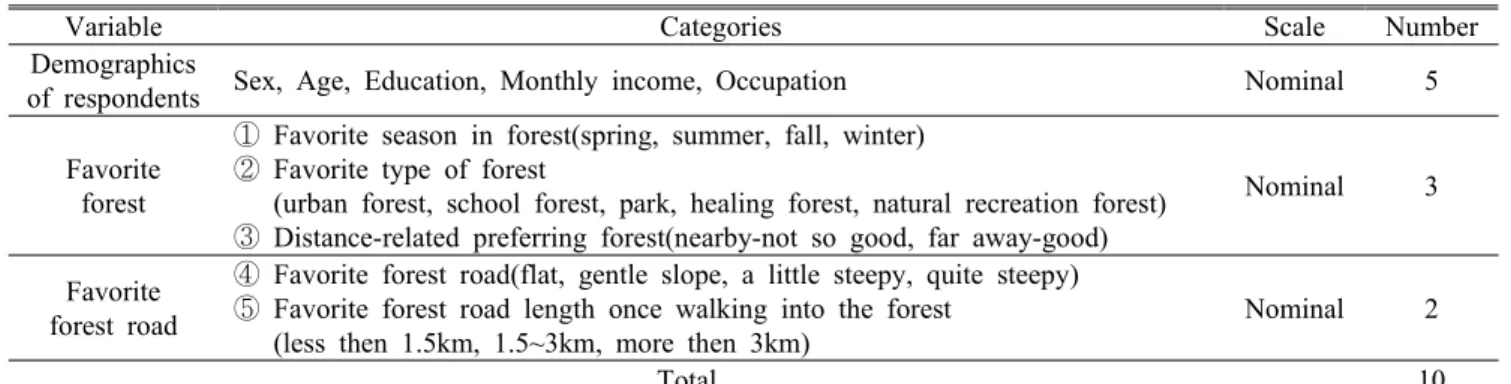
내용으로 구성되었다. 설문문항 구성을 위해 기존 연구의 설문항목(Kim, 2013; Shin et al., 2013; Lee and Kim, 2013)을 참고하였고, 관련 전문가 4인의 검토를 통해 완성 되었다. 설문내용은 명목척도(Nominal scale)를 이용하여 단순 선택형, 양자 선택형, 다중선택형으로 이루어졌다. 내 용은 (Table 1)에서 보는 바와 같다.
3. 자료분석
모든 자료의 통계적 처리와 분석은 SPSS 21.0 프로그램 을 이용하여, 기술통계분석(Descriptive statistics), 빈도분 석(Frequency analysis), 교차분석(Cross tabulation analysis), 다중응답분석(Multiple response)을 통해 일반 성인의 숲과 숲길의 선호도의 차이를 살펴보았다.
결과 및 고찰
1. 응답자의 인구통계학적 특징
응답자의 인구통계학적 특성을 분석한 결과, 성별은 남성 209명(34.1%), 여성 404명(65.9%)으로 여성 응답자 비율 이 다소 높게 나타났다. 연령대 분포는 20대 82명(13.4%),
30대 124명(20.2%), 40대 251명(40.9%), 50대 이상 156명 (25.4%)의 분포로 40대의 비율이 높은 것으로 확인되었다.
교육수준은 대학졸업 347명(56.6%), 대학원 석사 이상 135 명(22.0%), 대학재학 77명(12.6%), 고졸이하 54명(8.8%) 순으로 나타났다. 월평균 가계 소득으로 400만원 이상의 응답자가 274명으로(44.7%) 가장 많았고, 200만원 이상 400만원 미만 188명(30.7%), 200만원 미만 101명(16.5%) 순으로 나타났다. 직업별 분포는 주부 122명(19.9%), 사무․
행정․관리직 98명(16.0%), 무직·기타 90명(14.7%), 학생 70 명(11.4%), 교직 67명(10.9%), 전문․연구직 65명(10.6%), 생산․기술․서비스직 60명(9.8%), 자영업․CEO 41명(6.7%) 순으로 나타났다.
2. 산림치유 프로그램 장소로 선호하는 숲
1) 선호하는 계절의 숲
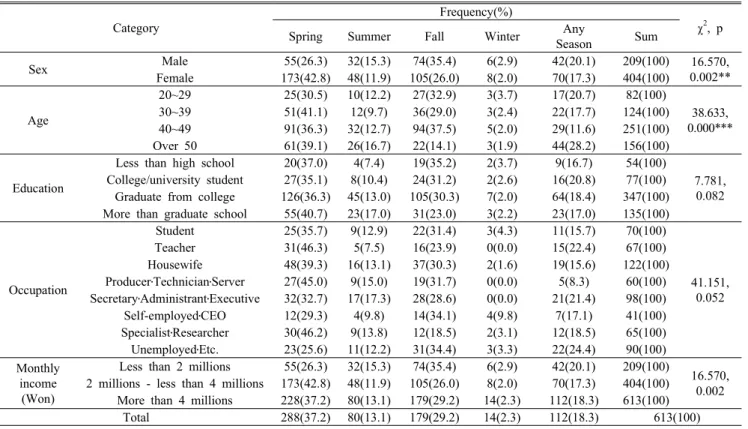
선호하는 계절의 숲을 조사한 결과, 봄 288명(37.2%), 가을 179명(29.2%), 계절 관계없음 112명(18.3%), 여름 80 명(13.1%), 겨울 14명(2.3%)의 순으로 조사되었다. 여성은 봄 173명(42.8%), 가을 105명(26.0%), 계절 관계없음 70명 (17.3%), 여름 48명(11.9%), 겨울 8명(2.0%) 순으로, 남성 은 가을 74명(35.4%), 봄 55명(26.3%), 계절 관계없음 42명
Category
Frequency(%)
Urban forest
School
forest Park Healing
forest
Natural Recreation
Forest
Sum
Sex Male 41(11.6) 1(0.3) 27(7.7) 109(31.0) 174(49.4) 352(35.0)
Female 74(11.3) 4(0.6) 31(4.7) 241(36.8) 305(46.6) 655(65.0)
Age
20~29 17(10.8) 2(1.3) 19(12.1) 50(31.8) 69(43.9) 157(15.6)
30~39 22(11.2) 1(0.5) 6(3.0) 72(36.5) 96(48.7) 197(19.6)
40~49 59(13.9) 2(0.5) 26(6.1) 144(33.9) 194(45.6) 425(42.2)
Over 50 17(7.5) 0(0.0) 7(3.1) 84(26.8) 120(52.6) 228(22.6)
Education
Less than high school 12(22.2) 0(0.0) 7(13.0) 33(61.1) 45(83.3) 54(8.8) College/university student 18(23.4) 2(2.6 ) 15(19.5 ) 45(58.4) 63(81.8) 77(12.6)
Graduate from college 65(18.7 ) 2(0.6 ) 26(7.5) 185(53.3) 265(76.4) 347(56.6) More than graduate school 20(14.8) 1(0.7) 10(7.4) 87(64.4) 106(78.5) 135(22.0)
Occupation
Student 15(11.5) 2(1.5) 14(10.8) 42(32.3) 57(43.8) 130(12.9)
Teacher 10(9.6) 0(0.0) 4(3.8) 40(38.5) 50(48.1) 104(10.3)
Housewife 23(11.6) 1(0.5) 8(4.0) 70(35.2) 97(48.7) 199(19.8)
Producer․Technician․Server 9(9.4) 0(0.0) 4(4.2) 34(35.4) 49(51.0) 96(9.5) Secretary․Administrant․Executive 22(13.3) 0(0.0) 11(6.7) 56(33.9) 76(46.1) 165(16.4)
Self-employed․CEO 6(9.5) 0(0.0) 6(9.5) 16(25.4) 35(55.6) 63(6.3)
Specialist․Researcher 7(6.6) 1(0.9) 6(5.7) 42(39.6) 50(47.2) 106(10.5)
Unemployed․Etc. 23(16.0) 1(0.7) 5(3.5) 50(34.7) 65(45.1) 144(14.3)
Monthly income
(Won)
Less than 2 millions 25(18.5) 1(0.7) 13(9.6) 77(57.0) 99(73.3) 135(22.0) 2 millions - less than 4 millions 33(17.6) 2(1.1) 15(8.0) 105(55.9) 145(77.1) 188(30.7) More than 4 millions 57(19.7) 2(0.7) 30(10.3) 168(57.9) 235(81.0) 290(47.3)
Total 115(11.4) 5(0.5) 58(5.8) 350(34.8) 479(47.6) 1007(100)
Table 3. Favorite forest type
(20.1%), 여름 32명(15.3%), 겨울 6명(2.9%) 순으로 나타났 다. 이 같은 결과는, 여성은 봄의 숲을, 남성은 가을의 숲을 더 선호하는 경향이 있다고 판단된다. 연령별로 살펴보면, 20대와 40대는 가을을, 30대와 50대는 봄을 가장 선호하는 것으로 나타났다. 교육수준으로 살펴보면, 봄, 가을, 겨울과 계절 관계없음 순으로 나타났다. 월평균 가계 소득으로 살 펴보면, 100만원대 이하, 200만원대, 300만원대는 가을을, 100만원대, 400만원대, 500만원 이상, 기타는 봄을 선호하 는 것으로 각각 나타났다. 직업별로 살펴보면, 자영업·CEO 와 무직·기타는 가을을, 그 외의 직업은 봄을 가장 선호하는 것으로 나타났다. 이는 각 계절의 특성에 맞는 다양한 프로 그램 개발이 필요한 것으로 판단되며 또한 성별, 연령, 월평 균 가계 소득에 따른 선호도 차이도 함께 고려해야 할 것으 로 해석된다(Table 2).
2) 산림치유 프로그램 장소로 선호하는 숲
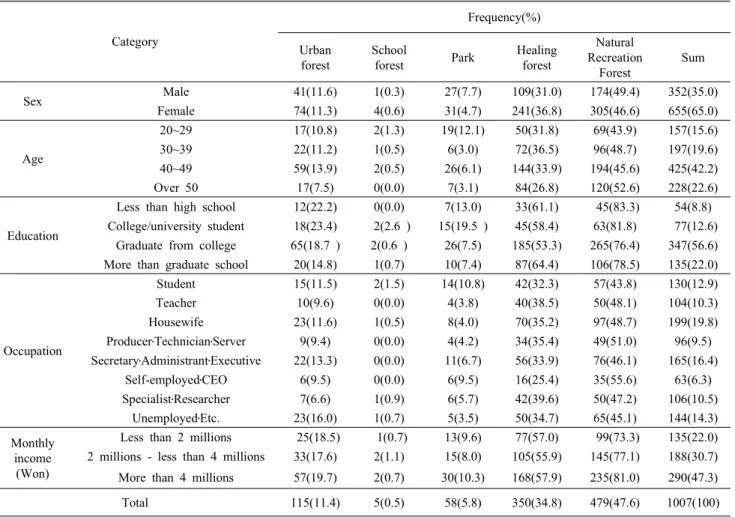
산림치유 프로그램 장소로 선호하는 숲을 2곳 이상 선택 하는 복수응답을 다중응답분석한 결과 자연휴양림 479명
(47.6%), 치유의 숲 350명(34.8%), 도시숲 115명(11.4%), 공원 58명(5.8%), 학교숲 5명(0.5%)순으로 응답하였다. 일 반 성인은 산림치유 프로그램 장소로 자연휴양림과 치유의 숲을 가장 선호하는 것으로 조사되었다(Table 3). 프로그램 장소로 자연 휴양림의 선호도가 높은 것은 자연휴양림의 개수가 치유의 숲의 경우보다 상대적으로 많기 때문이라고 판단된다. Kim(2013)은 현대인들의 스트레스를 해소하기 위한 산림공간으로 멀리 떨어져 있는 자연휴양림보다는 도 시 생활권 주변에 가까이에 위치하는 일반 도시숲에서 대부 분 해소가 가능하다고 하였다. 따라서, 산림치유 프로그램 장소로서 도시숲, 공원, 학교숲의 가치에 관해 적극적인 홍 보가 필요하고, 도시숲, 공원, 학교숲을 이용한 산림치유 프 로그램 개발 역시 함께 병행되어야 할 것으로 판단된다.
3) 프로그램 장소까지의 거리에 따른 선호하는 숲 거리에 따라 어떤 숲을 선호하는지에 관해서 살펴본 결 과, 가까이에 있으면서 적당한 숲 423명(69.0%), 거리는 멀 지만 좋은 숲 190명(31.0%)으로 조사되었다. 성별, 연령,
Category Frequency(%)
χ2, p Nearby - not so good Far away - good Sum
Sex Male 139(66.5) 70(33.5) 209(100) 0.925,
0.192
Female 284(70.3) 120(29.7) 404(100)
Age
20~29 56(68.3) 26(31.7) 82(100)
1.172, 0.760
30~39 89(71.8) 35(28.2) 124(100)
40~49 175(69.7) 76(30.3) 251(100)
Over 50 103(66.0) 53(34.0) 156(100)
Education
Less than high school 37(68.5) 17(31.5) 54(100)
2.423, 0.489
College/university student 48(62.3) 29(37.7) 77(100)
Graduate from college 240(69.2) 107(30.8) 347(100)
More than graduate school 98(72.6) 37(27.4) 135(100)
Occupation
Student 45(64.3) 25(35.7) 70(100)
5.589, 0.588
Teacher 51(76.1) 16(23.9) 67(100)
Housewife 88(72.1) 34(27.9) 122(100)
Producer․Technician․Server 44(73.3) 16(26.7) 60(100)
Secretary․Administrant․Executive 65(66.3) 33(33.7) 98(100)
Self-employed․CEO 25(61.0) 16(39.0) 41(100)
Specialist․Researcher 42(64.6) 23(35.4) 65(100)
Unemployed․Etc. 63(70.0) 27(30.0) 90(100)
Monthly income
(Won)
Less than 2 millions 94(69.6) 41(30.4) 135(100)
1.819, 0.403 2 millions - less than 4 millions 136(72.3) 52(27.7) 188(100)
More than 4 millions 193(66.6) 97(33.4) 290(100)
Table 4. Favorite forest type regarding to the distance 교육수준, 직업, 월평균 가계 소득에 대해 프로그램 장소까 지의 거리에 따른 선호하는 숲이 통계적으로 차이는 없었 다. 그러나, 여성은 남성보다 가까이에 있는 숲을 선호하는 것으로 나타났다. 연령별로 살펴보면, 30대가 다른 연령대 에 비해 가까이에 있으면서 적당한 숲을 선호하는 것으로 나타났다. 다른 연령과 비교해서 30대는 배우자를 선택하 고, 결혼해서 가정을 이루고, 자녀를 양육하고, 가정을 관리 하고, 직업생활을 시작하는 등의 발달 과업을 수행해야 하 는 시기로 어느 연령대보다도 바쁜 시간을 보낸다(Jang, 2009)는 선행연구결과로써 설명된다. 직업별로 살펴보면, 교사가 다른 직업에 비해 가까이에 있는 적당한 숲을 선호 하는 것으로 나타났다(Table 4).
3. 선호하는 숲길
1) 선호하는 숲길의 형태
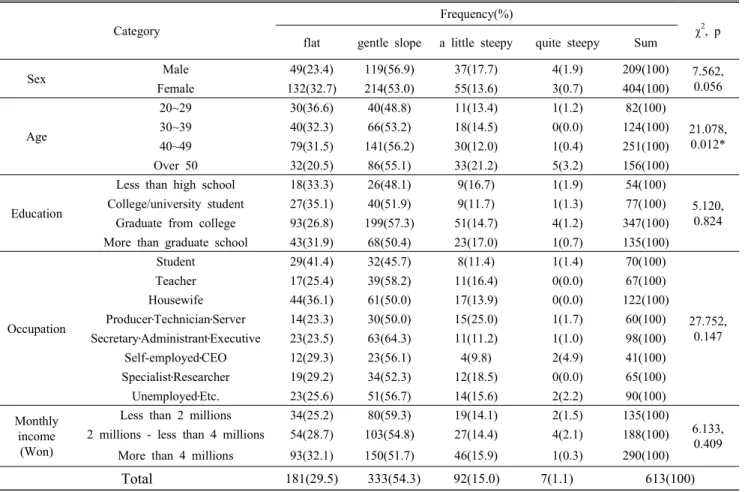
선호하는 숲길의 형태에 관해 살펴본 결과, 약간의 경사 가 있는 길 333명(54.3%), 평탄한 길 181명(29.5%), 약간 숨이 찰 정도의 경사가 있는 길 92명(15.0%), 숨이 심하게 찰 정도의 경사가 있는 길 7명(1.1%)순으로 나타났다. 성별,
연령, 교육수준, 직업, 월평균 가계 소득에 관계없이 약간의 경사가 있는 길을 가장 선호하는 것으로 나타났다. 연령별 로, 20대, 30대, 40대는 약간의 경사가 있는 길, 평탄한 길, 약간 숨이 찰 정도의 경사가 있는 길 순으로 선호하는 경향 이 있으나, 50대는 약간의 경사가 있는 길, 약간 숨이 찰 정도의 경사가 있는 길, 평탄한 길 순으로 선호하는 것으로 나타났는데, 이는 50대에서는 숲길을 걸음으로써 건강에 기 여하는 운동효과에 비중을 두는 것으로 해석된다(Table 5).
2) 선호하는 숲길의 길이
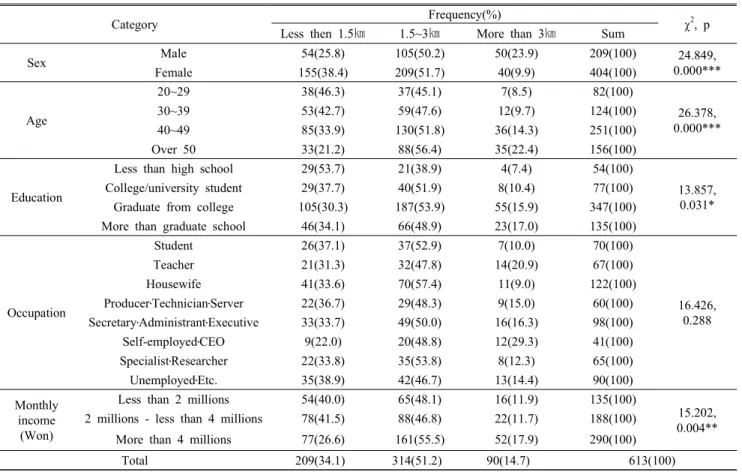
치유 목적으로 숲길을 1회 걸을 때, 어느 정도가 좋은지 살펴보면, 1.5~3㎞는 314명(51.2%), 1.5㎞ 미만은 209명 (34.1%), 3㎞ 이상은 90명(14.7%)순으로 나타났다(Table 6). 여성의 경우, 1.5~3㎞는 209명(51.7%), 1.5㎞ 미만은 155명(38.4%), 3㎞ 이상은 40명(9.9%) 순으로 나타났다.
남성의 경우, 1.5~3㎞는 105명(50.2%), 1.5㎞ 미만은 54명 (25.8%), 3㎞ 이상은 50명(23.9%) 순으로 나타났다. 이 같 은 결과는, 남성이 여성보다 숲길을 걷는 길이가 더 긴 것을 선호하는 경향이 있다고 판단된다. 연령별로 살펴본 결과, 모든 연령대에서 1.5~3㎞를 가장 선호하는 것으로 나타났
Category
Frequency(%)
χ2, p flat gentle slope a little steepy quite steepy Sum
Sex Male 49(23.4) 119(56.9) 37(17.7) 4(1.9) 209(100) 7.562,
0.056
Female 132(32.7) 214(53.0) 55(13.6) 3(0.7) 404(100)
Age
20~29 30(36.6) 40(48.8) 11(13.4) 1(1.2) 82(100)
21.078, 0.012*
30~39 40(32.3) 66(53.2) 18(14.5) 0(0.0) 124(100)
40~49 79(31.5) 141(56.2) 30(12.0) 1(0.4) 251(100)
Over 50 32(20.5) 86(55.1) 33(21.2) 5(3.2) 156(100)
Education
Less than high school 18(33.3) 26(48.1) 9(16.7) 1(1.9) 54(100)
5.120, 0.824 College/university student 27(35.1) 40(51.9) 9(11.7) 1(1.3) 77(100)
Graduate from college 93(26.8) 199(57.3) 51(14.7) 4(1.2) 347(100) More than graduate school 43(31.9) 68(50.4) 23(17.0) 1(0.7) 135(100)
Occupation
Student 29(41.4) 32(45.7) 8(11.4) 1(1.4) 70(100)
27.752, 0.147
Teacher 17(25.4) 39(58.2) 11(16.4) 0(0.0) 67(100)
Housewife 44(36.1) 61(50.0) 17(13.9) 0(0.0) 122(100)
Producer․Technician․Server 14(23.3) 30(50.0) 15(25.0) 1(1.7) 60(100) Secretary․Administrant․Executive 23(23.5) 63(64.3) 11(11.2) 1(1.0) 98(100)
Self-employed․CEO 12(29.3) 23(56.1) 4(9.8) 2(4.9) 41(100)
Specialist․Researcher 19(29.2) 34(52.3) 12(18.5) 0(0.0) 65(100)
Unemployed․Etc. 23(25.6) 51(56.7) 14(15.6) 2(2.2) 90(100)
Monthly income
(Won)
Less than 2 millions 34(25.2) 80(59.3) 19(14.1) 2(1.5) 135(100)
6.133, 0.409 2 millions - less than 4 millions 54(28.7) 103(54.8) 27(14.4) 4(2.1) 188(100)
More than 4 millions 93(32.1) 150(51.7) 46(15.9) 1(0.3) 290(100) Total 181(29.5) 333(54.3) 92(15.0) 7(1.1) 613(100)
* p<0.05
Table 5. Favorite forest road
다. 교육수준별로 살펴보면, 고등학교 이하는 1.5㎞미만을, 전문대학/대학재학, 대학졸업, 대학원 졸업이상은 1.5~3㎞
를 각각 가장 선호하는 것으로 나타났다. 직업에 따라 살펴 본 결과, 통계적으로 유의한 차이가 나타나지 않았다. 월평 균 가계 소득에 따라 살펴보면, 200만원 미만, 200~400만 원, 400만원 이상 모두 1.5㎞~3㎞를 가장 선호하는 것으로 나타났다. Kim(2009)의 치유 숲길 조성에 관한 이론적 고 찰연구에서 치유를 위한 숲길의 최소적정거리를 4㎞로 삼 았으나 본 연구의 일반성인이 선호하는 숲길 길이의 결과와 다소 차이가 있다. 숲길 산림치유 프로그램에 참여하는 대 상은 어린이부터 성인에 이르기까지 다양하므로 이용자의 체력조건과 질병 또는 선호도에 따라 이에 적합한, 다양하 면서 단계적인 프로그램이 구성되어야 할 필요가 있다. 이 에 성별, 연령, 교육수준, 월평균 가계 소득에 따라 차별화된 산림치유 프로그램이 제공되어야 할 것으로 판단된다.
인구통계학적 특성(성별, 연령, 교육수준, 직업, 월평균 가계 소득)에 따른 숲과 숲길의 선호도의 차이를 살펴 본 결과, 선호하는 계절의 숲은 봄, 가을, 계절 상관없음, 여름, 겨울 순으로 나타났는데 이는 각 계절의 특성에 맞는 다양
한 프로그램 개발이 필요한 것으로 판단되며 또한 성별, 연 령, 월평균 가계 소득에 따른 선호도 차이도 함께 고려해야 할 것으로 해석된다. 산림치유 프로그램 장소로서 선호하는 숲은 자연휴양림, 치유의 숲, 도시숲, 공원, 학교숲 순으로 응답하였고, 거주지로부터 프로그램 장소까지의 거리에 따 른 선호하는 숲을 조사한 결과는 모든 경우에 대해 통계적 으로 차이가 없게 나타났다. 이는 부담 없이 방문할 수 있는, 거주지에 가까운 도시숲을 활용한 단기 프로그램을 활성화 함과 동시에 치유의 숲과 자연휴양림을 중심으로 한 중장기 프로그램의 개발이 함께 진행되어야 할 것으로 사료된다.
숲길의 형태에 관해서는 약간의 경사가 있는 길을 가장 선 호하는 것으로 조사되었고, 산림치유 목적으로 1회 걸을 때 선호하는 숲길의 길이는 1.5~3㎞, 1.5㎞이하, 3㎞ 이상 순 으로 나타났으며, 성별과 연령, 교육, 월평균 가계 소득, 교 육에 따라 숲길 선호도에 유의한 차이가 있는 것으로 조사 되었다. 이는 프로그램이 진행되는 숲과 숲길의 선정에 있 어서 참가자의 특성이 함께 고려되어야 할 것으로 해석되며 특히, 연령에 따라 그에 적합한 환경과 차별화된 프로그램 이 제공되어야 할 것으로 판단된다.
Category Frequency(%)
χ2, p Less then 1.5㎞ 1.5~3㎞ More than 3㎞ Sum
Sex Male 54(25.8) 105(50.2) 50(23.9) 209(100) 24.849,
0.000***
Female 155(38.4) 209(51.7) 40(9.9) 404(100)
Age
20~29 38(46.3) 37(45.1) 7(8.5) 82(100)
26.378, 0.000***
30~39 53(42.7) 59(47.6) 12(9.7) 124(100)
40~49 85(33.9) 130(51.8) 36(14.3) 251(100)
Over 50 33(21.2) 88(56.4) 35(22.4) 156(100)
Education
Less than high school 29(53.7) 21(38.9) 4(7.4) 54(100)
13.857, 0.031*
College/university student 29(37.7) 40(51.9) 8(10.4) 77(100)
Graduate from college 105(30.3) 187(53.9) 55(15.9) 347(100)
More than graduate school 46(34.1) 66(48.9) 23(17.0) 135(100)
Occupation
Student 26(37.1) 37(52.9) 7(10.0) 70(100)
16.426, 0.288
Teacher 21(31.3) 32(47.8) 14(20.9) 67(100)
Housewife 41(33.6) 70(57.4) 11(9.0) 122(100)
Producer․Technician․Server 22(36.7) 29(48.3) 9(15.0) 60(100)
Secretary․Administrant․Executive 33(33.7) 49(50.0) 16(16.3) 98(100)
Self-employed․CEO 9(22.0) 20(48.8) 12(29.3) 41(100)
Specialist․Researcher 22(33.8) 35(53.8) 8(12.3) 65(100)
Unemployed․Etc. 35(38.9) 42(46.7) 13(14.4) 90(100)
Monthly income
(Won)
Less than 2 millions 54(40.0) 65(48.1) 16(11.9) 135(100)
15.202, 0.004**
2 millions - less than 4 millions 78(41.5) 88(46.8) 22(11.7) 188(100)
More than 4 millions 77(26.6) 161(55.5) 52(17.9) 290(100)
Total 209(34.1) 314(51.2) 90(14.7) 613(100)
*p<0.05, ** p<0.01, *** p<0.001
Table 6. Favorite forest road length once walking into the forest
일반 성인을 대상으로 하는 숲과 숲길을 이용한 산림치유 프로그램의 선호도를 파악하여 참가자의 특성과 환경을 고 려한 보다 표적화되고 차별화된 산림치유 프로그램을 적용 함으로써 참가자의 만족도를 높이고 향상된 치유효과를 거 둘 수 있을 것으로 사료된다. 추후 연구에서는 대상별 숲과 숲길의 선호도를 기반으로 한 산림치유 프로그램 개발과 함께 효과성 연구가 필요할 것으로 본다. 본 연구의 결과가 숲과 숲길을 이용한 산림치유 프로그램 개발을 위한 기초 자료로써 활용되어 대상에 맞는 다양하고 효과적인 산림치 유 프로그램이 구축되길 기대한다.
REFERENCES
An, K. W., L. H. Yoo. and J. H. Lee.(2010). Forest Recreation 8. in:
Invitation to a Forest. Korea Forest Service, Daejeon, Korea.
37pp. (in Korean)
An, H. Y. and G. H. Lee.(2013). Towards a Working Model for an MBSR-informed Forest Healing Program: Focusing on Patients with Hypertension. The Journal of Korean Institute of Forest Recreation. 17(4): 1-11. (in Korean, with English ab-
Cerling, T. E., J. G. Wynn., S. A. Andanje., M. I. Bird., D. K. Korir.
and N. E. Levin.(2011). Woody Cover and Hominin Environments in the Past 6 Million Years. Nature, 476: 51-56.
Ha, S. Y.(2014). Development of Forest Healing Program. in:
Forest Healing Instructor Class 1 Materials. Korea Forest serv- ice, Daejeon, Korea, pp. 345-391. (in Korean)
Hong, M. A., H. K. Lee., E. K. Han. and Y. G. Gwon.(2010). A States about Forest Therapy Program in Korean and the Prospect for the Fusion of Korean Medicine with Forestry.
Korean Journal of Oriental Medicine. 16(3): 95-105. (in Korean, with English abstract)
Jang, H. S.(2009). The Relationship of Developmental Tasks and Happiness in Early Adulthood. The Korean Journal of devel- opmental psychology. 22(1): 19-36. (in Korean, with English abstract)
Kim, J. M.(2011). Perceptions on the Nature Trail in the National Park in the City: Focused on the Seoulite's Perception on Dullegil in Bukhansan National Park. Korea. Korean J.
Environ. Ecol. 25(1): 102-110. (in Korean, with English ab- stract)
Kim, J. Y.(2014). Development and Effectiveness Verification of the Forest Healing Program for Children with Internet Addiction.
Unpublished master's thesis, National Univ. of Chungbuk, Republic of Korea, 160pp. (in Korean, with English abstract) Kim, K. M.(2013). Study on the Effects of Forest Healing according
to Types of Recreational Forests, Unpublished doctorial dis- sertation, National Univ. of Chungbuk, Republic of Korea, 73pp. (in Korean, with English abstract)
Kim, K. W. (2009). A Theoretical Study on Planning and Design of Forest therapeutic trails. J. Kor. Soc. People Plants Environ.
12(4): 57-66. (in Korean, with English abstract)
Kim, K. W., Y. H. Lee, H. Y. Kim., C. Y. Kim., J. W. Kim. and L.
H. Yoo.(2008). Management of Forest Healing Program in Saneum Forest. The Conference of Korean Institute of Forest Recreation, Seoul, pp. 41-44. (in Korean, with English abstract) Kim, Y. H., D. J. Kim., P. S. Kim. and B. J. Choi. (2014). The Analysis of Interests and Needs for the Development of Forest Therapy Program in Adults. Cheongju, Korea, 16pp.(un- published paper)
Kim, Y. H., E. J. Kim., D. J. Kim., P. S. Kim. and B. J. Choi. (2014).
The Preference Analysis of Adults on the Forest Therapy Program with regard to Demographic Characteristics. Cheongju, Korea, 21pp.(unpublished paper)
Korea Forest Research Institute.(2014). Green Doctor, Forest Therapy, Korea Forest research institute, Seoul, Korea, p 6.(in Korean)
Korea Forest Service.(2012) .The Master Plan of Composition and Management of Forest Roads for Promotion of Conservative Utilization of Forest. Korea Forest Service, Daejeon, Korea, p.
15. (in Korean)
Korea Forest Service.(2010). Survey Report for the National Forest.
Korea Forest Service, Daejeon, Korea, 133pp. (in Korean) Korea Forest Service.(2013). Forest therapy http://www.forest.go.kr
(2014.9.10) (in Korean)
Kwon, T. H. and D. J. Lee.(2013) User Satisfaction and Motivation to Forest Trail Near Metropolitan City of Korea: Focused on the Forest Trail of Daegu. Korean J. Environ. Ecol. 27(3): 405-412.
(in Korean, with English abstract)
Lee, E. D., L. H. Yoo., C. W. Park. and J. J. Kim.(2011). Analysis on the Activity Contents of Forest Healing Programs in Korea.
The Journal of Korean Institute of Forest Recreation. 15(2):
101-109. (in Korean, with English abstract)
Lee, H.R., J.J. Kim, E.K. Cho, M.J. Kang and S.Y. Han.(2011) Determinants of Users' Satisfaction and Behavioral Intention in Jirisan Trail of Korea. Jour. Korean For. Soc. 100(2): 273-282.
(in Korean, with English abstract)
Lee, I. S., H. S.Choi., K. S. Bang., G. U. Lee. and J. E. Kim.(2014) An Exploratory Study of Diffusion of Health Promotion Programs Using Forests. Perspectives in Nursing Science.
11(1): 30-38. (in Korean, with English abstract)
Lee, S. I., K. M.An., K. S. Lee., H. G. Kwon., H. J. Cho. and J. H.
Kim.(2010). The Influence of National Park Healing Camp on Patients with Atopic Dermatitis. The Journal of Korean Institute of Forest Recreation. 14(2): 45-50. (in Korean, with English abstract)
Lee, S. K.(2011). Application Plan for a Forest Therapy Program of Seasonal Customs Including Plant Elements. Unpublished master's thesis, Univ. of Kookmin, Republic of Korea, 155pp.
(in Korean, with English abstract).
Lee, Y. H. and K. W. Kim.(2013). Preference for Landscape and Tree Density of Forest Trail by Questionnaire Survey. J.
Korean Soc. People Plants Environ. 16(6): 449-455. (in Korean, English abstract)
Min, B. Y.(2014). A Study on Future Direction of Domestic Forest Healing Programs from the Perspective of Integrative Medicine. Unpublished master's thesis, Univ. of Sunmoon, Republic of Korea, 83pp. (in Korean, with English abstract).
Ministry of Culture, Sports and Tourism.(2012). 2012 National Survey of Leisure. Ministry of Culture, Sports and Tourism, Seoul, Korea, 285pp. (in Korean)
Ministry of Culture, Sports and Tourism.(2013). 2013 Ministry of Culture, Sports and Tourism. Ministry of Culture, Sports and Tourism, Seoul, Korea, 331pp. (in Korean)
Park, S. M., J. M. Woo., W. Kim. and Y. J. Lee.(2012). Sub-pop- ulations and Disorders that can be Applied to Forest Therapy.
The Journal of Korean Institute of Forest Recreation. 16(1):
35-42. (in Korean, with English abstract)
Seo, Y. A., P. S. Yeoun., C. S. Shin., J. J. Kim. and T. I. Kim.(2013).
Analysis on Visitor’s Psychological Benefits and Behavioral Pattern by Different Types of Forest Trails. The Journal of Korean Institute of Forest Recreation. 17(3):19-29. (in Korean, with English abstract)
Seok, H. D. and H. J. An.(2013). Policy of Forest Environmental Service for Happiness. Korea Rural Economic Institute, seoul, Korea, 155pp. (in Korean)
Shin, K. H.(2013) A Study on Development of School Violence Prevention Program that Applied Forest Therapy and Effectiveness: Centering on Middle School Students with Inability to Adapt to School. Unpublished doctorial dis- sertation, National Univ. of Chungbuk, Republic of Korea, 114pp. (in Korean, with English abstract).
Shin, W. S., C. S. Shin., P. S. Yeoun., N. W. Lee., K. T. Park., E. J.
Lee. and H. E. Lee.(2013). The Preference Survey of Pine Tree Density for Forest Healing. The Journal of Korean Institute of Forest Recreation. 17(1): 71-80. (in Korean, with English ab- stract)
Son, J. W. and S. Y. Ha.(2012). A Study on Visitor`s Behavior as a Characteristics of Different Forest Trails. Journal of Korean Forest Society. 101(2): 309-316. (in Korean, with English ab- stract)
Son, J. W., S. Y. Ha and J. J. Kim.(2012). A Study on Visitor Characteristics for Trail Program Development. Journal of Korean Forest Society. 101(3): 469-479. (in Korean, with English abstract)
Yeoun, P. S. (2014). Investigation of Demand for Forest Healing in: Forest Healing Instructor Class 1 Materials, Korea Forest service, Daejeon, Korea, pp. 321-341. (in Korean)
Yoo, K. J.(2014). A Study on Users` Attitude toward the Forest Trails : Focused on the Jirisan dulegil. Korean J. Environ. Ecol.
28(2): 247-252. (in Korean, with English abstract)
Yoo, K. J., B. H. Han., J. W. Choi. and J. Y. Hur.(2012). A Study on Community Member Perception due to Impacts on Development of the Dulegil in Bukhansan National Park.
Korean J. Environ. Ecol. 26(1): 113-124. (in Korean, with English abstract)
Yoo, S. G. (2011). A Study on the Development Method for Forest Therapeutic Function-centered Medical Tourism Products in Gangwon Area. Korea Journal of Tourism and Hospitality Research. 25(2): 19-40. (in Korean, with English abstract)