Print ISSN: 2288-4637 / Online ISSN 2288-4645 doi:10.13106/jafeb.2020.vol7.no10.1025
Green Supply Chain Management Practice of FDI Companies in Vietnam
Van Loi TA
1, Huy Nhuong BUI
2, Chi Dung CANH
3, Thi Dung DANG
4, Anh Duc DO
5Received: August 01, 2020 Revised: September 06, 2020 Accepted: September 10, 2020
Abstract
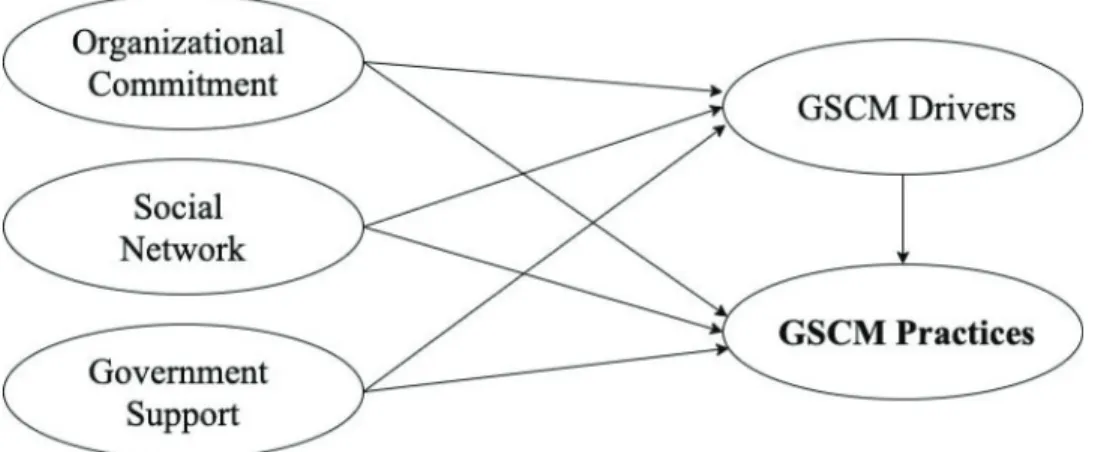
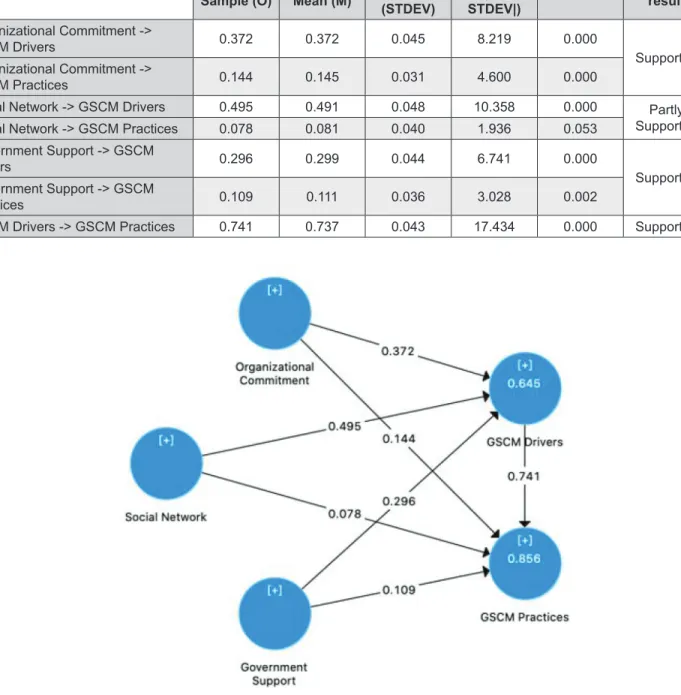
This paper aims to develop a conceptual framework for Green Supply Chain Management (GSCM) that takes into account the effect of GSCM drivers on implementing GSCM practices in Vietnam FDI companies. This study has considered organizational commitment, social network, and government support as GSCM driver factors and proposed a structural model of the relationships between GSCM drivers and GSCM practices in Vietnam FDI companies. The empirical analysis used data from 192 questionnaires which used a comprehensive, valid, and reliable tool (SPSS 26 and SmartPLS 3.0 software) to evaluate rigorous statistical tests including convergence validity, discriminatory validity, reliability, and Average Variance Extracted (AVE) to analyze and verify the gathered data and develop the hypothesis. The result of path analysis shows that GSCM driver factors constitute a structured system with different degrees of influence on GSCM drivers and GSCM practices. Organizational commitment and government support has a positive relationship with both GSCM drivers and GSCM practices, while social network only has a positive relationship on GSCM drivers. As a result, the testing of the relationship between GSCM drivers and GSCM practices has been verified and supported. The findings of this study can help managers and decision-makers to push the implementation of GSCM practices in FDI companies.
Keywords: GSCM, GSCM Drivers, GSCM Practices, FDI Companies, Vietnam JEL Classification Code: M11, M14, M16, L1
ecological environment. In developing countries, this situation is becoming increasingly serious because natural resources are slowly depleting and environmental problems are increasing.
Hence, Green Supply Chain Management (GSCM) as a feasible way to reduce the environmental problems and spur economic growth, create competitive advantage in terms of greater customer satisfaction, positive image and reputation, has been gaining much traction among practitioners and researchers (Srivastava, 2007; Seuring & Muller, 2008;
Sarkis, 2012; Tate et al., 2012; Fahimnia et al., 2015).
Previous research on GSCM extensively discusses GSCM drivers that drive companies to implement GSCM practices (Handfield et al., 2005; Zhu & Sarkis, 2004; Zhu et al., 2013;
Hoejmose et al., 2014). Existing studies also point out that the success of a company in implementing GSCM practices and achieving the targeted performance objectives could be hindered or encouraged by the effect of influential factors. Do et al. (2020) stated that GSCM creates a rebuilding system for a bright way. However, implementing and achieving GSCM is not an easy task. There is still a need for a better understanding of how GSCM drivers and its factors in isolation as well as jointly impact the success of the company in implementing GSCM practices. Specifically, GSCM practices in Vietnam FDI companies were relatively unexplored.
1. Introduction
In recent decades, the global economy has developed rapidly; however, people only pay attention to the importance of economic development, while ignoring the protection of the
1
First Author. Associate Professor, Dean, School of Trade and International Economics, National Economics University, Vietnam.
Email: [email protected]
2
Associate Professor, Head of Personal and Organizational Department, National Economics University, Vietnam.
Email: [email protected]
3
Deputy Director General, Personnel and Organization Department, Ministry of Education and Training, Vietnam.
Email: [email protected]
4
PhD Candidate. National Economics University, Vietnam. Bac Ninh Center for Rural Water Supply and Environmental Sanitation.
Email: [email protected]
5
Corresponding Author. Doctor, School of Trade and International Economics, National Economics University, Vietnam [Postal Address: 207 Giai Phong Road, Dong Tam Ward, Hai Ba Trung District, Hanoi, 116000, Vietnam] Email: [email protected]
© Copyright: The Author(s)
This is an Open Access article distributed under the terms of the Creative Commons Attribution Non-Commercial License (https://creativecommons.org/licenses/by-nc/4.0/) which permits unrestricted non-commercial use, distribution, and reproduction in any medium, provided the original work is properly cited.