Kor. J. Hort. Sci. Technol. 29(5):474-481, 2011
단일적응 감자 유전자원들의 역병저항성 및 주요 농업형질 평가
박영은1*ㆍ조현묵1ㆍ조지홍1ㆍ조광수1ㆍ김현준1ㆍ후안 란데오2
1국립식량과학원 고령지농업연구센터, 2국제감자연구소
Evaluation of Late Blight Resistance and Agronomic Characteristics of Short-day Adapted Potato Germplasm
Young Eun Park
1*, Hyun Mook Cho
1, Ji-Hong Cho
1, Kwang Soo Cho
1, Hyun Jun Kim
1, and Juan Landeo
21
Highland Agriculture Research Center, National Institute of Crop Science, Pyeongchang 232-955, Korea
2
International Potato Center, Avenida La Molina 1895, La Molina, Apartado Postal 1558, Lima, Peru
Abstract. Potato late blight caused by the fungus Phytophthora infestans is one of the most vital diseases damaging the potato plant. It is for this reason that breeding potato cultivars resistant to late blight is now becoming a major concern around the world. The B3C1 clones has been introduced by the Highland Agriculture Research Center, RDA. The clones which came from International Potato Center in 2005 have a durable resistance to late blight. The clones were bred under a short-day condition in Peru. However, there was still no report on the adaptability of these clones to the long-day condition in Korea. Therefore, this study was conducted to evaluate the late blight resistance and major agronomic characteristics of B3C1 clones under Korea’s long-day condition. This study was also done to generate genetic resources for developing new varieties resistant to late blight. In this study it was found out that in naturally infested field with P. infestans, AUDPC (area under disease progress curve) values of all B3C1 clones were significantly lower than those of the control varieties, ‘Superior’, ‘Atlantic’, and ‘Haryeong’. It was found out that B3C1 clones had a high level of resistance to late blight and that they could be used as genetic resources to breed potato varieties with late blight resistance. However, several undesirable characteristics such as extremely late maturity, excessive growth of stems and stolons, and production of tubers that cannot easily be removed from the stolons were also observed. Among the twenty B3C1 clones, two clones, LB-8 (CIP393077.159) and LB-11 (CIP393371.159), were selected for cultivating at the highland area of Korea. Two B3C1 clones were crossed with Korean breeding lines and clonal selection for the progenies is still in progress.
Additional key words: adaptability, day-length, Phytophthora infestans, potato breeding
*Corresponding author: [email protected]
※ Received 4 April 2011; Accepted 31 August 2011.
서 언
Phytophthora infestans에 의해 유발되는 감자역병은 전
세계의 모든 감자 재배지대에서 발생하는 가장 치명적인 병 중의 하나로서 감자역병에 대한 저항성 품종 육성은 매우 중요한 육종 목표로 인식되고 있다. 감자역병 저항성 육종 은 1845년 유럽에서 역병 대발생을 계기로 수평저항성 육종 으로부터 시작되었고, 그 후 주요 역병 레이스별 저항성 유 전자를 집적시키는 gene pyramiding 육종 방법에 집중되었 다(Black et al., 1953; Malcolmson and Black, 1966). 그러 나 레이스의 변동(Wastie, 1991), 새로운 교배형(Goodwin et
al., 1998)과 약제 내성균의 출현(Davidse et al., 1981; Dowley and Osullivan, 1981) 등으로 특정 레이스에 대한 수직 저항성 이 손쉽게 무너짐에 따라 1990년대와 2000년대에 이르러 감자 역병 저항성 육종의 방향은 수평저항성 육종으로 전환되었다 .
국제감자연구소에서도 1990년대부터 감자역병 수평저항 성 품종 육성을 시작하였고, 현재 가장 중요한 연구과제 중 의 하나이다 (Landeo and Turkensteen, 1990; Landeo et al., 2000). 국제감자연구소는 그 동안 전통적인 육성 방법으로 농업형질이 개량된 신품종들을 개발하여 단일 또는 중일 조 건의 열대 및 아열대 지역의 개발도상국가들에게 보급해 왔 으며, 지금까지 약 20여 개의 국가에 65종의 역병저항성 품 종들을 보급한 바 있다(CIP, 2010; Colon et al., 1995).
이러한 육종 성과들 중의 한 집단이 B3C1 계통들로서, 고
령지농업연구센터에서는 역병에 대한 수평 저항성 품종의 육성을 위한 육종 소재로 활용하고자 2005년에 국제감자연 구소로부터 B3C1 계통들을 도입하였다. B3C1 계통들은 남 미 안데스 산지에 자생적으로 분포되어 있는 Solanum(S.)
demissum, S. stenotomum 등의 근연야생종과 토착 재배종인 S. tuberosum ssp. andigena 등으로부터 유래되었으며, 이들 유전자원들로부터 역병저항성 유전자를 도입하고 야 생종 유래의 열악한 형질을 개량하기 위한 4배체 재배종들 과의 교잡과 순환선발을 통하여 보다 개량된 농업형질을 보 유한 집단이 B3C1 계통들이다(Landeo et al., 1995). 그러나 B3C1 집단은 남미 고산지대의 저온단일 환경에서 선발된 계통들로서 고온장일의 국내 환경에 대한 적응성 검토는 아 직까지 이루어진 바 없다.
따라서 본 연구는 국내의 고온장일 환경 조건에서 B3C1 계통들의 역병저항성과 주요 농업관련 형질들을 평가하여 국 내 재배 가능성을 검토해 보고, 앞으로 역병저항성 품종 육성 을 위한 육종 소재로써의 가치를 평가하고자 수행되었다.
재료 및 방법
식물재료
본 연구에 사용된 시험재료는 페루에 위치한 국제감자연 구소의 역병 저항성 감자 육종프로그램을 통하여 육성된 20 계통의 B3C1 집단으로 2005년에 고령지농업연구센터에 도 입된 후 망실에서 증식된 씨감자를 이용하였다.
시험구 처리 및 관리
B3C1 계통들의 역병저항성 및 주요 농업형질 평가를 위 하여 2007년에는 평난지인 강릉과 고랭지인 대관령 두 지역 에서, 그리고 2009년에는 대관령에서 시험을 수행하였다.
시험구는 계통별로 3열에 60주를 기본으로 2007년에는 두 지역에 완전임의배치 3반복, 2009년에는 4반복으로 처리하 였다. 강릉 지역은 3월 20일, 대관령 지역은 5월 1일경에 파 종하였고, 수확은 두 지역 모두 파종 후 130일에 실시하였 다. 대비품종으로 역병에 감수성이지만 우리나라에서 가장 많이 재배되는 ‘수미(cv. Superior)’, 역병에 중도저항성이면 서 건물함량이 높은 ‘대서(cv. Atlantic)’, 그리고 역병에 강 하고 건물함량도 높은 ‘하령(cv. Haryeong)’ 등 3품종을 사 용하였다. 포장환경 조건에서 역병에 대한 저항성 정도를 조사하기 위하여 역병방제 약제는 살포하지 않았으며, 시비 및 기타 재배상의 관리는 농촌진흥청에서 발행한 감자총서 에 준하여 처리하였다(RDA, 2005).
주요 농업형질 조사
지상부의 생육 정도를 조사하기 위하여 2007년 강릉과 대 관령 두 지역에서 파종 후 90일에 계통당 15주씩 줄기의 길 이를 측정하였다. 파종 후 130일이 경과되었을 때 수확을 하 였으며, 강릉은 7월 30일, 대관령은 9월 10일이었다. 수량조 사는 반복당 20주씩을 굴취하여 괴경 개수와 무게를 측정하 고 ha당 수량으로 환산하였다. 수확 당시에 주요한 괴경 특 성과 괴경의 외관 품질과 관련된 더뎅이병, 열개 및 기형서 발생 정도 등을 조사하였다. 숙기를 판단하기 위하여 파종 후 90일부터 10일 간격으로 5회에 걸쳐서 지상부 황엽기를 조사하였으며 , 황엽기를 기준으로 파종 후 90일 이전은 극조 생, 90-100일은 조생, 100-120일은 중생, 120-130일은 만생, 130일 이상은 극만생으로 판단하였다. 건물률은 각 반복 별 로 80-150g 정도 크기의 감자 15개씩을 취하여 조사하였다.
감자는 가로・세로・높이를 약 0.5cm의 크기로 깍둑썰기를 한 다음 생체 무게를 측정하고, 건조용 종이 봉투에 넣어 67℃
로 조정된 건조기에서 72시간 정도 완전히 건조시킨 다음 건조된 시료의 무게를 측정하여 건물률로 환산하였다.
건물률(%) = (건조무게 / 생체무게) × 100
역병 발병정도 조사
역병발병 조사는 2009년 7월 13일부터 약 1주일 간격으 로 4회 조사 하였고, 시험 처리간 역병저항성 정도의 차이는 역병 초발생 후 병진전도(AUDPC, area under the disease progress curve) 값을 이용하여 분석하였다(Haynes and Weingar, 2004). AUDPC는 다음 식에 의해 산출하였으며, X
i는 첫 번 째 병반 면적율 , X
i+1은 첫 번째 이후의 증가한 병반 면적율, T
i+1-T
i는 두 조사 시점의 경과 일수를 의미한다.
AUDPC = Σ(X
i+ X
i+1) / 2 × (T
i+1- T
i)
기상환경 조사
B3C1 계통들의 고온장일 환경에서의 생육특성을 평가하 기 위하여 시험기간 동안 강릉과 대관령 지역의 평균 기온 과 일장을 조사하였다. 모든 자료는 기상청에서 관측한 자 료를 인용하였다.
결과 및 고찰
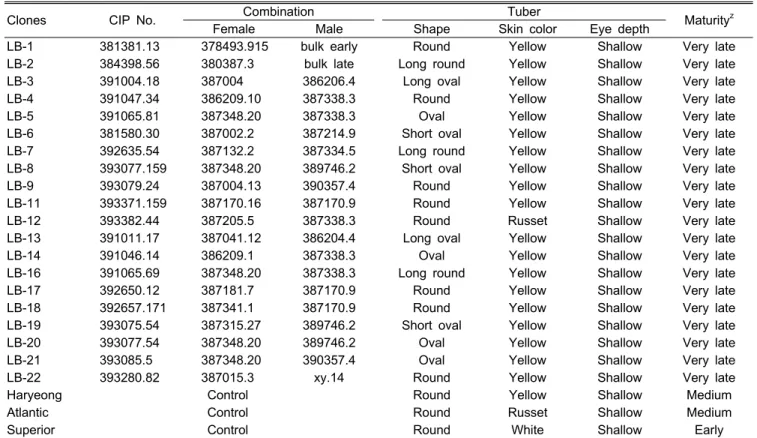
B3C1 계통들의 괴경 형태는 원형에서부터 장원형까지 다
양하였으나 표피색은 모두 황색이고 눈 깊이가 얕은 특성을
보였다(Table 1). 파종 후 90일에 조사한 지상부 줄기의 길
이는 전 계통이 대관령에서보다 강릉 지역에서 더 길었다
(Table 2). 지역간 생육량의 차이는 고온장일 환경에서 육성
Table 1. Major tuber characteristics and plant maturity of twenty B3C1 clones (LB-1 to 22) and control varieties in potato.
Clones CIP No. Combination Tuber
Maturity
zFemale Male Shape Skin color Eye depth
LB-1 381381.13 378493.915 bulk early Round Yellow Shallow Very late
LB-2 384398.56 380387.3 bulk late Long round Yellow Shallow Very late
LB-3 391004.18 387004 386206.4 Long oval Yellow Shallow Very late
LB-4 391047.34 386209.10 387338.3 Round Yellow Shallow Very late
LB-5 391065.81 387348.20 387338.3 Oval Yellow Shallow Very late
LB-6 381580.30 387002.2 387214.9 Short oval Yellow Shallow Very late
LB-7 392635.54 387132.2 387334.5 Long round Yellow Shallow Very late
LB-8 393077.159 387348.20 389746.2 Short oval Yellow Shallow Very late
LB-9 393079.24 387004.13 390357.4 Round Yellow Shallow Very late
LB-11 393371.159 387170.16 387170.9 Round Yellow Shallow Very late
LB-12 393382.44 387205.5 387338.3 Round Russet Shallow Very late
LB-13 391011.17 387041.12 386204.4 Long oval Yellow Shallow Very late
LB-14 391046.14 386209.1 387338.3 Oval Yellow Shallow Very late
LB-16 391065.69 387348.20 387338.3 Long round Yellow Shallow Very late
LB-17 392650.12 387181.7 387170.9 Round Yellow Shallow Very late
LB-18 392657.171 387341.1 387170.9 Round Yellow Shallow Very late
LB-19 393075.54 387315.27 389746.2 Short oval Yellow Shallow Very late
LB-20 393077.54 387348.20 389746.2 Oval Yellow Shallow Very late
LB-21 393085.5 387348.20 390357.4 Oval Yellow Shallow Very late
LB-22 393280.82 387015.3 xy.14 Round Yellow Shallow Very late
Haryeong Control Round Yellow Shallow Medium
Atlantic Control Round Russet Shallow Medium
Superior Control Round White Shallow Early
z
Plant maturity was determined by yellow leaf stage of potato plants. Early, yellow leaf stage ranges from 90 to 100 DAP (days after planting); Medium, yellow leaf stage ranges from 100 to 120 DAP; Very late, yellow leaf stage ranges over 130 DAP.
Table 2. Comparison of stem length, tuber yield and dry matter content of B3C1 clones (LB-1 to 22) and control varieties of potatoes grown at Gangneung and Daegwallyeong experimental fields in 2007.
Clones Stem length (cm) Tuber yield (ton・ha
-1) Dry matter content (%)
GN
zDGR GN DGR GN DGR
LB-1 144.9 ± 3.2
y109.5 ± 5.4 11.7 ± 0.4 27.5 ± 0.4 14.4 ± 1.2 19.8 ± 0.1
LB-2 119.7 ± 2.4 69.8 ± 3.4 7.6 ± 0.1 4.5 ± 0.1 15.4 ± 0.6 16.5 ± 0.2
LB-3 130.3 ± 2.3 106.5 ± 4.5 3.7 ± 0.2 22.9 ± 0.4 14.5 ± 0.4 19.6 ± 0.2
LB-4 135.4 ± 3.7 95.3 ± 2.7 12.4 ± 0.1 22.7 ± 0.3 14.3 ± 0.3 19.0 ± 0.5
LB-5 135.8 ± 2.1 101.3 ± 3.9 12.7 ± 0.2 11.3 ± 0.1 13.2 ± 0.4 16.7 ± 0.3
LB-6 140.1 ± 1.6 125.7 ± 4.0 28.7 ± 0.4 17.0 ± 0.3 14.4 ± 3.3 19.7 ± 0.1
LB-7 137.2 ± 1.4 107.3 ± 3.1 20.3 ± 0.2 17.7 ± 0.1 17.0 ± 0.6 19.7 ± 0.3
LB-8 126.7 ± 2.6 99.7 ± 6.9 25.2 ± 0.2 32.6 ± 0.4 15.5 ± 0.5 20.4 ± 0.7
LB-9 120.1 ± 2.2 97.1 ± 2.2 13.1 ± 0.2 27.9 ± 0.5 15.6 ± 0.3 20.1 ± 0.1
LB-11 120.2 ± 2.6 105.3 ± 3.9 30.5 ± 0.6 30.6 ± 0.2 16.3 ± 0.1 19.7 ± 0.7
LB-12 132.9 ± 2.9 116.7 ± 4.0 5.1 ± 0.1 10.4 ± 0.3 14.8 ± 0.2 18.1 ± 0.3
LB-13 125.5 ± 3.4 100.9 ± 2.7 27.2 ± 0.3 34.6 ± 0.3 16.0 ± 0.2 18.9 ± 0.5
LB-14 125.2 ± 3.4 114.8 ± 3.9 10.2 ± 0.3 15.3 ± 0.4 15.0 ± 0.1 19.3 ± 0.4
LB-16 125.7 ± 2.8 99.1 ± 4.5 6.7 ± 0.2 11.9 ± 0.2 13.8 ± 0.3 17.2 ± 0.5
LB-17 135.5 ± 3.6 111.5 ± 2.7 19.1 ± 0.6 15.5 ± 0.5 15.3 ± 0.9 18.2 ± 0.3
LB-18 121.5 ± 3.6 98.7 ± 2.6 10.8 ± 0.2 17.2 ± 0.1 14.9 ± 1.9 19.5 ± 0.2
LB-19 130.6 ± 2.8 104.5 ± 4.2 4.0 ± 0.1 12.7 ± 0.2 17.1 ± 0.8 20.6 ± 1.1
LB-20 132.0 ± 2.8 117.7 ± 2.7 26.0 ± 0.2 27.9 ± 0.6 15.4 ± 0.4 19.5 ± 0.4
LB-21 118.3 ± 2.2 105.1 ± 5.6 7.7 ± 0.2 14.1 ± 0.2 16.2 ± 0.4 20.2 ± 0.5
LB-22 141.6 ± 4.3 120.7 ± 5.7 12.7 ± 0.1 22.7 ± 0.1 16.6 ± 1.6 18.3 ± 1.1
B3C1 Mean 130.0 ± 1.8 105.4 ± 2.6 14.8 ± 2.0 19.8 ± 1.9 15.3 ± 0.2 19.1 ± 0.3
Haryeong 64.3 ± 1.6 65.1 ± 1.9 43.5 ± 0.3 51.1 ± 0.3 19.1 ± 0.3 20.6 ± 0.5
Atlantic 65.3 ± 1.8 71.4 ± 3.7 50.3 ± 0.1 49.9 ± 0.41 18.8 ± 0.3 19.2 ± 0.4
Superior 55.9 ± 2.1 50.5 ± 3.2 40.0 ± 0.3 32.7 ± 0.2 17.6 ± 0.3 16.7 ± 0.5
z
GN: Gangneung, DGR: Daegwallyeong.
y
Mean ± SE (n = stem length 90, tuber yield and dry matter content 6).
Fig. 1. Mean temperature (upper) and day length (below) at Gangneung and Daegwallyeong area according to the growing stage. MTGN07: Mean temperature at Gangneung in 2007, MTDGR07: Mean temperature at Daegwallyeong in 2007, MTDGR09: Mean temperature at Daegwallyeong in 2009.
DLGN: Day length at Gangneung in 2009, DLDGR: Day length at Daegwallyeong in 2009.
된 ‘하령’, ‘대서’, 그리고 ‘수미’ 품종에서의 차이 보다 페루 의 저온단일 환경에서 육성된 B3C1 계통들에서 더 크게 나 타났다. 수량은 LB-2, 5, 6, 7, 17을 제외한 모든 계통들이 강릉에서 보다 대관령 지역에서 더 많았다(Table 2). 강릉에 서는 대비 품종인 ‘수미’ 보다 수량이 더 많은 계통이 없었 으나, 대관령에서는 LB-13이 ‘수미’ 보다 더 많은 수량을 보였다. 두 지역간 건물함량의 차이도 수량성과 유사한 경 향을 보였다. 강릉에서는 모든 B3C1 계통의 건물함량이 대 비 품종인 ‘수미’나 ‘대서’에 비해 현저히 낮은 경향을 보였 으나, 대관령에서는 모든 계통이 ‘수미’와 유사하거나 더 높 았다. 특히 LB-1, 3, 6, 7, 8, 9, 11, 14, 18, 19, 20, 21 등 12계통은 ‘대서’보다도 건물함량이 높았다. 계통간 차이는 있었지만 장일환경에서 육성된 대비 품종들에 비해 단일환 경에서 육성된 계통들이 지상부 생육은 왕성한 반면 영양 저장기관인 괴경의 수량과 건물의 집적량은 떨어지는 것으 로 확인되었다. 또한 강릉과 대관령의 상이한 재배환경에서 대비품종에 비해 양적형질의 차이가 뚜렷하게 나타났다.
감자는 비교적 서늘하고, 주야간의 온도교차가 큰 지역에 서 괴경의 착생과 비대가 촉진되는 작물로 알려져 있다 (Bodlaender, 1963; Borah and Milthorpe, 1962). Minhas et al.(2001)은 북미지역에서 육성된 20계통의 감자를 포장 조 건에서와 고온의 온실에서 재배하여 생육량과 수량성을 비 교한 결과, 포장 시험구보다 온실 재배 시험구에서 줄기 길 이의 증가율은 2.1-121.1% 정도 높았고, 수량은 2.7-87.3%
감소하였다. 이와 같은 결과는 대관령에 비해 생육기간 중 평균기온이 높은 강릉지역에서 줄기 길이가 길었고, 수량성 이 낮게 나타났던 본 연구의 결과와 동일한 경향을 보였으며 (Table 2), 국내 육성집단을 대상으로 강릉과 대관령에서 생 육양상 차이를 구명한 Kim(2002)의 보고와도 일치하였다.
강릉과 대관령 지역은 감자 재배기간 중 온도 및 일장 환 경에서 많은 차이를 가지고 있다(Fig. 1). 재배기간 중 평균 온도는 대관령 지역의 경우 파종기부터 출현기까지(파종 후 30일)는 강릉보다 높았지만, 그 이후부터는 강릉보다 낮아 져서 괴경형성과 비대에 보다 유리한 조건이 되었다. 대관 령 지역의 경우 일장도 괴경 형성기(파종 후 60일)부터 서서 히 감소하여 괴경 비대기 이후에는 강릉 지역보다 약 1시간 정도 짧아졌다. 강릉에 비해 대관령 지역에서 수량성과 건 물함량이 더 높게 나타난 것은 괴경 비대기(파종 후 70일 이후)부터 비대에 적정한 온도 및 주야간의 큰 일교차(Kim et al., 1992; Saha et al., 1974; Schnieders et al., 1988; Slater, 1968), 그리고 일장이 짧아지면서 동화산물의 이동과 집적 에 보다 유리한 환경의 조성 등에 의한 것으로 추정되었다 (Ahn et al., 2002; Dick and Segreeva, 1999).
2007년 강릉과 대관령에서 주요 농업형질에 대한 평가를 실시한 결과, B3C1 계통들은 강릉의 평난지 환경보다는 대 관령의 고랭지 환경조건에서 적응성이 더 높은 것으로 확인 되었다. 또한 B3C1 계통들은 숙기가 너무 늦어 평난지 재배 시 경제성이 낮다고 판단됨에 따라, 고랭지 환경조건에서 농업형질이 우수한 계통을 선발하고자 2009년에는 대관령 지역에서만 시험을 수행하였다.
B3C1 계통들의 감자역병에 대한 저항성 반응 정도를 평 가하기 위하여 역병 무방제 시험포에서 시험을 진행하였다.
감자역병은 최초 발생한 이후 짧은 기간내에 포장 전체로
확산하여 식물체를 고사시키는 병해로 알려져 있다. 그러나
감자 유전자원 중에는 병 진전이 지연되어 최종 생산물에
크게 영향을 주지 않는 지속저항성 반응을 보이는 것들이
있는데, 이런 특징을 분석하기 위하여 AUDPC를 조사하였
다(Fig. 2). 그 결과 감자역병 저항성 품종인 ‘하령’(Park et
al., 2006)은 295, 역병에 감수성인 ‘수미’는 760이었던 것에
비해 , B3C1 계통은 0-130 정도로 모든 계통에서 매우 낮은
병진전도를 나타냈다. 특히, LB-2는 조사기간 중 역병 병징을
관찰할 수 없었다. 본 시험에 이용된 B3C1 집단은 국제감자
Fig. 2. Comparison of late blight resistance by AUDPC values of B3C1 clones (LB-1 to 22) and control varieties of potatoes evaluated at Daegwallyeong area in 2009. Vertical bar means SE (n = 4). HR: Haryeong, AT: Atlantic, SP: Superior.
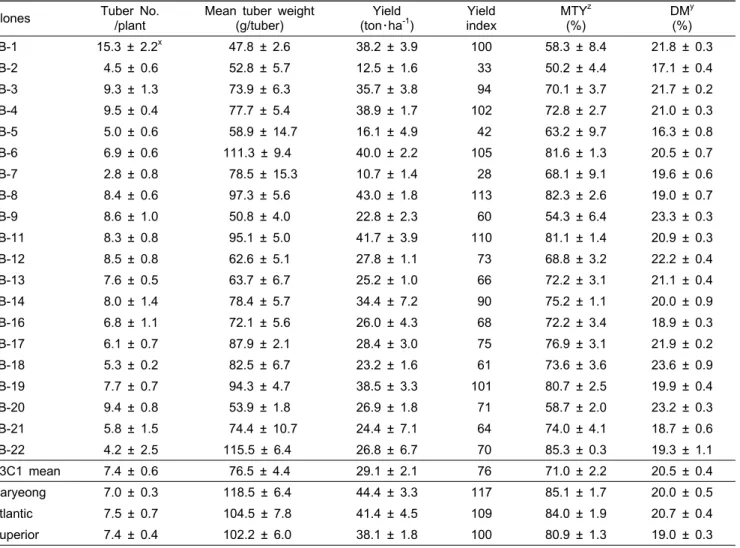
Table 3. Yield and dry matter content of B3C1 clones (LB-1 to 22) and control varieties of potatoes grown at Daegwallyeong in 2009.
Clones Tuber No.
/plant Mean tuber weight
(g/tuber) Yield
(ton・ha
-1) Yield
index MTY
z(%) DM
y(%)
LB-1 15.3 ± 2.2
x47.8 ± 2.6 38.2 ± 3.9 100 58.3 ± 8.4 21.8 ± 0.3
LB-2 4.5 ± 0.6 52.8 ± 5.7 12.5 ± 1.6 33 50.2 ± 4.4 17.1 ± 0.4
LB-3 9.3 ± 1.3 73.9 ± 6.3 35.7 ± 3.8 94 70.1 ± 3.7 21.7 ± 0.2
LB-4 9.5 ± 0.4 77.7 ± 5.4 38.9 ± 1.7 102 72.8 ± 2.7 21.0 ± 0.3
LB-5 5.0 ± 0.6 58.9 ± 14.7 16.1 ± 4.9 42 63.2 ± 9.7 16.3 ± 0.8
LB-6 6.9 ± 0.6 111.3 ± 9.4 40.0 ± 2.2 105 81.6 ± 1.3 20.5 ± 0.7
LB-7 2.8 ± 0.8 78.5 ± 15.3 10.7 ± 1.4 28 68.1 ± 9.1 19.6 ± 0.6
LB-8 8.4 ± 0.6 97.3 ± 5.6 43.0 ± 1.8 113 82.3 ± 2.6 19.0 ± 0.7
LB-9 8.6 ± 1.0 50.8 ± 4.0 22.8 ± 2.3 60 54.3 ± 6.4 23.3 ± 0.3
LB-11 8.3 ± 0.8 95.1 ± 5.0 41.7 ± 3.9 110 81.1 ± 1.4 20.9 ± 0.3
LB-12 8.5 ± 0.8 62.6 ± 5.1 27.8 ± 1.1 73 68.8 ± 3.2 22.2 ± 0.4
LB-13 7.6 ± 0.5 63.7 ± 6.7 25.2 ± 1.0 66 72.2 ± 3.1 21.1 ± 0.4
LB-14 8.0 ± 1.4 78.4 ± 5.7 34.4 ± 7.2 90 75.2 ± 1.1 20.0 ± 0.9
LB-16 6.8 ± 1.1 72.1 ± 5.6 26.0 ± 4.3 68 72.2 ± 3.4 18.9 ± 0.3
LB-17 6.1 ± 0.7 87.9 ± 2.1 28.4 ± 3.0 75 76.9 ± 3.1 21.9 ± 0.2
LB-18 5.3 ± 0.2 82.5 ± 6.7 23.2 ± 1.6 61 73.6 ± 3.6 23.6 ± 0.9
LB-19 7.7 ± 0.7 94.3 ± 4.7 38.5 ± 3.3 101 80.7 ± 2.5 19.9 ± 0.4
LB-20 9.4 ± 0.8 53.9 ± 1.8 26.9 ± 1.8 71 58.7 ± 2.0 23.2 ± 0.3
LB-21 5.8 ± 1.5 74.4 ± 10.7 24.4 ± 7.1 64 74.0 ± 4.1 18.7 ± 0.6
LB-22 4.2 ± 2.5 115.5 ± 6.4 26.8 ± 6.7 70 85.3 ± 0.3 19.3 ± 1.1
B3C1 mean 7.4 ± 0.6 76.5 ± 4.4 29.1 ± 2.1 76 71.0 ± 2.2 20.5 ± 0.4
Haryeong 7.0 ± 0.3 118.5 ± 6.4 44.4 ± 3.3 117 85.1 ± 1.7 20.0 ± 0.5
Atlantic 7.5 ± 0.7 104.5 ± 7.8 41.4 ± 4.5 109 84.0 ± 1.9 20.7 ± 0.4
Superior 7.4 ± 0.4 102.2 ± 6.0 38.1 ± 1.8 100 80.9 ± 1.3 19.0 ± 0.3
z
MTY: percentage of marketable tubers, over 80 g.
y
DM: dry matter content.
x
Mean ± SE (n = 4).
연구소의 감자역병 저항성 육종 프로그램을 통하여 선발된 집단으로서(Landeo et al., 2000), 국내 환경조건에서도 국제 감자연구소에서의 역병 평가 결과와 동일하게 매우 강한 저
항성을 나타내었다. 감자 역병의 AUDPC 분석은 환경변화에 따른 기주의 반응을 효과적으로 평가할 수 있어서 역병 저항 성을 평가하는 방법으로 널리 이용되고 있으며(Andrivon et al., 2006; Haynes and Weingar, 2004; Haynes et al., 2007), 본 연구에 적용한 결과 역병 저항성 계통을 선발하기 위한 지표로써 효용성이 높은 것으로 판단되었다.
B3C1 계통의 감자 1포기에서 수확된 평균 괴경 수는 7.4
개로서 대비 품종들과 유사했다(Table 3). 괴경 1개의 평균
무게는 76.5g으로 대비 품종들의 평균 무게인 108.4g 보다
현저히 작았고, 이에 비례하여 상품감자의 비율도 낮았다. 수
량도 평균 29.1톤/ha으로 대비 품종들 보다 낮았으나 LB-6,
8, 11은 ‘수미’보다 5-13% 정도 높은 수량을 나타냈다. 건물
함량은 감자의 가공성이나 조직감 , 식미를 좌우하는 중요한
품질요인으로서 본 연구에서도 매우 중요한 선발지표로 설
정하였다 . LB-2, 5, 16, 21을 제외한 모든 계통이 ‘수미’ 보
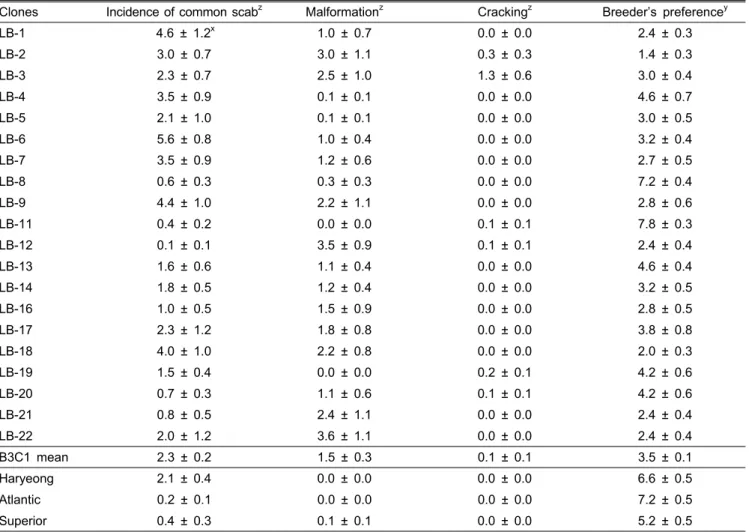
Table 4. Major tuber quality and breeder’s preference values of B3C1 clones (LB-1 to 22) and control varieties of potatoes grown at two locations in 2007 and 2009.
Clones Incidence of common scab
zMalformation
zCracking
zBreeder’s preference
yLB-1 4.6 ± 1.2
x1.0 ± 0.7 0.0 ± 0.0 2.4 ± 0.3
LB-2 3.0 ± 0.7 3.0 ± 1.1 0.3 ± 0.3 1.4 ± 0.3
LB-3 2.3 ± 0.7 2.5 ± 1.0 1.3 ± 0.6 3.0 ± 0.4
LB-4 3.5 ± 0.9 0.1 ± 0.1 0.0 ± 0.0 4.6 ± 0.7
LB-5 2.1 ± 1.0 0.1 ± 0.1 0.0 ± 0.0 3.0 ± 0.5
LB-6 5.6 ± 0.8 1.0 ± 0.4 0.0 ± 0.0 3.2 ± 0.4
LB-7 3.5 ± 0.9 1.2 ± 0.6 0.0 ± 0.0 2.7 ± 0.5
LB-8 0.6 ± 0.3 0.3 ± 0.3 0.0 ± 0.0 7.2 ± 0.4
LB-9 4.4 ± 1.0 2.2 ± 1.1 0.0 ± 0.0 2.8 ± 0.6
LB-11 0.4 ± 0.2 0.0 ± 0.0 0.1 ± 0.1 7.8 ± 0.3
LB-12 0.1 ± 0.1 3.5 ± 0.9 0.1 ± 0.1 2.4 ± 0.4
LB-13 1.6 ± 0.6 1.1 ± 0.4 0.0 ± 0.0 4.6 ± 0.4
LB-14 1.8 ± 0.5 1.2 ± 0.4 0.0 ± 0.0 3.2 ± 0.5
LB-16 1.0 ± 0.5 1.5 ± 0.9 0.0 ± 0.0 2.8 ± 0.5
LB-17 2.3 ± 1.2 1.8 ± 0.8 0.0 ± 0.0 3.8 ± 0.8
LB-18 4.0 ± 1.0 2.2 ± 0.8 0.0 ± 0.0 2.0 ± 0.3
LB-19 1.5 ± 0.4 0.0 ± 0.0 0.2 ± 0.1 4.2 ± 0.6
LB-20 0.7 ± 0.3 1.1 ± 0.6 0.1 ± 0.1 4.2 ± 0.6
LB-21 0.8 ± 0.5 2.4 ± 1.1 0.0 ± 0.0 2.4 ± 0.4
LB-22 2.0 ± 1.2 3.6 ± 1.1 0.0 ± 0.0 2.4 ± 0.4
B3C1 mean 2.3 ± 0.2 1.5 ± 0.3 0.1 ± 0.1 3.5 ± 0.1
Haryeong 2.1 ± 0.4 0.0 ± 0.0 0.0 ± 0.0 6.6 ± 0.5
Atlantic 0.2 ± 0.1 0.0 ± 0.0 0.0 ± 0.0 7.2 ± 0.5
Superior 0.4 ± 0.3 0.1 ± 0.1 0.0 ± 0.0 5.2 ± 0.5
z
Incidence = percentage of diseased tubers; 0: No symptom, 1: 10%, 3: 30%, 5: 50%, 7: 70%, 9: 90%.
y
Breeder’s preference = 1: very bad, 9: very good.
x
Mean ± SE (n = 10).
다 건물함량이 많았고, LB-1, 3, 4, 9, 11, 12, 13, 17, 18, 20 등10계통은 ‘대서’보다 건물함량이 많았다. B3C1 계통 들의 숙기는 모두 극도의 만생형으로서(Table 1) 수확 당시 인 9월 10일경에도 지상부는 왕성한 활력을 나타내었다. 대 관령 지역의 9월 기상조건은 단일이면서 서늘한 온도 특성 을 나타내는 바, 재배기간을 연장하면 수량성과 건물함량의 증가 효과가 더 클 것으로 판단되었다.
괴경의 주요 외관품질을 평가하기 위하여 2007년과 2009 년의 2개년에 걸쳐서 더뎅이병, 기형서, 열개서 발생 정도를 조사하였다(Table 4). 또한 괴경의 균일도, 상품율, 수량성 등의 형질을 종합하여 달관지수(breeder’s preference)로 표 현하였고, 외관품질을 측정하기 위한 지표로 사용하였다. 최 종적으로 LB-8과 LB-11 두 계통을 선발하였는데, 이들 계 통들은 더뎅이병, 기형서, 열개서의 발생율이 낮았고, 수량 은 ‘수미’보다 높았다(Table 3). 특히, LB-11은 강릉과 대관 령의 두 지역간에 수량 차이가 나타나지 않았는데(Table 2),
이는 다양한 환경요인에 대한 유전적 안정성이 높기 때문으 로 판단되었다.
페루의 저온단일 환경에서 육성된 B3C1 20계통을 우리 나라의 고온장일 환경에서 특성을 평가한 결과, 모든 계통 이 역병에 강한 저항성을 가지고 있어서 앞으로 역병 저항 성 품종 육성을 위한 육종소재로써 가치가 매우 높은 것으 로 판단되었다 . 평가된 계통들 중 LB-8, 11은 국내 고랭지 환경조건에서 재배 가능성이 비교적 높다는 것을 확인할 수 있었다. 그러나 Tarn et al.(1992)의 보고와 같이 단일 지역 에서 육성된 계통을 북미의 장일 조건에서 재배하였을 때 나타나는 괴경의 형성 및 비대 불량, 복지의 길어짐 현상, 괴경 탈립성 불량, 극도의 만숙성 등은 본 연구에서도 관찰 되었고, 품종의 상업화를 위해서는 반드시 개량되어야 할 형질로 판단되었다(Fig. 3).
본 연구를 통해 선발된 두 계통은 국내 환경에 대한 광지
역 적응성을 평가할 계획이다. 선발된 계통을 포함한 B3C1
Fig. 3. Major problems encountered in B3C1 potato clones during cultivation under high temperature and long day condition of Korea. Extremely late maturity (A), excessive growth of stems (B), stolons (C), and production of tubers that cannot easily be removed from the stolons (D).
계통들은 고온장일 환경에 대한 적응성을 높이고 농업형질 의 개량을 위하여 국내에서 육성된 품종과 교배를 실시하였 고, 교잡 후대 집단을 대상으로 역병저항성과 농업형질을 기초로 선발을 실시할 계획이다.
초 록
Phytophthora infestans에 의해 유발되는 감자역병은 전
세계의 모든 감자 재배지대에서 발생하는 가장 치명적인 병 중의 하나로서 감자역병에 대한 저항성 품종 육성은 매우 중요한 육종 목표로 인식되고 있다. B3C1집단은 국제감자 연구소로부터 도입되었으며 감자역병에 대하여 수평저항성 을 가지고 있다. 그러나 이 집단은 페루의 저온단일 환경에 서 선발된 계통들로서 고온장일의 국내 환경에 대한 적응성 검정은 이루어진 바 없었다. 따라서 본 연구는 국내의 고온 장일 환경 조건에서 B3C1 계통의 역병저항성과 주요 농업 관련 형질들을 평가하여 국내 재배 가능성을 검토해 보고, 앞으로 역병저항성 품종 육성을 위한 육종 소재로써의 가치 를 평가하고자 수행되었다. 무방제 포장에서 역병저항성을 평가한 결과 모든 B3C1 계통들은 매우 높은 역병저항성을 나타내어 역병저항성 자원으로 가치가 높은 것으로 확인되 었다. 그러나 모든 B3C1 계통에서 공통적으로 나타나는 극 도의 만숙성, 괴경 탈립성 불량, 괴경 비대 불량, 그리고 지상 부 및 땅속 줄기의 과번무 현상 등은 반드시 개량되어야 할 것으로 판단되었다. B3C1 계통들은 강릉 지역 보다는 대관 령 지역에서 더 높은 적응성을 나타내었으며, 최종적으로 20 계통 중 LB-8(CIP393077.159)과 LB-11(CIP393371.159) 2 계통을 선발하였다. 역병에 강하고 국내의 고온장일 환경에 적응성이 높은 계통을 육성하기 위하여 B3C1 계통들은 국 내 육성 계통들과 교배를 실시하였으며, 지속적인 계통 선 발이 진행되고 있다.
추가 주요어 : 적응성, 일장, Phytophthora infestans, 감자육종
인용문헌