송신단 채널 정보가 없는 재구성 안테나를 사용한 다중입출력 Z-간섭 채널에서의 자유도
양 희 철, 이 정 우°
Degrees of Freedom for MIMO Z-Interference Channels with Reconfigurable Antennas in the Absence of CSIT
Heecheol Yang, Jungwoo Lee°
요 약
본 논문에서는 송신단 채널 정보가 없는 다중안테나 Z-간섭 채널에서 수신단의 재구성 안테나를 통해 얻을 수 있는 자유도(DoF: degrees of freedom) 이득을 구한다. 수신단이 가지는 재구성 안테나의 안테나 모드 스위칭 패 턴 디자인을 통해 간섭 신호는 정렬하고 원하는 신호를 위해 충분한 신호부공간(signal subspace)을 남겨두는 새로 운 선형 기법을 제안한다. 제안하는 기법의 핵심은 송신단에서 일정 구간동안 신호를 보내지 않음으로써 수신단에 서 그 동안 받은 간섭신호를 부가 정보(side information)로 간섭 제거에 활용하는 것이다. 결론적으로, 수신단이 가지는 재구성 안테나를 활용해 재구성 안테나 모드의 개수가 RF 체인의 수 보다 클 때 더 큰 자유도 이득을 얻 을 수 있음을 밝힌다.
Key Words : Interference management, degrees of freedom, reconfigurable antenna, channel state information, z-interference channel
ABSTRACT
In this paper, we derive the achievable degrees of freedom (DoF) for multiple-input multiple-output (MIMO) Z-interference channels (Z-IC) with reconfigurable antennas at the receivers, assuming that channel state information is not available at the transmitters. We propose a new linear scheme to align interfering signals and to decode desired signals through the designed preset mode switching pattern of reconfigurable antennas at the receivers. The key idea of our scheme is to use interfering signals as a side information at the interfered receiver by being silent at the corresponding transmitter during some time slots. Consequently, it is shown that the reconfigurable antennas at the receivers can bring a DoF gain if the number of preset modes is greater than the number of RF chains at the receivers.
https://doi.org/10.7840/kics.2017.42.2.291
※ 본 연구는 한국연구재단 중견연구자지원사업(NRF-2015R1A2A1A15052493), 산업통상자원부 산업기술혁신사업(10051928), 방위사 업청 국방생체모방자율로봇특화센터(UD130070ID), BK21플러스 창의정보기술 인재양성사업단 및 뉴미디어통신공동연구소 지원으 로 수행되었습니다.
First Author : Department of Electrical and Computer Engineering, INMAC, Seoul National University, [email protected], 학생회원
° Corresponding Author : Department of Electrical and Computer Engineering, INMAC, Seoul National University, [email protected], 종신회원
논문번호:KICS2016-09-270, Received September 22, 2016; Revised December 1, 2016; Accepted January 5, 2017
Ⅰ. Introduction
Interference alignment (IA) has attracted much attention due to its novel approach to interference-limited networks[1]. This scheme aligns interfering signals into small subspaces and leaves room for the desired signal to occupy enough independent signal subspaces. For K-user interference channels (IC), each user achieves 1/2 degrees of freedom (DoF) by the IA approach.
Moreover, IA techniques have been applied to various communication model such as downlink/uplink cellular networks[2-4]. However, global channel state information at transmitters (CSIT) is necessary to implement IA scheme to communication systems. Unfortunately, global CSIT is hard to achieve or even cannot be achieved in practical systems. Moreover, if global CSIT is available, transmitters may obtain imperfect channel knowledge due to quantization error and feedback delay.
To alleviate system overhead to implement IA scheme in practical communication systems, there has been recent research for a new IA technique that can be carried out without CSIT, provided that the receivers are equipped with reconfigurable antennas[5]. Reconfigurable antennas at the receivers have been considered to provide a diversity gain, giving a choice to receive the signal on its different preset modes. They provide additional opportunities for alignment of interference via preset mode switching at the receivers. This IA technique is referred to as blind interference alignment (BIA).
The DoF characterization with reconfigurable antennas has been studied for various network scenarios such as broadcast channels[6], interference channels[7-9], and cellular networks[10].
The main contribution of this paper is to derive the achievable sum DoF for the two-user multiple-input multiple-output (MIMO) Z-interference channels (Z-IC) with reconfigurable antennas at the receivers by considering only linear coding strategies without channel knowledge at transmitters. We propose a new linear scheme to align interfering signals and to decode desired signals through the
switching of reconfigurable antennas at the receivers. The key concept of our proposed scheme is to use interfering signals as a side information at the interfered receiver by being silent at the corresponding transmitter during some time slots. As a result, we show that the reconfigurable antennas at the receivers can enhance the achievable linear sum DoF if the number of preset modes is greater than the number of RF chains at the receivers.
There have been some studies to characterize the sum DoF for the MIMO Z-IC with various CSIT assumptions. Ke and Wang derived DoF regions of MIMO Z-IC under the assumption that the transmitters are aware of perfect CSIT for all the links in MIMO Z-IC[11]. In this scenario, each transmitter should know channel state information (CSI) of the links from the other transmitter, which causes additional feedback overhead to the communication system. Recently, the DoF regions of MIMO Z-IC with delayed CSIT was also established[12]. In this paper, we derive DoF regions of MIMO Z-IC with reconfigurable antennas at the receivers assuming that any CSI is not available at the transmitters. Although there has been previous work to characterize the sum DoF for MIMO Z-IC with reconfigurable antennas at the transmitters[11], our work shows new DoF regions of MIMO Z-IC since we assume that receivers are equipped with reconfigurable antennas, which is the first work in the literature to the best of our knowledge.
The rest of this paper is organized as follows. In Section Ⅱ, we introduce the considered MIMO Z-IC system model. In Section Ⅲ, we derive the achievable linear sum DoF and propose a new achievable scheme for MIMO Z-IC with reconfigurable antennas at the receivers in the absence of CSIT. In Section Ⅳ, we conclude this paper.
Notation: For a vector , means Euclidean norm of , and represents a diagonal matrix whose diagonal entries are elements of . For a
matrix , means the transpose of ,
denotes the space spanned by the column vectors of
, is the dimension of . For a
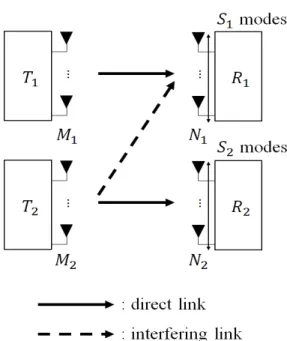
Fig. 1. MIMO Z-IC.
set of matrices , denotes the block-diagonal matrix consisting of . For ∈, denotes .
Ⅱ. System Model
We consider a MIMO Z-interference channel where two transmitters and have and antennas each, and two receivers and are equipped with and reconfigurable antennas that can switch among and preset modes, respectively. The preset modes at the receivers at time are represented as
where ⊆ , ∈. Each
has a message to send for its corresponding receiver , ∈. causes interference at
, but does not cause interference at
which implies that the signal from is received below noise level at . We call this model as
MIMO Z-IC. These are illustrated at Fig. 1.
We assume that channel gains remain constant throughout the course of communication, i.e.
quasi-static fading channel. In this scenario, the channel gain at each time only depends on the preset mode at the receiver. We denote the channel gain for the link from to at time as
∈×. We also represent the channel matrices for the link from to over
channel uses as
.
We assume that each intended to send a
message vector ∈ × to through the beamforming matrix ∈× . We restrict ourselves to linear coding strategies at the transmitters. Thus, the transmit signal from over
channel uses is given by . The input-output relationships at the receivers over
channel uses are given by
where is the additive white Gaussian noise vector over channel uses, whose entries are independent, each of which distributed as
at , ∈.
We assume that the transmitters have no knowledge about the channel gains, i.e., no CSIT.
On the contrary, the receivers are aware of CSI for their incoming links. At the receivers, interfering signals are aligned and desired signals occupy independent signal subspaces through predetermined
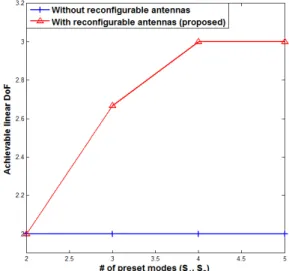
Fig. 2. The achievable linear DoFs for MIMO Z-IC when .
order of antenna switching, referred to as preset mode pattern. We denote the preset mode patterns of
during channel uses as
, ∈. Since the channel gain varies solely depending on the receiver's preset mode pattern, the channel gains of the links towards the same receive antenna have the identical changing pattern.
Lastly, the linear DoF (LDoF) tuple is
said to be achievable if there exists a set of beamforming vectors and preset mode patterns almost surely, satisfying
≥
lim
→∞
where denotes the vector space induced by projecting onto the orthogonal complement of
, and is the interference signal subspaces at
as
∅,
for ∈. The linear sum DoF for the MIMO Z-IC is defined as
.
Ⅲ. Achievable Scheme
In this section, we derive the achievable linear sum DoF and propose a new achievable scheme for MIMO Z-IC with reconfigurable antennas at the receivers in the absence of CSIT.
The main result of this work is as follows.
Theorem 1. For the
MIMO Z-IC with reconfigurable antennas at the
receivers in the absence of CSIT, the achievable linear sum DoF is
Remark 1. According to Theorem 1, the reconfigurable antennas at cannot increase the achievable linear sum DoF, since is not related to which is the number of preset modes at .
Remark 2. According to Theorem 1, the linear
DoF tuple
is
achievable if
goes to zero. This implies that the interfering link from to can be ignored from the DoF perspective if
goes to infinity, but
is a constant factor.
Remark 3. Without reconfigurable antennas, the achievable linear sum DoF for
MIMO Z-IC in the absence of CSIT is
. We can easily check that the achievable linear sum DoF is increased by reconfigurable antennas at the receivers. For instance, we compare the achievable linear DoFs for MIMO Z-IC where the receivers are not equipped with reconfigurable antennas and MIMO Z-IC () where the receivers are equipped with reconfigurable antennas. Fig. 2 shows that we can achieve the DoF gain by reconfigurable antennas if the number of preset modes are greater than the number of receive antennas.
The main idea of our achievable scheme is to use interfering signals as a side information at over the multiple of transmissions and silences at . We can easily see that can be achieved
by only transmitting if
. Thus, we only
focus on the case where
. Basically, our scheme uses time slots, required for a conventional MIMO transmission between and with reconfigurable antennas at the receiver. Let us explain our scheme into two-step design; 1) a conventional MIMO transmission between and and 2) multiple MIMO transmissions and silences between and
.
1) A conventional MIMO transmission between
and with reconfigurable antennas at the receiver: During time slots,
transmits its signals to as
× MIMO channel. Since
with preset modes can decode the desired symbols from at most transmit antennas when
transmits the signals as MIMO channel,
only uses transmit antennas to send its signals. Thus, the beamforming matrices at
and the preset mode patterns at are constructed as 1-user × MIMO channel with
preset modes at the receiver[13]. During
time slots, does not change its preset modes to align interfering signals from
into 1-dimensional signal subspace. Since
transmits its ×
signals over time slots, the achievable linear DoF of - pair is given by
×
2) Multiple MIMO transmissions and silences between and : From the 1st time slot to the
th time slot, a MIMO transmission proceeds in each time slot as if there do not exist the interfering signals from . In each time slot, the beamforming matrices at are constructed as a conventional × MIMO channels. During the remaining
time slots, keeps silent (does not transmit the signals), as does not change its preset mode patterns as in the previous time slots. These
time slots, where keeps silent, are required for canceling the interfering signals from at . At , the interfering signals from
the 1st time slot to the
th time slot can be canceled by utilizing the received signals during the last time slots, where the BS keeps silent, since only receive independent
signals from over
time slots. Thus, the achievable linear DoF of - pair is given by
×
Through our proposed scheme, the achievable linear sum DoF is
Let us give a toy example of our proposed scheme.
Example 1. Consider (1,2,1,1,1,2) MIMO Z-IC. In this scenario, two ( ) time slots are used to transmit two messages from and , respectively. First, transmits its message
∈ × over two time slots. Thus,
To decode its desired symbols at ,
switches its preset mode between the 1st and 2nd time slots as
By this scheme, can decode its desired symbols from since it receives two independent signals over two time slots for two desired symbols.
Let us see a signal transmission between and
. According to our proposed scheme, since
and ,
transmits its message to at the 1st time slot and do not transmit the signals to at the 2nd time slot. Thus,
To align the interfering signals from ,
does not change its preset mode as
The received signal at over two time slots is given by
can decode its desired symbol by subtracting the received signal at the 2nd time slot from the received signal at the 1st time slot. In conclusion, the sum of three symbols can be decoded at and
over two time slots, thus the achievable linear sum DoF is 3/2, which corresponds to Theorem 1.
×
Ⅳ. Concluding Remarks
This work mainly showed the achievable linear
sum DoF for the MIMO Z-IC with reconfigurable antennas at the receivers under the assumption that the transmitters do not have any channel state information. We proposed an achievable scheme to align interfering signals and to decode desired signals through the switching of reconfigurable antennas at the receivers. The key idea of our proposed scheme is to use interfering signals as a side information at the interfered receiver by being silent at the corresponding transmitter during some time slots. This implies that we showed that the reconfigurable antennas at the receivers can increase the achievable linear sum DoF in certain cases.
Future direction of this work could be to derive the upper-bound on the linear sum DoF for the MIMO Z-IC with reconfigurable antennas at the receivers in the absence of CSIT to show that the achievable linear sum DoF induced by our proposed scheme is tight. Moreover, we could extend our work for the MIMO Z-IC to the circular MIMO Z-IC in which three or more users exist in the network.
References
[1] V. Cadambe and S. A. Jafar, “Interference alignment and degrees of freedom of the K-user interference channel,” IEEE Trans. Inf.
Theory, vol. 54, no. 8, pp. 3425-3441, Aug.
2008.
[2] S. -W. Jeon and B. C. Jung, “Interference neutralization for small-cell wireless networks,” J. KICS, vol. 38, no. 12, pp. 1117- 1124, Dec. 2013.
[3] K. Kim, S. -W. Jeon, J. Yang, and D. K. Kim,
“Feasibility of interference alignment for reverse duplex in MIMO cellular networks with one-side base coopertation,” J. KICS, vol. 40, no. 2, pp. 273-284, Feb. 2015.
[4] S. -W. Jeon, “Recent study on interference management for full-duplex cellular systems,”
J. KICS, vol. 40, no. 7, pp. 1266-1275, Jul.
2015.
[5] T. Gou, C. Wang, and S. A. Jafar, “Aiming perfectly in the dark-blind interference alignment through staggered antenna
switching,” IEEE Trans. Sign. Process., vol.
59, no. 6, pp. 2734-2744, Jun. 2011.
[6] M. Yang, S. -W. Jeon, and D. K. Kim,
“Linear degrees of freedom of MIMO broadcast channels with reconfigurable antennas in the absence of CSIT,” arXiv preprint arXiv:1409.5532v1, Sept. 2014.
[7] Y. Lu, W. Zhang, and K. B. Letaief, “Blind interference alignment with diversity in K-user interference channels,” IEEE Trans. Commun., vol. 62, no. 8, pp. 2850-2859, Aug. 2014.
[8] C. Wang, “Degrees of freedom characteriza- tion: the 3-user SISO interference channel with blind interference alignment,” IEEE Commun. Lett., vol. 18, no. 5, pp. 757-760, May 2014.
[9] H. Yang, W. Shin, and J. Lee, “Degrees of freedom for K-user SISO interference channels with blind interference alignment,” in Proc. IEEE Asilomar Conf. on Sign., Syst., and Comput., Pacific Grove, CA, Nov. 2015.
[10] M. M. Cespedes, J. P. Chaves, D.
Toumpakaris, S. A. Jafar, and A. G. Armada,
“Blind interference alignment for cellular networks,” IEEE Trans. Sign. Process., vol.
63, no. 1, pp. 41-56, Jan. 2015.
[11] L. Ke and Z. Wang, “Degrees of freedom regions of two-user MIMO Z and full interference channels: the benefit of reconfigurable antennas,” IEEE Trans. Inf.
Theory, vol. 58, no. 6, pp. 3766-3779, Jan.
2012.
[12] K. Mohanty and M. K. Varanasi, “Degrees of freedom of the MIMO Z-interference channel with delayed CSIT,” IEEE Commun. Lett., vol. 19, no. 12, pp. 2282-2285, Dec. 2015.
[13] C. Wang, T. Gou, and S. A. Jafar,
“Interference alignment through staggered antenna switching for MIMO BC with no CSIT,” in Proc. IEEE Asilomar Conf.Signals, Syst., Comput., Pacific Grove, CA, Nov. 2010.
양 희 철 (Heecheol Yang)
2013년 2월:서울대학교 전 기․정보공학부 학사 2013년 3월~현재:서울대학교
전기․정보공학부 석박사통 합과정
<관심분야> 통신공학, 정보이 론
이 정 우 (Jungwoo Lee)
1988년:서울대학교 전기공학 학사
1990년:Princeton University 전기공학 석사
1994년:Princeton University 전기공학 박사
2002년~현재:서울대학교 전 기․정보공학부 교수
<관심분야> 무선통신, 정보이론, 머신러닝