439
http://dx.doi.org/10.9720/kseg.2015.4.439
Field Investigation of Debris Flow Hazard Area on the Roadside and Evaluating Efficiency of Debris barrier
Jong Hyun Lee
1, Jung Yub Lee
2, Sang Won Yoon
1, Young Suk Oak
1, Jae Jeong Kim
1*, and Seung Hyun Kim
11
Korea Institute of Civil Engineering and Building Technology
2
Korea Dyeing & Finishing Technology Institute
Received 4 November 2015; received in revised form 16 December 2015; accepted 21 December 2015
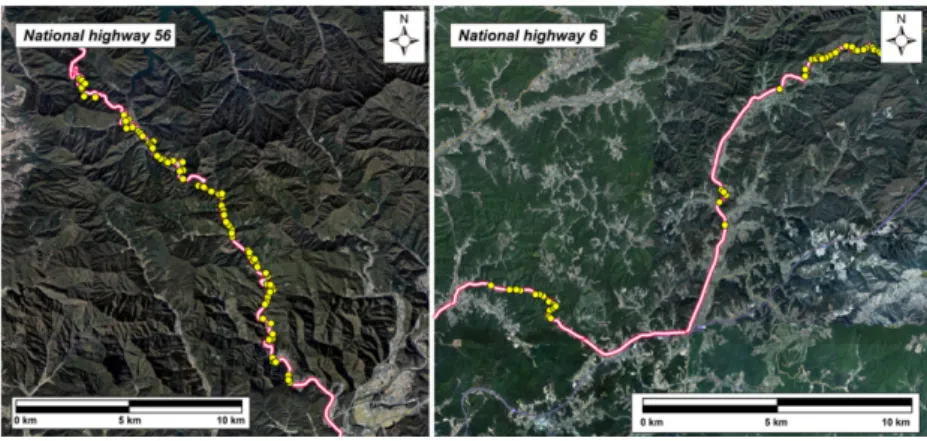
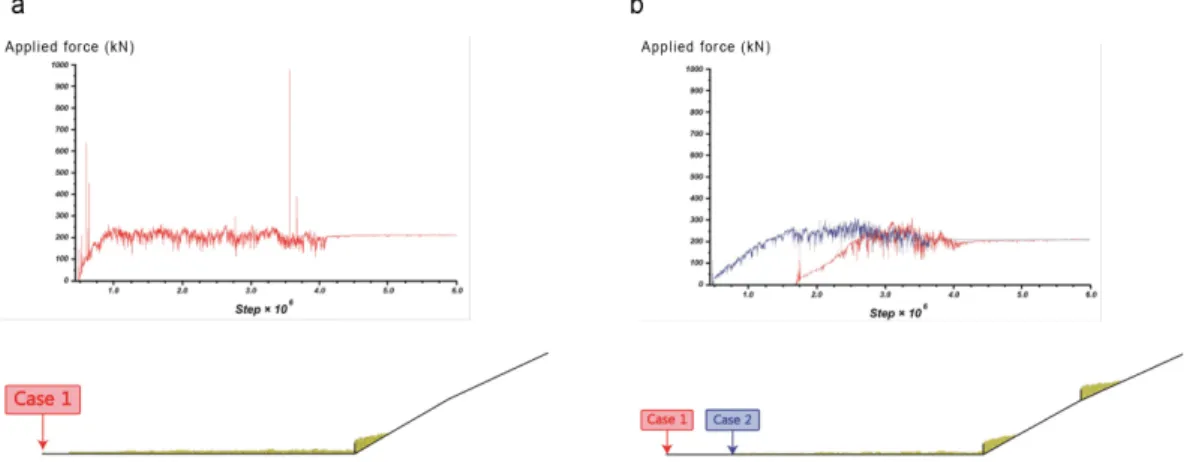
In this study, specific sections vulnerable to debris flow damage were selected, and a complete enumeration sur- vey was performed for the sections with debris flow hazards. Based on this, the characteristics of the sections with debris flow hazards and the current status of actions against debris flow were examined, and an efficient installa- tion plan for a debris flow damage prevention method that is required in the future was suggested. The results indi- cated that in the Route 56 section where the residential density is relatively higher between the two model survey sections, facilities for debris flow damage reduction were insufficient compared to those in the Route 6 section which is a mountain area. It is thought that several sites require urgent preparation of a facility for debris flow dam- age reduction. In addition, a numerical analysis showed that for debris barriers installed as a debris flow damage prevention method, distributed installation of a number of small-scale barriers facilities within a valley part was more effective than single installation of a large-scale debris barrier at the lower part of a valley.
Key words: debris flow, debris avalanche, field investigation, discrete element method, debris flow reducing facility
Introduction
More than 70% of the territory consists of mountain area. Thus, formation of slopes depending on road con- struction was inevitable, and there were many unstable slopes along the roads that had been constructed during the rapid economic growth in the past. Accordingly, in case of concentrated rainfall in the summer season where more than about 60% of the annual precipitation occurs, small and large rock falls and landslides have continu- ously occurred. However, for artificial slopes along national highways, nationwide surveys and proactive mea- sures have been prepared at a national level for the last 17
years, and thus, casualties and property damage from the collapse of artificial slopes have significantly decreased compared to the past (KICT, 2015).
In case of the debris flow, has not drawn much atten- tion compared to the interest in artificial slopes. However, with the recent occurrence of a lot of casualties and prop- erty damage due to frequent large-scale debris flow near concentrated residential areas, social interest in debris flow has increased and preparation of countermeasures has been required.
Debris flow is defined by many previous researchers. It has been defiend as a rapid movement of saturated soil, rocks and other debris down a steep mountain channel
*Corresponding author: [email protected]
ⓒ 2015, The Korean Society of Engineering Geology
This is an Open Access article distributed under the terms of the Creative Commons Attribution Non-Commercial License (http://creativecommons. org/
licenses/by-nc/3.0) which permits unrestricted non-commercial use, distribution, and reproduction in any medium, provided the original work is prop- erly cited.