1)
†
To whom correspondence should be addressed.
Department of Civil & Environmental Engineering, Kongju National University E-mail: [email protected]
∙ K.A.V. Yano Department of Civil and Environmental Engineering, Kongju National University, Cheonan City, Chungnamdo, South Korea/
Master's student ([email protected])
∙ N. J. D. G. Reyes Department of Civil and Environmental Engineering, Kongju National University, Cheonan City, Chungnamdo, South Korea/PhD Student ([email protected])
∙ F.K.F. Geronimo Department of Civil and Environmental Engineering, Kongju National University, Cheonan City, Chungnamdo, South Korea/PhD Student ([email protected])
∙ LM. S. Jeon Department of Civil and Environmental Engineering, Kongju National University, Cheonan City, Chungnamdo, South Korea/PhD Student ([email protected])
∙ Y. Kim Department of Environment Engineering, Hanseo University, Seosan City, Chungnam, South Korea/ Professor ([email protected])
∙ L. H. Kim Department of Civil and Environmental Engineering, Kongju National University, Cheonan City, Chungnamdo, South Korea/ Professor ([email protected])
A comprehensive review of microplastics: Sources, pathways, and implications
K.A.V. Yano・N. J. D. G. Reyes・F.K.F. Geronimo・M. S. Jeon・Y. Kim
*・L. H. Kim
†Department of Civil and Environmental Engineering, Kongju National University
*
Department of Environmental Engineering, Hanseo University
미세 플라스틱의 종합적 고찰: 근원, 경로 및 시사점
K.A.V. Yano・N. J. D. G. Reyes・F.K.F. Geronimo・전민수・김영철
*
・김이형†
공주대학교 건설환경공학과
*한서대학교 환경공학과
(Received : 04 May 2020, Revised : 21 May 2020, Accepted : 21 May 2020)
Abstract
Most studies defined microplastic (MP) as plastic particles less than 5 mm. The ubiquity of MP is raising awareness due to its potential risk to humans and the environment. MP can cause harmful effects to humans and living organisms.
This paper review aimed to provide a better understanding of the sources, pathways, and impacts of MP in the environment.
MP can be classified as primary and secondary in nature. Moreover, microplastic can also be classified as based on its physical and chemical characteristics. Stormwater and wastewater are important pathways of introducing MP in large water bodies. As compared to stormwater, the concentrations of MP in wastewater were relatively lower since wastewater treatment processes can contribute to the removal of MP. In terms of polymer distribution, wastewater contains a wider array of polymer varieties than stormwater runoff. The most common types of polymer found in wastewater and stormwater runoff were polypropylene (PP), polyvinyl chloride (PVC), polystyrene (PS), polyethylene (PE) and polyethylene terephthalate (PET). The continuous discharge and the increasing number of MP in the environment can pose greater hazards and harmful effects on humans and other living organisms. Despite the growing number of publications in relation to MP, further studies are needed to define concrete regulations and management strategies for mitigating the detrimental effects of MP in the environment.
Key words : microplastic, polymers, stormwater runoff, wastewater
요 약
미세플라스틱 관련 대부분의 연구에서는 미세플라스틱(MP)을 5mm 미만의 플라스틱 입자로 정의하고 있다. 미세플라스틱 은 자연계에 광범위하게 분포함으로써 인간과 환경에 잠재적 위험성이 높아지고 있는 물질이다. 특히 미세플라스틱은 인간 을 포함하여 살아있는 생명체에게 물리적 영향을 줄 뿐만 아니라 신진대사와 호르몬 등과 같은 생태적 기능에 심각한 영향 을 줄 수 있다. 따라서 본 연구는 환경에서 미세플라스틱의 근원, 경로 및 영향에 대한 이해를 돕기 위해 수행되었다. 미세플 라스틱은 본질적으로 1 차 및 2 차 미세플라스틱으로 분류되며, 물리적 및 화학적 특성에 따라 분류되기도 한다. 미세플라스 틱의 주요 경로는 강우유출수와 폐수를 통한 배출이며, 하천과 하구역을 거쳐 해양과 같은 대규모 수역으로 이동한다. 미세
1. Introduction
Microplastics (MP) have been drawing attention due to its persistence and its potential detrimental effects on human health and the environment (Arthur et al., 2008).
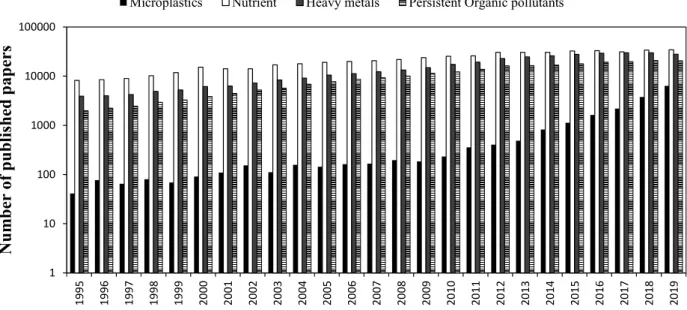
Currently, there is no standard definition of MP; however, most recent studies defined MP as plastic particles less than 5 mm (Hartmann et al., 2019). The occurrence of MP in surface waters was initially reported by Carpenter and Smith (1972) in the early 1970s. Early studies regarding the presence of plastics in the natural environment focused on the entanglement and ingestion of plastics by marine species and marine bird species (Andrady, 2011). Over the last 25 years, relevant studies and publications concerning MP increased by 26%. As exhibited in Figure 1, publications about MP were relatively low as compared with studies involving conventional water quality pollutants (nutrients, heavy metals, and persistent organic pollutants); however, the rate of increase in MP-related studies was two to four times higher as compared with other pollutant types,
indicating a shift in interest from conventional water pollutants to emerging pollutants. Pollution mainly originates from land activities with poor waste management practices and causes health and environmental problems (Auta et al., 2017). With the rapid development of MP research over the decades, it was also anticipated that the number of MP in the natural environment will continue to increase in the coming years. Most studies on MP reported environmental concentrations of MP in oceans and freshwater, but studies on the primary sources and pathways of MP were still limited. Therefore, this study presented a comprehensive review of the sources, pathways, and environmental impacts of MP. The primary classifications and environmental concentrations of MP were also discussed in this inquiry.
1.1 Classification of microplastic
According to Barrows et al. (2017), MP can be classified as Primary or Secondary. Primary MP were defined as microscopic plastics engineered for industrial purposes.
These MP particles are commonly used as exfoliants in 플라스틱은 폐수 처리 과정에서 크게 제거되기 때문에 폐수처리장 유출수의 미세플라스틱 농도는 강우유출수 내 농도보다 상대적으로 낮게 나타난다. 그러나 폴리머의 분포 측면에서는 폐수가 강우유출수보다 다양한 폴리머 종류를 포함하고 있는 것으로 나타났다. 폐수와 강우유출수에서 발견되는 일반적인 폴리머 유형은 폴리프로필렌(PP), 폴리염화비닐(PVC), 폴리스 티렌(PS), 폴리에틸렌(PE) 및 폴리에틸렌테레프탈레이트(PET) 등으로 나타났다. 환경에서 지속적으로 배출이 증가하고 있는 미세플라스틱의 수는 인간과 다른 생명체에게 미래 위험을 줄 수 있다. 그 동안 미세플라스틱에 대한 연구 결과물의 수가 증가함에도 불구하고 환경에 미치는 영향을 완화하기 위한 구체적 규제 및 관리 전략을 수립하기에는 많은 추가 연구가 필요한 것으로 나타났다.
핵심용어 : 미세플라스틱, 폴리머, 강우유출수, 폐수
1 10 100 1000 10000 100000
19 95 19 96 19 97 19 98 19 99 20 00 20 01 20 02 20 03 20 04 20 05 20 06 20 07 20 08 20 09 20 10 20 11 20 12 20 13 20 14 20 15 20 16 20 17 20 18 20 19
Num b er o f publ is hed pa pers
Microplastics Nutrient Heavy metals Persistent Organic pollutants
Fig. 1. Number of publications about Microplastic and conventional water pollutants for the past 25 years (Based on Google Scholar
search with keywords: microplastic, nutrient pollutants, heavy metal pollutants, and persistent organic pollutants)
personal care products, sandblasting media, and manufacturing of plastic products and synthetic clothes Duis and Coors (2016) and Chatterjee and Sharma (2019).
Primary MP can be discharged in the environment as a result of personal care product use, medical applications, drilling of fluids and gas explorations, utilization of industrial abrasives, and use of plastic pellets as a raw material for producing plastics (Duis et al., 2016).
Secondary MP originate from the breakdown of large plastic debris into smaller plastic fragments caused by environmental or mechanical degradation. These MPs mostly come from general littering, landfill sites, plastic mulching, fibers from synthetic textiles released from laundry, abrasion of from car tires, and from other plastic materials. It is still unknown which type is dominant in the environment (Syberg et al., 2015). However, the dominant type of MP may vary depending on the mass plastic consumption in a certain location.
1.2 Types of microplastic
The characterization of MP can be divided into physical and chemical aspects. Physical characteristics of MP mostly a concern in sizes, shapes, and colors since they were often mistaken for food by marine organisms and animals (Hidalgo-Ruz et al., 2012). Shapes of MP were
associated depending on the form of fragmentation and residence in the environment. Shapes can be categorized as fibers, fragments, foam, beads, and pellets. Colors help to identify
MP to non-MP material among large amounts ofdebris by separating eye-catching colors from dull colors, but the separation of colors can introduce bias when overlooked
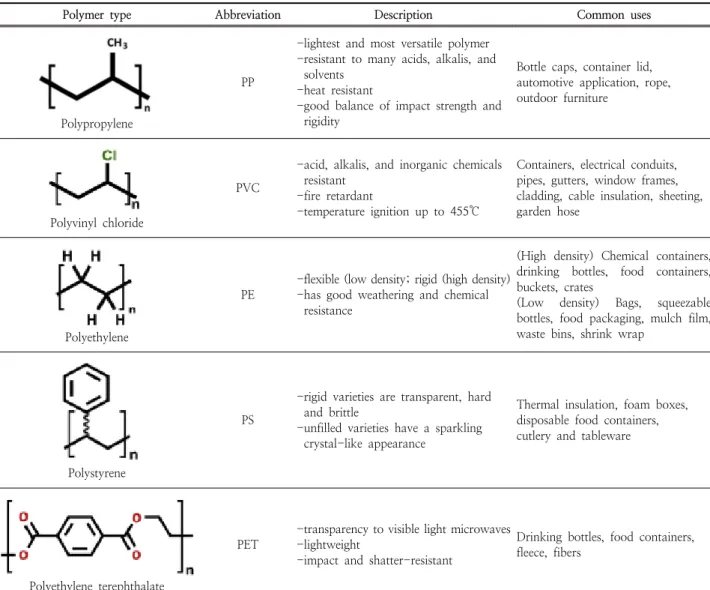
(Hidalgo- Ruz et al., 2012). As presented inTable 1, MP particles are made of polymers with different chemical compounds. These polymers are all thermoplastics, which means that plastic materials were melted and heated to produce useful products. The spectroscopic method is the most common method to identify polymeric compounds.
Polymer type Abbreviation Description Common uses
Polypropylene
PP
-lightest and most versatile polymer -resistant to many acids, alkalis, and
solvents -heat resistant
-good balance of impact strength and rigidity
Bottle caps, container lid, automotive application, rope, outdoor furniture
Polyvinyl chloride
PVC
-acid, alkalis, and inorganic chemicals resistant
-fire retardant
-temperature ignition up to 455℃
Containers, electrical conduits, pipes, gutters, window frames, cladding, cable insulation, sheeting, garden hose
Polyethylene
PE
-flexible (low density; rigid (high density) -has good weathering and chemical
resistance
(High density) Chemical containers, drinking bottles, food containers, buckets, crates
(Low density) Bags, squeezable bottles, food packaging, mulch film, waste bins, shrink wrap
Polystyrene
PS
-rigid varieties are transparent, hard and brittle
-unfilled varieties have a sparkling crystal-like appearance
Thermal insulation, foam boxes, disposable food containers, cutlery and tableware
Polyethylene terephthalate
PET
-transparency to visible light microwaves -lightweight
-impact and shatter-resistant
Drinking bottles, food containers, fleece, fibers
Table 1. The common type of MP found in the environment (adopted from Blair & Quinn, 2017)
This method employs radiation that classifies wavelength to identify the molecular composition of a polymer. Generally, the identification of chemical compounds of MP should confirm the physical characterization by visual inspection (Rocha-Santos & Duarte, 2015).
2. Sources, pathways, and occurrence
2.1 MP concentrations in stormwater, surface water, and wastewater
Aside from atmospheric deposition, stormwater runoff and wastewater are the primary pathways for land-based
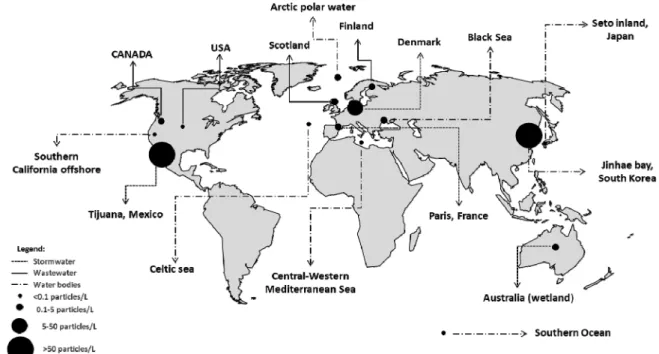
MP (Magnusson et al., 2016). Most studies on MP focused on the oceans and freshwater but limited data were available for MP in stormwater runoff. The amount of MP found on different water bodies across the world was summarized in Figure 2 and Table 2. The amount of MP varies greatly depending on the land use, plastic waste management, and anthropogenic activities of a certain location. Treated wastewater contained the least amount of MP among the studied samples. Although wastewaters may contain the largest amount of pollutants, the amount of MP can be significantly reduced by the wastewater treatment process. Based on the data presented in Table 2, the number of MP in surface water bodies was greater
Fig. 2. MP distribution in different pathways and surface waters based on published papers.
Table 2. MP concentrations in wastewater, stormwater, and surface waters.
Location Type Concentration (particles/L) Reference
Tijuana, Mexico Stormwater 88-289 de Jesus Piñon-Colin et al, 2020
Paris, France Stormwater 2-5 Treilles et al., 2019
Australia Stormwater 0.9 (IN); 4 (OUT) Ziajahromi et al., 2020
Denmark Stormwater 0.5 - 23 Liu et al., 2019
Canada Wastewater 31.1 (IN); 0.5 (OUT) Gies et al., 2018
USA Wastewater 0.05 Mason et al, 2016
Scotland Wastewater 15.7 (IN); 0.25 (OUT) Murphy et al., 2016
Finland Wastewater 57.6 (IN); 0.6 (OUT) Lares et al., 2018
Black Sea Surface water 0.6-1.2 Aytan et al., 2016
Arctic Polar Surface water 0.34 Lusher et al., 2015
Seto inland, Japan Surface water 0.39 (10
-3) Isobe et al., 2014
Jinhae bay, South Korea Surface water 88 Song et al., 2015
Celtic Sea Surface water 2.46 (10
-3) Lusher et al., 2014
Southern Ocean Surface water 0.031 (x10
-3) Isobe et al., 2017
Central-Western Mediterranean Sea Surface water 0.15 (x10
-3) de Lucia et al., 2014
Southern California offshore Surface water 3.92 (x10
-3) Sutton et al., 2016
than the treated wastewater since receiving water bodies (i.e. oceans, streams, and lakes) can accumulate MP from point and diffuse sources in the highest concentration of MP was observed on stormwater. Since a large portion of stormwater runoff can be released into surface water bodies without any treatment, it is necessary to establish intervention facilities to prevent the direct deposition of pollutants in the environment.
2.2 Point and non-point sources of MP
Urban areas are the major contributors to MP in the environment. Since urban areas are characterized by high population densities, sites that are adjacent to urban areas were found to have higher amounts of MP particles (Horton et al., 2017). The abundance of land-based MP sources is a significant factor affecting the detection or concentrations of MP in surface waters and large water bodies. on the other hand, sea- based MP mainly originate from marine coatings of cargo ships (Boucher & Friot, 2017). Overall, the combined effects of atmospheric deposition, land-based sources, and sea-based sources can collectively increase the number of MP on natural water bodies.
2.2.1 Point source MP
Incomplete removal of MP in wastewater treatment plants (WWTP) can introduce considerable amounts of MP in the environment (Estahbanati & Fahrenfeld, 2016).
The efficiency of WWTPs reducing MP in wastewater is
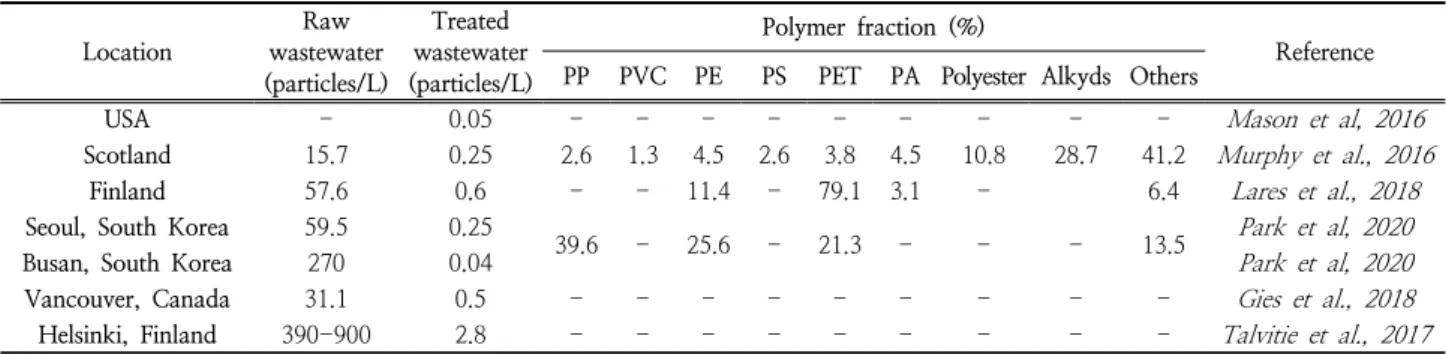
significant since the effluent is directly discharged on water bodies. The influent and effluent MP concentrations and the polymer distribution from different WWTPs were summarized in Table 3. The amount of MP varies greatly in different locations. The source of MP in wastewaters mainly comes from industrial wastes and plastic packagings such as containers and bottles (Carret et al., 2016). The treated wastewater from the studies listed in Table 3 was below 1 particle/L, except in Helsinki, Finland. The WWTP in Helsinki is the largest treatment plant in Finland and the Nordic countries and thus, a wide array of pollutants can be present in wastewater (Talvittie et al., 2017). Treated wastewater can discharge directly in rivers and streams.
Although some WWTPs can remove a significant fraction of MP in wastewater, low concentrations of MP in WWTP effluents can still contribute to MP pollution due to the large effluent volumes that are continuously discharged into the aquatic environment (Gies et al., 2018). The distribution of polymers in WWTPs exhibited many kinds of polymers.
Alkyds were the dominant types of polymer in a WWTP in Scotland. This type of polymer is mainly found in paints.
In Finland, PET was the most abundant polymer identified in the wastewater. Most PET particles exist in fibrous form, indicating that that laundry wastes from the municipal area have a significant contribution to MP in wastewater. In South Korea, consumer products can account for the dominance of PP polymers in Seoul and Busan area (Park et al., 2020).
Location
Raw wastewater (particles/L)
Treated wastewater (particles/L)
Polymer fraction (%)
Reference PP PVC PE PS PET PA Polyester Alkyds Others
USA - 0.05 - - - - - - - - - Mason et al, 2016
Scotland 15.7 0.25 2.6 1.3 4.5 2.6 3.8 4.5 10.8 28.7 41.2 Murphy et al., 2016
Finland 57.6 0.6 - - 11.4 - 79.1 3.1 - 6.4 Lares et al., 2018
Seoul, South Korea 59.5 0.25
39.6 - 25.6 - 21.3 - - - 13.5 Park et al, 2020
Busan, South Korea 270 0.04 Park et al, 2020
Vancouver, Canada 31.1 0.5 - - - - - - - - - Gies et al., 2018
Helsinki, Finland 390-900 2.8 - - - - - - - - - Talvitie et al., 2017
Table 4. MP concentrations and polymer distribution from different storm runoff collection
Location Land use Concentration
(particles/L)
Polymer number (%)
Reference
PP PVC PE PS PET Others
Denmark
Residential 0.5-1.4
71.5 7.4 9.1 2.2 - 5.5 Liu et al., 2019
Industrial 5.2-11.3
Commercial 22.9
Highway 0.5
Mexico
Residential 0.19-0.29
3.2 - 45.2 27.4 8.1 16.1 de Jesus Piñon-Colin et al, 2020
Industrial 0.2
Commercial & residential 0.09-0.13
France Residential 2-5 15 - 48 37 - - Treilles et al., 2019
Table 3. MP concentrations and polymer distribution from different municipal WTTPs before and after treatment
2.2.2 Non-point sources of MP
Stormwater is a pathway for delivering MP in water bodies (Liu et al., 2019). Only a few published studies reported the occurrence of MP in stormwater since the majority of the studies focused on the presence of MP in marine animal tissues and organisms and surface water bodies.
Table 4 summarized the concentration of MP and dominant polymers present in stormwater. The stormwater runoff in the commercial area in Denmark had the highest amount of MP concentration (22.9 particles/L.). The commercial and industrial area holds the highest amount of MP among the other land use in Denmark. These were characterized by high anthropogenic activities that can contribute to high amounts of pollutants in the environment. In Mexico, industrial and residential areas provided the highest amount of MP.
Industrial areas took advantage of the rain to discharge wastewater to the streets. It is a norm in Mexico to discharge domestic laundry in the streets even when they have the sewage system (de Jesus Piñon-Colin et al., 2020). The common polymers found in stormwater such a PP, PVC, PE, PS, and PET were the converted polymer types of plastics in the market (Plastics Europe, 2017). These common polymers are similar to the polymers that can be found in wastewaters.
3. Impacts of MP on animals, humans, and environment
Exposure to MP can be categorized into physical, chemical, and biological effects. Ingestion and entanglement are the most common cases in which MP can be accumulated in animal tissues. In the case of small microorganisms, the presence of MP may result in death by drowning, starving, and suffocation (Allsopp et al., 2006). Ingestion of MP can be found on almost all kinds and sizes of marine animals (Li et al., 2018). MP also served as a carrier of pollutants on its way to water bodies. MP can sorb lubrication oils, heavy metals, persistent organic pollutants, and other toxic chemicals that can be released when ingested and transported into waters (Wang et al., 2018). MP are made up of polymeric compounds that can have negative health effects. Some polymers and additives in plastics are resistant to biodegradation and cause disruption in endocrine functions through bioaccumulation processes (Li et al., 2018). Microorganisms that can also easily attach to MP surfaces and be transported together in various environmental media. This means that bacteria and other pathogenic organisms can be released to water bodies through MP (McCormick et al., 2014).
Humans are frequently exposed to plastics since it became a part of daily human necessities. to primary MP can be due to the use of personal care products and or by eating aquatic animals that ingested MP (Carbery et al., 2018). The ingestion of MP on humans can cause infertility, cancer, and obesity (Sharma and Chatterjee, 2017). Based on a conducted research, there will be more MP in the oceans than fishes by the year 2050 (Auta et al., 2017). Continuous manufacturing and constant release of MP in the environment can result in greater health risks in humans and marine organisms.
4. Conclusion
A range of factors can influence the distribution of MP across the ecosystem including human activities, population, and land use. Continuous study and research about MP are important to evaluate and prevent the implications brought about by the presence of MP in the environment. The most common polymers found in the major pathways were PP, PVC, PE, PET, and PS which were also in-demand polymers in the consumer market. The characteristics of polymers are important in determining the main source of MP in the environment. Studies indicated that wastewater could not define the levels of MP in water bodies alone as a direct pathway of MP. Despite the small concentrations of MP in treated wastewater, the continuous release and large effluent volumes can still contribute significant amounts of MP in the environment. Stormwater is a also significant pathway and contributor of MP in the aquatic environment. Since MP are proven to be existing and have potentially harmful effects, treatment of MP is necessary to reduce its detrimental effects on the environment and human health. Low impact development (LID) facilities or pollutant management facilities can be used as possible treatment mechanisms for reducing the amount of MP in stormwater and wastewater. LID facilities utilize essential processes such as sedimentation, adsorption, and filtration for the removal of MP from point and non-point sources. The complex pathways and transport mechanisms of MP are considered as the major challenges in quantifying the actual amount of MP in the environment. Further studies concerning the development of predictive models and control strategies are also necessary to limit the adverse effects of MP in the environment and human health.
References
2015, P.-T. F. (2015). Plastics - the facts 2015: An analysis
of European plastics production, demand and recovery for 2014.
PlasticsEurope
. https://doi.org/10.1016/j.marpolbul.2013.01.015
Allsopp, M., Walters, A., Santillo, D., & Johnston, P. (2006).
Plastic Debris in the World’s Oceans.
World
. Andrady, A. L. (2011). Microplastics in the marineenvironment.
Marine Pollution Bulletin
. https://doi.org/10.1016/j.marpolbul.2011.05.030
Arthur, C., Baker, J., Bamford, H., & (eds). (2009).
Proceedings of the international research workshop on the occurrence, effects and fate of microplastic marine debris, Sep 9-11, 2008. NOAA. Technical Memorandum NOS-OR&R-30. NOAA, Silver Spring 530pp.
September 9-11, 2008. NOAA Technical Memorandum NOS-OR&R-30
.Auta, H. S., Emenike, C. U., & Fauziah, S. H. (2017).
Distribution and importance of microplastics in the marine environmentA review of the sources, fate, effects, and potential solutions.
Environment International
. https://doi.org/10.1016/j.envint.2017.02.013Aytan, U., Valente, A., Senturk, Y., Usta, R., Esensoy Sahin, F. B., Mazlum, R. E., & Agirbas, E. (2016). First evaluation of neustonic microplastics in Black Sea waters.
Marine Environmental Research
. https://doi.org/10.1016/j.marenvres.2016.05.009
Barrows, A. P. W., Neumann, C. A., Berger, M. L., &
Shaw, S. D. (2017). Grab: Vs. neuston tow net: A microplastic sampling performance comparison and possible advances in the field.
Analytical Methods
. https://doi.org/10.1039/c6ay02387hBlair Crawford, C., & Quinn, B. (2017).
Microplastic Pollutants
. Candice G. Janco.Boucher, J., & Friot, D. (2017).
Primary microplastics in the oceans: A global evaluation of sources
.Primary microplastics in the oceans: A global evaluation of sources
. https://doi.org/10.2305/iucn.ch.2017.01.en Carbery, M., O’Connor, W., & Palanisami, T. (2018).Trophic transfer of microplastics and mixed contaminants in the marine food web and implications for human health.
Environment International
. https://doi.org/10.1016/j.envint.2018.03.007Carpenter, E. J., & Smith, K. L. (1972). Plastics on the Sargasso sea surface.
Science
. https://doi.org/10.1126/science.175.4027.1240
Carr, S. A., Liu, J., & Tesoro, A. G. (2016). Transport and fate of microplastic particles in wastewater treatment plants.
Water Research
. https://doi.org/10.1016/j.watres.2016.01.002
Chatterjee, S., & Sharma, S. (2019). Microplastics in our oceans and marine health.
Field Actions Science Report
. de Lucia, G. A., Caliani, I., Marra, S., Camedda, A., Coppa,S., Alcaro, L., … Matiddi, M. (2014). Amount and distribution of neustonic micro-plastic off the western Sardinian coast (Central-Western Mediterranean Sea).
Marine Environmental Research
. https://doi.org/10.1016/j.marenvres.2014.03.017
Duis, K., & Coors, A. (2016). Microplastics in the aquatic and terrestrial environment: sources (with a specific focus on personal care products), fate and effects.
Environmental Sciences Europe
. https://doi.org/10.1186/s12302-015-0069-y
Estahbanati, S., & Fahrenfeld, N. L. (2016). Influence of wastewater treatment plant discharges on microplastic concentrations in surface water.
Chemosphere
. https://doi.org/10.1016/j.chemosphere.2016.07.083 Gies, E. A., LeNoble, J. L., Noël, M., Etemadifar, A., Bishay,F., Hall, E. R., & Ross, P. S. (2018). Retention of microplastics in a major secondary wastewater treatment plant in Vancouver, Canada.
Marine Pollution Bulletin
. https://doi.org/10.1016/j.marpolbul.2018.06.006 Hartmann, N. B., Hüffer, T., Thompson, R. C., Hassellöv,M., Verschoor, A., Daugaard, A. E., … Wagner, M.
(2019). Are We Speaking the Same Language?
Recommendations for a Definition and Categorization Framework for Plastic Debris.
Environmental Science and Technology
. https://doi.org/10.1021/acs.est.8b05297 Hidalgo-Ruz, V., Gutow, L., Thompson, R. C., & Thiel,M. (2012). Microplastics in the marine environment:
A review of the methods used for identification and quantification.
Environmental Science and Technology
. https://doi.org/10.1021/es2031505Horton, A. A., Walton, A., Spurgeon, D. J., Lahive, E.,
& Svendsen, C. (2017). Microplastics in freshwater and terrestrial environments: Evaluating the current understanding to identify the knowledge gaps and future research priorities.
Science of the Total Environment
. https://doi.org/10.1016/j.scitotenv.2017.01.190 Isobe, A., Kubo, K., Tamura, Y., Kako, S., Nakashima,E., & Fujii, N. (2014). Selective transport of microplastics and mesoplastics by drifting in coastal waters.
Marine Pollution Bulletin
. https://doi.org/10.1016/j.marpolbul.2014.09.041
Isobe, A., Uchiyama-Matsumoto, K., Uchida, K., & Tokai, T. (2017). Microplastics in the Southern Ocean.
Marine Pollution Bulletin
. https://doi.org/10.1016/j.marpolbul.2016.09.037
Lares, M., Ncibi, M. C., Sillanpää, M., & Sillanpää, M.
(2018). Occurrence, identification and removal of microplastic particles and fibers in conventional activated sludge process and advanced MBR technology.
Water Research
. https://doi.org/10.1016/j.watres.2018.01.049
Li, J., Liu, H., & Paul Chen, J. (2018). Microplastics in freshwater systems: A review on occurrence, environmental effects, and methods for microplastics detection.
Water Research
. https://doi.org/10.1016/j.watres.2017.12.056
Liu, F., Olesen, K. B., Borregaard, A. R., & Vollertsen, J.
(2019). Microplastics in urban and highway stormwater retention ponds.
Science of the Total Environment
. https://doi.org/10.1016/j.scitotenv.2019.03.416 Lusher, A. L., Burke, A., O’Connor, I., & Officer, R. (2014).Microplastic pollution in the Northeast Atlantic Ocean:
Validated and opportunistic sampling.
Marine Pollution Bulletin
. https://doi.org/10.1016/j.marpolbul.2014.08.023 Lusher, A. L., Tirelli, V., O’Connor, I., & Officer, R. (2015).Microplastics in Arctic polar waters: The first reported values of particles in surface and sub-surface samples.
Scientific Reports
. https://doi.org/10.1038/srep14947 Magnusson, K., Eliasson, K., Fråne, A., Haikonen, K.,Hultén, J., Olshammar, M., … Voisin, A. (2016).
Swedish sources and pathways for microplastics to the marine environment. A review of existing data.
IVL Svenska Miljöinstitutet
.Mason, S. A., Garneau, D., Sutton, R., Chu, Y., Ehmann, K., Barnes, J., … Rogers, D. L. (2016). Microplastic pollution is widely detected in US municipal wastewater treatment plant effluent.
Environmental Pollution
. https://doi.org/10.1016/j.envpol.2016.08.056McCormick, A., Hoellein, T. J., Mason, S. A., Schluep, J., & Kelly, J. J. (2014). Microplastic is an abundant and distinct microbial habitat in an urban river.
Environmental Science and Technology
. https://doi.org/10.1021/es503610r
Murphy, F., Ewins, C., Carbonnier, F., & Quinn, B. (2016).
Wastewater Treatment Works (WwTW) as a Source of Microplastics in the Aquatic Environment.
Environmental Science and Technology
. https://doi.org/10.1021/acs.est.5b05416
Park, H. J., Oh, M. J., Kim, P. G., Kim, G., Jeong, D.
H., Ju, B. K., … Kwon, J. H. (2020). National Reconnaissance Survey of Microplastics in Municipal Wastewater Treatment Plants in Korea.
Environmental Science and Technology
. https://doi.org/10.1021/acs.est.9b04929
Piñon-Colin, T. de J., Rodriguez-Jimenez, R., Rogel- Hernandez, E., Alvarez-Andrade, A., & Wakida, F.
T. (2020). Microplastics in stormwater runoff in a semiarid region, Tijuana, Mexico.
Science of the Total
Environment
. https://doi.org/10.1016/j.scitotenv.2019.135411 Rocha-Santos, T., & Duarte, A. C. (2015). A criticaloverview of the analytical approaches to the occurrence, the fate and the behavior of microplastics in the environment.
TrAC - Trends in Analytical Chemistry
. https://doi.org/10.1016/j.trac.2014.10.011Sharma, S., & Chatterjee, S. (2017). Microplastic pollution, a threat to marine ecosystem and human health: a short review.
Environmental Science and Pollution Research
. https://doi.org/10.1007/s11356-017-9910-8Song, Y. K., Hong, S. H., Jang, M., Han, G. M., & Shim, W. J. (2015). Occurrence and Distribution of Microplastics in the Sea Surface Microlayer in Jinhae Bay, South Korea.
Archives of Environmental Contamination and Toxicology
. https://doi.org/10.1007/s00244-015-0209-9
Sutton, R., Mason, S. A., Stanek, S. K., Willis-Norton, E., Wren, I. F., & Box, C. (2016). Microplastic contamination in the San Francisco Bay, California, USA.
Marine Pollution Bulletin
. https://doi.org/10.1016/j.marpolbul.2016.05.077
Syberg, K., Khan, F. R., Selck, H., Palmqvist, A., Banta, G. T., Daley, J., … Duhaime, M. B. (2015).
Microplastics: Addressing ecological risk through lessons learned.
Environmental Toxicology and Chemistry
. https://doi.org/10.1002/etc.2914Talvitie, J., Mikola, A., Setälä, O., Heinonen, M., &
Koistinen, A. (2017). How well is microlitter purified from wastewater? – A detailed study on the stepwise removal of microlitter in a tertiary level wastewater treatment plant.
Water Research
. https://doi.org/10.1016/j.watres.2016.11.046
Treilles, R., Gasperi, J., Saad, M., Rabier, A., Breton, J., Rocher, V., … Tassin, B. (2020). Macro and Microplastics in Stormwater and Combined Sewer Overflows in Paris Megacity. https://doi.org/10.1007/
978-3-030-45909-3_23
Wang, F., Wong, C. S., Chen, D., Lu, X., Wang, F., &
Zeng, E. Y. (2018). Interaction of toxic chemicals with microplastics: A critical review.
Water Research
. https://doi.org/10.1016/j.watres.2018.04.003Ziajahromi, S., Drapper, D., Hornbuckle, A., Rintoul, L.,
& Leusch, F. D. L. (2020). Microplastic pollution in a stormwater floating treatment wetland: Detection of tyre particles in sediment.
Science of the Total Environment
. https://doi.org/10.1016/j.scitotenv.2019.136356