DI Engine with Compressed Natural Gas
TRAN DANG QUOC*†, KWANGJU LEE*, JONGTAI LEE**
*Grad. School of Sungkyunkwan Univ., 300, Chunchun-dong Janan-gu, Suwon-si, Gyeonggi-do, 440-746, Korea
**School of Mechanical Engineering, Sungkyunkwan Univ., 300, Chunchun-dong Janan-gu, Suwon-si, Gyeonggi-do, 440-746, Korea
ABSTRACT
본 연구에서는 직접분사식 CNG기관의 희박한계를 보다 확장하여 고효율 및 저배기 공해를 실 현시키고자 실린더 내에 고압의 천연가스를 직접분사함과 동시에 흡입과정 중 흡기관 내에 소량의 저압천연가스를 보조분사하는 경우의 희박한계 확장 및 제반특성에 대해 검토하였다.
그 결과, 흡기보조분사가 없을 경우 희박한계가 λ = 1.4 까지였으나, 흡기보조분사율이 5~15%
정도에서는 희박한계가 λ = 1.5 까지 확장되었다. 이는 흡기보조분사에 따른 혼합기의 혼합율 향상 에 기인한 것으로 해석하였다. 연소기간은 줄어들었지만, 흡기보조분사의 효과는 주연소기간에서 조 기연소기간보다 강하게 나타났다.
KEY WORDS : Auxiliary port injection ratio (흡기보조분사), Direct injection CNG engine(직분식 천연가스엔진), Heavy-duty engine(대형엔진), Expansion of lean limit(희박한계확장), Compressed Natural Gas (CNG).
†Corresponding author : [email protected]
[ 접수일 : 2011.9.28 수정일 : 2011.10.16 게재확정일 : 2011.10.21 ]
1. Introduction
The DING(Direct Injection Nature Gas) engine, which is known as the forth generation of the gas injection method, has potential ability for low emission, high thermal efficiency and high
power. Performance characteristics of DING engine, which has the early injection during compression process and spark ignition, had been carried out by the author's Lab1∼3). As the results, it was verified that direct injection is effective fuel supply method in the expansion of lean limit, high power, exhaust gas reduction and efficiency compare with port injection type. Considering the
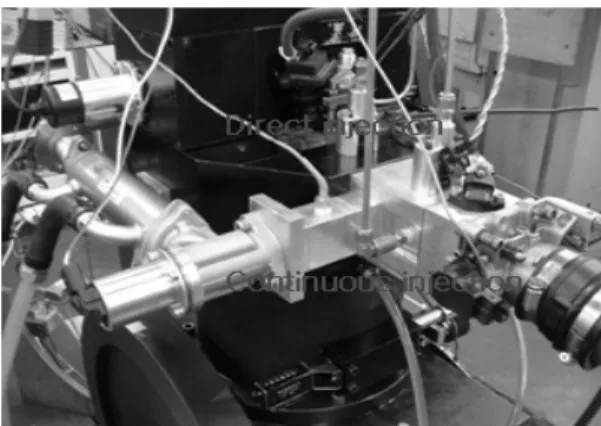
Fig. 1 Schematic diagram of experimental apparatus Fig. 2 Installed positions of direct injector and auxiliary port injector in research DING engine.
reinforced emission regulations for compressed natural gas (CNG) engine, however, lean limit of DING engine has to be extended more. The mixing rate of mixture is an important factor for enhancement of the lean limit as same as conventional engine4∼7).
Two concepts can be considered to enhance the mixing rate of mixture in the vicinity of spark plug at spark timing for a DING engine.
The one is control of the injection patterns such as injection timing, direct injection pressure during compression process. This type may be less effective in mixing due to short mixing duration. The other one is the auxiliary port injection that small portion of fuel is supplied in the intake port during intake process and main fuel into cylinder during the early stage of the compression process directly. The mixing duration from auxiliary port injection up to spark timing is increased. It may lead to better mixing rate and result in expansion of lean limit.
In this paper, the auxiliary port injection has investigated to expand the lean limit for a direct injection natural gas fueled engine with spark ignition. A heavy duty single cylinder research CNG fueled engine was used in the experiment.
Over all performance was evaluated with auxiliary port injection ratio and compared with direct injection type.
2. Experiments and methods
2.1 Experimental setup
The Fig. 1 is a schematic diagram of the experimental setup. It consists of the DING engine, a dynamometer system, a CNG supply system, intake/exhaust systems, a cooling system, data acquisition unit and several measuring devices.
The test engine has ε = 10.5 of the compression ratio, the displacement volume of 1842 cc, 123 mm x 125 mm in the bore and stroke, respectively. The engine has two injectors, the continuous injector inserted on intake pipe, the direct injector installed on the cylinder head close to spark plug. The direct injector used a ball valve type actuated by a solenoid, which had been developed in the preceding research by the authors1∼3). During fuel supply process, the ball shaped poppet valve is rotated to lead to better gas-tightness by polishing effect. Fig. 2 shows the installed
Fig. 3 COVimep with auxiliary port injection ratio
thermocouple type of flow meter (Bronchus, P-113AC-HAD-55-V). Between the CNG flow meter and the gas injectors, a 3.8 L accumulator was installed to minimize pulsation caused by fuel injection.
2.2 Experimental methods
The experimental variables are auxiliary port injection ratio(AR) and air-fuel equivalence ratio (λ). The auxiliary port injection ratio is varied in the range of AR = 0∼20% by ∆AR = 5%. The air-fuel equivalence ratio is varied from λ = 1 to lean limit by ∆λ = 0.1. At each experiment, engine speed, spark timing and temperature of cooling water are maintained 1400rpm, MBT and 353K respectively.
The auxiliary port injection ratio, AR is defined as follow:
×
: Mass flow rate of the port injection (kg/s)
: Mass flow rate of the direct injection (kg/s)
3. Results and discussions
3.1 Lean limit by changing auxiliary injection ratio In order to understand about the lean limits extended by auxiliary port injection, the coefficient
of cycle variation in the ultra- lean region was expressed with the auxiliary port injection ratio in Fig. 3. The coefficient of cycle variation(COV) determines as the root mean square of the indicated mean effective pressure (imep) derived by ensemble averaging 100 cycle data.
The COVimep tends to decrease as the auxiliary port injection ratio increases in the range 0∼10% due to the combustion enhancement resulting from the mixing rate.
When the auxiliary injection ratio is over 10% of AR value, the COVimep has the increased tendency. The variation of COVimep caused by the auxiliary port injection ratio becomes more apparent as it goes more lean region.
As a result, at a state of direct injection (AR
= 0%), the lean limit is approximately λ = 1.4, however, by increasing the auxiliary port injection ratio to 15%, the lean limit can be extended to as much as λ = 1.5. In generally, the engine can stably operate in the range 5∼15%
when COVimep is lower than 5%. The fuel-air equivalent ratio, therefore, was fixed at λ = 1.5 in the experiment and investigated the
Fig. 4 In-cylinder pressure at each auxiliary port injection ratio Fig. 5 Variation of combustion duration with auxiliary port injection ratio
Fig. 6 Lean limit according to auxiliary port injection ratio
combustion characteristics.
Fig. 4 shows the in-cylinder pressure for each auxiliary port injection ratio. The in-cylinder pressure tends to become greater than direct injection (AR = 0) with increasing the auxiliary port injection ratio and shows the maximum value at 15% of AR. In case of AR = 20%, the in-cylinder pressure is lower than those of different AR values. These results can be traced back to the fact that the CNG direct injection reduction effect increases with higher auxiliary port injection ratio as a result of the COVimep value of direct injection is higher 5%.
Fig. 5 shows combustion durations of flame development, rapid burning, final burning and its total according to auxiliary port injection ratio at λ = 1.5. The flame development was decreased as auxiliary port injection ratio rises to 20%.
However, the rapid burning was reduced in the range of AR = 0∼10%, and then it was increased in the range of AR = 20%. This is caused by the mass flow rate of CNG direct injection meaning heat value is reduced with higher auxiliary port injection ratio, so the
pressure of combustion process decreases. The total combustion duration was lessened when auxiliary port injection ratio increases to AR = 10% and then has the contrast tendency as AR goes to 20%. From above results showed that the auxiliary port injection ratio is strongly affected on combustion process. The desired AR for combustion duration is around ratio equal 10% and 15%.
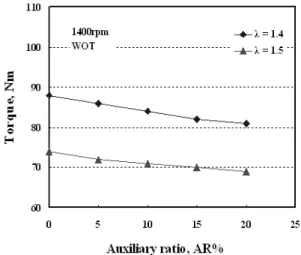
Fig. 7 Thermal efficiency as a function of auxiliary port
injection ratio Fig. 8 Variation of the torque according to auxiliary port
injection ratio
The Fig. 6 show lean limit according to auxiliary port injection ratio. The lean limit is extended to λ =1.5 at 15% of auxiliary port injection ratio due to reducement of combustion duration. The lean limit increased about 7% as compared with direct injection (λ =1.4) and higher than that of port injection about 16% (λ
=1.26).
3.2 Performance characteristic of lean limit Fig. 7 shows the thermal efficiency with auxiliary port injection ratio for each air-fuel equivalence ratio.
For two air-fuel equivalence ratios, the thermal efficiency tends to become greater as the auxiliary port injection ratio increases and becomes particularly evident as the mixture becomes ultra lean. This can be traced back to the fact that the cooling loss reduction effect increases with higher auxiliary port injection ratio as a result of combustion acceleration due to auxiliary port injection and a combustion gas temperature increase due to the decreased intake flow mass.
In addition, above results is demonstrate that auxiliary port injection is an effective method of achieving lean limit expansion and thermal efficiency increase in a heavy-duty direct injection engine with compressed natural gas.
The changes in brake torque with increasing the auxiliary port injection ratio are shown in Fig. 8. For both air-fuel equivalence ratio, the torque tends to decrease linearly due to decrease of the heat value as the auxiliary port injection ratio becomes greater.
4. Conclusion
To ascertain the possibility of achieving lean limit expansion in a heavy-duty direct injection engine with compressed natural gas, the effects of the auxiliary port injection ratio were analyzed in terms of lean limit and performance characteristic.
Lean limit extended to λ =1.5 and the stable region of engine operation found in the auxiliary injection ratio 5∼15%. The thermal efficiency is increased by auxiliary port injection ratio.
The test results also showed that the extension of lean limit by auxiliary injection method is about 7% and 16% compared with those of direct injection type and port injection type, respectively.
References
1) Tran Dang Quoc, Daewoo Nam, JongTai Lee,
“A Study on Compression Ratio of CNG Engine with Early Direct Injection”, KSAE 2008. 11 Annual Conference Proceedings, pp. 139.
2) Daewoo Nam, Tran dang Quoc, Jongtai Lee, 2008, “The Characteristic of Power and Emission for Heavy-duty CNG Engine with Direct Injection according to Various Compression Ratio”, Trans. of the KSME, 2008.11, pp. 3090-3095.
3) Tran Dang Quoc, Kwangju Lee, Changhee Byun, Daewoo Nam, JongTai Lee, “Experi- mental Study to Expend the Lean Limit for Heavy-Duty Direct Injection Natural Gas Spark Fueled Spark Ignition engine”, KSAE 2010.11 Annual Conference and Exhibition, pp 21.
4) K C Noh, Y S Song, J T Lee, “A Study on enhancement of the turbulence around the spark timing by auxiliary injection during the compression process”, Proc. Instn Mech. Engrs Vol. 217 Part D : J. Automobile Engineering, 2003.11, pp. 1011-1021.
5) Jari Hyvoenen, Carl Wilhelmsson and Bengt Johansson “The Effect of Displacement on Air- Diluted Multi-Cylinder HCCI Engine Perfor- mance”, SAE International 2006, pp. 123-139.
6) Kiyoshi Kawasaki, Akihiro Takegoshi and Koji Yamane, Hiroyuki Ohtsubo, Tohru Nakazono and Kazuyuki Yamauchi “Combustion Improvement and Control for Natural Gas HCCI Engine by the Internal EGR by Means of Intake-valve Pilot-opening”, SAE International 2006, pp.
169-176.
7) Ali Mohammadi, Hiroshi Kawanabe, Takuji Ishiyama and Masahiro Shioji, Atsushi Komada,
“Study on Compression Control in Natural-Gas PCCI Engines with Ozone Addition into Intake Gas”, SAE International 2006, pp. 223-230.