The Study on Property Criteria of Soil Dressing, Mounding and Earth Cutting for Farmland Preservation
Byung-Keun Hyun*, Yeon-Kyu Sonn, Chan-Won Park, Hyen-Chung Chun, Hyun-Jun Cho, Kwan-Cheol Song, Yong-Seon Zhang, and Deog-Bae Lee
National Academy of Agricultural Science, Suwon, Republic of Korea. 441-707
(Received: January 7 2014, Accepted: January 27 2014)
Korea’s agricultural land is constantly being reduced. The reasons for this are due to the change of agricultural profitability and the policy conditions. The reduction of agricultural land in 2010 showed a decline trend by 14.4 % of paddy fields and 1.2% of uplands compared to areas from 2000. These reductions were mainly due to switch rice paddy fields into upland or greenhouse facility cultivation because of low profitability of rice products compared to farm products. In addition, the permit system of agricultural areas was relaxed in switching paddy fields and this accelerated the reduction of agricultural land. For this reason, more than 1% of agricultural land area has been reduced every year for last five years. Moreover, indiscreet fill and cover materials such as construction wastes were used in agricultural lands and caused land contamination which threatened foundation as sustainable agricultural lands. For these reasons, it is a desperate situation to conserve good agricultural lands. However, the standards of transported soils, filling soils and cutting soils in the Agricultural Land Act are qualitative and have a problem of causing complaints. Therefore, the following criteria (proposals) are proposed in the Agricultural Land Act; ① Use the proper soils for crops (criterion), ② Soil components and amounts should be proper as transported soils (range), and ③ Prohibiting usage of improper earth rocks or recycled aggregates in case of filling soils (kinds). The presented criteria (proposals) suggest following; ① Use physio-chemically proper soils for crops (criterion), ② In case of transported soils,
ⅰ, exclude potential acid sulphate soils, ⅱ, gravel content sould be less than 15%, and ⅲ, Heavy metals and other contaminants should be less than the soil contamination warning limit from the Ministry of Environments, ③ In case of filling soils, 13 kinds of recycled wastes specified in the Wastes Control Act should not be used as filling soils, ④ Practice soil conservation technology in case of sloping areas, and ⑤ Follow proper fertilizer application standards for maturing paddy fields and uplands when cutting soils.
Key words: Prime farmland, Soil dressing, Moulding, Earth cutting, Criteria
Common factor for criteria of soil dressing, soil mounding, and earth cutting.
Division Criteria
Present
1. Suitable soil for crop cultivation should be used.
2. Soil should be with in the appropriate range for cultivated crops or perennial plants to grow.
3. Farm management in nearby farmlands would not be harmed by change or abolition of farmland improvements and soil outflow.
Revised
1. Suitable soil chemically and physically for crop cultivation should be used.
2. Soil should be with in the appropriate range for cultivated crops or perennial plants to grow.
However, gravel content (2-75mm) should be less han 15% and heavy metals and other pollutants contents less than standards of soil pollution concern by the Ministry of Environment except the acid sulphate soils.
3. Farmland in the nearby farming would not harm by improve the facilities of the abolition of agricultural change and sediment of soil etc.
1)
The Study on property criteria of soil dressing, mounding and earth cutting for farmland preservation
*Corresponding author : Phone: +821062159890, Fax: +82322900208, E-mail: [email protected]
§Acknowledgement: This study was carried out with the support of “Development system technology for sustainable use of agricultural land resources (Project No. PJ008417)”, Rural Development Administration, Republic of Korea.
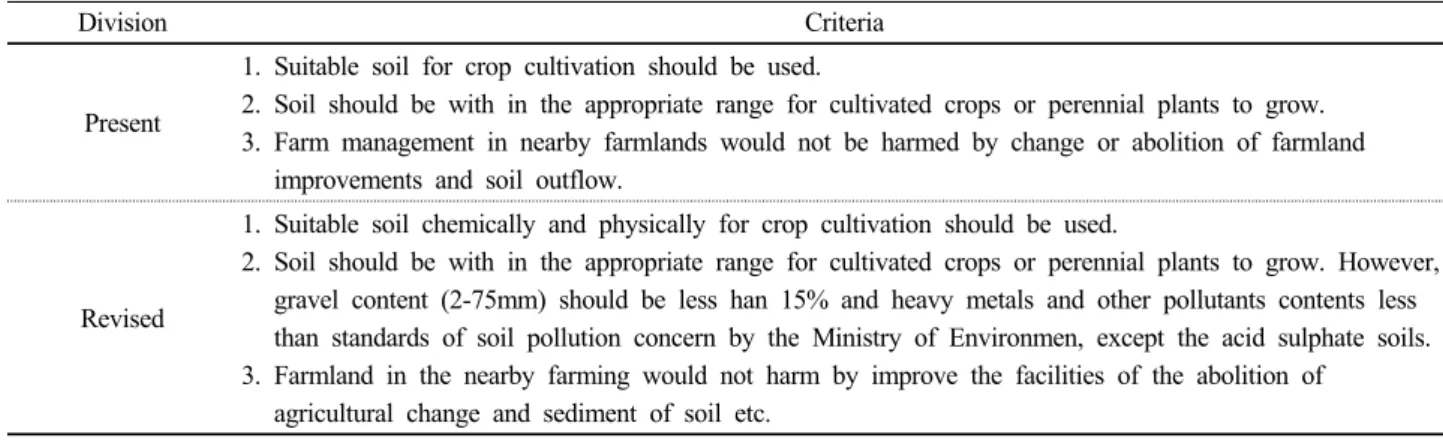
Table 1. Common factor for criteria of soil dressing, soil mounding, and earth cutting.
Division Criteria
Present
1. Suitable soil for crop cultivation should be used.
2. Soil should be with in the appropriate range for cultivated crops or perennial plants to grow.
3. Farm management in nearby farmlands would not be harmed by change or abolition of farmland improvements and soil outflow.
Revised
1. Suitable soil chemically and physically for crop cultivation should be used.
2. Soil should be with in the appropriate range for cultivated crops or perennial plants to grow. However, gravel content (2-75mm) should be less han 15% and heavy metals and other pollutants contents less than standards of soil pollution concern by the Ministry of Environmen, except the acid sulphate soils.
3. Farmland in the nearby farming would not harm by improve the facilities of the abolition of agricultural change and sediment of soil etc.
Introduction
우리나라의 농지면적은 1970년 2,256천ha를 정점으로 하여 2010년 현재는 1,715천ha 정도로 지속적으로 매년 감소추세이다 (MAFRA, 2012b). 농경지의 면적감소는 농 업수익성과 정책여건의 변화에서 기인되었다 (Statistics Korea, 2012). 연도별로 농지감소를 보면 1970년 대비 2010년에 는 논 22.7%, 밭 28.7%가 감소하였다. 그러나, 1990년 대 비 2010년의 경우에는 논 26.8%, 밭 4.2%가 감소되었으 며, 2000년 대비 2010년에는 논 14.4%, 밭 1.2%의 감소 추세를 보였다. 이는 밭작물재배에 의한 수익성이 벼 재 배에 의한 수익성 보다 더 높기 때문에 대부분 논이 밭 이나 시설재배지 등으로 전용되고 있다는 것을 의미한 다(Statistics Korea, 2012).
농지를 쉽게 전용할 수 있도록 농지 전용허가제도의 정책적 변화 또한 농지감소를 가속화시켰다. 한때는 농 지의 보전을 중시하는 정책을 폈으나, 정책이 개발에 주 안점을 두기 시작하면서 부터는 시도지사의 농지전용 위 임권한이 크게 강화되었다. 1997년 이전과 난개발로 한 때 농지법이 한때 강화되었던 1997년 및 2002년의 시도 지사의 위임권한 면적을 살펴보면 다음과 같다. 농업진 흥지역에서 시도지사는 3천m2이상 (1997년 이전)→2천m2
∼2만m2 (1997년)→3천m2∼3만m2 (2002년)을 전용허가 할 수 있도록 변경되었다. 농업진흥지역 밖에서는 1만m2 이상→6천m2∼6만m2→1만m2∼10만m2으로 확대되었다.
또한, 도시계획상 변경협의의 경우에도 1만m2이상→6만m2 미만→10만천m2미만으로 크게 확대되었다 (Chae and Kim, 2011). 이러한 제도의 변화로 인해 시도지역 내의 농지가 쉽게 전용될 수 있는 조건이 형성되었다고 할 수 있다.
또한, 건설폐기물 등 무분별한 성토재 및 복토재가 농 지에 사용됨으로써 농경지가 잠식되고 있으며, 최근 5년 간 농지면적이 매년 1% 이상씩 감소되고 있는 현상이 이 를 설명하고 있다 (Statistics Korea, 2012). 도로나 매립 지 등에 활용하고자 재활용 폐기물 종류별로 다양한 연
구가 진행되고 있다 (Suh et al., 1999; Kim et al, 2000; Cui et al., 2008; An et al., 2012; Lee and Lee; 2013).
대부분 논토양을 개량하거나 전용하기 위해서는 우선 객토, 성토, 절토 등의 토양개량이 먼저 이루어진다. 그 러나, 농지법상의 객토, 성토, 절토 기준은 현재 매우 정 성적으로 이루어져 있다 (MAFRA, 2012a; MAFRA, 2013).
예를 들면, 농지법상의 공통사항을 살펴보면 「농작물에 적합한 흙을 사용할 것」, 「객토원 흙의 성분 및 양이 적 합할 것」, 「성토시 부적합한 토석 또는 재활용골재 사용 을 금지할 것」 등으로 명시되어 있다. 이러한, 표현 때 문에 환경부 폐기물관리법 (ME 2013a)과 농식품부의 농 지법 (MAFRA, 2012a) 상의 의견차이가 발생할 수 있다.
따라서, 우량농지의 보전을 위해서는 농지법상의 객토, 성토, 절토 기준을 보다 명확하고 정량적으로 제시할 필 요가 있기에 그 보완된 기준(안)을 마련하여 보고하는 바이다.
Materials and Methods
검토내용 농지법 시행규칙 제4조의 2의 정성적인 부 분을 보다 구체적이고 정량적으로 제시하기 위하여 별 Table 1의 객토, 성토, 절토의 기준 (MAFRA, 2012a)에 대하여 검토하였다. 검토된 기준은 pH, 특이산성토, 염 류토, 자갈함량, 중금속함량, 폐기물종류, 토양보전관리 기술, 작물별비료사용기준 등이다.
공통사항 객토, 성토, 절토의 기준의 공통사항 (농지 법 시행규칙 제4조의 2, 별표1)에서는 적합한 흙의 기준 과 범위에 대하여 검토하였다. 검토된 기준은 pH, 특이 산성토, 염류토, 자갈함량, 중금속함량 등이다.
객토, 성토, 절토기준 객토, 성토, 절토의 각각의 기 준 (농지법 시행규칙 제4조의 2, 별표1)에 대해서는 흙 의 기준, 범위, 성토재 종류, 절토시 토양유실방지와 숙
Table 2. Soil dressing criteria.
Division Criteria
Present
1. The composition and amount of soil dressing should be suitable for the purpose of soil improvement.
2. It should be conducted by after harvesting crops under cultivation or perennial crop.
Revised 1. The composition and amount of soil dressing to be suitable for the purpose of destination.
2. It should be conducted by after harvesting crops under cultivation or perennial crop.
Table 3. Soil mounding criteria.
Division Criteria
Present
1. Soil mounding should not be higher than the neighboring lands or irrigation channels.
2. Inadequate debris or recycling aggregates that are not suitable for crop cultivation should not be used for mounding materials.
Revised
1. Soil mounding should not be higher than the neighboring lands or irrigation channels.
2. Recycled wastes that are specified in the Waste Management Acts should not be used for mounding materials.
전·숙답화시 고려되어야 할 사항이다. 따라서, pH, 특이 산성토, 염류토, 자갈함량, 중금속함량, 폐기물종류, 토양 보전관리기술, 작물별비료사용처방기준 등을 검토하였다.
Results and Discussion
공통사항 객토, 성토, 절토 기준에 대한 각론에 앞서 기존의 전체적인 공통사항의 기준은 Table 1에서와 같 다. ①농작물의 경작 등에 적합한 흙을 사용할 것, ②농 작물을 경작하거나 다년생식물을 재배하는데 필요한 범 위 이내일 것, ③농지개량시설의 폐지, 변경, 토사의 유 출 등 인근 농지의 농업경영에 피해를 주지 않을 것 등 이 명시되어 있다.
기존 기준의 경우에는 기준과 범위가 정성적이며, 포괄적으 로 설정되어 있기 때문에농지법 해석시 민원발생이나 이해당 사자 간의 분쟁의 소지가 발생할 수 있다. 그러므로, 보다 정 량적이고 세부적인 기준이 필요하다고 판단된다. 따라서, 기준 과 성분의 범위를 Table 1과 같이 개정(안)을 설정하였다.
작물별 토양의 적정 pH는 작물마다 차이가 있다. 그러 나, 대부분 pH 4.0-8.0 수준으로 제시되고 있다 (Henry, 1990). 또한, pH와 작물의 수량반응 역시 적정범위를 벗어 날 경우 수량의 감소로 이어진다 (Cho et al., 2003). 특히, pH가 3.5이하인 특이산성토양의 경우에는 생육이 어려울 뿐만이 아니라 고사하기까지 한다 (Shin and Jang, 1993).
따라서, 특이산성토양를 객토하거나 성토하는 것은 작물생 산의 지속적인 기반유지를 불가능하게 하기 때문에 객토, 성토시 제외되어야 한다. 또한, 염류토 (KSSSF, 2013)의 경 우에도 특이산성토양과 마찬가지로 객토 및 성토시에 제외 되어야 할 것이다 (Lee et al.. 1996; Lee et al., 2003)
대부분의 작물은 토양의 유효토심이 깊을수록 작물생산성
도 높아지는 것이 일반이다 (Jung et al., 2004; Hyun et al., 2008; Hyun et al., 2010). 또한, 뿌리뻗음, 농기계 적합성, 수분의 보수력 및 양분의 흡착과 같은 기작에 점토와 유기물 이 관여하지만, 모래와 자갈은 양수분의 흡착에는 기여하는 부분이 적기 때문에 자갈함량은 적을수록 좋다. 자갈은 토양 학에서 2 mm이상으로 분류하며, 그 함량은 없음 (15%이하), 있음 (15-35%), 많음 (35%이상) 세 가지로 구분하고 있다 (USDA, 1993). 따라서, 자갈함량은 2-75 mm의 함량이 15%
이하로 제한하는 것이 작물생육에는 유리하다고 할 수 있다 (Jung et al., 2004, Hyun et al., 2010; Hyun et al., 2013).
우리나라 농경지의 중금속 함량은 일부 몇 지점을 제외 하고는 대부분 환경부가 정한 토양환경오염 우려기준이나 대책기준을 초과하지 않은 양호한 토양이 대부분이다 (Kang, 2012). 따라서, 친환경 지속농업의 토양기반을 마련하기 위해서는 토양환경오염우려기준 (ME, 2013b) 미만인 토양 을 객토하거나 성토하여야 한다. 예를 들면, Cd 4 mgkg-1, 구리 150, 비소 25, 수은 4, 6가크롬 5, 아연 300, 비켈 100 함량이하를 가진 토양을 사용해야 한다.
객토기준 현행 농지법의 객토의 기준은 Table 2에서 와 같다. 1) 객토원의 흙의 성분과 그 양이 객토대상 농지 의 토양개량 목적에 적합할 것. 2) 해당 농지에 경작중인 농작물 또는 재배중인 다년생식물을 수확한 후에 시행할 것으로 명시되어 있다. 일반사항에서 명시한 바와 같이 객 토원으로 사용되는 흙은 특이산성토양, 염류토양, 자갈함 량, 토양오염우려기준을 명시하고 있기 때문에 객토기준의 경우에는 기존의 것을 사용해도 무방할 것으로 판단된다.
성토기준 성토기준은 Table 3과 같다. 1) 연접 토지 보다 높거나 해당 농지의 관개에 이용하는 용수로 보다 높
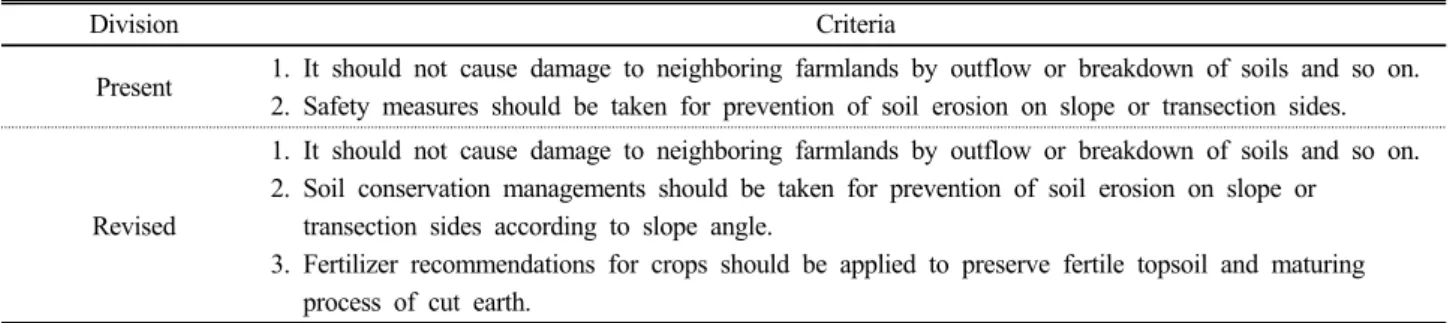
Table 4. Earth cutting criteria.
Division Criteria
Present 1. It should not cause damage to neighboring farmlands by outflow or breakdown of soils and so on.
2. Safety measures should be taken for prevention of soil erosion on slope or transection sides.
Revised
1. It should not cause damage to neighboring farmlands by outflow or breakdown of soils and so on.
2. Soil conservation managements should be taken for prevention of soil erosion on slope or transection sides according to slope angle.
3. Fertilizer recommendations for crops should be applied to preserve fertile topsoil and maturing process of cut earth.
게 성토하지 아니할 것. 2) 농작물의 경작 등에 부적합한 토석 또는 재활용골재 등을 사용하여 성토하지 아니할 것 이다. 그러나, 부적합한 토석 또는 재활용 골재의 경우에는 그 종류가 매우 다양하기 때문에 한정하기가 매우 어려운 실정이다. 따라서, 폐기물관리법 (ME, 2013a)에서 지정한 재활용폐기물 13종을 명시하여 농지에 재활용폐기물이 성 토용으로 무분별하게 유입되는 것을 제한한다면 농지가 지 속가능한 작물생산 기반으로서 유지·보전될 수 있을 것으 로 판단된다.
폐기물관리법에서 지정한 재활용 폐기물13종은 다음과 같다. 광재, 분진, 도자기조각, 석탄재, 연탄재, 점토점결폐 주물사, 폐석회, 폐석고, 폐내화물, 폐콘크리트전주, 폐석 재, 폐레미콘, 무기성오니이다. 무기성오니의 경우에는 아 직도 논란의 여지가 많은 것이 사실이다. 따라서, 무기성오 니의 경우에는 위해성이 없는 것으로 판명된 것에 한해서 만 객토용으로 소량만을 사용하는 것을 검토해 볼 수 있을 것이다.
절토기준 농지법의 절토기준은 Table 4와 같다. 1) 토 사의 유출, 붕괴 등 인근 농지의 피해발생이 우려되지 아 니할 것. 2) 비탈면 또는 절개면에 대하여 토양의 유실 등 을 방지할 수 있는 안전조치가 되어 있을 것으로 명시되어 있다. 그러나, 토양유출에 관한 안전조치 사항에 대해서는 경사도에 따라 구체적인 토양보전관리기술 (Oh et al., 1999) 을 실시해야 하는 것으로 강화해야 할 것이다. 또한, 절토 지의 경우에는 심토와 토양의 모재가 노출되어 토양비옥도 가 떨어지기 때문에 (Park et al., 2004) 비옥도 유지를 위 해서 작물별 비료사용처방 기준 (Jang, 2010)을 준수하도 록 한다. 그래야 농경지가 지속적인 작물생산 기반으로서 유지가 가능할 것으로 판단된다.
Conclusions
우리나라의 농경지 면적이 지속적으로 감소되고 있는데 그 이유는 농업수익성과 정책여건의 변화 때문인 것으로 생각된다. 2000년 대비 2010년의 농경지 감소는 논 14.4%,
밭 1.2%의 감소추세를 보였다. 이것은 대부분 벼 재배가 밭작물에 비해 수익성이 낮기 때문에 논을 밭, 시설재배지 로 전용하고 있기 때문이다. 또한, 농경지의 농지전용허가 제도 역시 전용을 쉽게 할 수 있도록 제도가 완화되어 농 경지 감소를 빠르게 하는 요인으로 작용하였다. 최근 5년 간 농지면적이 매년 1% 이상씩 감소되고 있다. 또한, 건설 폐기물 등 무분별한 성토재 및 복토재가 농지에 사용됨으 로써 농경지의 오염 및 지속적인 농경지의 기반을 위협하 고 있다. 따라서, 농업의 기반인 농지를 보호하기 위한 조 치가 필요하다.
그러나, 농지법상의 객토, 성토, 절토 기준은 정성적인 부 분이 많아 민원 발생의 문제가 야기된다. 따라서, 농지법상 의 ①농작물에 적합한 흙을 사용할 것(기준), ②객토원 흙 의 성분 및 양이 적합할 것(범위), ③성토시 부적합한 토석 또는 재활용골재 사용을 금지할 것(종류)의 내용을 다음과 같이 변경된 기준(안)으로 제안하고자 한다.
제안된 기준(안)은 ①농작물에 이화학적으로 적합한 흙 을 사용할 것(기준), ②객토원의 경우 (i, 잠재특이산성토 및 염류토 제외, ii, 자갈함량(2-75mm)은 15%이하일 것, iii, 중금속 및 기타오염물질의 함량은 환경부 토양오염 우 려기준 이하일 것), ③성토시 폐기물관리법에서 지정한 재 활용 폐기물 13종을 사용하여 성토하지 않을 것, ④경사지 의 경우 토양보전관리기술을 수행할 것, ⑤절토시 숙전, 숙답화를 위해 작물별 비료사용처방기준을 준수한다.
수정된 기준을 통하여 농경지의 관리방안이 보다 과학 적이고 객관적인 측면이 강조될 것으로 판단된다. 또한, 이 를 통하여 토양오염방지 및 안정적인 작물생산성을 확보할 수 있는 지속적인 농업기반이 유지될 것으로 생각된다.
References
An. G.H., B.C. Koo, Y.H. Choi, Y.H. Moon, Y.L. Cha, S.T. Bark, J.K. Kim, Y.M. Yoon, K.G. Park, and J.T. Kim. 2012. The Effects of solidified sewage sludge as a soil cover material for cultivation of bioenergy corps in reclaimed land. Korean. J.
Corp Sci. 57(3):238-247.
Chae, K.S. and H.S. Kim. 2011. A study on introducing proper
acreage for farmland preservation. KERI. p. 20.
Cho, S.J., C.S. Park, and D.I. Um. 2003. Soils (sajung). Yangmunsa.
p. 184.
Cui, M.C., J.H. Lim, Y.U. Phyung, M. Jang, Y.S. Shin, and J.H.
Khim. 2008. Dehydration of a coal mine drainage slude of the potential landfill cover. Korean J. Soil Sci. Fert. 41(5):324-329.
Henry, D. 1990. Forth. Fundamentals of soil science (8ed). p. 179.
Hyun, B.K., H.J. Cho, Y.K. Sonn, C.W. Park, H.J. Chun, K.C.
Song, Y.H. Moon, D.C. Noh, K. H. Yoon, M.S. Kim, and D.B.
Lee. 2013. Establishment of Soil Suitability for Korean Black Raspberry by Soil Morphological and Physical Properties.
Korean J. Soil Sci. Fert. 46(2):92-98.
Hyun, B.K., S.J. Jung, Y.K, Sonn, C.W. Park, Y.S. Zhang, K.C.
Song, Y.H. Kim, E.Y. Choi, S.Y. Hong, S.I. Kwon, and B.C.
Chang. 2010. Comparison between methods for suitability classification of wild edible greens. 2010. Korean J. Soil Sci.
Fert. 43(6):574-582.
Hyun, B.K., S.K. Lim, S.J. Jung, Y.K, Sonn, K.C. Song, D.C.
Noh, H.S. Lee, G.S. Hyun, Y.S. Zhang, S.Y. Hong, C.W. Park, Y.H. Kim, E.Y. Choi, and B.C. Chang. 2008. The Study on the limiting factor to determine available soil depth in Korea.
2008. Korean J. Soil Sci. Fert. 41(5):293-302.
Jang, B.C. 2010. The Guideline of Fertilizer application according to corps. National Academy of Agricultural Science.
Jung, S.J., B.S. Park, G.S. Jang, B.K. Hyun, and S.K. Lee. 2004.
Suitability class criteria for red pepper cultivation with respect to soil morphology and physical properties. Korean J. Soil Sci.
Fert. 37(5):336-340.
Kang, S.S. 2012. The monitoring reports of agricultural environment according to environmental change. National Agricultural and Academy Science.
Kim, J.H., S.Y. Park, J.T. Jung, D.M. Sung, K.W. Ryoo, and J.H.
Park. 2000. A Study on the utilization of specified wastes as a filling material. J. Korean Society of Environmental Administration.
6(2):159-163.
Korean Society of Soil Science and Fertilizer(KSSSF). 2013.
Terminology Dictionary of Soil and Fertilizer. p. 89.
Lee, S.J. and T.Y. Lee. 2013. Field tests for the application of
bottom ash and shared tire as fill materials. J. of Korea Geo-Environmental Soc. 14(10):k29-37.
Lee, S.H., B.D. Hong, Y. An, and H.Y. Ro. 2003. Relation between growth condition of six upland –crops and soil salinity in reclaimed land. Korean J. Soil Sci. Fert. 36(2):66-71.
Lee, Y.H., M.S. Yang, and H.D. Yun. 1996. Effect of plant- growth- promoting bacterial inoculation on the growth and yield of red pepper (capsicum annuum L.) with different soil electrical conductivity level. Korean J. Soil Sci. Fert. 29(4): 396-402.
Ministry of Agriculture, Food and Rural Affairs (MAFRA).
2013. law of farmland enforcement regulations (attached 1).
Ministry of Agriculture, Food and Rural Affairs.
Ministry of Agriculture, Food and Rural Affairs(MAFRA).
Farmland Policy Division. 2012a. Criteria of Soil Dressing, moulding, cutting of earth (attached 1). Law of farmland.
MAFRA. p. 265.
Ministry of Agriculture, Food and Rural Affairs (MAFRA).
Registrer of information and statistics. 2012b. Major statistics of agriculture, fishery and food. p. 27.
Ministry of Environment (ME). 2013a. Wastes control act enforcement regulations (attached 5-2). Ministry of Environment.
Ministry of Environment (ME). 2013b. Wastes control act enforcement regulations (attached 3). Ministry of Environment.
Oh, S.J., P.G. Jung, and J.S. Shin. Practical field studies of soil environmental conservation. 1999. National Academy of Agricultural Science. annual report pp. 229-238.
Park, C.S., Y.S. Jung, J.H. Joo, and J.E. Yang. 2004. Soil characteristics of the saprolite piled upland fields at highland in Gangwon province. Korean J. Soil Sci. Fert. 37(2):66-73.
Shin, J.S. and Y.S. Jang. 1993. Pedogenic Jarosit of Acid sulfate soil of Gimhae Series. Korean J. Soil Sci. Fert. 26(4):278-283.
Statistics Korea. Agriculture Statics Division. 2012. Statistics of agricultural area. Statistics Korea. p. 76.
Suh, J.M., C.J. Park, and J.S. Park. 1999. A study on the heavy metal ion removal of waste sand for utilization as a landfill cover soil. J. Korea Soc. of Environ. Adminstration. 5(3):525-529.
USDA. 1993. Soil survey manual (handbook No.18). pp. 142-146.