Lead Stabilization in Soil Amended with Lime Waste: An Extended X-ray Absorption Fine Structure (EXAFS) Investigation
Jung Eun Lim, Sang Soo Lee, Jae E Yang, and Yong Sik Ok*
Korea Biochar Research Center & Department of Biological Environment, Kangwon National University, Chuncheon 200-701, Korea
(Received: August 6 2014, Revised: November 12 2014, Accepted: November 12 2014)
To determine Pb species in soils following the immobilization process, sequential extraction has been used despite the possibility of overestimating Pb species from unintended reactions during chemical extraction.
Meanwhile, the application of extended X-ray absorption fine structure (EXAFS) has been shown to provide a more precise result than chemical extraction. In this study, the immobilization of Pb in contaminated soils treated with liming materials such as oyster shell (OS) or eggshell (ES) was evaluated with thermodynamic modelling and EXAFS analysis. Thermodynamic modelling by visual MINTEQ predicted the precipitation of Pb(OH) 2 in OS and ES treated soils. In particular, the values of saturation index (SI) for Pb(OH) 2 in OS (SI=0.286) and ES (SI=0.453) treated soils were greater than in the control soil (SI=0.281). Linear combination fitting (LCF) analysis confirmed the presence of C 12 H 10 O 14 Pb 3 (lead citrate, 44.7%) by citric acid from plant root, Pb-gibbsite (Pb adsorbed gibbsite, 26.4%), and Pb-kaolinite (Pb adsorbed kaolinite, 20.3%) in the control soil. On the other hand, Pb(OH) 2 (16.8%), Pb-gibbsite (39.3%), and Pb-kaolinite (25.6%) were observed in the OS treated soil and Pb(OH) 2 (55.2%) and Pb-gibbsite (33.8%) were also confirmed in the ES treated soil. Our results indicate that the treatment with OS and ES immobilizes Pb by adsorption of Pb onto the soil minerals as a result of the increase in soil negative charge and the formation of stable Pb(OH) 2 under high pH condition of soils.
Key words: Eggshell, EXAFS, Immobilization, LCF, MINTEQ, Oyster Shell
Spectra of k
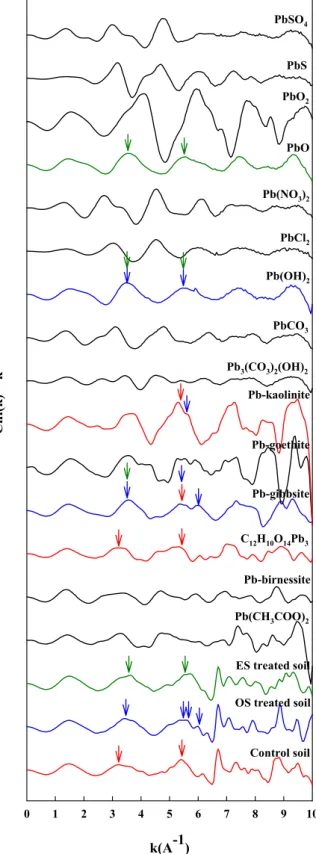
2-weighted EXAFS for the reference standards and incubated soil samples. Some reference standards were shared with Ahmad et al. (2014a). Arrows with same color indicate spectral similarity between the spectra.
1)
*Corresponding author : Phone: +82332506443, Fax: +82332595563, E-mail: [email protected]
§
Acknowledgement: This study was carried out with the support of “Cooperative Research Program for Agricultural Science & Technology
Development (Project No. PJ010182042014)”, Rural Development Administration, Republic of Korea.
Introduction
납 (Pb, Lead)은 원소번호 82, 원자량 207.2 g mol-1, 비중은 11.4 g cm-3인 대표적인 중금속(heavy metal)이다 (Adriano, 2001). 납으로 인한 토양오염은 휴 ․ 폐광산 인근 농경지 (Lim et al., 2013b; Ok et al., 2011a), 사격장 (Ahmad et al., 2012a; 2012c; 2014a), 도시 (Ajmone-Marsan and Biasioli, 2010) 등 다양한 지역에서 보고되고 있다. 특히 납은 오염된 토양에서 재배한 농작물의 섭취, 직접 흡입 등을 통해 인체 로 축적되며 이 경우 근육통 (myalgia), 무기력증 (lethargy) 과 함께 심한 경우 혼수상태 (coma) 및 사망에까지 이를 수 있다 (Adriano, 2001). 그러나 납과 같은 중금속은 유기오염 물질과 달리 자연적으로 분해가 되지 않아 토양 내에 지속 적으로 존재하게 된다 (Kumpiene et al., 2008; Lim et al., 2013a). 이로 인해 토양 내 납을 정화하기 위한 연구들이 지 속적으로 수행되어 왔다.
최근, 토양 중에 존재하는 중금속의 생물유효도 (bioavailability) 를 낮출 수 있는 중금속 안정화 (stabilization) 방법이 활발 하게 연구되고 있다 (Ok et al., 2011d). 이 중 오염토양 내 납을 안정화하는 대표적인 방법에는 인 (P)을 함유한 토양 개량제를 사용하여 납을 용해도가 매우 낮은 것으로 알려진 녹연석 (pyromorphite, Pb5(PO4)3X; X = Cl, OH, F, Br 등) 형태로 변환하는 방법이 있다 (Cao et al., 2011; Hashimoto et al., 2009; Ryan et al., 2001). 이와 함께 비산재, 고로슬 래그, 굴껍질 등의 폐석회물질을 사용하여 토양 pH를 상승 시켜 토양에 의한 중금속 흡착 및 수산화물 등으로의 침전 을 증대하여 중금속을 안정화하는 방법이 있다 (Kostarelos et al., 2006; Lee et al., 2009; Ok et al., 2011b; Zhao and Masaihiko, 2007). 최근에는 바이오차 (biochar)를 오염토 양에 처리함으로써 중금속을 안정화하고 토양질을 개선하 는 방법도 주목을 받고 있다 (Ahmad et al., 2012b; 2014a;
2014b; Almaroai et al., 2014; Awad et al., 2012; 2013;
Mohan et al., 2014; Moon et al., 2013).
상기 언급한 안정화 방법들의 적용 후에 토양 내에 존재 하는 중금속이 어떠한 화학종 (species) 형태로 변환되었는 지를 구명하는 것은 안정화 효율성과 환경 중으로의 재용출 (remobilization) 가능성을 평가하기 위해 매우 중요하다.
과거부터 사용된 안정화 기작 구명 방법으로는 중금속 분획 화 (fractionation)가 있으며, 토양 내 중금속의 연쇄추출 (sequential extraction)을 통해 화학종의 분포를 평가할 수 있다 (Gleyzes et al., 2002). 가장 널리 사용되는 방법으로 는 Tessier et al. (1979)이 고안한 방법이 있으며 이를 통해 5 가지 형태로 중금속 화학종의 분포를 평가할 수 있다. 그 러나 이 방법은 추출과정 중 인과 납이 반응하면서 녹연석 형태의 침전을 형성할 수 있어 residual 형태의 납을 과대평 가 (overestimation)할 수 있다 (Scheckel et al., 2005). 또
한 추출을 위해 화학약품을 사용하므로 토양시료의 회수가 불가능할 뿐만 아니라 정확한 화학종의 구명이 불가능하다 는 단점이 있다.
최근 X선 흡수분광법 (XAS, X-ray absorption spectroscopy) 을 통해 방사광 가속기 (synchrotron radiation) 시설 내에서 토 양 내 특정 원소의 X선 흡수미세구조 (XAFS, X-ray absorption fine structure)를 분석하여 안정화 기작을 구명하는 연구가 진행되고 있다 (Scheckel et al., 2005). XAFS는 에너지 영 역에 따라 X선 흡수끝머리 부근 미세구조 (XANES, X-ray absorption near edge structure)와 광범위 X선 흡수 미세 구조 (EXAFS, extended X-ray absorption fine structure) 로 구분되며 이에 대한 분석을 통해 각각 원자의 산화상태 (oxidation states)와 원자간 결합거리 (bond distance), 배 위수(coordination number) 등을 평가할 수 있다 (Sparks, 2002). 이 분석 방법을 활용하면 오염토양 내 중금속을 안 정화한 후 토양 내 대상 중금속 화학종을 비파괴적인 (non- destructive) 방법으로 구명할 수 있다 (Hashimoto et al., 2010). 특히 이 방법은 토양시료에 화학약품의 첨가없이도 분석이 가능하므로 실제로 존재하는 정확한 화학종의 구명 이 가능하다는 장점이 있어, 현재까지 이를 활용한 많은 연 구들이 진행된 바 있다 (Ahmad et al., 2012a; 2014; Hashimoto et al., 2010; 2011; Ippolito et al., 2012; Moon et al., 2011).
이에 본 연구에서는 중금속 (Pb, Cd) 분획화와 용출시험 을 통하여 폐석회물질인 굴껍질과 달걀껍질의 처리 후 오염 토양 내 중금속 안정화 효과를 제시한 본 연구진의 선행연 구 (Lim 등, 2013a)에 대한 정확한 메커니즘을 구명하고자 토양에 대한 열역학 모델링 (thermodynamic modelling)을 실시 하였으며, EXAFS 측정결과를 토대로 LCF (linear combination fitting)분석을 실시하여 안정화 후 토양 내 납의 화학종 형 태 및 분포를 정량적으로 구명하였다.
Materials and Methods
굴껍질과 달걀껍질
본 연구에서 사용한 굴껍질은 경 상남도 하동군의 굴 양식장 인근 야적장에서 수집하였으며, 달걀껍질은 강원도 춘천시 소재 대형 식당에서 폐기되는 것 을 수집하여 실험에 사용하였다. 수집한 굴껍질과 달걀껍질 은 세척 ․ 건조 ․ 파쇄과정을 거쳐 1 mm 이하로 체거름하여 재료로 사용하였으며, 주 구성성분은 CaCO3이다 (Lim et al., 2013a; Ok et al., 2010; 2011b).오염토양
본 연구에서 사용한 토양은 충청남도 서산시 에 소재한 서성광산 인근의 논에서 채취하였다 (Lim et al., 2013a). 이 논은 서성광산에서 발생한 광미 및 폐석을 객토 제로 사용하여 납으로 오염된 토양이다 (MRC, 2007). 토양 은 pH가 6.21인 양토 (loam)로써 납의 총 함량은 1233.21Table 1. Selected physicochemical properties of the contaminated soil (data obtained from Ok et al. (2011c) and Lim et al.
(2013a)).
Soil texture
pH EC
(1:5) O.M. Avail. P
2O
5Exchangeable cations
Total Pb
Ca K Mg
(1:5) dS m
-1g kg
-1mg kg
-1--- cmol
(+)kg
-1--- mg kg
-1Loam 6.2 0.2 38.7 18.9 7.7 0.3 3.1 1233.2
- 5.5-6.5
†- 25-30
†80-120
†5.0-6.0
†0.25-0.30
†1.5-2.0
†200
‡†
Optimum range (NAAS, 2014);
‡The Korean warning standard for agricultural land (MOE, 2014).
mg kg-1로 나타났는데 (Table 1), 이는 우리나라 토양오염 우려기준의 농경지 (1지역: 전 ․ 답 ․ 과수원 등) 기준치 (Pb:
200 mg kg-1)를 6배이상 상회하는 오염수준이다 (MOE, 2014).
항온배양 및 식물체 생장시험
항온배양 및 옥수수 생장시험은 본 연구진의 선행논문 (Lim et al., 2013a)을 통 해 보고되었으며 이를 요약하면 다음과 같다. 오염토양 100 g을 HDPE (high density polyethylene) 재질의 배양병에 담 고 중금속 안정화 처리제로서 OS와 ES를 토양 무게 기준으 로 1, 5 wt%씩 균일하게 혼합하였다. 이 후 토양은 항온배 양기 (Cooled incubator, MIR-554, Sanyo Japan) 내부에서 420일간 25°C를 유지하였다. 또한 배양기간 동안 처리제와 토양의 원활한 반응을 위해 토양의 수분을 보수력 (WHC, water holding capacity)의 70% 수준으로 유지하였다 (Ahmad et al., 2012a). 항온배양 후 옥수수 (Zea mays
L.)를 파종 하여 약 30일간 식물체 생장시험을 실시하였다. 이 후 옥수 수 잔유물을 모두 제거한 토양 시료는 풍건 (air dry)하여 분석에 사용하였다.열역학 모델링
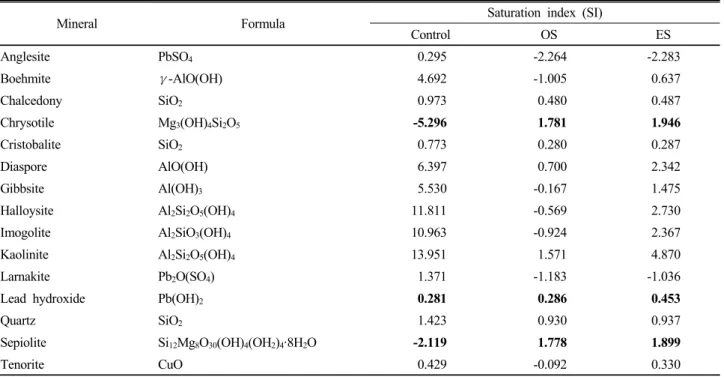
본 연구에서는 굴껍질과 달걀껍질을 오염토양에 처리한 후 형성 가능한 화학종의 확인을 위하여 visual MINTEQ ver. 3.0 (Gustafsson, 2012)으로 열역학 모 델링을 실시하였다. 모델링 시 입력값 도출을 위한 분석방 법은 다음과 같다. 식물체 생장시험 후 각각의 처리제 5 wt%가 적용된 토양 10 g에 증류수 100 ml (1soil:10water)를 가 하고 25°C에서 24시간 동안 교반한 뒤 0.45 μm membrane filter로 여과하여 기기분석을 실시하였다 (Ahmad et al., 2012a). 먼저, 여과액은 pH, EC (electrical conductivity)를 측정하였으며, DOC (dissolved organic carbon)은 총 유기 탄소측정기 (TOC-VCPH, Shimadzu, Japan), 양이온 (Pb, Cd, Si, Al, Fe, Ca, Na, K, Mg, Zn, Cu)은 유도결합플라즈 마발광광도계 (ICP-OES, Optima 7300 DV, PerkinElmer, USA), 음이온 (Cl, NO3, PO4, SO4)은 이온크로마토그래프 (IC, 861 Advanced Compact IC, Metrohm, Switzerland)를 사용하여 측정하였다. 이 후 EC값에 0.013을 곱하여 계산한 이온강도 (ionic strength)와 측정된 데이터를 MINTEQ 프로그램에 입력하여 처리구 별로 화학종에 대한 포화지수 (SI, saturation index)를 산출하였다. 한편, MINTEQ 프로 그램에서는 데이터 베이스를 바탕으로 평형상수와 열역학 반응을 사용하여 아래 식과 같이 SI를 산출한다 (Ahmad et al., 2012c).
SI = log IAP - log
K
sp여기서 IAP는 ion activity product이며,
K
sp는 용해도곱 상수 (solubility product constant)를 나타낸다. 특히, 본 연구에서는 SI>0인 경우 과포화상태 (supersaturation)로서 화학종이 침전 (precipitation) 될 가능성이 있는 것으로 평 가하였다 (Ahmad et al., 2012a; 2012c; Lindsay, 1979).EXAFS 분석
본 연구에서는 굴껍질 및 달걀껍질 처리 에 따른 오염토양 내 중금속 화학종을 EXAFS분석을 통해 구명하고자 포항가속기연구소 (PAL, Pohang Accelerator Laboratory)의 BL7D 빔라인에서 XAFS (X-ray absorption fine structure)를 측정하였다. 토양 시료는 무처리구 및 굴 껍질, 달걀껍질 5 wt% 처리구 토양을 풍건한 후 agate mortar 등으로 곱게 파쇄하여 75 μm 이하로 체거름 하였다. 이 후 시료를 일정한 두께로 압축시킨 pellet을 빔라인 장비 내 시 료 거치대에 장착하였다. 납에 대한 XAFS 데이터의 측정은 Si (111) 이중결정단색광기 (DCM, double crystal monochromator)를 사용하여 납 LIII edge 13035 eV에서 형광측정방식 (fluorescence mode)으로 실시하였다. 굴껍질 및 달걀껍질 처리 토양과의 비교를 위한 납 함유 표준물질은 PbSO4 (anglesite), PbS (galena), PbO2 (plattnerite), PbO (massicot), Pb(NO3)2 (lead nitrate), PbCl2 (cotunnite), PbCO3 (cerussite), Pb3(CO3)2(OH)2(hydrocerussite), C12H10O14Pb3 (lead citrate), Pb(CH3COO)2
(lead acetate)를 사용하였고 모든 시약은 Sigma Aldrich 제 품을 이용하였다. 이와 함께 Pb-birnessite, Pb-gibbsite, Pb-goethite, Pb-kaolinite와 같이 점토광물에 흡착된 납 표준물질과 Pb(OH)2 (lead hydroxide)은 실험실에서 제조하 여 사용하였으며 구체적인 방법은 Ahmad et al. (2014)에 제시하였다. 납 표준물질은 토양 시료와 동일한 방법으로 XAFS 데이터를 측정하였다. 측정된 XAFS 데이터는 Athena
Table 2. Predicted precipitations in the untreated soil (control) and oyster shell (OS), or eggshell (ES) treated soils using visual MINTEQ thermodynamic model.
Mineral Formula Saturation index (SI)
Control OS ES
Anglesite PbSO
40.295 -2.264 -2.283
Boehmite
γ-AlO(OH) 4.692 -1.005 0.637
Chalcedony SiO
20.973 0.480 0.487
Chrysotile Mg
3(OH)
4Si
2O
5-5.296 1.781 1.946
Cristobalite SiO
20.773 0.280 0.287
Diaspore AlO(OH) 6.397 0.700 2.342
Gibbsite Al(OH)
35.530 -0.167 1.475
Halloysite Al
2Si
2O
5(OH)
411.811 -0.569 2.730
Imogolite Al
2SiO
3(OH)
410.963 -0.924 2.367
Kaolinite Al
2Si
2O
5(OH)
413.951 1.571 4.870
Larnakite Pb
2O(SO
4) 1.371 -1.183 -1.036
Lead hydroxide Pb(OH)
20.281 0.286 0.453
Quartz SiO
21.423 0.930 0.937
Sepiolite Si
12Mg
8O
30(OH)
4(OH
2)
4·8H
2O -2.119 1.778 1.899
Tenorite CuO 0.429 -0.092 0.330
ver. 0.8.061 (Ravel and Newville, 2005)을 사용하여 분석 하였다. 각각의 XAFS 데이터는 pre-edge를 이용하여 background 를 제거하였으며, k-space 0~10 Å-1에 대한 k2-weighted EXAFS 스펙트럼을 추출하였다. 이 후 무처리구 및 굴껍질, 달걀껍질 처리구 토양 내 납 화학종의 정량적인 평가를 위 해 k2-weighted EXAFS 스펙트럼에 대하여 LCF를 실시하 였다. LCF는 미지시료 내 화학종의 스펙트럼과 이미 알고 있는 표준물질 스펙트럼간의 linear combination을 통해 시 료 내 화학종을 정량화할 수 있는 방법이며 이를 통해 시료 가 함유한 화학종에 대한 정량화가 가능하다 (Kelly et al, 2008; Scheckel et al., 2005). 본 연구에서는 각 처리구와 납 함유 표준물질간에 LCF를 실시하여 가장 낮은 R-factor 를 가지는 표준물질을 선별한 후 이를 처리구와 fitting하 고, 두 번째, 세 번째로 낮은 R-factor를 가지는 표준물질을 추가적으로 fitting 하였다 (Ahmad et al., 2014; Hashimoto et al., 2011).
Results and Discussion
열역학 모델링 결과
굴껍질, 달걀껍질 처리 후에 오 염토양 내 화학종 형성 확인을 위한 열역학 모델링 결과는 Table 2와 같다. 연구결과 굴껍질, 달걀껍질 처리에 의해 과 포화상태 (SI>0)에 도달하여 침전이 예상되는 화학종 중 납 함유물질로는 Pb(OH)2가 유일하였다. 특히, Pb(OH)2에 대 한 무처리구의 SI값은 0.281이었으나 굴껍질, 달걀껍질 처 리구에서는 SI값이 각각 0.286, 0.453로 증가하여 무처리구에 비해 Pb(OH)2 침전형성이 활발한 것으로 판단되었다. 일 반적으로 토양 pH의 상승은 중금속 양이온들의 수산화물 침전 을 야기하는데 (Paulose et al., 2007; Zhao and Masaihiko, 2007), 일례로 Ok et al. (2010)은 각각 CaCO3와 CaO가 주 성분인 굴껍질과 소성 (calcination)한 굴껍질을 오염토양에 처리하였으며, 이 후 증가된 토양 pH와 중금속 수산화물의 형성을 통해 용출되는 납의 농도가 감소하였다. 또한 Ahmad et al. (2012c)은 모델링 연구에서 달걀껍질이 15 wt% 처리 된 사격장 토양 중 납의 안정화가 토양 pH 상승에 따른 Pb(OH)2 및 PbCO3, Pb3(CO3)2(OH)2 침전물 형성과 관련한다 고 하여 본 연구결과와 유사하다. 선행연구결과 (Lim et al., 2013a), 무처리구의 토양 pH는 6.74였으며 굴껍질, 달 걀껍질 5 wt% 처리구에서 각각 8.03, 8.13까지 증가하였다.
또한 굴껍질과 달걀껍질 5 wt% 처리는 토양 내 TCLP 용출성 납의 농도를 각각 약 99% 및 68%까지 저감하였는데 (Lim et al., 2013a), 이는 본 연구에서 열역학 모델링을 통해 확인된 Pb(OH)2 침전 형성에 기인한 결과로 판단된다. 이와 함께 굴껍 질 및 달걀껍질 처리구에서 새롭게 형성되는 화학종으로는 chrysotile (Mg3(OH)4Si2O5)이 확인되었으며, 중금속을 흡착하 여 안정화하는 것으로 알려진 sepiolite (Si12Mg8O30(OH)4(OH2)4
․ 8H2O)가 확인되었다 (Lazarević et al., 2007; Sun et al., 2013). 이 외에도 무처리구, 굴껍질, 달걀껍질 처리구에서 여러 화학종들의 형성이 확인되었으나 대부분 무처리구에 비하여 SI값이 감소하는 것으로 나타났다.
EXAFS 분석 결과
Fig. 1은 무처리구와 굴껍질, 달걀k(A -1 )
0 1 2 3 4 5 6 7 8 9 10
Ch i(k) * k 2
Control soil OS treated soil ES treated soil Pb(CH
3COO)
2Pb-birnessite C
12H
10O
14Pb
3Pb-gibbsite Pb-goethite Pb-kaolinite Pb
3(CO
3)
2(OH)
2PbCO
3Pb(OH)
2PbCl
2Pb(NO
3)
2PbO PbO
2PbS PbSO
4Fig. 1. Spectra of k
2-weighted EXAFS for the reference standards and incubated soil samples. Some reference standards were shared with Ahmad et al. (2014a). Arrows with same color indicate spectral similarity between the spectra.
껍질 처리구 토양 및 납 함유 표준물질에 대한 XAFS 측정 후 k2-weighted EXAFS 스펙트럼을 추출한 결과이다. 각각 의 EXAFS 스펙트럼에 대한 육안검사 (visual inspection) 결
과, 무처리구 토양은 C12H10O14Pb3 (3.1, 5.4 Å-1), Pb-gibbsite (5.4 Å-1), Pb-kaolinite(5.4 Å-1)와 유사한 스펙트럼을 나타 내었다. Citric acid, oxalic acid등과 같은 유기산 (organic acid)은 식물의 뿌리로부터 분비되는 물질로서 토양 내 중 금속과 화합물을 형성하게 되는데 (Chen et al., 2003; Schwab et al., 2008), 무처리구에서 나타난 C12H10O14Pb3 (lead citrate) 는 옥수수 뿌리로부터 분비된 citric acid와 토양 내 납이 반 응하여 나타난 결과로 판단된다. 또한 굴껍질 처리구의 경 우 Pb(OH)2 (3.5, 5.5, 6.0 Å-1), Pb-gibbsite (3.5, 5.3, 6.0 Å-1), Pb-kaolinite (5.6 Å-1)와 유사성이 있었으며, 달걀껍 질 처리구는 Pb(OH)2 (3.5, 5.5 Å-1), PbO (3.5, 5.5 Å-1), Pb-gibbsite (3.6 Å-1)와 스펙트럼 상의 유사성이 있는 것으 로 나타났다.
Ahmad et al. (2012a)은 CaCO3가 주 성분인 달걀껍질이 처리된 토양의 알칼리성 pH 조건에서 Pb(OH)2가 형성된다 고 하였다. 더욱이 pH의 상승 시 토양의 음전하 (negative charge)가 증가하며 이 때 토양 표면으로의 중금속 흡착이 증대하게 된다 (Zhao and Masaihiko, 2007). 본 연구 결과 에서도 토양의 pH 상승에 의해 Pb(OH)2가 형성되었고 이와 함께 토양의 음전하가 증대되면서 kaolinite 및 gibbsite로의 납 흡착이 증가한 것으로 판단되었다 (Ahmad et al., 2012a;
2014; Puls et al., 1991).
토양 및 납 표준물질에 대한 EXAFS 스펙트럼으로부터 LCF을 실시하여 무처리구, 굴껍질, 달걀껍질 처리구 토양 내 납 화학종을 정량화한 결과는 Table 3과 같다. 무처리구의 경 우 C12H10O14Pb3가 44.7%로 가장 많이 존재하였고, Pb-gibbsite 와 Pb-kaolinite가 각각 26.4%, 20.3%로 존재하여 육안검 사에서 식별된 납 화학종이 전체 납 화학종의 대부분 (91.4%) 을 차지하는 것으로 나타났다. 한편, C12H10O14Pb3의 경우 식 물의 뿌리 분비물질 (root exudate)인 citric acid에 의해 생 성된 것으로 판단된다 (Ahmad et al., 2014; Schwab et al., 2008). OS 처리구의 경우, Pb-gibbsite와 Pb-kaolinite가 각각 39.3%, 25.6%를 차지하여 무처리구 (각각 26.4%, 20.3%) 에 비해 증가하였다. 또한 달걀껍질 처리구의 경우 Pb-gibbsite 가 33.8%를 차지하는 것으로 나타나 무처리구 (Pb-gibbsite:
26.4%)에 비해 증가하였다. 이는 굴껍질 및 달걀껍질 처리 시 증가된 pH로 인해 토양의 음전하가 증대되면서 토양 광 물인 gibbsite와 kaolinite로의 납 흡착이 증가된 것에 기인 한 결과로 판단된다 (Ahmad et al., 2012a; 2014; Puls et al., 1991). 특히, Pb(OH)2의 경우 무처리구에서는 존재하지 않았으나 굴껍질 및 달걀껍질 처리구에서 각각 16.8%, 55.2%가 존재하는 것으로 나타났다. 이는 CaCO3가 주성분 인 굴껍질과 달걀껍질의 처리가 토양의 pH를 상승시키면서 납의 수산화물 침전을 야기한 것으로 판단된다 (Paulose et al., 2007; Zhao and Masaihiko, 2007).
LCF을 통해 정량화한 납 화학종의 합계는 무처리구, 굴
Table 3. Calculated proportions of Pb species in untreated soil (control) and oyster shell (OS) or eggshell (ES) treated soils using linear combination fitting (LCF) on k
2-weighted EXAFS spectra.
Sample C
12H
10O
14Pb
3(lead citrate) Pb-gibbsite Pb-kaolinite Pb(OH)
2Total R-factor
--- % ---
Control 44.7 26.4 20.3 - 91.4 0.24
OS - 39.3 25.6 16.8 81.7 0.16
ES - 33.8 - 55.2 89.0 0.37
껍질 및 달걀껍질 처리구에서 각각 91.4%, 81.7%, 89.0%로 나타나 토양 내에 존재하는 납 화학종의 대부분을 설명할 수 있었다. 그러므로 선행연구결과 (Lim et al., 2013a)와 본 연구의 열역학 모델링에서 침전이 확인된 Pb(OH)2 및 EXAFS- LCF를 통해 확인된 Pb(OH)2, Pb-gibbsite, Pb-kaolinite를 감안할 때, 굴껍질과 달걀껍질을 토양에 처리하는 경우 토 양의 pH 상승을 야기하여 납을 수산화물 (예: Pb(OH)2)의 형태로 침전시킬 수 있으며, 토양으로의 납 흡착이 증대되 면서 납을 안정화하는 것으로 판단된다.
Conclusions
오염토양 내 납의 안정화 후 실시하는 연쇄추출방법은 시 료 회수가 불가능하고 추가적인 반응물 생성을 통해 residual 형태의 납을 과대평가할 수 있어 정확한 화학종 분포의 구 명이 불가능하다는 단점이 있다. 이와 달리 EXAFS 분석 방 법은 토양에 화학약품의 첨가없이 분석이 가능하여 실제 존 재하는 납 화학종의 구명이 가능하다는 장점이 있다. 이에 본 연구에서는 폐석회물질인 굴껍질과 달걀껍질이 처리된 오염토양 내 납의 안정화 기작을 구명하기 위해 visual MINTEQ 을 통한 열역학 모델링 및 EXAFS 분석을 실시하였다. 열역 학 모델링 결과 굴껍질, 달걀껍질 처리를 통해 토양 내 Pb(OH)2
침전 형성이 예상되었다. 굴껍질 및 달걀껍질 처리구 토양, 납 함유 표준물질의 EXAFS 스펙트럼들을 대상으로 LCF을 실시한 결과, 굴껍질 및 달걀껍질의 처리를 통해 토양 내 Pb-gibbsite와 Pb-kaolinite의 함량이 무처리구에 비해 증 가하였다. 이는 굴껍질과 달걀껍질 처리를 통해 토양 pH가 상승하면서 음전하가 증대된 토양에 납의 흡착이 증가된 것 에 기인한 결과로 판단되었다. 특히, Pb(OH)2의 경우 무처리 구에서는 존재하지 않았으나 굴껍질 및 달걀껍질 처리구에 서는 존재하는 것으로 나타났는데, 이는 굴껍질과 달걀껍질 처리에 의해 증가된 토양 pH 조건에서 토양에 존재하는 납 의 수산화물 형성이 증가된 것에 기인한 결과로 판단되었 다. 그러므로 폐석회물질인 굴껍질과 달걀껍질을 오염토양 에 처리하는 경우 납을 안정화할 수 있어 효과적인 토양 개 량제로 활용될 수 있을 것으로 판단된다.
References
Adriano, D.C. 2001. Trace elements in terrestrial environments, second edition. Springer-Verlag, New York, USA.
Ahmad, M., Y. Hashimoto, D.H. Moon, S.S. Lee, and Y.S. Ok.
2012a. Immobilization of lead in a Korean military shooting range soil using eggshell waste: an integrated mechanistic approach. J. Hazard. Mater. 209-210:392-401.
Ahmad, M., S.S. Lee, J.E. Lim, S.E. Lee, J.S. Cho, D.H. Moon, Y. Hashimoto, and Y.S. Ok. 2014a. Speciation and phytoa- vailability of lead and antimony in a small arms range soil amended with mussel shell, cow bone and biochar: EXAFS spectroscopy and chemical extraction. Chemosphere. 95:433-441.
Ahmad, M., S.S. Lee, J.E. Yang, H.M. Ro, Y.H. Lee, and Y.S.
Ok. 2012b. Effects of soil dilution and amendments (mussel shell, cow bone, and biochar) on Pb availability and phytotoxicity in military shooting range soil. Ecotox. Environ. Safe. 79:225-231.
Ahmad, M., D.H. Moon, K.J. Lim, C.L. Shope, S.S. Lee, A.R.A.
Usman, K.R. Kim, J.H. Park, S.O. Hur, J.E. Yang, and Y.S. Ok.
2012c. An assessment of the utilization of waste resources for the immobilization of Pb and Cu in the soil from a Korean military shooting range. Environ. Earth Sci. 67:1023-1031.
Ahmad, M., A.U. Rajapaksha, J.E. Lim, M. Zhang, N. Bolan, D.
Mohan, M. Vithanage, S.S. Lee, and Y.S. Ok. 2014b. Biochar as a sorbent for contaminant management in soil and water: A review, Chemosphere. 99:19-33.
Ajmone-Marsan, F. and M. Biasioli. 2010. Trace elements in soils of urban areas. Water Air Soil Poll. 213:121-143.
Almaroai, Y.A., A.R.A. Usman, M. Ahmad, D.H. Moon, J.S.
Cho, Y.S. Joo, Y.K. Joo, C. Jeon, S.S. Lee, and Y.S. Ok. 2014.
Effects of biochar, cow bone, and eggshell on Pb availability to maize in contaminated soil irrigated with saline water. Environ.
Earth Sci. 71:1289-1296.
Awad, Y.M., E. Blagodatskaya, Y.S. Ok, and Y. Kuzyakov.
2012. Effects of polyacrylamide, biopolymer, and biochar on decomposition of soil organic matter and plant residues as determined by 14C and enzyme activities. Eur. J. Soil Biol.
48:1-10.
Awad, Y.M., E. Blagodatskaya, Y.S. Ok, and Y. Kuzyakov.
2013. Effects of polyacrylamide, biopolymer, and biochar on the decomposition of 14C-labelled maize residues and on their stabilization in soil aggregates. Eur. J. Soil Sci. 64:488-499.
Cao, X., L. Ma, Y. Liang, B. Gao, and W. Harris. 2011.
Simultaneous immobilization of lead and atrazine in contaminated soils using dairy-manure biochar. Environ. Sci. Technol.
45:4884-4889.
Chen, Y.X., Q. Lin, Y.M. Luo, Y.F. He, S.J. Zhen, Y.L. Yu, G.B.
Tian, and M.H. Wong. 2003. The role of citric acid on the phytoremediation of heavy metal contaminated soil. Chemosphere.
50:807-811.
Gleyzes, C., S. Tellier, and M. Astruc. 2002. Fractionation studies of trace elements in contaminated soils and sediments:
a review of sequential extraction procedures. Trend Anal.
Chem. 21:451-467.
Hashimoto, Y., H. Matsufuru, M. Takaoka, H. Tanida, and T.
Sato. 2009. Impacts of chemical amendments and plant growth on lead speciation and enzyme activities in a shooting range soil: An X-ray absorption fine structure investigation. J. Environ.
Qual. 38:1420-1428.
Hashimoto, Y., N. Yamaguchi, M. Takaoka, and K. Shiota. 2011.
EXAFS speciation and phytoavailability of Pb in a contaminated soil amended with compost and gypsum. Sci. Total Environ.
409:1001-1007.
Ippolito, J.A., D.G. Strawn, K.G. Scheckel, J.M. Novak, M.
Ahmedna, and M.A.S. Niandou. 2012. Macroscopic and molecular investigations of copper sorption by a steam-activated biochar. J. Environ. Qual. 41:1150-1156.
Kelly, S.D., D. Hesterberg, and B. Ravel. 2008. Chapter 14 - Analysis of soils and minerals using X-ray absorption spectroscopy, p. 387-463. In: A.L. Ulery and L.R. Drees (eds.). Methods of Soil Analysis. Part 5 - Mineralogical methods. Soil Science Society of America, USA.
Kostarelos, K., D. Reale, D. Dermatas, E. Rao, and D.H. Moon.
2006. Optimum dose of lime and fly ash for treatment of hexavalent chromium-contaminated soil. Water Air Soil Poll.:
Focus. 6:171-189.
Kumpiene, J., A. Lagerkvist, and C. Maurice. 2008. Stabilization of As, Cr, Cu, Pb and Zn in soil using amendments - A review.
Waste Manage. 28:215-225.
Lazarević, S., I. Janković-Častvan, D. Jovanović, S. Milonjić, D.
Janaćković, and R. Petrović. 2007. Adsorption of Pb2+, Cd2+
and Sr2+ ions onto natural and acid-activated sepiolites. Appl.
Clay Sci. 37:47-57.
Lee, S.H., J.S. Lee, Y.J. Choi, and J.G. Kim. 2009. In situ stabilization of cadmium-, lead-, and zinc-contaminated soil using various amendments. Chemosphere. 77:1069-1075.
Lim, J.E., M. Ahmad, S.S. Lee, C.L. Shope, Y. Hashimoto, K.R.
Kim, A.R.A. Usman, J.E. Yang, and Y.S. Ok. 2013a. Effects of lime-based waste materials on immobilization and phytoavailability of cadmium and lead in contaminated soil. Clean-Soil Air Water 41:1235-1241.
Lim, J.E., M. Ahmad, A.R.A. Usman, S.S. Lee, W.T. Jeon, S.E.
Oh, J.E. Yang, and Y.S. Ok. 2013b. Effect of natural and calcined poultry waste on Cd, Pb and As mobility in contaminated
soil. Environ. Earth Sci. 69:11-20.
Lindsay, W.L. 1979. Chemical Equilibria in Soils, John Wiley &
Sons Inc., USA.
MOE. 2014. The Korean warning standard for agricultural land.
Ministry of Environment, Sejong, Korea.
Mohan, D., A. Sarswat, Y.S. Ok, and C.U. Pittman Jr. 2014.
Organic and inorganic contaminants removal from water with biochar, a renewable, low cost and sustainable adsorbent - A critical review. Bioresource Technol. 160:191-202.
Moon, D.H., K.W. Kim, I.H. Yoon, D.G. Grubb, D.Y. Shin, K.H.
Cheong, H.I. Choi, Y.S. Ok, and J.H. Park. 2011. Stabilization of arsenic-contaminated mine tailings using natural and calcined oyster shells. Environ. Earth Sci. 64:597-605.
Moon, D.H., J.W. Park, Y.Y. Chang, Y.S. Ok, S.S. Lee, M.
Ahmad, A. Koutsospyros, J.H. Park, and K. Baek. 2013.
Immobilization of lead in contaminated firing range soil using biochar. Environ. Sci. Pollut. Res. 20:8464-8471.
MRC. 2007. Annual report: Development of soil cover engineering protocol for remediation of heavy metal contaminated soil.
Mine Reclamation Corporation, Seoul, Korea.
NAAS. 2014. Korean Soil Information System. http://soil.rda.
go.kr/soil/index.jsp.
Ok, Y.S., S.C. Kim, D.G. Kim, J.G. Skousen, J.S. Lee, Y.W.
Cheong, S.J. Kim, and J.E. Yang. 2011a. Ameliorants to immobilize Cd in rice paddy soils contaminated by abandoned metal mines in Korea. Environ. Geochem. Heal. 33:23-30.
Ok, Y.S., S.S. Lee, W.T. Jeon, S.E. Oh, A.R.A. Usman, and D.H. Moon.
2011b. Application of eggshell waste for the immobilization of cadmium and lead in a contaminated soil. Environ. Geochem.
Heal. 33:31-39.
Ok, Y.S., J.E. Lim, and D.H. Moon. 2011c. Stabilization of Pb and Cd contaminated soils and soil quality improvements using waste oyster shells. Environ. Geochem. Heal. 33:83-91.
Ok, Y.S., S.E. Oh, M. Ahmad, S. Hyun, K.R. Kim, D.H. Moon, S.S. Lee, K.J. Lim, W.T. Jeon, and J.E. Yang. 2010. Effects of natural and calcined oyster shells on Cd and Pb immobilization in contaminated soils. Environ. Earth Sci. 61:1301-1308.
Ok, Y.S., A.R.A. Usman, S.S. Lee, S.A.M. Abd El-Azzem, B.
Choi, Y. Hashimoto, and J.E. Yang. 2011d. Effects of rapeseed residue on lead and cadmium availability and uptake by rice plants in heavy metal contaminated paddy soil. Chemosphere.
85:677-682.
Paulose, B., S.P. Datta, R.K. Rattan, and P.K. Chhonkar. 2007.
Effect of amendments on the extractability, retention and plant uptake of metals on a sewage-irrigated soil. Environ. Pollut.
146:19-24.
Puls, R.W., R.M. Powell, D. Clark, and C.J. Eldred. 1991. Effects of pH, solid/solution ratio, ionic strength, and organic acids on Pb and Cd sorption on kaolinite. Water Air Soil Poll. 57-58:
423-430.
Ravel, B. and M. Newville. 2005. ATHENA, ARTEMIS, HEPHAESTUS:
data analysis for X-ray absorption spectroscopy using IFEFFIT.
J. Synchrotron Radiat. 12:537-541.
Ryan, J.A., P. Zhang, D. Hesterberg, J. Chou, and D.E. Sayers.
2001. Formation of chloropyromorphite in a lead-contaminated soil amended with hydroxyapatite. Environ. Sci. Technol.
35:3798-3803.
Scheckel, K.G., J.A. Ryan, D. Allen, and N.V. Lescano. 2005.
Determining speciation of Pb in phosphate-amended soils:
Method limitations. Sci. Total Environ. 350:261-272.
Schwab, A.P., D.S. Zhu, and M.K. Banks. 2008. Influence of organic acids on the transport of heavy metals in soil. Chemosphere.
72:986-994.
Sparks, D.L. 2002. Environmental Soil Chemistry, Second Edition, Academic Press, San Diego, USA.
Sun, Y., G. Sun, Y. Xu, L. Wang, X. Liang, and D. Lin. 2013.
Assessment of sepiolite for immobilization of cadmium-contaminated soils. Geoderma. 193-194:149-155.
Tessier, A., P.G.C. Campbell, and M. Bisson. 1979. Sequential extraction procedure for the speciation of particulate trace metals. Anal. Chem. 51:844-851.
Zhao, X.L. and S. Masaihiko. 2007. Amelioration of cadmium polluted paddy soils by porous hydrated calcium silicate.
Water Air Soil Poll. 183:309-315.