
Winning Strategies for the Game of Chomp:
A Practical Approach
Chomp
게임의 승리 전략:
실천적 고찰Cho In-Sung
조인성The rule of the game of Chomp is simple and the existence of a winning strategy can easily be proved. However, the existence tells us nothing about what strate- gies are winning in reality. Like in Chess or Baduk, many researchers studied the winning moves using computer programs, but no general patterns for the winning actions have not been found. In the paper, we aim to construct practical winning strategies based on backward induction. To do this we develop how to analyze Chomp and prove and find the winning strategies of the simple games of Chomp.
Keywords: Chomp, combinatorial game, extensive game with perfect information,
backward induction, subgame perfect equilibrium, constructive proof.MSC: 91A18, 91A46, 03F07, 01A99 ZDM: E50
1 Introduction
1.1 The Game of Chomp
The game of Chomp is also known as a chocolate bar game. For example, Figrue 1 shows a rectangular chocolate bar of cells with four rows and five columns. One special thing is that the bottom left cell labeled with ⊗ is poisoned.
⊗
Figure 1. A game of Chomp: 4 by 5
The author was supported by a research grant (2015) from Kongju National Univ.
Cho In-Sung: Dept. of Economics, Kongju National Univ. E-mail: [email protected]
Received on Apr. 22, 2018, revised on Jun. 8, 2018, accepted on Jun. 18, 2018.
We call this rectangular chocolate bar a game of Chomp with the following simple rule. Two players alternately take turns to choose one of the cells. To choose one cell means that the player eats or chomps the cell and all the cells above and right of it. The next player chooses one cell among the remaining chocolate cells, and so on. This game ends when a player chooses or is forced to choose the poisoned cell. The player who chooses the poisonous cell loses and the other player wins the game. (You can play the 4 by 7 Chomp online at http://www.math.ucla.edu/
~tom/Games/chomp.html [12].) Chomp is one of the combinatorial games as well as Tic-tac-toe, Chess, and Baduk.
Though the rule of Chomp is simple, the general solution of this game is not known. The existence of a winning strategy of Chomp is proved, but the existence does not tell us what the real winning strategies are. That is why many studies such as [1, 6, 8, 9] tried to use computer programs to examine winning actions of Chomp.
And yet, ‘AlphaGo knows it’ is one thing, ’Lee Sedol knows it’ is another.
The paper aims to provide a constructive proof of winning strategies of Chomp, so that a human can understand what is going on. To do this, we suggest a way how to analyze Chomp based on backward induction. The suggested approach is also useful for the pedagogical purpose for those who discuss strategical thinking.
History of the Game of Chomp
The idea of the game of Chomp can be traced back to the ‘game of divisors’ de- scribed in the article by Schuh (1952) [7]. In the game for a fixed number that is a multiple of two distinct prime numbers, two players alternately choose one of the divisors of the number. Once a divisor is chosen, all the multiples of the chosen di- visor are removed. The next player chooses one from the remaining divisors. This continues to the end when a player chooses the divisor 1. The player who chooses or is forced to choose the number 1, loses the game.
For example, the divisors of the number 432 = 2
4× 3
3can be arranged as in Figure 2. The two games in Figures 1 (Chomp) and 2 (divisors) are isomorphic to each other. Gardner [5] said that“it is one of the prettiest isomorphisms I have ever encountered in recreational mathematics.”
3
327 54 108 216 432
3
29 18 36 72 144
3
13 6 12 24 48
3
01 2 4 8 16
2
02
12
22
32
4Figure 2. The game of divisors
The name ‘Chomp’ first appeared in the article by Gardner (1973) [4], where he
stated that Chomp was invented by David Gale, who first formulated and analyzed this game in his paper entitled ‘A Curious Nim-Type Game’ [3].
Chomp in a Game Tree
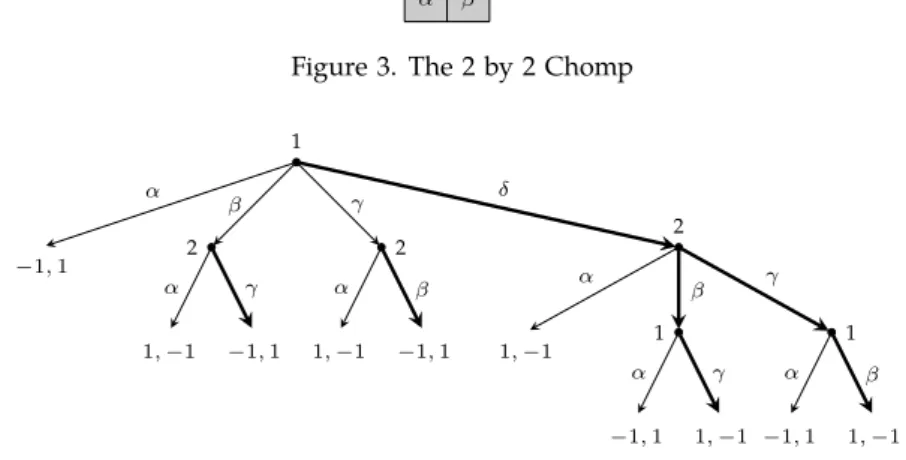
In a game theoretic jargon, a game of Chomp is simply an extensive game with per- fect information. More precisely, a game of Chomp is a two-person zero-sum finite extensive game with perfect information. For example, the 2 by 2 Chomp shown in Figur 3 can be represented by a game tree as in Figure 4, in which the winner’s payoff is 1 and the loser’s payoff is −1 with α as the poisonous cell.
α β
γ δ
Figure 3. The 2 by 2 Chomp
1
−1, 1
α β γ δ
2
1,−1 α
−1, 1 γ
2
1,−1 α
−1, 1 β
2
1,−1
α β γ
1
−1, 1 α
1,−1 γ
1
−1, 1 α
1,−1 β
Figure 4. The game tree for the 2 by 2 Chomp
We can use backward induction to find the subgame perfect equilibrium (SPE) actions, which are represented by thick arrowed edges in Figure 4. The SPE actions for the first player are to choose δ in the beginning and to choose γ when the oppo- nent chooses β or β when the opponent chooses γ. The equilibrium paths are δ-β-γ and δ-γ-β. In other words, the optimal moves for the first player are to choose δ first and then to alternatively choose between β and γ.
The very first theorem of game theory is the Zermelo’s theorem [11, 10].
Theorem 1.1 (Zermelo, 1913). In a two-person zero-sum finite extensive game with per- fect information,
(a) the first player can force a win, or (b) the second player can force a win, or (c) both players can force at least a draw.
Theorem 1.1 implies that if a game cannot end in a draw, one of the players must
have a winning strategy. For a specific game, Chomp, we can further narrow down
the results to one, due to Gale [3].
Theorem 1.2 (Gale, 1974). In any game of Chomp, the first player can force a win.
Proof. Suppose that the first player chooses the top right cell. If the second player wins, then the first player can choose the moves taken by the second player from the beginning to force a win.
The approach used to prove Theorem 1.2 is called a ‘strategy stealing.’ This proof is non-constructive. Thus, it is of no use to find winning strategies in practice.
The proof of Theorem 1.1 is based on the idea of backward induction. This im- plies that even a complicated game like Chess or Baduk is solvable through back- ward induction. However this does not mean that a human knows a complete so- lution for a given game, either.
To implement backward induction we start with smaller subgames and turn to larger subgames. We will do the same thing in our analysis of Chomp.
In the paper, we will construct the practical winning strategies of Chomp. We have proved the complete solutions up to the 4 by 7 Chomp. To do this, we devel- oped a way how to analyze the game to construct the solutions.
1.2 Notation and Terminology
To observe the tradition of the literatures on Chomp, we denote the game of Chomp with m rows and n columns by m ⊗ n (read as ‘m by n’) Chomp. Since the m ⊗ n Chomp and the n⊗m Chomp are strategically equivalent, without loss of generality, we take m as the number of rows and n as columns. However, it is convenient to denote a cell in the manner of Cartesian coordinates. The bottom left poisonous cell is denoted by (1, 1) and the top right cell by (n, m).
For example, in 3 ⊗ n Chomp, if ¬ after the first player chooses the cell (n − 2, 3)
the second player chooses the cell (n − 1, 2), then we have the resulting subgame as shown in Figure 5.
⊗
¬
a cells
b cells
c cells bottom row
top row a-top-row
bottom wing
Figure 5. A subgame [a,b,c] or simply [abc] when possible
The first row will also be called a ‘top row’ and the last row a ‘bottom row.’ De-
note by [a,b,c,...,n] a subgame in which the top row has a (uneaten gray) cells,
the second row has b cells, the third row has c cells, and so forth. Clearly, it must be
that a ≤ b ≤ c ≤ · · · ≤ n. When the numbers of cells uneaten in each row is of one digit, we will take out the commas for the sake of a simple notation. For example, a subgame [a,b,c] shown in Figure 5 can be written as [abc] when a, b, and c are all one digit natural numbers.
In a subgame [abc], if b ̸= c we say that it has a ‘bottom wing’ of the size c − b.
If every non-bottom row has only one uneaten cell, a ‘vertical wing’ is formed. For example as shown in Figure 6, the subgame [114] has a vertical wing with the size of 2 and a bottom wing with the size of 3.
⊗
vertical wing
bottom wing
Figure 6. A subgame [114] or equivalently [1113]′
We can read the subgame [114] from right to left. In this case we add the symbol of a prime like [1113]
′. The subgame [114] is equivalent to [1113]
′. Notice that [114] is strategically equivalent to [114]
′.
We say that a subgame is an ‘N -position’ if a player whose turn it is to move will lose the game when the other player does not make any mistakes. In other words, a subgame is an N -position when the next player is to lose. A subgame is a ‘P -position’ if the previous player can force a win in the game with best play. In other words, if a player makes the shape of a subgame of P -position, the player can win with best moves. We also simply call a subgame of N -position a ‘losing shape’
and that of P -position a ‘winning shape.’ When a subgame [A] of N -position is immediately followed by a subgame [B] of P -position we say that [A] is ‘blocked’
by [B].
2 Analysis: 3-Rowed Chomp 2.1 Trivial Rules
It is trivial that, in any game of Chomp, if a player chooses (1, 2) then the other player wins the game by choosing (2, 1), and vice versa.
2-Rowed Chomp
It is also trivial and well-known that, in a 2-rowed Chomp, choosing the top right cell is the optimal opening move for the first player.
Proposition 2.1 (2-Rowed Chomp Rule). Consider a 2-rowed Chomp, 2 ⊗ n .
(a) The optimal opening move is to choose the top-rightmost cell (n, 2).
(b) The winning strategy for the previous player to follow is to keep the shape of [b-1,b].
This also applies to any 2-column Chomp. Observe that a player facing any sub- game other than [b-1,b] can always make the winning shape in a 2-rowed Chomp.
Example 2.1. Consider the 2 ⊗ 5 Chomp. The winning opening move for the first player is to choose the top right cell (5, 2), resulting in Figure 7.
⊗
11 2 2 3 3 4 4
Figure 7. Winning moves for the 2
⊗ 5 Chomp
Now it is your opponent’s turn to move. And then, your winning actions are as follows: when your opponent chooses a cell with a number, you can force a win by keeping to choose the remaining cell with the same number to the end of the game.
Square Chomp
We have another trivial result for the game of square Chomp, m ⊗ m . Proposition 2.2 (Square Chomp Rule). Consider a square Chomp, m ⊗ m .
(a) The optimal opening move is to choose the cell (2, 2).
(b) The winning strategy for the previous player to follow is to keep the sizes of the vertical wing and the bottom wing the same.
Let us call the 2-Rowed Chomp Rule (Proposition 2.1) and the Square Chomp Rule (Proposition 2.2) together the ’trivial rules.’
Example 2.2. Consider the 4 ⊗ 4 square Chomp. The winning opening move of the first player is to choose (2, 2), ending up with the following subgame in Figure 8.
⊗
11
2 2
3 3
Figure 8. Winning moves for the 4
⊗ 4 square Chomp
And then, if the second player chooses one cell labeled with the number 1, the
first player can force a win by choosing the other cell labeled with the same number
1, ending up with the same size of the vertical and bottom wing. Similarly for the
numbers 2 and 3.
Notation: For convenience, let us represent the previous statement for the number 1 by the following expression:
1: Square Chomp Rule
meaning that ‘by alternatively choosing between the two cells labeled with the num- ber 1 the last player can force a win by the Square Chomp Rule.’ This applies to any labels with appropriate rules.
2.2 3-Rowed Chomp
For a 3-rowed Chomp [abc], when a = 1 and b ≥ 2, it is an N-position by the 2- Rowed Chomp Rule. When a = b = 1 it is trivial by the Square Chomp Rule. When a = 2 , we have the general result, which we will call the 2TopRow Rule [9, 2].
Proposition 2.3 (2TopRow Rule). In a 3-rowed Chomp, a subgame [2,b,b+2] is a P - position for b ≥ 2.
The 2TopRow Rule says, in words, that in a 3-rowed Chomp, if the top row has the size of a = 2, then making the bottom wing have the same size of 2 when it is possible, is an optimal move. According to Proposition 2.3 (2TopRow Rule), [224], [235], [246], [257], and so forth are all P -positions.
Now we start to analyze the smallest non-trivial Chomp, 3 ⊗ 4 .
Proposition 2.4. In the 3 ⊗ 4 Chomp, the winning opening move is to choose (3, 2). That is, the subgame [224] is the winning opening shape of the 3 ⊗ 4 Chomp.
Proof. Suppose that the first player chooses (3, 2) at the beginning of the game, end- ing up with the following subgame where it is the second player’s turn to move:
⊗ [224]
1
1 2 2
3 3 4 4
Then,
1: 2-Rowed Chomp Rule (Proposition 2.1) 2: 2-Rowed Chomp Rule
3: Square Chomp Rule (Proposition 2.2) Finally, it is trivial that alternatively choosing between the cells with the number 4 is optimal for the last mover. This shows that making the shape of [224] is the winning opening move.
We have proved that [224] is a winning shape only by using the trivial rules.
This implies that [224] is the smallest subgame that is not trivial to analyze.
To continue our backward induction analysis we gradually increase the size of Chomp. We now move to the 3 ⊗ 5 Chomp and start with a = 3, since we have a winning shape [235] by the 2TopRow Rule (Proposition 2.3).
Proposition 2.5. In the 3 ⊗ 5 Chomp, the winning opening move is to choose (4, 3). That is, the subgame [355] is the winning opening shape of the 3 ⊗ 5 Chomp.
Proof. Suppose that the second player faces the following subgame:
⊗ [355]
2 2 1
1
Then,
1: [224] (Proposition 2.4) 2: [235] (or 2TopRow Rule)
Choosing any other non-poisoned cells without labels can only make N -positions by the trivial rules.
Now we move to the 3⊗6 Chomp to continue backward induction. Observe that the subgame [246] is a P -position by the 2TopRow Rule.
Proposition 2.6. In the 3 ⊗ 6 Chomp, the winning opening move is to choose (4, 2). That is, the subgame [336] is the winning opening shape of the 3 ⊗ 6 Chomp.
Proof. Suppose that the second player faces the following subgame:
⊗ [336]
1
1 2
2 2′
2′
Then,
1: [235] (or 2TopRow Rule) 2: [224] (or 2TopRow Rule) 2
′: 2-Rowed Chomp Rule
Choosing the remaining cells not labeled can only make N -positions by the trivial rules.
In the proof of Propostion 2.6, when a player chooses the cell (5, 2) labeled with 2 or 2
′, the other player’s optimal move is to choose either (3, 2) or (1, 3). This implies that the winning actions are not unique.
We now turn to the 3 ⊗ 7 Chomp. First observe that [257] is a P -position by the 2TopRow Rule. To find the winning opening move of the 3 ⊗ 7 Chomp, we need the following result:
Proposition 2.7. The subgame [347] is a winning shape.
Proof. Suppose that it is the second player’s turn to move with the following sub- game:
⊗ [347]
1
1 2
2 3
3
Then,
1: 2TopRow Rule 2: [224]
3: [336] (Proposition 2.6)
Choosing the remaining cells can only make N -positions by the trivial rules.
Proposition 2.8. In the 3 ⊗ 7 Chomp, the winning opening move is to choose (5, 3). That is, the subgame [477] is the winning opening shape of the 3 ⊗ 7 Chomp.
Proof. Suppose that the second player faces the following subgame:
⊗ [477]
1 1
2
2 3
3 4
4 5
5
Then, 1: [336]
2: [355]
3: [224]
4: 2TopRow Rule
5: [347] (Proposition 2.7)
Choosing the remaining cells can only make N -positions by the trivial rules.
Summary 1 (3-Rowed Chomp). The following shapes are winning shapes that have been found so far, in addition to the trivial shapes.
[224] [235] [246] [257]
[336] [347] [355] [477]
By inspecting the shapes of [336] and [347] we can summarize as the following:
Corollary 2.9 (3TopRow Rule). In a 3-rowed Chomp, [3,b,b+3] is a winning shape for b = 3, 4 .
Summary 1 implies that in the 3 ⊗ 7 Chomp or smaller subgames, in order to win the game, it is sufficient to know that the trivial rules, the 2TopRow Rule, the 3TopRow Rule (Corollary 2.9), and the winning opening shapes.
Corollary 2.10. The followings are true.
(a) Any rectangular subgame is an N -position.
(b) The winning actions are not unique.
(c) Any subgame of the shape [33c] with c > 6 is blocked by [336].
(d) Any subgame of the shape [3bc] with c > b ≥ 5 is blocked by [355].
By Corollary 2.10(d), [358] is blocked by [355]. This implies that the 3TopRow Rule does not hold for c ≥ 8.
This completes the analysis of Chomp up to 3 ⊗ 7 .
3 Analysis: 4-Rowed Chomp
The 4⊗ 3 Chomp is strategically equivalent to the 3 ⊗ 4 Chomp. The 4 ⊗ 4 Chomp is trivial by the Square Chomp Rule.
3.1 4 ⊗ 5 Chomp
Now consider the 4 ⊗ 5 Chomp. Let us start with a subgame with the smallest a and then move gradually to a larger subgame to do backward induction.
If a = 1 and 2 ≤ b ≤ c ≤ d, then a subgame of the shape [1bcd] is trivial to analyze by the 2-Rowed Chomp Rule.
If a = b = 1 and 3 ≤ c < d, then every subgame of the shape [11cd] is blocked by [1133] or equivalently by [224]
′.
If a = b = 1, c = 2, and d > 5, it turns out that any subgame of the shape [112d]
is block by [1125], which is a winning shape as proved in Proposition 3.1.
Proposition 3.1. The subgame [1125] is a winning shape.
Proof. Suppose that the next player faces the following subgame:
⊗
1
1
[1125]
Then,
1: Square Chomp Rule (Proposition 2.2)
Choosing the remaining cells can only make N -positions by the trivial rules.
Now we go with a = 2.
Proposition 3.2. In the 4 ⊗ 5 Chomp, the winning opening move is to choose (3, 3). That is, [2255] is the winning opening shape of the 4 ⊗ 5 Chomp.
Proof. Suppose that the second player faces the following subgame:
⊗ [2255]
1 1
2 2
3 3
Then,
1: [224]
′(or equivalently [1133]) 2: 2TopRow Rule
3: [1125] (Proposition 3.1)
Choosing the remaining cells can only make N -positions by the trivial rules.
Proposition 3.3. The subgame [2335] is a winning shape.
Proof. Suppose that the next player faces the following subgame:
⊗ [2335]
1
1 2
2 3
3
Then,
1: [224]
′(or equivalently [1133]) 2: [1125]
3: 2TopRow Rule
Choosing the remaining cells can only make N -positions by the trivial rules.
Note, about a ≥ 3, that [3335] is blocked by [2335] and that [3345] is trivial.
Note also that [3355], [3455], [4455] are all blocked by the winning opening shape [2255] (Proposition 3.2). This completes the analysis of the 4 ⊗ 5 Chomp.
3.2 4 ⊗ 6 Chomp
Proposition 3.4. In the 4 ⊗6 Chomp, choosing (2, 3) is an optimal move. That is, [2226]
is the winning opening move for the 4 ⊗ 6 Chomp.
Proof. Suppose that the second player faces the following subgame:
⊗ [2226]
1
1 2
2 2′
2′
Then, 1: [1125]
2: 2TopRow Rule (or [224]) 2
′: Square Chomp Rule
Choosing the remaining cells can only make N -positions by the trivial rules.
Observe that no other subgames of the 4 ⊗ 6 Chomp are P -positions. This com-
pletes the analysis of the 4 ⊗ 6 Chomp.
3.3 4 ⊗ 7 Chomp
Since it is easy to analyze the 4 ⊗ 7 Chomp when a=1, we start with a = 2.
Subgame [22cd]
When c = 2, it is blocked by [2226]. When c = 3, we have the following result:
Proposition 3.5. The subgame [2237] is a winning shape.
Proof. Suppose that the next player faces the following subgame:
⊗ [2237]
1 1
2 2
3 3
Then,
1: [2226] (Proposition 3.4) 2: [235]
3: [224]
′(or equivalently [1133])
Choosing the remaining cells can only make N -positions by the trivial rules.
Subgame [23cd]
Proposition 3.6. The subgame [2357] is a winning shape.
Proof. Suppose that the next player faces the following subgame:
⊗ [2357]
1 1
2 2
3 3
4 4
5 5 4′
4′
Then, 1: [2255]
2: [224]
′3: [347]
4: [2335] (Proposition 3.3) 4
′: [2237] (Proposition 3.5) 5: [2226]
Choosing the remaining cells can only make N -positions by the trivial rules.
As we can see in the proof of Proposition 3.6, when your opponent chooses the
cell (4, 2) your optimal move is to choose either (6, 1) or (3, 3). However, when your
opponent chooses (6, 1) you can fight back to choose either (4, 2) or (3, 3). And
again, when your opponent chooses (3, 3) your optimal move is to choose either
(6, 1) or (4, 2). This implies that during the play of the game you can have multiple
options to fight back. This makes the game more complicated than we thought.
Subgame [24cd]
Proposition 3.7. The subgame [2447] is a winning shape.
Proof. Suppose that the next player faces the following subgame:
⊗ [2447]
1 1
2 2
3
3 4
4
Then,
1: [2226]
2: [224]
′(or equivalently [1133]) 3: [2237] (Proposition 3.5) 4: [347] (or 3TopRow Rule)
Choosing the remaining cells can only make N -positions by the trivial rules.
Observe that [2455] and [2456] are blocked by [2255] and that [2466] is blocked by [2226]. Note that [2457] is blocked by [2357] and that [2467] is trivial.
It is also clear that any subgame of the shape [2bc7] with b ≥ c ≥ 5, is blocked by [2447] (Proposition 3.7).
Subgame [33cd]
Proposition 3.8. In the 4 ⊗ 7 Chomp, choosing (4, 3) is the winning opening move. That is, the subgame [3377] is the winning opening shape for the 4 ⊗ 7 Chomp.
Proof. Suppose that the second player faces the following subgame:
⊗ [3377]
1 1
2 2
3 3
4 4
5 5
6 6
Then, 1: [2226]
2: [2255]
3: [224]
′4: [2357] (Proposition 3.6) 5: [347]
6: [2237]
Choosing the remaining cells can only make N -positions by the trivial rules.
Observe that [3337] is blocked by [2237], [3347] blocked by [347], and [3357]
blocked by [2357] and that [3467] is trivial.
Subgame [34cd]
Proposition 3.9. The subgame [3457] is a winning shape.
Proof. Suppose that the next player faces the following subgame:
⊗ [3457]
1 1
2 2
3 3
4 4 5
5 6
6 7
7
Then,
1: [2255]
2: [224]
′3: [2447]
4: [2237]
5: [2226]
6: [2357]
7: 2TopRow Rule
Choosing the remaining cells can only make N -positions by the trivial rules.
Note that [3467] is trivial and that [3477] is blocked by [3457].
Note also that [3557] is blocked by [3457], that [3567] and [3667] are trivial, and that [3677] and [3777] are blocked by [3377] (Proposition 3.8).
For the shape of [44cd] note that [4447], [4457], and [4477] are blocked by [3457], [3457], and [3377], respectively. Note also that [4467] is trivial.
Subgame [45cd]
Proposition 3.10. The subgame [4557] is a winning shape.
Proof. Suppose that the next player faces the following subgame:
⊗ [4557]
1 1
2 2
5
5 3 3
4 4
6 6 7
7 8
8
Then, 1: [2226]
2: [2255]
3: [224]
′4: [2447]
5: [2237]
6: [3457] (Proposition 3.9) 7: [2357]
8: 2TopRow Rule Choosing the remaining cells can only make N -positions by the trivial rules.
Observe that [4566] is blocked by [2226].
Note that [5557] is blocked by [4557] (Proposition 3.10) and that [5567] and [5667] are losing shapes by the trivial rules.
This completes the analysis of the 4-rowed Chomps up to 4 ⊗ 7 .
Summary 2 (4-Rowed Chomp). So far, we have found the following winning shapes, in addition to the shapes found previously:
[1133] [1125] [2255] [2335] [2226]
[2237] [2357] [2447] [3377] [3457] [4557]
Note that [1133] is equivalent to [224]
′. Observe that there are no general pat-
terns for the winning shapes in the games of 4-rowed Chomp.
4 Concluding Remarks
We have constructed the complete solutions of one-digit 3-rowed Chomp games (as commented below) and up to the 4 ⊗ 7 Chomp. The paper also suggests a way of analyzing Chomp constructively. By using the suggested method we can add solutions to a larger Chomp, though it is tedious.
For the 3 ⊗ 8 Chomp, it is not difficult to prove that [448] is a winning opening shape. The subgame [268] is a P -position by the 2TopRow Rule and no other sub- games turn out to be additional P -positions. We have also proved, on the basis of the results previously found, that the 3 ⊗ 9 Chomp has additional winning shapes:
[459], [569], and [699]. The subgame [279] is a P -position by the 2TopRow Rule and no other subgames can be added as P -positions for the 3 ⊗ 9 Chomp. This completes the analysis of 3-rowed Chomp with one digit columns.
As the size of Chomp increases, the cases to consider in the analysis geometri- cally increase. Since there are no patterns for the winning actions, we claim that the suggested method is the only way to construct them without the help of com- puter programs.
For the uniqueness, it was verified by a computer program that in a 3⊗n Chomp the winning opening move is unique for n ≤ 100000 [2]. It is also known that the smallest counterexample of the unique opening move is the 8 ⊗ 10 Chomp [5, 3].
Finally, we suggest some practical tips. Once the play reduces the game to the size of 3 ⊗ 7 or smaller, it is sufficient to know the trivial rules, the opening moves, the 2TopRow Rule, and the 3TopRow Rule in order to win Chomp.
Acknowledgments
The author would like to thank anonymous referees for valuable comments on the paper.
References
1. S. Badillo-Rios and V. Mojica, Mathematical and Computational Analysis of Chomp, mimeo.
2. A. Brouwer, G. Horvaráth, I. Molinár-Sáka, and C. Szabó, On Three-Rowed Chomp,
Integers, 5, G07 (2005), 1–14.
3. D. Gale, A Curious Nim-Type Game, American Mathematical Monthly, 81 (1974), 876–
879.
4. M. Gardner, Sim, Chomp and Race Track: new games for the intellect (and not for Lady Luck), Mathematical Games, 228(1) (Jan. 1973), 108–115.
5. M. Gardner, A new miscellany of problems, and encores for Race Track, Sim, Chomp and elevators, Mathematical Games, 228(5) (May 1973), 102–107.
6. E. Friedman and A. Landsberg, Nonlinear dynamics in combinatorial games: Renor- malizing Chomp, CHAOS 17, 023117 (2007).
7. F. Schuh, Spel van delers, Nieuw Tijdschrift voor Wiskunde, 39 (1952), 299–304.
8. X. Sun, Improvements on Chomp, Integers, 2, G01 (2002), 8.
9. D. Zeilberger, Three-Rowed CHOMP, Advances in Applied Mathematics, 26 (2001), 168–
179.
10. U. Schwalbe and P. Walker, Zermelo and the Early History of Game Theory, Games and
Economic Behavior, 34 (2001), 123–137.
11. E. Zermelo, Über eine Anwendung der Mengenlehre auf die Theorie des Schachspiels,
Proceedings of the Fifth International Congress of Mathematicians, Cambridge, 1912, Cam-
bridge University Press, 1913, 501–504.12.
![Figure 5. A subgame [a,b,c] or simply [abc] when possible](https://thumb-ap.123doks.com/thumbv2/123dokinfo/5503277.453256/4.722.223.499.773.881/figure-subgame-b-c-simply-abc-possible.webp)