• 검색 결과가 없습니다.

Low Temperature Cure Film Adhesive

N/A
N/A
Protected

Academic year: 2021

Share "Low Temperature Cure Film Adhesive"

Copied!
7
0
0

로드 중.... (전체 텍스트 보기)

전체 글

(1)

Low Temperature Cure Film Adhesive

Bin Liang*, Shenglong Zhao

Beijing Institute of Aeronautical Materials, Beijing, 100095,China Email: [email protected]

Tel: +86-10-62452113 (+44-20-7882-6381) Fax:+86-10-62456925 (+44-20-8981-9804)

(current temporary address: Department of Materials, Queen Mary, University of London, Mile End Road, London E1 4NS United Kindoms)

ABSTRACT: A novel carboxyl terminated butadiene-acrylonitrile (CTBN) modified, low temperature cure epoxy film adhesive was developed in this paper. It can be cured at as low as 75℃ for 4 hours with a pressure of 0.1MPa. After post cure at 120℃ for 2 hours, the bonding strengths of Phosphoric Acid Anodizing(PAA) surface treated aluminum adherend were similar to those of structural film adhesives curing at 120℃. It is suitable to bond both metal/composite laminate-to-laminate and laminate to honeycomb structure.

Key Words: low temperature cure, film adhesive, honeycomb sandwich

1 Introduction

A lot of low temperature cure composite resins have been developed to make composite affordable and widely applied in aeronautics, electronics and ships industry.

Low temperature cure prepregs led to low moulding cost, less equipment requirement and cheap auxiliary materials. It can used to not only fabricate large size component, but also manufacture composite tooling and repair composite structure. Furthermore, low temperature cure process can improve the contour precision of composite component and decrease internal stress which improves the composite mechanical properties.

Low temperature cure film adhesive was usually employed when low temperature

cure composite need to be bonded. It can be used not only to bond low temperature

prepregs to honeycomb core and composite laminate to laminate, but also to bond

metal sheet to sheet and sheet to honeycomb core

[1]

. A novel low temperature cure

carboxyl terminated butadiene-acrylonitrile (CTBN) toughened epoxy film adhesive

SY-70 was presented in this paper, its curing reaction properties, mechanical

properties, aging resistant ability and vacuum cure process were discussed in detail.

(2)

2 Experimental

2.1 Specimen preparing and testing

LY12CZ bare and clad aluminum sheets were used as the substrates for mechanical property evaluation, 2mm sheet for lap shear test and 0.5mm sheet for honeycomb climbing drum peel. Aluminum honeycomb core 7.9-1/4”-40N was used for honeycomb peel specimen. All of the aluminum sheets were phosphoric acid anodized (PAA) per ASTM D3933.

Low temperature cure prepreg LTVB/T700 pre-cured laminates were assembled to achieve a substrate thickness of 2 mm for lap shear specimen. Prior to bonding, dry peel ply was removed from the pre-cured laminates followed by sanding of the test area. After that, laminates were acetone wiped and ethanol solution of KH-550(coupling agent) was painted on the bonding zone and heated at 70℃ for 30 minutes.

All of the adhesively bonded specimen were pre-cured at 75℃ for 4hours at a pressure of 0.1 MPa, then post-cured at 120℃ without pressure for 2 hours. The lap-shear strength was tested per ASTM D 1002 and the honeycomb climbing drum peel strength was tested according to ASTM D 1876.

2.2 DSC analysis

A Perkin Elmer Differential Scanning Calorimeter(DSC) model DSC-7, was operated to obtain DSC curves at different heating rates ranging from 2℃/min to 20℃/min from 25℃to 250℃ under dry nitrogen circumstance.

2.3 Gel time

Gel time was tested by probing the adhesive resin in a thermal plate at controlled temperature with a glass rod to observe long strands drawn out from the adhesive resin. Gelation is the point where no such stringing of the resin was noticed and the probed material has rubber feel. Gel time is the elapsed time when the adhesive reached the point of gelation as measured by a stopwatch under the controlled temperature.

2.4 Viscosity

A Brookfield cylinder viscometer was used to test the viscosity of film adhesive at

different temperature at a heating rate of 2℃/min or 5℃/min.

(3)

3 Results and Discussion

3.1 Curing reaction

The gel time to temperature curve, viscosity to temperature curve and DSC curve were provided in Fig.1, Fig 2 and Fig 3. The adhesive kept quite low reactivity below 70℃ but reacts very quickly when the temperature reached to 80℃. That’s why it not only can be cured at 75℃ but also had a quite long storage life.

0 50 100 150 200 250 300

70 80 90 100 110 120 130 140 150

Temperature,C

G el t im e, M in

Fig.1 Gel time of SY-70 to temperature curve

SY- 70 Vi scosi t y t o Temper at ur e Cur ve

0 100 200 300 400 500

65 75 85 95 105 115 125

Temper at ur e, C

Vi sc os ity , cp s

2C/M

5C/M

(4)

Fig. 2 SY-70 viscosity to temperature curve

SY- 70 DSC CURVE(10C/MI N)

- 12 - 10 - 8 - 6 - 4 - 2 0 2

0 50 100 150 200 250

TEMP, C

H EA TF LO W ,m W

Fig. 3 SY-70 DSC curve (heating rate: 10℃/min)

3.2 Mechanical Properties

The basic mechanical properties of SY-70 was presented in Table 1 and compared to industry standard 121℃ cure film adhesive.

[2]

After pre-cure, the bonding strength reached strength of 5~7 MPa, which is enough for handling. After post-cure process, the final bonding strength were similar to those of 121℃ cure film adhesive.

Table 1Typical mechanical properties of SY-70 Typical Strength

121 ℃ cure film adhesive standard Al-Al lap-shear

strength MPa

R.T.(pre-cure) 7.97

R.T. 31.8 29

-55℃ 25.6 29

70℃ 28.9 21

Honeycomb Climbing Drum Peel strength, N.mm/mm

R.T. (Upper panel) 64.1

R.T. (Tool side) 73.6 67 Composite lap-shear

strength,MPa

R.T. (pre-cure) 5.33

R.T. 28.1 20

3.3 Aging properties

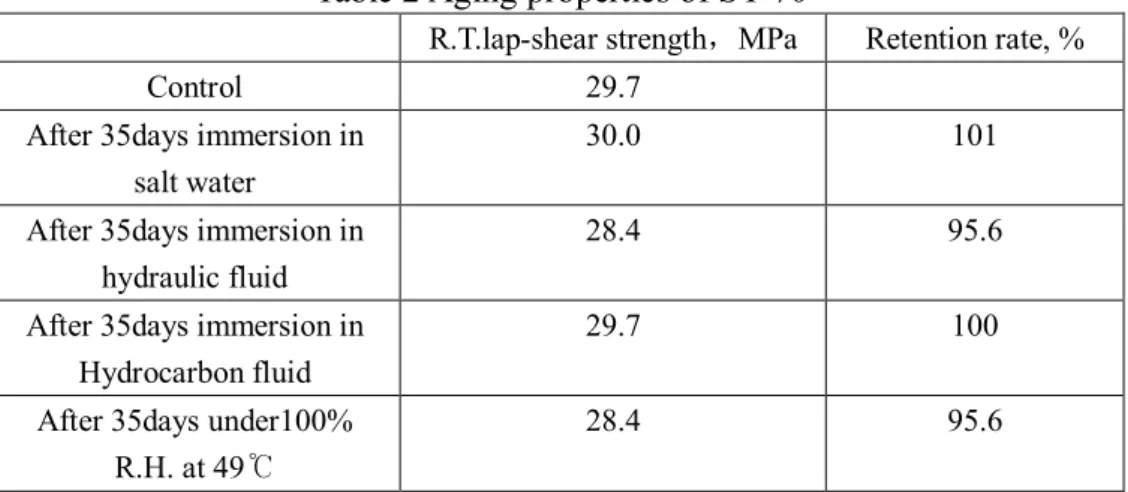
The aging resistant ability of SY-70 was illustrated in Table 2 showing that the

(5)

after each aging condition exceeds 95%, much better than requirement for 121℃ film adhesive.

Table 2 Aging properties of SY-70

R.T.lap-shear strength,MPa Retention rate, %

Control 29.7

After 35days immersion in salt water

30.0 101

After 35days immersion in hydraulic fluid

28.4 95.6

After 35days immersion in Hydrocarbon fluid

29.7 100

After 35days under100%

R.H. at 49℃

28.4 95.6

3.4 Vacuum cure process

The lap-shear strength cured at heat press and vacuum were presented in Fig.4. Data generated show vacuum processing yields results within 11% of those available from the heat press cure, therefore making the adhesive suitable for vacuum process and repair application.

0 10 20 30

R. T. 70℃

Heat Pr ess Cur e Vacuum Cur e

Fig. 4 Lap-shear strength at different cure process 3.5 Storage properties

The storage properties were illustrated in Fig. 5. After stored at R.T. for 14days or

-18℃ for 6 months, the lap-shear strength and honeycomb climbing drum peel

strength remained almost the same, and shows that the adhesive had long storage life,

long out time, which is very important for manufacturing large parts.

(6)

st or age pr oper t i es of SY- 70

10 0 20 30 40 50 60 70 80

R. T.

shear 70C

shear upper panel peel

t ool si de

peel

St re ng th (M Pa o r N .m m /m m )

cont r ol at R. T. /14d at - 18C/6 mont hs

Fig. 5 Storage properties of SY-70

4 Conclusion

A low temperature cure film adhesive SY-70 was developed for applications similar to 121℃ cure film adhesive. The adhesive offers the user the ability to cure at 75℃

under either positive or vacuum pressure. The material has the capability to almost meet the requirement of 121℃ cure film adhesive and is designed for use in composite and metallic bonded assembly. The adhesive is ideal for applications such as secondary aircraft structures, radome, antennae and sports goods.

5 Reference

[1] Liang Bin, Liu Qingfang, Liu Linan, Epoxy Film Adhesive for Aluminum and Composite Repairing, The 11

th

International Conference on Composite Materials, July, 1997,Brisbane.

[2] Boeing Material Specification BMS 5-101J

(7)

Curriculum Vitae

Bin Liang is Deputy Head of Composites and Applications Lab for Beijing Institute of

Aeronautical Materials(BIAM). He major in polymer materials and got his master degree in 1991

(Northwestern Polytechnical University, Xian). Since joined in BIAM as an R&D engineer in

Composites and Applications Lab in March 1991, most of his research work focused on epoxy

toughening, including adhesives and composite matrix resin.

수치

Table 2 Aging properties of SY-70

참조

관련 문서