www.earticle.net
한우고기와 수입육 등심과 홍두깨 부위의 휘발성 향기성분 비교
조수현* · 성필남 · 강근호 · 정석근 · 김현섭 · 박범영 · 강선문 · 김동훈 농촌진흥청 국립축산과학원
Comparison of Volatile Flavor Profiles for Hanwoo and Imported Beef
Soohyun Cho*, Pilnam Seong, Geunho Kang, Seokgeun Jung, Hyunsup Kim, Beomyoung Park, Sun Moon Kang and Donghun Kim
National Institute of Animal Science, R.D.A.
ABSTRACT1)
The study was conducted to investigate the differences in the compounds responsible for volatile flavors in Hanwoo and imported fresh beef from Australia, United States and New Zealand. Different imported beef samples were prepared as Angus beef from Australia, United States and New Zealand and the cross beef from the United States. Significant differences (p<0.05) in hexanal, benzaldehyde, octanal, nonanal, nonenal, decanal, E-2-decenal, hexadecyloxirane, tetradecanal, 2,2-dideutero octadecanal, octadecanal, pentadecane, 2,5-dimethyl pyrazine, 4-methyl-2-propyl-furan, 2-hexylfuran, 2-butylfuran, 2-pentylfuran, 2-heptyl furan were observed between loin and eye of round from Hanwoo and imported beef (p<0.05). In loin muscles, various volatile compounds such as hexanal, heptanal, octanal, E-2-octenal, nonenal, E-2-decenal, E,E,2,4-decadienal, 2-undecenal, heptane, 2-butyl furan were found to be significantly higher in Hanwoo beef as compared to imported beef.
However, in the round muscles of Hawnoo eye compounds that were observed to be significantly higher were pentanal, hexanal, heptanal, benzaldehyde, octanal, nonanal, E-2-decenal, octadecanal, 2-furan methanol and 2-pentyl furan. Further study need to be determined if those volatile compounds can be used as a bio-marker to identify origins of beef.
(Key words: Flavor profile, Hanwoo beef, Imported beef)
Ι .
서론수입자유화 및 유통시장이 개방되면서 외국의 질 좋은 쇠고기가 들어오고 있어 한국소비자들의 선택의 폭은 점차 확대되고 있다. 2003년 12월 광우병 파동으로 쇠고기 수입 중단 조치 이후 소비자들의 쇠고기에 대한 불안 심리와 함 께 1인당 쇠고기 소비량이 2003년 8.14 kg에서 2004년 6.8 kg으로 급감하였으나 고품질의 안전한 한우고기 생산 노 력, 원산지 표시제의 적용 확대, 이력제 실시 등으로 국내 산 쇠고기의 소비시장 대체가 이루어지면서 2009년 1인당
소비량이 8.11 kg 수준으로 다시 회복세를 보이고 있다 (KMTA, 2011). 그럼에도 불구하고 다른 나라의 연간 1인 당 쇠고기소비량은 아르헨티나가 55.7 kg, 미국 38.5 kg, 호주 35.3 kg, 캐나다 29.5 kg, 홍콩 30.3 kg, 일본 9.5 kg 수준인 것과 비교했을 때 한국의 쇠고기 소비는 상대적으 로 여전히 적은 수준이다.
Cho 등(2010)이 전국소비자들을 대상으로 한우고기 관능 평가를 실시한 결과 한국소비자들이 쇠고기 맛에 대한 기 호도를 결정할 때 연도 55%, 다즙성 18%, 향미 27%의 영 향력이 있다고 보고함으로서 쇠고기 향미가 연도 다음으로
* Corresponding author: Soohyun Cho, Animal Products Research and Development Division, National Institute of Animal Science, Suwon 441-706, Korea. Tel: +82-31-290-1703, E-mail: [email protected]
[Provider:earticle] Download by IP 118.70.52.165 at Monday, December 20, 2021 8:05 PM
www.earticle.net
기호도를 결정하는 중요한 요인으로 나타났다. Huffman 등(1996)도 미국소비자들이 가정에서 스테이크 요리할 때 고기향미는 전반적인 기호도를 결정할 때 매우 영향력 있 는 중요한 요인이라고 하였다. 고기의 향기 성분에 영향을 미치는 요인은 품종, 성별, 사양조건, 도축 연령 및 성, 고 기의 pH, 숙성기간, 요리방법 및 요리온도 등으로 보고되 었으며(Elmore 등, 1997; Mottram, 1994, 1998;
Sutherland와 Ames, 1996; Tai와 Ho, 1997, 1998; Vernin 와 Parkanyi, 1982), 수입육의 생산 환경으로 주로 목초 사 양하는 가축들은 휘발성성분들이 계절, 지역별 목초성분 (Mariaca 등, 1997) 및 사양기간(Viallon 등, 1999)과 같은 다양한 환경적인 요인에 의하여 영향을 받을 수 있다 (Fernandez-Garcia 등, 2002). 가열육의 휘발성 향기성분은 사료로부터 섭취되어 반추미생물의 작용에 의하여 사료분 자의 변형으로 유래되거나 가열 중에 maillard 반응과 지 방산화에 의하여 발생되어 조직에 전이될 수 있다.
Macleod(1994)는 고기의 비휘발성 물질이 가열에 의해 향 을 발생시키는 1차 경로는 지방의 산화 및 분해, 단백질, 펩타이드, 아미노산, 당 및 뉴클레오티드 대상물질의 열분 해 및 상호작용이고 2차 경로는 maillard 반응의 생성물질 끼리의 반응과 maillard 반응에서 생성된 물질과 지방분해 및 산화에서 형성된 성분과의 상호작용에 의해 발생된다 고 하였다. 가열 쇠고기의 경우 밝혀진 성분들은 주로 aldehydes, hydrocarbons, alcohols, phenols, ketones, carboxylic acids, esters, lactones, furans, pyrans, pyrroles, pyridines, pyrazines, oxazoles, oxaxoliners, thiophenes, thiazoles 등이다. 고기와 관련된 향성분의 유 래는 대부분이 cystine에서 유래한 황(sulphur)과 뉴클레오 티드 대사물질에서 유래한 ribose이다(Nishimura 등, 1998;
Tikk 등, 2006, 2008). 특히 황(sulphur)을 포함한 휘발성 성분 중에서 2-methylfuran-3-thiol과 bis(2-methyl-3-furyl) disulfide는 적정 수준에서는 좋은 향을 내지만 과도하면 좋지 않은 향성분으로 바뀐다고 한다. 그 밖에도 고기에는 산화취(rancid off-flavor)를 내는 성분인 pantanal, 2-pentylfuran, pantanal, hexanal, 3-hydroxy-2-butanone, hexanoic acid들이 있다(Macleod, 1994; Mottram, 1998).
현재까지 한우와 수입육에 대한 연구는 각 나라의 등급 체계 및 유통조건의 차이로 현실적으로 동급의 품질비교 가 어려웠으며 특히 휘발성 향기성분에 대한 연구는 쇠고 기 기호도를 결정하는 영향력 있는 요인임에도 불구하고 과학적인 연구 자료가 매우 부족한 실정이다. 따라서 본 연구는 한우고기(육질등급 1+)와 국내시장에 본격적으로 수입되어 유통되고 있는 호주, 미국, 뉴질랜드산 냉장 쇠
고기들의 휘발성 향기성분을 분석하고 비교하여 한우고기 와 수입육간의 차이점을 도출해 내고자 실시하였다.
Ⅱ. 재료 및 방법
1. 분석시료 준비
본 연구에 사용된 한우고기 시료는 국립축산과학원 한 우시험장에서 동일한 조건에서 사육된 거세우(26~28개월) 중에서 육질등급 판정결과에 따라 육질등급 1+ 등급 판정 을 받은 거세한우 8두를 공시축으로 사용하였다. 공시축으 로 사용된 소들은 정상적인 방법으로 도축한 다음 도체는 1℃ 냉각실에 24시간 냉각 후 농림부고시(제 2007-82호)에 준하여 발골 하였으며 그 중에서 2 부위[등심(loin) 홍두깨 (eye of round)]을 분리하여 진공 포장하고 2℃에서 14일 간 숙성시킨 다음 분석에 이용하였다. 한편 수입육은 국내 전문수입업체로부터 호주산 앵거스 흑우(300일 곡류비육) 및 교잡육, 미국산 앵거스 흑우(200일 곡류비육), 뉴질랜드 산 앵거스 흑우(130일 곡류비육)에서 생산된 각 원산지별 로 등심 8, 홍두깨 8 부위(미국산은 제외)를 냉장상태로 구입하였다. 국내에서 유통되는 수입육은 유통시점이 도축 가공 후 국내에 수입되고 통관되고 나면 약 35~90일 이 내인 것을 고려하여 본 연구에 사용된 수입산 시료는 모 두 도축 일자로부터 진공포장 상태로 0-1℃에서 약 50~55 일이 되는 시점으로 동일하게 맞추어 분석하였다.
2. 휘발성 향기 성분분석
결체조직과 지방을 제거한 시료 100-150 g을 액체질소와 함께 분쇄하여 사용 전까지 -20℃에 보관한다. 각각 1 g의 시료를 40 ml SPME 병에 넣어 121℃에서 30분 동안 가열 하였다. 1 ul의 내부표준물질(2-methyl-3-heptanone, 0.816 mg/ml in methanol)을 분석 전 시료에 첨가하였다. 60℃
의 항온수조에서 탕진하면서 SPME 섬유(Carboxen/
PDMS, 75 μm, Supelco Co., USA)에 향기 관련 휘발성 성 분을 흡착시켰다. 흡착 직후 GC/MS(Agilent Technologies 6890N, 5973MSD, USA)의 250℃에 5분 동안 노출시켰다.
성분은 DB-5MS capillary column(30 m x 0.25 mm i.d. x 0.25 μm film thickness, Agilent J & W Scientific, model No. 122-5532, Folcom, USA)로 분석하였다. 정량을 위하여 분석된 피크들은 Chem Station(Agilent Technologies,
[Provider:earticle] Download by IP 118.70.52.165 at Monday, December 20, 2021 8:05 PM
www.earticle.net
Version D.01.00, USA)을 이용하여 면적을 구하였고, 향기 성분의 동정은 Wiley Registry of Mass Spectral Data 7th edition(McLafferty, 2000; Agilent part No. G1035B)과 비 교하여 결정하였다. 또한 Kovats 인덱스를 alkanes C8-C20(Fluka, Cat. No. 04070, New Zealand)을 활용하여 계산하여 동정하였다. 성분의 정량은 내부표준물질을 fact 1로 하여 정량하였다. 분석시 시료의 split ratio는 10:1이 고 split flow는 10 mL/min으로 헬륨을 캐리어로 압력은 7.03 psi, 유속은 1.0 mL/min의 속도로 실시하였으며, 평 균 velocity는 36 cm/sec이었다. 검출된 성분들의 피크는 다시 동일 화학물질(pentanal, hexanal, heptanal, octanal, octenal, nonanal, E-2-hetenal, E-2-octenal, E,E-2,4 -nonadienal, E,E-2,4-decadienal, E-2-nonenal, phenyl -acetaldehyde, 2-octanone, 1-octanol, pyrazine, 2-methyl -pyrazine, 1-pentanol(Aldrich, USA), 1-octen-3-ol, naphthalene, 2-heptanone, 2-hexanone(Fluka, Switzer- land), decanal(Sigma, USA))을 분석하여 확인하였다. 이 표준성분은 아세톤에 100배 희석하여 1 uL을 GC/MS로 분석하였다. 분석 조건은 초기온도는 40℃, 검출온도는 325℃, 대기시간은 5분으로 하였고 총 분석시간은 40분으 로 설정하였다.
3. 통계분석
원산지별 향기성분 비교는 SAS(2005) ANOVA procedure를 이용하여 분석하였으며 원산지별 향기성분 평균의 유의성은 Student-Newman-Keuls multiple range test(SNK) 방법을 이용하였다. 주성분분석은 SAS(2005) PRINCOMP procedure를 이용하였다.
Ⅲ. 결과 및 고찰
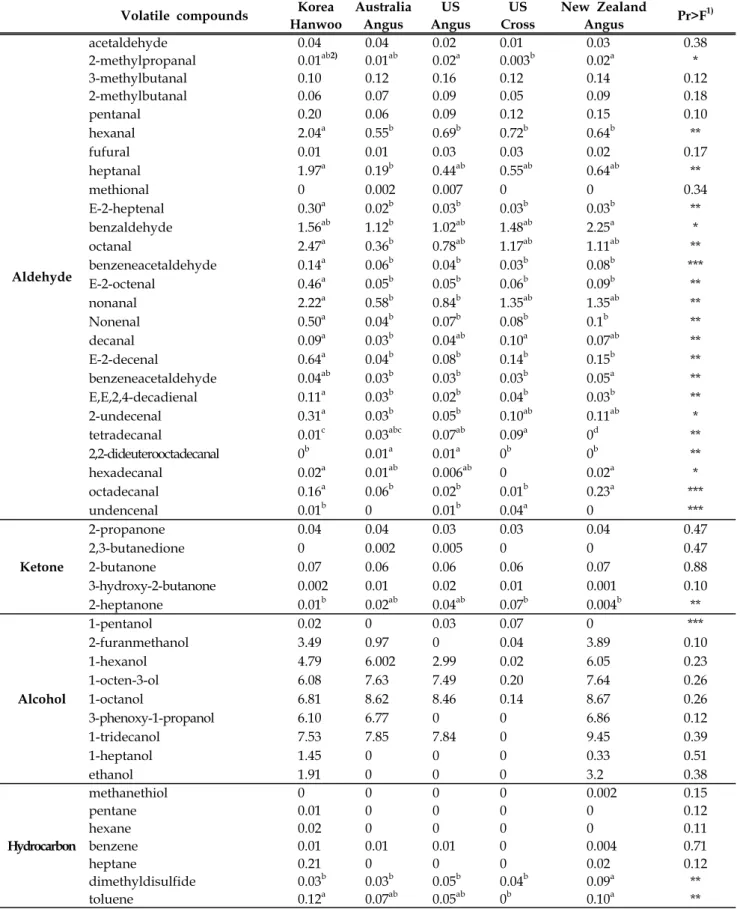
한우, 호주산 흑우, 미국산 흑우 및 교잡종, 뉴질랜드산 흑우의 등심 부위 향기성분을 분석한 결과는 Table 1과 같았다. 등심부위에서는 aldehyde류 26종, ketone류 5종, alcohol류 9종, hydrocarbon류 20종, pyrazine류 4종, furan 류 7종으로 총 71 성분이 검출되었으며 그 중에서 원산지 간에 유의성이 있는(p<0.05) 성분은 2-methylpropanal, hexanal, heptanal, E-2-hepenal, benzaldehyde, octanal, benzene-acetaldehyde, E-2-octenal, 2-undecenal, hexadecanal, dimethyl trisulfide, dodecane, tridecane, nonanal,
nonenal, decanal, E-2-decenal, E,E,2,4-decadienal, 1-pentanol, undecenal, dimethyltetrasulfide, hexa- decyloxirane, toluene, 2-heptanone, tetradecanal, 2,2-dideutero octadecanal, dimethyldisulfide, octadecanal, pentadecane, 2,5-dimethyl pyrazine, 4-methyl-2-propyl- furan, 2-hexylfuran, 2-octylfuran, 2-butylfuran, 2-pentylfuran, 2-heptyl furan 이었다. 한우, 호주산 흑우, 뉴질랜드산 흑 우의 홍두깨 부위의 향기성분을 분석한 결과는 Table 2와 같았다. 홍두깨 부위에서는 aldehyde류 25종, ketone류 5 종, alcohol류 10종, hydrocarbon류 16종, pyrazine류 4종, furan류 7종으로 총 67 성분이 검출되었다. 그 중에서 원 산지간에 유의성이 있는(p<0.05) 성분은 hexanal, nonanal, nonenal, decanal, tetradecanal, 2,3-butanedione, 3- hydroxy-2-butanone, heptanal, benzaldehyde, octanal, E-2-decenal, 2-undecenal, 2,2-dideutero octadecanal, octadecanal, pentanal, 3,8-dimethyldecane 3-ethyl-2- methyl-1,3-hexadiene, 3,4-dimethyl decane, hexadecyl oxirane, 2,5-dimethylpyrazine, 2-pentyl furan, 4-methyl-2- propyl furan, 2-hexylfuran, 2-ethylfuran, 2-heptylfuran, 2-butylfuran이었다.
적색육의 향미는 아미노산과 환원당 사이에 일어나는 maillard 반응과 지방의 열처리에 의한 분해로부터 생성된 다. Maillard 반응에서는 구운 또는 고기 향미(roasted/
meaty flavor)를 생성하고 지방의 열처리 분해는 축종간의 향미 차이를 보여준다(Gandemer, 1999; Mottrqam, 1998).
Maillard 반응 또는 비효소적 작용에 의한 갈변화 (non-enzymatic browning)는 식품에서 amine과 carbonyl 물질간의 반응이다. 일반적으로 환원당의 carbonyl group 을 가진 아민 물질들이 열처리에 의하여 농축되면서 glycosylamine으로 변화되었다가 다시 Amadori, Strecker 및 Schiff 반응을 통하여 amine, amino acids, aldehydes, hydrogen sulfide, ammonia 등과 반응하여 furfural, furanone 유도체, hydroxyketone 및 dicarbonyl 과 같은 물질로 변화되고 결국 melanoidin 이라고 하는 기호성에 영향력 있는 물질이 생성된다(Manley and Choudhury, 1999). 지방 역시 향미에 영향을 미치는데 고기 속에 함유 된 향미물질들이 가공, 취급 및 열처리를 통하여 산화과정 을 거치면서 생성된다(Moody, 1983; Mottram과 Edwards, 1983). 고기의 지방분획의 지방산조성을 변형시키면 생성 되는 휘발성지방산의 양과 종류를 변화시킬 수 있고 또한 아로마와 향미도 변화시킬 수 있다(Elmore 등, 1999;
Elmore 등, 2004). Campo 등(2003)는 쇠고기 향미는 3종 의 불포화지방산 종류 및 함량과 관련 있다고 하여 훈련
[Provider:earticle] Download by IP 118.70.52.165 at Monday, December 20, 2021 8:05 PM
www.earticle.net
된 요원들을 통하여 개별 지방산 C18:1n9, C18:2n6, C18:3n3과 같은 개별 지방산 및 cysteine과/또는 ribose와 의 혼합효과를 분석하였는데 고기향미는 maillard 반응 생 성물과 지방산 간의 반응물질이 있을 때 즉, cysteine과 ribose가 존재할 때 훨씬 더 강하게 생성되었다고 하였다.
3종의 지방산이 다른 향미 프로파일을 생성해내는데 C18:
3n3의 경우 더 강한 fishy 향과 linseed/putty 향을 생성 하며 cysteine과 ribose는 ‘grassy'한 냄새가 더 우세하였다 고 보고하였다.
Ho 등(1994)에 의하면 C18:2n6에서 발생된 알데히드들 은 hexanal, E-2-heptenal, E-2-octenal, (E,E)-2,4-deca -dienal이며, C18:3n3에서 발행된 알데히드 중 (E,E)- 2,4- heptadienal과 (E,Z)-2,4-heptadienal이 많았다고 하였고 3-methylbutanal과 2-methylpropanal은 각각 isoleucine과 valine에서 비롯되었다고 보고하였다. 한편, 지방의 산화와 분해는 많은 지방족 화합물, alcohol, aldehydes, ketone, acid, lactone 및 2-alkylfurans을 형성하며 고기의 향을 오 히려 저감시킨다고 하였다(Elmore 등, 2002).
Lorenz 등(2002)은 목초사양 또는 곡류사양한 고기에서 생성되는 휘발성 물질을 정량 분석한 결과 목초사양한 가 축의 고기에서 생성되는 ‘green odor'가 C18:1n9 및 C18:
3n3에서 생성되는 hexanal 물질과 C18:2n6에 생성되는 soapy odor를 발생하는 octanals 물질과 연관되어 있다고 하였다. Larick과 Turner(1990)는 목초사양 및 농추사료로 사양한 쇠고기 사이의 향미차이는 PUFA 함량 증가 및 그 것의 지방산화 안정성과 관련 있다고 하였다. 등심에서는 뉴질랜드산 흑우육이 benzaladehyde 함량이 높았으나 2- pentylfuran은 한우육 홍두깨에 많았다. 한편, hexanal, heptanal, decadienal 및 octanal 은 다른 수입육들보다 한 우육의 등심 및 홍두깨 부위에서 많이 검출되었다(Table 1 과 2). Larick 등(1990)은 목초사양을 많이 할수록 쇠고기 에서 linolenic acid에서 생산되는 4-heptenal, 2,4- heptadienal, 2,6-nonadienal 함량이 높고 반면에 곡류사양 을 많이 할수록 고기에 linoleic acid에서 생산되는 hexanal, 2-heptenal, 2,4-decadienal 함량이 높다고 하였다.
Descalzo 등(2005)은 곡류사양을 할수록 목초사양한 경우 보다 고기에서 aldehyde류 함량 수준이 높다고 하였다. 고 기 내에서 C20:4n6은 hexanal, methyl 5-oxopentanoate, pentane 및 2,4-decadienal 휘발성 물질성분으로 자동 산 화되는데(Artz 등, 1993) 그 중에서 가장 향미가 강한 것 은 1-octen-3-one, 2,4-decadienal, 2,4,7-tridecatrienal 및 hexanal로 밝혀진 바 있었다(Blank 등, 2001). 한편, 목초
사양 및 건초사양으로 생산된 고기는 향미의 기호도가 떨 어지는 것으로 보고되었다(Dube 등, 1971; Melton, 1990).
Cho 등(2005)은 한우고기와 호주산 앵거스육의 관능특성 에 영향을 미치는 불포화지방산은 C16:1n7, C18:2n6, C18:3n3, C20:3n6, C20:4n6, C22:4n6, C22:5n3이었으며, 원 산지별로는 호주산 앵거스 쇠고기가 등심, 꾸리, 우둔 부 위에서 n3 계열 불포화지방산 함량이 유의적으로 높았다 고 보고한 바 있었다. Raes 등(2003)은 아르헨티나와 아일 랜드에서 수입하여 곡류사양한 Limousin과 목초사양한 Belgium Blue retail beef의 지방산조성과 향기성분을 비교 한 결과 목초사양한 쇠고기가 장쇄 불포화지방산의 산화 로부터 유래된 저분자 불포화 알데히드류 함량이 높아 향 미의 강도가 높은 것으로 나타났다. 또한 목초사양한 German Holstein과 Simmental bull은 농후사료를 사양한 가축들보다 n3 함량이 더 높았으나 관능평가 프로파일에 서는 목초사양한 가축들이 더 높은 ’bloody' 또는 ‘fishy' 향미가 강한 것으로 나타났다(Nuernberg 등, 2005). 황 (2010)은 한우고기에서 높은 수준으로 생성된 25종 향기성 분 중에서 동시에 우리의 전통식품인 된장, 청국장, 참기 름에도 공통으로 존재하는 성분들을(octanal, heptanal, methonal, E,2-heptenal, E,2-octenal, E,2-noneanl, E,2- decenal, nonanal) 찾아냈는데 그 중에서도 올레인산(C18:
1n9)에서 생성되는 octanal은 한국전통식품인 한우, 참기 름, 된장, 청국장에서 2-7배 가량 높은 수준으로 존재함으 로써 이 성분들이 한국인들이 기억하는 물질일 것으로 보 고하였다. 본 연구에서도 methional 및 E,2-nonenal을 제 외한 octanal, heptanal, E,2-heptenal, E,2-octenal, E,2- decenal, nonanal 등 6종 성분이 한우 등심 및 홍두깨 부 위에서 수입육들보다 높은 수준으로 검출되었다(Table 1과 2).
Maillard 반응은 반응물질에 따라 또는 같은 반응물질 간에도 반응상태에 따라 서로 다른 물질을 형성하는데 cysteine과 glucose 반응은 황을 포함한 성분이 형성되거 나 산화된 상태에서 일어나는 경우에는 대부분은 pyrazine 과 furan류를 형성한다. 본 연구에서 등심과 홍두깨 부위 에서 4종의 피라진류가 검출되었는데 황(2010)은 피라진류 의 향기는 참기름과 쇠고기의 볶은 냄새(roasted odor)의 특성을 나타내고 높은 온도에서 가열된 낮은 수분의 식품 요리에서 많이 발생한다고 하였다.
황(2010)의 연구보고에 의하면 맛과 관련된 전구체 물질 은 한우가 수입육에 비하여 정미성이 높은 GMP와 hypoxanthin이 각각 34%, 61% 로 높았고 한우에서 단맛,
[Provider:earticle] Download by IP 118.70.52.165 at Monday, December 20, 2021 8:05 PM
www.earticle.net
Table 1. Volatile flavor profiles of loin muscles for Hanwoo and imported beef Volatile compounds Korea
Hanwoo
Australia Angus
US Angus
US Cross
New Zealand
Angus Pr>F1)
Aldehyde
acetaldehyde 0.04 0.04 0.02 0.01 0.03 0.38
2-methylpropanal 0.01ab2) 0.01ab 0.02a 0.003b 0.02a *
3-methylbutanal 0.10 0.12 0.16 0.12 0.14 0.12
2-methylbutanal 0.06 0.07 0.09 0.05 0.09 0.18
pentanal 0.20 0.06 0.09 0.12 0.15 0.10
hexanal 2.04a 0.55b 0.69b 0.72b 0.64b **
fufural 0.01 0.01 0.03 0.03 0.02 0.17
heptanal 1.97a 0.19b 0.44ab 0.55ab 0.64ab **
methional 0 0.002 0.007 0 0 0.34
E-2-heptenal 0.30a 0.02b 0.03b 0.03b 0.03b **
benzaldehyde 1.56ab 1.12b 1.02ab 1.48ab 2.25a *
octanal 2.47a 0.36b 0.78ab 1.17ab 1.11ab **
benzeneacetaldehyde 0.14a 0.06b 0.04b 0.03b 0.08b ***
E-2-octenal 0.46a 0.05b 0.05b 0.06b 0.09b **
nonanal 2.22a 0.58b 0.84b 1.35ab 1.35ab **
Nonenal 0.50a 0.04b 0.07b 0.08b 0.1b **
decanal 0.09a 0.03b 0.04ab 0.10a 0.07ab **
E-2-decenal 0.64a 0.04b 0.08b 0.14b 0.15b **
benzeneacetaldehyde 0.04ab 0.03b 0.03b 0.03b 0.05a **
E,E,2,4-decadienal 0.11a 0.03b 0.02b 0.04b 0.03b **
2-undecenal 0.31a 0.03b 0.05b 0.10ab 0.11ab *
tetradecanal 0.01c 0.03abc 0.07ab 0.09a 0d **
2,2-dideuterooctadecanal 0b 0.01a 0.01a 0b 0b **
hexadecanal 0.02a 0.01ab 0.006ab 0 0.02a *
octadecanal 0.16a 0.06b 0.02b 0.01b 0.23a ***
undencenal 0.01b 0 0.01b 0.04a 0 ***
Ketone
2-propanone 0.04 0.04 0.03 0.03 0.04 0.47
2,3-butanedione 0 0.002 0.005 0 0 0.47
2-butanone 0.07 0.06 0.06 0.06 0.07 0.88
3-hydroxy-2-butanone 0.002 0.01 0.02 0.01 0.001 0.10
2-heptanone 0.01b 0.02ab 0.04ab 0.07b 0.004b **
Alcohol
1-pentanol 0.02 0 0.03 0.07 0 ***
2-furanmethanol 3.49 0.97 0 0.04 3.89 0.10
1-hexanol 4.79 6.002 2.99 0.02 6.05 0.23
1-octen-3-ol 6.08 7.63 7.49 0.20 7.64 0.26
1-octanol 6.81 8.62 8.46 0.14 8.67 0.26
3-phenoxy-1-propanol 6.10 6.77 0 0 6.86 0.12
1-tridecanol 7.53 7.85 7.84 0 9.45 0.39
1-heptanol 1.45 0 0 0 0.33 0.51
ethanol 1.91 0 0 0 3.2 0.38
Hydrocarbon
methanethiol 0 0 0 0 0.002 0.15
pentane 0.01 0 0 0 0 0.12
hexane 0.02 0 0 0 0 0.11
benzene 0.01 0.01 0.01 0 0.004 0.71
heptane 0.21 0 0 0 0.02 0.12
dimethyldisulfide 0.03b 0.03b 0.05b 0.04b 0.09a **
toluene 0.12a 0.07ab 0.05ab 0b 0.10a **
[Provider:earticle] Download by IP 118.70.52.165 at Monday, December 20, 2021 8:05 PM
www.earticle.net
Volatile compounds Korea Hanwoo
Australia Angus
US Angus
US Cross
New Zealand
Angus Pr>F1)
Aldehyde
acetaldehyde 0.05 0.04 - - 0.01 0.44
2-methylpropanal 0.01 0.01 - - 0.02 0.78
3-methylbutanal 0.13 0.11 - - 0.10 0.81
2-methylbutanal 0.09 0.06 - - 0.07 0.39
pentanal 0.25a2) 0b - - 0.07ab ***
hexanal 1.07 0.42b - - 0.28b *
fufural 0.02 0.03 - - 0.02 0.81
heptanal 0.98a 0.20b - - 0.24b **
E-2-heptenal 0.06 0.02 - - 0.02 0.06
benzaldehyde 2.95a 1.10b - - 0.84b **
octanal 1.79a 0.43b - - 0.43b **
benzeneacetaldehyde 0.09 0.06 - - 0.03 0.49
E-2-octenal 0.18 3.21 - - 0.04 0.52
nonanal 2.39a 0.89b - - 0.56b *
Nonenal 0.22a 0.03b - - 0.05b *
decanal 0.12a 0.05b - - 0.03b *
E-2-decenal 0.35a 0.03b - - 0.05b **
benzeneacetaldehyde 0.08 0.04 - - 0.03 0.25
Table 1. Continued
Volatile compounds Korea Hanwoo
Australia Angus
US Angus
US Cross
New Zealand
Angus Pr>F1)
Hydrocarbon
styrene 0 0.002 0 0 0.004 0.10
dimethyltrisulfide 0.24ab 0.16b 0.20b 0.22ab 0.36a *
2-acetylthiazole 0.10 0.05 0.04 0.04 0.08 0.40
3-ethyl-2-methyl-1,3-hexadiene 0.22 0.02 0.03 0.03 0.07 0.07
3,4-dimethyldecane 0.09 0.007 0 0 0.03 0.06
3,8-dimethyldecane 0.07 0.004 0 0 0.02 0.15
undecane 0.15 0.02 0.03 0.03 0.04 0.08
dodecane 0.10a 0.03b 0.04b 0.05b 0.07ab **
***
0.03a 0.01b
0.01b 0.006c
0.02ab dimethyltetrasulfide
**
0.07a 0.04b
0.03b 0.06b
0.09a tridecane
0.61 0.02
0 0.01
1.58 0.05
tetradecane
0.02ab 0.01abc 0.01bc 0 0.03a **
pentadecane
0b 0.01a 0.002b 0b 0b ***
hexadecyl-oxirane
0.37 Pyrazine
0 0
0.001 0.001
0 pyrazine
0.54 0.04
0.05 0.04
0.03 0.04
methylpyrazine
**
0.10a 0.11a
0.09ab 0.05b
0.09ab 2,5-dimethylpyrazine
0.17 0.05
0.03 0.03
0.02 0.15
3-ethyl-2,5-dimethylpyrazine
0.60 0
0 14
0.05 0
Furan
2-ethylfuran
***
1.07ab 1.37ab
0.98ab 0.73b
1.59a 2-pentylfuran
**
0b 0.005b
0.01b 0.02a
0b 4-methyl-2-propyl-furan
**
0.09ab 0.10ab
0.05ab 0.03b
0.13a 2-hexylfuran
***
0.06ab 0.09a
0.04bc 0.02c
0.08ab 2-heptylfuran
**
0.08ab 0.08a
0.04ab 0.03b
0.07ab 2-octylfuran
**
0.05ab 0
0.02b 0.01b
0.11a 2-butylfuran
1) Means within the same row having different letters are significantly different at p<0.05.
2) F-ratio statistic: * p<0.05, ** p<0.01, *** p<0.001.
T
able 2. Volatile flavor profiles of eye of round for Hanwoo and imported beef[Provider:earticle] Download by IP 118.70.52.165 at Monday, December 20, 2021 8:05 PM
www.earticle.net
Volatile compounds Korea Hanwoo
Australia Angus
US Angus
US Cross
New Zealand
Angus Pr>F1)
Aldehyde
E,E,2,4-decadienal 0.06 0.03 - - 0.01 0.12
2-undecenal 0.24a 0.03b - - 0.04b **
tetradecanal 0.01 0.06 - - 0 *
2,2-dideuterooctadecanal 0 0.03 - - 0 **
hexadecanal 0.06 0.04 - - 0.01b 0.49
octadecanal 0.44a 0.04b - - 0.06b **
undencenal 0.004 0 - - 0 0.48
Ketone
2-propanone 0.06 0.04 - - 0.02 0.37
2,3-butanedione 0 0.01 - - 0 *
2-butanone 0.1 0.09 - - 0.03 0.76
3-hydroxy-2-butanone 0 0.02 - - 0.01 *
2-heptanone 0.004 0.03 - - 0 0.29
Alcohol
1-pentanol 0.01 0 - - 0 0.45
2-furanmethanol 3.15 0 - - 0 0.26
1-hexanol 4.36 1.50 - - 0.02 0.45
1-octen-3-ol 5.51 7.58 - - 0.23 0.61
1-octanol 6.21 8.46 - - 0.06 0.62
3-phenoxy-1-propanol 3.7 0.01 - - 0.03 0.44
1-tridecanol 6.84 0.01 - - 0 0.14
1-hexadecanol 1.07 0 - - 0 0.69
1-heptanol 1.32 0 - - 0 0.69
ethanol 1.74 0 - - 0 0.69
Hydrocarbon
benzene 0.02 0.02 - - 0 0.81
dimethyldisulfide 0.09 0.04 - - 0.03 0.12
toluene 0.09 0.07 - - 0.07 0.79
styrene 0.01 0 - - 0 0.32
dimethyltrisulfide 0.31 0.16 - - 0.20 0.20
2-acetylthiazole 0.05 0.07 - - 0.08 0.49
3-ethyl-2-methyl-1,3-hexadiene 0.04ab 0.01b - - 0.07a **
3,4-dimethyldecane 0.02ab 0b - - 0.06a **
3,8-dimethyldecane 0.002b 0b - - 0.04a ***
undecane 0.05 0.03 - - 0.03 0.48
dodecane 0.10 0.05 - - 0.03 0.07
dimethyltetrasulfide 0.03 0.01 - - 0.004 0.06
tridecane 0.14 0.08 - - 0.02 0.23
tetradecane 0.03 0.02 - - 0.005 0.27
pentadecane 0.04 0.02 - - 0.005 0.28
hexadecyl-oxirane 0 0.03 - - 0 **
Pyrazine
pyrazine 0 0.001 - - 0 0.25
methylpyrazine 0.04 0.03 - - 0.02 0.63
2,5-dimethylpyrazine 0.11a 0.04b - - 0.06b *
3-ethyl-2,5-dimethylpyrazine 0.02 0.02 - - 0.07 0.10
Furan
2-ethylfuran 0 0.14 - - 0 **
2-pentylfuran 1.92a 0.77ab - - 0.44b *
4-methyl-2-propyl-furan 0 0.02 - - 0 *
2-hexylfuran 0.14a 0.04b - - 0.05b *
2-heptylfuran 0.11a 0.03b - - 0.03b **
2-octylfuran 0.17 0.06 - - 0.03 0.08
2-butylfuran 0.09a 0.002b - - 0.02ab **
T
able 2. Continued1) Means within the same row having different letters are significantly different at p<0.05.
2) F-ratio statistic: * p<0.05, ** p<0.01, *** p<0.001.
[Provider:earticle] Download by IP 118.70.52.165 at Monday, December 20, 2021 8:05 PM
www.earticle.net
짠맛, 신맛과 관련된 다양한 유리아미노산이 더 많은 양이 검출되어 한우고기가 수입육에 비하여 더 복합적인 맛 물 질들과 관련되어 있다고 하였다. Rhee 등(2004)은 쇠고기 향미는 연도, 결체조직, 다즙성, 근절길이, desmin 분해도 및 가열감량과 같은 육질특성과도 약하지만 각각 -0.14, -0.11, 0.13, -0.31, 0.34, -0.20의 상관관계를 나타냈다고 보 고하였다.
한편, 본 연구에서 수입쇠고기보다 한우고기에서 3배 이 상 더 많이 검출된 성분은 등심부위에서는 hexanal, heptanal, octanal, E-2-octenal, nonenal, E-2-decenal, E,E,2,4-decadienal, 2-undecenal, heptane, 2-butyl furan이 었고 홍두깨 부위에서는 pentanal, hexanal, heptanal, benzaldehyde, octanal, nonanal, E-2-decenal, octadecanal, 2-furan methanol, 2-pentyl furan 등 이었는데 이들 성분 들은 향후 한우육을 수입육들과의 차이를 나타낼 수 있는 향미 마커로 활용할 수 있을지에 대한 추가연구가 필요할 것으로 생각된다.
사사
이 논문은 2009-2010년도 농촌진흥청 국립축산과학원 경 상연구비에 의하여 수행되었으며 이에 감사드립니다.
Ⅳ. 요약
본 연구의 목적은 한우고기(육질등급 1+)와 국내시장에 본격적으로 수입되어 유통되고 있는 호주, 미국, 뉴질랜드 산 냉장 쇠고기들의 휘발성 향기성분을 분석하고 비교하 여 한우고기와 수입육간의 차이점을 비교하고자 실시하였 다. 등심과 홍두깨 부위에서 모두 원산지별로 유의적인 차 이(p<0.05)가 있었던 휘발성 성분은 hexanal, benz- aldehyde, octanal, nonanal, nonenal, decanal, E-2-decenal, hexadecyloxirane, tetradecanal, 2,2-dideutero octadecanal, octadecanal, pentadecane, 2,5-dimethyl pyrazine, 4-methyl-2-propyl-furan, 2-hexylfuran, 2-butylfuran, 2-pentylfuran, 2-heptyl furan 이었다. 또한 수입쇠고기보다 한우고기에서 3배 이상 더 많이 검출된 성분은 등심부위에서는 hexanal, heptanal, octanal, E-2-octenal, nonenal, E-2-decenal, E,E,2,4-decadienal, 2-undecenal, heptane, 2-butyl furan 이었고 홍두깨 부위
에서는 pentanal, hexanal, heptanal, benzaldehyde, octanal, nonanal, E-2-decenal, octadecanal, 2-furan methanol, 2-pentyl furan 등이었는데 이들 성분들은 향후 한우육을 수입육들과의 차이를 나타낼 수 있는 향미 마커 로 활용할 수 있을지에 대한 추가연구가 필요할 것으로 생각된다.
V. 인용문헌
1. Artz, W. E., Perkins, E. G. and Salvador-Henson, L.
1993. Characterization of the volatile decomposition products of oxidized methyl arachidonate. J. Am. Oil Chem. Soc. 70:377-382.
2. Blank, I., Lin, J., Vera, F. A., Welti, D. H. and Fay, L. B. 2001. Identification of potent odorants formed by autoxidation of arachidonic acid: Structure elucidation and synthesis of (E,Z,Z,Z)-2,4,7-tridecatrie -nal. J. Agric. Food Chem. 49:2959-2969.
3. Campo, M. M., Nute, G. R., Wood, J. D., Elmore, S.
J., Mottram, D. S. and Enser, M. 2003. Modelling the effect of fatty acids on odour development of cooked meat in vitro: part I-sensory perception. Meat Sci. 63 :367-375.
4. Cho, S. H., Park, B. Y., Kim, J. H., Hwang, I. H., Kim, J. H. and Lee, J. M. 2005. Fatty Acid Profiles and Sensory Properties of Longissimus dorsi, Triceps brachii, and Semimembranosus Muscles from Korean Hanwoo and Australian Angus Beef. Asian-Australian J. Anim. Sci. 18:1786-1793.
5. Cho, S. H., Kim, J., Park, B. Y., Seong, P. N., Kang, G. H., Kim, J. H., Jung, S.G., Im, S. K. and Kim, D.
H. 2010. Assessment of meat quality properties and development of a palatability prediction model for Korean Hanwoo steer beef. Meat Sci. 86:236-242.
6. Descalzo, A. M., Insani, E. M., Biolatto, A., Sancho, A. M., Garcia, P. T., Pensel, N. A. and Josifovich, J.
A. 2005. Influence of pasture or grain-based diets supplemented with vitamin E on antioxidant/
oxidative balance of Argentine beef. Meat Sci. 70:35- 44.
[Provider:earticle] Download by IP 118.70.52.165 at Monday, December 20, 2021 8:05 PM
www.earticle.net
7. Dube, G., Bramblett, V. D., Howard, R. D., Homler, B. E., Johnson, H. R., Harrington, R. B. and Judge, M. D. 1971. Dietary effects on beef composition. 4.
Processing and palatability attributes. J. Food Sci. 36:
147-154.
8. Elmore, J. S., Mottram, D. S., Enser, M. and Wood, J.
D. 1997. Novel thiazoles and 3-thiazolines in cooked beef aroma. J. Agric. Food Chem. 45:3603-3607.
9. Elmore, J. S., Motram, D. S., Enser, M. and Wood, J.
D. 1999. Effect of the polyunsaturated fatrty acid composition of beef muscle on the profile of aroma volatiles. J. Agric. Food Chem. 47:1619-1625.
10. Elmore, J. S., Campo, M. M., Enser, M. and Mottram, D. S. 2002. Effect of lipid composition on meat-like model systems containing cysteine, ribose and polyunsaturated fatty acids. J. Food Chem.
50:1126-1132.
11. Elmore, J. S., Warren, H. F., Mottram, D. S., Scollan, N. D., Enser, M., Richardson, R. I. and Wood, J. D.
2004. A comparison of the aroma volatiles and fatty acid compositions of grilled beef muscle from Aberdeen Angus and Holstein-Friesian steers fed digest based on silage or concentrates, Meat Sci.
68:27-33.
12. Fernández-Garcia, E., Serrano, C. and Nuñez, M.
2002. Volatile fraction and sensory characteristics of Manchego cheese. 2. Seasonal variation. J. Dairy Res.
69:595-604.
13. Gandemer, G. 1999. Lipids and meat quality:
lipolysis, oxidation, Maillard reaction and flavour.
Science des Aliments. 19:439-458.
14. Ho, C. T., Oh, Y. C. and Bae-Lee, M. 1994. The flavour of pork. In Flavor of meat and meat products, F. Shahidi (Ed.), Blackie Academic and Professional, London, pp. 38-51.
15. Huffman, K. L., Miller, M. F., Hoover, L. C., Wu, C.
K., Brittin, H. C. and Ramsey, C. B. 1996. Effect of beef tenderness on consumer satisfaction with steaks consumed in the home and restaurant. J. Anim. Sci.
74:91-97.
16. Korea Meat Trade Association (KMTA). 2011.
Information and data of agricultural statistics of
Korea. Available from http://kmta.or.kr/html/
sub6-1.html?scode=6. accessed on January 12, 2011.
17. Lane, G. A. and Frazer, K. 1999. A comparison of phenol and indole flavour compounds in fat and of phenols in urine of cattle fed pasture or grass. New Zealand J. Agric. Res. 42:289-296.
18. Larick, D. K., Hedrick, H. B., Bailey, M. E., Williams, J. E., Hancock, D. L., Garner, G. B. and Morrow, R. E. 1987. Flavor constituents of beef as influenced by forage and grain feeding. J. Food Sci.
52:245-251.
19. Larick, D. K. and Turner, B. E. 1990. Flavor characteristics of forage and grain-fed beef as influenced by phospholipid and fatty acid compositional differences. J. Food Sci. 55:312-317.
20. Livestock and poultry: World market and trade:
2010 Forecast United states Department of Agriculture, Foreign agricultural service October 2010.
21. Lorenz, S., Buettner, A., Ender, K., Nuernberg, G., Papstein, H. J., Schieberle, P. and Nuernberg, K.
2002. Influence of keeping system on the fatty acid composition in the longissimus muscle of bulls an dodrants formed after pressure-cooking. Eur. Food Res. Technol. 214:112-118.
22. Mandell, I. B., Buchanan-Smith, J. G. and Campbell, C. P. 1998. Effects of forage vs. grain feeding on carcass characteristics, fatty acid composition, and beef quality in Limousin-cross steers when time on feed is controlled. J. Anim. Sci. 76:2619-2630.
23. Manley, C. H. and Choudhury, B. H. 1999. Thermal process flavorings. In Food flavoring, P. R. Ashurst (Ed.), Kluwer Academic Publisher, Boston, pp. 283 -326.
24. Mariaca, R. G., Berger, T. F. H., Gauch, R., Imhof, M. I., Jeangros, B. and Bosset, J. O. 1997. Occurrence of volatile mono- and sesquiterpernoids in highland and lowland plant specids as possible precursors for flavor compounds in milk and dairy products. J.
Agric. Food Chem. 45:4423-4434.
25. Melton, S. L. 1990. Effects of feeds on flavor of red meat: A review. J. Anim. Sci. 68:4421-4435.
[Provider:earticle] Download by IP 118.70.52.165 at Monday, December 20, 2021 8:05 PM
www.earticle.net
26. Macleod, G. 1994. The flavor of beef. In The flavor of meat and meat products, F. Shahidi (Ed.), Blackie, London, pp. 4-37.
27. Moody, W. G. 1983. Beef flavor-A review. Food Technology, 37:227-232, 238.
28. Mottram, D. S. and Edwards, R. A. 1983. The role of triglycerides and phospholipids in the aroma of cooked beef. J. Sci. Food Agric. 34:517-522.
29. Mottram, D. S. 1998. Flavor formation in meat and meat products: a review. Food Chem. 62:415-424.
30. Mottram, D. S. 1994. Some aspects of the chemistry of meat flavor. In The flavor of meat and meat products, F. Shahidi (Ed.), Blackie, Glasgow, pp. 210 -230.
31. Nishimura, T., Rhue, M. R., Okitani, A. and Kato, H. 1998. Components contributing to the improvement of meat taste during storage. Agri.
Biol. Chem. 52:2323-2330.
32. Nuernberg, K., Dannenbrger, D.. Nuernberg, G., Ender, K., Voigt, J., Scollan, N. D., Wood, J. D., Nute, G. R. and Richardson, R. I. 2005. Effect of a grass-based and a concentrate feeding system on meat quality characteristics and fatty acid composition of longissimus muscle in different cattle breeds. Liv. Prod. Sci. 94:137-147.
33. Raes, K., Balcaen, A., Dirinck, P., De Winne, A., Claeys, E., Demeyer, D. and De Smet, S. 2003.
Meat quality, fatty acid composition and flavor analysis in Belgian retail beef. Meat Sci. 65:1237- 1246.
34. Rhee, M. S., Wheeler, T. L., Shackelford, S. D. and Koohmaraie, M. 2004. Variation in palatability and biochemical traits within and among eleven beef muscles. J. Anim. Sci. 82:534-550.
35. SAS. 2005. SAS/STAT Software for PC. Release 6.11, SAS Institute Inc., Cary, NC, USA.
36. Specht, K., and Baltes, W. 1994. Identification of volatile flavor compounds with high aroma values from shallow-fried beef. J. Agric. Food Chem. 42:
2246-2253.
37. Sutherland, M. M. and Ames, J. M. 1996. Free fatty acid composition of the adipose tissue of intact and
castrated lambs slaughtered at 12 and 30 weeks of age. J. Agric. Food Chem. 44:3113-3116.
38. Tai, C. Y. and Ho, C. T. 1998. Influence of glutathione oxidation and pH on thermal formation of Maillard-type volatile compounds. J. Agric. Food Chem. 46:2260-2265.
39. Tai, C. Y. and Ho, C. T. 1997. Influence of cysteine oxidation and pH on thermal formation of Maillard aromas. J. Agric. Food Chem. 45:3586-3589.
40. Tikk, M. 2008. Peptides and ribonucleotides in fresh meat as a function of aging in relation to sensory attributes of pork. Ph. D. Dissertation
41. Tikk, M., Tikk, K., Torngren, M. A., Meinert, L., Aaslyung, M., Karlson, A. H. and Andersen, H. J.
2006. Development of inosine monophosphate and its degradation products during aging of pork of different qualities in relation to basic taste and retronasal flavor perception of the meat. J. Agric.
Food Chem. 54:7769-7777.
42. Vernin, G. and Parkanyi, C. 1982. Mechanism of formation of heterocyclic compounds in Maillard and pyrolysis reactions: In Chemistry of Heterocyclic Compounds in Flavors and Aromas, G. Vernin (Ed.), Ellis Horwood, Chichester, pp. 151-207.
43. Viallon, C., Verdier-Metz, I., Denoyer, C., Pradel, P., Coulon, J. B. and Berdagué, J. L. 1999. Desorbed terpense and sesquiterpenes from forages and cheeses. J. Dairy Res. 66:319-326.
44. Whittington, F. M., Nute, G. R., Scollan, N. D., Richardson, R. I., Nute, G. R. and Wood, J. D. 2004.
Effect of diet and breed on skatole deposition in cattle slaughtered at 19 or 24 months. Proceedings of the British Society of Animal Science, pp. 194.
45. 조수현, 성필남, 김진형, 김경의, 박범영, 이종문, 김동 훈. 2009. 브랜드 한우고기에 대한 소비자구매실태 및 소비성향, 한국축산식품학회 추계학술발표대회, pp.
173.
46. 황인호 2011. 한우고기의 관능특성과 관련된 화학적 전구물질 탐색연구 한우자조금관리위원회 연구용역 보 고서.
(투고일: 2011.03.09. 수정일: 2011.04.15. 판정일: 2011.04.16.)
[Provider:earticle] Download by IP 118.70.52.165 at Monday, December 20, 2021 8:05 PM