• 검색 결과가 없습니다.

Analyzing the Working Conditions for Female Field Managers Employed by General Contractors

N/A
N/A
Protected

Academic year: 2021

Share "Analyzing the Working Conditions for Female Field Managers Employed by General Contractors"

Copied!
8
0
0

로드 중.... (전체 텍스트 보기)

전체 글

(1)

Journal of the Korea Institute of Building Construction, Vol. 13, No. 5

http://dx.doi.org/10.5345/JKIBC.2013.13.5.441 www.jkibc.org

Analyzing the Working Conditions for Female Field Managers Employed by General Contractors

Son, Chang-Baek

1

Shin, Won-Sang

2

Lee, Dong-Eun

3*4)

Department of Architectural Engineering, Semyung University, Jecheon-si, 390-711, Korea

1

Graduate School of Department of Architectural Engineering, Semyung University, Jecheon-si, 390-711, Korea

2

School of Architecture and Civil Engineering, Kyungpook National University, Buk-Gu, Dae-Gu, 702-701, Korea

3

Abstract

In recent years, the number of female workers pursuing careers in the construction engineering and management field has increased, despite the fact that the job positions have been traditionally considered as retaining job functions and/or qualities that are more appropriate to male than female. This may be attributed to the fact that the positions also require delicate and/or detail-oriented job functions, which can be successfully performed by female. It is important for project participants to understand the working conditions for female field managers by analyzing their job performance. This study collects expert opinions regarding female's managerial performance on job site. Survey questionnaires were administered to two focus groups, male and female field managers who work for general contractors. This study contributes to encouraging female's social and economic involvement by investigating the challenges they face in the workplace, and provides measures to respond to such challenges.

Keywords : female field manager, working condition, job satisfaction

1. Introduction

1.1 Research background and objective

In the past, marriage prevented female from ac- tively participating in the economy due to child rearing. However, as educational opportunities have expanded and the social roles for female have changed, more and more female have made inroads into professional fields that were once considered solely the realm of male, and the construction field is no exception. Some believe that female manag- ers can handle construction projects in a more

Received : February 2, 2013 Revision received : March 13, 2013 Accepted : March 30, 2013

* Corresponding author : Lee, Dong-Eun

[Tel: 82-51-950-7540, E-mail: [email protected]]

©2013 The Korea Institute of Building Construction, All rights reserved.

delicate and detail-oriented manner compared with male managers, and are considered more appro- priate for the successful management of a project, as the scale of construction projects becomes larger and more specialized.

Therefore, it is believed that a plan to utilize female workers effectively is necessary for the success of construction projects. To do this, a comparative analysis needs to be conducted to evaluate the working conditions for female field managers and for male field managers, and this can be utilized as fundamental data to establish a plan to resolve the discrimination that might be experienced by female field mangers at a job site.

For this reason, this study aims to perform a

comparative analysis by investigating working con-

ditions for the female field managers who are cur-

rently working for general contractors from the

(2)

Analyzing the Working Conditions for Female Field Managers Employed by General Contractors

male and the female perspectives, respectively, in order to provide fundamental data that could be used to expand the female workforce in the do- mestic construction field and raise its social contribution.

1.2 Research scope and methodology

The scope of this study was limited to an anal- ysis of the working conditions for female field managers in terms of job satisfaction, promotion policy, facilities, salary policy, type of employment contract, welfare policy and areas of responsibility.

In addition, we selected the companies among the top 50 general contractors that had female field managers actually working at a site, and con- ducted a direct interview and a questionnaire sur- vey of the female field managers.

Due to the recent downturn in the construction business, the subject companies do not currently have as many construction sites as they used to.

Notably, there was a relatively small number of construction sites where female field managers are currently working. For this reason, the survey was done on a total of 31 female field managers at 19 construction fields of 13 general contractors, whereas the survey was done on a total of 89 male field managers at 31 construction fields of 24 general contractors.

1.3 Review on previous studies

There has been a limited number of studies on female workers in the construction industry com- pared to studies on female workers in other fields.

Jang et al.[1] proposed a plan to utilize female workers to resolve the problem of the lack of a skilled workforce in the construction industry. Son et al.[2] analyzed the design tasks usually done by female, deduced the factors hindering work effi- ciency and presented an improvement plan. In ad- dition, with respect to the management tasks at a

construction site, Son and Kim[3] investigated the current state and detailed management tasks of an apartment construction site, and presented an im- provement plan for the establishment of an oper- ation system for field management tasks. Park and Son[4] deduced the business details for each task of a field manager for a general contractor to an- alyze the importance and the difficulty level of each item, based on which they sought a direction for improvement to raise the efficiency and pro- ductivity of a construction project.

However, these previous studies only presented improvement plans based on the problems found and the utilization of a female workforce in the construction industry. There have been no studies conducted on the working conditions for female field managers. Therefore, this study is unique in that it provides fundamental data for the inflow of female field managers in the construction field in the future and an efficient plan for the utilization of these managers by investigating the current state of the work they are in charge of for general contractors.

2. Trend of female workers’ activities in the construction field

As illustrated in Figure 1, which shows the 5-year trend of the ratio of female field managers, there was a slight decline in 2007, but has been a gradual increase since 2008. Generally speaking, work in the construction field has been avoided by the younger generation because of its so-called

“3D ” properties. An increase in the number of

female in the construction industry is believed to

have helped resolve the workforce shortage to

some degree. Therefore, by analyzing the current

state of working conditions and of the tasks for

the female field mangers, we expect to provide

(3)

inflow of capable female human resources to the construction field.

Figure 1. 5-year trend of rate of female field managers on construction job sites

3. Analysis of the current state of the tasks for female field managers

A questionnaire survey was conducted for the male and female field managers who are currently working for general contractors to analyze the working conditions for female field managers. The female managers are the subjects directly related with this research, and we investigated their per- ceptions of their working conditions. The male managers were also investigated, if necessary, to understand the working conditions from the view- point of males who have direct observance and experience to perform a comparative analysis.

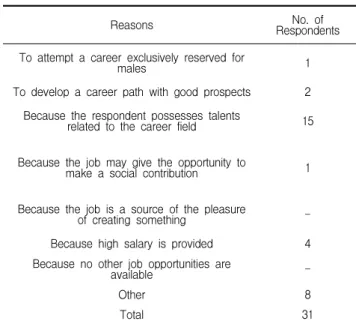
3.1 Career choice motivations and job satisfaction To the question of what made them choose the job, a majority of the female managers, as in- dicated in Table 1, answered that they ‘possess talents related to the field.’ This can be in- terpreted as meaning that female managers believe that they could apply their unique abilities, have a competitive edge and compete against male man- agers in the construction field. Under the mis- cellaneous opinions, there were ‘to gain field ex-

The satisfaction of female field managers was an- alyzed using a 5-point scale (very satisfied 5, sat- isfied 4, neutral 3, dissatisfied 2, and very dissat- isfied 1). Table 2 indicates the survey results, and the average response was 3.19, which means that a majority of female field managers are satisfied with their job to a moderate level. This may also reflect that female field managers feel their work- ing conditions at a construction site are not sat- isfactory in several aspects.

Table 1. Female field managers' motivation to pursue the career path

Reasons No. of

Respondents To attempt a career exclusively reserved for

males 1

To develop a career path with good prospects 2 Because the respondent possesses talents

related to the career field 15

Because the job may give the opportunity to

make a social contribution 1

Because the job is a source of the pleasure

of creating something -

Because high salary is provided 4 Because no other job opportunities are

available -

Other 8

Total 31

Table 2. Female field managers' job satisfaction

Satisfaction No. of Respondents

Strongly dissatisfactory 2

Dissatisfactory 2

Neutral 16

Satisfactory 10

Strongly satisfactory 1

Total 31

Mean 3.19

(4)

Analyzing the Working Conditions for Female Field Managers Employed by General Contractors

3.2. Job description

For both female and male managers, the job de- scription was found to be construction engineering and management engineering, as shown in Figure 2. However, the job functions female field mangers can take responsibilities for are shown to be lim- ited compared with those available to male managers. Therefore, the job functions female mangers can be responsible for should be expanded to include more diverse jobs in the future.

(a)The ratio of job functions handled by male field

managers (%)

(b) The ratio of job functions handled by female field

managers(%) Figure 2. The share of site Jobs by the two groups

3.3. Promotion

Conventional wisdom holds that in the tradition- ally male-dominated construction industry, female managers suffer a disadvantage or lag behind. To determine whether or not this was true, we asked female field managers about promotion. Our survey result showed, as shown in Figure 3, that most of the female managers stated that they had a more difficult time getting promoted than male managers.

Figure 3. The possibility of being promoted to department head for female field managers

The results of the survey question asking both female and male managers why they think female managers have a harder time getting promoted than male mangers are presented in Table 3.

Table 3. Barriers to promotion faced by female

Reasons No. Respondents

Male Female

Because of the stereotypes that the job

is a male-dominated profession 23 12

Because female has relatively lower capability to perform the job function

than man 26 1

Because female work less hours than

man 6 1

Because female can carry less workload

than man 6 3

Because female has less interpersonal

skills and connection 13 2

Because female retain incomplete

competence than man 2 3

Because female has less personal relations that can support them (e.g.,

regionalism or graduates, etc.) 2 -

Others 10 7

No response 1 2

Total 89 31

Among male managers, the most common response was ‘because female have a relatively lower capacity to perform the job than male,’ followed by ‘because of the stereotype that the job is a male-dominated profession.’ However, most female managers re- sponded ‘the stereotype that the job is a male-do- minated profession.’ To sum it up, construction sites are still considered as male-dominated, and this is a fact that is acknowledged by male managers. It is believed that to break the stereotype, more oppor- tunities should be provided for female managers to prove their capability in the field.

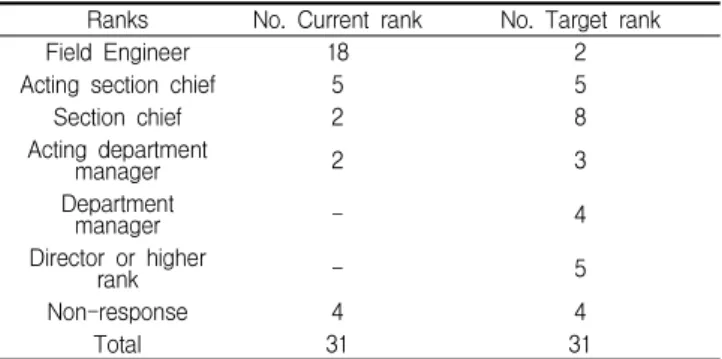
The results of the survey current and target rank of female managers are provided in Table 4.

Currently, female field managers mainly work as

engineers. In terms of the target rank, about 30%

(5)

or higher, while about 50% of the females consid- ered an acting department manager or lower rank as their final position. As mentioned earlier, this may be the result of reduced expectations due to their disadvantage in terms of promotion compared with male managers. Therefore, to achieve an in- flow of capable female field managers to con- struction sites, the evaluation method for promo- tion should be systemized to secure a job rank for female managers, equivalent to males, without discrimination.

Ranks No. Current rank No. Target rank

Field Engineer 18 2

Acting section chief 5 5

Section chief 2 8

Acting department

manager 2 3

Department

manager - 4

Director or higher

rank - 5

Non-response 4 4

Total 31 31

Table 4. The current and target ranks of female field managers

3.4. Facilities

We also surveyed the facilities for female man- agers and their satisfaction with them. As shown in Table 5, while a female’s toilet is installed at almost every site, female’s locker and shower rooms, and female’s resting lounge are not built on almost all construction sites. Our survey, based on a 5-point scale (very satisfied 5, satisfied 4, neutral 3, dissatisfied 2, and very dissatisfied 1), found that female managers were comparatively satisfied with the toilet, but were greatly dissat- isfied with the locker and shower room, and the resting lounge. The working conditions of the con- struction industry are poor compared with those of other industries, particularly for female workers.

To expand the management workforce by increas- ing the inflow of capable female field managers,

facilities for female.

Table 5. Female’s welfare/sanitary facilities on the job site Whether to Installation

Satisfaction Installation Non-

installation Total

Female toilet 29 2 31 3.60

Female locker and shower

room 8 23 31 2.95

Female

resting lounge 7 24 31 3.06

3.5. Wage policy

Given that the construction industry is consid- ered male-dominated, we surveyed the current state of wages for female field managers. Our survey found that female managers with equivalent work experience did earn a similar level of wage compared with male managers, as indicated in Table 6. Therefore, female field managers are be- lieved to be more satisfied with wage policy com- pared to other working conditions, including pro- motion and facilities.

We asked the female managers who responded that the female managers earned a lower salary than male managers about the level of the wage for the female workers, and it was found that if the salary paid to male managers is 100%, the salary paid to female managers was 79.3%.

Table 6. The salary paid to female field managers

Items No. Respondents

Male>Female Male=Female Male<Female

Salary level 9 21 1

Difference between the

female and male's salaries

levels

Female's salary corresponds to 79.3 percent of male's salary

3.6.Type of employment contract

In terms of type of employment contact, the

(6)

Analyzing the Working Conditions for Female Field Managers Employed by General Contractors

portion of part-time employment has been on the rise. For this reason, we surveyed the types of employment contract held by female field managers. As indicated in Table 7, it was found that the ratio of part-time employment was slightly high among both female and male managers.

Table 7. Employment contract type for female managers

Contract type No. Respondents

Male Female

The ratio of part-time to full-time employment is the same for both

male and female field managers. 33 8

The ratio of part-time of female managers is higher than that of

male managers. 37 11

The ratio of part-time of male managers is higher than that of

female managers. 9 7

Both male and female field

managers are employed full-time. 3 1

Others - 2

Non-response 7 2

Total 89 31

In the question regarding why more female field managers are contracted on a part-time employ- ment basis, male managers mainly responded ‘fe- male field managers leave the position after a short period of employment,’ and ‘the job functions that female field managers are in charge of are appropriate for part-time employment.’ On the other hand, among female managers the most common response was that ‘female managers leave the position after a short period of employment.’

It seems that most female field managers tend to quit the job after a short period of employment due to child rearing and housekeeping. Therefore, if support plans for female field managers are made, such as a grant to help female workers with children to pay for child care and the operation of a nursery in the workplace, the long-term em- ployment of female managers can be expected and the ratio of part-time employment to full-time

employment would be reduced accordingly, which is expected to create a desirable virtuous circle to increase the longer-term employment of the female workforce.

Reasons No. Respondents

Male Female

Because female field managers leave the position after a short period of employment, the company prefers a part-time

employment contract.

21 8

Because the job functions that female field managers are in charge of are appropriate for

part-time employment. 21 1

Part-time employment is more

cost-effective. 4 5

No particular reason is involved.

It was adapted without any

concerns and policies. 10 2

Others 4 2

Non-response 29 13

Total 89 31

Table 8. The reasons why female field managers have high rates of part-time employment

3.7. Welfare policy

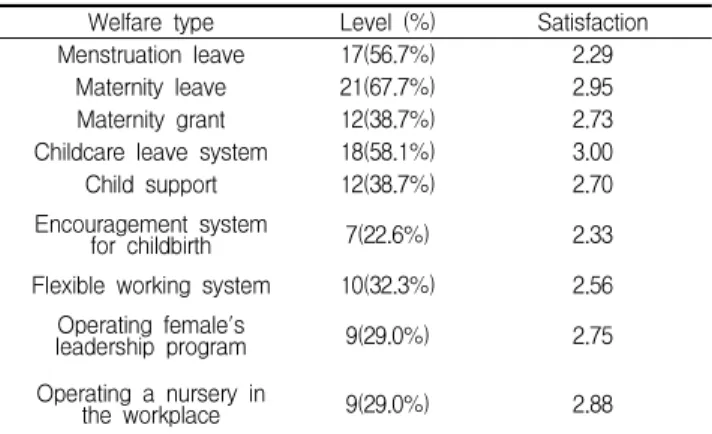
The welfare policy for female field managers in- cluding benefits and satisfaction with them was evaluated using a 5-point scale (very satisfied 5, satisfied 4, neutral 3, dissatisfied 2, and very dis- satisfied 1), and the results are shown in Table 9.

Female field managers were given the benefits of

maternity leave, childcare leave and menstruation

leave, but were not fully benefited with other

leaves. Although they are currently benefited with

these leaves, they responded that they were dis-

satisfied overall with the benefits. It is reality that

the welfare policy for the female workers is still

lacking in terms of awareness and consideration

due to the long male-dominated organizational

culture of the construction industry. To the survey

question regarding what female managers want the

most in a welfare policy, a flexible working system

was the most common response, followed by the

operation of a nursery in the workplace, and the

operation of a female’s leadership program.

(7)

Welfare type Level (%) Satisfaction

Menstruation leave 17(56.7%) 2.29

Maternity leave 21(67.7%) 2.95

Maternity grant 12(38.7%) 2.73

Childcare leave system 18(58.1%) 3.00

Child support 12(38.7%) 2.70

Encouragement system

for childbirth 7(22.6%) 2.33

Flexible working system 10(32.3%) 2.56 Operating female's

leadership program 9(29.0%) 2.75

Operating a nursery in

the workplace 9(29.0%) 2.88

4. Difficulties at a construction site faced by female managers

The difficulties faced by female field managers at a site are presented in Table 10. ‘Working time(heavy workload)’ was the most common re- sponse, followed by ‘working conditions on the site(including facilities),’ ‘adjustment to the unique culture of a construction site,’ ‘promotion problem,’

and ‘welfare policy,’ in that order. This may reflect the reality that the female managers feel that the working time is too long for them to take because they need to take care of their child(ren) in their home, lack facilities for female workers and are disadvantaged in terms of promotion.

Table 10. Difficulties faced at construction sites by female managers

Difficulties No. Respondents

Type of employment contract and Condition 4

Salary policy 2

Promotion policy 5

Ability to perform the job(The degree of

difficulty that the job provides) -

Welfare condition 5

Work environment in the field (convenience

facilities etc.) 9

Opportunity for education and/or training 1 Excessive office hours and workload 16 Discrimination by male employees 2

Conflicts between co-workers 4

Strong culture of construction site 6

Others 2

Non-response 6

Total 62

In this study, a comparative analysis of working conditions for female field managers was performed from both the female and male perspectives to provide fundamental data to support an increase in the flow of capable female field managers to the construction field, and to develop a plan for the efficient utilization of female workers. The findings of this research can be summarized as follows:

1) The most common motivation among female field managers for choosing their career was that they have talent in field management, but their job satisfaction was found to be relatively low.

2) The salary paid to female managers was shown to be similar to that paid to male managers. However, in terms of promotion, facilities, and type of employment contract, working conditions were disadvantageous for female managers compared with male managers. In terms of the welfare policy, female managers were not fully benefited, and were dissatisfied overall with the welfare system.

3) The difficulties faced by female managers on the site were described as heavy workload required for long working time, insufficient facilities exclusive for female workers, unfair treatment in promotion, and an insufficient welfare policy for female workers.

4) To utilize capable female field managers in

the future, sufficient facilities for female

should be built, and an evaluation system for

promotion that secures a status for female

workers equivalent to that of male workers

should be prepared. In addition, concrete

support plans for the long-term employment

of female managers should be established,

(8)

Analyzing the Working Conditions for Female Field Managers Employed by General Contractors

including a flexible working system, and the operation of a nursery in the workplace.

This study has some limitations in that the number of female field managers sampled is fairly small, and it does not provide a concrete improve- ment plan. To address these limitations, a concrete improvement plan should be sought in a future study that can be utilized efficiently to help pro- mote the gradual inflow of capable female human resources to the construction field.

References

1. Jang SY, Yoon JS, Paek JH. A Study on the Efficient Application of Female Crafts in a Changing Construction Environment. Proceeding of Architectural Institute of Korea 2004 Spring Conference; 2004 Apr 24; Seoul National University. Seoul (Korea): the Architectural Institute of Korea ; 2004. p. 435-8.

2. Son CB, Lee DJ, Seo BK. A Study on Investigation of Female’s Work Performance in Design Stage, Journal of Architectural Institute of Korea. 2011 Dec;13(4):323-31.

3. Son CB, Kim BR. Improvement of the Field Management Work and Operation System in the Apartment Construction.

Journal of Architectural Institute of Korea. 2006 Jun;22(6):165-72.

4. Park KH, Son CB. Analyzing the Level and Influence Factors for Work Performance of Field Managers in General Construction Companies. Journal of Architectural Institute of Korea. 2010 May;11(3):115-24.

5. Ministry of Employment and Labor. Female and Find a Job.

Gwacheon (Korea): Ministry of Employment and Labor; 2011.

p. 52-4.

수치

Table 1. Female field managers' motivation to pursue the career path
Figure 3. The possibility of being promoted to department head for female field managers
Table 5. Female’s welfare/sanitary facilities on the job site Whether to Installation Satisfaction Installation  Non-installation Total Female toilet 29 2 31 3.60 Female locker and shower room 8 23 31 2.95 Female resting lounge 7 24 31 3.06 3.5
Table 8. The reasons why female field managers have high rates of part-time employment
+2

참조

관련 문서