논문번호 04-01-14
(117) I. Introduction
The discrimination between the effects of strain and temperature on fiber Bragg grating (FBG) wavelength shift is a subject of considerable interest, regarding FBG sensors. A number of approaches to discriminate these parameters have
been proposed [1]-[7], among which are the hybrid FBG/long period grating (LPG) [6] and a single LPG[7]. In general, the sensor schemes using LPG are barely capable of fast-dynamic measurement, because of the long scanning time required for the estimation of the resonant wavelength. It would also be very helpful if a simple sensor, such as a single FBG sensor, could be found which is capable of measuring both strain and temperature. In addition to information on Bragg wavelength, one additional parameter, such as power or the phase at Bragg wavelength is required. Recently, we reported a
Simultaneous Measurement of Strain and Temperature by use of Fiber Bragg Grating Written in an Erbium: Ytterbium-Doped Fiber
단일 광섬유 격자와 Erbium과 Ytterbium 첨가된 광섬유 를 이용한 스트레인 및 온도의 동시 측정
정 재 훈 Jaehoon Jung
Abstract
We demonstrate a fiber-optic sensor scheme, capable of the simultaneous measurement of strain and temperature using a single fiber Bragg grating written in an erbium: ytterbium-doped fiber. This novel and compact fiber grating based sensor scheme can be used for synchronous measurement of strain and temperature over ranges of 1100 με and 50-180 ℃ with rms errors of 55.8 με and 3℃, respectively. The simple and low-cost sensor approach has a considerable potential, particularly for wide-range strain sensing applications in which high resolution is not required.
Keywords: Bragg grating, erbium:ytterbium-doped fiber, fiber sensor, strain, temperature
요 약
단일 광섬유 격자와 Yb와 Er이 첨가된 광섬유를 이용한 스트레인 및 온도의 동시 측정을 시행하였다. 스트레인과 온도에 대해서 1100 με and 50-180 ℃ 범위에서 55.8 με 와 3℃의 오차를 가지고 측정하였다. 본 센서의 소형 및 저가의 특성으로 미루어 볼 때 넓은 범위의 스트레인 센서로 활용가치가 높다고 사료된다.
단국대학교 전기전자컴퓨터공학부
(School of Electrical, Electronics and Computer Engineering, Dankook Univ. )
接受日:2004年 4月 6日, 修正完了日:2004年 6月 25日
전기전자학회(Journal of IKEEE) Vol. 8. No.1
(118)
novel sensor which uses a single FBG and can simultaneously measure strain and temperature by means of a 1480nm-pumped erbium-doped fiber amplifier (EDFA) [8]. In this configuration, the effects of strain and temperature imposed on FBG could be discriminated by measuring the Bragg wavelength and the transmitted power variation of EDFA. However, it is essential, in this method, to place the erbium-doped fiber (EDF) close to the FBG, so that they both experience the same temperature. This requirement, however, limits the use of this sensor in some applications. In this paper, we present a simple sensor scheme which is capable of the simultaneous measurement of strain and temperature using a single FBG written into a 25cm long Er3+:Yb3+ doped fiber(EYDF). This sensor approach is simpler and more convenient than our previously described one (Ref. [8]).Furthermore, this short sensor scheme could be applicable as a point sensor.
II. Principle
In EYDF, the 980 nm pump is largely absorbed by Yb3+ ions and then transferred to the Er3+. Higher Yb3+ ion concentrations can also be used without detrimental side-effects. The 980 nm pump absorption can therefore be typically increased by up to two orders of magnitude, via the use of Yb3+
codoping due to the large 980 nm absorption cross section of Yb3+ . We observed that the amplified spontaneous emission (ASE) power of the EYDF amplifier (EYDFA) has a monotonically decreasing dependency on temperature in the range of measurement used here. By virtue of this characteristic, we were able to measure the temperature within the relative intensity noise (RIN).
The increased absorption enables the short EYDF to produce sufficient ASE power, which results in an acceptable temperature variation.
The small signal gain G(T) of an EYDFA varies with temperature T and the ASE power PASE of
EYDF is temperature-dependent, due to the relation PASE=nsphνΔν(G(T)-1), where nsp is the spontaneous emission factor, h is Planck's constant, ν is the frequency of the light, and Δν is the bandwidth of ASE. The power variation of ASE P and the Bragg wavelength shift ΔλB can be expressed by
∆
=
∆
∆
T D C
B P A
B
ε
λ
(1) where ε is the applied strain and ΔT is the change in temperature. Therefore the two measurands can be determined simultaneously by measuring the power change and Bragg wavelength and solving the following linear matrix equation:
∆
∆
=
∆
− B
P D C
B A
T λ
ε
1(2)
III. Experiment and results
Figure 1 shows the experimental setup for our test.
The 8mm-long FBG was written into a hydrogen-loaded EYDF at =1541.5 nm which was 25cm in length. To apply strain to the FBG, both ends of the FBG were fixed to the translation stages with an adhesive. To heat the FBG a thermal chamber was employed between the stages holding the FBG. We used the ASE power of EYDFA and no other light source was necessary.
The ASE of the EYDFA passed through the FBG and the transmission spectrum was monitored by an optical spectrum analyzer (OSA) as shown in Figure 1. In fact, OSA can be replaced by other demodulation systems, e.g., fiber tunable filter and data acquisition board which are cost-effective compared to a conventional foil strain gauge and its data acquisition system. The EYDF was doped with sufficient ytterbium to produce about an 800 dBm/m absorption at the peak near 980nm. The pump power was 18dBm and it was hold constant during the measurement interval. We measured the strain and temperature coefficients of this sensor by independently applying strain and temperature. The
Simultaneous Measurement of Strain and Temperature by use of Fiber Bragg Grating Written in an Erbium:
Ytterbium-Doped Fiber
(119)
test results showed that the value of A is negligible and B is estimated as -0.0048 dBm/℃ within the measurement range. The power of ASE fluctuated within 0.01dB and the measurement performance of the sensor was limited by the accuracy of 2.084 ℃ and 22.2 με.Translation Stage
Translation Stage Isolator
Thermal Chamber
OSA FBG written in
EYDF Pump
Laser Diode
Adhesive
Fig. 1. Experimental setup for the simultaneous measurement of strain and temperature using a
single FBG written in EYDF.
그림 1. EYDF에 새겨진 단일 FBG를 이용한 스트레인 및 온도의 동시측정 실험장치
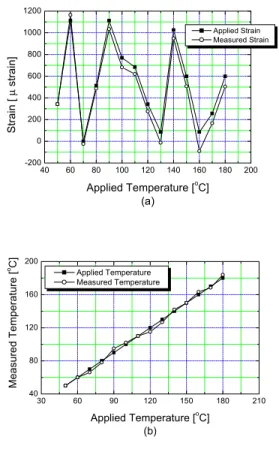
Figure 2 shows a comparison between the measured and applied: The strain in (a) and temperature in (b), respectively. The decoding of both parameters from Bragg wavelength shift and the transmitted power was accomplished via the use of the Eq (2).
We heated the sensor head up to 180℃ while the strain was randomly applied in the range of 0~1100 με during the heating, as has been described in Ref.
8. The rms deviations of strain and temperature were 55.8 με and 3 ℃ over ranges of 0-1100 με and 50-180 ℃, respectively. The sensing ranges can be further extended. No hysterisis was observed in these experiments. This sensor scheme can be used for the point-sensing of both parameters because the sensor head is rather short by writing the grating directly into the Yb3+ codoped fiber. The temperature resolution of this sensor can be enhanced by increasing the extent of Yb3+ doping and hence, the accuracy of the overall system can be improved. The narrow bandwidth of FBG can also permit the multiplexing sensing of strain and temperature by using EDF's with different lengths or different ytterbium ion doping densities. Each FBG can be written on each EYDF with different Bragg wavelengths. Wavelengths and powers of
reflected light can be monitored, to deduce information on the strain and temperature at multiple points. Referencing of the ASE power might be required in order to achieve better reliability.
40 60 80 100 120 140 160 180 200 -200
0 200 400 600 800 1000 1200
Strain [µ strain]
Applied Temperature [oC]
(a)
Applied Strain Measured Strain
30 60 90 120 150 180 210
40 80 120 160 200
Applied Temperature Measured Temperature
Measured Temperature [oC]
Applied Temperature [oC]
(b)
Fig. 2. (a) Comparison between measured and applied strain, (b) Comparison between measured
and applied temperature. In these measurements, strain and temperature were measured simultaneously by measuring transmitted power and wavelength shift as the FBG written in EYDF was heated up to 180 ℃ while the strain was randomly
applied to the FBG during heating.
그림 2.(a) 인가된 스트레인과 측정된 스트레인의 비교, (b) 인가된 온도와 측정된 온도의 비교. 본 실험은 센서를 180 ℃까지 온도를 가하며 임의의 스트레인을 인가하여 그 투과 광파워와 FBG의
파장이동을 이용하여 시행되었다.
전기전자학회(Journal of IKEEE) Vol. 8. No.1
(120) IV. Conclusion
We have demonstrated a low-cost and very simple FBG sensor, which is capable of the simultaneous measurement of strain and temperature by measuring transmitted power and Bragg wavelength shift by use of a single FBG written in EYDF. By using a Yb3+ codoped fiber, the size of the sensor head is sufficiently decreased (compared with Ref. 8) so as to be applicable as a point sensor. This technique is particularly suitable for large strain sensing applications such as damage detection in maritime, aerospace, and civil engineering industries in which high resolution is not required.
Acknowledgment
The present research was conducted by the research fund of Dankook University in 2003.
References
[1] A. D. Kersey, M. A. Davis, H. J. Patrick, M.
LeBlanc, K. P. Koo, C. G. Askins, M. A.
Putnam, and E. J. Friebele, "Fiber grating sensors," J. Lightwave Technol. 15, pp.
1442-1463, 1997.
[2] M. G. Xu, J. L. Archambault, L. Reekie, and J.
P. Dakin, "Discrimination between strain and temperature effects using dual-wavelength fiber grating sensors," Electron. Lett. 30, pp.
1085-1087, 1994.
[3] M. Song, S. B. Lee, S. S. Choi, and B. Lee,
"Simultaneous measurement of temperature and strain using two fiber Bragg gratings
embedded in a glass tube," Optical Fiber Technol. 3, pp. 194-196, 1997.
[4] S. E. Kanellopoulos, V. A. Handerek, and A. J.
Rogers, "Simultaneous strain and temperature sensing with photogenerated in-fiber gratings,"
Opt. Lett. 20, pp. 333-335, 1995.
[5] S. W. James, M. L. Dockney, and R. P. Tatam,
"Simultaneous independent temperature and strain measurement using in-fiber Bragg grating sensors," Electron. Lett. 32, pp.
1133-1134, 1996.
[6] H. J. Patrick, G. M. Williams, A. D. Kersey, J.
R. Pedrazzani, and A. M, Vengsarkar, "Hybrid fiber Bragg grating/long period fiber grating sensor for strain/temperature discrimination,"
IEEE Photon. Technol. Lett. 8, pp. 1223-1225, 1996.
[7] V. Bhatia, D. Campbell, R. O. Claus, and A. M.
Vengsarkar, "Simultaneous strain and temperature measurement with long-period gratings," Opt. Lett. 22, pp. 648-650, 1997.
[8] J. Jung, H. Nam, J. H. Lee, N. Park, and B. Lee,
"Simultaneous measurement of strain and temperature by use of a single fiber Bragg grating and an erbium-doped fiber amplifier,"
Applied Optics 38, pp. 2749-2751, 1999.
저 자 소 개
정 재 훈 (鄭 載 勳)
1994년 : 서울대학교 전기공학과 졸업 (공학사)
. 1996년 2월 : 서울대학교 대학원 전기 공학과 졸업(공학석사).
2000년 8월 : 서울대학교 대학원 전기 공학부 졸업(공학박사).
2000년 8월~ 2003년 2월 : 삼성전자 정보통신총괄 광 사업부 근무
2003년 3월 ~ 현재 : 단국대학교 전기전자컴퓨터공학 부 전임강사 재직중.
< 주관심 분야는 광소자, 광통신 소자, 및 광섬유 센 서 등임 >