Printed in the Republic of Korea DOI 10.5012/jkcs.2011.55.2.251
(E)-4'-Amino-3,4,5-trimethoxystilbene의 선택적인 합성 및 결정 구조
Xia-Bing Li, Xi-Quan Zhang†, Hong-Mei Gu†, and Bao-Lin Li*
Key Laboratory of the Ministry of Education for Medicinal Resources and Natural Pharmaceutical Chemistry, and School of Chemistry and Materials Science, Shaanxi Normal University, Xi’an 710062, China. *E-mail: [email protected]
†Jiangsu Chia Tai Tianqing Pharmaceutical Co., Ltd. Nanjing 210018, P. R. China (접수 2010. 5. 8; 수정 2010. 7. 19; 게재확정 2010. 8. 20)
A Highly Stereoselective Synthesis and Crystal Structure of (E)-4'-Amino-3,4,5- trimethoxystilbene
Xia-Bing Li, Xi-Quan Zhang†, Hong-Mei Gu†, and Bao-Lin Li*
Key Laboratory of the Ministry of Education for Medicinal Resources and Natural Pharmaceutical Chemistry, and School of Chemistry and Materials Science, Shaanxi Normal University, Xi’an 710062, China. *E-mail: [email protected]
†Jiangsu Chia Tai Tianqing Pharmaceutical Co., Ltd. Nanjing 210018, P. R. China (Received May 8, 2010; Revised July 19, 2010; Accepted August 20, 2010)
요 약. 3,4,5-Trimethoxybenzaldehyde과 p-nitrotoluene을 출발물질로 하여 두 단계 반응으로 (E)-4'-amino-3,4,5-trimethoxy- stilbene을 합성할 수 있는 합성 방법을 개발하였으며, 이 화합물에 대한 결정 구조를 X-ray 회절분석법으로 결정하였다.
주제어: (E)-4'-amino-3,4,5-trimethoxystilbene,(E)-3,4,5-trimethoxy-4'-nitrostilbene, 입체 선택성, 결정 구조, 수소결합
ABSTRACT. A new and highly stereoselective synthesis of (E)-4'-amino-3,4,5-trimethoxystilbene was achieved by using 3,4,5-trimethoxybenzaldehyde and p-nitrotoluene as starting materials through condensation under solvent-free condition and followed by the reducing of nitro group with the system of NH2NH2/FeCl3/Cin ethanol. The crystal structure of (E)-4'-amino- 3,4,5-trimethoxystilbene was also determined by X-ray diffraction analysis.
Keywords: (E)-4'-amino-3,4,5-trimethoxystilbene,(E)-3,4,5-trimethoxy-4'-nitrostilbene, Stereoselectivity, Crystal structure, Hydrogen bond
INTRODUCTION
The polymethoxylated stilbenes are very useful build- ing block for many applications in materials science and synthetic chemistry since E/Z isomerization, cyclization, cyclodimerization, and statistical C-C bond formations (polymerization, crosslinking) offer various reaction pos- sibilities.1 Interest in the drug synthesis and evaluation of polymethoxylated stilbenes as potential anticancer agents stems from the discovery of many such natural products as antimitotic and antileukemic agents.2-6 Therefore, in order to obtain new analogues of polymethoxylated stil- benes with antitumor activity, previously we designed and synthesized a series of (E)-4'-alkyloylimino-3,4,5-trime- thoxystilbene7 from (E)-4'-amino-3,4,5-trimethoxystilbene (1) as a key starting material. In this process, starting com- pound 1 was synthesized from the condensation of 3,4,5- trimethoxybenzaldehyde and p-nitrotoluene in the pres- ence of MeONa with low yield and following reduced
reaction (total yield <28%).8 Recently we found a new synthesis method of 1 and fortunately got single crystal of 1. The present paper describes the synthesis method and the crystal structure features of compound 1.
EXPERIMENTAL
General
All chemicals were of analytical reagent grade. The NMR spectra were recorded with a Bruker AVANCE300 spectrometer using TMS as internal standard. The IR spectra were recorded with a Nicolet 170SX FT-IR spectrometer using KBr pellets. Elemental analyses were performed on a VarioEL CHNS Elementar Analysensystem. The melt- ing points were determined using a WRS-113 digital melt- ing point instrument (the thermometer was not corrected).
Synthesis of (E)-3,4,5-trimethoxy-4'-nitrostilbene 1.96 g (10.0 mmol) 3,4,5-trimethoxybenzaldehyde, 1.37
g (10.0 mmol) p-nitrotoluene, 2.76 g (20.0 mmol) anhy- drous K2CO3 and 1.0 mL PGE-400 were added to 50 mL flask and the mixture was heated to 100 oC with magnetic stirring for 3 h. To the mixture was added water of 10.0 mL and filtered. After the filter cake was rinsed with H2O (5 mL×3) and recrystallized with ethanol, 3,4,5-trimethoxy- 4'-nitrostilbene of 2.40 g was obtained as pale yellow solid in 85% yield. M.p. 192-194oC; 1H-NMR(300 MHz, CDCl3) δ: 3.89(s, 3H, OCH3), 3.93(s, 6H, 2OCH3), 6.77(s, 2H, 2,6-Ar-H), 7.07(d, 1H, J=16.2 Hz, -CH=CH-), 7.17(d, 1H, J=16.2 Hz, -CH=CH-), 7.64(d, 2H, 2',6'-Ar-H), 8.24 (d, 2H, 3',5'-Ar-H); 13C-NMR(75 MHz, CDCl3) δ: 56.2, 60.9, 104.4, 124.1, 125.7, 126.7, 131.8, 133.3, 139.2, 143.8, 146.7, 153.6; IR(KBr) ν: 3066, 2928, 2831, 1633, 1587, 1503, 1454, 1329, 1236, 1122, 980 cm-1. Anal. Calcd. for C17H17NO5: C, 64.75; H, 5.43; N, 4.44. Found: C, 64.77;
H, 5.39; N, 4.43%.
Synthesis of (E)-4'-amino-3,4,5-trimethoxystilbene (1) (E)-3,4,5-Trimethoxy-4'-nitrostilbene of 3.15 g (10.0 mmol), activated carbon of 1.50 g and FeCl3·6H2O of 0.10 g were added to ethanol of 70.0 mL. The mixture was heated to reflux. 4.0 mL (47.0 mmol) hydrazine hydrate of 80% was dripped to the refluxing mixture. After refluxing for another 2 h, the result mixture was filtered. The filtrate was con- centrated to 20 mL in vacuum. To residue was added H2O of 20 mL and filtered, (E)-4'-amino-3,4,5-trimethoxystil- bene of 2.59 g was obtained as white crystal in 91% yield.
M.p. 140-142 oC; 1H-NMR(300 MHz, CDCl3) δ: 3.86(s, 3H, -OCH3), 3.90(s, 6H, 2-OCH3), 6.69(d, 2H, 3',5'-Ar- H), 6.69(s, 2H, 2,6-Ar-H), 6.86(d, 1H, J=18.0 Hz, -CH=
CH-), 6.90(d, 1H, J=18.0 Hz, -CH=CH-), 7.30(d, 2H, 2',6'-Ar-H); 13C-NMR(75 MHz, CDCl3) δ: 56.2, 60.9, 104.4, 124.1, 125.7, 126.7, 131.8, 133.3, 139.2, 143.8, 146.7, 153.6; IR IR(KBr) ν: 3430, 3353, 2936, 2832, 1634, 1578, 1508, 1454, 1234, 1119, 955(trans, CH=CH) cm-1. Anal.
Calcd. for C17H19NO3: C, 71.56; H, 6.71; N, 4.91. Found:
C, 71.63; H, 6.55; N, 4.77%.
Crystal structure determination of 1
After recrystallization from acetone, white single crys- tals of 1 were obtained, which were suitable for X-ray dif- fraction analysis. X-ray diffraction data were collected on a Bruker Smart-1000 CCD diffractometer with graphite- monochromated Mo-Kα radiation (λ=0.071073 nm) by using ϕ and ω scan technique. The structure has solved by a direct method with the SHELXS-97 program9 and refined on F2 by the full-matrix least-squares method with the SHELXL-97 program.10 All non-hydrogen atoms were
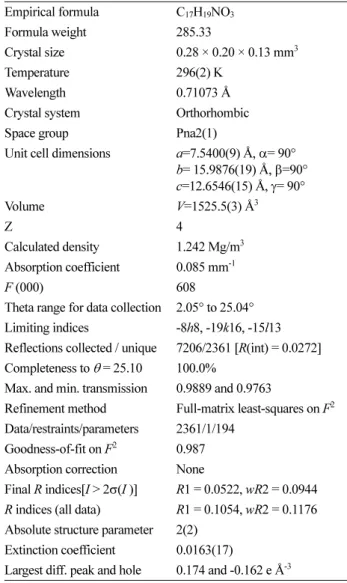
refined anisotropically. All hydrogen atoms were added at calculated positions and refined using a riding model. The crystal used for the diffraction study showed no decom- position during data collection. The crystal data, experi- mental details, and refinement results are summarized in Table 1. Tables containing complete information on atomic coordinates and equivalent isotropic displacement param- eters, bond distances and angles, anisotropic displace- ment parameters and hydrogen coordinates are available from the authors upon request.
Crystallographic data for the structural analysis have been deposited with the Cambridge Crystallographic Data Centre, CCDC 710679 for compound 1. Copies of this information can be obtained free of charge on application to The Director, CCDC, 12 Union Road, Cambridge, CB2 1EZ UK, (Fax: (+44) 1223-336-033; E-mail: deposit@
ccdc.cam.ac.uk).
Table 1. Crystal data and structure refinement for 1 Empirical formula C17H19NO3
Formula weight 285.33
Crystal size 0.28 × 0.20 × 0.13 mm3
Temperature 296(2) K
Wavelength 0.71073 Å
Crystal system Orthorhombic
Space group Pna2(1)
Unit cell dimensions a=7.5400(9) Å, α= 90°
b= 15.9876(19) Å, β=90°
c=12.6546(15) Å, γ= 90°
Volume V=1525.5(3) Å3
Z 4
Calculated density 1.242 Mg/m3 Absorption coefficient 0.085 mm-1
F (000) 608
Theta range for data collection 2.05° to 25.04°
Limiting indices -8h8, -19k16, -15l13 Reflections collected / unique 7206/2361 [R(int) = 0.0272]
Completeness to θ = 25.10 100.0%
Max. and min. transmission 0.9889 and 0.9763
Refinement method Full-matrix least-squares on F2 Data/restraints/parameters 2361/1/194
Goodness-of-fit on F2 0.987 Absorption correction None
Final R indices[I > 2σ(I )] R1 = 0.0522, wR2 = 0.0944 R indices (all data) R1 = 0.1054, wR2 = 0.1176 Absolute structure parameter 2(2)
Extinction coefficient 0.0163(17)
Largest diff. peak and hole 0.174 and -0.162 e Å-3
RESULTS AND DISCUSSION
Synthesis of (E)-4'-amino-3,4,5-trimethoxystilbene To the best of our knowledge, a few literatures reported on the synthesis of compound 1. Cushman’s group, for the synthesis of an array of methoxylated stilbenes and related compounds as potential cytotoxic agents and their eval- uation for the inhibition of tubulin polymerization, preparaed compound 1 by two steps.11 First, through Wittig reaction of 3,4,5-trimethoxybenzyl triphenyl phosphonium bro- mide with p-nitrobenzaldehyde in the presence of sodium hydride in benzene under an argon atmosphere for 16 h gave the mixture of cis- and trans-3,4,5-trimethoxy-4'- nitrostilbene, followed by preparative thin layer chromato- graphic separation got the corresponding trans-3,4,5-tri- methoxy-4'-nitrostilbene in 44% yield. Then the result compound was reduced with lithium aluminum hydride in THF to provide (E)-4'-amino-3,4,5-trimethoxystilbene in 82% yield. There are three drawbacks obviously in this course: phosphonium bromide, sodium hydride and lith- ium aluminum hydride are sensitive to moist or air, thus the reaction need in anhydrous condition and under an argon atmosphere; the low stereoselectivity of reaction gave a mixture of cis- and trans-3,4,5-trimethoxy-4'-nitrostil- bene and a low reaction yield. To overcome these disad- vantages, we attempted to find a new synthesis method for compound 1. Initial synthesis of 1, we refered to Zou’s method for synthesis of pterostilbene,12 the mixture of 10 mmol 3,4,5-trimethoxybenzaldehyde and 20 mmol p- nitrotoluene was refluxed in dry methanol in the presence of sodium methoxide for 48 h to give (E)-3,4,5-tri- methoxy-4'-nitrostilbene in 39% yield. Basic substance, sodium methoxide, is necessary in this reaction. It despoils the proton of the methyl of p-nitrotoluene to yield nucleo- philicity carbanion. The double bond is formed from the nucleophilic addition of the carbanion to carbonyl of 3,4,5-trimethoxybenzaldehyde and followed by dehydra- tion. The result compound was reduced by hydrazine hydrate of 50% in ethanol in the presence of catalyst of FeCl3 and activated carbon to give compound 1 in 71%
yield. However, this process still need in anhydrous con- dition and longer time, and exhibited a low yield (total yield <28%).8
Some reactions can be achieved in high yield and shorter time by grinding under solvent free condition.13 There- fore we grinded the mixture of 3,4,5-trimethoxybenzal- dehyde, p-nitrotoluene and anhydrous K2CO3 to explore the solvent free synthesis of 3,4,5-trimethoxy-4'-nitrostil- bene, but the result indicated the reaction did not occur,
maybe because K2CO3 did not adequately touch with p- nitrotoluene to despoil the proton of the methyl in solid.
Polyethylene glycols(PEGs) have been widely used as phase transfer catalyst in many organic reactions14,15 owing to their stability, low cost, environment-friendly and easy availability. It is more effective that PEGs catalyze the reactions of K+ or Na+ salts participation.16 Thus Cao’s group used PEG-400 and K2CO3 as catalysts to explore Knoevenagel condensation of aromatic aldehydes with ethyl cyanoacetate etc as active methylene compounds under solvent free condition, and got successfully an effi- cient synthesis method for mono-arylidene compounds.17 In our exploration for the synthesis reaction of stilbene, namely diarylidene compound, when adding PEG-400 as a phase transfer catalyst to the mixture of 3,4,5-trimethox- ybenzaldehyde, p-nitrotoluene and anhydrous K2CO3, after adequately grinding and depositing the mixture for 24 h, 3,4,5-trimethoxy-4'-nitrostilbene was found by tracking reaction with TLC. This result inspirited us to further explore this process. Considering p-nitrotoluene has a lower melt- ing point at 54.5oC, we want to know whether the con- densation reaction of 3,4,5-trimethoxybenzaldehyde with p-nitrotoluene can be accelerated in the presence of anhy- drous K2CO3 and PEG-400 when the mixture are heated up to melting point temperature of p-nitrotoluene, namely p-nitrotoluene being a reactant and a solvent. A good result was gotten when the mixture of 10.0 mmol 3,4,5-tri- methoxybenzaldehyde, 10.0 mmol p-nitrotoluene, 20.0 mmol anhydrous K2CO3 and 1.0 mL PGE-400 was heated to 100oC with magnetic stirring for 3 h. After adding water to mixture and filtrating, recrystallizing with ethanol, 3,4,5-trimethoxy-4'-nitrostilbene was obtained in 85% yield (see Scheme 1), trans isomer was obtained exclusively by this simple process without chromatographic separation, which was confirmed by its characteristic coupling con- stant in NMR spectrum for the olefinic protons of 16.2 Hz.18 This method exhibited remarkable advantage com- pared with previous one. It is possible that this method
Scheme 1. Synthesis of (E)-4'-amino-3,4,5-trimethoxystilbene.
will be applied extensively to stereoselective synthesis of other stilbene compounds. Subsequently, (E)-3,4,5-tri- methoxy-4'-nitrostilbene was reduced with hydrazine hydrate of 80% in the presence of catalyst of FeCl3 and activated carbon in ethanol to give compound 1 in 91%
yield without isomerization of trans double bond. This course for synthesis of 1 avoided completely anhydrous condition and using noxious organic solvent.
Crystal structure of (E)-4'-amino-3,4,5-trimethox- ystilbene
Fig. 1 shows the molecular structure of 1 from X-ray crystallographically determining, while the crystal data and selected parameters are summarized in Table 1 and
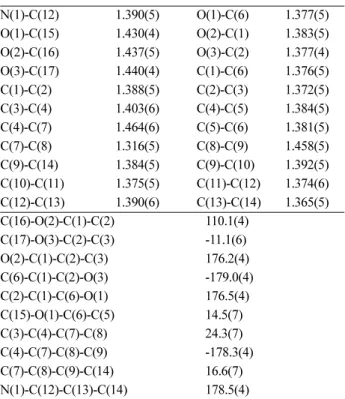
Table 2, respectively. The bond lengths and angles in mol- ecule 1 are closely similar to that of stilbene itself and its derivatives.19-21 The C(4)-C(7) and C(8)-C(9) bonds [1.464 (6) and 1.458 (5) Å, respectively] are relatively short com- pared with a normal single bond of 1.54 Å,22 this indicate the resonance and partial double bond character of C(4)- C(7) and C(8)-C(9). The structure data shows compound 1 has an anomalously short olefinic bond of 1.316 (5) Å, compared to the normal conjugated olefinic bond of 1.38 Å.22 This antifact was attributed to two factors: orienta- tional disorder and dynamical disorder due to torsional vibration of the C-phenyl bonds in a direction perpendic- ular to the molecular plane.23,24 The dihedral angel of C(4)-C(7)-C(8)-C(9)[-178.3(4)o] indicate that C(4)-C(7)- C(8)-C(9) are nearly coplane resulting from sp2 hybrid- ization of C(7) and C(8), but two benze ring are not coplane and the two planes of benze rings form a inter- planar angel of 45.11o. This indicate that partial double bond character of C(4)-C(7) and C(8)-C(9) may permit two benze rings to slightly twist in the axeses of C(4)-C(7) and C(8)-C(9), respectively. In molecule of 1, the carbon atoms of methoxy groups are almost coplane with the aro- matic rings, except the carbon atom of O(2) methoxy group, which twists to avoid steric hindrance with the neigh- bouring O(1) and O(3) methoxy groups, with the torsion of C(16)-O(2)-C(1)-C(2)[110.1(4)o].
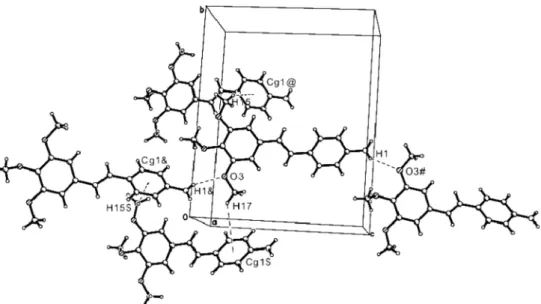
As showing in Fig. 2, molecules of 1 interact via N—
H···O(3) hydrogen bonds (0.860, 2.388, 3.031Å; ∠NHO 131.96o), forming infinite zigzag chains along the c axis.
Two C-H···π interactions of C(15)-H(15)---Cg1@ (2.788 Å, Cg1@ presents the center of ring C(9)—C(14) in mol- ecule@) and C(17)-H(17)---Cg1$ (3.621Å, Cg1$ presents the center of ring C(9)—C(14) in molecule $) assemble the title compound 1 to three dimension networks.
CONCLUSIONS
A new and efficient synthesis method of (E)-4'-amino- 3,4,5-trimethoxystilbene was achieved using 3,4,5-tri- methoxybenzaldehyde and p-nitrotoluene as starting mate- rials in presence of anhydrous K2CO3 and PEG-400, through condensation under solvent-free condition and subsequently reducing of nitro group by the system of NH2NH2/FeCl3/C in ethanol. This method avoided com- pletely anhydrous condition and using noxious organic solvent, and exhibited high stereoselectivity, higher total yield in 77% and shorter reaction time. Meanwhile, the crystal structure of (E)-4'-amino-3,4,5-trimethoxystilbene was determined by X-ray diffraction analysis.
Fig. 1. Molecular structure of 1.
Table 2. Selected bond lengths [Å] and torsion angles [deg] for 1
N(1)-C(12) 1.390(5) O(1)-C(6) 1.377(5)
O(1)-C(15) 1.430(4) O(2)-C(1) 1.383(5)
O(2)-C(16) 1.437(5) O(3)-C(2) 1.377(4)
O(3)-C(17) 1.440(4) C(1)-C(6) 1.376(5)
C(1)-C(2) 1.388(5) C(2)-C(3) 1.372(5)
C(3)-C(4) 1.403(6) C(4)-C(5) 1.384(5)
C(4)-C(7) 1.464(6) C(5)-C(6) 1.381(5)
C(7)-C(8) 1.316(5) C(8)-C(9) 1.458(5)
C(9)-C(14) 1.384(5) C(9)-C(10) 1.392(5) C(10)-C(11) 1.375(5) C(11)-C(12) 1.374(6) C(12)-C(13) 1.390(6) C(13)-C(14) 1.365(5)
C(16)-O(2)-C(1)-C(2) 110.1(4)
C(17)-O(3)-C(2)-C(3) -11.1(6)
O(2)-C(1)-C(2)-C(3) 176.2(4)
C(6)-C(1)-C(2)-O(3) -179.0(4)
C(2)-C(1)-C(6)-O(1) 176.5(4)
C(15)-O(1)-C(6)-C(5) 14.5(7)
C(3)-C(4)-C(7)-C(8) 24.3(7)
C(4)-C(7)-C(8)-C(9) -178.3(4)
C(7)-C(8)-C(9)-C(14) 16.6(7)
N(1)-C(12)-C(13)-C(14) 178.5(4)
Acknowledgements. The authors are thankful to financial support from the Natural Science Foundation of China (No. 20972090), and Jiangsu Chia Tai Tianqing Pharma- ceutical Co., Ltd., P. R. China.
REFERENCES
1. Soomro, S. A.; Schulz, A.; Meier, H. Tetrahedron 2006, 62, 8089.
2. Pinney, K. G.; Mejia M. P.; Villalobos, V. M.; Rosenquist, B. E.Pettit, G. R. Verdier-Pinard, P.; Hamel, E. Bioorg.
Med. Chem. 2000, 8, 2417.
3. Bai, R.; Petit, G. R.; Hamel, E. Biochem. Pharmacol. 1990, 39, 1941.
4. Pettit, G. R.; Singh, S. B.; Cragg, G. M. J. Org. Chem.
1985, 50, 3404.
5. Pettit, G. R.; Singh, S. B.; Schmidt, J. M.; Nivin, M. L.;
Hamel, E.; Lin, C. M. J. Nat. Prod. 1988, 51, 517.
6. Chang, J. Y.; Yang, M. F.; Chang, C. Y.; Chen, C. M.;
Kuo, C. C.; Liou, J. P. J. Med. Chem. 2006, 49, 6412.
7. Zhang, X. Q.; Gu, H. M.; Xu, H. J.; Fu, H.; Li, B. L.;
Guo, J.; Lai, Y. T.; Wang, W. China Patent 100861805, 2006.
8. Du, J.; Zhang, X. Q.; Guo, J.; Gu, H. M; Xu, H. J.; Li, B.
L. Huaxue Yanjiu Yu Yingyong 2009, 21(1), 120.
9. Sheldrick, G. M. SHELXS-97. Program for the Solution of Crystal Structures. University of Göttingen, Germany, 1997.
10. Sheldrick, G. M. SHELXL-97, Program for the Refine- ment of Crystal Structures, University of Göttingen, Ger-
Fig. 2. Intermolecular interactions in the crystal of 1. Symmetry codes: (@) 1-x, 1-y, -1/2+z; (#) 1/2+x, 1/2-y, 1+z; ($) 1/2-x, -1/2+y, -1/2+z; (&) -1/2+x, 1/2-y, -1+z.
many, 1997.
11. Cushman, M.; Nagarathnam, D.; Gopal, D.; Chakraborti, A. K.; Lin, C. M.; Hamel, E. J. Med. Chem. 1991, 34, 2579.
12. Zou, S.; Zhang, X. J.; Lin, H. Z. China Patent 101118854, 2003.
13. Li, B. L.; Zhang, Z. G.; Wang, W.; Li, J.; Wang, C. W. Z.
Naturforsch. B 2008, 63b, 77.
14. Brem, G.; Lowpy, A.; Sansonlet, J. Isr. J. Chem. 1985, 26, 291.
15. Timko, J. M.; Moore, S. S.; Walba, D. M.; Hiberty, P.C.;
Cram, D. J. J. Am. Chem. Soc. 1977, 99, 4207.
16. Wang, M. L.; Chang, K. R. Ind. Eng. Chem. Res. 1990, 29(1), 40.
17. Cao, Y. Q.; Dai, Z.; Zhang, R.; Chen, B. H. Synth. Com- mun. 2004, 34, 2965.
18. Silverstein, R. M.; Baeeler, G. C.; Morrill, T. C. Spectro- metric Identification of Organic Compounds; Wiley &
Sons: New York, 1981, pp 264-265.
19. Bernstein, J.; Mirsky, K. Acta Cryst. A 1978, 34, 161.
20. Zhang, J.; Chen, S. F.; Klausmeyer, K. K.; Kane, R. R.
Acta Cryst. C 2003, 59, 381.
21. Gordon, G. C.; Charles, R. E.; Robert, A.G.; Hilary, A. J.
Tetrahedron Lett. 2006, 47, 2245.
22. Chen, X. M.; Cai, J. W. Single-Crystal Structure Analysis Principles and Practices, Science Press: Beijing, 2004, p 101.
23. Ogawa, K.; Sano, T.; Yoshimura, S.; Takeuchi, Y.; Toriumi, K. J. Am. Chem. Soc. 1992, 114, 1041.
24. Harada, J.; Ogawa, K. J. Am. Chem. Soc. 2001, 123, 10884.