Uterovaginal duplication with an obstructed hemi- vagina is a rare disease entity that is often accompanied by ipsilateral renal agenesis. It was recognized as early as 1922 (1) and is sometimes referred to as Herlyn- Werner-Wunderlich (HWW) syndrome (2, 3). The asso- ciation of renal agenesis with ipsilateral blind hemivagi- na was reported as Herlyn-Werner syndrome in 1971 (4), while the association of renal aplasia, bicornuate uterus with isolated hematocervix, and a simple vagina
was reported by Wunderlich in 1976 (5). This complex of anomalies is observed in adolescents and young women with progressive dysmenorrhea, abnormal pain, menstrual irregularities and a pelvic mass. Early and ac- curate diagnosis of this entity is important, and a resec- tion of the obstructing vaginal septum can provide pain relief and prevent further complications (6, 7).
We report the initial and follow-up imaging findings of a case of HWW syndrome associated with thin glomeru- lar basement membrane disease of the contralateral kid- ney, which to our knowledge is the first radiological re- port in the domestic literature.
Case Report
A 12-year-old female visited the pediatric department
Herlyn-Werner-Wunderlich Syndrome with Unilateral Hemivaginal Obstruction, Ipsilateral Renal Agenesis,
and Contralateral Renal Thin GBM Disease:
A Case Report with Radiological Follow Up
1Noh Hyuck Park, M.D., Hee Jin Park, M.D., Chan Sup Park, M.D., Sung Il Park, M.D.2
1Department of Radiology, Myongji Hospital, Kwandong University, College of Medicine
2Department of Radiology, Bucheon Hospital, Soonchunhyang University Received June 16, 2009 ; Accepted September 15, 2009
Address reprint requests to : Noh Hyuck Park, M.D., Department of Diagnostic Radiology, Kwandong University College of Medicine Myongji Hospital, 697-24 Hwajung-dong, Deogyang-gu, Koyang-si, Kyunggi-do 412-279, Korea.
Tel. 82-31-810-7167 Fax. 82-31-962-4902
Herlyn-Werner-Wunderlich syndrome is a rare Mullerian ductal anomaly that is characterized by the presence of a hemivaginal septum, a didelphic uterus and ipsilat- eral renal agenesis. It is generally difficult to diagnose the uterine malformation before menarche owing to its small size. Therefore, a follow-up study is very important for confirming the uterine malformation in girls with renal agenesis. We report a patient with renal agenesis and microscopic hematuria, who showed symptoms before menarche. A follow-up study eventually revealed uterine didelphys with a hemivagi- nal obstruction. A biopsy proved that the microscopic hematuria was caused by thin glomerular basement membrane disease of the contralateral kidney.
Index words :Herlyn-Werner-Wunderlich syndrome Thin glomerular basement membrane disease Ultrasonography
Tomography, X-Ray Computed Magnetic Resonance Imaging Abnormalities, multiple Uterus
with the chief complaint of left flank pain and fever for a 1 week duration. Her previous history revealed renal agenesis, which was diagnosed at age of 31 months.
Since then she had multiple episodes of urinary tract in- fections. At age of 9 years, she was hospitalized for an-
other episode of urinary tract infection, at which ultra- sonography revealed right renal agenesis and a very hy- poplastic uterus with indiscernible detailed structures (Fig. 1). Ultrasonography and contrast enhanced CT scan at age of 11, revealed right renal agenesis (Fig. 2A) and a
B
Fig. 2. Contrast enhanced CT at the age of 11 shows right renal agenesis (A) and a newly developed small cystic lesion in the right sided pelvic
A B
C
Fig. 1. Initial ultrasonography of a 9-year-old female on April 2004 demonstrating the absence of the right kidney in the renal fossa (A) and hypertrophic contralateral kidney (10.6 cm in length) (B). Pelvic ultrasonography revealed a hypoplastic uterus (cursors in C), and associated Mullerian duct anomaly was sus- pected.
newly developed cystic lesion in the right pelvic cavity (Fig. 2B). Seven months later, she was admitted for fever and left flank pain. Upon admission, urinalysis revealed
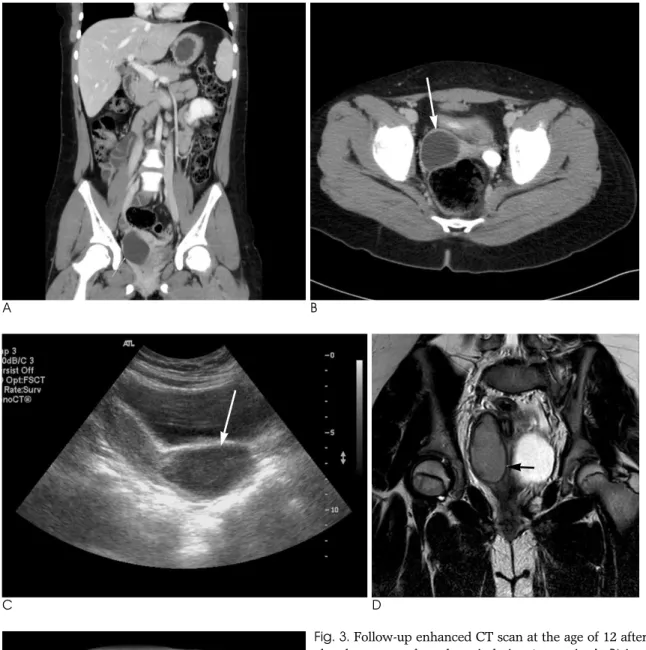
red blood cells (4+, 20-29/HPF) with white blood cells (5-10/HPF). The contrast enhanced CT scan (Figs. 3A, B), ultrasonography (Fig. 3C) and MR images (Figs. 3D, E)
A B
C D
E
Fig. 3. Follow-up enhanced CT scan at the age of 12 after menar- che shows an enlarged cystic lesion (arrow in A, B) in the right pelvic cavity, as compared with a previous examination, sugges- tive of hematocolpos. Ultrasonography (C) also reveals the hema- tocolpos. Subsequent MR shows a blind hemivagina with hemato- colpos (D, E).
after admission revealed the absence of her right kidney, compensatory hypertrophy with multifocal scarring in the left kidney, and a further enlarged cystic lesion in the pelvic cavity, which was eventually confirmed to be right hematocolpos in uterine didelphys. A percutaneous core needle biopsy of the left kidney was performed to confirm the cause of the microscopic hematuria, with a subsequent pathological diagnosis of thin glomerular basement membrane disease (Fig. 4).
Discussion
The precise etiology and pathogenesis of HWW syn- drome is still unknown. It has been considered to repre- sent anomalous Mullerian (paramesonephric) and Wolffian (mesonephric) duct development (8, 9). The in- ternal genital organs and lower urinary tract are derived from two paired urogenital structures that develop in both genders; the Wolffian ducts and the Mullerian ducts. In females, the Mullerian ducts are located just lateral to the Wolffian ducts, which act as inductor ele- ments, grow downward and toward the midline, cross- ing the Wolffian ducts, coming in contact with each oth- er, and fusing to form the uterovaginal canal, from which the fallopian tubes, uterus and upper two-thirds of the vagina develop. A range of uterine anomalies can occur as a consequence of the non-development or fail- ure of fusion of the distal segments of the Mullerian ducts, such as hypoplasia/agenesis, unicornuate, didel- phys, bicornuate, septate and arcuate uterus. Wolffian ducts are the origin of the kidneys, and inductor ele-
developmental anomaly of the caudal portion of one of the Wolffian ducts may be the cause of the unilateral re- nal agenesis associated with imperforate hemivagina (6, 10).
Renal agenesis is a fairly common congenital anomaly with an unknown definite etiology. Renal agenesis may be unilateral or bilateral. Bilateral renal agenesis is a rare anomaly that is incompatible with life, occurring in only one or two per 10.000 births.
Renal agenesis occurs when there is: (1) an absence of the metanephric blastema; (2) ureteral bud maldevelop- ment; or (3) lack of induction of the metanephric blastema by the ureteral bud. Sometimes a solitary kid- ney is the result of post-natal involution of a multicystic dysplastic kidney and a hydronephrotic kidney.
Associated ipsilateral urogenital anomalies are com- mon, and include an absence of the vas deferens, uni- cornuate uterus and an absence or cysts of the seminal vesicle. Other associated anomalies include skeletal ab- normalities, anorectal malformations, cryptorchism and cardiovascular abnormalities. The classical association is observed in VATER syndrome, where developmental lesions may include vertebral and ventricular septal anomalies, anorectal atresia, tracheal and esophageal le- sions and radial bone abnormalities (11).
HWW syndrome is usually discovered at puberty, shortly after menarche due to the cyclic, increasing low abdominal pain secondary to hematocolpos resulting from longstanding, retained, partially clotted menstrual blood in the obstructed hemivagina.
The syndrome remains unrecognized at first because
A B
Fig. 4. Pathology of the contralateral kidney shows normal appearing but enlarged glomeruli with preserved tubulointerstitium (×200) on the methenamine silver stain (A). The electron microscopy section (B) re- vealed a thinned glomerular mem- brane (174-260 nm in thickness range) and no electron dense deposit (×
2,500).
patent. Hematocolpos is suspected only months after menarche and the diagnosis is generally made only if this syndrome is suspected (3, 9). A right-sided prevalence of an obstructed hemivagina has been described (3, 8).
Another Mullerian ductal anomaly that can be associ- ated with a renal anomaly is Mayer-Rokitansky-Ku¨ster- Hauser (MRKH) syndrome, which is characterized by congenital aplasia of the uterus and the upper part (2/3) of the vagina in women showing normal development of their secondary sexual characteristics and a normal 46XX karyotype. It may be isolated but it is associated more frequently with renal, vertebral, and to a lesser ex- tent, auditory and cardiac defects (12).
Early recognition and prompt surgical removal of the obstructing vaginal septum with drainage is the defini- tive treatment (3, 9, 13) that will rapidly relieve the symptoms and prevent complications related to chronic cryptomenorrhea, such as endometriosis, pelvic adhe- sion and infectious conditions of pyocolpos, pyometros and pyosalpinx (3, 13). Resolution of the obstruction is also essential for preventing secondary endometrisosis (14, 15). Fertility is not decreased significantly in women with a didelphic uterus (6).
Along with IgA nephropathy, thin basement mem- brane disease (also known as benign familial hematuria and thin basement membrane nephropathy) is the most common cause of asymptomatic hematuria. Thinning of the basement membrane of the glomeruli in the kidneys is the only abnormal finding with this disease. Its impor- tance lies in the fact that it has a benign prognosis, and maintains a normal kidney function. This condition has been reported to be associated with Alport syndrome or loin pain hematuria syndrome (16-19). However, to our knowledge, this is the first report of this condition being associated with HWW syndrome.
In conclusion, when the absence of a kidney is found in an infant or young child, the small size and tubular shape of the uterus can make it difficult to evaluate the combined uterine anomaly. Therefore, the patient should be followed-up until the end of puberty because an appropriate preoperative diagnosis and treatment will prevent unnecessary procedures and offer the relief of symptoms. Furthermore, in HWW syndrome patients, it is necessary to consider the TGBM of the contralateral kidney when microscopic hematuria is present.
References
1. Purslow CE. A case of unilateral haematocopo, haematomethra
and haematosalpinx. J Obstet Gynaecol Br Emp 1922;29:643 2. Siegelman ES, Outwater EK, Banner MP, Ramchandani P,
Anderson TL, Schnall MD. High resolution MR imaging of the vagina. Radiographics 1997;17:1183-1203
3. Gholoum S, Puligandla PS, Hui T, Su W, Quiros E, Laberge JM.
Management and outcome of patients with combined vaginal sep- tum, bifid uterus and ipsilateral renal agenesis (Herlyn-Werner- Wunderlich syndrome). J Pediatr Surg 2006;41:987-992
4. Herlyn U, Werner H. Simultaneous occurrence of an open Gartner-duct cyst. A homolateral aplasia of the kidney and a dou- ble uterus as a typical syndrome of abnormalities. Geburtshife Frauenheikd 1971;31:340-347
5. Wunderlich M. Unusual form of genital malformation with aplasia of the right kidney. Zentralbl Gynakol 1976;98:559-562
6. Orazi C, Lucchetti MC, Schingo PM, Marchetti P, Ferro F. Herlyn- Werner-Wunderlich syndrome: uterus didephys, blind hemivagi- na and ipsilateral renal agenesis. Sonographic and MR findings in 11 cases. Pediatr Radiol 2007;37:657-665
7. Kiechl-Kohlendorfer U, Geley TE, Unsinn KM, Ga�ner I.
Diagnosing neonatal female genital anomalies using saline-en- hanced sonography. AJR Am J Roentgenol 2001;177:1041-1044 8. Candiani GB, Fedele L, Candiani M. Double uterus, blind hemi-
vagina and ipsilateral renal agenesis: 36 cases and long-term fol- low-up. Obstet Gynecol 1997;90:26-32
9. Prada Arias M, Muguerza Vellibre R, Montero Sa’nchez M, Va’zquez Castelo JL, Arias Gonza’lez M, Rodriguez Costa A. Uterus didelphys with obstructed hemivagina and multicystic dysplastic kidney. Eur J Pediatr Surg 2005;15:441-445
10. Tanaka YO, Kurosaki Y, Kobayashi T, et al. Uterus didelphys as- sociated with obstructed hemvagina and ipsilateral renal agenesis:
MR findings in seven cases. Abdom Imaging 1998;23:437-441 11. Mishra A. Renal agenesis: report of an interesting case. Br J Radiol
2007;80:e167-e169
12. Morcel K, Camborieux L, Programme de Recherches sur les Aplasies Mu¨lle’riennes (PRAM), Guerrier D. Mayer-Rokitansky- Ku¨ster-Hauser (MRKH) syndrome. Orphanet J Rare Dis 2007;2:13 13. Zurawin RK, Dietrich JE, Heard MJ, et al. Didelphic uterus and
obstructed hemivagina with renal agenesis: case report and review of the literature. J Pediatr Adolesc Gynecol 2004;17:137-141 14. Batt RE, Mitwally MF. Endometriosis from thelarche to midteens:
pathogenesis and prognosis, prevention and pedagogy. J Pediatr Adolesc Gynecol 2003;16:337-347
15. Sanfilippo JS, Wakim NG, Schikler KN, Yussman MA.
Endometriosis in association with uterine anomaly. Am J Obstet Gynecol 1986;154:39-43
16. Royat CS, Joshi K, Dey P, Sakhuja V, Minz RW, Datta U.
Glomerular morphometry in biopsy evaluation of minimal change disease, membranous glomerulonephritis, thin basement mem- brane disease and Alport’s syndrome. Anal Quant Cytol Histol 2007;29:173-182
17. Kashtan CE. Familial hematuric syndromes-Alport syndrome, thin glomerular basement membrane disease and Fechtner/Epstein syndromes. Contrib Nephrol 2001;(136):79-99
18. Kashtan CE. Alport syndrome and thin glomerular basement membrane disease. J Am Soc Nephrol 1998;9:1736-1750
19. Hebert A, Betts JA, Sedmak DD, Cosio FG, Bay WH, Carlton S.
Loin pain-hematuria syndrome associated with thin glomerular basement membrane disease and hemorrhage into renal tubules.
Kidney Int 1996;49:168-173
대한영상의학회지 2010;62:383-388
반대측 비박형 사구체 기저막 질환이 동반된 일측성 폐쇄질 및 동측 신장 무형성을 보인 HWW증후군: 방사선학적 추적검사 1예 보고1
1관동대학교 의과대학 명지병원 영상의학과
2순천향대학교 부천병원 영상의학과
박노혁∙박희진∙박찬섭∙박성일2
Herlyn-Werner-Wunderlich증후군은 드문 뮬러씨관 기형의 하나로서, 중복자궁과 일측에 생긴 질격막 및 동 측의 신장 무형성을 동반하는 질환이다. 초경이 시작되기 전에는 자궁이 작아서 자궁기형을 진단하기 어렵기 때문에 신장 무형성이 있는 환자에서, 동반되는 자궁기형을 진단하기 위해서는 영상의학적 추적검사가 중요하다. 저자들은 초경 이전에 진단된 일측의 신장무형성 및 현미경적혈뇨가 있는 환자를 경험하였으며 영상 추적 검사에서 자궁중복 기형 및 이에 동반된 일측성 질폐쇄를 진단할 수 있었고, 또한 반대측 신장의 생검으로 혈뇨의 원인이 되는 비박형 사구체 기저막 질환을 확인할 수 있어 이에 보고하는 바이다.