Paper
Preparation and Mechanical Properties of Wheat Protein Isolate Films Cross-linked with Resorcinol
M. Chandrasekhar*, M.N. Prabhakar*, Jung-Il Song*†
ABSTRACT: The purpose of the present work was to preparation and study of full biodegradable Eco-friendly bio- composites by using renewable resources. In this study, wheat protein isolate (WPI) films were formed by cross linking with resorcinol through solution casting method for packaging applications. By varying the resorcinol content (10, 20, 30, 40, and 50 wt %), its effect on mechanical properties of the wheat protein isolate film was measured. The addition of 20% resorcinol led to an overall increase in the tensile strength from 5.2 to 18.6 MPa and modulus increase from 780 to 1132 MPa than WPI films. The % elongation was increased from 2.8 to 9.05 when compared to unmodified WPI film. A thermal phase transition of the prepared WPI was assessed by means of DSC. FTIR is evident that the characteristic WPI spectral IR bands shifted on cross-linking with resorcinol.
Key Words: Wheat protein isolate, Resorcinol, Mechanical properties, Biodegradable films
1. INTRODUCTION
Petroleum-based plastics dominate today’s plastics market because of their high strength, lightweight, low cost, easy pro- cessability, and good water barrier properties. Plastic materials may be degraded by naturally occurring microorganisms in the environment, but the process may take about 150 years (low density polyethylene), while paper can be naturally bio- degraded in about one year [1]. Inert and non-biodegradable plastic materials account for about 30% by weight of municipal solid wastes, but due to their low density they represent 2/3 of the wastes volume. There has been a growing interest for edi- ble films and coatings in recent years trying to reduce the amount of wastes, capable of protecting the food once the pri- mary packaging is open, and because of public concerns about environmental protection [2]. However, most of the synthetic polymers are not biodegradable. Synthetic biodegradable poly- mers, such as poly(lactic acid), polycaprolactone, and poly (hydroxy butyrate) have high production costs. With the increasing concerns of environmental pollution caused by non-biodegradable, petroleum based plastics; increasing efforts have been made to utilize the polymeric materials derived from agricultural products.
Environmental concern about plastic materials is leading to and an increasing interest towards the development of eco- logical products. The use of disposable plastic material increases in understandable waste portion and for this reason it is necessary to develop more recyclable and/or biodegrad- able plastics to reduce the amount of plastic waste. The recent trend is to develop fully sustainable, biodegradable, eco- friendly and easily disposable materials. Therefore, in the past decades, extensive studies have been made for the potential use of polymeric materials derived from renewable resources, such as carbohydrate, starch and proteins [3-5]. Plant proteins from soy [6,7], corn [8], why protein [9], cotton seed [10], and wheat [11], have been studied because of their abundance, low cost, good biodegradability and sustainable properties for usage as films and plastics. Natural matrices are biodegradable, renewable and cheaper. Further, these materials are expected to lower the usage of synthetic polymers which are non- degradable and derived from precious depleting fossil fuels. In addition to its use as a food ingredient, non-food applications of wheat protein as polymeric materials have attracted increas- ing attention in recent years. The main attractive features of wheat protein-based plastics are that they are biodegradable, environmentally friendly, and from an abundant renewable
Received 5 March 2015, received in revised form 28 April 2015, accepted 29 April 2015
**†
Department of Mechanical Engineering, Changwon National University
Department of Mechanical Engineering, Changwon National University, Corresponding author (E-mail: [email protected])
resource. Use of wheat protein as a plastic material can be traced back to the 1930s. Brother and Mckinney studied the formaldehyde-hardened wheat plastics and their compound- ing with the phenolic resin. The formaldehyde-treated wheat plastics compounded with phenolic resin were reported to dis- play very low water absorption.
However, in 1995 about 62% of total whey production was used in some application, but the remaining 38% of whey pro- teins (270,000 tons) were still available as valuable food ingre- dients. In the USA about 51.2% of the liquid whey produced was used by the food industry [12]. The whey protein is high quality, since it has all essential amino acids, and a biological value higher than egg or casein proteins [13]. Whey protein has also some functional properties of interest to the food industry, such as solubility, emulsification, foaming, gelation, and viscosity development [14,15].
Biopolymer films are generally designed from biological resources such as polysaccharides, proteins, lipids, and their derivatives. Proteins (plants or animal derived) are ideal mate- rial for bio-plastics production due to the presence of many polar and non-polar amino acid groups providing a broad spectrum of functional and structural properties [16-20].
Various researchers have been investigating the film prop- erties of proteins from soy protein, cottonseed, wheat gluten, pea proteins, maize zein, sunflower proteins, collagen [21-23], corn [24], Faba Bean protein isolate [25] and whey protein [26]. In general, protein films are very brittle due to the exten- sive interactions that exist between the protein chains. One of the effective ways to overcome this problem is the addition of plasticizers during film casting. Plasticizer is a substance, which changes certain properties of the materials by reducing the intermolecular forces among polymer chains, brittleness of the films, causing a decrease in film strength and increase in film extensibility which can facilitate polymer processing [28].
Several theories have been proposed to explain the mechanism of plasticization action [27].
Protein-based film materials have a three-dimensional net- work structure. Such structure is formed through the three steps: first, rupture of low-energy intermolecular bonds using rupture agents, secondly rearrangement and orientation of polymer chains (shaping) and finally, the formation of a three dimensional network structure by forming new interactions and bonds. Generally, protein based biodegradable materials are manufactured by two technological processes: a wet pro- cess technology, which is based on dispersion or solubilisation of proteins and a dry process, which is based on the ther- moplastic properties of proteins under low-moisture condi- tions [28,29]. Wheat protein isolate (WPI) WPI is a highly refined or purified form of wheat gluten (76.5% protein) with a minimum 90% protein content on a moisture-free basis. The United States is one of the major producers of wheat seed in the world. Wheat protein isolate containing approximately 90% protein, 4% fat, about 5% ash and 1% remaining other
constituent. Several researchers modified wheat protein to improve its mechanical and physical properties and thermal stability, to reduce the moisture absorption, and to improve processability. WPI was modified by glutaraldehyde [30-32], to improve its physical and mechanical properties, and in the present study, glycerol used as plasticizers.
Although, very limited information is available on the pro- duction and characterization of protein isolate prepared from wheat, commercial production of wheat protein isolate, offers an inexpensive protein source for use in various applications ranging from food products to packaging films. Wheat protein isolate (WPI) is a protein obtained from wheat seeds of an annual plant with a protein content of 90%. Wheat protein iso- late (WPI) has been studied as a film former due to its func- tional, cohesive and elastic properties [33-36] and they are non toxic and safe; hence, it provides possible applications in food packaging industry.
In this study, the author used resorcinol as a cross linking agent to prepare WPI films and then studied their tensile properties. Resorcinol has two hydroxyl groups, which can crosslink with carboxyl, amine, and amide groups present in WPI. External plasticizer was not used in the present case.
According to material safety data sheet, both glutaraldehyde and resorcinol have a health risk index of 2 which is moderate on a scale of 0-4 and resorcinol-formaldehyde mixture is widely used in endodontic therapy [21]. As resorcinol has a 127.28C flash point and a 607.8oC auto ignition temperature the cross linking reactions were carried out at temperatures below 110oC.
2. MATERIALS AND METHODS
2.1 Processing and Modification of Wheat Protein Iso- late Resin (MWPI)
WPI powder was obtained from Honeyville Food Products, Salt Lake City, Utah, USA. According to the supplier, the WPI used in the present case consisted 90% protein, 4%, about 5%
ash and 1% remaining unknown constituents. Analytical grade sodium hydroxide (NaOH) was purchased from MERCK Chemicals, Mumbai, India and resorcinol was obtained from FINAR- Chemicals Ltd., Ahmadabad, India.
WPI resin films were prepared using a casting method. To prepare these films; WPI powder was mixed with distilled water (15 times by weight of WPI powder) and the mixture was stirred in a water bath at 75oC for 20 min, at the end 1N NaOH solution was added to adjust the pH value to 10. The stirring was continued at 75oC for another 20 min. Then 10- 50% resorcinol was added and stirred for 5 min at 75oC. This stir-heating process denatures the WPI and is called ‘pre-cur- ing’. To obtain cured resin films, the pre-cured suspension was poured onto the Teflon-covered glass mould (150 × 150 × 3 mm3) to form a sheet with desired thickness. The glass mould with the pre-cured WPI was dried for 24 h at room
temperature. The dried WPI film was peeled from the mould, sandwiched between two aluminium sheets and cured by hot pressing at 100oC for 20 min under a pressure of 2 MPa. The hot-pressing was carried out on a hydraulic hot press (Model PFM15, Technosearch Instruments, Kolbad, Maharashtra, India). It was very difficult to form a pristine WPI film due to its brittle nature.
2.2 Fourier Transform Infrared (FTIR) Spectra
The normalized infrared spectra of the WPI and MSPI film samples were recorded on an Analect RFX-65A Fourier trans- form infrared (FTIR) spectrophotometer. The samples were dried in an oven and ground into powder. In each case 2 mg of the powdered samples were mixed with 98 mg of KBr to pre- pare sample pellets. FT-IR analysis was performed with a res- olution of 2 cm-1 in the range of 4000-400 cm-1.
2.3 Moisture Content
The moisture content of the specimens was determined as per the ASTM D 1576-90 method, a procedure recommended for protein (wool) fibers. In this method, pre weighed samples in aluminium foil were dried in a circulating air oven at 105oC for 24 h, and the weight loss was then calculated.
2.4 Differential Scanning Calorimetry (DSC)
The differential scanning calorimetry analysis of wheat pro- tein isolate (WPI), modified wheat protein isolates (MWPI) and resorcinol samples were scanned using SDT-Q 600, TA instrument under a nitrogen atmosphere. The samples were scanned from 30oC to 400oC at heating rate of 10oC/min.
2.5 Tensile Test
In order to study the composite films mechanical strength, its tensile properties are measured. The tensile test was per- formed as per ASTM D 882-02 standard method. Specimens with dimensions of 100 × 20 × 0.2 mm3 were selected. The tensile properties such as maximum stress, Young’s modulus and percent elongation at break were determined using an INSTRON 3369 Universal Testing Machine at a crosshead speed of 20 mm/min maintaining a gauge length of 50 mm.
For tensile tests and for each category, five samples were tested at 50% RH and 23oC and the average values are reported.
3. RESULTS AND DISCUSSION
3.1 Characterization of wheat protein isolate with resor- cinol
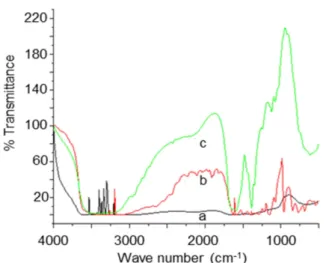
Fourier transform infrared spectrometer is an effective method to assess the structural changes in protein. In order to probe the cross-linking of the WPI molecules with resorcinol, the Fourier transform infrared spectra of pure WPI, cross- linked WPI with different resorcinol content and pure resor- cinol are presented in the Fig. 1.
From Fig. 1, it is evident that the characteristic WPI IR bands shifted on cross-linking with resorcinol. The band posi- tion at 3355.9 cm-1 correspond to N-H stretching of WPI and the band at 3270 cm-1 correspond to O-H stretching of the phenolic group in resorcinol. Then characteristic peak posi- tion at 1651 and 1581.5 corresponds to C=O stretching and N- H stretching of amide I and amide II of unmodified WPI films, respectively. In case of resorcinol modified WPI films the band at 1582 cm-1 decreased its intensity and shifted slightly when compared to unmodified WPI film. This indi- cates that the cross-linking was affected by the NH2 group of WPI and OH groups of resorcinol by hydrogen bonding.
3.2 Moisture Content
The moisture content values of the films for various resor- cinol loadings are presented in Fig. 2.
From Fig. 2, it is evident that the moisture content was lower when the resorcinol content was 20%. For other loadings, the moisture content increased. It can also be observed from Fig. 3 that the moisture content of the resorcinol modified WPI films Fig. 1. FTIR spectra of (a) Pure WPI (b) pure Resorcinol (c) WPI
20% resorcinol
Fig. 2.Moisture content of resorcinol modified wheat protein isolate films
was lower than that of the unmodified ones. A similar obser- vation was made by Zhichao et al. [23] in the case of N- hydroxymethyl-acrylamide cross linked with resorcinol. They observed that hydrophilicity of the polymeric chains decreased with increasing cross-linking that induced the attraction between cross-linked chains until the integral network was formed.
3.3 Differential Scanning Calorimetry (DSC)
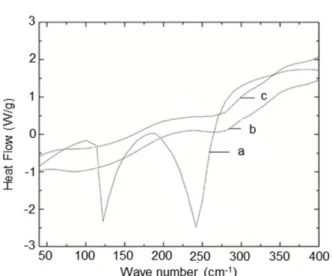
The DSC endothermic curves of pure WPI, MWPI and pure resorcinol samples are presented in the Fig. 3. DSC ther- mograms showed two thermal transitions for WPI films, irre- spective of their resorcinol content; a glass transition for the amorphous fraction and a melting transition for the crystalline one.
The Thermogram for pure resorcinol depicts two endo- therms, the first one starting at approximately 110oC (corre- sponding to its melting point) and another at approximately 240oC (corresponding to its boiling point). In the case of pure WPI and modified WPI these two peaks are missing, indi- cating the plasticizing and crosslinking nature of resorcinol in the MWPI and the absence of free resorcinol in pure WPI.
3.4 Tensile Properties
The variation of ultimate tensile strength, modulus and % elongation at break of WPI films with resorcinol loading is shown in Fig. 4(a), Fig. 4(b) and Fig. 4(c) respectively. From Fig. 4(a) and Fig. 4(b), it is evident that both tensile strength and modulus of WPI films were at a maximum when resor- cinol content was 20%. Thus the tensile studies indicate that the resorcinol content of 20% (w/w) was required in WPI films for optimum cross-linking.
From Fig. 4(c), it is observed that the percent of elongation at break is increasing with resorcinol content, due to the fact that, incorporation of resorcinol reduces make crosslink
between protein chains, thus increasing the chain mobility.
This behaviour indicates that resorcinol is also acting as a plas- ticizer.
3.5 Morphology (SEM) Analysis of WPI Films
The crosslinked WPI films were dried in vacuum and stored in a desiccator before the SEM micrographs recorded. Some specimens were cryogenically cooled and brittle fractured. Fig.
Fig. 3. DSC curves of (a) pure resorcinol (b) pure WPI (c) WPI 20%
resorcinol
Fig. 4.(a): Tensile strength of wheat protein isolate films with resorcinol content, (b) Tensile modulus of wheat protein isolate films with resorcinol content, and (c). % Elongation at break of wheat protein isolate films with resorcinol con- tent
5 shows the cross-sectional images of crosslinked WPI films and the effect of resorcinol level on films. The film obtained was very clear and uniform in thickness. At relatively less than 10 wt % of resorcinol, the films were brittle and difficult to peel from the casting surface. The author used resorcinol as a cross linking agent and no external plasticizer was used. Resorcinol was homogeneously incorporated within a network of hydro- gen bonds between the WPI molecular chains, which makes the film more flexible, soft and transparent. The resorcinol apparently affects the intra and intermolecular interactions of WPI films. The rides and valleys were likely formed due to the extensive local deformation of the “protein-matrix” formed after consolidation of individual protein particles.
4. CONCLUSION
Fully bio-degradable eco-friendly WPI films were prepared with resorcinol as a cross linking agent. In this case, no exter- nal plasticizer was used. The optimum resorcinol level required for effective cross linking was determined using the tensile strength, tensile modulus and % elongation at break.
The data show that the best combination was obtained when the resorcinol content was 20% by weight of WPI. Further, the moisture content of these modified films was at a minimum when the resorcinol content was 20% by weight of WPI. DSC analysis indicated the absence of free resorcinol present in the MWPI films. The transparent resorcinol crosslinked WPI films showed superior tensile strength and modulus, % of elongation and thermal stability. In conclusion, the prepared transparent films can be applicable for food packaging espe- cially medical applications. Preparation of wheat protein iso- late composites by using resorcinol as crosslinker is an innovative study in the field which the most employed tech- nique to prepare films is a low cost solution casting.
ACKNOWLEDGEMENT
This work was supported by the National Research Foun-
dation of Korea (NRF) grant funded by the Government of the Republic of Korea (Ministry of Science, ICT and Future Plan- ning (MSIP)) (No. 2013R1A2A2A01017108 and 2011-0030058).
REFERENCES
1. Tharanathan, R.N., “Biodegradable Films and Composite Coat- ings: Past, Present and Future”, Trends in Food Science & Tech- nology, Vol. 14, 2003, pp. 71-78.
2. Hunt, R.G., Sellers, V.R., Franklin, W.E., Nelson, J.M., Rathje, W.L., Hughes, W.W., and Wilson, D.C., “Estimates of the Vol- ume of MSW and Selected Components in Trash Cans and Landfills”, Franklin Associates Ltd. Prairie Village, Kansas and the Garbage Project, Tucson Arizona, 1990.
3. Krochta, J.M., and De Mulder-Johnston, C., “Edible and Bio- degradable Polymer Films: Challenges and Opportunities”, Food Technology, Vol. 51, 1997, pp. 61-74.
4. Zhang, J., Mungara, P., and Jane, J., “Mechanical and Thermal Properties of Extruded Soy Protein Sheets”, Polymer, Vol. 42, 2001, pp. 2569-2578.
5. Yamamoto, Y., Zahora, D., and Netravali, A.N., “Determination of the Interfacial Properties between Modified Soy Protein Resin and Kenaf Fiber”, Composite Interfaces, Vol. 14, 2007, pp. 699-713.
6. Lodha, P., and Nethravali, A.N., “Characterization of Stearic Acid Modified Soy Protein Isolate Resin and Ramie Fiber Rein- forced ‘green’ Composites”, Comp Science and Technology, Vol.
65, 2005, pp. 1211-1225.
7. Lodha, P., and Nethravali, A.N., “Thermal and Mechanical Properties of Environment-friendly ‘green’ Plastics from Stearic Acid Modified-soy Protein Isolate”, Industrial Crops and Prod- ucts, Vol. 21, 2005, pp. 49-64.
8. Lodha, P., and Netravali, A.N., “Characterization of Interfacial and Mechanical Properties of “green” Composites with Soy Protein Isolate and Ramie Fiber”, Journal of Materials Science, Vol. 37, 2002, pp. 3657-3665.
9. Gioia, D.I., and Guilbert, S., “Corn Protein-based Thermoplas- tic Resins: Effect of Some Polar and Amphiphilic Plasticizers”, Journal of Agricultural and Food Chemistry, Vol. 47, 1999, pp.
1254-1261.
10. Anker, M., Standing, M., and Hermonsoon, A.M., “Effect of pH and the Gel State and the Gel State on the Mechanical Prop- erties, Moisture Contents, and Tgs of Why Protein Films”, Jour- nal of Agricultural and Food Chemistry, Vol. 47, 1999, pp. 1878- 1886.
11. Marquie, C., Aymard, C., Cuq, J.L., and Guilbert, S., “Biode- gradable Packaging Made from Cottonseed Flour: Formation and Improvement by Chemical Treatments with Gossypol, formaldehyde, and Glutaraldehyde”, Journal of Agricultural and Food Chemistry, Vol. 43, 1995, pp. 2762-2767.
12. ADPI. American Dairy Products Institute. Whey Products Uti- lization and Production Trends, Illinois, 2002, pp. 35.
13. Marshall, K., “Therapeutic Applications of Whey Protein”, Alternative Medicine Review, Vol. 9, 2004, pp. 136-156.
14. Aguilera, J.M., “Gelation of Whey Proteins”, Food Technology, Fig. 5.The scanning electron microscope (SEM) photographs of
10 wt% of resorcinol plasticizer WPI film
Vol. 49, 1995, pp. 83-89.
15. Walzem, R.L., Dillard, C.J., and German, J.B., “Whey Compo- nents. Millennia of Evolution Create Functionalities for Mam- malian Nutrition: What We Know and What We May be Overlooking”, Critical Reviews in Food Science and Nutrition, Vol. 42, 2002, pp. 353-375.
16. Guilbert, S., and Graille, J., “Biomateria Uxetmolecules Fonctionnelles. In Valorisations Non Alimentaires Des Grandes Productions Agricoles. Les Colloques, Gueguen, J (ed) INRA Editions, Paris, Vol. 71, 1994, pp. 195-206.
17. Mohanty, A.K., Misra, M., and Hinrichsen, G., “Biofibres, Bio- degradable Polymers and Biocomposites: An Overview”, Mac- romolecular Materials and Engineering, Vol. 276, 2000, pp. 1-24.
18. Paulo J. do A. Sobral, Juliana S. dos Santos, and Farah T. García,
“Effect of Protein and Plasticizer Concentrations in Film Form- ing Solutions on Physical Properties of Edible Films Based on Muscle Proteins of a Thai Tilapia”, Journal of Food Engineering, Vol. 70, 2005, pp. 93-100.
19. Josiane Irissin-Mangata, Gérard Bauduin, Bernard Boutevin, Nathalie Gontard, “New Plasticizers for Wheat Gluten Films”, European Polymer Journal, Vol. 37, 2001, pp. 1533-1541.
20. de Carvalho, R.A., and Grosso, C.R.F., “Properties of Chemi- cally Modified Gelatin Films”, Brazilian Journal of Chemical Engineering, Vol. 23, 2006, pp. 45-53.
21. Mo, X., and Sun, X., “Plasticization of Soy Protein Polymer by Polyol-Based Plasticizers”, Journal of Oil & Fat Industries, Vol.
79, 2002, pp. 197-202.
22. Yin, S.W., Tang, C.H., Wen, Q.B., and Yang, X.Q., “Properties of Cast Films from Hemp (Cannabis sativa L.) and Soy Protein Isolates. A Comparative Study”, Journal of Agricultural and Food Chemistry, Vol. 55, 2007, pp. 7399-7404.
23. Olivier Orliac, Antoine Rouilly, Françoise Silvestre, and Luc Rigal, “Effects of Various Plasticizers on the Mechanical Prop- erties, Water Resistance and Aging of Thermo-moulded Films Made from Sunflower Proteins”, Industrial Crops and Products, Vol. 18, 2003, pp. 91-100.
24. Lodovico di Gioia and Ste´phane Guilbert, “Corn Protein- Based Thermoplastic Resins: Effect of Some Polar and Amphi- philic Plasticizers”, Journal of Agricultural and Food Chemistry, Vol. 47, 1999, pp. 1254-1261.
25. Saremnezhad, S., Azizi, M.H., Barzegar, M., Abbasi, S., and Ahmadi, E., “Properties of a New Edible Film Made of Faba Bean Protein Isolate”, Journal of Agricultural Science and Tech- nology, Vol. 13, 2011, pp. 181-192.
26. Ramos, O.L., Reinas, I., Silva, S.I., Fernandes, J.C., Cerqueira, M.A., Pereira, R.N., Vicente, A.A., Poças, M.F., Pintado, M.E., and Malcata, F.X., “Effect of Whey Protein Purity and Glycerol Content Upon Physical Properties of Edible Films Manufac- tured Therefrom”, Food Hydrocolloids, Vol. 30, 2013, pp. 110- 122.
27. Birley, A.W., “Polymers: Structure and Properties”, C. A. Dan- iels, Technomic Publishing AG, Switzerland, 1989. pp. vii + 107, price SwF 110/£40.45. ISBN 0-87762-552-2, British Poly- mer Journal, Vol. 22, 1990, pp. 261-262.
28. Song, Y., Zheng, Q., and Liu, C., “Green Biocomposites from Wheat Gluten and Hydroxyethyl Cellulose: Processing and Properties”, Industrial Crops and Products, Vol. 28, 2008, pp. 56- 62.
29. Sun, S., Song, Y., and Zheng, Q., “Morphologies and Properties of Thermo-molded Biodegradable Plastics Based on Glycerol- plasticized Wheat Gluten”, Food Hydrocolloids, Vol. 21, 2007, pp. 1005-1013.
30. Jagadeesh, D., Jeevan Prasad Reddy, D., and Varada Rajulu, A.,
“Preparation and Properties of Biodegradable Films from Wheat Protein Isolate”, Journal of Polymers and the Environ- ment, Vol. 19, 2011, pp. 248-253.
31. Chandra Sekhar, M., Veerapratap, S., Song, J.I., Luo, N., Zhang, J., Varada Rajulu, A., and Chowdoji Rao, K., “Tensile Properties of Short Waste Silk Fibers/wheat Protein Isolate Green Com- posites”, Materials Letters, Vol. 77, 2012, pp. 86-88.
32. Jagadeesh, D., Jeevan Prasad Reddy, D., Varada Rajulu, A., and Li, R., “Green Composites from Wheat Protein Isolate and Hil- degardia Populifolia Natural Fabric”, Polymer Composites, Vol.
32, 2011, pp. 398-406.
33. Jagadeesh, D., Jeevan Prasad Reddy, D., and Varada Rajulu, A.,
“Preparation and Properties of Biodegradable Films from Wheat Protein Isolate”, J. Polym. Environ., Vol. 19, 2011, pp.
248-253.
34. Song, Y., Zheng, Q., and Liu, C., “Green Biocomposites from Wheat Gluten and Hydroxyethyl Cellulose: Processing and Properties”, Ind. Crops. Prod., Vol. 28, 2008, pp. 56-62.
35. Sun, S., Song, Y., and Zheng, Q., “Morphologies and Properties of Thermo-molded Biodegradable Plastics Based on Glycerol- plasticized Wheat Gluten”, Food Hydrocol, Vol. 21, 2007, pp.
1005-1013.
36. Galdeano, M.C., Mali, S., Grossmann, M.V.E., Yamashita, F., and Garcia, M.A., “Effects of Plasticizers on the Properties of Oat Starch Films”, Mater Sci Eng: C, Vol. 29, 2009, pp. 532-538.